🚀 Key Takeaways
- Google DeepMind has unveiled Gemma 4 12B, a new 12 billion parameter multimodal AI model released under the Apache 2.0 license, specifically targeting the acceleration of personal and on-device AI markets.
- This intermediate model features an integrated (Encoder-Free) multimodal structure, allowing the language model to directly process images and audio, and is the first medium-sized Gemma model to natively support voice input.
- It demonstrates remarkable efficiency, achieving inference performance close to the 26B MoE model while utilizing less than half its total memory footprint.
- Gemma 4 12B is uniquely designed to run locally on general consumer laptops with just 16GB of memory, making advanced AI agent capabilities accessible without dedicated AI hardware.
- The model is built for complex workflows, applying Multi-Token Prediction (MTP) technology to enhance response speed and efficiently process multi-stage inference and AI agent tasks.
- While designed to bring flagship-level agentic capabilities to local devices and support major AI development tools, user feedback on its performance varies, with some reports noting regressions for tool calling in Quantization Aware Training (QAT) models.
Google DeepMind has officially launched Gemma 4 12B, a powerful new open-source multimodal AI model designed to revolutionize personal and on-device AI.
This 12-billion-parameter model stands out in the Gemma series as an intermediate solution, bridging the gap between lighter and more extensive models while focusing on efficiency and broad accessibility.
At its core, Gemma 4 12B boasts an integrated, encoder-free multimodal architecture, allowing it to natively process images, audio, and video directly within its language model, a first for a medium-sized Gemma model to support voice input.
This innovative design significantly reduces memory usage and latency, enabling high-performance inference that rivals much larger models while maintaining a substantially smaller memory footprint.
Critically, Gemma 4 12B is engineered for local execution, capable of running on standard consumer laptops with as little as 16GB of memory, democratizing access to advanced AI agent capabilities.
Its release under the Apache 2.0 license, coupled with extensive developer support for major AI tools and a new Gemma Skills Repository, underscores Google's commitment to fostering innovation in the personal AI space.

1. Google Unveils Gemma 4 12B: A New Era for Personal AI
This section details the official release and strategic market positioning of Google's new open-source model, Gemma 4 12B, directly addressing the core announcement of the article "Google Unveils Multimodal Model 'Gemma 4 12B'".
Strategic Positioning in the Gemma Series
Google, through its renowned Google DeepMind division, has officially released its new open-source AI model, Gemma 4 12B.
Fresh off its recent public debut in June 2026, this model dynamically expands the company's portfolio of accessible, cutting-edge AI tools.
It is a 12 billion parameter multimodal model designed to occupy a specific niche within the company's offerings.
Gemma 4 12B is strategically positioned as an intermediate model, bridging the gap between the lightweight E4B model and the much larger 26B Mixture of Experts (MoE) model.
This launch builds on the established success of the Gemma family, which has already achieved over 150 million cumulative downloads across its various models.
Defining 'Unified' in Gemma 4 12B
A key technical distinction is embedded in the model's full name, Gemma 4 12B Unified.
The term "Unified" in this context refers directly to its advanced encoder-free architecture.
This design indicates a more streamlined and integrated method for processing data inputs, a significant architectural detail for a multimodal system.
Market Impact and Growth Projections
Google has clearly articulated its goals for Gemma 4 12B, targeting a rapidly expanding segment of the technology landscape.
The model is specifically engineered for the personal AI market.
In line with this focus, Google expects this new release to be a key driver of innovation.
The company projects that Gemma 4 12B will accelerate the growth of personal AI and on-device AI markets, enabling more powerful and efficient applications directly on user hardware.

2. Balancing Power and Efficiency: Gemma 4 12B's Performance Edge
This section delves into the performance characteristics of Gemma 4 12B, showcasing how Google engineered a model that provides a compelling balance between computational power and resource efficiency, a key factor in its strategic release.
Inference Performance and Memory Footprint
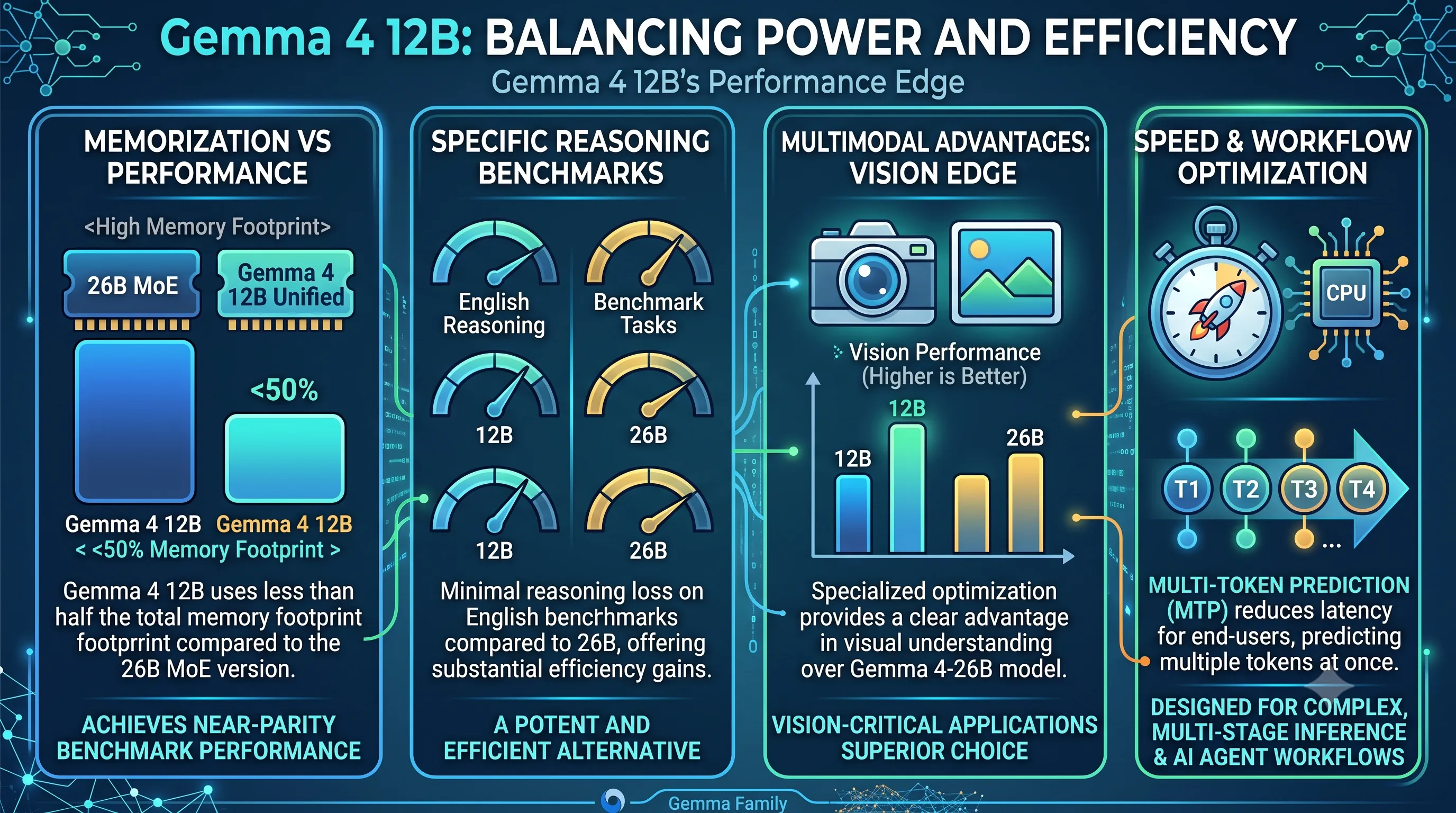
Despite its smaller parameter count, Gemma 4 12B maintains high-performance inference capabilities, positioning it as a potent and efficient alternative to larger models.
A central evaluation of the model is its ability to simultaneously achieve strong performance and efficiency.
When benchmarked, it achieves inference performance that is close to its larger counterpart, the 26B Mixture-of-Experts (MoE) model.
This near-parity in performance is especially notable given the significant resource savings; the Gemma 4 12B model uses less than half the total memory footprint compared to the 26B MoE version.
This reduction makes it far more accessible for deployment on systems with constrained memory.
Furthermore, the model runs slightly leaner than Gemma 4-26B, and on most English reasoning benchmarks, it is genuinely close in performance, indicating that users sacrifice minimal reasoning capability for substantial efficiency gains.
Multimodal Performance Advantages
Interestingly, the smaller size of Gemma 4 12B does not translate to a universal performance deficit.
In specific domains, it demonstrates a clear advantage, particularly in visual understanding.
The model has an edge on vision tasks when compared directly to the Gemma 4-26B model, suggesting specialized optimization that makes it a superior choice for certain multimodal applications where visual processing is critical.
Efficiency Through Multi-Token Prediction
A key technological innovation underpinning Gemma 4 12B's responsiveness is its application of Multi-Token Prediction (MTP) technology.
This technique is specifically implemented to increase the model's response speed, reducing latency for end-users by predicting multiple tokens at once.
This optimization is part of a broader design philosophy that makes the model particularly well-suited for modern AI applications.
It is explicitly designed to efficiently process complex, multi-stage inference and AI agent workflows, where speed and resource management are paramount for successful execution.
3. Revolutionary Multimodal Architecture and Advanced Agentic Capabilities
This section delves into the innovative technical architecture of the newly announced Gemma 4 12B, explaining how its unique design enables powerful, efficient multimodal and agentic capabilities directly on local devices.
Encoder-Free Multimodality for Efficiency
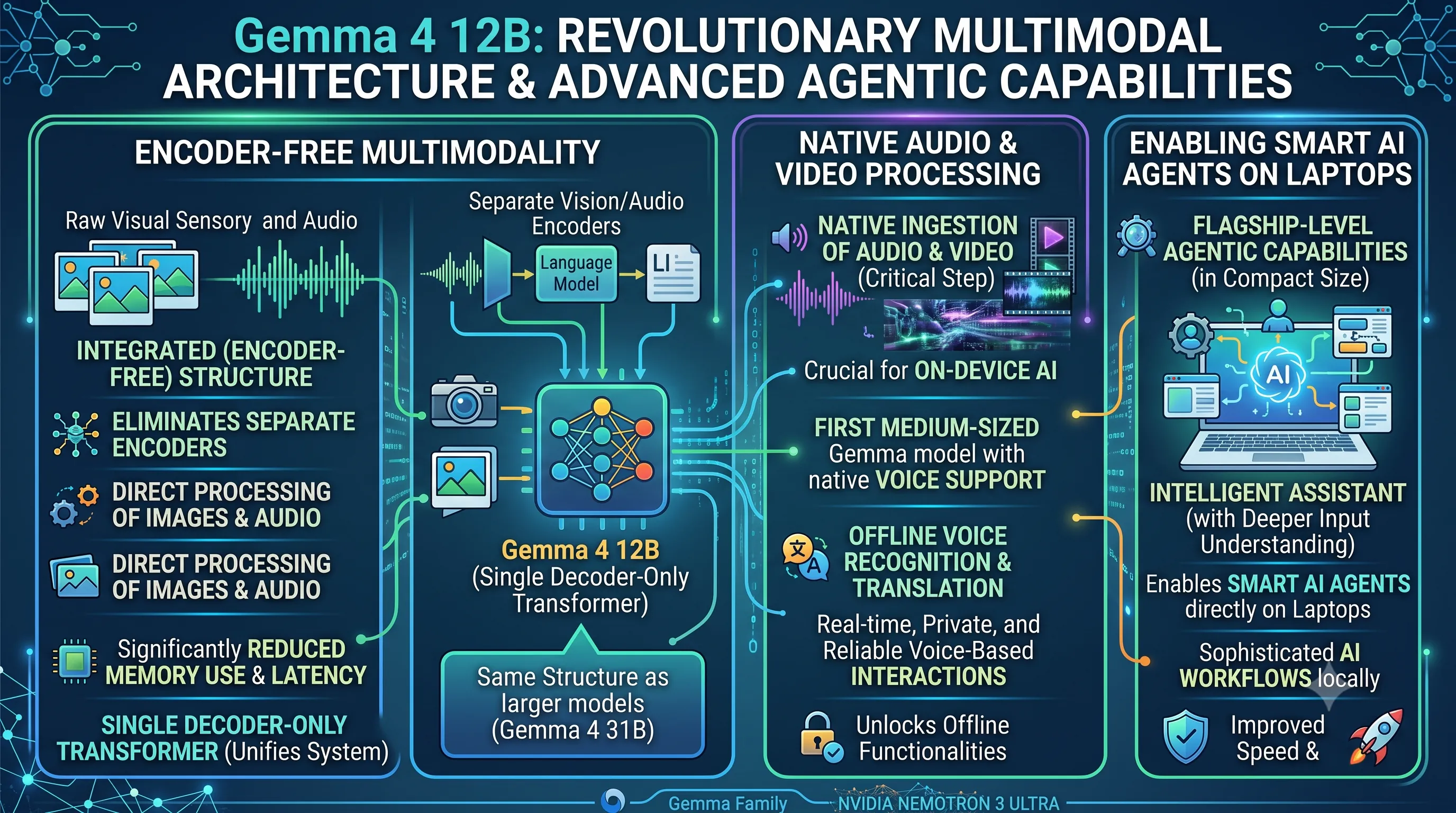
Gemma 4 12B introduces a significant architectural shift with its integrated (Encoder-Free) multimodal structure.
Instead of relying on separate components to handle different data types, this design allows the language model to directly process images and audio.
This approach fundamentally eliminates the need for separate vision and audio encoders, which are traditionally used to convert sensory data into a format the language model can understand.
The removal of these encoders is a key optimization, as it significantly reduces memory usage and latency, making the model more responsive and less resource-intensive.
Powering this unified system is a single decoder-only transformer, a streamlined approach that enhances efficiency.
Furthermore, this model contains the same advanced decoder structure as the larger Gemma 4 31B, ensuring that its more compact size does not compromise on architectural sophistication.
Native Audio and Video Processing
A standout feature of Gemma 4 12B is its ability to natively ingest and process complex data streams.
The model is capable of natively ingesting both audio and video, a critical step forward for on-device AI.
Marking a significant milestone, it is the first Google medium-sized Gemma model to natively support voice input.
This built-in capability unlocks powerful functionalities that can operate without a constant internet connection.
For instance, the model can perform offline voice recognition and translation, enabling real-time, private, and reliable voice-based interactions directly on a user's machine.
Enabling Smart AI Agents on Laptops
The combination of its efficient architecture and native multimodal features culminates in a major leap for practical AI applications.
Gemma 4 12B brings flagship-level agentic capabilities to a more accessible model size.
This means the model can perform complex, multi-step tasks and act as an intelligent assistant with a deeper understanding of its inputs.
The ultimate benefit of this design is that it enables smart AI agents directly on laptops, allowing for sophisticated AI-powered workflows to run locally with improved speed and privacy.
4. Bringing AI Local: Gemma 4 12B's Accessibility and Hardware Footprint
A significant aspect of the Gemma 4 12B model is its deliberate design for accessibility on consumer-grade hardware, moving powerful AI capabilities from the cloud to the local machine.
This section, part of the larger analysis on Google's "Google Unveils Multimodal Model 'Gemma 4 12B'," focuses specifically on the hardware requirements and local execution features that define its practical use for developers and enthusiasts.
Memory Footprint Across Quantization Levels
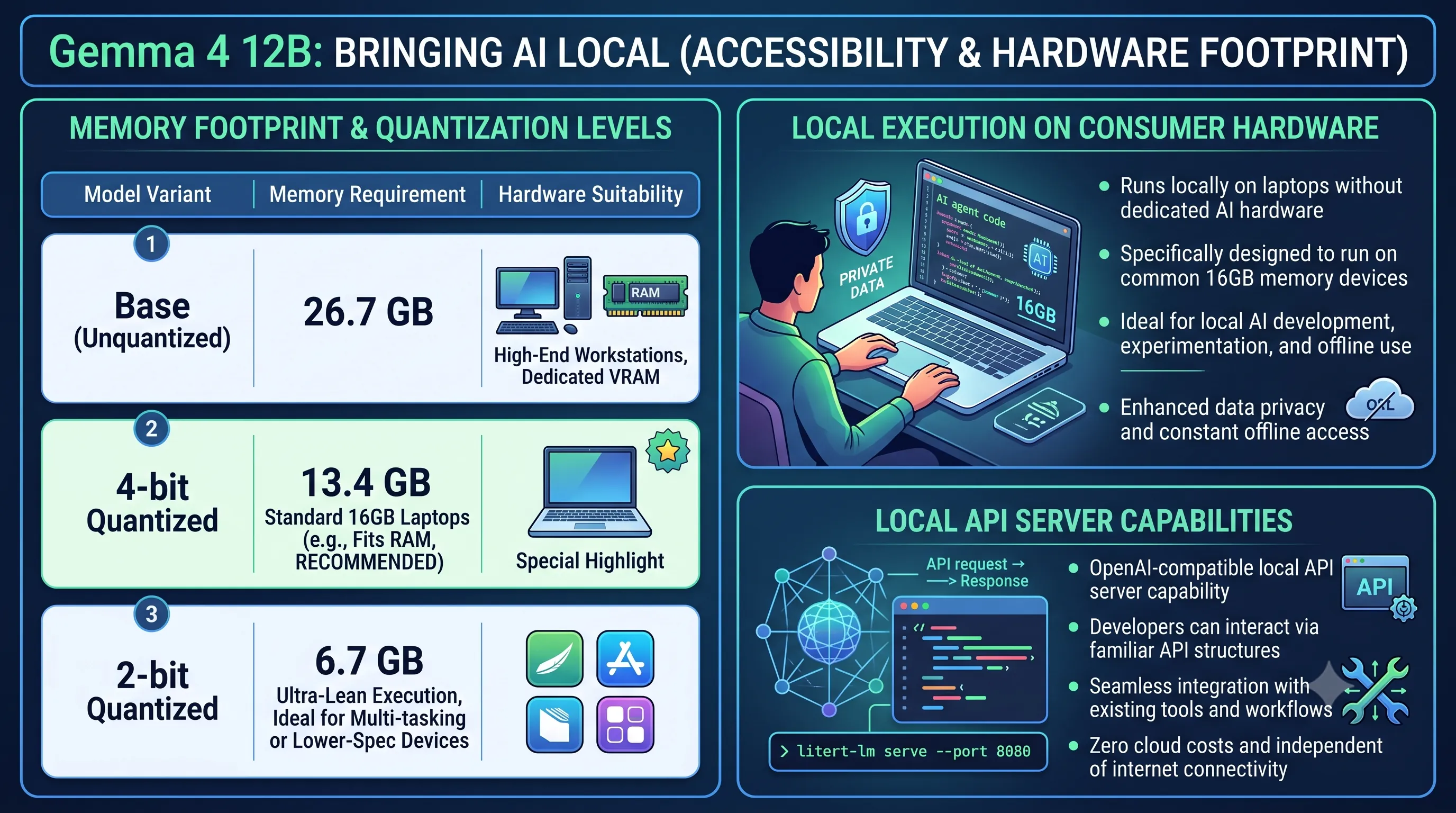
To make local execution seamless on consumer hardware, Gemma 4 12B supports various quantization levels to drastically optimize its memory footprint:
| Model Variant | Memory Requirement | Hardware Suitability (e.g., 16GB Laptops) |
| Base (Unquantized) | 26.7 GB | Requires high-end workstations or dedicated VRAM |
| 4-bit Quantized | 13.4 GB | Perfectly fits standard 16GB RAM laptops (Recommended) |
| 2-bit Quantized | 6.7 GB | Ultra-lean execution, ideal for multi-tasking or lower-spec devices |
Running Locally on Consumer Hardware
These optimized memory profiles are central to the model's ability to run locally on consumer laptops without dedicated AI hardware.
The model was specifically designed to run on general laptops equipped with 16GB memory, a common configuration for modern consumer devices.
By using the 4-bit or 2-bit quantized versions, users can comfortably run the model within this memory budget.
This focus on local execution makes Gemma 4 12B ideal for local AI development, experimentation, and applications where data privacy or offline access is paramount.
Local API Server Capabilities
Beyond simple execution, Gemma 4 12B can be deployed as a local, OpenAI-compatible API server.
This is achieved using the `litert-lm serve` CLI command.
This feature allows developers to interact with the model on their own machine using familiar API structures, facilitating seamless integration with existing tools and workflows designed for the OpenAI ecosystem without incurring cloud costs or relying on internet connectivity.
5. Open-Source Power: Developer Tools and Licensing for Gemma 4 12B
This section details the open and developer-friendly ecosystem Google has built around the Gemma 4 12B release, focusing on its licensing, tool support, and resources for building AI agents.
Apache 2.0 Licensing for Broad Adoption
Google has strategically released Gemma 4 12B under the Apache 2.0 license.
This decision is significant as it permits broad, unrestricted use, allowing for both academic and commercial applications without charge.
By opting for such a permissive open-source license, Google ensures that developers, startups, and established enterprises can freely integrate, modify, and distribute solutions built on Gemma 4 12B, fostering a vibrant and collaborative community around the model.
This approach dramatically lowers the barrier to entry for advanced AI development and encourages widespread adoption.
Extensive Toolchain Integration
To ensure seamless integration into existing developer workflows, Gemma 4 12B is supported by a comprehensive suite of major AI development tools.
This out-of-the-box compatibility includes leading platforms and frameworks such as Hugging Face, Ollama, LM Studio, llama.cpp, MLX, and vLLM.
This extensive support means developers can immediately begin experimenting and deploying the model using their preferred environments, whether for local testing on consumer hardware, large-scale inference serving, or research and fine-tuning.
New Gemma Skills Repository
Coinciding with the model's release, Google has also launched an official Gemma Skills Repository.
This new resource is specifically designed to accelerate the creation of sophisticated AI agents.
The repository provides developers with pre-built components and examples, offering a practical foundation for building applications that can perform complex, multi-step tasks.
This initiative moves beyond simply providing a base model by offering tangible tools to help developers unlock the full agentic potential of Gemma 4 12B from day one.

6. Real-World Performance and User Observations of Gemma 4 12B
Strengths in Specific Use Cases
Initial feedback from the user community indicates that Gemma 4 12B demonstrates significant strengths in particular domains.
Users have reported that the model can be excellent for specific tasks like tool orchestration, suggesting a robust capability to understand and execute complex commands that interact with external software or APIs.
In the realm of software development, some have found it to be "almost excellent" for writing code, particularly when provided with detailed one-shot prompts.
This highlights its potential as a powerful coding assistant for well-defined, single-turn requests.
Quantization-Aware Training Model Regressions
Alongside the base model, a Quantization Aware Training (QAT) model of Gemma 4 12B exists, designed for more efficient deployment.
However, early adopters have encountered performance issues with this specific version.
Specifically, some users reported QAT model regressions for tool calling use cases.
This suggests that while the base model excels at tool orchestration, the optimization process for the QAT variant may have inadvertently diminished its effectiveness in this critical area.
Comparative Performance and Varied User Experiences
The overall reception of Gemma 4 12B has been mixed, with its performance being highly dependent on the task at hand.
In direct comparisons, the model has shown weaknesses in its multimodal capabilities.
Some comparative results show Qwen 3.5 0.8b dominating Gemma 4 12B in image tests, indicating that competing models may offer superior performance for vision-related tasks.
More broadly, a key takeaway from user observations is that the performance reported by users varies, pointing to an inconsistent experience that may depend on the specific application, prompt quality, or system configuration.

📚 Related Posts
NVIDIA & Microsoft Launch RTX Spark: AI Agent PCs with 1 PFLOPS Local Power, Ultimate Privacy, and 128GB Memory for Creators & G
🚀 Key TakeawaysNVIDIA and Microsoft are launching the RTX Spark platform, ushering in an era of 'AI Agent PCs' that perform tasks directly on the user's device, ensuring unprecedented privacy, security, and local AI processing power.The platform boasts
tech.dragon-story.com
Mayo Clinic & Microsoft Partner to Develop Next-Gen Specialized Medical AI: Transforming Healthcare, Diagnosis, and Global Acces
🚀 Key TakeawaysMayo Clinic and Microsoft are collaborating to develop next-generation, specialized medical AI models, combining Mayo's vast clinical data and expertise with Microsoft's AI and cloud technology.These AI models are uniquely designed for me
tech.dragon-story.com
Microsoft Project Solara: Unveiling the AI Agent Era, Ending Apps, and Redefining Computing for Global Dominance
🚀 Key TakeawaysProject Solara marks a pivotal shift from the traditional app-centric computing model to an AI agent-centric paradigm, where devices are powered by intelligent agents capable of understanding user intent and autonomously executing tasks a
tech.dragon-story.com


