🚀 Key Takeaways
- Google has unveiled its largest-ever upgrade for NotebookLM, transforming it into an advanced AI research partner.
- The updated platform is now built on the powerful Gemini 3.5 model and Google's agentic infrastructure, Antigravity.
- NotebookLM now boasts advanced agentic capabilities, including direct code execution and deep data analysis within a cloud environment.
- It can independently browse the web and suggest materials, enabling users to build comprehensive research projects from the ground up.
- The system automatically generates research outputs in diverse formats, such as PDF reports, Excel files, and presentations.
- Internal metrics reveal a significant performance boost, with improvements exceeding 65% in document analysis and web exploration.
- These enhanced features are currently being rolled out to Google AI Ultra and Workspace AI customers globally.
The latest enhancements leverage the cutting-edge Gemini 3.5 model alongside Google's innovative Antigravity framework, delivering advanced agentic capabilities. This powerful combination allows NotebookLM to perform functions like directly executing code, analyzing vast datasets, and dynamically gathering reliable web sources, fundamentally changing how users approach research.
With significant performance improvements and the ability to generate diverse output formats, the upgraded NotebookLM aims to drastically increase productivity for researchers, data analysts, and businesses. These advanced features are now becoming available to Google AI Ultra and Workspace AI subscribers, signaling a new era for AI-powered intelligence.

1. NotebookLM's Major Leap: From Assistant to Agentic Research Partner
This section delves into Google's recent large-scale update for NotebookLM, which fundamentally transforms the tool from a simple assistant into an agentic research partner, connecting directly to the main announcement of its most significant upgrade to date.
Evolution to an AI Research Partner
Google has officially announced a large-scale update for NotebookLM, specifically designed to enhance its research and document analysis features.
This move marks a significant evolution for the platform, shifting its identity from a passive AI research assistant to a proactive AI research partner.
The transformation is not merely conceptual; millions of individuals and businesses are already using NotebookLM as a collaborative partner for their research needs.
Underscoring this commitment to deeper integration, Google is also expanding its suite of AI tools, including NotebookLM and Gemini, for broader use in the education sector.
Agentic Capabilities and Advanced Reasoning
The core of NotebookLM's latest upgrade is its transformation into an agent-type AI, capable of tackling complex research projects with a new level of autonomy.
This evolution moves beyond simple query-and-response interactions, empowering the tool with more sophisticated capabilities.
Specifically, these latest upgrades deliver new agentic capabilities and more advanced reasoning skills.
This allows NotebookLM to not just find information within source documents but to synthesize, analyze, and assist in complex intellectual tasks, solidifying its new role as a true partner in knowledge work.

2. Under the Hood: Gemini 3.5 and Antigravity Powering NotebookLM
This section explores the fundamental technological shifts that enable the latest capabilities in NotebookLM, connecting directly to the main topic by revealing the core engine behind the platform's major upgrade.
Gemini 3.5 Integration
At the heart of the revamped NotebookLM is its foundation on the latest Gemini 3.5 model.
This move represents a significant leap in the platform's reasoning and comprehension abilities.
Supporting this powerful new model is a completely new inference engine, designed to optimize performance and enable more complex interactions with user-provided source materials.
Antigravity: Google's Agentic Infrastructure
The upgrade extends beyond just the AI model.
NotebookLM now operates on a dual architecture, running Gemini 3.5 alongside a new framework known as Antigravity.
Google has defined Antigravity as its internal agentic infrastructure, suggesting it provides the necessary framework for the AI to perform more sophisticated, multi-step tasks autonomously.
The direct impact of this is already visible, as some of the application's new features are explicitly powered by Google's Antigravity code editor.

3. Unleashing Productivity: New Features and Enhanced Capabilities
This section explores the groundbreaking functionalities that transform NotebookLM from a note-taking tool into a dynamic research and productivity platform, directly supporting the article's main topic of Google's largest-ever upgrade.
Automated Research and Data Analysis
At the core of the new NotebookLM is a fundamental shift in its architecture, with each notebook now functioning as its own self-contained, cloud-based computing environment.
This enables the integrated AI to move beyond simple text generation and directly execute code and analyze data within the platform.
To facilitate complex inquiries, the system can leverage a library of over 100 software functions, allowing for significantly deeper and more technical research.
This computational power means NotebookLM can now actively write code for users, streamlining tasks for developers and data scientists alike.
The introduction of new data tables further enhances this analytical capability, providing a structured format for organizing and interacting with datasets.
Enhanced Content Generation and Source Management
NotebookLM now empowers users to build research from scratch, even without providing initial source materials.
During a conversation, the AI proactively suggests necessary materials and can browse the web using Google Search to find reliable sources to add to the notebook.
Crucially, the user retains full control and can choose which materials to incorporate, ensuring the integrity and reliability of the research base.
Managing these sources is now more intuitive thanks to the overhauled Sources Panel, which features three new specialized search functions.
Once sources are established, NotebookLM automatically generates results in a variety of formats.
These outputs are not static; users have the complete freedom to freely modify any generated results to perfectly suit their needs.
Advanced Tools for Deep Research
The upgrade introduces a suite of sophisticated tools, accessible through a powerful, redesigned Studio panel, which serves as the central hub for advanced research tasks.
This new interface brings together several key innovations, including a new advanced deep research capability that integrates multiple functionalities for comprehensive analysis.
To help manage and organize outputs, NotebookLM now includes a new artifact system.
For digesting complex video content, the platform offers Video Overviews, a feature that distills lengthy information into manageable summaries.
| New Feature/Component | Primary Functionality |
|---|---|
| Redesigned Studio Panel | A powerful, centralized workspace for accessing and managing advanced research tools. |
| New Artifact System | A system for organizing and interacting with the various types of content generated by the AI. |
| Video Overviews | Distills complex information from video sources into concise, understandable summaries. |
| Overhauled Sources Panel | Features three new search functions to streamline finding and managing research materials. |
| Data Tables | Provides a structured format for presenting, organizing, and analyzing datasets within a notebook. |

4. Diverse Output Formats for Seamless Integration
As part of its landmark upgrade, Google has significantly expanded NotebookLM's export capabilities, allowing users to seamlessly integrate their research and insights into various professional workflows.
This enhancement transforms the platform into a versatile hub, capable of producing content tailored for data analysis, formal reporting, and dynamic presentations.
Structured Data Outputs
NotebookLM now directly supports the generation of structured data files, a crucial feature for users who need to process and analyze their findings programmatically or within other applications.
Outputs include standard formats like CSV (Comma-Separated Values) and JSON (JavaScript Object Notation), which are ideal for exporting tabular data or complex nested information for use in databases, custom scripts, or other software.
Furthermore, the platform can generate native Excel files, enabling users to move their synthesized data directly into spreadsheets for financial modeling, statistical analysis, or business intelligence tasks without manual data entry.
Visual and Document Outputs
Beyond raw data, the upgrade introduces a suite of formats designed for communication and presentation.
Users can now create polished PDF reports directly from their notes, perfect for formal documentation, academic papers, or sharing insights in a universally accessible format.
For business and academic presentations, NotebookLM can export summaries and key points into PowerPoint slides, streamlining the creation of presentation decks.
The tool also supports the generation of visual aids such as Charts to represent data graphically and standalone Images, which can be easily embedded into other documents or platforms.
| Output Format | Primary Use Case | Type |
|---|---|---|
| PDF reports | Formal documentation, sharing, and archiving research findings. | Document |
| Excel files | Spreadsheet analysis, financial modeling, and data manipulation. | Structured Data |
| PowerPoint | Creating presentation slides for meetings, lectures, or reports. | Presentation |
| Charts | Visualizing data and trends to include in reports or presentations. | Visual |
| CSV | Exporting tabular data for use in spreadsheets or other data tools. | Structured Data |
| JSON | Exporting structured data for web applications and software integration. | Structured Data |
| Images | Generating standalone visual elements for embedding in other content. | Visual |

5. Significant Performance Boosts and Accuracy Improvements
This update to NotebookLM is not merely an incremental change; it represents a fundamental leap in the platform's core processing power and analytical precision, directly addressing user needs for faster and more reliable insights from their source materials.
This section details the specific, data-backed enhancements that quantify the upgrade's impact, connecting directly to the main article's theme of this being NotebookLM's largest upgrade to date.
Quantitative Performance Gains
The most striking aspect of the new NotebookLM is its raw speed and efficiency.
According to internal evaluations, the platform now demonstrates an average performance improvement of over 65% compared to the previous version, a significant boost that impacts every user interaction.
This enhancement is even more pronounced in specific, high-demand use cases.
For users working with extensive source materials, performance for large-volume document analysis improved by approximately 70%.
Furthermore, when leveraging NotebookLM to synthesize information from web-based sources, the system now operates with a performance gain of approximately 78%.
These metrics underscore a major re-architecture focused on reducing processing time and delivering results faster, especially for complex research tasks.
| Area of Improvement | Performance Gain (vs. Previous Version) |
|---|---|
| Large-Volume Document Analysis | Approximately 70% |
| Web-Based Material Exploration | Approximately 78% |
| Overall Average Performance | Over 65% |
Qualitative Improvements in Accuracy
Beyond raw speed, the upgrade delivers crucial enhancements to the quality and reliability of the AI's output.
The system now provides more accurate answers, a direct result of improved algorithms that better comprehend nuance and context within the source documents.
This increased precision is complemented by what Google describes as improved analysis capabilities.
Users can expect the AI to generate more insightful summaries, identify more subtle connections between sources, and produce outputs that are more coherent and directly grounded in the provided material.
This translates to a more trustworthy research assistant, reducing the need for users to manually verify every generated insight and allowing them to focus on higher-level analytical work.

6. Accessing the Advanced Capabilities: Subscriptions and Target Users
This section details the availability of the major NotebookLM upgrade, outlining who the new features are for and the subscription models required to access them.
Target Audience and Rollout
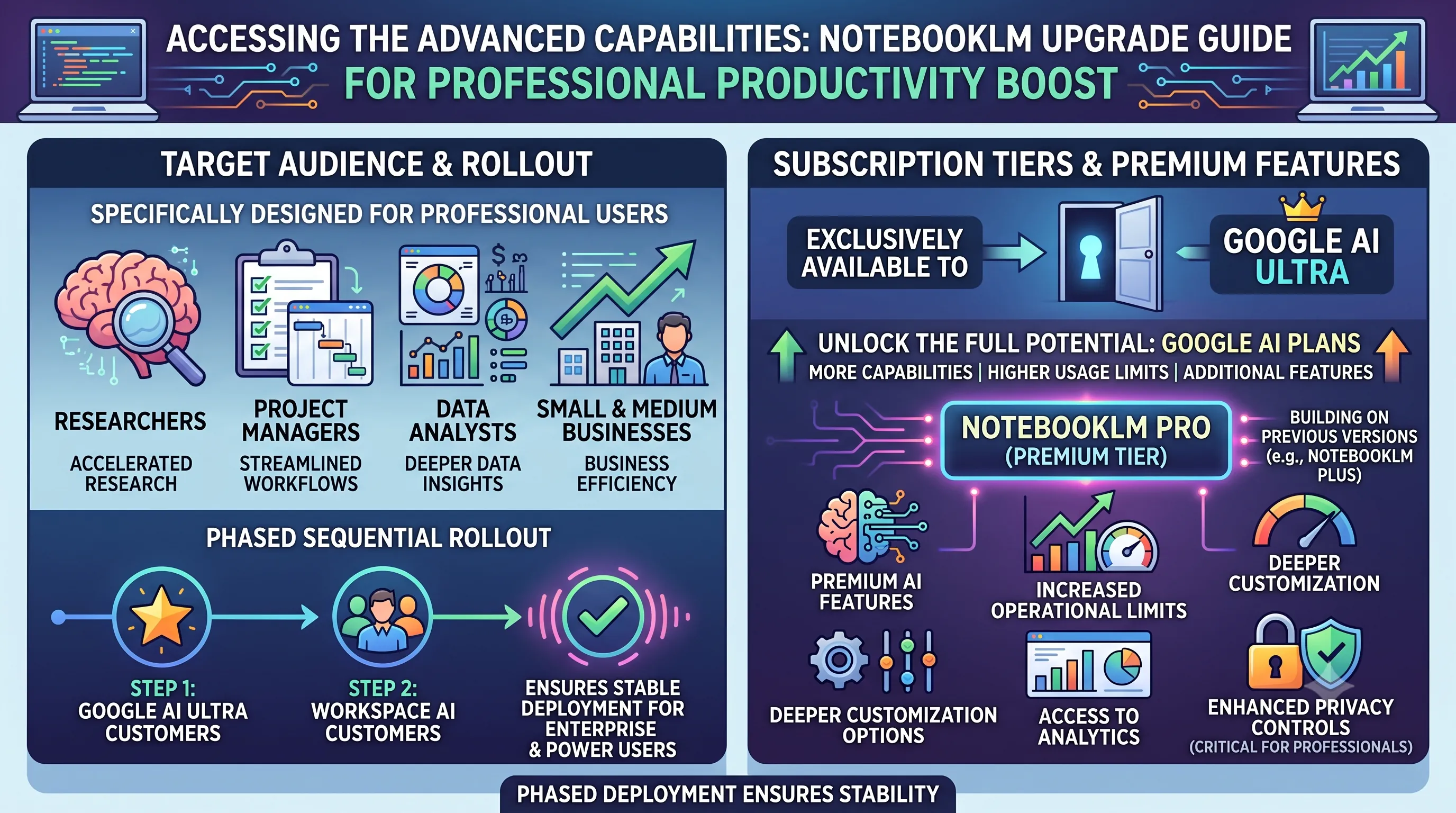
Google has specifically designed this update to boost productivity for a professional user base, including researchers, project managers, data analysts, and operators of small and medium businesses.
The new capabilities are not being released to all users at once; instead, they are currently being provided sequentially to customers of Google AI Ultra and Workspace AI.
This phased approach ensures a stable deployment for its core enterprise and power-user segments.
Subscription Tiers and Premium Features
Access to these powerful new upgrades is exclusively available to users with a Google AI Ultra subscription.
For those seeking to unlock the full potential of the platform, Google offers upgrade paths through its Google AI Plans, which provide additional capabilities, higher usage limits, and more features.
A key offering in this structure is NotebookLM Pro, a premium tier that delivers a suite of advanced benefits.
These include premium AI features, increased operational limits, deeper customization options, access to analytics, and critically for professional users, enhanced privacy controls.
This tier builds upon the company's previous premium offerings, such as the NotebookLM Plus version that was introduced in the past.
7. A Look Back: Recent Milestones in NotebookLM's Development
This latest major release is the culmination of a steady cadence of significant enhancements over the past several months, demonstrating Google's consistent investment in the platform.
The June 2026 Global Rollout
The most recent major update cycle prior to the current one took place on June 8, 2026.
On that date, Google initiated an across-the-board upgrade for NotebookLM.
The deployment of these upgrades started rolling out globally via the web, setting the stage for the even more substantial changes that followed.
Earlier Enhancements: March 2026 and December 2024
Before the June update, Google had already pushed forward notable improvements earlier in the year.
In March 2026, the company introduced updates that gave users more flexibility for uploading sources and provided new ways to create and edit visuals within the tool.
This followed an earlier feature drop in December 2024, which also introduced new capabilities to the platform.

8. Current Status: Known Limitations
This section addresses the known issues and temporary feature adjustments that accompany the major NotebookLM upgrade, providing a complete picture of its current operational state.
Temporary Feature Rollbacks
While the latest update introduces a host of powerful capabilities, it is important for users to be aware of certain temporary adjustments.
Notably, Google has temporarily rolled back access to Slide Decks as a source material within NotebookLM.
This means that for the time being, users cannot upload or analyze presentation files directly in the platform, a feature that was previously available or expected as part of the broader source integration.
The rollback is positioned as a temporary measure, though a specific timeline for its reinstatement has not been provided.

📚 Related Posts
Anthropic Fable 5 & Mythos 5: US Government's Global Shutdown Over AI 'Jailbreak,' Restoration & Industry Security Reforms
🚀 Key TakeawaysThe U.S. government mandated the global suspension of Anthropic's Fable 5 and Mythos 5 models due to national security concerns in June 2026.This unprecedented order affected hundreds of millions of users worldwide, with Anthropic immedia
tech.dragon-story.com
ChatGPT's Revolutionary Memory Upgrade: Deep Dive into Personalized AI, User Control & Future Collaboration
🚀 Key TakeawaysOpenAI significantly upgraded ChatGPT's memory system to enhance recency, consistency, and relevance across conversations.The new system intelligently learns user preferences and project details in the background, automatically integratin
tech.dragon-story.com
OpenAI Codex Evolves: Comprehensive AI Platform for All Job Roles with New Plugins, Collaboration & Enterprise Adoption
🚀 Key TakeawaysOpenAI has significantly expanded its Codex AI platform to cater to all job roles, moving beyond its developer-centric origins.The update introduces role-specific plugins and integrations with popular business tools, enhancing functionali
tech.dragon-story.com


