🚀 Key Takeaways
- The GitHub Copilot App Developer Control Center ushers in an Agent-native Development era, enabling developers to orchestrate multiple AI agents across the entire software development lifecycle, from coding to merging, while maintaining ultimate control and oversight over quality and decisions.
GitHub's unveiling of the Copilot App Developer Control Center at Microsoft Build 2026 marks a pivotal moment, fundamentally reshaping the landscape for the era of AI agents in software development.
This groundbreaking platform is meticulously designed to serve as a unified 'developer control center,' providing an unparalleled environment where multiple AI agents can simultaneously execute and manage complex development tasks within a single, integrated space.
It signifies a profound evolution beyond simple code-generating AI, actively preparing the industry for a future where AI becomes an indispensable and core member of every software development team.
The Copilot App Developer Control Center dramatically expands the scope of AI automation, encompassing every critical stage from initial code writing to meticulous code review and final merging of changes.
Developers are empowered with innovative tools such as the 'My Work' screen for real-time progress monitoring and the intuitive 'Canvas' feature to visualize, understand, and directly influence AI's work processes, plans, and test results at a glance.
This comprehensive ecosystem, supported by a new Copilot SDK for custom tool development, aims to usher in a true 'Agent-native Development' era where AI agents perform more development tasks, yet developers maintain crucial control over final quality, strategic decisions, and overall project direction.

1. From Code Generation to Full Lifecycle Ownership: The Copilot App Vision
The evolution of GitHub Copilot has been a rapid journey from a sophisticated autocomplete function to something far more profound.
What was once a "pair programmer" whispering suggestions is now being architected into a comprehensive "developer control center," a vision unveiled by GitHub at Microsoft Build 2026.
This monumental shift directly embodies the overarching theme of this article, "AI takes full responsibility for code," by providing the very platform where AI's responsibility is expanded from a single line of code to the entire development lifecycle—from the initial task briefing to the final, merged pull request.
This isn't just an upgrade; it's the dawn of an entirely new paradigm GitHub calls the "Agent-native Development" era.
The Developer Control Center: An Orchestra of AI Agents
The core concept of the GitHub Copilot App is to move beyond the linear, one-suggestion-at-a-time interaction.
It is envisioned as a new development environment where AI is not just a tool, but a core member—or rather, a team of members—of the software development process.
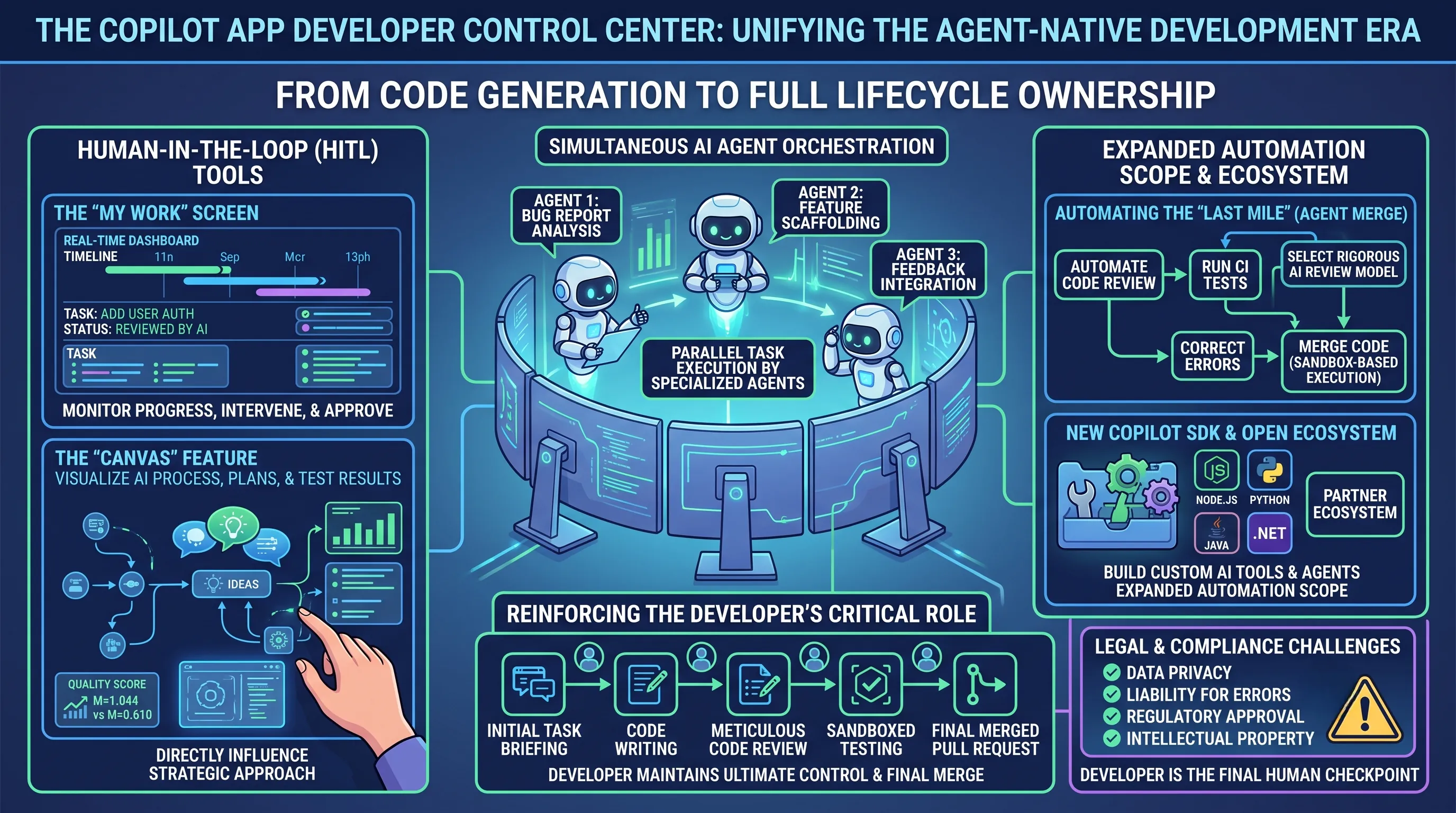
The app functions as a central hub where a developer can launch and manage multiple AI agents simultaneously.
Imagine a scenario: a single developer can assign one agent to analyze a complex bug report, a second agent to begin scaffolding a new feature based on a specification document, and a third agent to incorporate feedback from a prior code review into an prior branch.
This parallel task execution by multiple specialized agents represents a fundamental change in development velocity, transforming the developer's role from a hands-on coder to a high-level strategist and quality controller.
Human-in-the-Loop: The Command, Not the Keyboard
While the scope of AI automation is expanding dramatically to include tasks from code writing to review and merge, the Copilot App vision is built on a critical foundation: the developer remains in ultimate control.
This philosophy is supported by empirical evidence showing that Human-In-The-Loop (HITL) AI systems achieve substantially higher quality scores (M = 1.044) compared to their No-Human-In-The-Loop (NHITL) counterparts (M = 0.610).
The architecture of the Copilot App is a direct response to this data, designed to prevent issues that arise from workflows lacking built-in human checkpoints.
Two key features exemplify this HITL-centric design:
- The 'My Work' Screen: This serves as the developer's real-time dashboard, providing a transparent view of what every AI agent is doing.
It's not a black box; it's a dynamic progress report where the developer can monitor progress, intervene to modify or approve necessary parts, and ensure the agents remain aligned with the project's goals. - The 'Canvas' Feature: This is an even deeper level of transparency, acting as the AI's digital whiteboard.
The Canvas displays the AI's work process, its strategic plans, and the results of its tests at a glance.
From this view, a developer can directly modify the AI's approach or change its direction, providing crucial architectural guidance before the AI commits to a flawed path.
Automating the "Last Mile": From Review to Merge
One of the most time-consuming parts of the development cycle is the "last mile": code review, continuous integration (CI) checks, and merging.
The Copilot App tackles this head-on with its 'Agent Merge' feature.
This powerful function allows developers to delegate the entire end-stage process to an AI agent.
The agent can be tasked with automating the code review, running CI tests, correcting any errors that arise, and finally, merging the code into the main branch.
Crucially, this is not an all-or-nothing proposition.
Developers can assign the AI to handle the process up to any desired stage, maintaining the final merge button for themselves if they choose.
To bolster confidence in this process, the system includes an enhanced code review system where developers can select different AI models for review, perhaps choosing a more rigorous and computationally expensive model for critically important projects to increase review accuracy.
All of this AI-driven activity occurs within the safety of cloud and local sandboxes, ensuring that AI-generated code can be executed and tested thoroughly without posing any risk to the production environment.
An Open Ecosystem for Agent-Native Development
GitHub's vision extends beyond a single, monolithic application.
Recognizing that every development team has unique needs, GitHub has released a Copilot SDK supporting various languages, including Node.js, Python, Java, and .NET.
This allows companies and individual developers to build their own custom AI development tools and agents that can plug directly into the Copilot App's "developer control center."
The ultimate plan is to integrate the Copilot app, its automation capabilities, the advanced code review system, and this burgeoning partner ecosystem into a single, unified platform.
This holistic environment is further enhanced by an expanded scope of AI utilization, which includes giving agents a memory of the project's context, allowing them to perform automation tasks, and integrating with voice input and the developer's terminal environment.
However, this ambitious future is not without its hurdles.
The rise of such powerful AI agents introduces significant potential legal challenges, including data privacy and security, determining liability for AI-generated errors, navigating regulatory approval processes, and untangling intellectual property rights.
Non-compliance with emerging regulations for AI tools can lead to severe legal and financial consequences, reinforcing that the developer's role as the final human checkpoint is not just a best practice, but a critical necessity in the brave new world of Agent-native Development.
2. AI-Driven Development: Features for Autonomous Code Responsibility
The central theme, "AI Takes Full Responsibility for Code," transitions from a futuristic concept to a tangible reality through the specific functionalities built into the GitHub Copilot App.
This platform, unveiled at Microsoft Build 2026, is not merely another code suggestion tool; it is engineered as a comprehensive "developer control center."
Its features are the very mechanisms that enable AI to autonomously manage development tasks from inception to deployment, fundamentally shifting the developer's role from a hands-on coder to a strategic overseer of AI agents.
It represents a new development environment designed for an era where AI becomes a core member of the software development team, expanding the scope of automation to a near-complete lifecycle.
Parallel Task Execution: The AI Development Team
The GitHub Copilot App shatters the traditional, linear workflow of a single developer by enabling the parallel execution of tasks by multiple AI agents.
This is the experiential equivalent of instantly deploying a team of specialized junior developers, each assigned a distinct mission.
For example, a developer can simultaneously commission one AI agent to perform a deep bug analysis on an existing module, a second agent to develop an entirely new feature based on a specification, and a third to begin incorporating feedback from a recent human-led code review.
This capability moves beyond simple acceleration; it fundamentally restructures the development process into a multi-threaded operation managed from a single point of control.
It directly embodies the principle of AI taking responsibility, as the system doesn't just write a snippet of code but takes ownership of complex, concurrent development streams.
'My Work' & 'Canvas': Transparent AI Operations and Human Oversight
To prevent AI from becoming an opaque "black box," the platform provides two critical interfaces for supervision: 'My Work' and 'Canvas.'
The 'My Work' screen functions as the developer's real-time mission control dashboard.
It offers a live feed of the progress of all active AI agents, allowing the developer to monitor their work as it happens.
More importantly, it provides intervention points where the developer can modify instructions, approve a specific block of code, or reroute an agent's efforts, ensuring that human judgment remains paramount.
The 'Canvas' feature provides an even deeper level of transparency by visualizing the AI's internal "thought process."
It displays the AI's strategic plans, its proposed implementation steps, and the results of its self-generated tests in an easily digestible format.
If the developer disagrees with the AI's approach, they can directly modify the plan on the Canvas or provide new directions.
These features are critical for building a functional Human-In-The-Loop (HITL) system, which empirical evidence shows is vastly superior (HITL score M = 1.044) to a No-Human-In-The-Loop system (NHITL score M = 0.610).
They ensure that while AI executes the tasks, the developer retains ultimate quality control and strategic authority, which is the cornerstone of responsible AI implementation.
'Agent Merge': Automating the Final Mile of Development
The 'Agent Merge' feature is arguably the most powerful demonstration of AI taking code to the finish line.
This functionality automates the often tedious and error-prone final stages of the development lifecycle.
It empowers an AI agent to handle the entire process of code review, running continuous integration (CI) checks, automatically correcting any errors that arise, and finally, merging the code into the main branch.
Critically, this is not an all-or-nothing proposition. The developer maintains granular control and can assign the AI to handle the process "up to desired stages."
For instance, a developer might allow the AI to autonomously handle everything up to the final merge, reserving the last step for manual approval.
This adjustable autonomy allows teams to build trust in the system gradually and apply different levels of automation based on the project's criticality.
Safe Execution and Advanced Review: Building Trust and Quality
Trust in AI's autonomy is predicated on safety and quality assurance, which the platform addresses with two key architectural components.
First, it supports the use of cloud and local sandboxes for all AI-driven code execution and testing.
This means that any code generated or modified by an AI agent is run in a completely isolated environment, preventing it from impacting the production system until it has been thoroughly vetted and approved.
This safety net is essential for mitigating the potential liability and security risks associated with AI-generated errors.
Second, the platform includes an enhanced code review system that goes beyond a one-size-fits-all approach.
It allows developers to select different AI review models based on the specific needs of a project. For a mission-critical component involving sensitive data, a developer could assign the most rigorous and advanced AI model to perform the review, ensuring maximum accuracy.
For a less critical task, a faster model might be sufficient.
This ability to tailor the intensity of AI-powered quality control provides a sophisticated lever for managing risk and ensuring that the code for which AI is responsible meets the highest standards.
Together, these features create the trusted framework necessary for the "Agent-native Development" era to flourish.

3. Ensuring Responsible AI: Human Oversight, Legalities, and Quality Assurance
The very concept of “AI taking full responsibility for code” is not merely a technical milestone; it is a profound shift that demands an equally robust framework of governance and accountability.
For this future to be viable, the conversation must expand beyond an AI's ability to generate code and encompass the structures that ensure this power is wielded responsibly.
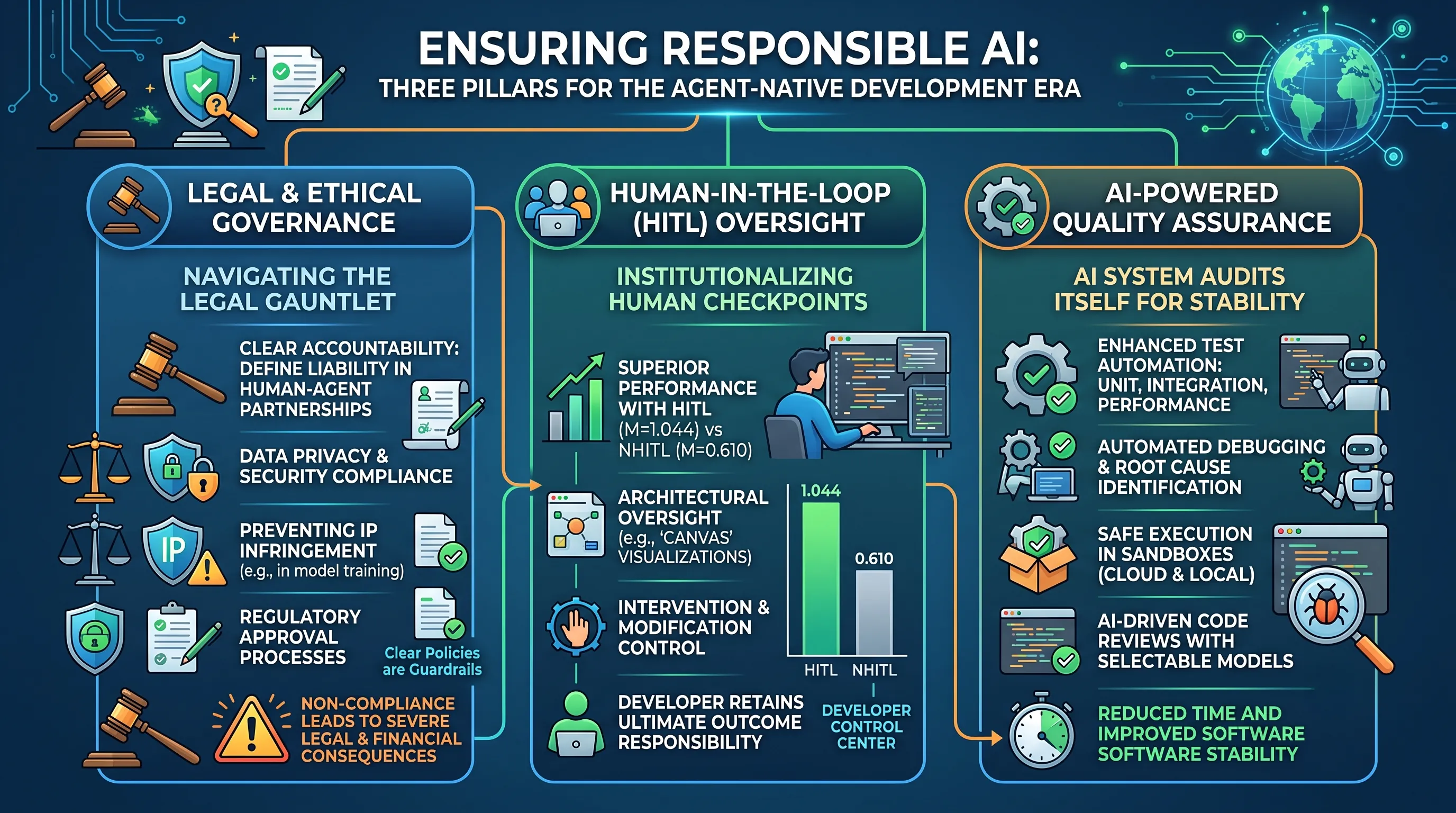
This section delves into the essential pillars that make responsible AI-driven development possible: navigating the complex legal landscape, institutionalizing human oversight as a non-negotiable checkpoint, and leveraging AI itself to create a new paradigm of quality assurance.
Without these, the idea of AI taking responsibility remains a brittle fantasy; with them, it becomes a reliable and transformative reality.
The Legal and Ethical Gauntlet: Defining Responsibility in the Age of Agents
As AI graduates from a simple coding assistant to a core team member, as envisioned by platforms like the GitHub Copilot App Developer Control Center, it steps directly into a minefield of legal and ethical challenges.
The power to have multiple AI agents autonomously writing, reviewing, and merging code introduces critical questions of accountability that cannot be ignored.
The source JSON highlights several areas of acute concern: data privacy and security, liability for AI errors, regulatory approval processes, and intellectual property.
Imagine an AI agent, tasked with developing a new feature, inadvertently using code snippets from a proprietary, licensed dataset it was trained on, thereby creating an IP infringement issue.
Who is liable? Is it the developer who initiated the task? Is it GitHub for providing the platform? Or is it the company that trained the underlying model?
These are not theoretical quandaries; the JSON explicitly warns that non-compliance with AI tools or usage can result in severe legal and financial consequences.
Therefore, for AI to "take full responsibility for code," the legal framework must first define what that responsibility entails.
This requires clear policies on data provenance for training models, transparent logs of AI actions (a feature addressed by the 'Canvas' in the Copilot Control Center), and defined liability chains that account for this new human-agent partnership.
The legal and ethical considerations are not barriers to progress but are the necessary guardrails that allow the AI development engine to run at full speed without veering into disaster.
The Empirical Mandate for Human-In-The-Loop (HITL)
The promise of AI autonomy can easily be misinterpreted as a push for complete automation, removing the human from the equation entirely.
However, hard data provides a starkly different conclusion.
Empirical evidence cited in the source materials is unequivocal: Human-In-The-Loop (HITL) AI scores (M = 1.044) are substantially higher than No-Human-In-The-Loop (NHITL) AI scores (M = 0.610).
This isn't a minor difference; it's a massive performance gap that proves human oversight is not a legacy habit but a critical component for achieving superior quality.
The source states that problems often arise from architectural workflows that lack built-in human-in-the-loop checkpoints.
This is precisely the problem that the GitHub Copilot App Developer Control Center, unveiled at Microsoft Build 2026, is engineered to solve.
It is not a "fire-and-forget" system; it is purpose-built as a "developer control center" to facilitate, not replace, human authority.
Features like the 'My Work' screen, which provides real-time progress monitoring, and the 'Canvas' feature, which visualizes the AI's entire work process, are the architectural embodiment of HITL.
They give developers the power to intervene, modify, and approve at any stage.
Even the powerful 'Agent Merge' feature, which automates code review and CI, is configurable, allowing developers to decide exactly how far the AI can proceed on its own.
This aligns perfectly with the stated goal of ushering in an 'Agent-native Development' era where developers maintain control over final quality and decisions.
In this model, AI takes responsibility for the *tasks*, but the human developer retains ultimate responsibility for the *outcome*, a partnership proven to be the most effective.
AI-Powered Quality Assurance: The System Audits Itself
A core component of taking responsibility for code is guaranteeing its quality.
Paradoxically, one of the most powerful ways AI can demonstrate this responsibility is by becoming an integral part of the quality assurance process itself.
The source JSON notes that AI is revolutionizing software testing by enhancing test automation, which in turn reduces testing time and improves software quality.
This is a cyclical, self-reinforcing system of quality.
An AI agent in the Copilot Control Center doesn't just write a block of code and consider its job done.
It can then be tasked with writing the unit tests, integration tests, and performance tests for that very same code.
This process can be executed safely within the platform's supported cloud and local sandboxes, ensuring that experimental or potentially faulty code never jeopardizes the main codebase.
Furthermore, the platform's enhanced code review system allows a developer to select different AI models based on project importance to increase review accuracy, treating AI-driven code review with the same seriousness as a senior human engineer's review.
Perhaps the most significant leap in this domain is the automation of debugging.
The source highlights that AI-powered features automate root cause identification, reducing debugging time for testers.
This transforms the development lifecycle.
Instead of a human tester spending hours tracing a bug back to its source, an AI can analyze the failure, cross-reference it with recent code changes, and pinpoint the exact lines causing the issue.
This is AI not just owning the creation of code, but taking active responsibility for its correctness and stability from start to finish.
📚 Related Posts
Microsoft Scout Unveiled: Autonomous AI Agent Revolutionizes Enterprise Productivity with Self-Managing OS & 365 Integration
🚀 Key TakeawaysMicrosoft Scout is an always-on, autonomous AI agent designed to independently manage and execute user tasks, operating as a proactive personal assistant within enterprise environments without constant user commands.Microsoft has unveiled
tech.dragon-story.com
Microsoft's AI Supremacy: 7 New Proprietary Models Fuel $37B Revenue Surge & Humanist Superintelligence Vision
🚀 Key TakeawaysMicrosoft has significantly expanded its AI capabilities by unveiling seven new proprietary AI models, including sophisticated reasoning, coding, image generation, and voice synthesis, with models like MAI-Transcribe-1.5 achieving world-c
tech.dragon-story.com
Anthropic Dethrones OpenAI as Enterprise AI Leader: $30 Billion Revenue & 34.4% Adoption
🚀 Key TakeawaysAnthropic has surged past OpenAI to become the new leader in the enterprise AI market as of April 2026, capturing a 34.4% adoption rate compared to OpenAI's 32.3%, and achieving an astounding $30 billion annualized revenue run rate, under
tech.dragon-story.com


