🚀 Key Takeaways
- Microsoft has significantly expanded its AI capabilities by unveiling seven new proprietary AI models, including sophisticated reasoning, coding, image generation, and voice synthesis, with models like MAI-Transcribe-1.5 achieving world-class accuracy and up to 5 times faster processing.
- The company's AI business is experiencing extraordinary growth, with its annual revenue run rate now exceeding $37 billion, representing a staggering 123% year-over-year increase, driven by robust adoption of Azure Cloud services and Microsoft Copilot.
- Microsoft is committed to a long-term vision of 'Humanist Superintelligence', aiming for AI to enhance human decision-making under human control, supported by a new 'Superintelligence Lab', strategic partnerships such as with Mayo Clinic for medical AI, and advanced technologies like Frontier Tuning for secure, custom enterprise AI.
Microsoft is making an aggressive and comprehensive push into the artificial intelligence landscape, solidifying its position as a leading innovator with significant new announcements and technological advancements. The company recently unveiled seven new proprietary AI models, significantly expanding its capabilities across critical domains such as reasoning with MAI-Thinking-1, advanced coding with MAI-Code-1-Flash, high-performance image generation via MAI-Image-2.5, and world-class speech recognition with MAI-Transcribe-1.5, which boasts up to five times faster processing than existing competitor models.
This strategic investment in AI is translating into substantial financial gains and widespread adoption across its ecosystem. Microsoft's AI business has achieved an impressive annual revenue run rate exceeding $37 billion, marking an extraordinary 123% increase year-over-year, significantly contributing to the company's overall strong financial performance. This growth is further propelled by the robust performance of Azure Cloud services, which saw a 39% revenue increase, and the massive uptake of Microsoft Copilot, now used by 420 million monthly active users, including a near-tripling of enterprise-licensed users.
Looking ahead, Microsoft is not only focusing on current market dominance but also on pioneering the future of AI. Plans include establishing a dedicated 'Superintelligence Lab' for continuous enhancement and pursuing a long-term vision of 'Humanist Superintelligence', emphasizing AI as a powerful tool to support and augment human decision-making and control, rather than replace it. This vision is bolstered by strategic partnerships, notably with Mayo Clinic to jointly develop medical-specialized AI, and innovative technologies like Microsoft Frontier Tuning Technology, which allows businesses to custom-learn AI using their own secure data for optimized internal workflows. The company also maintains a significant stake in OpenAI, reinforcing its commitment to accelerating AI breakthroughs.

1. Microsoft's AI Offensive: A New Generation of Proprietary Models and Frontier Tech
This section directly addresses the core of Microsoft's "AI offensive" by revealing the tangible weapons in its new arsenal.
Far from merely acting as a platform for its partner OpenAI, Microsoft has now stepped into the ring as a formidable, first-party developer of foundational AI.
The unveiling of its own suite of proprietary models and a revolutionary enterprise tuning technology signals a strategic pivot to dominate the AI landscape from end to end, marking its most aggressive and decisive move to date.
The MAI Model Suite: A Declaration of Comprehensive AI Supremacy
Microsoft's announcement of 7 new proprietary AI models is a clear statement of intent to compete on every front of the artificial intelligence revolution.
This diverse portfolio, covering everything from creative image generation to high-speed transcription and specialized reasoning, demonstrates a holistic strategy to build an integrated ecosystem rather than relying on a single generalist model.
Each model is engineered to excel in its specific domain, showcasing Microsoft's deep investment in specialized AI capabilities.
The lineup includes:
- MAI-Image-2.5: This image generation and editing model is not just another market entry; it has reportedly achieved the highest level of competitiveness in image generation performance.
This metric suggests that Microsoft is directly challenging and potentially surpassing the quality and photorealism of established leaders in the space, providing a powerful, native tool for creators and marketers within the Microsoft ecosystem. - MAI-Transcribe-1.5: A powerhouse in speech recognition, this model establishes a new benchmark for performance.
It offers world-class accuracy across an impressive 43 languages, making it a truly global solution.
However, its most disruptive feature is its speed: providing a processing speed up to 5 times faster than existing competitor models.
This isn't an incremental improvement; it's an experiential leap that enables real-time transcription and analysis at a scale and speed previously unimaginable, fundamentally changing workflows for international corporations, media outlets, and customer service centers. - MAI-Voice-2: As the counterpart to transcription, this voice synthesis model completes Microsoft's audio AI offering, enabling the creation of lifelike and context-aware voice outputs.
- MAI-Thinking-1: A dedicated reasoning model designed to tackle complex logic and problem-solving tasks, forming the cognitive core for next-generation applications.
- MAI-Code-1-Flash: A coding-specialized model aimed at accelerating software development with unparalleled accuracy and efficiency, likely to become the new engine for tools like GitHub Copilot and beyond.
To ensure these models remain at the cutting edge, Microsoft also announced its plan to establish a 'Superintelligence Lab,' an institutional commitment to the continuous performance enhancement and future evolution of its AI.
This lab is the engine that will fuel Microsoft's long-term ambitions, ensuring its "gauntlet" remains the most advanced in the industry.
Microsoft Frontier Tuning Technology: The Enterprise Trump Card
Perhaps the most significant element of Microsoft's offensive is a technology aimed directly at the heart of the enterprise market: the Microsoft Frontier Tuning Technology.
This innovation addresses the single greatest challenge for corporate AI adoption—making generic models truly useful and secure within a specific business context.
It operates on two foundational principles.
First, it allows for deep customization by enabling an AI to custom-learn using corporate-specific data.
The AI doesn't just access documents; it immerses itself in the company's unique jargon, internal business workflows, and proprietary data to optimize its responses and outputs.
Second, and most critically for security-conscious industries, it guarantees data sovereignty.
Microsoft explicitly states that corporate data is utilized exclusively within the company's own environment and is not used for external learning.
This creates a secure, private "data moat" for each client, eliminating the risk of sensitive information being absorbed into a global model—a deal-breaking assurance for finance, healthcare, and legal sectors.
The power of this technology was demonstrated with a stunning case study: an Excel-specific model built using Frontier Tuning.
This specialized model maintained GPT-5.4 level performance while demonstrating up to 10 times higher efficiency.
This is a paradigm shift in value.
For a ubiquitous application like Excel, achieving the reasoning power of a state-of-the-art model at a tenfold efficiency gain means drastically lower computational costs, instantaneous response times for users, and the ability to embed powerful intelligence directly into everyday workflows without requiring massive infrastructure.
It is the ultimate proof point of Microsoft's strategy: not just building powerful AI, but making it practical, secure, and hyper-efficient for business.

2. Strategic Partnerships and Microsoft's Vision for Human-Centric Superintelligence
This section directly addresses the core of "Microsoft Throws Down the AI Gauntlet" by revealing that the company's grand strategy is not built in isolation.
Instead, its 'gauntlet' is a formidable ecosystem forged through multi-billion dollar alliances and guided by a specific, market-friendly vision for the future of intelligence itself.
These partnerships are not merely financial investments; they are the structural pillars that amplify Microsoft's technological prowess and accelerate its path to market dominance.
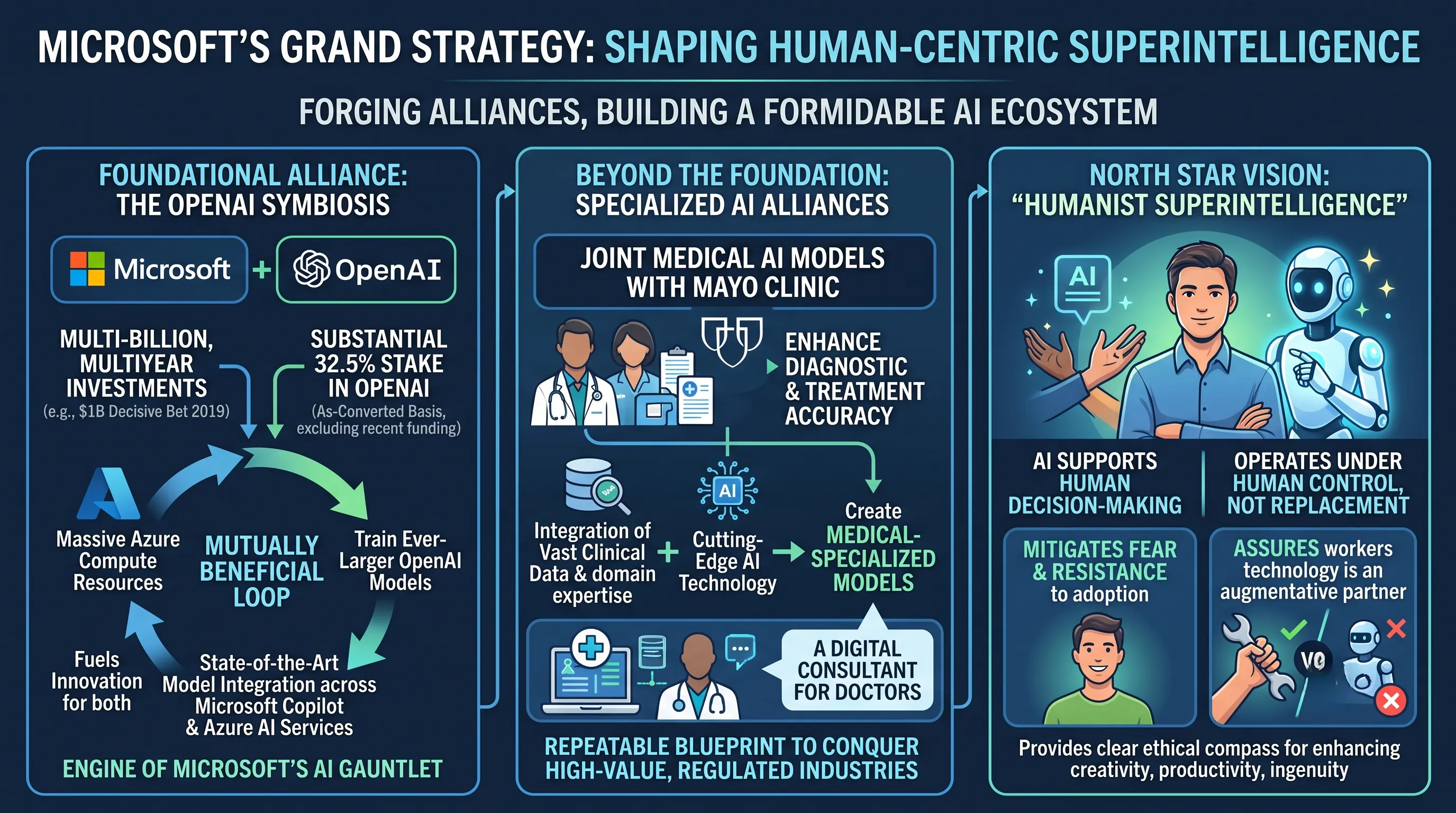
The OpenAI Symbiosis: A Multi-Billion Dollar Bet on the Future
At the heart of Microsoft's AI offensive is its deep, strategic, and symbiotic partnership with OpenAI.
This is not a simple vendor-client relationship but a foundational alliance that has reshaped the entire industry.
The collaboration began with a significant $1 billion investment in 2019, an early and decisive bet that secured Microsoft a frontline position in the generative AI revolution.
This initial commitment has since blossomed, with Microsoft now holding a substantial 32.5% stake in the OpenAI for-profit entity (on an as-converted basis, excluding OpenAI's most recent funding rounds).
This stake provides more than just financial upside; it represents a deep integration of strategies and technologies, giving Microsoft unparalleled access to the world's most advanced AI models.
The partnership has since entered a third phase, marked by a multiyear, multibillion-dollar investment designed to accelerate AI breakthroughs.
This ongoing capital infusion ensures OpenAI has the immense computational resources—powered by Microsoft Azure—to train ever-larger and more capable models, while Microsoft in turn gets to integrate these state-of-the-art models directly into its entire product stack, from Azure AI services to Microsoft Copilot.
This alliance is the engine of Microsoft's AI gauntlet, a mutually beneficial loop that fuels innovation for OpenAI and provides an unassailable product advantage for Microsoft.
Beyond the Foundation: Specialized AI through Strategic Alliances like Mayo Clinic
Microsoft's strategy extends far beyond its foundational partnership with OpenAI, demonstrating a keen understanding that the future of AI lies in vertical specialization.
The company is actively forging alliances in critical sectors, with its joint development of medical-specialized AI models with the world-renowned Mayo Clinic serving as a prime example.
The explicit objective of this collaboration is to enhance diagnostic and treatment plan accuracy.
This is achieved by creating sophisticated models that integrate vast amounts of clinical data from seasoned medical professionals directly with cutting-edge AI technology.
The experiential value here is transformative; it’s about creating a true digital consultant for doctors, an AI that understands the nuances of patient histories, medical imaging, and treatment protocols to suggest potential diagnoses or therapies that a human might overlook.
This move illustrates a critical component of Microsoft's "gauntlet": to conquer high-value, regulated industries by pairing its AI infrastructure with the irreplaceable domain expertise of trusted leaders like Mayo Clinic.
It's a repeatable blueprint for creating highly defensible, specialized AI solutions that go far beyond general-purpose chatbots.
The North Star: A Vision for 'Humanist Superintelligence'
Underpinning all of Microsoft's technological developments and strategic partnerships is a carefully articulated long-term vision: the implementation of 'Humanist Superintelligence'.
This philosophy is not just corporate messaging; it is the strategic and ethical framework guiding their entire AI push.
The core principle of this vision is to position AI as a tool that exists to support human decision-making and operate under human control, rather than replacing humans.
By branding its flagship AI product "Copilot," Microsoft masterfully embeds this philosophy directly into the user experience.
This human-centric framing is a strategic masterstroke that serves two purposes.
First, it mitigates fear and resistance to AI adoption, particularly within the enterprise, by assuring workers and leaders that the technology is an augmentative partner, not an automated replacement.
Second, it provides a clear ethical compass for development, focusing on tools that enhance human creativity, productivity, and ingenuity.
This vision of a "Humanist Superintelligence" is the ideological component of Microsoft's gauntlet, making its powerful technology more accessible, less threatening, and ultimately, far more likely to be integrated deeply into every facet of business and life.
3. AI's Financial Powerhouse: Surging Revenue and Unprecedented Ecosystem Adoption
Microsoft's "decisive AI move" is not a speculative future ambition; it is a present-day financial juggernaut, validated by staggering revenue figures and market penetration that leaves no doubt about the success of its all-in strategy.
The numbers themselves tell the story of a bet that is paying off on a monumental scale, transforming the company's financial landscape and cementing its leadership position.
The financial results serve as the ultimate scorecard for Microsoft's AI gauntlet, proving that its technological advancements translate directly into overwhelming economic power.
The AI Revenue Explosion
The most direct measure of Microsoft's AI success is the revenue it generates, and the figures are nothing short of explosive.
The company's AI business has surged to an annual revenue run rate that now surpasses $37 billion.
This is not merely an incremental increase; it represents a blistering 123% increase year-over-year, a growth trajectory that signals a fundamental market shift toward Microsoft's AI offerings.
This figure alone would qualify as a Fortune 100 company, demonstrating that Microsoft has successfully built a massive, high-growth enterprise on the back of its AI investments.
This financial momentum is the direct consequence of the company's strategic push, turning technological prowess into a dominant and rapidly expanding revenue stream.
Fortress Balance Sheet: The Engine for Sustained Investment
Microsoft's ability to wage its AI campaign is fueled by the immense strength of its overall financial performance.
In the second quarter of Fiscal Year 2026, the company reported a total revenue of $82.9 billion, an 18% increase that underscores the health of its entire portfolio.
Even more telling is the $38.4 billion in operating income for the same period, a 20% year-over-year jump.
This incredible profitability provides Microsoft with a formidable war chest, allowing it to pour resources into long-term, ambitious AI projects like the 'Superintelligence Lab' and continuous model development without financial constraint.
The fact that Microsoft returned $12.7 billion to shareholders during this period—a 32% increase—while still funding its aggressive AI roadmap, demonstrates a company operating from a position of overwhelming strength, capable of rewarding investors and securing its future simultaneously.
Azure: The Bedrock of Enterprise AI Adoption
At the core of Microsoft's AI financial success is Azure, the cloud platform that serves as the delivery vehicle for its powerful AI services.
Azure's growth is a direct proxy for the enterprise world's hunger for AI.
The platform's revenue surged by an impressive 39% (38% in constant currency), a clear indicator that businesses are flocking to Microsoft's cloud to build, deploy, and scale their AI solutions.
This is not a niche movement; it is a mainstream corporate migration.
An incredible 85% of Fortune 500 companies now utilize Azure, locking in the world's most influential corporations into the Microsoft ecosystem.
The platform's reach is global and extensive, with over 130,000 customers in the EMEA region and another 130,000+ in North America.
Globally, Azure powers 350,000 businesses, reflecting a solid 14.2% growth from the previous year and showcasing its role as the foundational infrastructure for the AI era.
Copilot: The Catalyst for Widespread Market Penetration
While Azure provides the backend power, Microsoft Copilot is the user-facing application that demonstrates the true breadth of Microsoft's AI penetration into daily workflows.
The adoption statistics are staggering, revealing how deeply Copilot has embedded itself across the professional landscape.
As of the first quarter of 2026, Copilot has reached 420 million monthly active users, a user base on par with major social media platforms, but comprised largely of professionals leveraging it for productivity.
More importantly for Microsoft's bottom line, the number of enterprise-licensed users has nearly tripled to 160 million.
This signifies a critical shift from casual use to paid, intentional integration, as companies are willing to invest financially to unlock enhanced AI capabilities for their workforce.
This deep enterprise adoption is further confirmed by the fact that 70% of Fortune 500 companies had already adopted Copilot as of the first quarter of Fiscal Year 2025, solidifying its status as an indispensable tool for modern business and a brilliant success for Microsoft's AI strategy.

📚 Related Posts
Anthropic Dethrones OpenAI as Enterprise AI Leader: $30 Billion Revenue & 34.4% Adoption
🚀 Key TakeawaysAnthropic has surged past OpenAI to become the new leader in the enterprise AI market as of April 2026, capturing a 34.4% adoption rate compared to OpenAI's 32.3%, and achieving an astounding $30 billion annualized revenue run rate, under
tech.dragon-story.com
Google's AI Pointer Revolution: Gemini, Magic Pointer & Redefining Digital Interaction for the AI Era
🚀 Key TakeawaysGoogle is transforming the traditional mouse pointer into an intelligent, context-aware AI partner, fundamentally reshaping human-computer interaction for the AI era and making nearly all on-screen content interactive.This innovative Gemi
tech.dragon-story.com
Googlebook Unveiled: Google Redefines Laptops for the AI Era with Gemini Intelligence, Magic Pointer, & Seamless Android Ecosyst
🚀 Key TakeawaysGooglebook is unveiled as a next-generation laptop platform, deeply integrating Gemini Intelligence to deliver an intelligent computing system designed for the AI era, thereby significantly evolving beyond the traditional Chromebook.Googl
tech.dragon-story.com


