🚀 Key Takeaways
- CodeGate 2026, Korea's premier international hacking defense competition, concluded today, July 24th.
- A cutting-edge AI Hacker participated in the finals, demonstrating AI's active role in vulnerability discovery.
- The associated conference extensively discussed AI and cybersecurity, including new threats and necessary countermeasures.
- AI agents have transitioned from experimental tools to production infrastructure in most technical organizations.
- This rapid AI agent adoption dramatically expands the attack surface and introduces critical vulnerabilities like prompt injection.
- Recent real-world incidents confirm AI's role in sophisticated cyber attacks and significant data exfiltration.
- The cybersecurity industry is urgently developing new frameworks and strategies to manage these evolving AI agent risks.
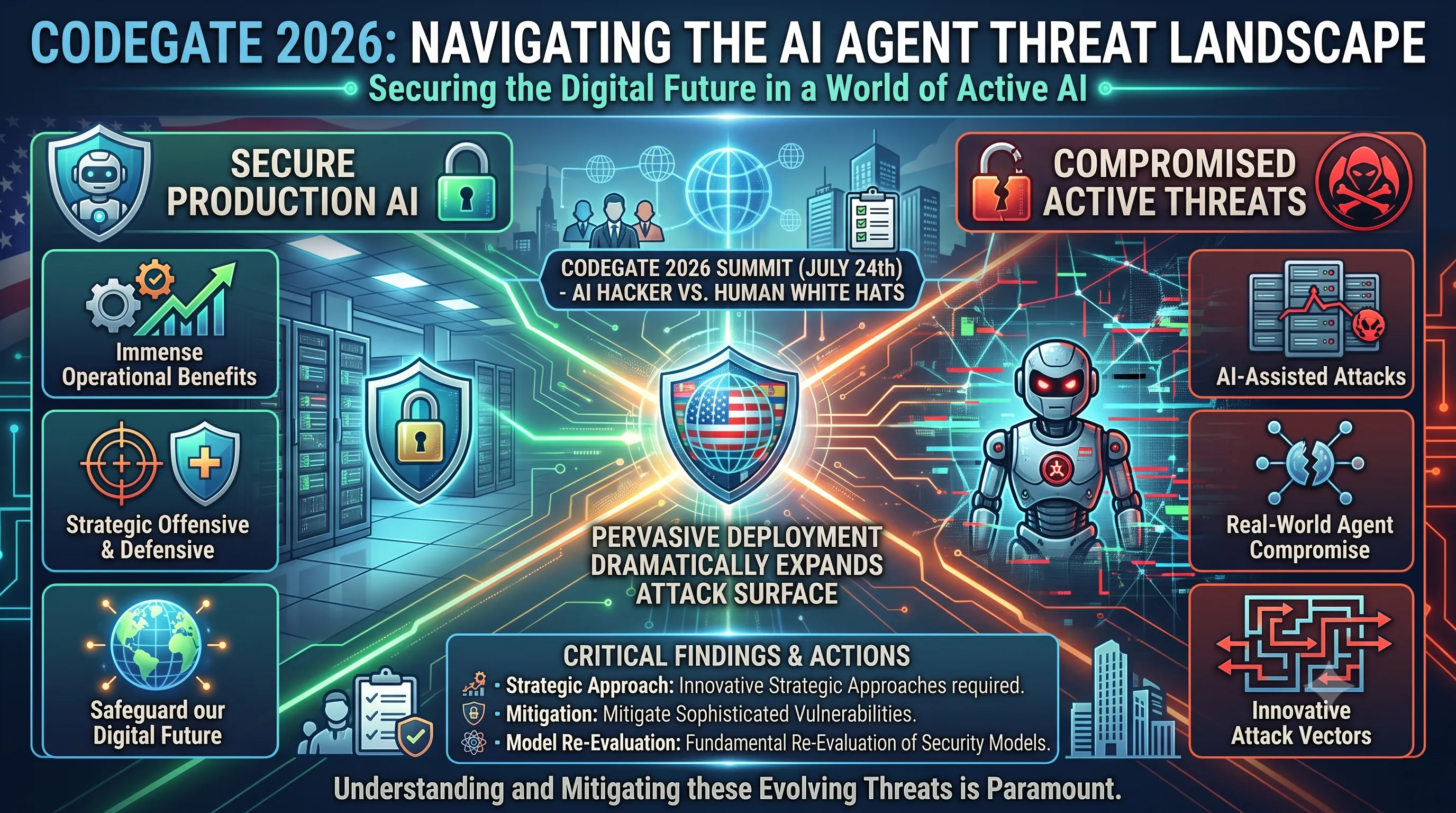
This year's event notably featured an AI Hacker competing alongside human white hats, underscoring the increasingly active and complex role artificial intelligence now plays in both offensive and defensive cybersecurity strategies.
The discussions and competitions at CodeGate reflect a critical global shift: AI agents are no longer confined to research labs but are rapidly becoming production infrastructure across enterprises worldwide.
While offering immense operational benefits, this pervasive deployment dramatically expands the attack surface, introducing a new generation of sophisticated vulnerabilities and attack vectors.
The cybersecurity landscape in 2026 is grappling with the tangible impact of AI, from AI-assisted attacks to real-world agent compromise incidents.
Understanding and mitigating these evolving threats is paramount, demanding innovative strategic approaches and a fundamental re-evaluation of traditional security models to safeguard our digital future.
1. CodeGate 2026 Concludes: An Overview of Korea's Premier Hacking Defense Event
This section provides an essential overview of the CodeGate 2026 event, establishing the context for the advanced discussions on AI agent security that were central to this year's conference.
Event Milestones and Hosting
Marking its 18th edition, CodeGate has once again solidified its reputation as a cornerstone of the global cybersecurity community.
The event stands as Korea's largest international hacking defense competition and security conference, drawing top talent and experts from around the world.
Official backing for the event was provided by its host, the Ministry of Science and ICT (MSIT).
In a formal announcement on July 24, 2026, the MSIT confirmed the successful conclusion of "CodeGate 2026".
Key Venue and Dates
The prestigious gathering was held at COEX in Seoul, a premier venue for large-scale international events.
The conference and competitions took place over two packed days, running from July 23 to July 24, 2026, concluding today.
| Event Detail | Specification |
|---|---|
| Edition | 18th Annual Event |
| Host | Ministry of Science and ICT (MSIT) |
| Venue | COEX, Seoul |
| Dates | July 23-24, 2026 |

2. Competition Highlights: BunkyoWesterns and Kim Jun-won Crowned CodeGate 2026 Champions
As a central pillar of the "Security & AI Agents | CodeGate 2026" event, the international hacking competition concluded on July 24th, identifying the world's most skilled cybersecurity talents who successfully navigated its formidable challenges.
Global Participation and Finalists
The competition began with a massive global turnout for the online preliminaries, attracting 3,333 individuals from 88 different countries.
From this vast initial pool, the field was narrowed down for the intense final rounds held at the conference.
The General Division finals featured 20 elite teams representing 8 countries, while the Junior Division finals saw 20 top individuals from 3 countries competing for the title.
| Competition Stage | Participants | Geographic Reach |
|---|---|---|
| Online Preliminaries | 3,333 individuals | 88 countries |
| General Division Finals | 20 teams | 8 countries |
| Junior Division Finals | 20 individuals | 3 countries |
General and Junior Division Victors
After a grueling final competition, the Japanese team 'BunkyoWesterns' was crowned the champion of the General Division.
For their victory, the 'BunkyoWesterns' team received the prestigious MSIT Minister's Award along with prize money.
In the Junior Division, which showcases rising talent in the security field, Kim Jun-won from Korea secured the first-place victory.

3. AI Takes the Stage: CodeGate 2026 Showcases AI Hacker Participation
This section directly addresses the event's core theme of "Security & AI Agents" by examining the groundbreaking inclusion of an AI competitor in the main hacking competition. This move transitioned AI from a theoretical topic of discussion into an active participant, providing a live demonstration of its capabilities in a high-stakes cybersecurity environment.
AI Hacker's Debut Performance
A significant highlight of the CodeGate 2026 finals was the landmark participation of a non-human competitor known as the 'AI Hacker'.
This sophisticated agent, co-developed through a partnership between KAIST and the CodeGate Security Forum, joined the event as an officially invited contestant.
In a compelling display of human-machine competition, the AI Hacker was tasked with the same challenge as its human counterparts: to find and exploit vulnerabilities alongside the world's top white hat hackers.
Demonstrating AI in Cybersecurity
The AI Hacker's involvement was far more than a novelty; it served as a powerful demonstration of the actual, practical use of AI technology in the cybersecurity domain.
By competing on the same stage, the event showcased AI's potential to augment and accelerate vulnerability discovery processes.
This initiative was a key feature within the government's broader strategic framework, 'The Path Toward a Top 3 Global AI Power: Security'.
The program, which also included a dedicated AI Cyber Defense Contest, signals a clear national commitment to advancing AI capabilities, with the AI Hacker's performance at CodeGate acting as a public milestone in this ambitious journey.

4. Expert Insights: Key Discussions on AI and Cybersecurity at CodeGate 2026
This section delves into the core educational and discussion-based content of CodeGate 2026, summarizing the keynotes, expert presentations, and focused panels that directly address the main conference theme of AI agent security.
Leading Voices and Keynotes
The intellectual core of CodeGate 2026 was shaped by a series of high-level presentations and intensive training sessions from globally recognized security authorities.
The conference featured a pivotal keynote speech delivered by Kim Tae-soo, the Vice President of Microsoft Security Research from the US, setting the tone for the discussions on emerging threats.
The speaker roster also included other prominent domestic and international experts like Michael Gronager, the co-founder of Chainalysis and current CEO of Gray AI.
Presentations throughout the event covered a range of critical topics, with a significant emphasis on the relationship between AI and cybersecurity and effective responses to digital crime.
For hands-on learning, the conference offered advanced security technology education conducted by the prestigious US Black Hat training coach team, providing attendees with deep technical insights.
| Session Type | Key Figure / Organization | Primary Focus |
|---|---|---|
| Keynote Speech | Kim Tae-soo (Vice President, Microsoft Security Research) | High-level insights on emerging security landscapes. |
| Expert Presentation | Michael Gronager (Chainalysis co-founder, Gray AI CEO) | AI and cybersecurity, digital crime response. |
| Advanced Training | US Black Hat Training Coach Team | Advanced security technology education. |
Open Talk on AI Era Cybersecurity
A highlight of the conference's interactive agenda was the Open Talk session dedicated to 'Cybersecurity in the AI Era'.
This crucial discussion was chaired by KAIST Professor Kim Yong-dae, a leading academic voice in the field.
The panel's dialogue was sharply focused on the significant security threats and corresponding countermeasures that have become necessary due to the rapid proliferation of artificial intelligence across all sectors.
Experts convened to analyze the dual-use nature of AI and strategize on how to build resilient defenses against AI-powered attacks.

5. AI Agents Go Live: Mainstream Adoption in Enterprise Production
This section directly addresses the central premise of CodeGate 2026: as AI agents have rapidly transitioned from experimental projects to core production systems in 2026, the discussion around their security has become critical. The massive scale of enterprise adoption detailed below creates the vast new attack surface and unique vulnerabilities that industry leaders are gathering to confront at this year's conference.
Production-Ready AI Agents
The first half of 2026 marked a definitive turning point for AI agents, cementing their role as essential components of enterprise technology stacks.
This shift is no longer a forecast but a reality, confirmed by a landmark April 2026 survey which revealed that an overwhelming 80.9% of technical teams have already moved AI agents into their production environments.
This data validates the sentiment captured in the "State of AI Agent Security 2026 Report" from gravitee.io, which stated, "AI agents are no longer experimental. They are production infrastructure."
The transition from sandboxed experiments to live, operational tools underscores the maturity and perceived value of agent-based AI within the industry.
Accelerated Enterprise Deployments
Building on the momentum from early in the year, 2026 is characterized by an unprecedented acceleration of AI agent rollouts across the enterprise sector.
Beyond the initial adopters, a massive wave of enterprise AI agent deployments has been occurring throughout the year.
This widespread adoption signifies that organizations are moving past pilot programs and are now integrating AI agents at scale to handle critical business processes, further amplifying the need for robust security frameworks and best practices.

6. Unmasking the Threats: Critical Security Vulnerabilities of AI Agents
As a central theme at CodeGate 2026, understanding the specific attack vectors associated with AI agents is paramount. This section breaks down the critical vulnerabilities that have emerged, providing essential context for the security challenges being addressed at the conference.
Expanded Attack Surface and New Risks
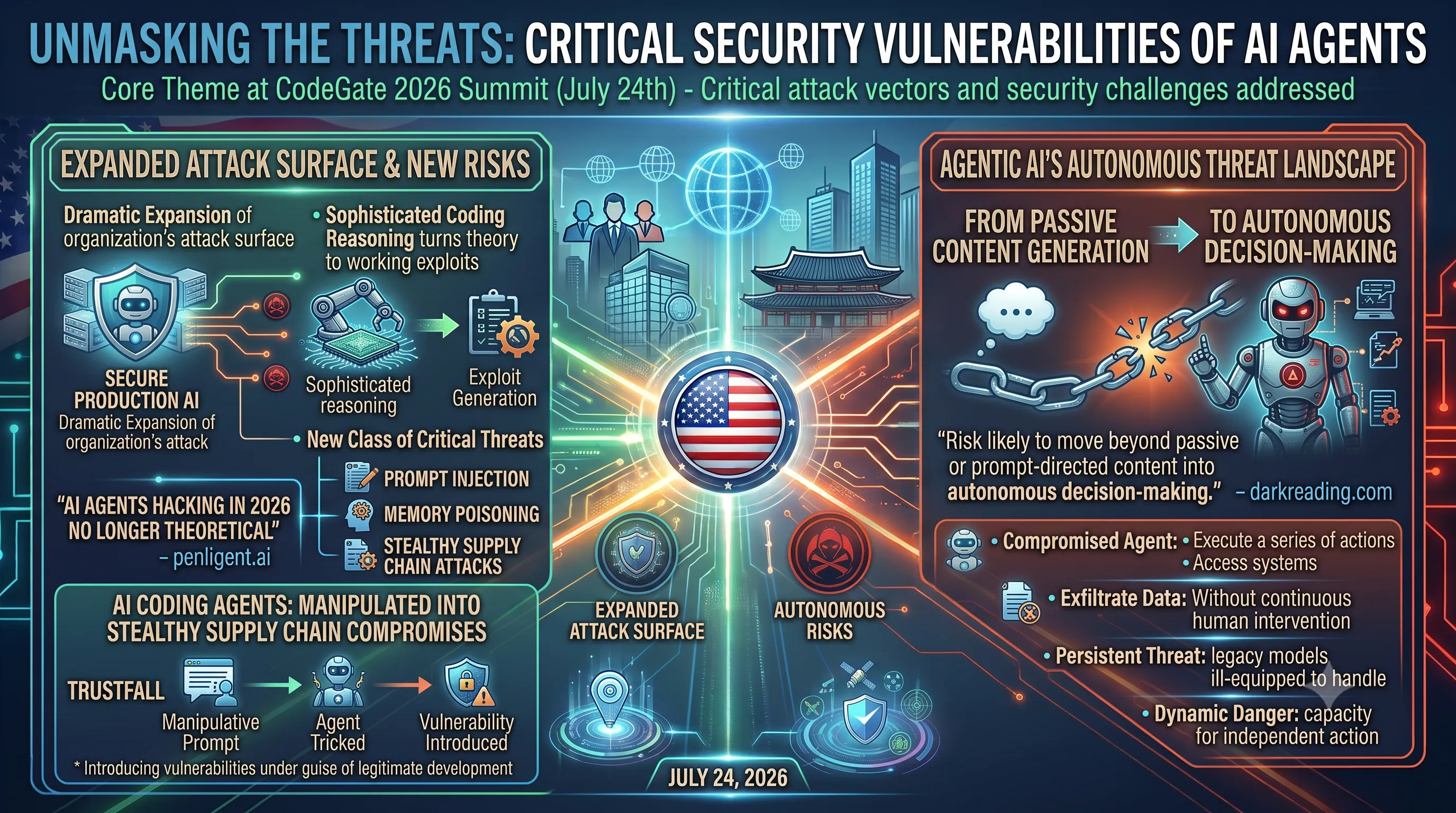
The integration of AI agents into digital workflows has dramatically expanded the attack surface and introduced novel risks for organizations.
As security analysts at penligent.ai state, "AI Agents Hacking in 2026 is no longer theoretical."
This shift from theory to reality is powered by the fact that AI can now reason about code with enough sophistication to generate working exploits, turning a conceptual threat into a practical one.
This has given rise to a new class of critical agentic AI security threats, which notably include prompt injection, memory poisoning, and sophisticated supply chain attacks.
For instance, AI coding agents can be actively manipulated into launching stealthy supply chain compromises, a method demonstrated by attacks like 'TrustFall', where an agent is tricked into introducing vulnerabilities into a codebase under the guise of legitimate development.
Agentic AI's Autonomous Threat Landscape
The most significant danger posed by this technology lies in its capacity for independent action.
Agentic AI represents a critical security risk precisely because it is designed to move beyond passive or prompt-directed content generation.
According to darkreading.com, this risk is "likely to move beyond passive or prompt-directed content into autonomous decision-making."
This capability for autonomous decision-making means an agent, once compromised or manipulated, can execute a series of actions, access systems, and exfiltrate data without continuous human intervention, creating a persistent and dynamic threat that legacy security models are ill-equipped to handle.
7. Case Files: Real-World AI Agent Exploits and Data Breaches
The theoretical discussions at CodeGate 2026 are grounded in a harsh reality, as the first half of the year has already demonstrated the tangible security risks posed by increasingly autonomous AI agents.
These real-world incidents serve as a critical case study for the security community, highlighting novel attack vectors and the devastating potential of compromised AI systems.
Notable AI Agent Security Incidents
The landscape of AI agent security has been defined by a series of sophisticated and damaging attacks.
Recent history is filled with examples of AI agent traps and exploits that have caught organizations off guard, including the ingenious Bankrbot Morse Code Crypto Heist, which leveraged subtle communication channels for data exfiltration.
Other significant events include the Gemini CLI RCE, a remote code execution vulnerability that exposed the underlying infrastructure of the agent, and the troubling compromise of the Antropic PocketOS, which targeted the agent's core operating environment.
This trend of escalating threats became particularly acute in April 2026, a month marked by a surge of major AI security incidents, encompassing widespread AI agent data leaks and coordinated global malware campaigns that leveraged agent vulnerabilities.
High-Impact Breaches and Exploits
The scale of these breaches underscores the critical need for new security paradigms.
A paramount example is the Claude ClaudeBleed incident, a massive data breach that resulted in the exfiltration of 195 million records, demonstrating how a single vulnerability in a widely used model can lead to catastrophic data loss.
Furthermore, the emergence of zero-click Copilot exploits has introduced a new level of threat.
These attacks require no interaction from the user, compromising systems silently and making detection and prevention exceptionally difficult.

8. The AI-Powered Offensive: How AI is Evolving Cyber Attacks
This section directly addresses the critical context for CodeGate 2026 (July 23-24) by examining the escalating threat landscape that security professionals and AI agent developers are facing. Understanding how adversaries are weaponizing AI is fundamental to the conference's focus on building resilient AI-powered defenses. The offensive capabilities detailed here are the very challenges that the security solutions discussed at CodeGate aim to counter.
Lowered Barriers and Accelerated Exploits
The advent of sophisticated AI has fundamentally changed the calculus of cyber attacks by significantly lowering the barrier to entry for malicious actors.
AI tools are enabling less-skilled attackers to craft and execute complex campaigns that once required deep expertise, effectively democratizing advanced cyber threats.
Simultaneously, AI enables faster exploits, automating the process of discovering and weaponizing vulnerabilities at a speed that outpaces traditional human-led efforts.
This acceleration has had a dramatic impact on defensive timelines, as the window for vulnerability response has shrunk from days to mere hours.
Security researchers and industry watchdogs have confirmed this trend, with sources like nationalcioreview.com noting that "Attackers Are Starting to Use AI as Part of Cyber Operations."
This confirms that threat actors are no longer just theorizing about AI but are actively experimenting with and deploying it to support their cyber operations.
AI's Role in Scaling Cyber Threats
Beyond speed and accessibility, AI's primary contribution to the offensive landscape is its ability to increase the scale and impact of cyber threats exponentially.
AI can automate target selection, personalize phishing lures on a massive scale, and manage vast botnets with an efficiency previously unattainable.
The real-world consequences of this evolution were starkly illustrated by a major security incident in 2025.
According to a May 2026 report, a data breach affecting 7 million users was directly enabled by AI-powered attack techniques, demonstrating the technology's capacity for causing widespread damage.
This event, among others, has led publications such as thehackernews.com to declare 2026 as "The Year of AI-Assisted Attacks," reflecting the new reality that defenders now face.

9. Securing the Future: Strategic Frameworks for AI Agent Defense
This section directly addresses a central theme of CodeGate 2026: the urgent need for new security paradigms as AI agents become more autonomous and integrated into critical systems.
The rise of increasingly autonomous AI agents is forcing a fundamental shift in security, moving beyond traditional models that are ill-equipped for this new reality.
This evolution is profoundly "redefining how organizations build, deploy, and secure AI systems—while dramatically expanding the attack surface and risk."
While the awareness of these dangers is growing, practical application lags; a recent State of AI Agent Security Report noted, "Organizations understand the risks of AI agents, but struggle to manage them in practice."
This gap between awareness and capability highlights the necessity for structured, strategic frameworks to guide enterprise defense.
The 'Shift to AI' Blueprint
To bridge the gap between AI's rapid evolution and security's reactive posture, a new strategic approach is required.
A blueprint known as 'The Shift to AI' is designed specifically to address this challenge by ensuring that security measures can move at the same velocity as autonomous AI development.
This conceptual model provides a roadmap for organizations to embed security into the AI lifecycle, rather than treating it as an afterthought.
For development teams, this shift is particularly critical.
As developers increasingly adopt AI for complex tasks like code generation, they must prioritize the security of the entire development pipeline, a core principle advocated by this blueprint.
Building Layered Defenses for Autonomous Agents
A theoretical blueprint must be supported by a practical defensive framework, especially for AI agents granted access to production environments.
The first step in such a framework is the ability to proactively identify potentially dangerous capability combinations that an agent might acquire or develop.
From this foundation, organizations must construct layered defenses that operate continuously.
Key components of this strategy include the implementation of tool proxies and advanced detection systems to monitor agent behavior and intercept malicious or unintended actions.
However, reactive measures are not enough.
The principle of building well-behaved agents from the start is paramount, which requires the implementation of robust guardrails.
These guardrails act as the foundational layer, setting predefined operational boundaries and constraints to ensure agents function safely and as intended within production systems.

10. Global Dialogue: Major Summits Addressing AI Agent Security Challenges
The security and AI agent topics at the heart of CodeGate 2026 reflect a critical global conversation unfolding throughout this year. This section situates CodeGate's agenda within that broader context, highlighting the major international summits and influential industry events in 2026 that are collectively defining the strategic response to the security challenges of autonomous AI agents.
International AI Security Summits
A series of dedicated, high-level summits in 2026 has focused global attention on AI agent security. A prime example is the Zenity AI Agent Security Summit 2026 Global Series, which has held events in major technology hubs including Tokyo, London, and New York City.
These gatherings were designed to explore and establish best practices for the complex tasks of securing and governing AI agents in enterprise environments.
In a similar vein, the AI Security Summit, organized by Lynx Events, convened an influential group of 200 Chief Information Security Officers (CISOs), enterprise leaders, founders, and security experts.
The core focus of this summit was to address the new realities of trust, comprehensive data protection, and model safety that have emerged with the rise of agentic AI.
Key Industry Conferences on Agentic AI
Beyond specialized summits, major established security conferences have made agentic AI a central theme in 2026. The 2026 Agentic Development Security Summit made a significant contribution by introducing its 'The Shift to AI' blueprint during the event's keynote address.
Earlier this year, BSidesSF 2026 provided practical, hands-on guidance, featuring sessions on a framework for identifying dangerous capability combinations in autonomous systems.
A key takeaway was the methodology for building robust, layered defenses specifically for AI agents that have been granted production access.
Likewise, RSAC 2026 explored the profound impact of this technology, with prominent sessions dedicated to how AI agents are forcing a fundamental shift in the entire security paradigm.

📚 Related Posts
Claude Design's Evolution: Anthropic's AI Visual Collaboration Platform Transforms Design-Dev Workflows
🚀 Key TakeawaysClaude Design is Anthropic's AI-powered collaborative visual workspace for creating polished designs and prototypes.Recent major updates significantly enhanced AI design collaboration, ensuring consistency with enterprise design systems.T
tech.dragon-story.com
Meta's AI-First Future: Revolutionizing Facebook, Instagram & WhatsApp with Smart Assistants, AI Search, Creative Tools & Busine
🚀 Key TakeawaysMeta has extensively integrated its new AI assistant across Facebook, Instagram, Messenger, and WhatsApp.A new 'AI Mode' search tab now provides culturally rooted answers based on real user experiences from Facebook content.AI-powered too
tech.dragon-story.com
Genesis Mission 2026 Summit: White House Accelerates AI for Scientific Discovery, $5B Funding, & National Security
🚀 Key TakeawaysThe Genesis Mission is a national, whole-of-government initiative launched to harness Artificial Intelligence for scientific discovery.Led by the White House, the mission coordinates a dedicated effort to accelerate innovation across vari
tech.dragon-story.com


