🚀 Key Takeaways
- The Genesis Mission is a national, whole-of-government initiative launched to harness Artificial Intelligence for scientific discovery.
- Led by the White House, the mission coordinates a dedicated effort to accelerate innovation across various federal agencies.
- The inaugural Genesis Mission 2026 Summit was hosted by the Department of Energy on July 22, 2026.
- The Summit convened leaders from government, industry, academia, and National Labs to discuss AI's role in science.
- A core objective is to establish an integrated AI platform to leverage extensive federal scientific datasets and computing power.
- The mission aims to significantly accelerate scientific discovery and double U.S. scientific productivity within a decade.
- Strategic goals encompass translating breakthroughs into practical benefits, strengthening national security, and securing energy dominance.
The Genesis Mission, a comprehensive, whole-of-government effort launched by President Donald J. Trump, is designed to unleash unprecedented innovation by integrating AI across the spectrum of federal scientific endeavors.
This ambitious undertaking signifies a critical national commitment to bolstering scientific discovery and maintaining global leadership in advanced technology.
Just this week, a pivotal event in this national journey took place with the successful conclusion of the Genesis Mission 2026 Summit.
Hosted by the Department of Energy on July 22, 2026, the summit gathered an influential array of leaders from government, industry, academia, philanthropy, and National Laboratories.
Attendees convened to strategize on harnessing AI-accelerated breakthroughs across vital sectors, including health, infrastructure, energy, and national security.
This mission is poised to redefine America's approach to research and development, aiming to dramatically accelerate scientific discovery and enhance national capabilities.
By leveraging vast organized datasets and immense computing power, the Genesis Mission seeks to translate scientific breakthroughs into tangible benefits, ultimately strengthening the nation's economy, security, and global standing.

1. The Genesis Mission: A National Imperative for AI-Accelerated Discovery
This section provides the foundational background on the Genesis Mission, offering essential context for the strategic discussions and outcomes of the "Genesis Mission 2026" Summit held on July 22nd.
Origins and Vision
The Genesis Mission was formally launched in November 2025, established by an Executive Order from President Trump.
Its central purpose is to serve as a dedicated and coordinated national effort to harness artificial intelligence for scientific advancement.
The mission's vision is to systematically unleash AI-accelerated innovation and discovery across all sectors of research and development.
While it has since expanded, the initiative originally began within the Department of Energy (DOE), leveraging the agency's deep expertise in high-performance computing and large-scale scientific projects.
Scope and Collaboration
From its initial home at the DOE, the Genesis Mission has rapidly evolved into a comprehensive, whole-of-government initiative.
Underscoring its national priority, the mission is now directly led by the White House, ensuring high-level coordination and strategic alignment.
The scope of this national effort is significant, with more than 15 Federal agencies contributing resources, data, and expertise to achieve its ambitious goals.

2. Foundational Documents and Milestones of the Genesis Mission
This section details the key official publications and executive actions that established the framework for the Genesis Mission, providing essential context for the recent 'Genesis Mission 2026' summit held on July 22nd.
Executive Orders and Fact Sheets
The official genesis of the mission occurred in late 2025 through foundational executive actions.
The initiative was formally launched via President Trump's Executive Order, dated November 24, 2025.
On the same day, the administration provided further detail and public framing through an official Fact Sheet titled, "President Donald J. Trump Unveils the Genesis Mission to Accelerate AI for Scientific Discovery."
Key Reports and Publications
The strategic vision of the mission was further articulated in a key report released just days ago.
The report, titled “Science: A New Golden Age,” was published on July 21, 2026.
This document was officially released by Director Kratsios and provides a guiding philosophy for the mission's goals.

3. Leadership Driving the Genesis Mission: Key Figures and Statements
The Genesis Mission, a cornerstone of the administration's technology policy, was launched directly by President Donald J. Trump, who has mandated that the United States must achieve and maintain undisputed leadership in artificial intelligence.
This directive from the highest office has mobilized a wide array of government leaders, each tasked with steering the nation's vast resources toward this ambitious goal, as highlighted during the recent summit.
White House and Cabinet Leaders
At the forefront of coordinating this multi-agency effort is Michael Kratsios, serving as the Assistant to the President and Director of the White House Office of Science and Technology Policy.
His role is central to aligning the mission's objectives across various cabinet departments.
Key cabinet secretaries are spearheading the mission's application in their respective domains, including Robert Kennedy, the Secretary of Health and Human Services, who oversees AI's integration into public health and biomedical research.
In the energy sector, U.S. Energy Secretary Chris Wright is a pivotal figure, while U.S. Transportation Secretary Sean Duffy is tasked with implementing AI advancements in national infrastructure.
The initiative's reach extends to natural resources and land management under Secretary of the Interior Doug Burgum.
Furthermore, national security and defense applications are guided by Emil Michael in his capacity as Under Secretary of War for Research and Engineering.
The mission's scope also includes space exploration, with NASA Administrator Jared Isaacman leading the charge for AI in aeronautics and space technology.
Agency Experts and Visionaries
Supporting the cabinet-level leadership is a deep bench of scientific and technical experts who manage the day-to-day execution of research and development.
At the National Institutes of Health, Director Dr. Jay Bhattacharya is a crucial leader for the mission's health-related R&D.
Within the Department of Energy, Under Secretary Dr. Darío Gil provides technical oversight for advanced computing and energy research.
Fundamental scientific discovery is under the purview of Acting National Science Foundation Director Brian Stone.
In agriculture, the integration of AI is directed by Dr. Scott Hutchins, the U.S. Department of Agriculture's Under Secretary and Chief Scientist.
Ensuring the U.S. sets global AI standards and benchmarks falls to Dr. Arvind Raman, who serves as the Under Secretary of Commerce for Standards and Technology and the Director of NIST.

4. Powering Innovation: Financial Commitments and Infrastructure of Genesis Mission
This section, directly connected to the announcements at the "Genesis Mission 2026" summit, details the substantial financial and operational backbone established by the U.S. government to ensure the initiative's success.
Funding and Project Scope
At the summit, it was unveiled that the mission is being expanded with over $5 billion in new Federal commitments.
This financial push builds upon earlier actions, such as the Department of Energy's announcement of funding in March 2026 specifically to advance the Genesis Mission's efforts.
The investment is directed towards the 278 projects that have been selected to participate in the mission.
Participating federal agencies are providing a range of foundational support for the National Science and Technology Challenges that are part of the mission's scope.
| Federal Agency Contributions to the Genesis Mission |
|---|
| Research awards |
| Funding opportunities |
| Specialized scientific datasets |
| Research facilities |
Infrastructure and Resources
The ambitious goals of the Genesis Mission require two core elements at a massive scale: vast amounts of organized, high-quality data and significant computing power.
Fortunately, these required resources already exist within the Department of Energy’s extensive network of National Laboratories and across the Federal government.
To connect these disparate assets, the Genesis Mission will build an integrated AI platform designed to harness Federal scientific datasets.
The key to this integration is the American Science and Security Platform, an infrastructure developed and built by the DOE.
This platform is foundational to the mission's operations, providing shared infrastructure that connects researchers with the critical data, compute capabilities, and AI tools needed to drive their projects forward.
Federal agencies participating in the mission will directly leverage this platform to facilitate their research and development efforts.

5. Recap: The Inaugural Genesis Mission 2026 Summit
This section provides a summary of the inaugural Genesis Mission 2026 summit, an event central to the U.S. government's recent strategic initiatives discussed in this article.
Summit Overview and Participants
The inaugural Genesis Mission 2026 Summit was hosted by the Department of Energy (DOE) as a live event.
It was held on July 22, 2026, at the Capital Hilton, located at 1001 16th St NW in Washington, DC.
The official program commenced at 9:00 a.m. ET, with a dedicated networking session for attendees starting at 8:30 a.m.
The summit brought together a high-level assembly of leaders from a wide array of sectors, including government, industry, academia, philanthropy, and the National Labs, to foster a multi-disciplinary dialogue.
Key Discussion Areas
The discussions and presentations during the summit were focused on several key strategic areas.
The agenda covered foundational and applied sciences, with specific talks dedicated to mathematics and advanced imaging.
Furthermore, the sessions addressed critical national infrastructure and policy, with focused conversations on the energy grid and its modernization, as well as broader issues of national security.

6. Advancing Healthcare: Genesis Mission's Science and Technology Challenges
As a core pillar of the Genesis Mission 2026 summit, the administration outlined several ambitious science and technology challenges aimed at transforming American healthcare.
These initiatives leverage a multi-agency approach, combining vast datasets with high-performance computing to tackle some of the most persistent medical problems.
Chronic Disease Research
A significant focus is on uncovering the fundamental causes of chronic diseases.
This multi-faceted effort involves a strategic collaboration across several key government bodies.
The Department of Health and Human Services (HHS) is contributing by leveraging extensive health cohorts, providing a rich source of longitudinal patient data.
To understand environmental factors, the Environmental Protection Agency (EPA) supplies crucial chemical monitoring data.
The National Science Foundation (NSF) underpins this work by funding foundational biological sciences research, while the Department of Energy (DOE) provides the essential high-performance compute infrastructure required to analyze these massive and disparate datasets.
Pediatric Cancer Cures
The mission also targets a particularly challenging area: unlocking cures for pediatric cancer.
HHS is at the forefront, providing a pediatric cancer data ecosystem, which serves as a centralized hub for research.
This is supported by its network of established cancer centers and deep domain expertise.
Complementing these resources, the DOE is applying its formidable supercomputing power to train advanced predictive models, aiming to accelerate the discovery of new treatments and therapies for children.
Drug Discovery and Veteran Health
To streamline the creation of new medicines, the Genesis Mission is accelerating drug discovery and its clinical translation.
This initiative sees HHS, the DOE, and the Department of War (DOW) collaborating to build a scalable biomedical data infrastructure.
This platform is designed to handle a wide variety of datasets, breaking down silos and fostering faster research cycles.
In a closely related effort focused on a specific population, the mission aims to deliver better health outcomes for veterans.
The Department of Veterans Affairs (VA) is spearheading this by combining its vast repository of electronic health records with genomic data.
This powerful combined dataset is then processed using DOE supercomputing resources, enabling unprecedented insights into diseases and treatments tailored for the veteran community.
| Challenge Area | Participating Agencies & Key Contributions |
|---|---|
| Finding the Root Causes of Chronic Disease | HHS (health cohorts), EPA (chemical monitoring data), NSF (foundational biological research), DOE (compute infrastructure) |
| Unlocking Cures for Pediatric Cancer | HHS (pediatric cancer data ecosystem, cancer centers, expertise), DOE (supercomputers for training models) |
| Accelerating Drug Discovery and Clinical Translation | HHS, DOE, & Department of War (DOW) (scalable biomedical data infrastructure for various datasets) |
| Delivering Better Health Outcomes for Veterans | Department of Veterans Affairs (VA) (electronic health records & genomic data), DOE (supercomputing) |

7. Building the Future: AI for Infrastructure and Energy Security
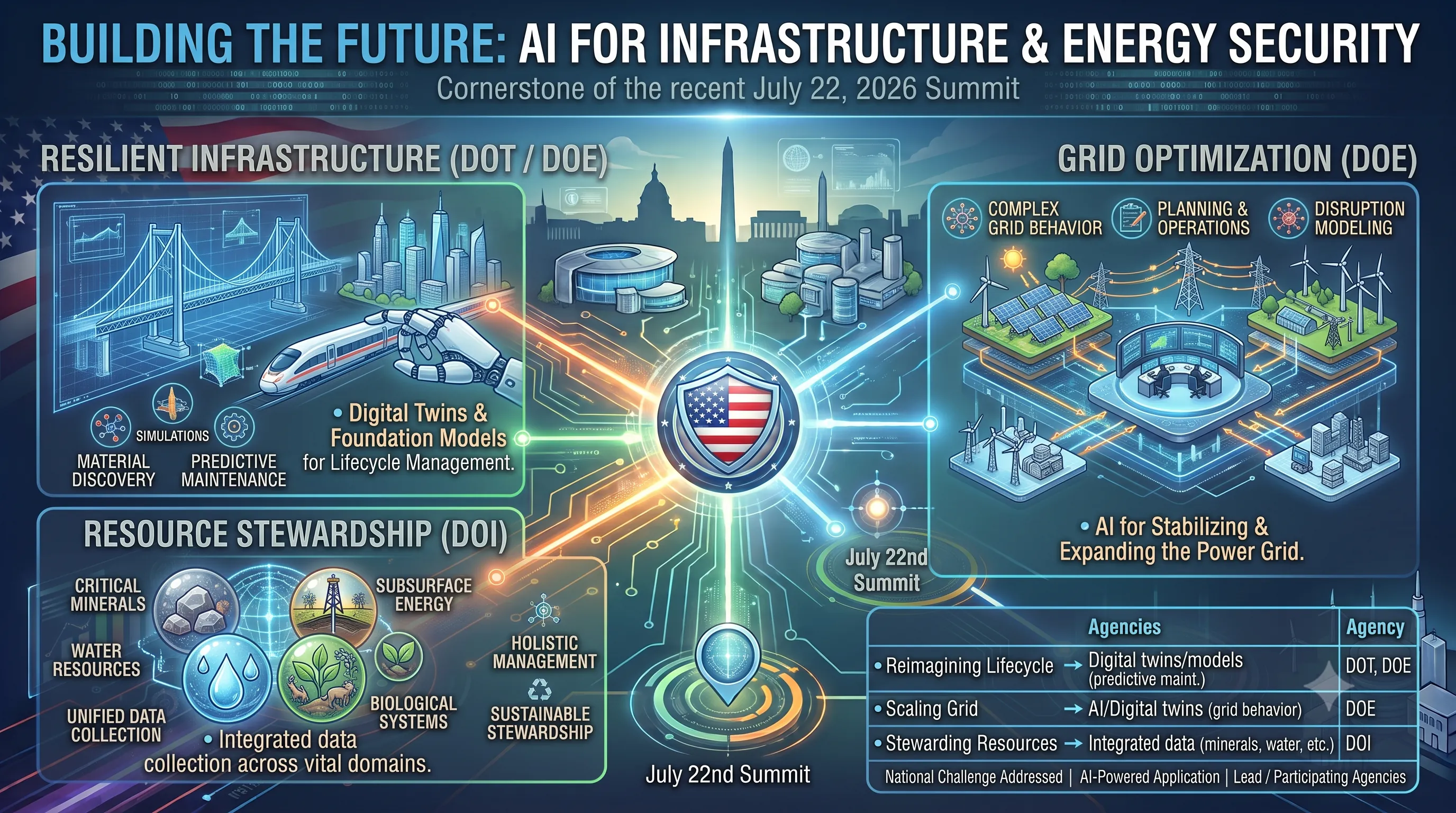
A cornerstone of the 'Genesis Mission 2026' summit held on July 22nd was the government's plan to overhaul national infrastructure and energy systems using artificial intelligence.
Officials outlined a multi-agency effort focused on creating resilient, efficient, and secure foundational services for the country.
Resilient Infrastructure
The initiative is actively reimagining the entire lifecycle of American infrastructure.
In a key collaboration, the Department of Transportation (DOT) and the Department of Energy (DOE) are creating sophisticated digital twins and foundation models.
This technology is designed to significantly accelerate the discovery of new materials, enable complex simulations of stress and wear, and implement predictive maintenance schedules to prevent failures before they occur.
Grid Optimization
To support a growing economy, the Genesis Mission is prioritizing the expansion and stabilization of the national power grid.
The Department of Energy is at the forefront of this push, employing AI and digital twins to gain a deeper understanding of complex grid behaviors.
By modeling energy flow and potential disruptions, the DOE is improving both long-term grid planning and daily operational control.
Resource Stewardship
Properly managing the nation's natural assets is another critical component.
The Department of the Interior (DOI) is leading an effort to integrate data collection across several vital domains.
This unified approach covers the tracking and management of critical minerals, water resources, subsurface energy reserves, and essential biological systems, ensuring a more holistic and sustainable stewardship of America’s natural resources.
| National Challenge Addressed | AI-Powered Application | Lead / Participating Agencies |
|---|---|---|
| Reimagining the Lifecycle of American Infrastructure | Digital twins and foundation models for material discovery, simulation, and predictive maintenance. | Department of Transportation (DOT), Department of Energy (DOE) |
| Scaling the Grid to Power the American Economy | AI and digital twins to understand grid behavior for improved planning and operations. | Department of Energy (DOE) |
| Stewarding America’s Natural Resources | Integrated data collection across critical minerals, water, subsurface energy, and biological systems. | Department of the Interior (DOI) |
8. Strengthening American Industrial Leadership through AI
A core focus of the Genesis Mission 2026 summit held on July 22nd was the strategic application of artificial intelligence to reinvigorate and secure American industrial leadership across critical sectors.
The initiatives detailed below, presented as key National Science and Technology Challenges, form the bedrock of this strategy, aiming to leverage AI to solve complex industrial problems and outpace global competitors.
Microelectronics Innovation
To reclaim and solidify the nation's leadership in the vital semiconductor industry, the Genesis Mission is championing a new approach to microelectronics.
The Department of Energy (DOE) is spearheading the development of an AI-driven, full-stack co-design ecosystem.
This platform is designed to pair advanced AI models with comprehensive datasets, creating a powerful engine to dramatically accelerate the research and development cycle for next-generation chips and restoring American preeminence in the field.
Bio-Industrial Advancement
The summit also highlighted a significant cross-agency effort to translate America's world-leading biological research into tangible industrial might.
Recognizing that breakthroughs in the lab must lead to products on the shelf, the mission coordinates the Department of Energy (DOE), Health and Human Services (HHS), National Science Foundation (NSF), Department of War (DOW), Department of the Interior (DOI), and the Department of Agriculture (USDA).
These agencies are combining their unique data repositories and scientific expertise to create a pipeline that moves biological discoveries into commercial-scale production, bolstering the U.S. bioeconomy.
Defense Technology Acceleration
In the critical domain of national security, the Genesis Mission is applying AI to compress development timelines for essential defense systems.
The Department of War (DOW) and the Department of Energy’s National Nuclear Security Administration (NNSA) are collaborating on this front.
Their joint initiative pairs sophisticated modeling and simulation environments with agentic AI workflows.
This synergy is engineered to fundamentally accelerate the design, testing, and certification processes for crucial weapon components, ensuring a decisive technological edge.
| National Industrial Challenge | Key Participating Agencies | AI-Driven Approach |
|---|---|---|
| Recentering Microelectronics | Department of Energy (DOE) | Building an AI-driven, full-stack co-design ecosystem to accelerate R&D. |
| Scaling Biology for Industry | DOE, HHS, NSF, DOW, DOI, USDA | Combining data and expertise to translate biological discoveries into commercial products. |
| Accelerating Defense Design | Department of War (DOW), DOE (NNSA) | Pairing modeling and simulation with agentic workflows to compress design and testing cycles. |

9. Frontiers of Science: AI in Discovery and Quantum Computing
A cornerstone of the "Genesis Mission 2026" summit held on July 22nd was the unveiling of ambitious national science and technology challenges, focusing on harnessing AI and quantum systems to accelerate fundamental discovery across multiple domains.
These initiatives represent a coordinated, multi-agency push to solve some of the most complex problems in science by integrating advanced computational techniques with vast, often untapped, datasets.
Space Data Analysis
One of the most data-intensive goals involves a partnership between NASA and the Department of Energy (DOE) to extract new knowledge from historical space observations.
The agencies are applying physics-informed and agentic AI models to analyze a colossal repository of over 150 petabytes of accumulated space data, aiming to make novel discoveries that were previously computationally out of reach.
Autonomous Labs and Living Systems
The Genesis Mission is also driving the creation of next-generation research infrastructure through AI-driven autonomous laboratories.
A coalition involving the DOE, Department of Health and Human Services (HHS), National Science Foundation (NSF), and the National Institute of Standards and Technology (NIST) is building these "self-driving" labs, which leverage robotics, edge AI, and real-time analysis to conduct experiments with minimal human intervention.
This platform is critical for another grand challenge: predicting the behavior of living systems.
A broader group of agencies, including HHS, DOE, NSF, DOW, and the USDA, is working to integrate extensive biological datasets with advanced AI models within these autonomous laboratory environments to achieve breakthroughs in predictive biology.
Quantum System Development
Moving from classical to quantum computing is a central theme, with the DOE and DOW leading the charge.
Their joint effort applies AI as an accelerator to advance quantum computing, sensing, and communication technologies.
The explicit goal articulated at the summit is to push these quantum systems beyond theoretical research and towards tangible, real-world use and discovery.
Materials Design
In the field of materials science, the DOE is spearheading an initiative to design new materials with predictable functionality from the ground up.
This program pairs experimental and computational capabilities in a closed-loop system, using large-scale materials datasets and physics-informed AI models to rapidly discover and validate novel materials with desired properties.
| National Science & Technology Challenge | Participating Agencies |
|---|---|
| Mining Decades of Space Data for Discovery | NASA, DOE |
| Achieving AI-Driven Autonomous Laboratories | DOE, HHS, NSF, NIST |
| Predicting Living Systems | HHS, DOE, NSF, DOW, USDA |
| Designing Materials with Predictable Functionality | DOE |
| Realizing Quantum Systems for Discovery and Use | DOE, DOW |

10. Safeguarding the Nation: Genesis Mission's Security Initiatives
As detailed during the Genesis Mission 2026 summit on July 22nd, a core pillar of the initiative is the application of advanced AI to address critical national science and technology challenges, particularly in national security.
These efforts leverage the nation's top scientific talent and computational resources to create a more resilient and secure future against a spectrum of modern threats.
The mission's security-focused programs are divided into three primary areas, each with distinct objectives and a coalition of specialized government agencies.
| National Security Challenge | Core Methodology & Approach | Participating Agencies |
|---|---|---|
| Early Detection and Attribution of Biological Threats | Application of AI to fuse various signals from multiple sources for rapid identification. | CDC, DHS, DOW, DOE, NIST, USDA |
| Accelerating Materials for Strategic Deterrence | AI workflows built on mission data, advanced test facilities, and supercomputing. | NNSA (National Nuclear Security Administration) |
| Attribution of Nuclear Signatures | AI and physics-based machine learning to characterize and trace nuclear materials and debris. | NNSA (National Nuclear Security Administration) |
Biological Threat Detection
A key initiative involves the early detection and attribution of biological threats, a complex challenge requiring a multi-agency, data-driven approach.
Under the Genesis Mission, a powerful coalition including the Centers for Disease Control and Prevention (CDC), Department of Homeland Security (DHS), DOW, Department of Energy (DOE), National Institute of Standards and Technology (NIST), and the Department of Agriculture (USDA) is collaborating on this front.
These agencies are applying advanced AI to fuse a wide variety of signals, allowing for faster and more accurate identification of potential biological threats before they can escalate.
Strategic Deterrence Materials
The mission also focuses on accelerating the discovery, production, and qualification of new materials crucial for strategic deterrence.
The National Nuclear Security Administration (NNSA) is spearheading this effort by integrating its unique assets: historical mission data, state-of-the-art test facilities, and world-class supercomputing power.
By combining these resources, the NNSA is building sophisticated AI workflows designed to dramatically shorten the development cycle for next-generation materials essential to maintaining the nation's strategic capabilities.
Nuclear Signature Attribution
Finally, the Genesis Mission is enhancing national security by strengthening deterrence through the attribution of nuclear signatures.
This highly specialized work, also led by the NNSA, employs a combination of AI and physics-based machine learning.
The goal of this program is to rapidly and accurately characterize and trace nuclear materials, as well as post-detonation debris, providing the U.S. with a formidable capability to identify the source of nuclear events and hold malicious actors accountable.

11. Beyond Discovery: The Strategic Vision and Impact of Genesis Mission
This section, following the main discussion of the 'Genesis Mission 2026' summit, delves into the foundational strategic vision that underpins the initiative, exploring its long-term objectives and anticipated impact across American science, security, and the economy.
Strategic Objectives and Vision
The Genesis Mission represents more than a collection of research projects; it sets out an entirely new operating model for American science.
This approach reflects the core themes outlined in the “Science: A New Golden Age” report by Director Kratsios, aiming to unite the nation’s brightest minds behind ambitious, common missions.
A central pillar of this vision is building the foundational infrastructure for AI-enabled scientific discovery, a move designed to dramatically accelerate the pace of breakthroughs.
To achieve this, the mission is focused on enabling American scientists to do their best work by providing access to world-class research and development (R&D) infrastructure.
The overarching goals extend beyond the laboratory, targeting key areas of national interest.
| Goal Category | Strategic Objective |
|---|---|
| Scientific Advancement | To dramatically accelerate scientific discovery. |
| National Security | To strengthen national security. |
| Energy & Economy | To secure energy dominance. |
| Human Capital | To enhance workforce capabilities. |
Ultimately, the mission intends to translate these scientific breakthroughs into practical benefits for the American people.
Further details are anticipated, with future announcements expected to clarify the roles of industry, philanthropy, and international partners in this expansive engagement.
Measuring Success: R&D and Productivity Goals
The Genesis Mission's ambitious vision is matched by concrete, measurable targets for success.
The initiative has set a clear objective to double America’s R&D output.
This is further quantified by a specific, time-bound goal: to double U.S. scientific productivity within a 10-year timeframe.
These metrics underscore the mission's focus on not just funding research, but on fundamentally increasing the efficiency and impact of the entire American scientific enterprise.

📚 Related Posts
Samsung Galaxy Unpacked July 2026: Z Fold 8, Z Flip 8, Watch 9, & Galaxy Ring Unveiled in London – Full Details & Recap
🚀 Key TakeawaysSamsung is gearing up for its next Galaxy Unpacked event on July 22, 2026, in London, highlighting its latest portfolio additions.The event will prominently feature new innovations in the foldable category, especially with the anticipated
tech.dragon-story.com
Claude Design's Evolution: Anthropic's AI Visual Collaboration Platform Transforms Design-Dev Workflows
🚀 Key TakeawaysClaude Design is Anthropic's AI-powered collaborative visual workspace for creating polished designs and prototypes.Recent major updates significantly enhanced AI design collaboration, ensuring consistency with enterprise design systems.T
tech.dragon-story.com
Midjourney Pivots to Healthcare: Unveiling 60-Second Radiation-Free Ultrasonic CT Scans & 'Midjourney Spa' for Early Disease Det
🚀 Key TakeawaysMidjourney, renowned for AI image generation, has made a major strategic pivot into healthcare with the launch of 'Midjourney Medical'.The company introduced the 'Midjourney Scanner', an 'Ultrasonic CT' system promising a 60-second, radia
tech.dragon-story.com


