🚀 Key Takeaways
- Google expanded its Gemini Flash series on July 21, 2026, introducing Gemini 3.6 Flash, 3.5 Flash-Lite, and 3.5 Flash Cyber.
- The new models are engineered to make production AI agents faster, more reliable, and more cost-effective for scalable agentic workflows.
- Gemini 3.6 Flash is a versatile "workhorse" model, delivering improved performance in coding, knowledge work, and multimodal tasks with enhanced safety features.
- Gemini 3.5 Flash-Lite is optimized for extreme speed and cost efficiency, targeting low-latency, high-throughput applications like agentic search and document processing.
- Gemini 3.5 Flash Cyber is a specialized model fine-tuned for finding and fixing cybersecurity vulnerabilities, intended for governments and trusted partners.
- Despite these new releases, the flagship Gemini 3.5 Pro model remains in testing, raising questions about its broader availability.
- Google is also advancing its AI hardware, with the 'Frozen v2' chip designed to bake Gemini architecture directly into silicon for improved efficiency.
Google continues to push the boundaries of artificial intelligence, recently unveiling significant updates to its Gemini Flash model lineup on July 21, 2026. This strategic expansion introduces Gemini 3.6 Flash, 3.5 Flash-Lite, and the highly specialized 3.5 Flash Cyber, reflecting a clear focus on enhancing the efficiency, speed, and reliability of AI agents for production environments.
These new additions are poised to empower developers and enterprises with more agile and cost-effective solutions for scaling complex agentic workflows. From optimizing code generation and knowledge tasks to accelerating high-volume data processing and addressing critical cybersecurity threats, Google's latest offerings aim to meet diverse industry demands and make advanced AI more accessible.
The releases arrive as the AI landscape rapidly evolves, highlighting Google's commitment to delivering practical, high-performance models while simultaneously embarking on the ambitious pre-training for Gemini 4. However, the continued anticipation for the broader release of the flagship Gemini 3.5 Pro also frames this important moment in Google's AI development journey.

1. Google Unveils New Gemini Flash Models on July 21st
As a central part of Google's July 21st update to its lightweight and specialized model lineup, the company announced a significant expansion of its high-speed Flash series, introducing three new models designed to power the next generation of AI agents.
Introducing the Gemini Flash Series
On July 21, 2026, Google officially introduced a trio of new models to its portfolio: Gemini 3.6 Flash, Gemini 3.5 Flash-Lite, and Gemini 3.5 Flash Cyber.
This launch diversifies the Flash family, providing developers with more specialized tools optimized for speed and efficiency.
Goals: Faster, Cheaper, More Reliable AI Agents
The primary goal for these new Flash models is to make AI agents in production environments significantly faster, cheaper, and more reliable.
The entire Flash series is engineered with a focus on efficiency and quality, a combination critical for developers looking to build and deploy complex applications at scale.
By optimizing for these core metrics, Google aims to enable the scaling of sophisticated agentic workflows, where AI systems must perform multiple steps or interact with various tools to complete a task.
Leadership in the Announcement
The announcement detailing these new models and their strategic importance was presented by Tulsee Doshi, the Senior Director of Product Management, who represented the Gemini team.

2. Gemini 3.6 Flash: The New Workhorse Model
As a core component of Google's recent update to its lightweight and specialized model lineup on July 21st, Gemini 3.6 Flash is positioned as the new workhorse model for a wide range of applications, balancing performance, safety, and accessibility.
Key Performance Improvements
Positioned as a versatile workhorse model, Gemini 3.6 Flash delivers significant upgrades across several key domains.
It demonstrates improved performance in coding, knowledge work, and multimodal tasks, making it a more capable tool for developers and information workers alike.
Enhanced Safety Features
This release ships with enhanced Frontier Safety safeguards specifically designed to mitigate misuse for CBRN (Chemical, Biological, Radiological, and Nuclear) threats and cyber offenses.
The model is also engineered to be substantially more resistant to jailbreaks, a critical improvement for maintaining operational integrity.
Alongside these restrictions, Google has worked to minimize refusals for beneficial and harmless uses, improving the model's overall utility.
For a more detailed breakdown of its safety evaluations, a comprehensive model card for 3.6 Flash is available.
Widespread Availability and Access
Google has made Gemini 3.6 Flash broadly available across its ecosystem for developers, enterprises, and consumers.
Developers can access the model through the Gemini API via Google AI Studio and Android Studio, as well as through Google Antigravity.
For business and enterprise clients, it is integrated into the Gemini Enterprise Agent Platform and the Gemini Enterprise app.
Finally, it has been rolled out for everyone to use directly within the main Gemini app.
Customer Perspectives on 3.6 Flash
Early feedback from users highlights the model's successful balance of key attributes.
According to reports, customers find that 3.6 Flash represents a step forward in both cost and quality.
They emphasize its ability to balance token efficiency, accuracy, and speed, particularly when applied to complex workflows and knowledge-based tasks.

3. Deep Dive: Gemini 3.6 Flash Efficiency and Cost
This section provides a detailed analysis of the performance, efficiency, and pricing of the Gemini 3.6 Flash model, a cornerstone of the recent update to Google's lightweight and specialized model lineup announced on July 21st.
Token Efficiency and Pricing
Gemini 3.6 Flash introduces significant advancements in token efficiency, directly impacting operational costs for developers and enterprises.
On the Artificial Analysis Index, the new model consumes 17% fewer output tokens than its predecessor, Gemini 3.5 Flash.
This efficiency gain is even more pronounced in specific tasks; benchmarks like DeepSWE by Datacurve show up to a 65% reduction in output token usage compared to the 3.5 version.
Such improvements are attributed to reduced verbosity and more precise outputs, a trend verified in OSWorld tasks where 3.6 Flash demonstrates better token efficiency.
These gains translate into lower overall costs for completing agentic tasks.
The pricing structure is set at $1.50 per 1 million input tokens and $7.50 per 1 million output tokens, establishing a lower cost per output token than 3.5 Flash.
Performance Benchmarks Against 3.5 Flash
Quantitative benchmarks reveal marked improvements across multiple domains, from coding to knowledge work.
In coding, Gemini 3.6 Flash achieves a 49% success rate on the DeepSWE benchmark, a significant increase from 3.5 Flash's 37%.
This indicates higher precision with fewer unwanted code edits and a reduction in execution loops.
For ML research tasks measured by MLE Bench, the model shows a major leap in capability, scoring 63.9% versus 49.7% for 3.5 Flash.
Its proficiency in computer use, a built-in client-side tool available via the Gemini API and Gemini Enterprise, also improved, scoring 83.0% on OSWorld-Verified compared to 78.4% for the previous version.
Finally, in complex knowledge work assessed by the GDPval-AA v2 benchmark, 3.6 Flash outperforms its predecessor with a score of 1421 to 1349.
| Metric | Gemini 3.6 Flash | Gemini 3.5 Flash |
|---|---|---|
| Pricing (Input Tokens) | $1.50 / 1M tokens | (Reference Not Provided) |
| Pricing (Output Tokens) | $7.50 / 1M tokens | (Higher Cost) |
| DeepSWE (Coding Precision) | 49% | 37% |
| MLE Bench (ML Research) | 63.9% | 49.7% |
| OSWorld-Verified (Computer Use) | 83.0% | 78.4% |
| GDPval-AA v2 (Knowledge Work) | 1421 | 1349 |
Multimodal and Agentic Workflow Capabilities
The architectural improvements in Gemini 3.6 Flash allow it to accomplish multi-step workflows with fewer reasoning steps and tool calls compared to 3.5 Flash.
Customer feedback highlights its strong performance in multimodal tasks, including document parsing, chart and data analysis, and drafting reports.
These capabilities are enhanced by its function as a built-in, client-side tool accessible through the Gemini API and Gemini Enterprise, streamlining its integration into existing systems for computer use cases.
Real-World Application Examples
The enhanced efficiency and accuracy of Gemini 3.6 Flash are enabling more sophisticated applications.
When deployed with Managed Agents on AIS, the model can parse and analyze financial data and transcripts with greater efficiency and accuracy than 3.5 Flash.
In software development, it executes code migrations using multi-agent orchestration on AGY, delivering higher quality results with lower latency.
The model's strong visual understanding skills are also being leveraged in creative fields.
For instance, developers are using it within the Gemini App's canvas to build a photographic texture extractor for 3D workflows.
In another use case, it works with AGY and the tldraw offline editor to build interactive theme studios, demonstrating its advanced visual reasoning.

4. Introducing Gemini 3.5 Flash-Lite: Speed for High-Throughput Workflows
As a key part of Google's July 21st update to its specialized model lineup, Gemini 3.5 Flash-Lite emerges as the new standard for tasks demanding rapid response times and massive scale.
This model is specifically engineered to address the needs of developers and enterprises building systems that process high volumes of information quickly, such as sophisticated agentic workflows.
Designed for Low-Latency, High-Throughput
Gemini 3.5 Flash-Lite is positioned as the fastest model in the 3.5 series, purpose-built for low-latency tasks and workflows that require high throughput.
Its architecture is optimized for use cases like agentic search and large-scale document processing, where speed is critical for user experience and operational efficiency.
This focus delivers a strong price-to-performance ratio, making it an economically viable choice for customers running high-throughput production traffic who need to maintain performance without incurring prohibitive costs.
The model's efficiency is a core tenet of its design, enabling the scaling of complex systems that rely on rapid model inference.
Flexible Configuration for Agentic Systems
A key innovation in 3.5 Flash-Lite is its configurable "thinking levels," which allows developers to fine-tune the model's behavior based on task complexity and volume.
For high-volume, repetitive tasks, developers can configure the model to use minimal and low thinking levels, prioritizing low-latency and low-cost execution.
Conversely, for more complex operations involving multi-step subagent workloads, the model can be set to engage higher thinking levels to ensure thorough processing.
This flexibility makes it highly efficient for scaling agentic systems.
Furthermore, 3.5 Flash-Lite includes computer use as a built-in tool, expanding its native capabilities for interacting with digital environments.
A detailed model card is also available for those seeking more in-depth information about its characteristics and performance.
Availability Across Google Platforms
Google has made Gemini 3.5 Flash-Lite widely accessible across its ecosystem to support diverse development and deployment needs.
The model is currently available through the Gemini API via Google AI Studio and Android Studio, as well as within the Gemini Enterprise Agent Platform.
It is also integrated into the consumer-facing Gemini app and is actively rolling out in Google Search.
| Platform | Availability Status |
|---|---|
| Gemini API (via Google AI Studio & Android Studio) | Available |
| Gemini Enterprise Agent Platform | Available |
| Gemini app | Available |
| Google Search | Rolling Out |
Early Customer Insights
Initial feedback from early adopters underscores the model's practical benefits.
According to Google, early customers of 3.5 Flash-Lite highlight its unique combination of speed, intelligence, and cost efficiency for scaling agentic workflows and data processing tasks.
This positive reception points to the model's success in meeting its design goals for high-throughput, latency-sensitive applications.

5. Gemini 3.5 Flash-Lite: Benchmarks and Cost-Effectiveness
As a key component of Google's July 21st update to its specialized model lineup, Gemini 3.5 Flash-Lite establishes a new benchmark for efficiency, targeting workloads that previously relied on 2.5 and 3 Flash.
It is engineered to be a faster and more capable option for high-volume, latency-sensitive tasks.
Speed and Pricing Structure
Gemini 3.5 Flash-Lite is designed for rapid response, achieving a speed of 350 output tokens per second as measured by Artificial Analysis.
This performance allows it to execute high-volume tasks with lower latency than even the larger 3.5 Flash model.
Its pricing structure is highly competitive, set at $0.3 per 1 million input tokens and $2.5 per 1 million output tokens, making it an economical choice for scaling applications.
Performance Against Previous Generations
The new model delivers a substantial upgrade over its predecessor, showing significantly better quality than 3.1 Flash-Lite.
This improvement is not incremental; 3.5 Flash-Lite significantly outperforms 3.1 Flash-Lite across various thinking levels.
In long context tasks, this leap is quantified by its score on the GDM-MRCR v2 benchmark, where it achieved 72.2% accuracy compared to 60.1% for 3.1 Flash-Lite.
For real-world task execution, its superiority is demonstrated by its score of 1140 on the GDPval-AA v2 benchmark, a massive increase over 3.1 Flash-Lite's score of 642.
Enhanced Capabilities for Agentic and Coding Tasks
Gemini 3.5 Flash-Lite shows a significant step up in sophisticated reasoning, particularly in coding and agentic tasks.
On the Terminal-Bench 2.1 evaluation, it scored 54%, a major improvement over the 31% achieved by 3.1 Flash-Lite.
Remarkably, its capabilities in this domain allow it to outperform the older, larger Gemini 3 Flash model on many evaluations.
For instance, on the SWE-Bench Pro coding benchmark, 3.5 Flash-Lite scored 54.2%, surpassing 3 Flash's 49.6%.
This trend continues in agentic performance, where it achieved a 74.0% score on OSWorld-Verified, compared to 65.1% for 3 Flash.
| Benchmark | Gemini 3.5 Flash-Lite | Gemini 3.1 Flash-Lite | Gemini 3 Flash |
|---|---|---|---|
| Terminal-Bench 2.1 (Agentic) | 54% | 31% | N/A |
| SWE-Bench Pro (Coding) | 54.2% | N/A | 49.6% |
| OSWorld-Verified (Agentic) | 74.0% | N/A | 65.1% |
| GDM-MRCR v2 (Long Context) | 72.2% | 60.1% | N/A |
| GDPval-AA v2 (Real-World Tasks) | 1140 | 642 | N/A |
Practical Applications and Use Cases
The model's combination of speed, cost-effectiveness, and advanced capabilities unlocks several practical applications.
In e-commerce, it can rapidly extract and synthesize product features from massive datasets.
For web design, it can function within a larger system, working alongside a master agent like 3.6 Flash to instantly generate 25 unique, ready-to-explore design concepts.
Its multimodal understanding allows it to scale tasks like receipt processing, where it can handle both translation and summarization at volume.
In game development, its speed enables developers to instantly generate and iterate through multiple options, accelerating the creative process.

6. Gemini 3.5 Flash Cyber: Securing Code with AI
As part of its broader July 21st update focused on specialized and efficient models, Google has unveiled Gemini 3.5 Flash Cyber, a purpose-built AI for tackling one of the most critical challenges in software development: security.
This model exemplifies the strategy of building highly targeted tools on top of a nimble foundation, in this case, extending the Gemini 3.5 Flash architecture into the cybersecurity domain.
Specialized for Cybersecurity
Gemini 3.5 Flash Cyber is a specialized model built directly on the Gemini 3.5 Flash foundation.
It has been specifically fine-tuned for the complex tasks of identifying and remediating cybersecurity vulnerabilities within code.
The underlying performance and efficiency of the Flash architecture make it an ideal base for this application.
Its speed and resource-light nature allow it to detect, validate, and ultimately patch code security issues at the massive scale required by modern enterprises and government agencies.
Role in CodeMender Platform
The model's capabilities are leveraged within a broader system called CodeMender.
Inside this platform, a multi-agent approach is used, deploying multiple Gemini 3.5 Flash Cyber agents that work in concert to analyze and secure code.
This sophisticated, multi-agent structure has proven highly effective, achieving competitive performance on the demanding CyberGym benchmark for cybersecurity tasks.
Controlled Access and Dual-Use Nature
Google acknowledges the powerful, dual-use nature of this technology; a tool capable of finding vulnerabilities can be used for both defense and offense.
To mitigate the risks of misuse, access to Gemini 3.5 Flash Cyber will be tightly controlled.
It is slated to be exclusively available to governments and other trusted partners through the CodeMender platform.
This rollout will occur as part of a limited-access pilot program.
The primary goals of this restricted access are to provide frontline defenders with a crucial head start in finding and fixing critical vulnerabilities and to prevent the tool's capabilities from being broadly misused by malicious actors.
Cost Efficiency
A significant advantage of this specialized model is its economic efficiency.
Gemini 3.5 Flash Cyber is offered at a lower price per token when compared to larger, more general-purpose models.
This lower cost structure is critical for its intended use case, making it financially feasible for organizations to conduct continuous, large-scale security analysis and automated patching across their entire codebase.

7. Beyond Flash: Gemini 3.5 Pro, Gemini 4, and Recent AI Milestones
This section broadens the perspective from the main article's focus on Google's lightweight and specialized models, such as Gemini Flash. It provides crucial context by examining the status of the next-generation flagship models, Gemini 3.5 Pro and the upcoming Gemini 4. Furthermore, it situates the recent updates within a timeline of other significant AI milestones across the entire Gemini family, including major rollouts for Gemini Nano and Gemini Apps, offering a more complete picture of Google's multi-tiered AI strategy.
Upcoming Gemini Models: 3.5 Pro and Gemini 4
While specialized models are seeing rapid iteration, Google continues its work on the next generation of foundational models.
The anticipated flagship model, Gemini 3.5 Pro, is currently in a testing phase with select partners.
Google has stated its plan to make the model broadly available as soon as it is deemed ready, though a specific timeline remains unclear.
Looking even further into the future, the team is already focusing on the subsequent generation of models, having officially started an ambitious pre-training run for what will become Gemini 4.
Recent Gemini Model & Feature Rollouts
The past few months have been active for the broader Gemini ecosystem, with several significant deployments and updates preceding the most recent Flash developments.
Between late April and early May 2026, Google executed a massive, unannounced deployment of Gemini Nano, a 4GB AI model, which was pushed onto over a billion computers through the Chrome browser without user notification.
More recently, Gemini 3.5 Live Translate was launched in June 2026.
This was followed by a major update to Gemini Apps in July 2026, which introduced Memory Stream and new Multimodal Features.
Separately, the capability for computer use was also introduced in Gemini 3.5 Flash.
| Date / Period | Model / Application | Key Development |
|---|---|---|
| Late April / Early May 2026 | Gemini Nano (4GB) | Pushed onto over a billion computers via Chrome without notification. |
| June 2026 | Gemini 3.5 Live Translate | New translation feature was launched. |
| July 2026 | Gemini Apps | Received a major update with Memory Stream and Multimodal Features. |
| (Undated Past Release) | Gemini 3.5 Flash | Introduced computer use capabilities. |
Related AI Model Mentions
In discussions and stories related to the Gemini family's expansion, other model names have also surfaced.
Notably, these include mentions of Nano Banana 2 Lite and Gemini Omni Flash, suggesting further diversification within Google's AI portfolio.
Challenges and Delays for 3.5 Pro
Despite the progress on multiple fronts, the path for Google's next flagship model has not been entirely smooth.
Gemini 3.5 Pro is still delayed from a broad public release.
This continued absence has started to raise fresh questions among industry observers about its development timeline and eventual rollout.

8. The Google AI & Developer Ecosystem Supporting Gemini
The recent updates to Google's lightweight and specialized model lineup are not isolated events; they are the tangible outputs of a vast and deeply integrated AI and developer ecosystem designed to research, build, deploy, and support these technologies at a global scale.
Core AI Research & Development Teams
The foundational research and model development behind technologies like Gemini are driven by a trio of interconnected teams.
Google DeepMind, Google Research, and Google Labs form the core of the company's AI innovation engine.
These groups are collectively responsible for the fundamental breakthroughs in models and research, with a sharp focus on advancing the capabilities of Gemini models and exploring next-generation paradigms like Quantum computing.
Key Developer Tools and Products
To make its powerful models accessible and useful, Google provides a suite of products for both developers and end-users.
This includes a range of developer tools designed to help build applications on top of Google's AI.
For direct user interaction, the Gemini app serves as the primary consumer-facing interface, while the Gemini Notebook offers a more specialized environment for experimentation and development.
Infrastructure and Cloud Support
The immense computational demands of training and serving state-of-the-art AI models are met by Google's world-class infrastructure.
This foundation is built upon the company's private global network, ensuring high-speed, low-latency data transfer worldwide.
All of this is supported and made available to enterprise customers through Google Cloud, which provides the scalable compute, storage, and AI services necessary to deploy these models securely.
Strategic Technology Focus Areas
Beyond general-purpose AI, Google directs its technological efforts toward specific, high-impact domains.
Key areas of focus include applying AI to enhance Safety & Security, developing solutions to protect users and systems.
Additionally, the field of Health is a significant area where Google is leveraging its AI technology to tackle complex medical challenges.

9. Recap: Google I/O 2026 AI Innovations
To understand Google's latest specialized model updates from July 21st, it is essential to first revisit the foundational announcements made just two months prior at Google I/O 2026.
That event set the strategic direction for the company's AI efforts, introducing the core models and platforms that are now being refined and expanded upon.
New Models, Agents, and Tools Revealed
At the May 2026 developer conference, Google unveiled a comprehensive suite of new models, agents, and tools.
These innovations were designed to fundamentally change how users and developers build applications, search for information, create content, discover ideas, shop, and accomplish daily tasks.
Key Gemini 3.5 Series Unveiling
A centerpiece of the keynote was the official announcement of the Gemini 3.5 series of models.
This introduction marked the next major evolution of Google's flagship AI, providing the advanced capabilities that power many of the newly announced tools and platform features.
Platform Upgrades and New Product Introductions
Google's agent-first development platform, Antigravity, received a significant upgrade during the event, further empowering developers to build sophisticated AI agents.
The company also introduced a slate of new products and services, including Gemini Spark and Gemini Omni, alongside the next iteration of its agent platform, Anti-Gravity 2.0.
For consumers, Google introduced a new e-commerce feature called Universal Cart.
In the creative space, the company launched Google Pics, a new image-generation platform integrated into the Google Workspace suite and explicitly noted as being powered by Nano Banana technology.

10. Advancements in Google AI Hardware and Model Lifecycle
This section delves into the foundational hardware innovations and model lifecycle updates that support Google's expanded lineup of lightweight and specialized AI models, ensuring both enhanced performance and predictable long-term planning for developers.
Next-Generation AI Chip: 'Frozen v2'
To complement its software advancements, Google is developing new, specialized hardware designed to run its AI models with greater efficiency.
The forthcoming chip, known as 'Frozen v2', represents a significant step in this direction by baking the Gemini architecture directly into the silicon itself.
This hardware-level integration moves beyond software optimization, creating a purpose-built processor for Google's flagship AI.
The result is a projected 6-x improvement in efficiency, which promises to make deploying these sophisticated models more cost-effective and performant, though the specific context for this efficiency metric is not yet detailed.
Upcoming Model Retirement Dates
Alongside hardware development, Google has provided updated lifecycle guidance for several of its key models, offering clarity for long-term project planning.
The official retirement dates for Gemini 2.5 Pro, Gemini 2.5 Flash-Lite, and Gemini 2.5 Flash have now been set.
All three models are scheduled for retirement on October 16, 2026.

11. Google's Extensive Product and Platform Ecosystem
To fully grasp the strategic importance of Google's specialized and lightweight model updates announced on July 21st, it is essential to understand the vast and deeply integrated ecosystem they are designed to enhance.
These AI advancements are not just theoretical; they are destined for deployment across a massive portfolio of products, platforms, and hardware that billions of users interact with daily, providing both the training grounds and the delivery mechanisms for next-generation AI features.
Core Google Products
Google's influence begins with its suite of widely-used digital products that define many users' online experiences.
This portfolio includes foundational services like Search, the company's flagship information retrieval system, and Maps, which provides global navigation and location-based services.
The ecosystem extends to the Chrome web browser, the dominant gateway to the internet for a significant portion of the global population.
Beyond these core utilities, Google has established strong footholds in specialized sectors with Google Workspace for productivity and collaboration, Google Health for health-related initiatives, Learning & Education for educational tools, and Shopping for e-commerce and product discovery.
Key Operating Systems and Platforms
Underpinning its product and hardware strategies are Google's powerful platforms, which create a cohesive environment for developers and users.
The most prominent of these is Android, the world's leading mobile operating system, which powers a vast majority of smartphones and tablets.
This is complemented by Google Play, the official app store and digital distribution platform for the Android ecosystem.
In the wearables market, Google's platform is Wear OS, an operating system designed specifically for smartwatches and other wearable devices.
Hardware Devices and Brands
Google directly competes in the hardware market with a growing family of devices designed to showcase its software and AI capabilities.
This lineup includes the Pixel brand of smartphones, known for their advanced camera technology and deep integration with Android.
In the smart home category, Google Nest offers a range of devices including smart speakers, displays, and thermostats.
For personal health and fitness tracking, the company's portfolio includes Fitbit devices.
Finally, in the computing space, Google offers Chromebooks, which are laptops running the lightweight, cloud-focused ChromeOS.

12. Google Leadership and Global Initiatives
While the July 21st update centers on Google's new lineup of lightweight and specialized AI models, these technological advancements are developed within a much broader corporate framework.
They directly reflect the company's overarching strategy and values, which are established by its leadership and demonstrated through its extensive global initiatives.
This section outlines the corporate context that guides the purpose and deployment of Google's technology.
Leadership
At the helm of the company is CEO Sundar Pichai.
His leadership is central to steering Google's strategic priorities, most notably its significant and continued push into artificial intelligence, which encompasses everything from large foundational models to the specialized, efficient models detailed in the recent announcements.
Corporate Responsibility and Outreach
Google's role extends beyond technological innovation into a wide array of public-facing initiatives that shape its ethical and strategic direction.
These corporate outreach programs provide the foundational principles for how Google's technology is intended to serve society.
The company organizes its efforts across several key domains:
- Creating opportunity: Programs designed to provide access to tools, training, and economic growth for individuals and businesses.
- Safety & security: A core commitment to building products that protect user data and online safety, a principle that is critical in the development of responsible AI.
- Google.org: The company's dedicated philanthropic arm, which leverages Google's technology and resources to address pressing global challenges.
- Public policy: Proactive engagement with policymakers and regulators worldwide to help craft sound policy for the digital age.
- Sustainability: A major corporate goal focused on operating on carbon-free energy and building more sustainable technology, a mission supported by the creation of more computationally efficient AI models.
- Health: A dedicated initiative applying Google's technological expertise to improve health outcomes and access to information for individuals and communities.
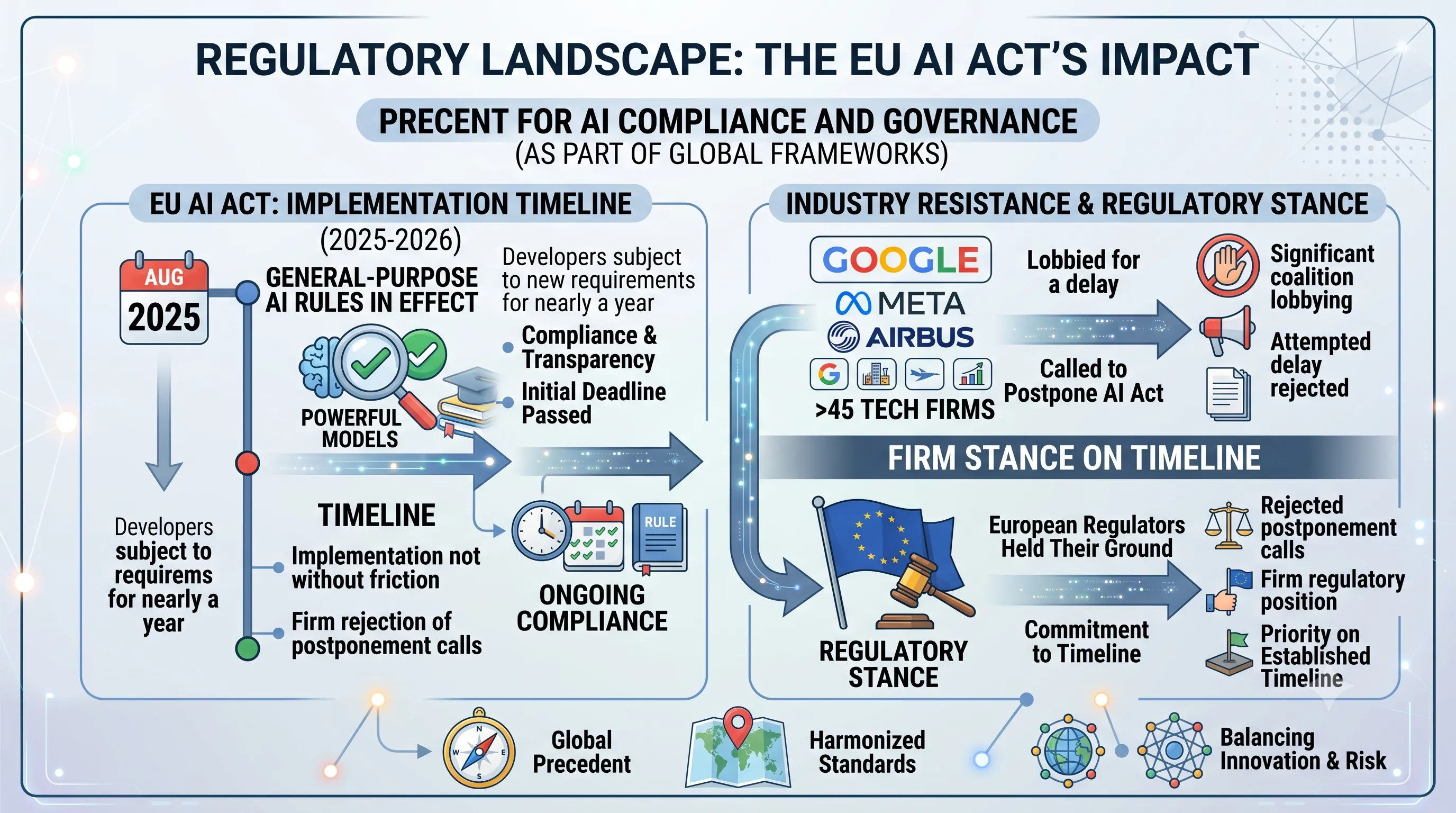
13. Regulatory Landscape: The EU AI Act's Impact
As Google continues to update its lineup with more lightweight and specialized AI models, these developments occur within a global regulatory landscape that is rapidly taking shape, with the European Union's AI Act setting a significant precedent for compliance and governance.
EU AI Act: Implementation Timeline
A pivotal deadline has already passed for technology companies operating in the European Union.
The specific rules governing general-purpose AI, a core component of the EU AI Act, officially went into effect in August 2025.
This implementation means that developers of powerful, broad-application models have been subject to these new compliance and transparency requirements for nearly a year.
Industry Resistance and Regulatory Stance
The path to implementation was not without friction.
Leading up to the effective date, the EU firmly rejected calls to postpone the AI Act from a large contingent of more than 45 technology firms.
This significant industry coalition, which included major players such as Google, Meta, and Airbus, had lobbied for a delay, but European regulators held their ground, underscoring a commitment to the established timeline for AI governance.

14. Flashback: Google's Earlier Lightweight AI Models
To fully appreciate the context of Google's July 2026 updates to its lightweight and specialized AI lineup, it is useful to revisit the company's prior foundational releases in this space.
These earlier models set the stage for the more advanced tools being rolled out today.
The Gemma Model Family (2024)
A significant milestone in Google's development of smaller, more accessible models was the launch of Gemma on February 21, 2024.
This event introduced a new family of lightweight, open-weight models intended to empower developers and researchers.
The initial release featured two sizes, Gemma 2B and Gemma 7B, providing a clear signal of Google's strategy to compete in the efficient model segment long before the latest Gemini Flash updates.

📚 Related Posts
NVIDIA SIGGRAPH 2026: AI Redefines Virtual Worlds, Creative Workflows, and Media Integrity with Neural Rendering, MCP & Detectio
🚀 Key TakeawaysNVIDIA showcased significant advancements in neural rendering, generative AI, and physical AI at SIGGRAPH 2026.The company emphasized creating realistic, real-time virtual worlds and advanced simulation methods built by AI.New Model Conte
tech.dragon-story.com
Google DiffusionGemma Unveiled: Open-Source LLM Achieves 4x Faster Text Generation via Novel Diffusion & MoE Architecture for Re
🚀 Key TakeawaysGoogle has released DiffusionGemma, an experimental open-source LLM introducing a novel text diffusion method for simultaneous text block generation.It delivers significantly faster generation speeds, up to 4x quicker than traditional mod
tech.dragon-story.com
Google NotebookLM's Massive Upgrade: Gemini 3.5 & Antigravity Unlock Agentic AI Research with Code Execution, Web Browsing, & 65
🚀 Key TakeawaysGoogle has unveiled its largest-ever upgrade for NotebookLM, transforming it into an advanced AI research partner.The updated platform is now built on the powerful Gemini 3.5 model and Google's agentic infrastructure, Antigravity.Notebook
tech.dragon-story.com


