🚀 Key Takeaways
- NVIDIA showcased significant advancements in neural rendering, generative AI, and physical AI at SIGGRAPH 2026.
- The company emphasized creating realistic, real-time virtual worlds and advanced simulation methods built by AI.
- New Model Context Protocol (MCP) integrations are empowering AI agents within leading creative applications like Adobe, Blender, and Unreal Engine.
- NVIDIA introduced a Synthetic Video Detector NVIDIA NIM microservice to help media professionals identify AI-generated content.
- The NVIDIA Cosmos platform expanded with Cosmos 3 Edge, an omnimodel for real-time vision analytics and robot action at the edge.
- The NVIDIA Agent Toolkit and DGX Station now provide a powerful, local platform for developing and deploying AI agents and large foundation models.
- NVIDIA published 21 technical papers, revealing breakthroughs in areas such as real-time character motion, 3D scene reconstruction, and advanced physics simulation.
NVIDIA made a significant impact at SIGGRAPH 2026, held in Los Angeles, unveiling a suite of innovations designed to revolutionize the creation of virtual worlds and advance physical AI systems. The company's keynote address on July 20th, along with numerous sessions and demonstrations, showcased its commitment to pushing the boundaries of generative AI, neural rendering, and intelligent simulation across diverse industries.
At the core of NVIDIA's announcements were groundbreaking developments aimed at empowering creators and developers with more sophisticated tools. These include enhancements in AI-driven content generation, solutions for ensuring the authenticity of digital media, and platforms that bring complex AI models closer to practical, real-time applications. The focus was on building hyper-realistic, interactive environments that bridge the digital and physical realms.
These announcements are poised to reshape workflows in design, entertainment, robotics, and autonomous systems. By enabling AI agents to seamlessly integrate into creative pipelines and providing powerful on-device AI capabilities, NVIDIA is delivering the foundational technology for the next era of digital creation and intelligent automation. The technologies revealed at SIGGRAPH highlight a future where imagination is amplified by AI, leading to unprecedented levels of fidelity and interactivity.

1. NVIDIA at SIGGRAPH 2026: Event Highlights and Key Focus Areas
This section provides an overview of the SIGGRAPH 2026 conference and outlines NVIDIA's primary activities and strategic focus areas, setting the context for the key announcements made on July 20th.
SIGGRAPH 2026 Schedule & NVIDIA Presence
The premier conference for computer graphics and interactive techniques, SIGGRAPH 2026, took place in Los Angeles from July 19 through July 23, 2026.
NVIDIA established a significant presence at the event, anchored by its special keynote address which was held on Monday, July 20, at 3:45 p.m. PT.
Following the main presentation, the company hosted an NVIDIA Developer Meetup later that evening, running from 5:30 p.m. to 7:30 p.m. PT on July 20.
Beyond these scheduled key events, NVIDIA's engagement at the conference was extensive, featuring a variety of training labs, numerous technical sessions, and community-focused events for attendees.
NVIDIA's Core Focus at the Conference
NVIDIA's presentations and technology showcases at SIGGRAPH 2026 were centered on several key strategic pillars that are shaping the future of graphics and computation.
The company's primary focus areas included the advancement of neural and generative rendering techniques, pushing the boundaries of realism and content creation.
Another major theme was physical AI, demonstrating how AI can understand and interact with the physical world in simulations.
This was complemented by a focus on robotics workflows, highlighting new tools and platforms for developing and deploying intelligent machines.
Finally, NVIDIA continued its strong advocacy and development for OpenUSD, emphasizing its critical role as the standard for building and collaborating on 3D worlds and industrial digital twins.

2. Keynote Insights: NVIDIA AI Leaders on Virtual Worlds and AI-Driven Creation
This section delves into the core messages from the NVIDIA keynote on July 20th, a central part of the company's SIGGRAPH 2026 presence. It focuses on the researchers and engineers shaping the next wave of generative AI, connecting their vision directly to the broader announcements made at the event.
Distinguished Speakers and Their Vision
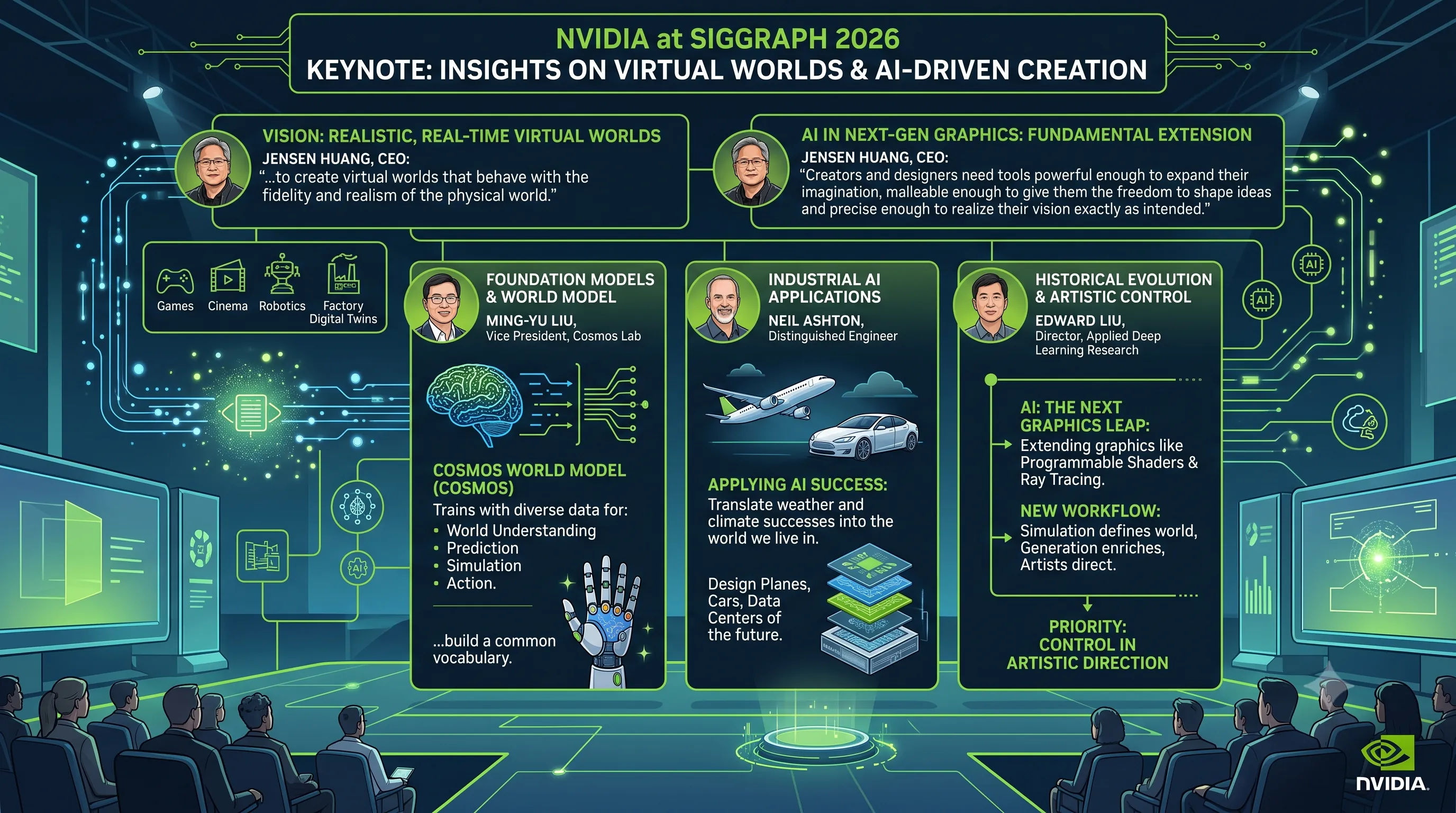
The keynote featured a powerful lineup of NVIDIA's AI research and engineering leaders, who detailed the company's focus on creating virtual worlds that behave realistically and respond in real time.
This research direction underpins many of the 21 technical papers NVIDIA had accepted at SIGGRAPH this year.
The featured speakers and their roles are outlined below:
| Speaker | Title |
|---|---|
| Edward Liu | Director of Applied Deep Learning Research |
| Neil Ashton | Distinguished Engineer |
| Ming-Yu Liu | Vice President of Cosmos Lab |
Their collective message aligned with CEO Jensen Huang's stated goal: "Whether for games, cinema, robotics or factory digital twins, the goal is the same: to create virtual worlds that behave with the fidelity and realism of the physical world."
Ming-Yu Liu, from NVIDIA's Cosmos Lab, spoke on the power of foundation models.
"What makes a foundation model a foundation model is its capability to consume enormous amounts of diverse data," he stated.
He explained how his team approached this with their world model, Cosmos: "We trained Cosmos with data for diverse physical tasks, including world understanding, prediction, simulation and action.
We use one backbone to solve all the different tasks."
Recognizing that different agents or robots have unique ways of interacting with the world, Liu noted, "Every embodiment speaks a different language."
To solve this, he said, "Our solution is to build a common vocabulary."
Neil Ashton, a Distinguished Engineer, contextualized this research by connecting it to real-world industrial applications.
"The challenge that we have is to translate the success of using these AI models in weather and climate into the world that we live in, to be able to design the planes and cars and data centers of the future," Ashton explained.
He affirmed NVIDIA's commitment, stating, "One of the things that NVIDIA is really focused on is helping to achieve that vision."
AI's Role in Next-Gen Graphics: Key Quotes
The speakers emphasized a new paradigm where AI is not just a tool, but a fundamental extension of the graphics pipeline, built by AI for AI.
This vision serves the creative community, as articulated by Jensen Huang: "Creators and designers need tools powerful enough to expand their imagination, malleable enough to give them the freedom to shape ideas and precise enough to realize their vision exactly as intended."
Edward Liu, Director of Applied Deep Learning Research, framed AI's impact as a historic evolution for the industry.
He described a new workflow where "Simulation defines the world, generation enriches its appearance and artists direct the outcome."
This philosophy positions AI as the next great leap forward, with Liu adding that AI is "extending graphics the same way programmable shaders and ray tracing have extended graphics before."
Maintaining artistic intent within these powerful new systems is a key priority.
"Control in artistic direction is a really exciting research direction for us," Liu concluded.
3. Breakthroughs in Neural Rendering and AI Physics: Achieving Realism
As part of its major announcements at SIGGRAPH 2026 on July 20th, NVIDIA detailed significant progress in using AI to generate photorealistic and physically accurate visuals, bridging the gap between digital content and the real world.
Advancing Neural Rendering Techniques
NVIDIA showcased its latest advancements in neural rendering, directly addressing several long-standing challenges in computer-generated imagery.
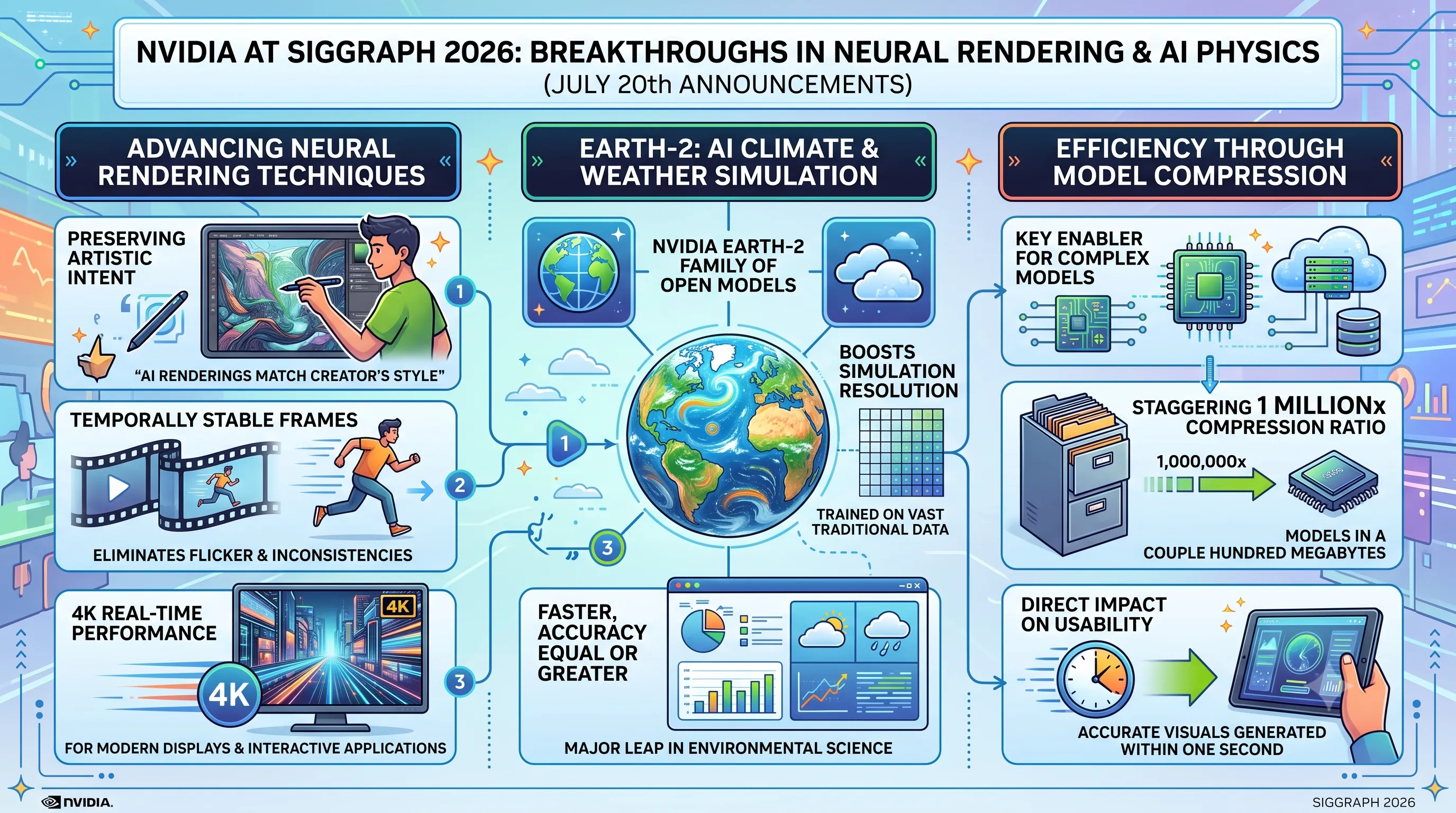
A primary focus was on new techniques designed to preserve the original artistic intent of a creator, ensuring that AI-driven rendering enhancements do not compromise the desired style or aesthetic.
Furthermore, the company has made strides in ensuring output is temporally stable across frames, a critical development for eliminating flicker and other inconsistencies in motion sequences.
These stability and fidelity improvements are now paired with high performance, as the new methods are capable of rendering 4K content in real time, meeting the demands of modern high-resolution displays and interactive applications.
Earth-2: AI for Climate and Weather Simulation
Expanding its AI-driven simulation capabilities, NVIDIA presented the NVIDIA Earth-2 family of open models.
These models are designed to significantly boost the resolution of climate and weather simulations by using AI models that have been trained on vast amounts of traditional simulation data.
This AI-based approach is not just faster but also highly effective, with NVIDIA stating that Earth-2 achieves an accuracy equal to or greater than traditional simulation approaches, representing a major leap in predictive environmental science.
Efficiency Through Model Compression
A key enabler for these complex AI models is a breakthrough in efficiency developed by NVIDIA Research and its partners.
The teams developed new model architectures that can compress model checkpoints to "a couple hundred megabytes," which represents a staggering million-times compression ratio.
This dramatic reduction in model size has a direct and immediate impact on usability, as this level of compression enables physically accurate visualizations to be generated within one second.
4. Model Context Protocol (MCP): Empowering AI Agents in Creative Workflows
As part of its major announcements at SIGGRAPH 2026 on July 20th, NVIDIA introduced the Model Context Protocol (MCP), a foundational technology designed to integrate generative AI agents directly into complex creative workflows.
MCP: Bridging AI and Creative Apps
The Model Context Protocol (MCP) establishes a crucial connection that allows AI agents to operate directly inside leading creative applications.
This integration transforms agents into powerful digital assistants capable of understanding the context of a project and performing complex, tedious tasks.
Using MCP-connected tools, an agent can be tasked with a variety of production-critical functions.
For instance, an agent can inspect entire scenes to find and report missing textures, flag any inconsistent color management settings across different assets, or automatically prepare multiple export variants based on a set of rules.
Other capabilities include generating playblasts for review or validating shots against established pipeline protocols to ensure they meet technical requirements before moving to the next stage.
Crucially, this system is designed to augment, not replace, the artist; creators maintain full control over all creative decisions, using the agents to accelerate technical steps and quality checks.
Benefits of Local AI Agent Deployment
The NVIDIA platform is architected to power local agents, model inference, and sophisticated multi-application workflows on systems built for professional creators.
This emphasis on local deployment provides significant advantages over cloud-based alternatives.
Running models and agents locally on a powerful workstation improves responsiveness, as there is no latency from communicating with external servers.
It also reduces reliance on third-party services, giving studios more autonomy and preventing bottlenecks caused by internet outages or service provider issues.
Perhaps most importantly, this approach keeps sensitive creative data within controlled, local environments, enhancing security and confidentiality for high-stakes projects.
NVIDIA Agent Toolkit and MCP Integration
To facilitate the adoption and expansion of this ecosystem, NVIDIA is providing the NVIDIA Agent Toolkit.
This toolkit is the key to supporting MCP integration from both a user and developer perspective.
For users looking to connect to existing agent-enabled tools, the toolkit includes an MCP client, which can establish a connection to remote servers.
For developers and studios wanting to create their own custom agents, the toolkit provides an MCP server for publishing their tools, making them available to any user with an MCP client.
This dual-component structure fosters a flexible and open framework for building and deploying AI-powered assistants across the creative industry.

5. Expanding Creative Horizons: MCP Integrations Across Industry-Leading Applications
A core theme of NVIDIA’s SIGGRAPH 2026 presentation on July 20th was the power of an open ecosystem, and nowhere is this more evident than in the rapid, industry-wide adoption of its Media and Communications Platform (MCP) standard.
Leading creative software developers have integrated MCP to connect powerful AI agents directly into their flagship applications, transforming complex, manual workflows into streamlined, conversational tasks.
Adobe's AI Assistant Enhancements
Adobe showcased a significant expansion of its creative agent, now integrated across Firefly, Express, and the broader Creative Cloud suite.
This agent powers new AI Assistant experiences designed to orchestrate complex, multistep creative workflows from simple user prompts.
To further extend its reach, Adobe is bringing its professional-grade creative tools to third-party AI platforms through the Adobe connector.
For developers and coders, the company also provides the Adobe Express Developer MCP Server, which allows AI coding assistants to interact directly with the platform.
Affinity by Canva: Natural Language Automation
Affinity by Canva introduced a new AI Connector for Claude that leverages MCP to enable powerful natural-language automation.
This integration allows the Claude AI to handle a wide range of repetitive and time-consuming production tasks.
Users can now instruct the AI to perform actions such as renaming layers and artboards, resizing and reformatting assets for different outputs, applying bulk edits across multiple objects, optimizing complex vector paths, and preparing final files for delivery.
Beyond simple commands, the connector also helps users build reusable scripts and develop custom features tailored to their specific workflows.
Blender, Silhouette, and Houdini: New AI Workflows
The open-source and specialized effects communities have also embraced MCP.
Blender Lab now offers a lightweight MCP server, providing a natural-language interface that allows AI agents to access Blender’s extensive Python API, documentation, and even complex project setups.
Boris FX has integrated an MCP server directly into its rotoscoping and paint tool, Silhouette.
This enables AI assistants to work inside projects using the FX Scripting API to inspect project structures, build node trees, edit shapes and keyframes, and render frames.
Setup has been simplified through a new preferences panel for package installation, client configuration, and connection testing.
Silhouette supports an interactive online mode for connecting to active sessions and an offline, headless mode for automation and batch processing.
Similarly, SideFX announced MCP support for Houdini 22 through its new APEX Script workflow.
This gives AI assistants access to a curated collection of APEX Script syntax, functions, and documentation, allowing them to generate and refine code for creating sophisticated procedural character rigs.
Foundry Griptape & Unreal Engine: VFX and Game Dev Integration
In the high-end VFX and game development spaces, MCP is facilitating new levels of AI orchestration.
Foundry Griptape now offers native MCP support, enabling studios to securely manage multiple AI models and agents within professional VFX pipelines.
This framework ensures creative control and traceability while integrating with tools like Blender and Foundry Nuke to automate tasks such as cleanup, matte painting, and quality control.
Epic Games also announced that Unreal Engine can now connect AI clients to the Unreal Editor via MCP.
This pivotal integration enables AI-driven workflows that can interact directly with a wide range of editor capabilities, opening new possibilities for automated scene generation, asset placement, and in-editor assistance.
| Application / Platform | Key MCP Integration Feature | Example AI-Powered Tasks |
|---|---|---|
| Adobe Creative Cloud | Expanded creative agent and AI Assistant | Orchestrate multistep workflows across Firefly, Express, and CC applications. |
| Affinity by Canva | AI Connector for Claude | Rename layers, resize assets, apply bulk edits, optimize vector paths, and prep files. |
| Blender (via Blender Lab) | Lightweight MCP server | Provide a natural-language interface to Blender’s Python API, documentation, and setups. |
| Boris FX Silhouette | Built-in MCP server with FX Scripting API access | Inspect projects, build node trees, edit shapes and keyframes, and render frames. |
| Foundry Griptape | Native MCP support for AI orchestration | Automate cleanup, matte painting, and quality control in VFX pipelines with Nuke/Blender. |
| SideFX Houdini 22 | APEX Script workflow with MCP support | Generate and refine code for procedural character rigs using curated API examples. |
| Unreal Engine | MCP connection for AI clients to the editor | Enable AI workflows to interact directly with editor capabilities for scene manipulation. |

6. Safeguarding Media Integrity: NVIDIA Synthetic Video Detector NIM
Introducing the Synthetic Video Detector
As part of its announcements at SIGGRAPH 2026, NVIDIA introduced the Synthetic Video Detector NVIDIA NIM microservice.
This new tool is a component of the comprehensive NVIDIA AI for Media platform, designed to address the growing challenge of synthetically generated content.
Its primary function is to bring a reliable, AI-assisted detection signal directly into the workflows of editorial and media organizations, providing a first line of defense against manipulated media.
How it Works: AI-Assisted Content Analysis
The NIM microservice operates by performing a deep analysis of video content on a frame-by-frame basis.
This process generates a classifier score for each frame, which indicates the probability that the content is synthetic.
This score is not a final judgment but a powerful signal for editorial teams.
Media organizations can use this signal to automatically prioritize clips that require human review, flag or quarantine questionable footage, or escalate a clip for more intensive forensic analysis.
By providing a clear indicator for time-sensitive decisions, the microservice helps teams move quickly to verify content, thereby protecting their editorial standards and maintaining public trust.
Performance and Deployment Scenarios
A critical feature of the Synthetic Video Detector is its robustness in real-world scenarios.
NVIDIA confirmed that the model remains effective even after undergoing compression, resizing, cropping, and re-encoding—all common steps in newsroom and social-video workflows that can degrade detection signals.
Internal NVIDIA testing demonstrated strong accuracy rates under these conditions.
| Video Condition | Model Accuracy (NVIDIA Testing) |
|---|---|
| Uncompressed Video | Up to 92% |
| 15% Compression | 87% |
| 50% Compression | 82% |
The microservice is engineered for high-speed performance, processing 1080p video in as little as 22 milliseconds on NVIDIA RTX systems and approximately 30 milliseconds on NVIDIA L40 GPUs.
To ensure broad accessibility, organizations can deploy the NIM microservice in a variety of environments, including on-premises, at the edge, in hybrid clouds, and in approved air-gapped systems.
Highlighting its industry adoption, partner Wowza is embedding the microservice into livestreaming workflows through the Wowza Video Intelligence Framework.

7. NVIDIA Cosmos Platform: Foundation Models for Physical AI Systems
As a significant part of its SIGGRAPH 2026 announcements, NVIDIA unveiled major advancements in its Cosmos platform, a foundational pillar for creating and deploying intelligent physical systems.
This platform is engineered to serve as a world foundation model, drastically accelerating the development cycle for physical AI, from autonomous vehicles to robotics.
Overview of the Cosmos Platform
The NVIDIA Cosmos platform provides developers with a family of open models designed for a range of computational needs.
These models are accessible on Hugging Face, while the necessary inference and post-training frameworks and recipes are available on GitHub, fostering an open ecosystem for innovation.
The family is structured in various sizes to accommodate different deployment targets.
| Model Name | Parameter Count | Tier |
|---|---|---|
| Cosmos 3 Edge | 4 Billion | Smallest model for on-device deployment |
| Cosmos Nano | 16 Billion | Mid-tier model |
| Cosmos Super | 64 Billion | Largest model for maximum capability |
Cosmos 3 Edge: An Omnimodel for Physical AI
At the event, NVIDIA released Cosmos 3 Edge, a new 4-billion-parameter addition to the platform.
This model is a true omnimodel, capable of understanding and generating a rich variety of modalities including text, images, video, ambient sound, and physical actions.
Its power lies in a sophisticated mixture-of-transformers architecture.
This design enables physically grounded, real-time vision analytics and direct robotic action on edge devices, a critical capability for autonomous systems.
Demonstrating its efficiency and performance, Cosmos 3 Edge has already achieved the No. 1 ranking on VANTAGE-Bench for vision analytics success within its parameter class.
Cosmos-Dreams: Simulating Autonomous Futures
To complement the foundation models, NVIDIA also introduced Cosmos-Dreams, a collection of advanced closed-loop simulators.
These simulators provide a virtual proving ground for AI models before they are deployed in the physical world.
A showcased simulator for autonomous vehicles demonstrated the ability to generate an entire, interactive world from just a single input frame.
This capability allows developers to rigorously verify model accuracy before deploying to a real fleet.
Furthermore, Cosmos-Dreams can train models on entirely AI-generated scenarios, a method that both accelerates development timelines and significantly saves on operational costs associated with physical testing.
Remarkably, the autonomous vehicle simulator runs efficiently on a single NVIDIA RTX PRO 6000 GPU, making this powerful technology highly accessible.

8. Deploying Cosmos 3 Edge: Real-World Applications at the Edge
As a key part of the announcements from NVIDIA at SIGGRAPH 2026, the real-world deployment of Cosmos 3 Edge demonstrates the model's practical impact.
Cosmos 3 Edge is specifically optimized for memory-efficient deployment and high throughput across a variety of NVIDIA systems and GPUs, making it ideal for edge computing workloads.
Cosmos 3 Edge in Robotics
In the field of robotics, developers can leverage Cosmos 3 Edge to build highly specialized world action models.
The workflow involves post-training the model on proprietary robot and sensor data using the powerful NVIDIA DGX Station.
Once trained, these models are deployed on the NVIDIA Jetson Thor platform to execute real-time robot control policies, enabling complex tasks like manipulation or locomotion.
Several industry leaders, including Agile Robots, Doosan Robotics, Siemens, and Skild AI, are already evaluating Cosmos 3 Edge for their advanced robotics workflows.
Empowering Autonomous Vehicles
For autonomous vehicles, Cosmos 3 Edge provides crucial capabilities on resource-constrained hardware.
It supports advanced functions such as road-scene understanding, traffic reasoning, and the prediction of object intent.
A significant application is its use in policy-model distillation, where it can act as a student backbone for more complex models, including the NVIDIA Alpamayo vision language action models, to run efficiently in-vehicle.
Smart Infrastructure with Vision Agents
Cosmos 3 Edge is transforming smart infrastructure by enabling a new generation of vision agents.
When deployed on NVIDIA Jetson Thor, it delivers best-in-class throughput and accuracy with real-time inference, allowing agents to reason across live video streams.
This technology has broad applications in traffic monitoring, public safety, logistics, and industrial inspection.
Remarkably, its 2-billion-parameter NVIDIA Nemotron-powered reasoning module is so efficient it can run independently on an NVIDIA Jetson Orin 8GB module.
Companies such as Centific, Vaidio, and YUAN are actively evaluating Cosmos 3 Edge to accelerate the development and deployment of their vision agents at the edge.
| Application Area | Key Use Cases | Deployment Hardware | Companies Evaluating |
|---|---|---|---|
| Robotics | Real-time control policies (manipulation, locomotion), specialized world action models. | NVIDIA Jetson Thor (Deployment), NVIDIA DGX Station (Training) | Agile Robots, Doosan Robotics, Siemens, Skild AI |
| Autonomous Vehicles | Road-scene understanding, traffic reasoning, object-intent prediction, policy-model distillation. | Resource-constrained automotive hardware | N/A |
| Smart Infrastructure | Vision agents reasoning across live video for traffic monitoring, public safety, logistics, and industrial inspection. | NVIDIA Jetson Thor, NVIDIA Jetson Orin 8GB | Centific, Vaidio, YUAN |

9. Local AI Supercomputing: NVIDIA DGX Station and Agent Toolkit
Announced at SIGGRAPH 2026, NVIDIA is bringing turnkey AI agent development to the desktop with a powerful new combination of hardware and software, focusing on secure, local supercomputing capabilities.
DGX Station: AI at Your Desk
NVIDIA introduced the NVIDIA DGX Station as a deskside supercomputer specifically designed for the AI era.
This system packages immense computational power into a form factor suitable for an office environment, anchored by the NVIDIA GB300 Grace Blackwell Ultra Desktop Superchip.
The GB300 provides up to 20 petaflops of FP4 AI compute performance and is equipped with 748GB of coherent memory, enabling it to run massive models like Nemotron Ultra locally.
For connectivity and scaling, the DGX Station includes the NVIDIA ConnectX-8 SuperNIC, which delivers up to 800GB/s of bandwidth.
This networking capability supports linking up to two DGX Station systems together to handle more complex workloads.
| Component | Specification / Feature |
|---|---|
| Compute | NVIDIA GB300 Grace Blackwell Ultra Desktop Superchip offering up to 20 petaflops of FP4 AI compute. |
| Memory | 748GB of coherent memory to run large models. |
| Networking | NVIDIA ConnectX-8 SuperNIC delivering up to 800GB/s bandwidth. |
| Key Model | NVIDIA Nemotron 3 Ultra, a 550-billion-parameter frontier open model. |
NVIDIA Agent Toolkit: Components and Setup
Paired with the hardware is the new NVIDIA Agent Toolkit, which can be set up on a DGX Station in just three steps and be operational in approximately 30 minutes.
The toolkit is a self-contained, secure system that requires no internet connection.
It integrates several key NVIDIA technologies: the NVIDIA NemoClaw agent framework, the NVIDIA Nemotron 3 Ultra 550-billion-parameter open model, NVIDIA Omniverse libraries for 3D interaction, and a secure runtime.
This combination allows developers to have the core pieces of a sophisticated AI agent workflow—a frontier model, an open harness, a secure runtime, and 3D tools—all running together in one box.
Scaling Local AI and Omniverse Integration
The DGX Station is designed for scalability.
Multiple systems can be connected to serve concurrent users, deploy more agents, and run bigger models as workloads grow.
A significant announcement for physical AI workflows is the new blueprint for integrating Omniverse libraries directly into Blender.
This integration gives NemoClaw agents callable RTX sensor simulation and physics tools, allowing them to interact with and understand 3D scenes realistically.
Furthermore, the architecture supports using frontier models to orchestrate NemoClaw as a specialized sub-agent for complex tasks.
Industry Adoption and Resources
The new toolkit and models have already seen adoption from key players in the AI community.
LangChain tuned its Deep Agents harness specifically for the Nemotron 3 Ultra model.
Similarly, Nous Research has fine-tuned Nemotron 3 Ultra for its Hermes Agent harness and has adopted it for production workloads.
In a related move, the Hermes Agent has added Blender to its Model Context Protocol catalog, signaling tighter integration with 3D workflows.
To support developers, NVIDIA has made two new playbooks available to help build and run agents with NemoClaw and manage dual-node deployments.
The NVIDIA DGX Station is available to order from a wide range of partners, including ASUS, Dell Technologies, Exxact, GIGABYTE, HP, MSI, and Supermicro.

10. Pioneering Research: NVIDIA's Innovations for Virtual and Physical AI
At the SIGGRAPH 2026 event on July 20th, NVIDIA's presence was defined not only by product demonstrations but by the foundational science driving the future of graphics and AI.
The company highlighted 21 accepted technical papers that form the bedrock of next-generation real-time systems, designed to both generate complex virtual worlds and train intelligent machines for the physical world.
Revolutionizing Character Animation
NVIDIA introduced several breakthroughs aimed at making character animation more dynamic, controllable, and accessible.
A key innovation is MotionBricks, a real-time motion model trained on an extensive library of over 350,000 motion clips.
This model operates at game-engine speeds, giving creators the power to intuitively direct and connect character movements.
Its versatility was demonstrated by its ability to drive not only on-screen animated characters but also a physical Unitree G1 humanoid robot.
Building on this, the company presented GPC (Generative Controllers), a framework for training generative controllers using large-scale motion datasets.
Through this method, NVIDIA pretrains a single, powerful controller on vast amounts of human motion data, providing it with transferable motor skills applicable to various scenarios.
For direct creative control, NVIDIA unveiled ARDY, an autoregressive diffusion model that allows creators to steer 3D character motion in real time simply by using a text prompt.
From 3D Captures to Clean Virtual Scenes
Creating pristine virtual environments from real-world scans is a major challenge, which NVIDIA addressed with its ArtiFixer technology.
This tool is designed to take messy, incomplete 3D captures from the real world and automatically transform them into clean, complete virtual scenes.
ArtiFixer also includes a groundbreaking new method for predicting photorealistic global illumination directly from a scene’s geometry, achieving this stunning visual fidelity without the need for traditional ray tracing.
Advanced Physics and Material Simulations
To enhance realism, NVIDIA unveiled a new physics solver for its NVIDIA Newton physics engine.
This advanced solver brings previously hard-to-simulate materials—such as snow, sand, and various elastic solids—to life with unprecedented accuracy.
Material acquisition was also a focus with the VideoNeuMat pipeline.
This system provides reusable, relightable materials that are derived directly from generative video models, streamlining the creation of realistic surfaces for virtual worlds.
Open Research for the Community
Underscoring its commitment to advancing the entire industry, NVIDIA emphasized that this wealth of innovation is not being kept proprietary.
All the research papers presented at the conference, along with their associated code and models, are openly available for anyone to download and use for free.

11. Upcoming: NVIDIA GTC Berlin
Following the significant announcements and technological showcases at SIGGRAPH 2026, NVIDIA is providing another key opportunity for the community to connect later this year.
The next major conference on the calendar is NVIDIA GTC Berlin, scheduled to run from October 20-22.
For developers, creators, and industry leaders looking to attend, registration for the event is currently open.
📚 Related Posts
Samsung Galaxy Unpacked July 2026: Z Fold 8, Z Flip 8, Watch 9, & Galaxy Ring Unveiled in London – Full Details & Recap
🚀 Key TakeawaysSamsung is gearing up for its next Galaxy Unpacked event on July 22, 2026, in London, highlighting its latest portfolio additions.The event will prominently feature new innovations in the foldable category, especially with the anticipated
tech.dragon-story.com
NVIDIA Nemotron 3 Ultra: Open-Source LLM Empowers Next-Gen AI Agents with 5x Faster Inference & Advanced Reasoning
🚀 Key TakeawaysNVIDIA Nemotron 3 Ultra is a new open-source, open-weight Mixture-of-Experts (MoE) model designed for AI agents to perform complex, long-duration tasks.It features 550 billion total parameters (55 billion activated for inference), support
tech.dragon-story.com
NVIDIA & Microsoft Launch RTX Spark: AI Agent PCs with 1 PFLOPS Local Power, Ultimate Privacy, and 128GB Memory for Creators & G
🚀 Key TakeawaysNVIDIA and Microsoft are launching the RTX Spark platform, ushering in an era of 'AI Agent PCs' that perform tasks directly on the user's device, ensuring unprecedented privacy, security, and local AI processing power.The platform boasts
tech.dragon-story.com


