🚀 Key Takeaways
- For immersive synchronization, the Govee AI Gaming Sync Box Kit 2 introduces advanced CogniGlow Technology and HDMI 2.1 for AI-driven content recognition, while Philips Hue Play HDMI Sync Box 8K offers robust HDMI 2.1 Certified syncing for its established ecosystem, and Nanoleaf 4D Screen Mirror + Lightstrip Kit utilizes a versatile camera for 4D screen mirroring with added Rhythm sound reactivity.
- In terms of performance and connectivity, Govee AI supports resolutions up to 8K at 60Hz and 4K at 144Hz, features a high-density 75 LEDs/m strip with RGBWIC four-color mixing, and includes Matter Support for broad smart home integration. Philips Hue also handles 8K at 60Hz and 4K at 120Hz across four HDMI ports but requires a Hue Bridge for full functionality. Nanoleaf 4D is designed for TVs up to 65 inches with an addressable gradient lightstrip and Sync+ Technology for extending effects across other Nanoleaf devices.
- Targeting specific users, Govee AI is ideal for gamers and tech enthusiasts prioritizing cutting-edge AI and future-proof HDMI 2.1 connectivity. Existing Philips Hue users seeking seamless, multi-device HDMI integration into their smart home will favor their Sync Box. Creative users or those wanting unique camera-based visuals and sound interaction for TVs up to 65" should consider Nanoleaf 4D.
The quest for ultimate home entertainment immersion reaches new heights with the latest ambient lighting solutions, transforming your screen into a dynamic extension of your living space.
In this showdown, we pit three leading contenders against each other: the Govee AI Gaming Sync Box Kit 2 (HDMI 2.1), the Philips Hue Play HDMI Sync Box 8K, and the Nanoleaf 4D Screen Mirror + Lightstrip Kit.
Each promises to elevate your gaming, movie watching, and music listening experiences with synchronized light shows, but they take distinct approaches to achieving this captivating effect.
The Govee AI Gaming Sync Box Kit 2 enters the arena equipped with a latest HDMI 2.1 interface for data transmission and lighting synchronization, supporting impressive resolutions up to 8K at 60Hz or 4K at 144Hz.
It also boasts CogniGlow Technology, an innovative AI feature designed to recognize images and text for even more intelligent lighting effects, along with Matter Support for integration into broader smart ecosystems.
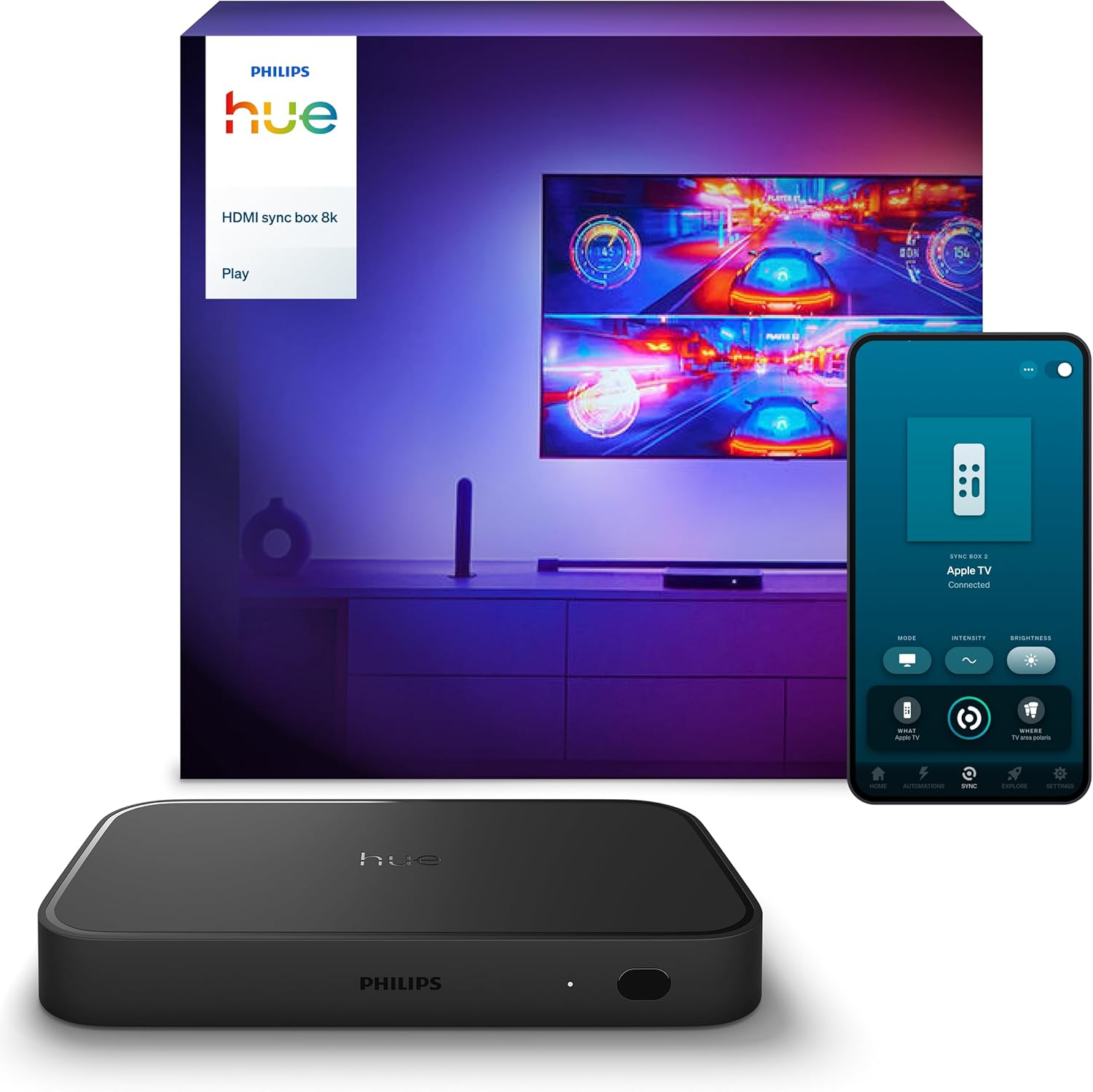
The Philips Hue Play HDMI Sync Box 8K, also featuring an HDMI 2.1 Certified interface, allows users to connect up to four HDMI devices—from gaming consoles to streaming devices—to sync their Hue lights, supporting visuals up to 8K at 60 Hz or 4K at 120 Hz.
Finally, the Nanoleaf 4D Screen Mirror + Lightstrip Kit offers a unique, camera-based approach to TV screen mirroring for displays up to 65 inches, introducing 4 Mirror Modes and Rhythm sound reactivity for an immersive audio-visual experience.
This review dives deep into their specifications, features, and user experiences to help you decide which system truly lights up your world.

1. Honest Verdict Box: Side-by-Side Comparison
| Feature | Govee AI Gaming Sync Box Kit 2 | Philips Hue Play HDMI Sync Box 8K | Nanoleaf 4D Screen Mirror + Lightstrip Kit |
|---|---|---|---|
| Sync Technology / Method | CogniGlow AI, HDMI 2.1 Passthrough | HDMI 2.1 Passthrough, Hue Ecosystem | Camera-Based Screen Mirroring |
| Max Resolution / Refresh Rate | 8K@60Hz, 4K@144Hz | 8K@60Hz, 4K@120Hz | Up to 65" TVs (Camera-based) |
| Gaming Specific Features | VRR, ALLM Support | No explicit VRR/ALLM | Rhythm sound reactivity |
| Smart Home Integration | Matter Support, DreamView Sync | Requires Hue Bridge, Alexa/Google/Apple HomeKit | Sync+ Technology for Nanoleaf devices |
| Content Compatibility | External HDMI Devices only | External HDMI Devices only | Any on-screen content, Native TV Apps |
| Unique Features | CogniGlow AI image/text recognition, RGBWIC 75 LEDs/m strip | Connects up to 4 HDMI devices, Established ecosystem | 4 Mirror Modes, Versatile camera positioning, Magnetic Privacy Cover |
| Key Limitation / Requirement | No auto-signal switching, HDR desaturation | Requires Hue Bridge, No TV app sync | Voice control only for non-mirroring effects |
| Customer Rating (out of 5) | 4.2 (479 reviews) | 4.2 (220 reviews) | 3.4 (10 reviews) |


2. The Ultimate Showdown: Decoding the Future of Immersive Lighting
🔹 The Battleground: HDMI Passthrough vs. Camera Perception
The world of immersive lighting is fiercely contested by innovators like the Govee AI Gaming Sync Box Kit 2, the Philips Hue Play HDMI Sync Box 8K, and the Nanoleaf 4D Screen Mirror.
At their core, these systems employ two distinct methods to bring your screen content into the room.
The Govee AI Gaming Sync Box Kit 2 and Philips Hue Play HDMI Sync Box 8K both utilize an HDMI passthrough approach.
This means they process the video signal directly as it travels from your source device to your display.
In contrast, the Nanoleaf 4D Screen Mirror takes a camera-based approach.
It positions a camera to observe your screen, translating what it "sees" into corresponding light effects.
🔹 Tailoring Brilliance: Matching Tech to Your Experience
The choice between these technologies profoundly shapes the immersive experience for different users.
For high-end gamers, the HDMI passthrough systems, such as the Govee AI Gaming Sync Box Kit 2 and Philips Hue Play HDMI Sync Box 8K, are often favored.
Their direct connection can offer a seamless and responsive synchronization of light with on-screen action, crucial for competitive play and deep immersion without perceptible lag.
Deskterior enthusiasts, who prioritize aesthetics and an integrated environment, might find the camera-based Nanoleaf 4D Screen Mirror appealing for its versatility in application and potential for creative placements without interfering with HDMI chains.
Its ability to mirror any content, even smart TV apps, offers a broad appeal.
For beginners entering the immersive lighting space, the camera-based simplicity of the Nanoleaf 4D Screen Mirror can be particularly welcoming.
It bypasses complex HDMI routing, making setup more straightforward for those new to the ecosystem.
However, HDMI passthrough systems offer a dedicated pathway for signal integrity, which some users might prefer for consistent performance across various media.
🔹 Community Pulse: Weighing Pros, Cons, and User Choices
Community sentiment highlights a trade-off between direct signal accuracy and broader content compatibility.
Users of HDMI passthrough solutions like the Govee AI Gaming Sync Box Kit 2 and Philips Hue Play HDMI Sync Box 8K often praise their precise, real-time light synchronization, especially for external devices.
However, a common consideration for these systems is their inability to sync with content from built-in smart TV apps, as they only process external HDMI sources.
The camera-based approach of the Nanoleaf 4D Screen Mirror is appreciated for its flexibility to work with any on-screen content, regardless of its source, which is a significant draw for users wanting universal mirroring.
Yet, some users might consider the presence of a camera in front or on top of the screen a minor aesthetic point, though measures like privacy covers are often included.
Ultimately, the "best" approach depends on whether a user prioritizes universal content compatibility and easy setup, or dedicated, high-fidelity synchronization for external gaming and media devices.
3. For the 1% Gamer: The HDMI 2.1 High-Performance Battle
🔹 The Ultimate HDMI 2.1 Showdown
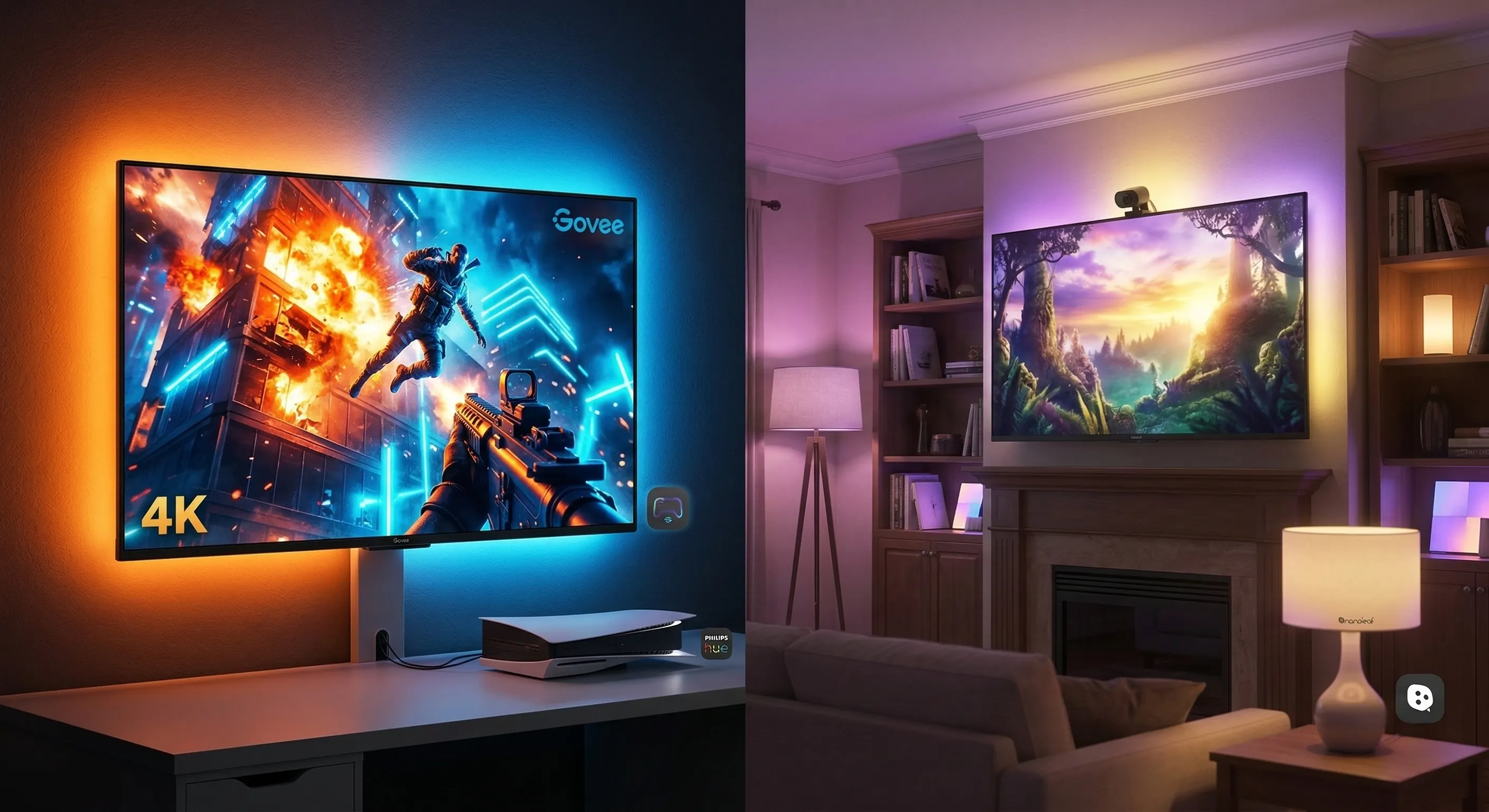
Both the Govee AI Gaming Sync Box Kit 2 and the Philips Hue Play HDMI Sync Box are engineered around the cutting-edge `HDMI 2.1` interface.
This ensures a robust foundation for handling demanding video signals from `next-gen consoles` and high-end PCs.
Regarding `Max_Resolution_Support`, Govee offers an impressive `8K at 60Hz` and `4K at 144Hz`.
The Philips sync box also supports `8K at 60 Hz` but trails slightly with `4K at 120 Hz`.
A critical differentiator for serious gamers is Govee's explicit inclusion of `VRR` (Variable Refresh Rate) and `ALLM` (Auto Low Latency Mode) support within its features.
These essential gaming technologies are notably absent from the listed specifications for the Philips Hue Play HDMI Sync Box.
🔹 Lag-Free Dominance: Real-World Gaming Impact
For the discerning `4K gamer` demanding ultimate fluidity, Govee's `4K at 144Hz` capability provides a distinct competitive edge over Philips' `4K at 120Hz`.
This higher refresh rate translates directly into smoother on-screen motion and potentially faster reaction times in high-octane gaming scenarios.
Govee's integrated `VRR` is a game-changer, dynamically synchronizing the display's refresh rate with the game's frame rate, effectively eliminating `screen tearing` and `stuttering`.
This results in a consistently smooth and immersive visual experience, crucial during fast camera movements or intense action sequences.
Furthermore, `ALLM` on the Govee unit ensures that your display automatically switches to its lowest latency mode the moment you fire up a game.
This significant reduction in `input latency` means your commands register almost instantly, a non-negotiable feature for competitive play.
While the Philips sync box handles `HDMI 2.1` with `8K at 60Hz` and `4K at 120Hz` admirably, the omission of `VRR` and `ALLM` support means it might not fully satisfy gamers accustomed to these features on modern consoles and gaming PCs.
Both units deliver stunning clarity at `8K at 60Hz` for compatible displays, but Govee's comprehensive suite of gaming-centric features defines its superior performance profile for the avid gamer.
🔹 The Gamer's Verdict: Prioritizing Performance
For the "1% Gamer" whose primary focus is unparalleled, `lag-free performance` and responsiveness, the Govee AI Gaming Sync Box Kit 2 emerges as the frontrunner.
Its support for `4K at 144Hz` combined with the crucial gaming technologies of `VRR` and `ALLM` directly addresses the core demands of `next-gen console` and `high-refresh-rate PC gaming`.
The ability to virtually eliminate `screen tearing` and minimize `input latency` makes Govee an incredibly attractive option for those who cannot tolerate compromises in their gaming experience.
While the Philips Hue Play HDMI Sync Box offers a robust `HDMI 2.1` foundation with impressive `8K at 60Hz` and `4K at 120Hz` capabilities, the lack of explicitly stated `VRR` and `ALLM` support places it a step behind Govee in the fierce battle for superior gaming performance.
Ultimately, gamers seeking the most complete and optimized package for minimizing visual artifacts and maximizing responsiveness will find Govee's offering more aligned with their high-performance expectations.

4. The AI Brain vs. The Established Ecosystem
🔹 Intelligent Ambiance & Centralized Control Foundations
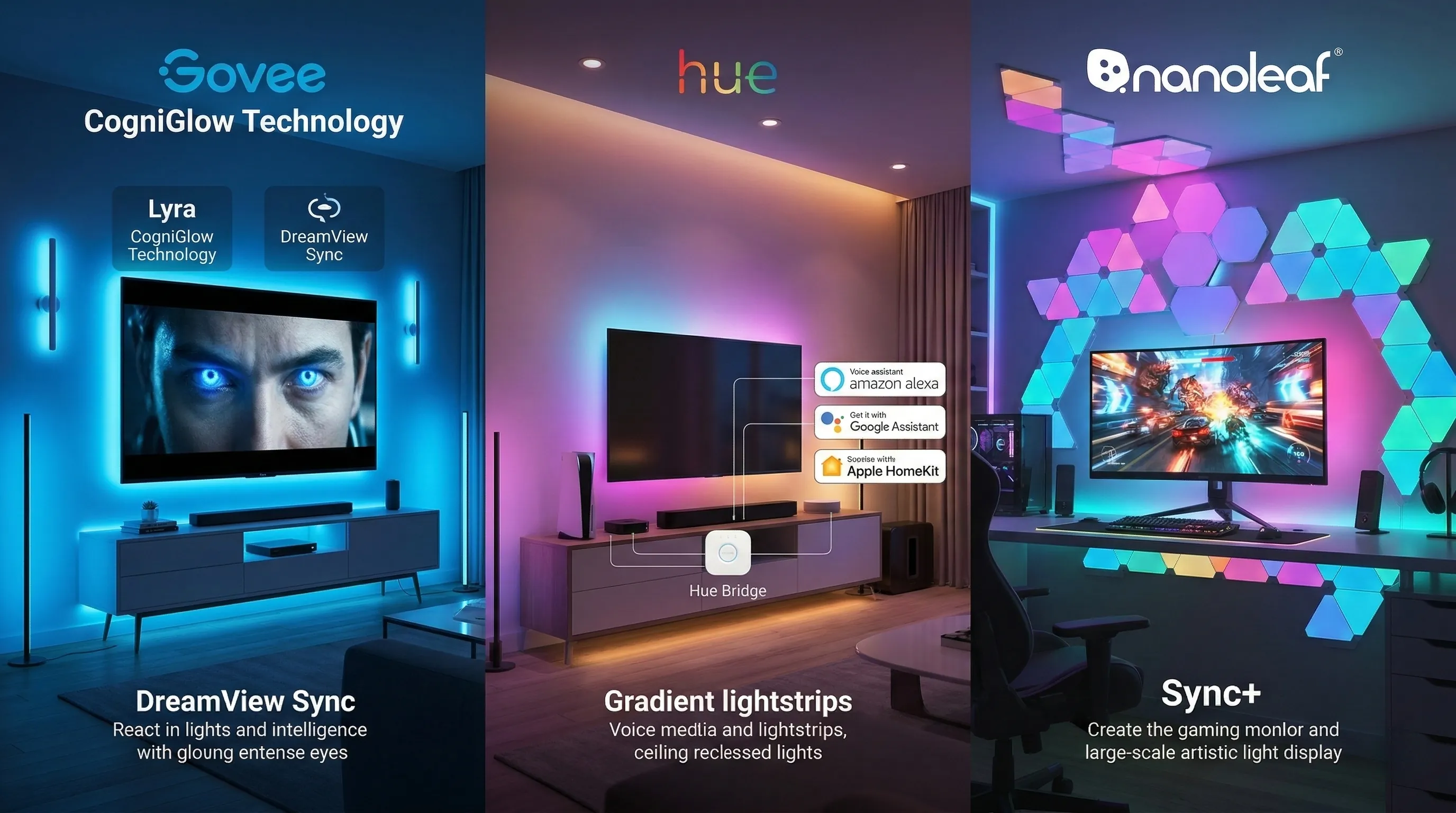
Govee distinguishes itself with its pioneering CogniGlow Technology.
This advanced AI recognizes specific images and text on-screen, dynamically generating lighting effects that go beyond mere color replication, adding a layer of intelligent interpretation to your visuals.
Crucially, Govee future-proofs its offering with robust Matter Support, enabling seamless integration into broader smart home ecosystems and facilitating voice control for lighting functions across various platforms.
Within its own suite, DreamView sync ensures that colors are harmonized across multiple Govee lights for a cohesive display.
In contrast, Philips Hue stands on the bedrock of an extensively developed and widely adopted smart home ecosystem.
Its robust network is primarily managed through the essential Hue Bridge, which serves as a stable central hub for all Hue lighting products.
This system offers significant practicality by allowing the connection of up to 4 HDMI devices, centralizing entertainment sources.
Philips Hue also boasts deep and proven integration with Alexa, Google Assistant, and Apple HomeKit, providing a versatile and familiar control experience for users already invested in major smart home platforms.
Nanoleaf, meanwhile, builds on its creative legacy with Sync+ technology.
This feature dramatically extends the screen mirroring effect across a vast array of over 50 compatible Nanoleaf RGB lighting devices, pushing immersion beyond the immediate screen.
🔹 Experiencing Adaptive Immersion & Unified Smart Living
Imagine Govee's CogniGlow Technology bringing a new dimension to your gaming, subtly highlighting in-game text prompts or character animations with precisely matched light, drawing you deeper into the narrative.
With Matter Support, your Govee setup could effortlessly join your existing smart home routine, allowing a single voice command to dim ambient lights, adjust your thermostat, and activate your entertainment system, regardless of the brand of each device.
The fluidity of DreamView sync means your entire room, adorned with various Govee lights, moves as one harmonious canvas, adapting perfectly to your on-screen content.
For a user seeking unparalleled smart home convenience, Philips Hue provides a dependable framework.
The central Hue Bridge ensures consistent and responsive control over your extensive lighting network, allowing for complex scene creation and automation across all your Hue devices.
The ability to connect 4 HDMI devices streamlines your entertainment center, meaning you can switch from a console game to a streaming movie or a Blu-ray without any interruption to your synchronized lighting.
Its comprehensive integration with Alexa, Google Assistant, and Apple HomeKit allows for effortless voice commands – a simple "Siri, dim the living room lights" or "Alexa, set movie scene" transforms your space instantly and intuitively.
Nanoleaf's Sync+ technology transforms your environment into a dynamic, artistic extension of your screen.
Picture a vibrant scene from your favorite show not just reflected by a light strip, but sprawling across Nanoleaf wall panels and other fixtures throughout your room, creating an expansive, captivating visual experience that wraps around you.
This creates a truly unique and visually stunning immersive ambiance.
🔹 Choosing Your Smart Lighting Command Center
The decision among these innovative lighting systems ultimately depends on whether you prioritize cutting-edge AI intelligence or the breadth and stability of an established smart home ecosystem.
Govee's CogniGlow Technology offers a pioneering approach to dynamic, AI-powered lighting, delivering an unprecedented level of contextual responsiveness to your screen content.
Its embrace of Matter Support strategically positions it for seamless future integration into the evolving smart home landscape.
Conversely, Philips Hue excels as the champion of the established smart home, leveraging its robust Hue Bridge and comprehensive integration with Alexa, Google Assistant, and Apple HomeKit to provide a reliable, centralized, and expansive ecosystem for users deeply committed to smart living.
The practical advantage of connecting 4 HDMI devices is a significant draw for media enthusiasts and avid gamers.
Nanoleaf, with its distinctive Sync+ technology, appeals strongly to users who seek a highly creative and visually immersive extension of their screen mirroring effects, expanding the ambiance across its unique range of decorative lighting products.
In essence, Govee targets the tech-forward individual seeking intelligent, adaptive light, Philips Hue serves those valuing deep smart home compatibility and media hub capabilities, and Nanoleaf appeals to the creative user desiring a unique visual ecosystem.
5. The Universal Solution: Nanoleaf's Camera Advantage
🔹 Visual Immersion, Unboxed and Uninterrupted
Nanoleaf offers a distinctive camera-based approach to ambient screen mirroring, revolutionizing how your TV content extends into your living space.
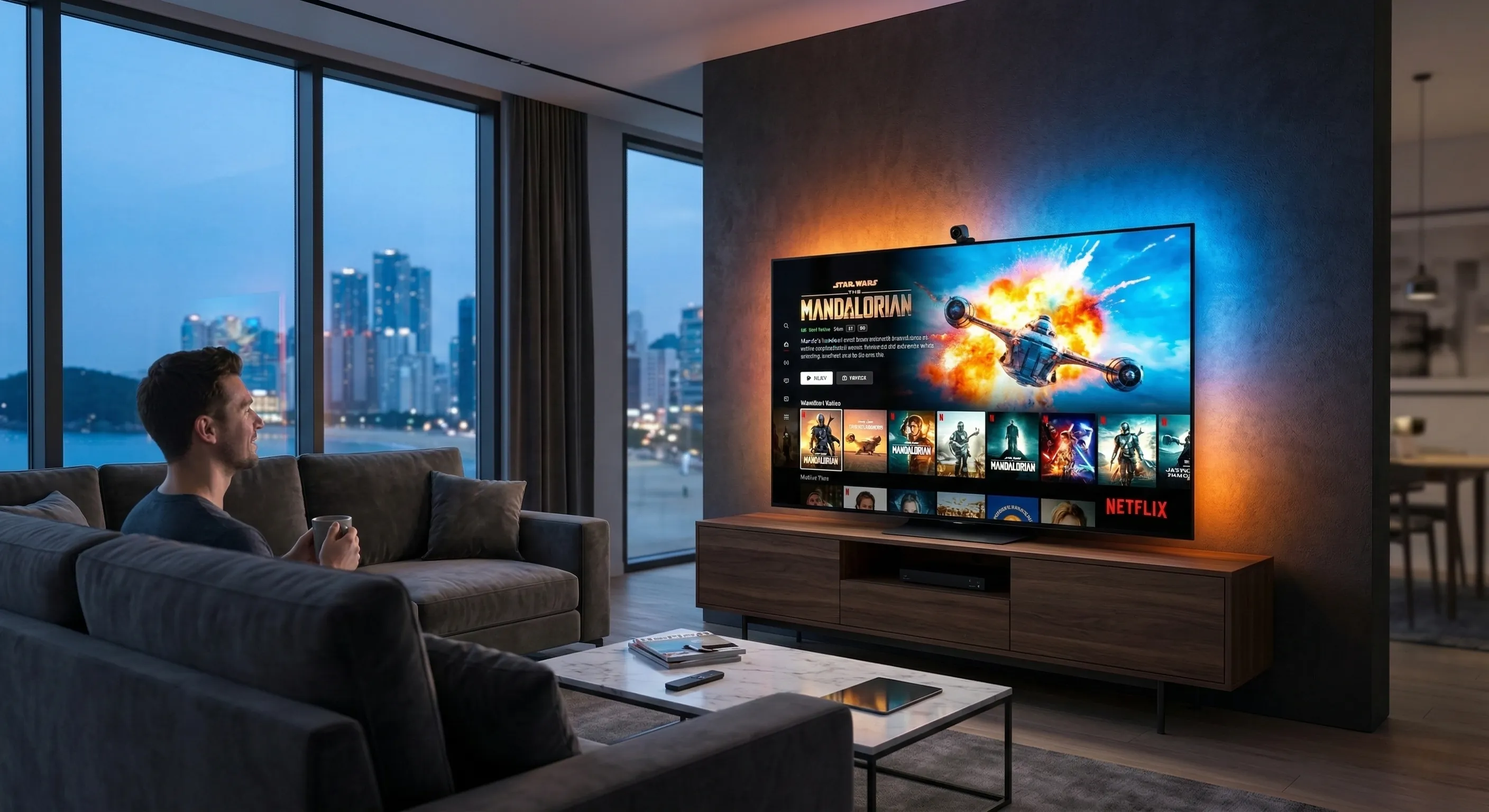
This innovative system employs a dedicated camera to analyze the colors displayed on your screen, then replicates those hues dynamically via the accompanying lightstrip.
A significant advantage of this method is its inherent compatibility with native TV apps, meaning you can enjoy immersive lighting effects directly from your smart TV's built-in streaming services like Netflix or Disney+ without needing additional HDMI switching.
Users benefit from 4 Mirror Modes, allowing them to choose between subtle ambient background lighting, fluid color melts for a seamless transition, or a direct '4D' match for intense, accurate color synchronization.
The Versatile Camera Positioning ensures flexible installation, as the camera can be mounted either above or below your screen to suit your specific setup.
For added peace of mind, a Magnetic_Privacy_Cover is included, allowing you to easily block the camera lens when screen mirroring is not in use.
🔹 Tailored Light for Every Smart TV Streamer
The primary benefit of Nanoleaf's camera-based approach is its unparalleled universal compatibility, making it an ideal choice for households that heavily rely on their smart TV's built-in streaming apps.
Imagine effortlessly transitioning from a game on your console to a movie on Netflix, directly within your smart TV's interface, and your ambient lighting seamlessly follows the content without any extra effort or hardware changes.
This eliminates the need for complex HDMI setups or external boxes, simplifying your entertainment system significantly.
The Versatile Camera Positioning is a practical pro, accommodating various TV mounts and room configurations, ensuring that most users can achieve optimal light synchronization regardless of their setup.
Furthermore, the inclusion of a Magnetic_Privacy_Cover directly addresses modern privacy concerns, building trust and offering users full control over when the camera is active.
The flexibility of the 4 Mirror Modes caters to a spectrum of preferences, from those seeking a subtle, relaxing glow to enthusiasts desiring a hyper-dynamic, direct match to their on-screen action.
However, a trade-off of a camera-based system is its reliance on visual input; ambient room lighting or screen reflections can, in some scenarios, subtly influence the camera's color interpretation, though Nanoleaf's advanced algorithms are designed to mitigate this.
While generally compact, the camera's physical presence on your TV might not appeal to everyone.
🔹 Real-World Readiness and User Experience Insights
Community sentiment for the Nanoleaf 4D system currently shows a rating of 3.4 out of 5 stars from a modest 10 customer reviews.
This suggests a generally positive but still evolving user reception, with potential for further refinement as more users share their experiences.
An important consideration for users is that voice assistant control for the system is currently limited to non-mirroring effects, such as turning lights ON/OFF, activating pre-set Scenes, or engaging Rhythm Mode.
Mirroring functions, being dynamic and screen-dependent, are controlled via the Nanoleaf App or physical controller.
For users who primarily consume content through their smart TV's native applications and prioritize simplicity over intricate wiring, the Nanoleaf 4D Screen Mirror + Lightstrip Kit presents a compelling, ready-to-use solution.
To achieve the best possible color accuracy, expert tip: ensure your room lighting doesn't cast harsh glares on the screen, and experiment with the Versatile Camera Positioning to find the spot that gives the camera the clearest view of your TV's display.
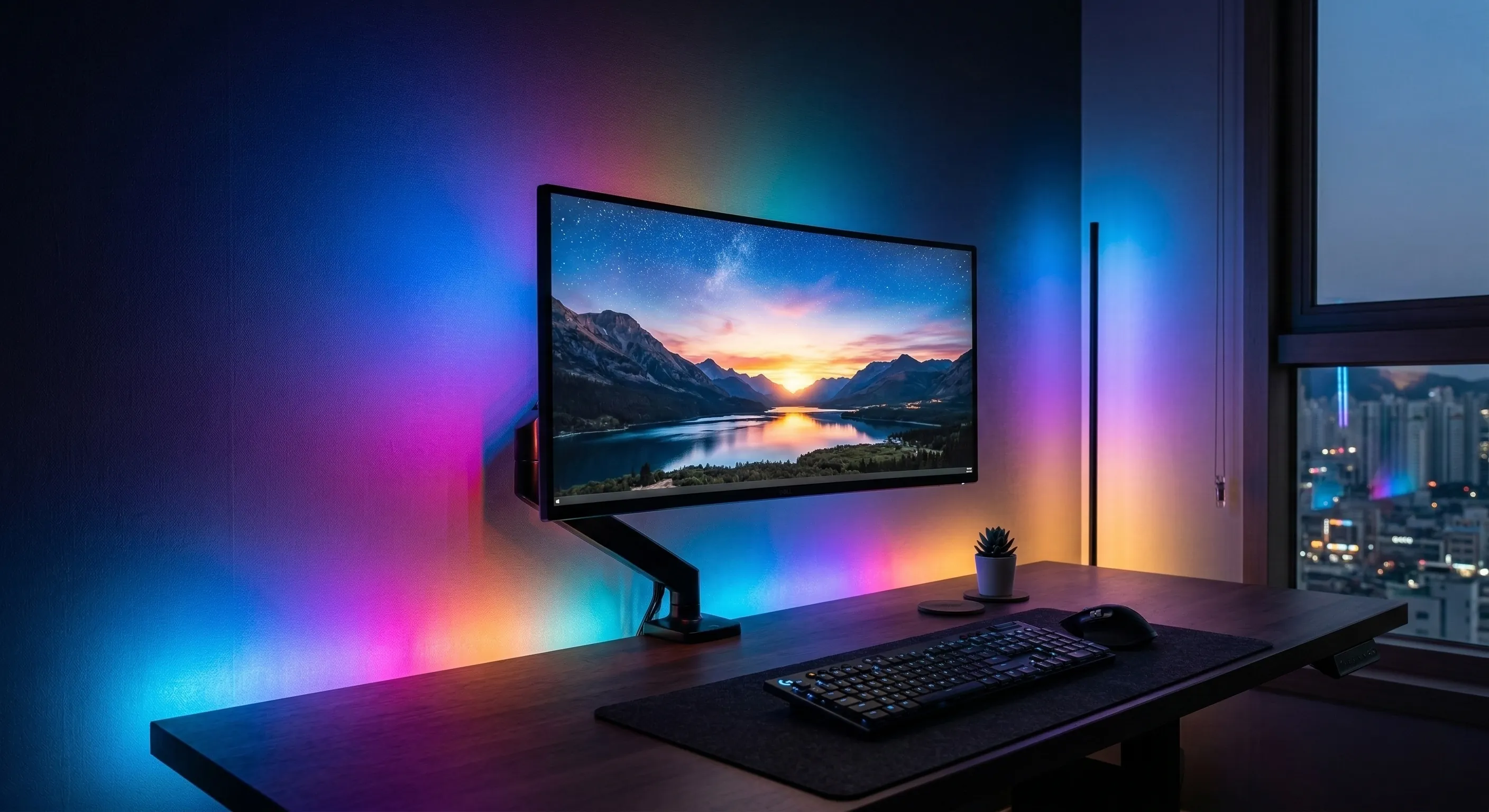
6. Designing Your 'Deskterior': A Deep Dive into Light Quality & Aesthetics
🔹 Illuminating Specs: Density, Brightness, and Color Craft
When curating the perfect desk environment, the foundational elements of light quality are paramount.
`Govee's light strips` stand out with a robust `LED density of 75 LEDs/m`, ensuring a remarkably continuous and smooth light emission around your workspace.
These strips deliver a substantial `light strip brightness of 450 lumens/m`, providing ample direct and ambient illumination.
Crucially, `Govee utilizes RGBWIC Four-Color Mixing`, a sophisticated technology designed to achieve purer white light and exceptionally accurate, vivid color blends.
In contrast, `Nanoleaf's Addressable Gradient strips` prioritize dynamic effects, offering `10 color zones per meter` for incredibly granular and fluid color transitions.
The total `white brightness for Nanoleaf` is stated as `1075 Lumens`, though this is for the entire strip, with its strength lying in intricate color sequencing rather than uniform per-meter intensity.
For those meticulously planning a pristine, distraction-free aesthetic, the `Philips Hue approach` offers a significant `"full screen view" benefit (no camera)`, ensuring no hardware interferes with your display's clean lines.
🔹 Crafting Ambiance: From Subtle Gradients to Vivid Washes
Imagine beginning your workday bathed in a soft, uniform glow from `Govee's 75 LEDs/m strips`, their `450 lumens/m brightness` reducing screen glare and eye strain.
The `RGBWIC Four-Color Mixing` effortlessly renders a perfect, pure white light for focused tasks or shifts to vibrant, accurate colors that dynamically enhance your screen content, creating an immersive backdrop for productivity or casual browsing.
For the evening, consider a creative session where `Nanoleaf's Addressable Gradient strip` transforms your desk with seamless color shifts, each of its `10 color zones per meter` contributing to a living, breathing lightscape.
Whether it's a gentle, flowing sunset or an energetic burst of game-synced hues, the `addressable gradient` creates an artistic ambiance that feels bespoke, leveraging its `1075 Lumens white brightness` for overall environmental illumination without overshadowing the intricate light play.
For the minimalist who values an uninterrupted visual experience, the `Philips Hue "full screen view" benefit (no camera)` ensures that your sleek monitor remains the focal point, with ambient light extending from the screen without any physical obstruction.
This allows for a truly seamless extension of your display's visuals into your room, enhancing the overall deskterior without compromising its clean aesthetic.
🔹 The Luminary's Verdict: Prioritizing Your Deskterior Vision
When evaluating the best visual quality for a pristine desk setup, your choice hinges on desired effect and aesthetic preference.
`Govee's light strips` excel for those seeking high `LED density (75 LEDs/m)`, superior `brightness (450 lumens/m)`, and exceptional `color accuracy through RGBWIC Four-Color Mixing`, delivering a consistently vibrant and uniform light.
This makes it ideal for a desk that needs powerful, precise, and evenly distributed illumination.
Conversely, `Nanoleaf's Addressable Gradient strip with 10 color zones per meter` is the go-to for users who prioritize sophisticated dynamic lighting, fine-grained control over color flow, and unique artistic gradients, even if its overall `1075 Lumens white brightness` is distributed across the strip.
The integration of `Philips' "full screen view" benefit (no camera)` offers a compelling advantage for ultimate aesthetic purity, ensuring no physical camera interrupts your monitor's sleek profile.
Ultimately, your ideal 'deskterior' will dictate whether you lean towards Govee's bright, accurate uniformity or Nanoleaf's dynamic, granular artistry, all while considering the visual impact of an unobtrusive setup.
7. Buyer's Remorse? Unboxing the Real-World Quirks & Limitations
🔹 The Unadvertised Hurdles and Hidden Requirements
For those considering the Govee AI Gaming Sync Box Kit 2, you'll find the setup straightforward with the included HDMI 2.1 Cable * 2, HDMI 2.1 Sync Box *1, Strip Lights *1, and Power Adapter *1.
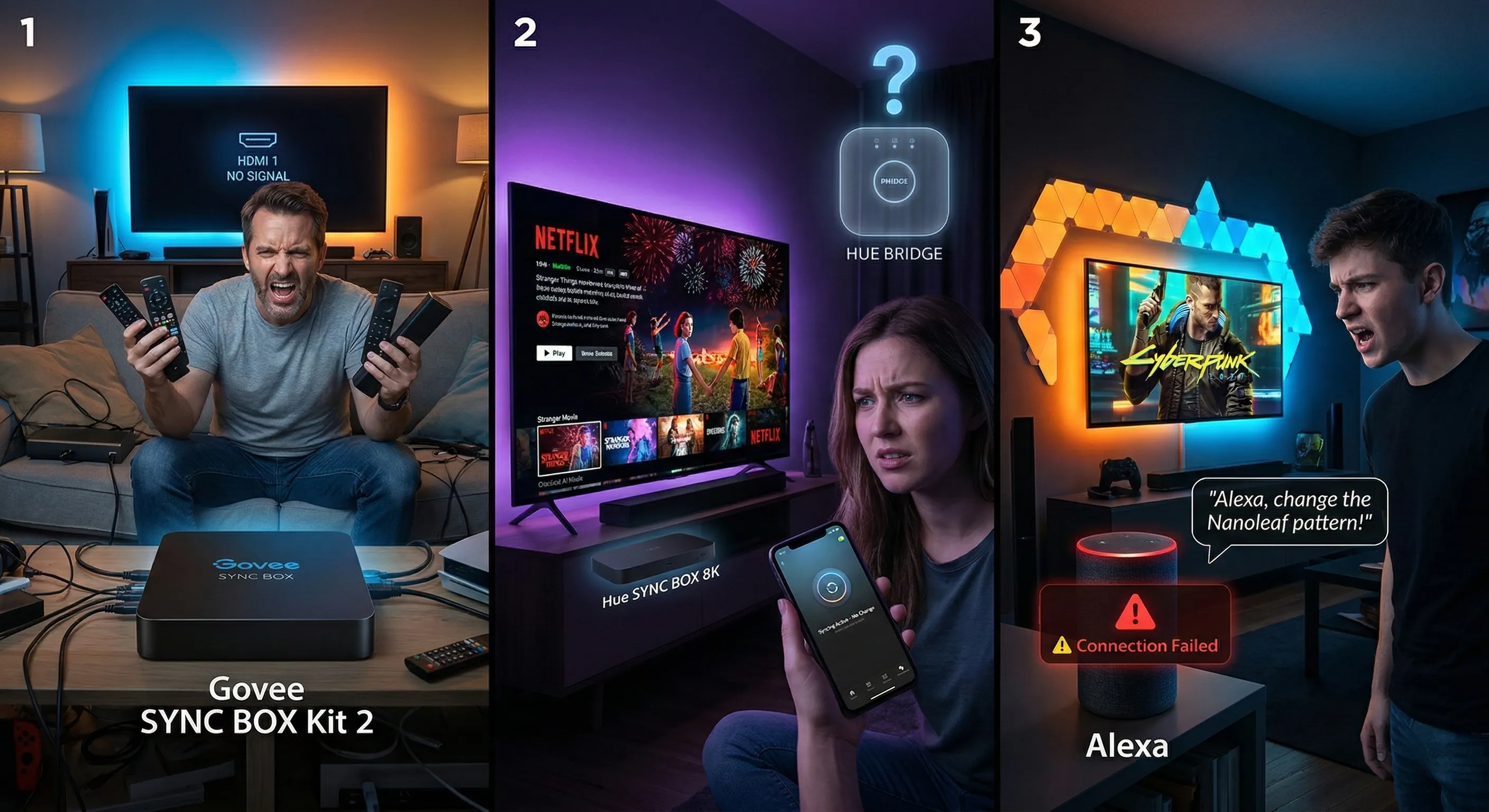
However, a significant practical limitation quickly surfaces: automatic signal switching is not supported when multiple devices are connected.
This means you'll be manually toggling inputs.
Furthermore, when using high dynamic range formats like HDR, HDR10+, or Dolby Vision, be prepared for the saturation of the light's color to decrease.
While Govee states this is "normal" and "adjustable in app," it's an undeniable impact on visual fidelity for advanced users.
Shifting focus to the Philips Hue Play HDMI Sync Box 8K, a crucial prerequisite often catches new users off guard.
This system requires a Hue Bridge to use for full potential.
This is an additional, non-negotiable purchase to unlock the system's core capabilities, significantly adding to the overall cost and complexity.
Another major point of contention is its syncing capability: it can only sync with HDMI devices, not with TV apps.
So, if you primarily use your smart TV's built-in apps for streaming, this box won't extend those colors into your room.
Finally, with the Nanoleaf 4D Screen Mirror + Lightstrip Kit, which includes the Addressable Zigzag Gradient Lightstrip x1, Magnetic Privacy Cover x1, Nanoleaf 4D Controller x1, Power Supply x1, Screen Mirror Camera x1, and Camera Mount x1, the promise of smart control is somewhat curtailed.
Be aware that Voice Assistant control is only for non-mirroring effects.
This means commands like ON/OFF, switching Scenes, or engaging Rhythm Mode work fine.
However, managing or altering the actual screen mirroring functions via voice is off-limits.
🔹 Day-to-Day Disappointments and Connectivity Conundrums
Imagine setting up your new Govee AI Gaming Sync Box Kit 2, excited to dive into your next gaming session or movie night.
You've painstakingly run the strip lights around your TV and connected both your console and streaming stick to the sync box using the provided HDMI 2.1 Cables.
But then, the initial frustration hits: every time you switch from your PlayStation to Netflix, you have to manually change the input on the sync box.
That seamless, smart home experience you envisioned is disrupted by constant manual intervention.
Even more disappointing, when you finally settle into a stunning HDR movie, the vibrant, rich ambient lighting you expected might appear duller, with colors noticeably desaturated.
While you *can* tweak it in the app, it's an extra step you shouldn't have to take to achieve the expected visual punch.
For the Philips Hue Play HDMI Sync Box 8K, the initial setup can quickly sour.
You've invested in this premium syncing solution, only to discover that the fundamental brain of the operation – the Hue Bridge – isn't included and is an absolute requirement for it to function beyond basic on/off.
It's an unwelcome hidden cost that feels like being nickel-and-dimed after a significant purchase.
Then, you settle down to watch your favorite show via your TV's built-in Netflix app, expecting your Hue lights to dance with the on-screen action.
Nothing.
The realization that it can only sync with HDMI devices and completely ignores your smart TV's native apps is a massive letdown, severely limiting its utility for modern streaming habits.
With the Nanoleaf 4D Screen Mirror + Lightstrip Kit, you might be eager to integrate it fully into your smart home ecosystem, leveraging its lightstrip, camera, and controller.
You're used to barking commands at Alexa or Google Assistant for everything, only to find a peculiar silence when trying to control the actual mirroring effects.
"Alexa, change Nanoleaf 4D mirror mode" yields no response.
Your voice assistant is relegated to basic functions like turning the lights ON/OFF or changing Scenes, forcing you to grab the physical Nanoleaf 4D Controller or your phone for anything related to the core mirroring feature.
This breaks the immersion of a truly smart, voice-controlled environment, adding a layer of inconvenience to what should be effortless ambiance.
🔹 The Fine Print: What Current Users Are Discovering
In the realm of ambient lighting, buyers are quickly learning that even with sophisticated kits that include numerous components for setup, the devil is often in the details of their limitations.
The expectation of a truly seamless, "set it and forget it" experience often clashes with the reality of practical use.
Whether it's the Govee AI Gaming Sync Box Kit 2 demanding manual intervention for input switching and compromising HDR color, or the Philips Hue Play HDMI Sync Box 8K silently demanding an additional Hue Bridge and refusing to play nice with popular TV apps, these systems present significant caveats.
The Nanoleaf 4D Screen Mirror + Lightstrip Kit, too, falls short of a fully integrated smart home experience when voice commands are restricted from its most engaging feature.
Prospective buyers should carefully weigh these quirks and limitations against their individual usage patterns and willingness to tolerate workarounds or invest further, lest they find themselves suffering from a case of buyer's remorse.
The "normal" operation or "full potential" often translates into unexpected inconveniences or additional expenses post-purchase.
8. Final Verdict: Your Perfect Immersive Lighting Match
🔹 Core Strengths in Illumination
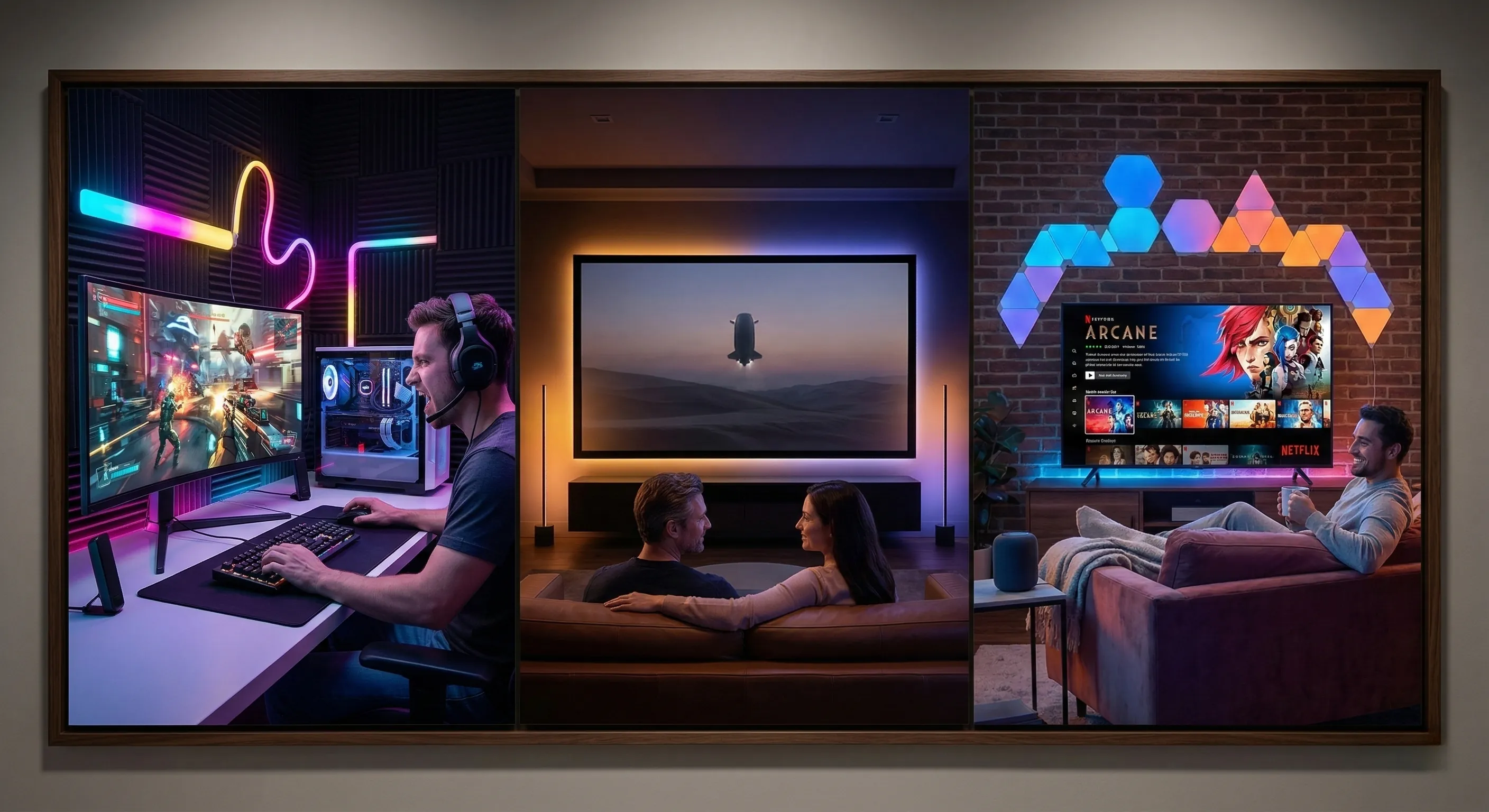
The Govee AI Gaming Sync Box Kit 2 (HDMI 2.1) stands out as the ultimate choice for performance gamers who demand the most responsive and detailed screen mirroring experience.
For those deeply embedded in the Philips Hue smart home ecosystem, the Philips Hue Play HDMI Sync Box 8K offers unparalleled integration for existing Hue home theater users, seamlessly extending their ambient lighting.
The Nanoleaf 4D Screen Mirror + Lightstrip Kit caters perfectly to users seeking simplicity and direct smart TV app integration, providing an easy entry into immersive lighting.
🔹 Tailored Experiences for Every User
If you're a high-spec enthusiast, particularly a dedicated gamer, the Govee system transforms your play into a hyper-responsive, full-room spectacle.
Imagine the vibrant explosions and subtle environmental shifts in your favorite AAA title expanding beyond your screen, engulfing your entire space in real-time.
For the desk-conscious developer who values a cohesive and integrated smart home, the Philips Hue Sync Box provides a seamless expansion of your existing Hue lighting setup.
Your meticulously curated home theater comes alive, enhancing movie nights or streaming sessions with synchronized lighting that feels like a natural extension of your environment, without cluttering your workspace with new apps or devices.
The plug-and-play beginner will find the Nanoleaf 4D kit incredibly accessible, especially if your primary content source is smart TV apps.
Forget complicated setups; simply mount the camera and enjoy instant, dynamic screen mirroring that brings your shows and movies to life directly from your television's built-in applications.
🔹 Community Consensus & Your Final Pick
The Govee AI Gaming Sync Box Kit 2 (HDMI 2.1) holds a strong reputation, boasting a Customer_Reviews_Rating of 4.2 out of 5 stars from an impressive 479 Customer_Reviews_Count, solidifying its appeal to serious gamers.
Similarly, the Philips Hue Play HDMI Sync Box 8K maintains a robust Customer_Reviews_Rating of 4.2 out of 5 stars across 220 Customer_Reviews_Count, a testament to its reliability within the Hue ecosystem.
The Nanoleaf 4D Screen Mirror + Lightstrip Kit, while offering unique simplicity, has a Customer_Reviews_Rating of 3.4 out of 5 stars from 10 Customer_Reviews_Count, suggesting it's a newer entrant or has a more niche audience that values its specific camera-based approach.
Choose Govee for ultimate gaming performance, Philips Hue for seamless existing smart home integration, or Nanoleaf for straightforward smart TV app mirroring.
9. 💡 Tech Talk: Making Sense of the Jargon
- CogniGlow Technology: Imagine your TV is smart enough to "see" what's on the screen – whether it's a green forest or a red explosion – and then instantly tells your lights to match those specific colors, even recognizing text for nuanced effects.
- RGBWIC Four-Color Mixing: This isn't just mixing red, green, and blue. The 'WIC' adds extra white, amber, and cool white lights, allowing for super vibrant colors, delicate pastels, and truly pure, natural white light without any unwanted yellow or blue tint.
- Matter Support: Think of "Matter" as a universal language for all your smart home gadgets. It allows your Govee lights to easily talk to and work seamlessly with smart home systems from Apple, Google, Amazon, and others, making everything simpler to control from one place.
- Addressable Gradient Lightstrip: Imagine your light strip isn't just one long light, but many tiny sections, each like its own mini-light. "Addressable gradient" means each of these mini-lights can show a different color, creating smooth, flowing changes or waves of color along the strip, rather than just being one solid color.
🎁 Special Offers for You
Find the perfect Amazon Prime plan that fits your lifestyle and budget.
Standard Prime
Elevate your shopping experience. Fast, free delivery and exclusive streaming.
Prime for Students
Student life just got better. Get 6 months of Prime for $0 and 5% cash back.
Prime Access
All of Prime, half the price. Get full access for just $6.99/month.
📚 Related Posts
Smart Ring Showdown 2024: Oura vs. Samsung vs. RingConn Review
🚀 Key TakeawaysThe Oura Ring 4 stands out as a true "performance instrument," offering comprehensive health tracking with blood oxygen, continuous heart rate, and advanced sleep/readiness insights.These specs ensure reliable daily wearability and uninte
tech.dragon-story.com
2026 AI Translator Earbuds Review: Timekettle W4 Pro vs Samsung Buds4 Pro
🚀 Key TakeawaysThe Timekettle W4 Pro AI Interpreter Earbuds lead the market as a dedicated tool for real-time, bidirectional simultaneous translation across 43 languages.Unlike general audio gear, it features a unique Bone-Voiceprint Sensor and AI Self-
tech.dragon-story.com
ASUS Zenbook S 16 vs. Surface Laptop 7: The Ultimate 2026 AI PC Buying Guide
🚀 Key TakeawaysThe ASUS Zenbook S 16 (UM5606) leads the charge for local AI tasks, featuring the AMD Ryzen™ AI 9 HX470 Processor.Microsoft's Surface Laptop (7th Edition) - 15" offers a compelling Snapdragon® X Elite processor with a 45 TOPS Qualcomm
tech.dragon-story.com


