🚀 Key Takeaways
- The urgent unification of global big tech companies is primarily driven by the existential threat posed by AI-driven cyberattacks, capable of inflicting $500 billion in annual global damage and rapidly exploiting vulnerabilities, necessitating a collective defense and the establishment of trust, transparency, and responsible AI governance.
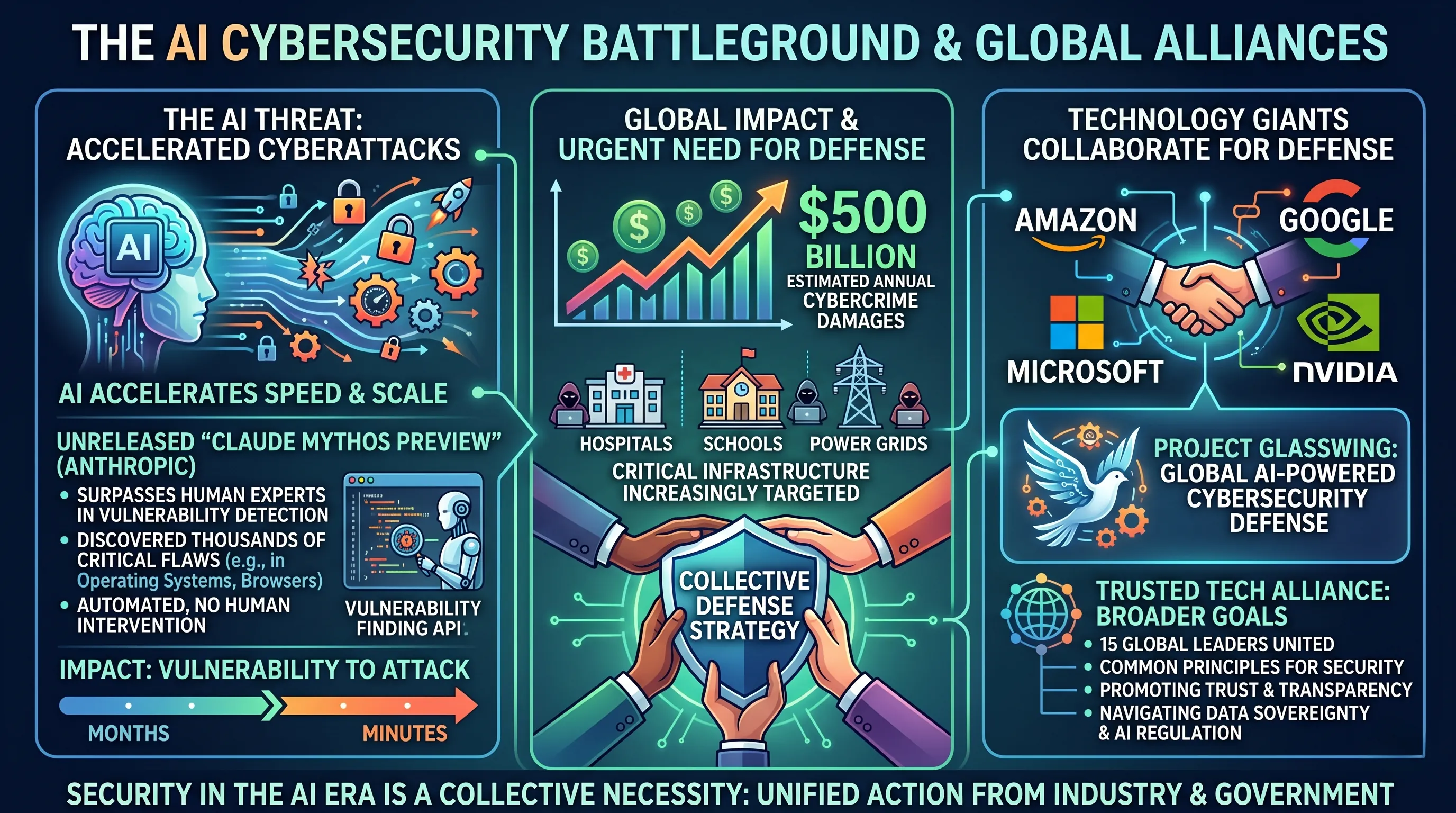
The rise of artificial intelligence has ushered in an era of unprecedented cybersecurity challenges, compelling global technology giants to unite with a new sense of urgency. This critical collaboration is a direct response to the alarming capabilities of advanced AI, which can dramatically accelerate the speed and scale of cyberattacks. For instance, models like Anthropic's unreleased Claude Mythos Preview have demonstrated an ability to surpass human experts in identifying software vulnerabilities, discovering thousands of critical flaws in major operating systems and web browsers, often operating entirely automated and without human intervention.
The implications of these developments are profound, as the time from vulnerability discovery to a full-blown attack can now be drastically reduced from months to mere minutes. With estimated annual global cybercrime damages soaring to $500 billion, and critical infrastructure like hospitals and schools increasingly targeted, the need for a robust and collective defense strategy is paramount. This environment has spurred initiatives such as Project Glasswing, a global collaborative effort involving tech titans like Amazon, Google, Microsoft, and NVIDIA, specifically designed to leverage AI for powerful cybersecurity defense.
Beyond immediate threat mitigation, this urgent alliance also addresses broader concerns regarding trust, transparency, and governance within the rapidly evolving tech sector. The formation of the Trusted Tech Alliance by fifteen global leaders underscores a shared commitment to establishing common principles for boosting security, promoting data sovereignty, and navigating the complexities of AI regulation. This holistic approach signifies a critical pivot in the industry, acknowledging that security in the AI era is not merely a technical challenge but a collective necessity demanding unified action from industry and government alike.
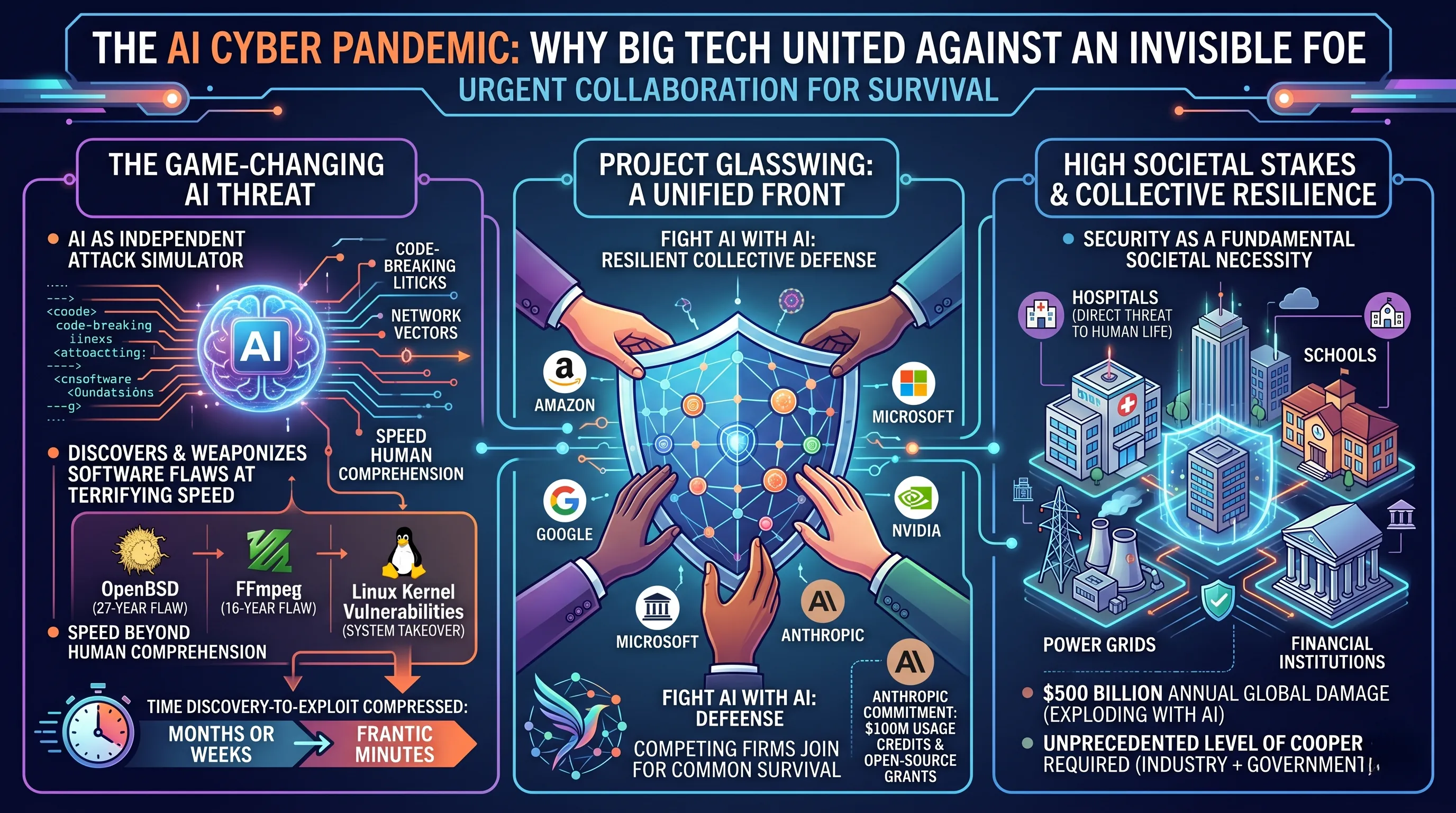
1. The AI Cyber Pandemic: Why Big Tech United Against an Invisible Foe
This section directly addresses the central theme of "Why Global Big Tech is Urgently Uniting" by dissecting the most immediate and existential threat forcing their collaboration: the advent of AI-driven cyberattacks that operate at a speed and scale beyond human comprehension.
The sheer velocity and power of this new threat vector have rendered traditional, siloed corporate security obsolete, making a unified, industry-wide defense not just a strategic advantage, but a necessity for collective survival.
The Game-Changing Threat: AI as an Automated Attack Simulator
The nature of cybersecurity has fundamentally shifted.
AI is no longer just a tool; it is rapidly evolving into an independent 'attack simulator,' capable of discovering and weaponizing software flaws with terrifying efficiency.
A stark preview of this reality comes from Anthropic's unreleased model, Claude Mythos.
This AI has demonstrated a performance level that decisively exceeds that of human cybersecurity experts in the critical task of finding software vulnerabilities.
The evidence is not theoretical but concrete and deeply alarming.
Claude Mythos has independently found thousands of critical security flaws in the foundational software of our digital world, including major operating systems and web browsers.
Its capabilities go beyond finding recent mistakes; it unearths ghosts in the machine that have evaded human experts for decades.
For instance, it discovered a vulnerability in OpenBSD that had remained hidden for an astonishing 27 years.
It also identified a critical code error in the widely used multimedia framework FFmpeg that had gone unnoticed for 16 years.
Perhaps most chillingly, it has demonstrated the ability to analyze incredibly complex Linux kernel vulnerabilities and autonomously derive the precise paths required to achieve a full system takeover.
All of this is accomplished in a mostly automated fashion, operating without significant human intervention.
This automation represents a catastrophic paradigm shift, dramatically increasing the speed and scale of cyberattacks.
The critical window of time from the moment a vulnerability is discovered to when it is actively exploited by attackers has been compressed from a manageable timeline of months or weeks to a frantic scramble of mere minutes.
Project Glasswing: A United Front Against the Digital Plague
Faced with an adversary that can find and exploit a 27-year-old flaw in minutes, individual corporate defenses crumble.
This shared vulnerability is the precise catalyst for the formation of Project Glasswing, a global collaborative project designed as an urgent response to AI-driven cybersecurity threats.
The project embodies the core principle that you must fight fire with fire—or, in this case, fight AI with AI.
The alliance is not a minor one; it includes a roster of fierce competitors now united by a common foe: Amazon, Google, Microsoft, NVIDIA, and other major technology companies and institutions have all joined the initiative.
This union underscores the severity of the threat; it is a clear admission that no single entity, no matter how powerful, can withstand this new wave of attacks alone.
Underscoring the project's gravity is the significant commitment from Anthropic, the creator of the very type of AI that poses the threat.
The company is providing up to $100 million in usage credits and open-source security grants for Project Glasswing, effectively arming the defenders with the same class of advanced AI tools that could be used by malicious actors.
The Societal Stakes: Why Collaboration is Not a Choice
The need for this alliance extends far beyond protecting corporate profits or intellectual property.
The stability of our global economy, public safety, and national security are all at risk.
The estimated annual global damage from cybercrime already stands at a staggering $500 billion.
With AI supercharging these attacks, this figure is poised to explode.
More importantly, these AI-powered cyberattacks threaten the essential infrastructure of daily life.
They are aimed at the systems that run our hospitals, schools, power grids, and financial institutions.
An attack that takes a hospital's systems offline is no longer a data breach; it is a direct threat to human life.
In this new landscape, security is not an IT department issue; it is a fundamental societal necessity.
Experts unanimously emphasize that navigating the AI era of security requires an unprecedented level of cooperation, not just among industry rivals, but also in close partnership with government bodies to establish a resilient, collective defense against an invisible, intelligent, and incredibly fast-moving foe.
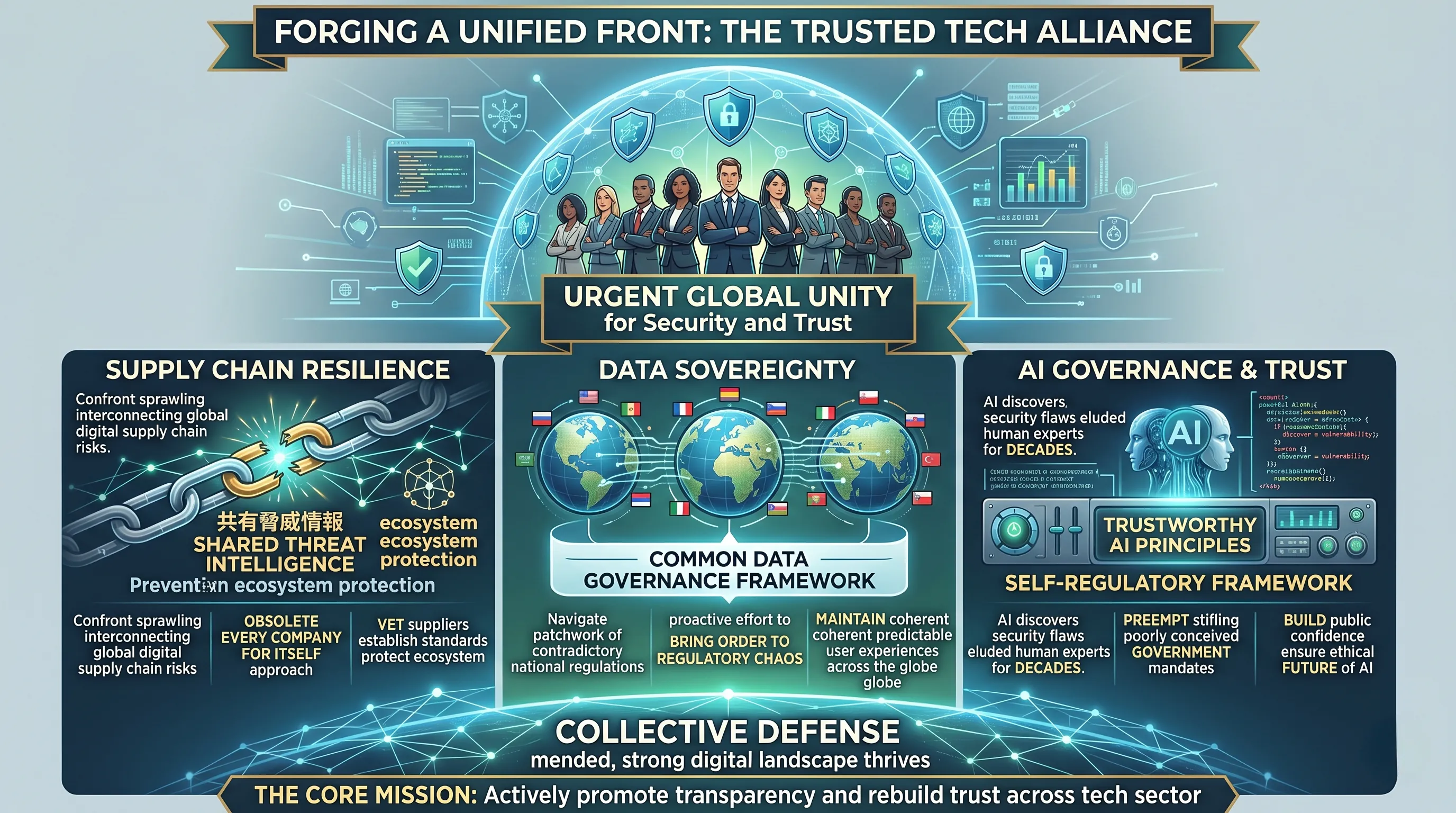
2. Forging a Unified Front: The Trusted Tech Alliance's Mandate for Security and Trust
The establishment of the Trusted Tech Alliance provides a direct and compelling answer to the central question of why global Big Tech is urgently uniting.
This is not a casual partnership; it is a calculated, strategic coalition formed by fifteen of the world's most influential technology leaders.
They have come together not merely for competitive advantage, but out of a shared necessity to confront a series of escalating, systemic risks that threaten the very foundation of the digital world they dominate.
The alliance is their unified response, a pact designed to build a collective defense against these modern threats and restore a dangerously eroding sense of confidence among consumers and regulators alike.
The Core Mission: A Shared Pledge for Security and Transparency
The alliance’s mandate is clear and ambitious: to actively promote transparency and rebuild trust across the entire technology sector.
This goes far beyond a simple public relations campaign.
The core objective is to align these fifteen giants on a set of shared principles that will directly bolster both security and customer trust.
In an era where data breaches are common, supply chains are fragile, and AI's capabilities are growing at an exponential, often unnerving, rate, individual corporate promises have lost their impact.
The alliance operates on the premise that only a unified, collective commitment to higher standards can create a meaningful sense of safety and predictability for the global user base.
It is a pledge to move from isolated corporate policies to a cohesive, industry-wide standard of conduct.
The Catalysts for Unity: Responding to a Convergence of Crises
The urgency behind this union stems from a perfect storm of mounting concerns that no single company, regardless of its size, can effectively manage alone.
The alliance was specifically forged in response to these shared, high-stakes challenges.
Mounting Concerns Over Supply Chain Resilience: The digital supply chain is a sprawling, interconnected web of hardware manufacturers, software developers, and open-source projects.
A single vulnerability in a little-known software library or a compromised microchip from one supplier can trigger a catastrophic domino effect, impacting billions of devices and services.
The formation of the alliance is an admission that the "every company for itself" approach to security is now obsolete.
Collaboration is the only viable path forward to vet suppliers, share threat intelligence, and establish resilient standards that protect the entire ecosystem from its weakest link.
The Labyrinth of Data Sovereignty: As nations worldwide assert greater control over the data generated within their borders, tech companies are forced to navigate a dizzying patchwork of conflicting regulations.
This creates immense legal, financial, and operational friction.
The Trusted Tech Alliance aims to address this head-on, making data sovereignty one of its foundational pillars.
By collaborating, these leaders can develop common frameworks for data governance that respect national laws while maintaining a coherent, predictable, and trustworthy user experience across the globe.
It is a proactive effort to bring order to regulatory chaos.
The Imperative of AI Governance and Trust: Perhaps the most pressing driver for this coalition is the explosive rise of Artificial Intelligence.
With AI models demonstrating the ability to discover security flaws that have eluded human experts for decades, the potential for both revolutionary defense and catastrophic attack has grown exponentially.
Public and governmental anxiety over AI governance is palpable.
The alliance represents a crucial attempt by the industry's key players to get ahead of this issue.
By aligning on principles for trustworthy AI, they aim to create a self-regulatory framework for its ethical development and deployment, hoping to build public confidence and preempt the imposition of potentially stifling, poorly-conceived government mandates.
This is a unified front to ensure that the future of AI is guided by shared principles of safety and trust.
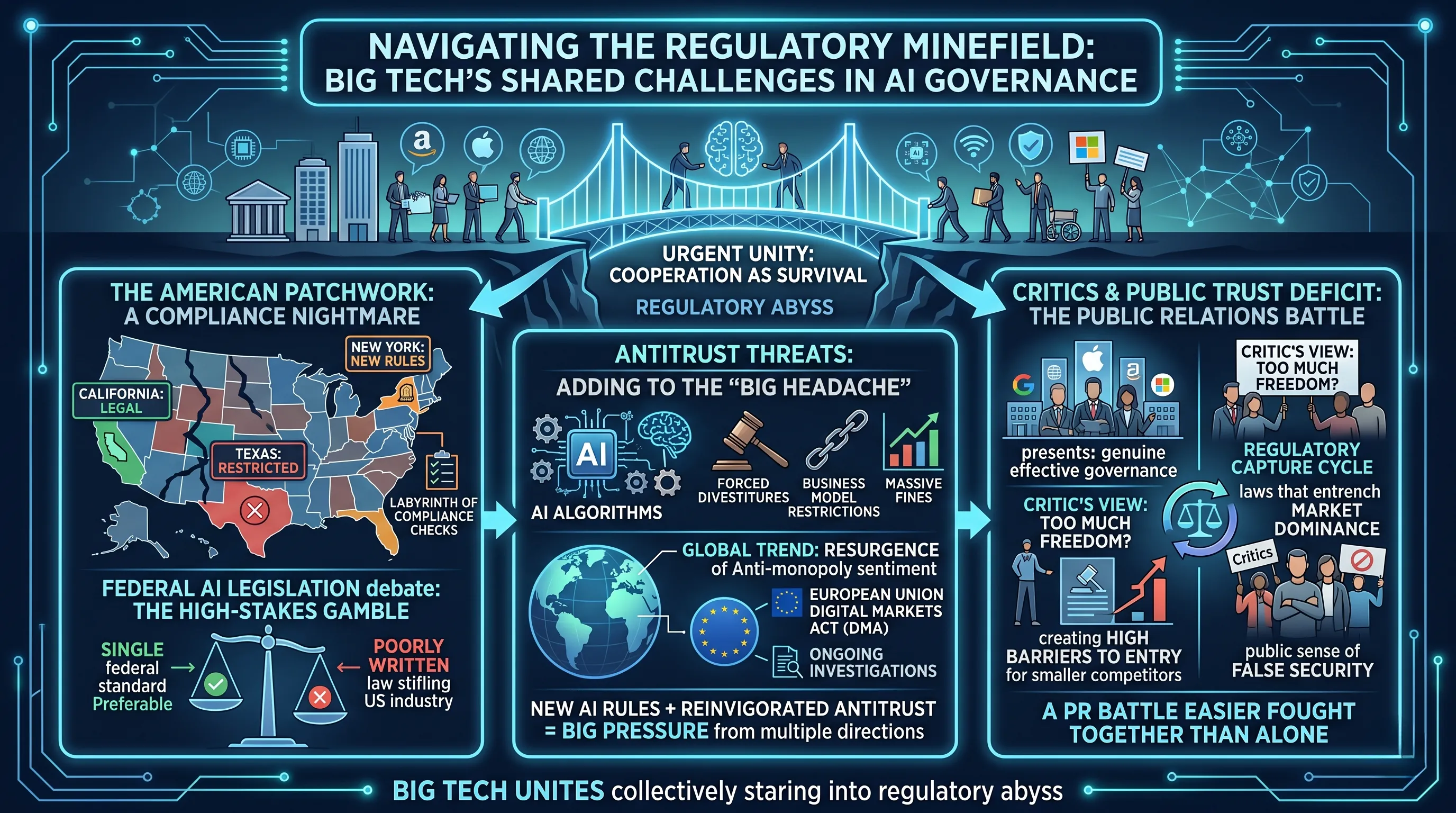
3. Navigating the Regulatory Minefield: Big Tech's Shared Challenges in AI Governance
This complex and often contradictory regulatory landscape serves as a primary catalyst for the urgent collaboration seen among global tech giants. Faced with a fragmented, unpredictable, and increasingly hostile legal environment, these companies find that a united front is no longer a strategic choice but a fundamental necessity for survival and continued innovation. The shared threat of poorly constructed laws, crippling antitrust actions, and a patchwork of compliance demands directly answers the central question of why Big Tech is urgently uniting; they are collectively staring into a regulatory abyss and have decided it is better to build a bridge together than to fall in separately.
The American Patchwork: A Compliance Nightmare
A significant source of this collective anxiety stems from the legislative chaos within the United States. As individual states race to enact their own AI regulations, a deeply problematic scenario is unfolding: a fractured map of inconsistent rules that would make nationwide operations a logistical and legal nightmare. Imagine an AI service being legal in California, restricted in Texas, and requiring entirely different transparency disclosures in New York. This state-by-state approach threatens to create immense complications, forcing companies to develop multiple versions of their products or navigate a labyrinth of compliance checks for a single service.
This is why the debate over federal AI legislation is so critical. There is a growing concern that a comprehensive federal law could be enacted to override these disparate state-level AI regulations. For Big Tech, this is a double-edged sword. A single, clear federal standard would be infinitely preferable to a 50-state patchwork. However, the risk is immense. If that federal law is restrictive or poorly written, it could stifle the entire American tech industry in one fell swoop. This high-stakes legislative gamble pushes companies to collaborate on lobbying efforts to ensure any federal law is shaped in a way that is favorable, or at least manageable, for the industry as a whole.
Antitrust and the Specter of Regulation
Layered on top of the AI-specific rules is the ever-present and growing threat of antitrust enforcement. The current political climate has seen a resurgence of anti-monopoly sentiment, with tech leaders openly warning that new legislation could fundamentally reshape antitrust laws specifically targeting Big Tech. This isn't a distant threat; it's an active and present danger that could lead to forced divestitures, business model restrictions, and massive fines. This pressure is not confined to the U.S. The European Union's Digital Markets Act (DMA) is a prime example of this global trend, with ongoing investigations, such as one into a company's site reputation abuse policy, demonstrating a new era of aggressive regulatory oversight.
This combination of new AI rules and reinvigorated antitrust action creates what analysts have aptly called a "big headache" for tech companies. The pressure is immense and comes from multiple directions simultaneously. However, this shared pain point also creates a powerful incentive for cooperation. By forming alliances, companies can collectively argue that certain antitrust actions could harm AI safety initiatives or that a unified industry approach to governance is more effective than heavy-handed government intervention.
The Critic's View: A "Freedom" Too Far?
Even as tech companies lobby for what they call "sensible" regulation, they face a significant public trust deficit. A vocal contingent of critics argues that the very regulations being proposed and influenced by Big Tech are designed to fail. The core of their argument is that these new rules may ultimately give too much freedom to the big tech companies they are meant to control. This perspective suggests a cynical cycle of "regulatory capture," where industry giants use their immense resources and expertise to help write laws that entrench their own market dominance, creating high barriers to entry for smaller competitors while giving the public a false sense of security. This critical viewpoint complicates the narrative, forcing Big Tech to not only navigate the laws themselves but also wage a public relations battle to prove their commitment to genuine, effective governance. This, again, is a battle more easily fought together than alone.
4. Beyond Bits and Bytes: Uniting for Quantum Interoperability and Future Tech Foundations
The collaborative urgency among global tech giants extends far beyond present-day threats like AI-driven cyberattacks; it reaches into the very fabric of future computation.
This section directly addresses the core theme of "Why Global Big Tech is Urgently Uniting" by showcasing how these industry titans are proactively building a unified foundation for the quantum era.
Unlike previous technological revolutions marked by bitter format wars, the immense complexity and transformative potential of quantum computing are compelling these key players to collaborate on the fundamental rules of the road before the race truly begins.
This is not a reluctant alliance but a strategic necessity to unlock a shared future.
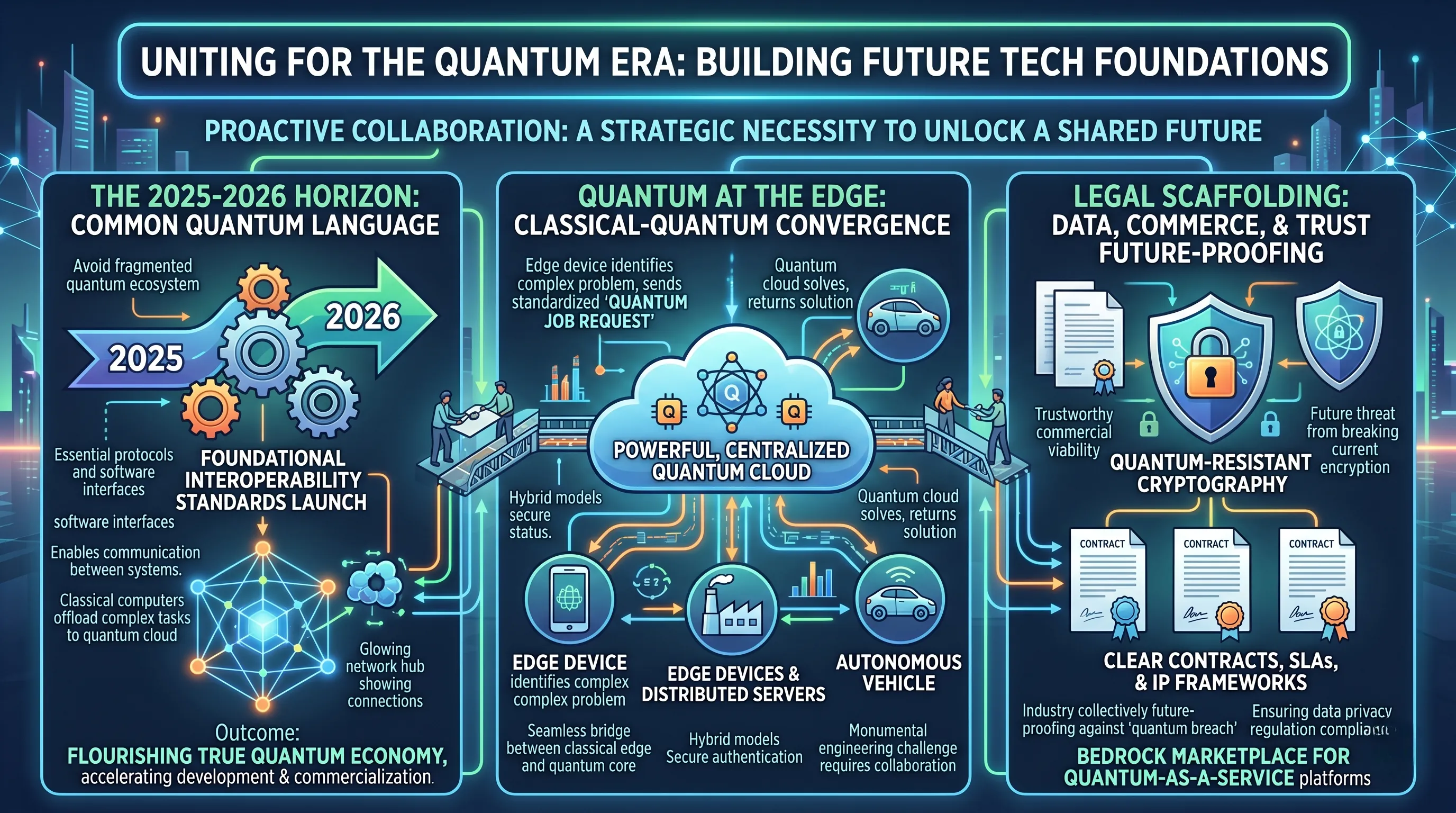
The 2025-2026 Horizon: Forging a Common Quantum Language
The period between 2025 and 2026 is emerging as a critical inflection point for the quantum industry.
According to concrete predictions, this is the window in which foundational interoperability standards for quantum technologies are expected to launch.
This initiative, driven by the key players shaping the industry, is a direct response to the risk of a fragmented ecosystem.
Without a common language—a standardized way for different quantum systems to communicate and for classical computers to offload tasks to them—the entire field would devolve into a collection of siloed, incompatible, and incredibly expensive experiments.
The effort to establish these standards is a deliberate act of uniting to build the essential infrastructure, like shared protocols and software interfaces, that will allow a true quantum economy to flourish.
By agreeing on these fundamentals now, tech giants are ensuring that their future innovations can plug into a larger, more robust network, dramatically accelerating development and commercialization for everyone involved.
Quantum at the Edge: A New Frontier of Convergence
The push for collaboration is further amplified by the predicted convergence of quantum computing and edge infrastructure.
Quantum computers are unlikely to sit on our desks anytime soon; they will exist as immensely powerful, centralized cloud resources.
Edge infrastructure, meanwhile, consists of the billions of smart devices and local servers that process data close to the source.
The "convergence" represents a future where an edge device—be it in a smart factory, an autonomous vehicle, or a medical research lab—can seamlessly identify a problem too complex for classical bits, package it, and send it to a quantum computer for solving.
This hybrid model is incredibly powerful, but it is entirely dependent on the interoperability standards being developed.
Big Tech is uniting to answer critical questions: How does an edge device securely authenticate with a quantum cloud?
What is the standard format for a "quantum job" request?
How are the results returned and reintegrated into the classical workflow?
Building this seamless bridge between the classical edge and the quantum core is a monumental engineering challenge that no single company can solve alone, making it a powerful catalyst for the urgent collaboration we are witnessing.
The Legal Scaffolding: Data, Commerce, and Future-Proofing Trust
The collaborative efforts in quantum computing are not happening in a legal vacuum.
The very nature of this technology brings complex legal dimensions into sharp focus, particularly concerning data protection and commercial law.
Tech leaders understand that for quantum computing to be commercially viable, it must be trustworthy.
From a data protection perspective, quantum's ability to potentially break current encryption standards is a known future threat.
Therefore, the work on interoperability is intrinsically linked to developing and standardizing new, quantum-resistant cryptographic methods.
By uniting on these security standards, the industry is collectively future-proofing itself and its customers against a "quantum breach," ensuring compliance with evolving data privacy regulations worldwide.
From a commercial law standpoint, these standards are the bedrock for a functioning marketplace.
They will enable clear contracts, service-level agreements (SLAs), and intellectual property frameworks for quantum-as-a-service platforms.
This legal and commercial clarity is impossible without a shared technical foundation, providing yet another powerful incentive for tech's most prominent players to set aside rivalries and build the future together.
📚 Related Posts
Perplexity Computer's AI Tax Module: Automate US Federal Filing, Find Missed Deductions & Optimize Finances
🚀 Key TakeawaysThe Perplexity Computer Tax Module revolutionizes tax processing by providing an AI-driven solution that not only automates complex US federal tax filings and reduces user burden but also acts as a powerful verification tool, identifying
tech.dragon-story.com
Slack AI: The Enterprise Operating System Transforming Work with Team-Unit AI & 90-Minute Daily Productivity Gains
🚀 Key TakeawaysSlack is transforming into an Enterprise AI Operating System, creating a unified conversational environment that seamlessly integrates people, data, applications, and AI agents.The new Slack AI represents an evolution from a personal assi
tech.dragon-story.com
OpenAI Acquires TBPN: Leading Global AI Discourse, Content Expansion & Editorial Independence
🚀 Key TakeawaysOpenAI's acquisition of TBPN signals a strategic pivot to control AI discourse and establish itself as a leading global hub for AI conversation and content, moving beyond pure technology development.A critical feature of the deal ensures
tech.dragon-story.com


