🚀 Key Takeaways
- Slack is transforming into an Enterprise AI Operating System, creating a unified conversational environment that seamlessly integrates people, data, applications, and AI agents.
- The new Slack AI represents an evolution from a personal assistant to a sophisticated 'team-unit AI', demonstrating deep understanding of organizational context and providing extensive automation capabilities across various work functions.
- This innovative update promises significant productivity gains, with some reports indicating up to 90 minutes of time savings per day, fundamentally reshaping work structures and positioning AI as a collaborative 'colleague'.
- Serving as an AI Agent Hub, the new Slack allows users to execute complex tasks automatically through simple requests, abstracting away system complexities and connecting thousands of integrated services.
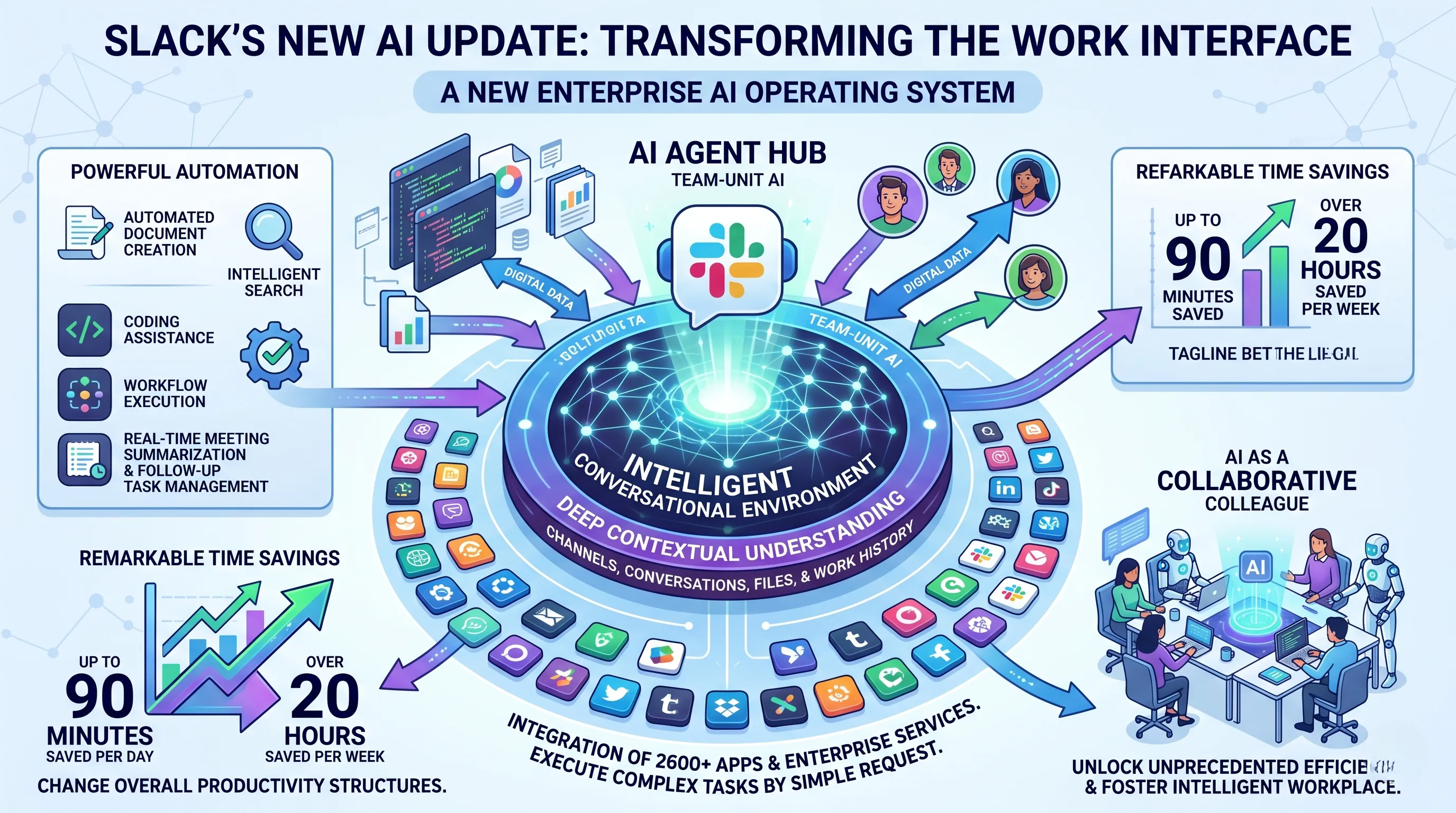
Slack has declared a profound transformation with its "New Slack AI Update," signaling a strategic shift to redefine the very interface of work. This ambitious evolution aims to converge people, data, applications, and advanced AI agents into a single, highly intelligent conversational environment.
This move positions Slack not merely as a communication tool but as a foundational enterprise AI operating system, fundamentally changing how organizations operate and interact with information.
At the heart of this innovation is the radical evolution of Slackbot into a sophisticated 'team-unit AI', moving beyond simple commands to offer deep contextual understanding across channels, conversations, files, and an organization's entire work history.
This enhanced AI now offers a suite of powerful automation features, including automated document creation, intelligent search, coding assistance, workflow execution, and real-time meeting summarization with integrated follow-up task management.
Functioning as an AI Agent Hub, it integrates over 2600 apps and countless enterprise services, empowering users to execute complex tasks simply by request, without needing to understand the underlying systems.
The implications for productivity are substantial, with some companies already reporting remarkable time savings of up to 90 minutes per day, translating to over 20 hours per week.
This significant reduction in work time is poised to change overall productivity structures, fostering an environment where AI is not just a tool but a collaborative colleague.
By connecting scattered internal "intelligence" into actionable execution, Slack's new AI promises to unlock unprecedented efficiency and foster a more integrated and intelligent workplace.
1. The Transformative Leap: Slackbot's Evolution to an Enterprise AI Operating System
This profound transformation of Slackbot from a simple utility into a core strategic asset is the very essence of Slack's "Slackbot Innovation" declaration.
It represents a paradigm shift not just for a single feature, but for the entire concept of a digital workspace, directly addressing the core theme of revolutionizing how work gets done.
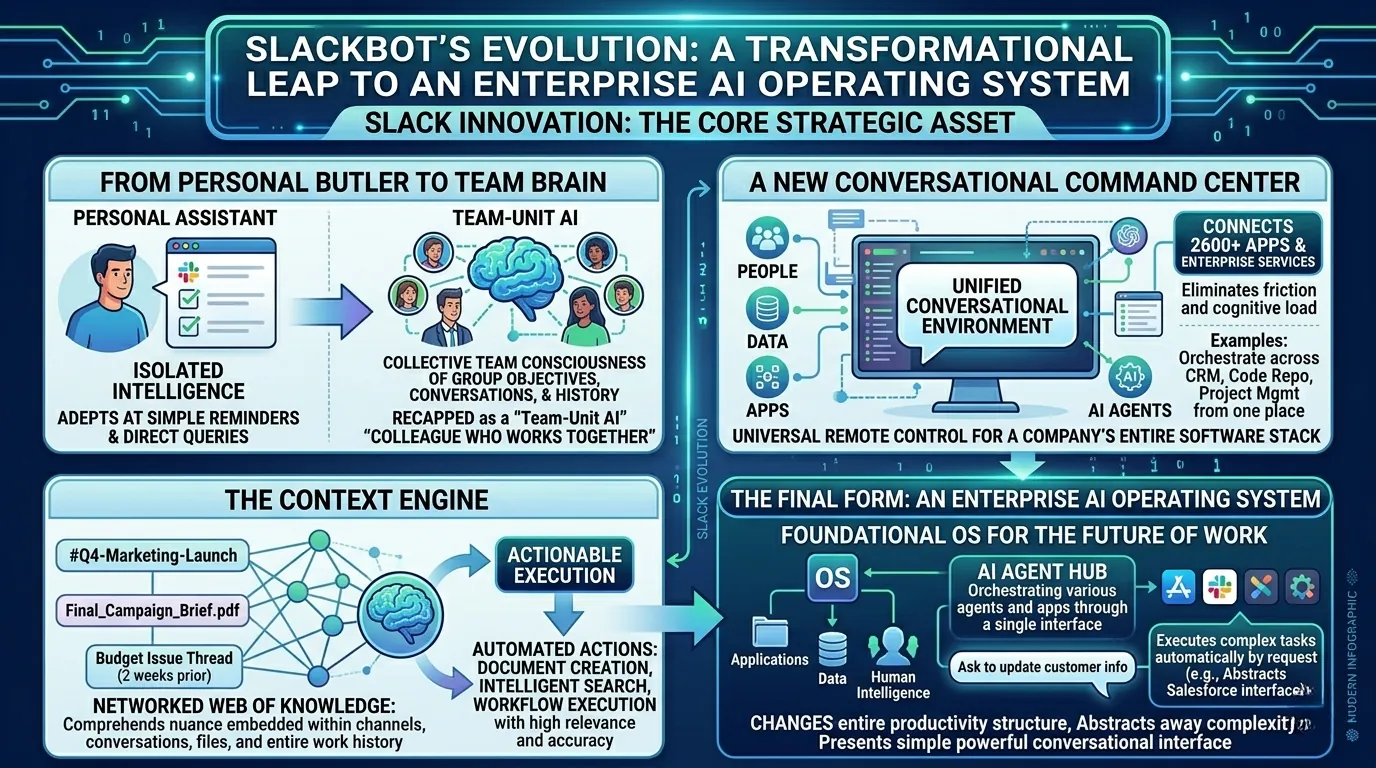
From Personal Butler to Team Brain
The original Slackbot was a helpful, yet fundamentally limited, personal assistant.
It operated on a one-to-one basis, adept at setting reminders or answering simple, direct queries for an individual user.
Its scope was personal; its intelligence, isolated.
The latest evolution shatters this limitation, fundamentally recasting Slackbot as a 'team-unit AI'.
This is not merely an upgrade in capability but a change in its core identity.
It has moved from being a digital butler who serves one person to a collective team brain that possesses a shared consciousness of the group's objectives, conversations, and history.
Experientially, this means the AI is no longer just a tool but, as some have noted, a 'colleague who works together', fully integrated into the team's dynamic and aware of the collective workflow.
A New Conversational Command Center
This evolution is powered by a new central philosophy: to redefine the work interface itself.
The goal is to eliminate the friction and cognitive load of constantly switching between different applications and contexts.
The new Slack AI achieves this by creating a single, unified conversational environment that seamlessly integrates people, data, apps, and AI agents.
This is the ultimate convergence layer for enterprise work.
Instead of opening a separate tab for a CRM, a code repository, and a project management tool, a user can now orchestrate actions across all of them from one place, using natural language.
With the ability to integrate with over 2600 apps and thousands of enterprise services, Slack becomes the universal remote control for a company's entire software stack.
The Context Engine: Understanding the 'Why' Behind the 'What'
The true breakthrough that enables this 'team-unit AI' is its profound ability to understand organizational context.
The system is designed to perceive and process information not as isolated data points, but as an interconnected web of knowledge.
It comprehends the nuanced context embedded within channels, conversations, files, and the entire work history of the organization.
For example, it doesn't just see a message; it understands that the message is in the `#Q4-Marketing-Launch` channel, references a document named `Final_Campaign_Brief.pdf`, and is part of a thread resolving a budget issue discussed two weeks prior.
This deep contextual awareness is the mechanism that connects scattered internal 'intelligence' to actionable execution.
It transforms a chaotic sea of information into a coherent, queryable knowledge base, allowing for automated actions like document creation, intelligent search, and workflow execution with an unprecedented level of relevance and accuracy.
The Final Form: An AI Operating System for the Enterprise
Cumulatively, these advancements have led industry analysts to a powerful conclusion: Slack is evolving into an enterprise AI operating system (OS).
The analogy is remarkably fitting.
Like a traditional OS that manages hardware and software, Slack now manages the core resources of the modern enterprise: applications, data, and human intelligence.
Its function as an 'AI Agent Hub' allows it to connect and orchestrate various specialized AI agents and apps through a single interface, much like an OS runs multiple programs.
Furthermore, it provides a crucial layer of abstraction.
Users can now execute complex tasks automatically by request, without needing to know the underlying system.
One can ask Slack to update customer information without ever learning the specific interface of Salesforce.
This move changes the entire productivity structure, abstracting away complexity and presenting a simple, powerful conversational interface to the entire enterprise, solidifying its role as the foundational OS for the future of work.
2. Empowering Workflows: Slack AI's Comprehensive Feature Set for Modern Work
The bold declaration of a ‘Slackbot Innovation’ (Slackbot Innovation) is not merely a marketing slogan; it is the strategic foundation upon which Slack's entire new feature set is built.
This evolution transforms the platform from a communication tool into a proactive, intelligent work hub.
The features detailed below are the tangible execution of this vision, demonstrating how Slack AI is purposefully designed to redefine the modern work interface by integrating people, data, apps, and now, a new class of AI agents into a single, seamless conversational environment.
Each capability directly contributes to making the new Slackbot a 'team-unit AI' rather than just a personal assistant.
The Automation of Everyday Knowledge Work
At the core of the Slack AI update is a profound automation of tasks that traditionally consume hours of a knowledge worker's day.
This is where the reported time savings of up to 90 minutes per day become a reality.
The system leverages its deep, contextual understanding of your organization's channels, conversations, files, and work history to deliver unparalleled efficiency.
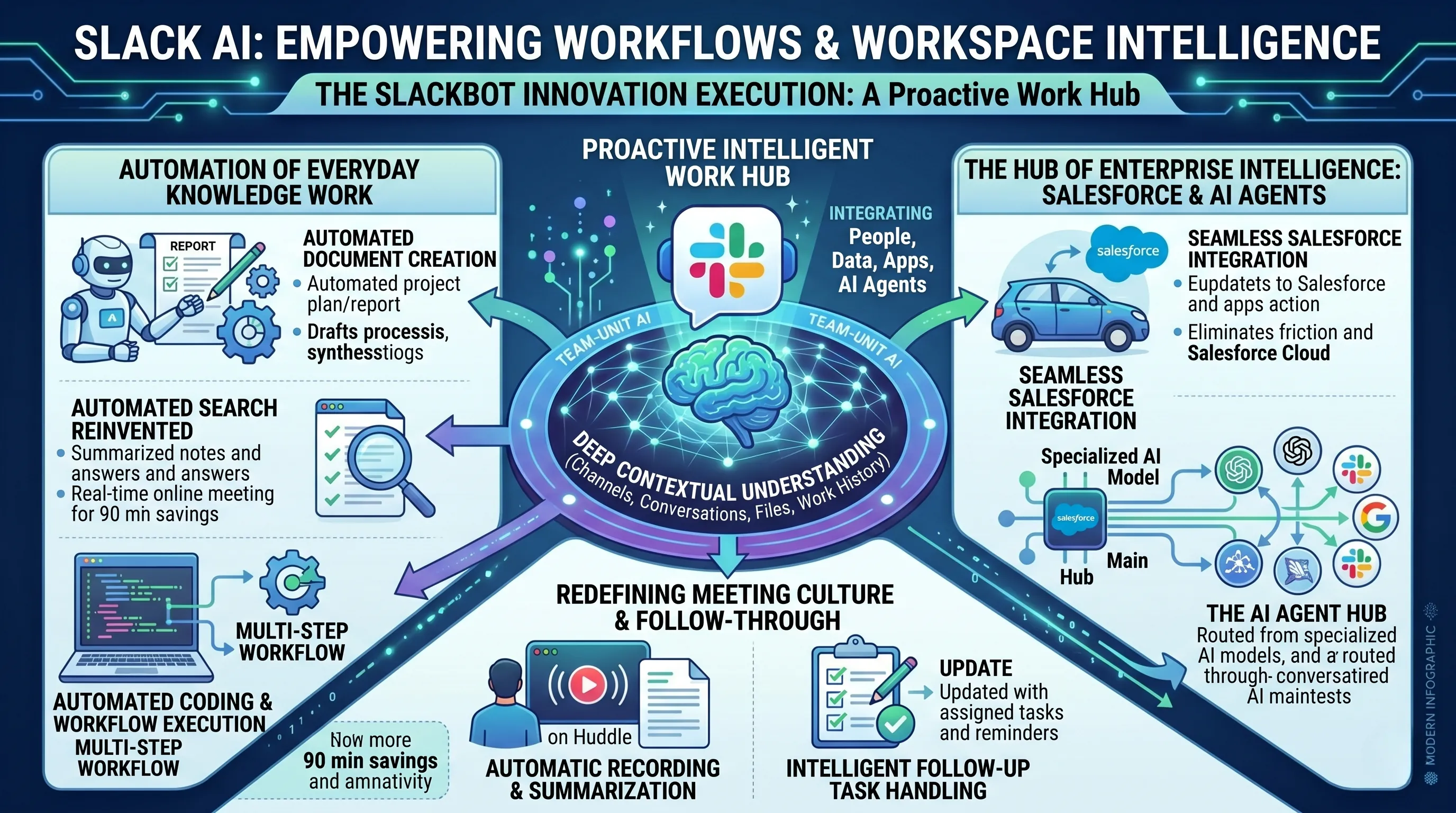
- Automated Document Creation:
Users can now prompt Slack AI to generate project plans, reports, or strategy documents directly within a channel.
The AI doesn't just use a generic template; it synthesizes information from relevant past conversations and attached files to create a contextually rich starting point, effectively turning a scattered discussion into a structured, actionable document.
- Automated Search Reinvented:
This goes far beyond a simple keyword search.
A user can ask a natural language question like, "What were the key takeaways from the Q4 client feedback session?" and Slack AI will not just link to a file, but provide a summarized answer based on its understanding of the relevant conversations and meeting notes.
It effectively connects scattered internal 'intelligence' to actionable execution, eliminating the time wasted digging through archives.
- Automated Coding and Workflow Execution:
For technical and non-technical users alike, this is a game-changer.
Developers can ask the AI to write boilerplate code or debug a function, while other team members can trigger complex multi-step workflows with a simple request.
For instance, a user could type, "Launch the new client onboarding process for Acme Corp," and Slack AI, acting as the orchestrator, could automatically create a new channel, invite the correct team members, populate it with standard documents, and assign initial tasks in a project management tool.
This allows users to execute tasks automatically by request, without needing to know the underlying system.
Redefining Meeting Culture and Follow-Through
Meetings are often the biggest drain on productivity, not just during the meeting itself but in the administrative overhead that follows.
Slack AI targets this pain point directly, transforming meetings from static events into dynamic, intelligent assets.
The features are designed to ensure that the value generated in a conversation is never lost.
- Automatic Recording and Summarization:
For meetings held in Slack Huddles, the AI can automatically record the content and, more importantly, generate a concise summary of key decisions, discussion points, and action items.
This makes it effortless for team members who couldn't attend to catch up in minutes rather than hours, and provides an objective record of what was agreed upon.
- Intelligent Follow-Up Task Handling:
This is where the AI becomes a true 'colleague who works together'.
Based on the meeting summary, Slack AI can identify and suggest follow-up tasks, assign them to the appropriate individuals, and even create reminders or entries in a connected task-management app.
This critical function closes the loop between discussion and action, ensuring that momentum is never lost.
The Hub of Enterprise Intelligence: Salesforce and the AI Agent Ecosystem
The true power of the ‘Slackbot Innovation’ is revealed in its capacity to serve not just as a tool, but as a central nervous system for the entire enterprise—an enterprise AI operating system.
This is most evident in its deep integrations and its function as an AI Agent Hub.
- Seamless Salesforce Integration:
The connection with Salesforce is more than a simple data lookup.
Sales teams can conversationally ask Slack AI to update customer information and sales data directly from a channel.
For example, "Update the Acme Corp opportunity to 'Negotiation Stage' and add a note that the client requested a new demo."
The AI parses this request and performs the action in Salesforce automatically, eliminating the need to switch contexts and manually enter data, thereby significantly reducing work time and improving data hygiene. - The AI Agent Hub:
This is the ultimate expression of Slack's vision.
The platform is designed to connect its over 2600 apps and thousands of enterprise services with a new layer of various specialized AI agents.
A user doesn't need to know if a task requires a Google AI, an Anthropic model, or an internal proprietary agent.
They make a request in Slack—"Draft three marketing taglines for our new product launch based on the latest customer feedback"—and Slack AI intelligently routes the request to the best agent for the job, collects the result, and presents it back in the conversation.
It functions as the single interface for a vast ecosystem of intelligence, fundamentally changing the overall productivity structure of the organization.
3. Redefining Productivity: The Tangible Impact and Cultural Shift Driven by Slack AI
The "Slackbot Innovation" is not merely a technical upgrade; it represents a fundamental rewiring of how work is accomplished, and this section will delve into the tangible, measurable outcomes and the profound cultural shift it initiates.
The evolution of Slackbot into a team-centric AI directly powers a new paradigm of productivity, where the metrics of efficiency are not just improved but completely redefined.
The Astonishing ROI of Time: Reclaiming the Workday
The most immediate and quantifiable impact of Slack AI is the dramatic reduction in time spent on low-value, repetitive tasks.
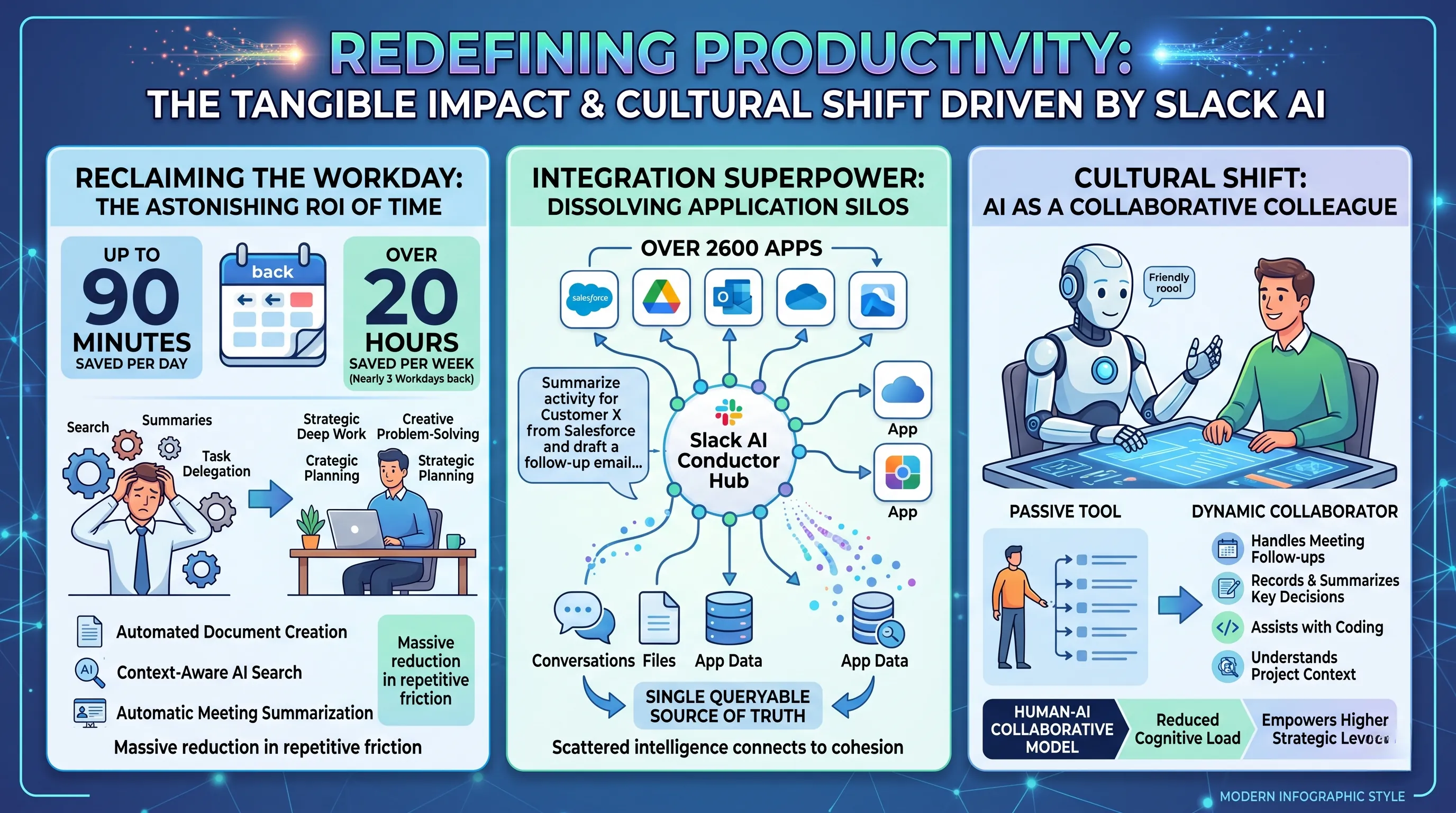
The reported time savings are staggering: for some companies, this amounts to up to 90 minutes per day per employee.
This isn't just about having an extra coffee break; it's the equivalent of getting more than an hour of your most focused, strategic time back, every single day.
When scaled across a week, this translates to over 20 hours—effectively giving an employee back nearly three full workdays every week.
This reclaimed time is the currency of modern innovation.
It’s the time that can now be dedicated to deep work, creative problem-solving, and strategic planning rather than being consumed by the friction of searching for information, summarizing long conversations, or manually updating different systems.
This massive reduction in work time is a direct consequence of features like automated document creation, AI-powered search that understands context, and automatic meeting summarization, which eliminate the digital "busywork" that plagues knowledge workers.
The Integration Superpower: Dissolving Application Silos
A core pillar of this new productivity structure is Slack AI's immense integration capacity.
By connecting with over 2600 apps and thousands of enterprise services, Slack transforms from a communication tool into a true enterprise operating system.
The value here isn't just the number of connections but the seamlessness of the interaction.
An employee no longer needs to leave Slack, log into Salesforce to pull customer data, then switch to a different tool to draft a follow-up, and finally return to Slack to report on the action.
Instead, they can simply ask the AI, "Summarize the latest activity for Customer X from Salesforce and draft a follow-up email based on our last meeting's notes."
The AI acts as a universal conductor, orchestrating these disparate systems without the user ever needing to know the underlying mechanics.
This ability to function as an AI Agent Hub, where different AI agents and apps communicate through a single conversational interface, is what connects scattered internal 'intelligence' into a cohesive, actionable whole.
The organization's entire knowledge base—conversations, files, data from integrated apps—becomes a single, queryable source of truth.
The Cultural Shift: AI as a Collaborative Colleague
Perhaps the most profound change driven by the new Slackbot is the shift in how employees perceive and interact with artificial intelligence.
The AI is no longer a passive tool waiting for a command; it has evolved into what can only be described as a 'colleague who works together'.
Because the AI understands the context of channels, project history, and team conversations, it can perform tasks with an awareness that mimics a human team member.
It can handle follow-up tasks from a meeting, automatically record and summarize key decisions, and even assist with coding, all while understanding the broader project goals.
This changes the overall productivity structure from a human-centric model of delegation to a human-AI collaborative model.
Work becomes less about managing tasks and more about setting strategic direction, with the AI colleague executing the complex, data-driven steps.
This fosters a new culture where the cognitive load on individuals is significantly reduced, empowering them to operate at a higher strategic level and transforming the very definition of a productive team.
📚 Related Posts
Invisible Tech: Top Smart Devices That Automate Your Home Life, Security & Chores Effortlessly
🚀 Key Takeaways"Invisible Tech" products are engineered to seamlessly integrate into daily life, automating mundane tasks and enhancing security or well-being without demanding constant user attention.In an increasingly connected world, the most revolut
tech.dragon-story.com
Retro Meets AI: Old-School Gadgets Reinvented with Cutting-Edge Smart Features – Vinyl Players, Pixel Speakers & Gaming Keyboa
🚀 Key TakeawaysThe "Retro Meets AI" trend successfully merges classic aesthetics with modern smart features, enhancing beloved old-school gadgets like vinyl players, mini speakers, and cameras with advanced functionality such as Bluetooth connectivity,
tech.dragon-story.com
Trinity-Large-Thinking: Arcee AI's 400B Open-Source AI Agent Redefines the Agent Era with Unmatched Performance and 96% Cost Sav
🚀 Key TakeawaysTrinity-Large-Thinking, an open-source 400B-parameter AI model from Arcee AI, is specifically engineered for advanced agent-type AI, capable of complex reasoning and long-horizon tasks, setting a new benchmark for performance in multi-sta
tech.dragon-story.com


