🚀 Key Takeaways
- Trinity-Large-Thinking, an open-source 400B-parameter AI model from Arcee AI, is specifically engineered for advanced agent-type AI, capable of complex reasoning and long-horizon tasks, setting a new benchmark for performance in multi-stage environments.
- This groundbreaking model introduces a sophisticated "thinking" process" before generating responses, providing unparalleled stability and context maintenance across multi-turn conversations and seamlessly integrating with external tools and APIs.
- Operating under an Apache 2.0 license, Trinity-Large-Thinking offers exceptional economic viability, being approximately 96% cheaper than other high-performance models, making it an incredibly attractive and accessible choice for startups and enterprises.
- Hailed as a "Game-Changer in Open Source", its combination of top-tier agent performance and cost-effectiveness signifies a pivotal moment where open models actively challenge and compete with closed-source counterparts, expanding market competition to encompass "openness and cost" alongside raw performance.
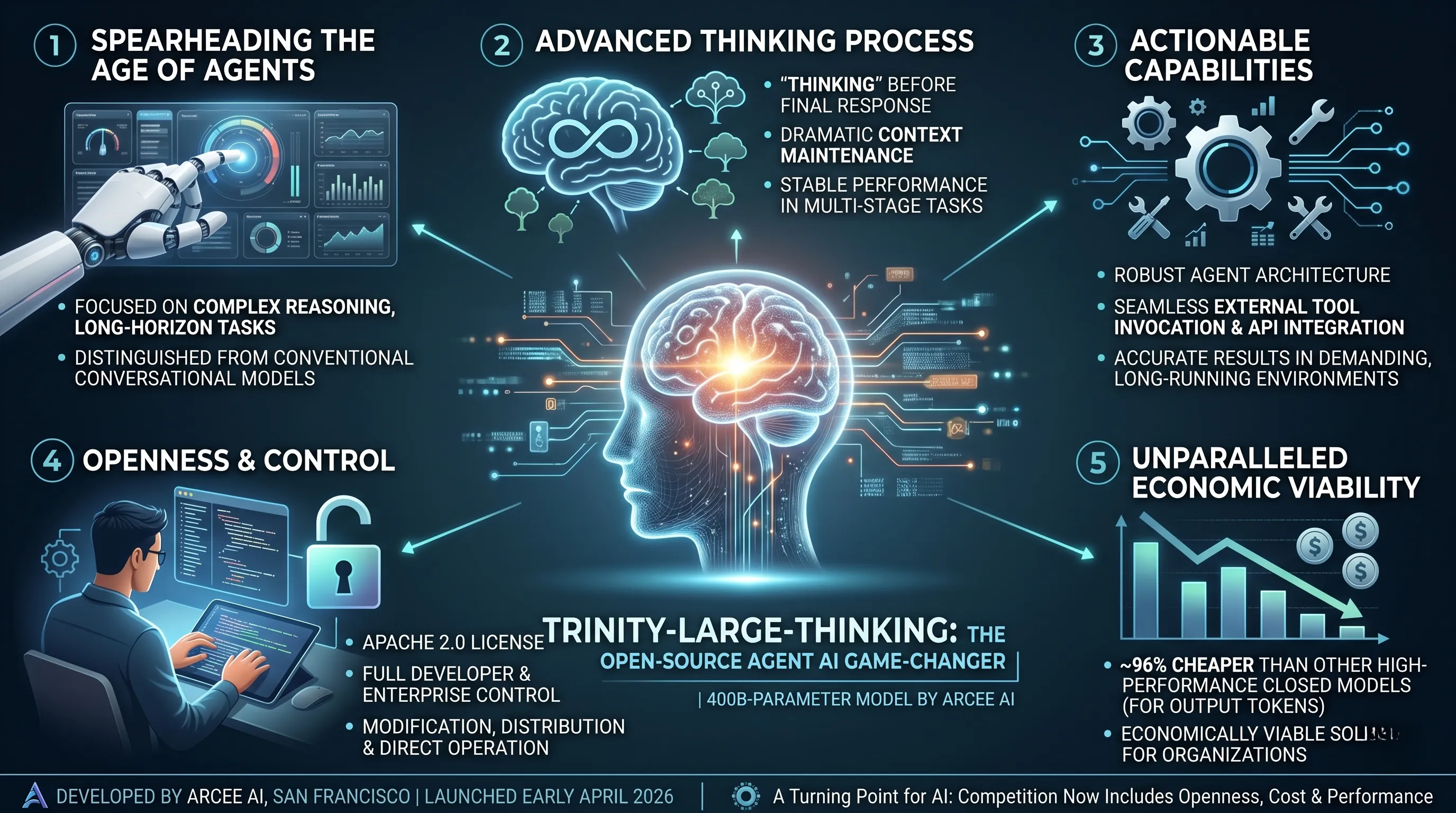
The AI landscape is witnessing a transformative shift with the official launch of Trinity-Large-Thinking, a cutting-edge open-source AI model developed by Arcee AI, a prominent San Francisco-based lab. This 399-billion parameter (400B-parameter) model, released in April 2026, is specifically designed to spearhead the next generation of agent-type AI, focusing intently on complex reasoning and long-horizon tasks, distinguishing itself from conventional conversational models.
Trinity-Large-Thinking introduces an advanced "thinking" process that precedes its responses, dramatically enhancing its ability to maintain context, deliver stable performance in multi-stage tasks, and effectively manage multiple conversation flows. Its robust architecture and seamless external tool invocation capabilities make it an ideal foundation for building sophisticated autonomous agents, capable of accurate results in demanding, long-running environments. Enterprises and developers gain full control through its Apache 2.0 license, allowing for modification, distribution, and direct operation, ensuring high utility and customization.
Evaluated as a true "real-world AI", Trinity-Large-Thinking has garnered significant market attention for its exceptional performance in agent benchmarks and its compelling cost-efficiency. Being approximately 96% cheaper than other high-performance models, it presents an economically viable and highly attractive solution for organizations building autonomous agents. This potent combination of top-tier performance, openness, and affordability marks a crucial "turning point" in the AI industry, where open models are now directly competing with closed models, broadening the scope of competition to include not just raw performance, but also "openness and cost", solidifying its reputation as a "Game-Changer in Open Source".
1. Trinity-Large-Thinking: Unpacking the Open-Source 400B Agent Model
Trinity-Large-Thinking is not an iterative update to existing language models; it is a foundational piece of infrastructure meticulously engineered by Arcee AI to serve the new paradigm of autonomous systems. Its entire design philosophy directly addresses the central theme of our main topic, "TRINITY-LARGE-THINKING, Aimed at the Age of Agents". Every specification, from its architecture to its license, is a deliberate choice to empower the development of sophisticated, independent AI agents, making it a cornerstone for this emerging era.
The Architectural Blueprint: 400B Parameters and a Sparse MoE Design
At the core of Trinity-Large-Thinking lies a colossal sparse 400B architecture, with a precise parameter count of 399-billion.
This sheer scale provides the model with an immense capacity for nuanced understanding and complex reasoning, which are non-negotiable prerequisites for agents tasked with executing multi-step, real-world workflows.
However, its true architectural brilliance is the implementation of a Sparse Mixture-of-Experts (MoE) design.
This is not merely a technical detail; it is the model's engine of efficiency.
Unlike dense models that activate all their parameters for every task, MoE intelligently routes a query to only the most relevant "expert" sub-networks.
For an AI agent that must constantly process information and make decisions, this translates into a dramatic reduction in computational overhead and a significant increase in processing speed, directly tackling the economic viability concerns of deploying large-scale agentic systems.
Identity and Purpose: A Foundation for Autonomous Agents
Trinity is explicitly defined as an 'Agent-type AI' and a 'Reasoning model'.
This distinction is critical and sets it apart from the vast sea of conversational chatbots.
Developed by the San Francisco-based lab Arcee AI, it was specifically created for long-horizon tasks, an environment where most chat-optimized models falter.
Its fundamental identity is that of a system built to "think" before responding, enabling stable performance in long conversations and the ability to maintain multiple, concurrent conversational flows.
This is the bedrock upon which true agents are built—systems that can maintain context over extended periods, invoke external tools and APIs seamlessly, and produce accurate results within long-running, complex operational environments.
It is, by its very nature, a text-only reasoning model designed for doing, not just chatting.
Openness as a Strategic Advantage: The Apache 2.0 License
Perhaps the most powerful strategic element of Trinity-Large-Thinking is its release under the Apache 2.0 license.
This decision transforms the model from a mere product into a public utility for innovation.
The license explicitly grants enterprises the right to download and customize the model, and it empowers developers to freely modify, distribute, and operate the model directly.
This removes the prohibitive licensing fees and restrictive usage policies characteristic of closed, proprietary models.
For startups and businesses aiming to build autonomous agent services, this open-source nature represents a massive reduction in barriers to entry, making it an incredibly attractive choice that balances top-tier performance with unparalleled cost-effectiveness.
It is a direct challenge to the closed-model ecosystem, shifting the competitive landscape to include openness and cost as primary metrics alongside raw performance.
Market Entry and Immediate Impact: Release and Reception
Trinity-Large-Thinking's official launch occurred in early April 2026, with release information citing both April 1, 2026, and April 7, 2026, suggesting a rapid rollout sequence.
The market's response was immediate and definitive.
The model quickly amassed over 22K downloads from the official `arcee-ai` repository.
This figure is far more than a simple metric; it is a powerful signal of a massive, pent-up demand within the developer and enterprise communities for a powerful, open-source, and commercially viable agentic foundation.
This fervent early adoption validates Arcee AI's strategy and confirms that Trinity-Large-Thinking arrived as the right tool at the exact moment the industry began its pivot towards the age of agents.

2. Redefining Agent AI: Trinity-Large-Thinking's Advanced Reasoning Engine
The central thesis of the main topic, "TRINITY-LARGE-THINKING, Aimed at the Age of Agents," is not a marketing slogan but a reflection of the model's core architecture and purpose.
Unlike general-purpose models optimized for conversational chat, Trinity-Large-Thinking, developed by the San Francisco-based lab Arcee AI, is a purpose-built engine designed from the ground up to power the next generation of autonomous agents.
Its entire feature set directly addresses the historical limitations of LLMs in agentic roles, focusing on the complex reasoning, long-term memory, and actionable capabilities that define a true agent.
It is this laser focus on agent-type AI that makes this 400B-parameter model a foundational piece of technology for the emerging agent-driven economy.
From Reaction to Reason: The 'Thinking' Process
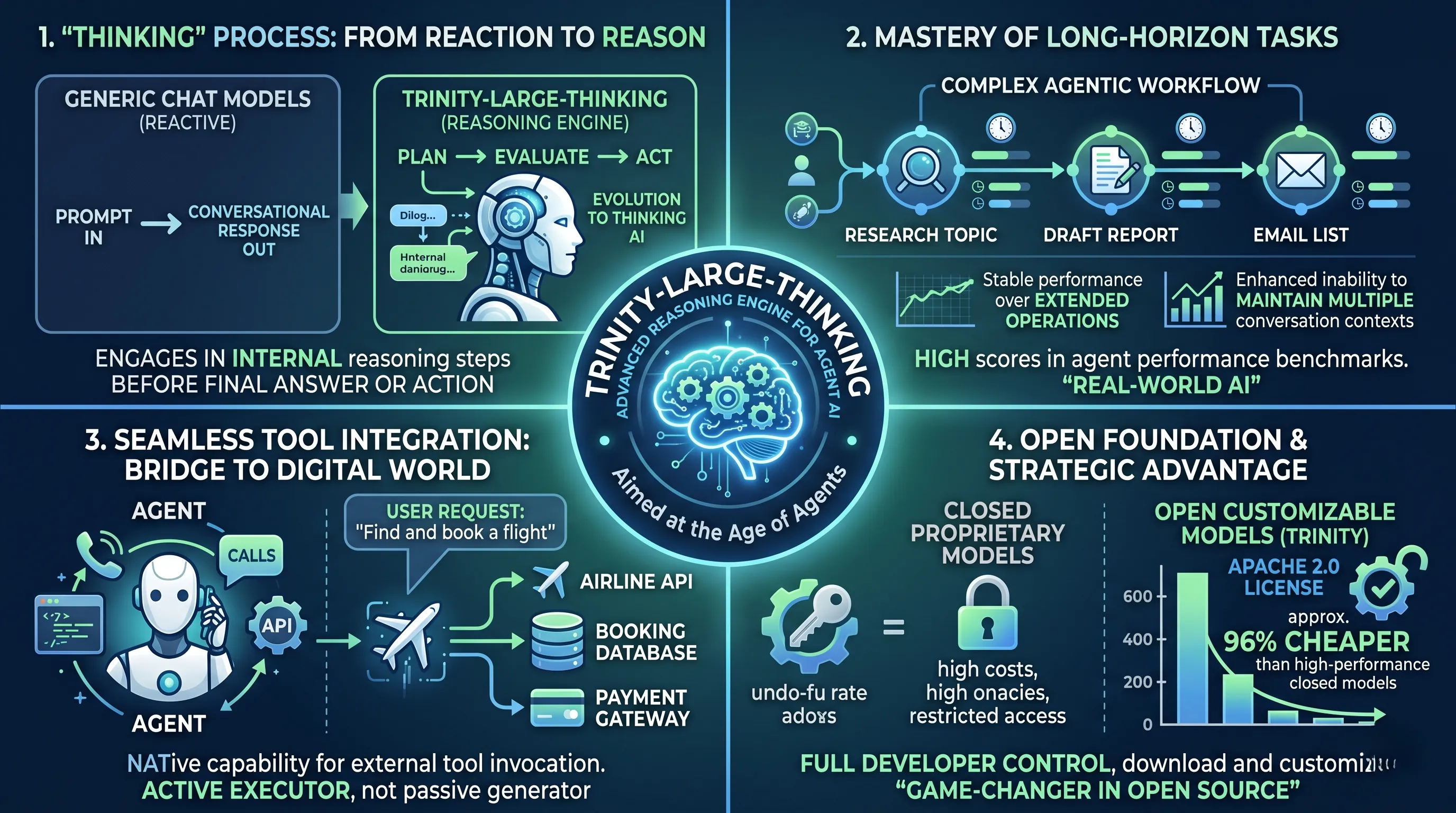
The most significant leap forward Trinity-Large-Thinking introduces is its formalized 'thinking' process.
This is a deliberate architectural choice that fundamentally changes how the model operates, moving beyond the simple, reactive pattern of prompt-in, response-out.
Before generating a final answer or taking an action, the model engages in an internal reasoning step, effectively creating a plan or a chain of thought.
This capability, a marked improvement over its Preview version, is what underpins its evaluation as an evolution towards 'Thinking AI'.
For an AI agent, this is not a luxury; it is a necessity.
An agent tasked with a complex goal cannot simply react to the last instruction; it must anticipate steps, evaluate potential outcomes, and formulate a coherent strategy.
This internal monologue is the cognitive engine that prevents the agent from getting lost in complex tasks and ensures its actions are deliberate and goal-oriented, directly serving the vision of an agent-led future.
Mastery Over Long-Horizon Tasks
The true test of an AI agent is not its performance on a single query but its consistency and reliability over extended, multi-step operations—what are known as long-horizon tasks.
Trinity-Large-Thinking was specifically developed to excel in these environments.
It provides exceptionally stable performance in multi-stage tasks, meaning it can execute a sequence of dependent actions, like researching a topic, drafting a report, and then emailing it to a list of contacts, without losing its way or degrading in quality.
This is complemented by an enhanced ability to maintain multiple conversation flows (multi-turn), allowing an agent to manage sub-tasks or parallel dialogues without confusion.
Crucially, the model excels at maintaining context and producing accurate results in long-running agent environments.
An agent powered by Trinity-Large-Thinking can work on a project for hours or even days, recalling initial instructions and nuanced details from the very beginning, a feat that is often a critical failure point for other models.
This mastery over long-term context is why it has achieved top scores in agent performance evaluation benchmarks and is considered a 'real-world AI' applicable to actual services.
The Agent's Bridge to the Digital World: Seamless Tool Integration
An agent that cannot act is merely a conversationalist.
Trinity-Large-Thinking is engineered to be an actor in the digital world through its native capability for seamless external tool invocation and API integration.
This feature transforms the model from a passive text generator into an active executor.
It can query databases, interact with scheduling software, access real-time information from the web, or trigger workflows in enterprise systems.
When a user asks an agent built on this model to "find the best flight option and book it for me," the model doesn't just describe the flight; it has the innate capacity to call the airline's API, process the data, and execute the booking transaction.
This ability to fluidly integrate with a vast ecosystem of digital tools is the core mechanism that allows an agent to perform meaningful, complex work, fulfilling the promise of AI that directly impacts business operations and daily life.
An Open Foundation for a Custom Agent Ecosystem
Perhaps the most strategic aspect of Trinity-Large-Thinking is its accessibility.
As an open-source model released under the permissive Apache 2.0 license, it represents a 'turning point' where open models are now actively and fiercely competing with closed, proprietary systems.
This has profound implications for the dawning "Age of Agents".
Enterprises are not locked into a one-size-fits-all solution; they can download and customize the model to create highly specialized agents trained on their own proprietary data and aligned with their specific workflows.
Similarly, developers have the freedom to modify, distribute, and operate the model directly, fostering a vibrant ecosystem of innovation.
This openness is paired with staggering economic viability; the model is reported to be approximately 96% cheaper than high-performance models based on output tokens.
This combination of top-tier performance, deep customizability, and radically lower cost makes Trinity-Large-Thinking an incredibly attractive choice for startups and businesses, labeling it a 'Game-Changer in Open Source' and the premier choice for organizations looking to build their own fleets of autonomous agents.
3. Shaping the Agent Era: Trinity-Large-Thinking's Economic and Competitive Edge
The emergence of Trinity-Large-Thinking is not merely an incremental update in the AI landscape; it is a strategic and powerful move designed to catalyze and define the next technological epoch: the Agent Era.
This section delves into the model's profound market impact, explaining how its unique combination of advanced reasoning, radical cost-effectiveness, and an open-source philosophy serves as the foundational architecture for the widespread development of autonomous agents, directly fulfilling the promise of its design to target and enable this new era.
A Paradigm Shift: The Evolution into 'Thinking AI'
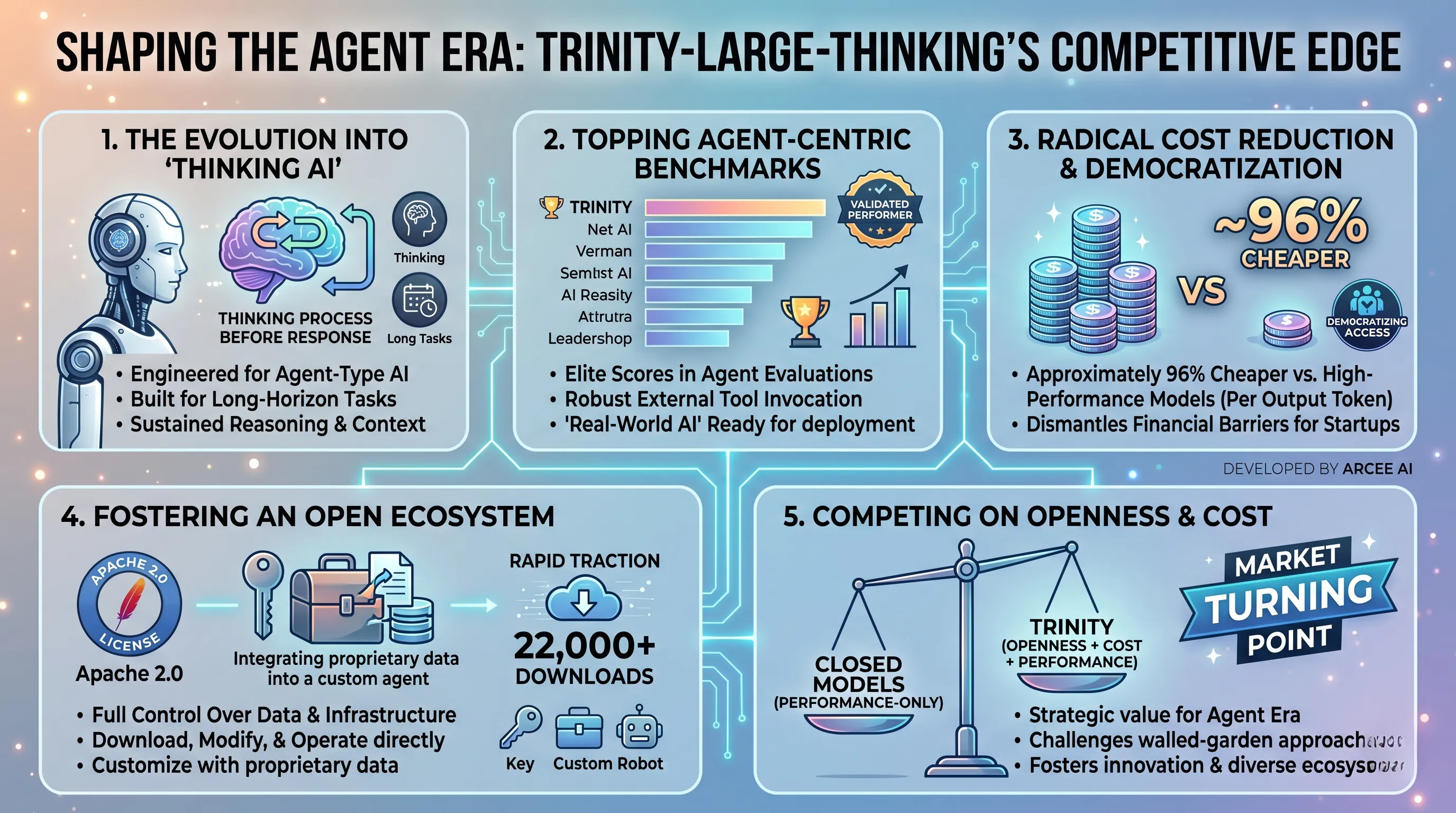
Trinity-Large-Thinking's primary distinction lies in its fundamental design philosophy, representing a significant evolution from conversational models to a true 'Thinking AI'.
Developed by the San Francisco-based lab Arcee AI, this model was explicitly engineered for the demands of 'agent-type AI'.
This means it excels not at simple Q&A, but at performing complex reasoning and executing long-term, multi-stage tasks.
A core innovation is its ability to engage in a 'thinking' process before generating a response, a feature that dramatically improves upon its Preview version and provides the stable, coherent performance necessary for long-running agentic processes.
Unlike models optimized for brief conversational chats, Trinity-Large-Thinking is built for long-horizon tasks, maintaining context and producing accurate results even in extended operational environments.
This capacity for sustained reasoning and seamless integration with external tools and APIs is precisely what the Agent Era requires, allowing AI to move beyond answering questions to actively accomplishing goals.
Redefining Performance: Topping Agent-Centric Benchmarks
While conceptual design is critical, real-world applicability is proven through performance.
Trinity-Large-Thinking has substantiated its claims by achieving top scores in agent performance evaluation benchmarks.
This is a crucial validation, demonstrating that its specialized architecture translates into superior capability for the very tasks that define autonomous agents.
Its enhanced ability to maintain multiple conversation flows (multi-turn) and invoke external tools without losing context showcases a robustness that has earned it the evaluation of being a 'real-world AI' ready for deployment in actual services.
This benchmark dominance signals to the market that a new standard has been set, not just for raw intelligence, but for practical, agentic competence.
The Economic Game-Changer: Democratizing Access with Radical Cost Reduction
Perhaps the most disruptive aspect of Trinity-Large-Thinking is its economic viability.
The model is approximately 96% cheaper than other high-performance models when measured by the cost of output tokens.
This is not merely a competitive discount; it is a fundamental democratization of cutting-edge AI.
Such a drastic cost reduction dismantles the financial barriers that have historically confined the development of sophisticated AI agents to a handful of tech giants.
For startups, small businesses, and researchers, this economic accessibility is a turning point.
It makes it feasible to build and deploy complex, always-on autonomous agents without incurring crippling operational expenses.
This combination of elite performance and unprecedented low cost makes Trinity-Large-Thinking an overwhelmingly attractive choice, fueling a wave of innovation by placing the tools for building the future directly into the hands of a much broader developer community.
The Open-Source Catalyst: Fostering an Ecosystem with the Apache 2.0 License
The economic advantage is powerfully amplified by the model's open-source nature.
Released under the permissive Apache 2.0 license, the 399-billion (or 400B) parameter model is more than just free to use; it is a foundation for others to build upon.
This license grants developers and enterprises the freedom to download, modify, distribute, and operate the model directly.
This is a critical competitive edge over closed, API-only models.
Businesses can customize Trinity-Large-Thinking on their proprietary data, ensuring a tailored and differentiated AI, all while maintaining full control over their data and infrastructure.
The rapid traction, evidenced by over 22,000 downloads from `arcee-ai`, confirms the market's hunger for this level of openness and control.
This philosophy has positioned the model as a 'Game-Changer in Open Source' and the premier choice for organizations serious about building proprietary autonomous agents.
A Turning Point in the AI Market: Competing on Openness and Cost
Ultimately, Trinity-Large-Thinking has triggered a 'turning point' in the AI market, fundamentally altering the competitive landscape.
The battle for AI dominance is no longer being fought solely on the axis of performance benchmarks.
Arcee AI has expanded the battlefield to include the crucial dimensions of 'openness and cost'.
By delivering top-tier agent performance in a customizable, freely licensed, and economically sustainable package, Trinity-Large-Thinking actively challenges the walled-garden approach of closed models.
It proves that open models can not only compete but can offer a strategically superior value proposition for the dawning Agent Era, fostering a more diverse, innovative, and competitive ecosystem for real-world AI applications.
📚 Related Posts
Google Veo 3.1 Lite: $0.05 AI Video Disrupts Market, Accelerating Mass Adoption & High-Volume Creation
🚀 Key TakeawaysGoogle's Veo 3.1 Lite redefines AI video generation pricing at an unprecedented $0.05 per video, making it the most cost-effective model available.It significantly lowers the barrier to entry for developers, enabling the creation of high-
tech.dragon-story.com
Microsoft Unleashes Next-Gen MAI Models: MAI-Transcribe, MAI-Voice, MAI-Image-2 Redefine AI for Developers
🚀 Key TakeawaysMicrosoft has launched three next-generation MAI models—MAI-Transcribe-1, MAI-Voice-1, and MAI-Image-2—offering groundbreaking advancements in speech recognition, voice generation, and image creation with unparalleled accuracy, speed,
tech.dragon-story.com
Microsoft's MAI-Transcribe-1: Revolutionizing Speech Recognition with 3.9% WER, 2.5x Speed, and Unmatched Enterprise Value
🚀 Key TakeawaysMAI-Transcribe-1 by Microsoft is redefining speech recognition standards, offering unprecedented accuracy with an average 3.9% Word Error Rate across 25 languages, superior speed (2.5 times faster), and significant cost savings, making it
tech.dragon-story.com


