🚀 Key Takeaways
- MAI-Transcribe-1 by Microsoft is redefining speech recognition standards, offering unprecedented accuracy with an average 3.9% Word Error Rate across 25 languages, superior speed (2.5 times faster), and significant cost savings, making it a powerful and accessible solution for diverse enterprise needs.
Microsoft has unveiled MAI-Transcribe-1, a groundbreaking multilingual speech recognition model poised to revolutionize how enterprises and users interact with spoken language.
Developed by a small team of fewer than 10 engineers, this innovative system delivers a substantial leap forward in accuracy, speed, and cost-efficiency, establishing a new benchmark in the competitive field of speech-to-text technology.
MAI-Transcribe-1 boasts a remarkable 3.9% average Word Error Rate (WER) across 25 languages, demonstrably outperforming leading competitors such as Whisper-large-v3, Gemini 3.1 Flash, and GPT Transcribe.
Beyond its superior accuracy, the model excels in performance, processing speech up to 2.5 times faster than existing cloud services while significantly cutting GPU inference costs by about half.
Priced at just $0.36 per hour for enterprise transcription, it offers an exceptionally cost-effective solution, undercutting every hyperscaler and making advanced speech recognition more accessible than ever before.
Designed for practical, real-world application, MAI-Transcribe-1 is a "battle-ready AI" capable of stable performance in diverse and challenging environments.
It effectively handles real-world noise, low-quality recordings, and overlapping voices, ensuring robust accuracy whether in meeting rooms, on the street, or during phone calls.
Already driving Copilot's Voice Mode transcriptions and the new dictation feature, its capabilities will soon extend to Microsoft Teams and other Copilot voice functions, solidifying its role as a pivotal component in Microsoft's expanding AI ecosystem.
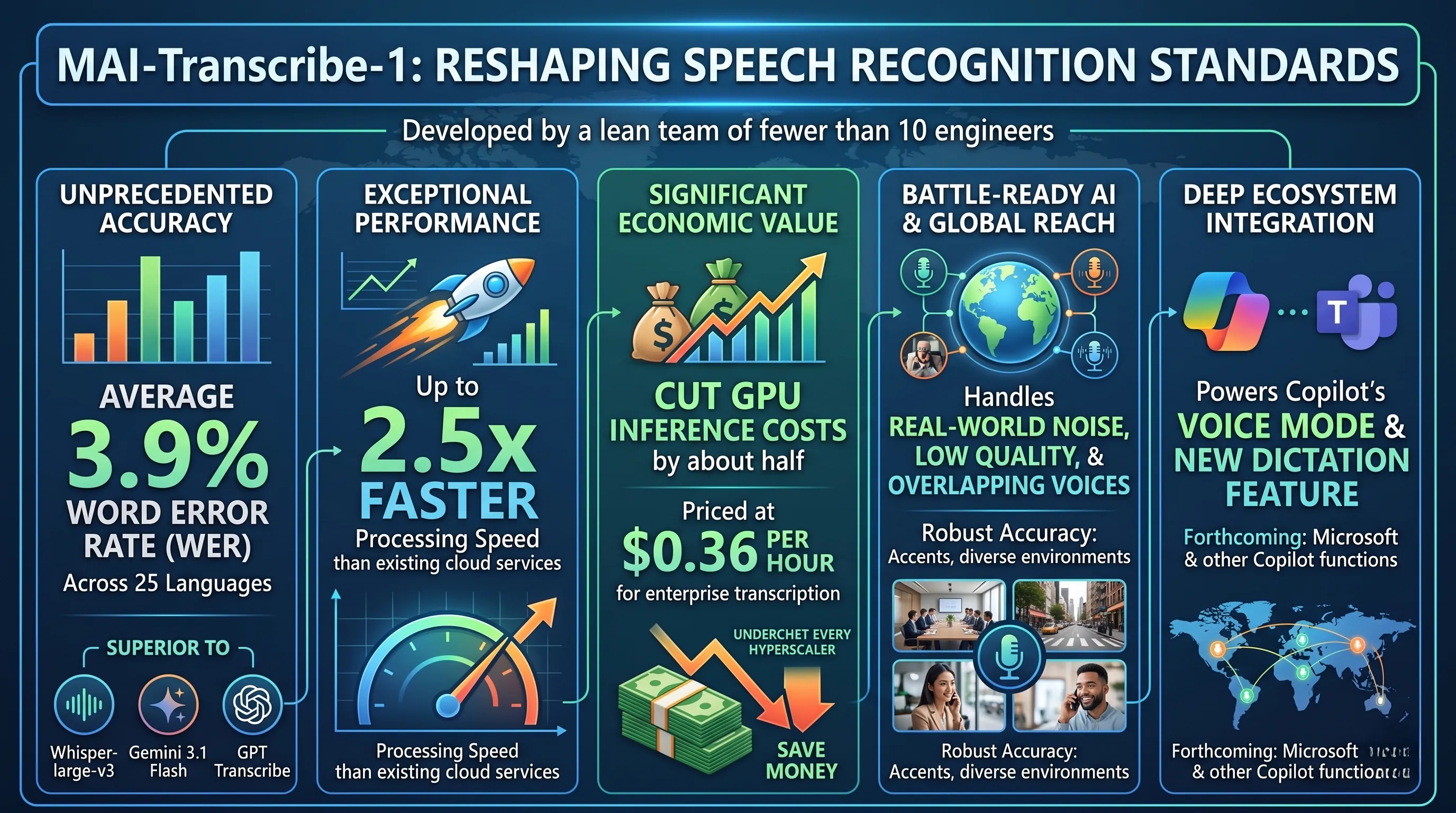
1. MAI-Transcribe-1: Redefining Speech Recognition Accuracy and Global Reach
The core reason MAI-Transcribe-1 is poised to change the entire speech recognition landscape lies in its fusion of elite-level accuracy with unprecedented global consistency.
It moves beyond the incremental improvements of its predecessors by delivering a new standard of performance that is both statistically superior and practically resilient, establishing a foundation for truly global, voice-enabled AI services.
This dual mastery of precision and worldwide applicability is the primary driver behind its game-changing potential.
🔹A New Industry Benchmark for Accuracy
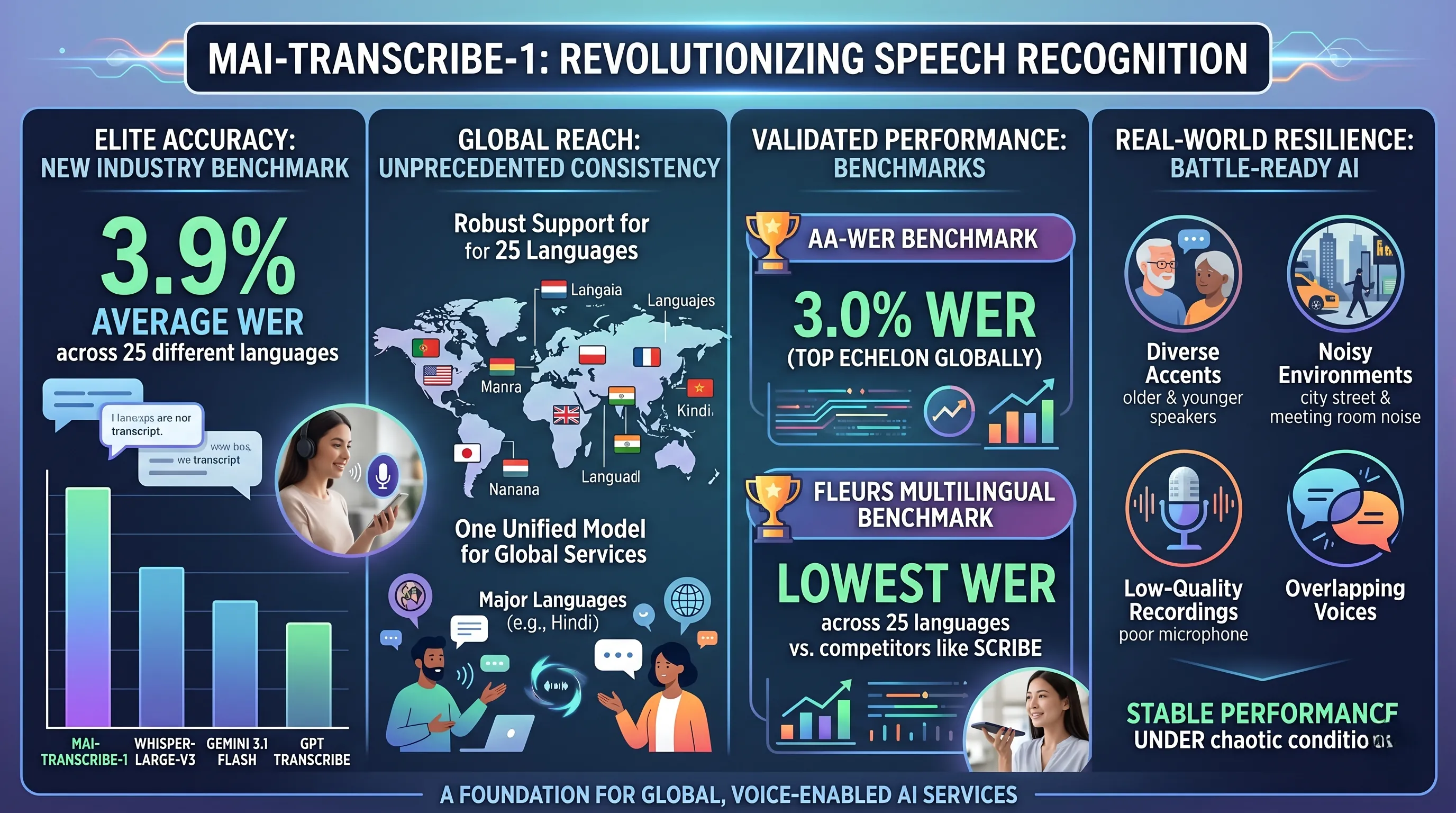
At the heart of MAI-Transcribe-1's disruptive power is its exceptional 3.9% average Word Error Rate (WER) across 25 different languages.
This single metric represents a monumental leap forward, positioning it decisively ahead of established industry titans like Whisper-large-v3, Gemini 3.1 Flash, and GPT Transcribe.
A lower WER is not merely a technical achievement; it represents the experiential difference between a tool that requires constant human correction and one that can be trusted to produce nearly flawless transcripts out of the box.
A 3.9% WER transforms transcription from a tedious, semi-automated task into a reliable, almost invisible utility, making it viable for mission-critical applications where accuracy is non-negotiable.
This level of precision is the bedrock upon which the next generation of voice-powered features, from Microsoft's own Copilot to enterprise-level analytics, will be built.
🔹Elite Performance in Standardized Testing
While its overall average is impressive, MAI-Transcribe-1's capabilities are further validated by its performance on rigorous industry benchmarks.
🔹Performance on the Rigorous AA-WER Benchmark
On the highly competitive AA-WER (AssemblyAI-WER) benchmark, a strenuous test for ASR models, MAI-Transcribe-1 achieves a remarkable 3.0% Word Error Rate.
It is crucial to note that this positions it 4th overall, behind models from Mistral, which demonstrates the intense competition at the apex of AI development.
However, achieving a 3.0% WER places it firmly within the top echelon of speech recognition systems globally.
This is not a shortcoming but rather a confirmation that MAI-Transcribe-1 operates at a world-class level, capable of holding its own against the most specialized and powerful models in the field.
🔹Dominance on the FLEURS Multilingual Benchmark
Where MAI-Transcribe-1 truly asserts its dominance and proves its global-first design is on the FLEURS (Few-shot Learning Evaluation of Universal Representations of Speech) benchmark.
In a direct comparison against competitive speech-to-text models across 25 languages, it delivered the lowest WER, significantly outperforming rivals like Scribe.
This victory is not just a win on a single test; it is a powerful statement about its core architecture.
Unlike many models that excel in English but show a marked drop-off in other languages, MAI-Transcribe-1's performance on FLEURS validates its claim of balanced performance with less language-specific variation.
This consistent, high-level accuracy across a wide linguistic spectrum is precisely how it is changing the game for developers looking to build universally accessible products.
🔹A Single, Resilient Model for a Diverse World
MAI-Transcribe-1's technical prowess translates directly into a revolutionary capability: the power to construct robust, global services with a single, unified model.
With its robust support for 25 languages, including major world languages like Hindi, it eliminates the massive overhead and complexity of developing, deploying, and maintaining separate models for different regions.
This "one model to rule them all" approach ensures a consistent user experience whether the speaker is in a quiet office in London or on a noisy street in Mumbai.
Its true "battle-ready" nature is revealed in its stable performance under the chaotic conditions of the real world.
The model is engineered to be resilient against:
- Diverse accents, reducing the accuracy gap often seen with non-native speakers.
- Noisy environments, reliably transcribing speech from busy meeting rooms, city streets, and imperfect phone calls.
- Low-quality recordings, extracting clear text even from devices with poor microphones or low-bitrate audio.
- Overlapping voices, showing a remarkable ability to parse conversations where multiple people are speaking.
This resilience is what elevates MAI-Transcribe-1 from a high-performing lab experiment to a dependable tool for global enterprise.
Its ability to maintain exceptional accuracy not just in ideal conditions, but in the unpredictable messiness of everyday life, is what truly redefines the reach and reliability of modern speech recognition.
2. Unlocking Unprecedented Speed and Economic Value with MAI-Transcribe-1
While raw accuracy metrics often capture the headlines, MAI-Transcribe-1's most profound impact on the speech recognition landscape is delivered through its revolutionary operational and economic advantages.
It is here, in the practical realities of speed, efficiency, and cost, that this model fundamentally alters the calculus for enterprises, making high-quality, large-scale voice data processing more accessible and viable than ever before.
This is not merely an incremental improvement; it is a strategic dismantling of the cost and performance barriers that have historically constrained the adoption of AI-powered transcription services.
🔹Redefining 'Real-Time': A 2.5x Velocity Leap
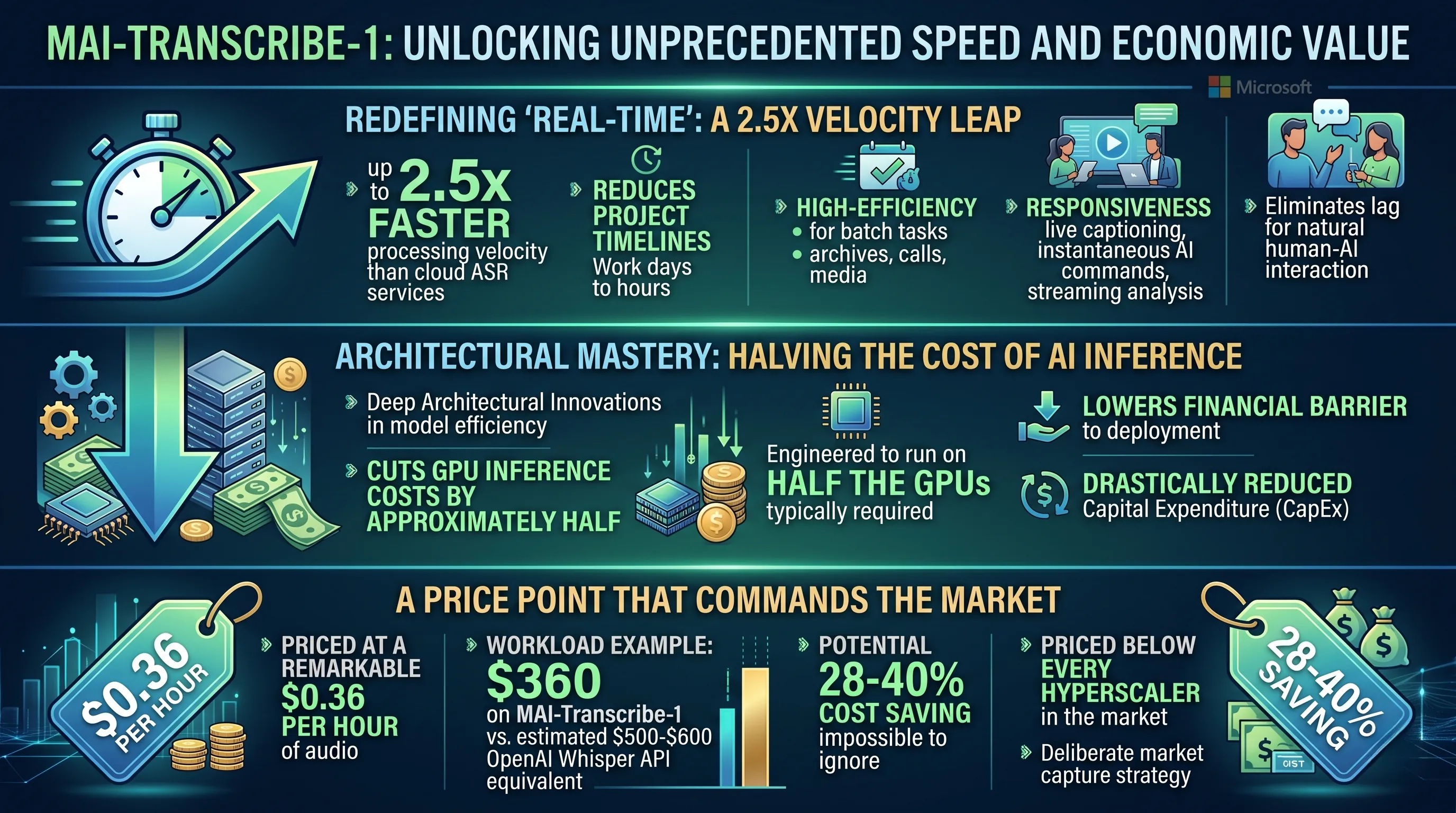
MAI-Transcribe-1 introduces a seismic shift in processing velocity, operating at speeds up to 2.5 times faster than existing cloud speech recognition services.
This is not a trivial benchmark; it is a complete redefinition of what businesses can expect from an ASR system.
For batch processing tasks—such as transcribing vast archives of audio files, customer service calls, or media content—this acceleration translates directly into dramatic reductions in project timelines.
Work that once took a full day to process can now be completed in a matter of hours.
However, the most transformative impact of this speed is felt in real-time applications.
The model's high efficiency enables a level of responsiveness crucial for live captioning in meetings, instantaneous voice commands for AI agents, and immediate analysis of streaming audio.
This velocity eliminates the frustrating lag that has plagued many real-time systems, creating a seamless and natural interaction between human speech and artificial intelligence.
This performance advantage is a core component of how MAI-Transcribe-1 is changing the game, moving ASR from a passive, post-event tool to an active, in-the-moment facilitator of communication and operations.
🔹Architectural Mastery: Halving the Cost of AI Inference
The speed and economic value of MAI-Transcribe-1 are not accidents of pricing but are rooted in deep architectural innovations.
Microsoft's engineers have achieved a breakthrough in model efficiency, resulting in optimizations that cut GPU inference costs by approximately half.
Inference, the process of running a trained model to make a prediction (or in this case, a transcription), is the most significant operational cost for any AI service at scale.
By slashing this cost, MAI-Transcribe-1 fundamentally lowers the financial barrier to deploying world-class ASR.
Further compounding this advantage, the model is engineered to run on half the GPUs that would typically be required for a system of this caliber.
This is a double victory for enterprises: not only is the cost-per-transcription lower, but the capital expenditure on the underlying hardware infrastructure is also drastically reduced.
This efficiency makes it possible to deploy powerful voice recognition capabilities in environments with constrained hardware resources or to process significantly more data with the same hardware budget.
This mastery of efficiency is a key reason it is poised to disrupt the market, as it makes superior performance economically sustainable at an unprecedented scale.
🔹A Price Point That Commands the Market
MAI-Transcribe-1 leverages its technical efficiency to deliver a pricing model that is aggressively competitive and designed for market capture.
For enterprise transcription needs, the service is priced at a remarkable $0.36 per hour of audio.
To put this into a real-world context, a workload priced at $360 using MAI-Transcribe-1's published rates would cost an estimated $500-$600 if processed through the equivalent token-based pricing of the OpenAI Whisper API.
This represents a potential cost saving of 28-40%, a figure that is impossible for any CIO or CTO to ignore when evaluating ASR solutions.
The strategic intent becomes even clearer with the fact that MAI-Transcribe-1 is positioned to be priced below every hyperscaler in the market.
This is not merely competing; it is a deliberate move to undercut the entire competitive landscape, making MAI-Transcribe-1 the default choice for any organization where both performance and budget are critical decision factors.
By combining top-tier accuracy with industry-leading speed and a price point that reshapes the economic landscape, MAI-Transcribe-1 makes a compelling case as the new standard for enterprise-grade speech recognition.
3. MAI-Transcribe-1: The Battle-Ready AI Driving Microsoft's Voice Ecosystem
MAI-Transcribe-1's emergence is not merely an incremental update; it represents a fundamental shift in how voice recognition technology is designed and deployed, directly contributing to the main topic of how it is set to change the entire voice recognition landscape.
Unlike models developed in pristine lab conditions, MAI-Transcribe-1 was engineered from the ground up to be a 'battle-ready AI', a system forged for the chaos of the real world.
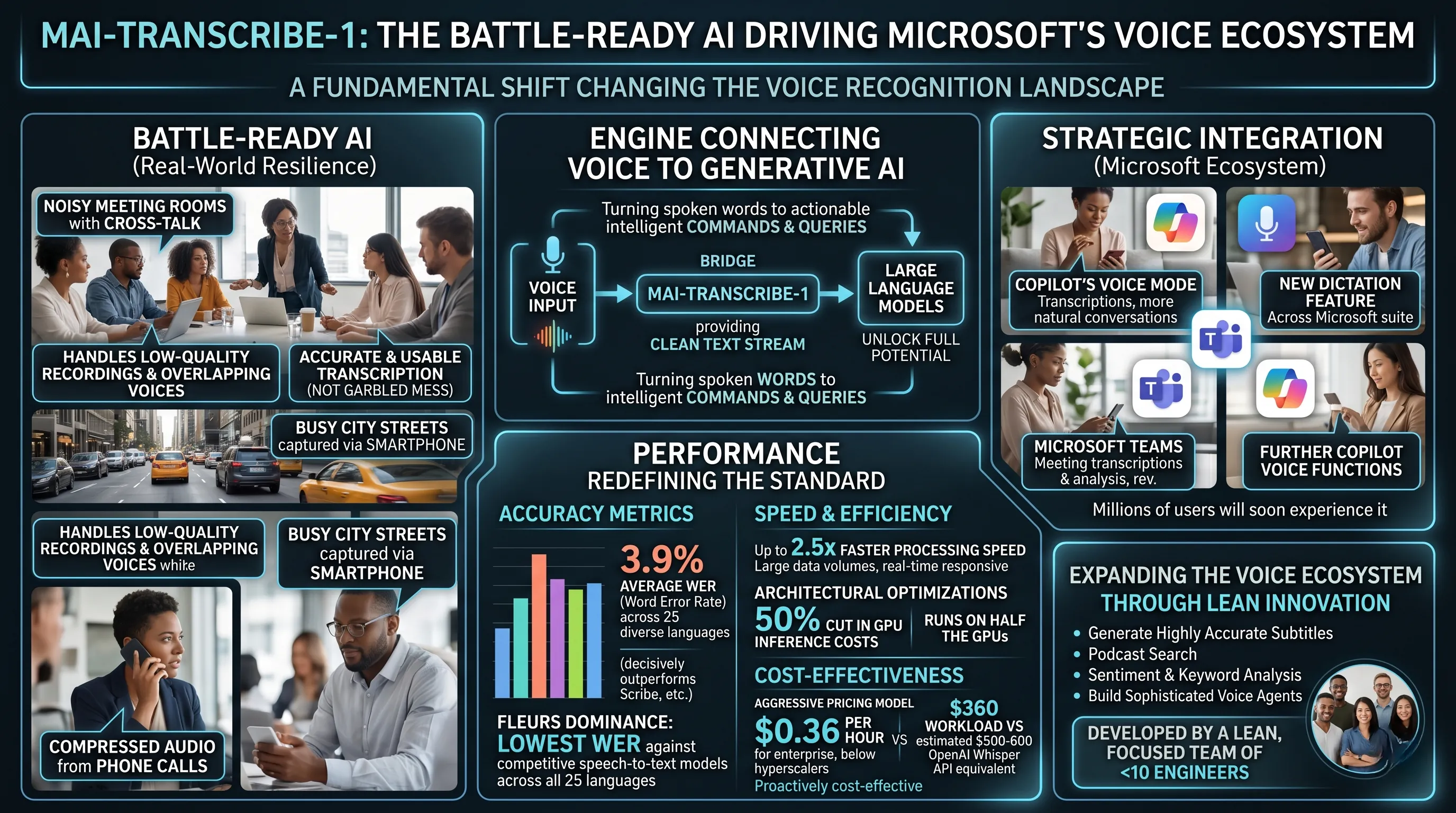
This design philosophy is pivotal; it means the model is architected for stable, reliable performance in the unpredictable acoustic environments where business and life actually happen: noisy meeting rooms with cross-talk, busy city streets captured through a smartphone microphone, and compressed audio from phone calls.
It demonstrates remarkable resilience, working stably even with low-quality recordings or the common problem of overlapping voices, ensuring that the final transcription is accurate and usable, not a garbled mess.
🔹The Engine Connecting Voice to Generative AI
At its core, MAI-Transcribe-1 is a state-of-the-art Automatic Speech Recognition (ASR) model built to deliver exceptionally high-quality batch transcriptions whenever a user speaks.
However, its most strategic feature is its role as a bridge, seamlessly connecting natural human voice input with the power of generative AI.
This is the critical link that elevates it beyond a simple transcription tool.
By providing a clean, accurate text stream, it unlocks the full potential of large language models for voice-based interactions.
This connection is the foundational element that is changing the voice recognition landscape, turning spoken words into actionable, intelligent commands and queries for the next generation of AI.
🔹Strategic Integration: The Microsoft Product Onslaught
Microsoft is not treating MAI-Transcribe-1 as a standalone service but as the new voice foundation for its entire ecosystem.
This deep, strategic integration is already underway, a clear signal of its importance.
It is the engine driving the transcriptions for Copilot's Voice Mode, allowing for more natural and accurate conversations with the AI assistant.
It also powers the new, more robust dictation feature being rolled out across Microsoft's software suite.
The deployment roadmap reveals an even deeper commitment, with plans for it to be sequentially applied in Microsoft Teams, promising to revolutionize meeting transcriptions and analysis, and integrated into further Copilot voice functions.
This deliberate, phased integration ensures that millions of users will soon experience its superior performance, cementing it as the default voice interface for the Microsoft ecosystem.
🔹Performance That Redefines the Standard
The "battle-ready" claim is substantiated by world-class performance metrics that directly challenge established leaders.
MAI-Transcribe-1 achieves an average Word Error Rate (WER) of just 3.9% across 25 diverse languages, a figure that decisively outperforms competitors like Whisper-large-v3, Gemini 3.1 Flash, and GPT Transcribe.
On the FLEURS benchmark, it records the lowest WER against competitive speech-to-text models across all 25 languages, demonstrating a balanced performance with less language-specific variation—a key advantage for building a single, global service.
While it secures 4th place on the highly competitive AA-WER benchmark with a 3.0% WER (behind Mistral's model), its overall profile of speed, cost, and multilingual accuracy presents a more compelling package for practical enterprise use.
Performance is not just about accuracy; it's also about efficiency.
The model boasts up to 2.5 times faster processing speed than existing cloud speech recognition services.
This isn't just a minor improvement; it's a transformative leap that enables high-efficiency processing for large data volumes and makes real-time speech recognition far more responsive.
Crucially, Microsoft has achieved this through architectural optimizations that cut GPU inference costs by about half, allowing it to run on half the GPUs compared to previous systems.
This efficiency directly translates to an aggressive pricing model of $0.36 per hour for enterprise transcription, a rate priced below every other hyperscaler.
To put this in perspective, a transcription workload that costs $360 with MAI-Transcribe-1 would cost an estimated $500-600 using the equivalent OpenAI Whisper API's token-based pricing, making Microsoft's offering profoundly more cost-effective at scale.
🔹Expanding the Voice Ecosystem Through Lean Innovation
The impact of MAI-Transcribe-1 extends far beyond Microsoft's internal product suite.
Its combination of high accuracy, speed, and low cost makes it a foundational technology poised to expand the entire AI voice ecosystem.
Developers and businesses can now leverage this power for a vast array of applications: generating highly accurate subtitles for video content, transcribing podcast recordings for search and accessibility, performing sentiment and keyword analysis on customer service calls, and building sophisticated voice-based agents and assistants.
Perhaps the most remarkable aspect of this technological leap is its origin.
This globally competitive, landscape-altering model was developed by a lean, focused team of fewer than 10 engineers at Microsoft.
This fact underscores a new paradigm in AI development, where small, agile teams can produce world-class results, challenging the notion that only massive research groups can push the boundaries of what's possible.
📚 Related Posts
Microsoft's MAI-Image-2: Unveiling the AI Image Generator Setting New Standards for Photorealism and Professional Creativity
🚀 Key TakeawaysMAI-Image-2, developed by Microsoft, has rapidly ascended to become a global top 3 contender in text-to-image generation, provisionally holding the #5 model slot on Arena.ai.It delivers greatly enhanced photorealism, with nuanced natural
tech.dragon-story.com
NVIDIA NemoClaw: The Secure, Policy-Controlled Stack & OpenClaw OS Driving the Personal AI Agent Era
🚀 Key TakeawaysNVIDIA's NemoClaw significantly advances the personal AI era by enhancing the OpenClaw platform with a secure, policy-controlled, and enterprise-ready software stack that enables the easy deployment and operation of always-on, autonomous
tech.dragon-story.com
Google's Personal Intelligence: Your Next-Gen AI Assistant for Hyper-Personalized, Private Digital Life
🚀 Key TakeawaysGoogle's "Personal Intelligence" marks a pivotal shift, evolving AI from a mere search tool into a true personal assistant that deeply understands individual user context, preferences, and history.This advancement promises to significantl
tech.dragon-story.com


