🚀 Key Takeaways
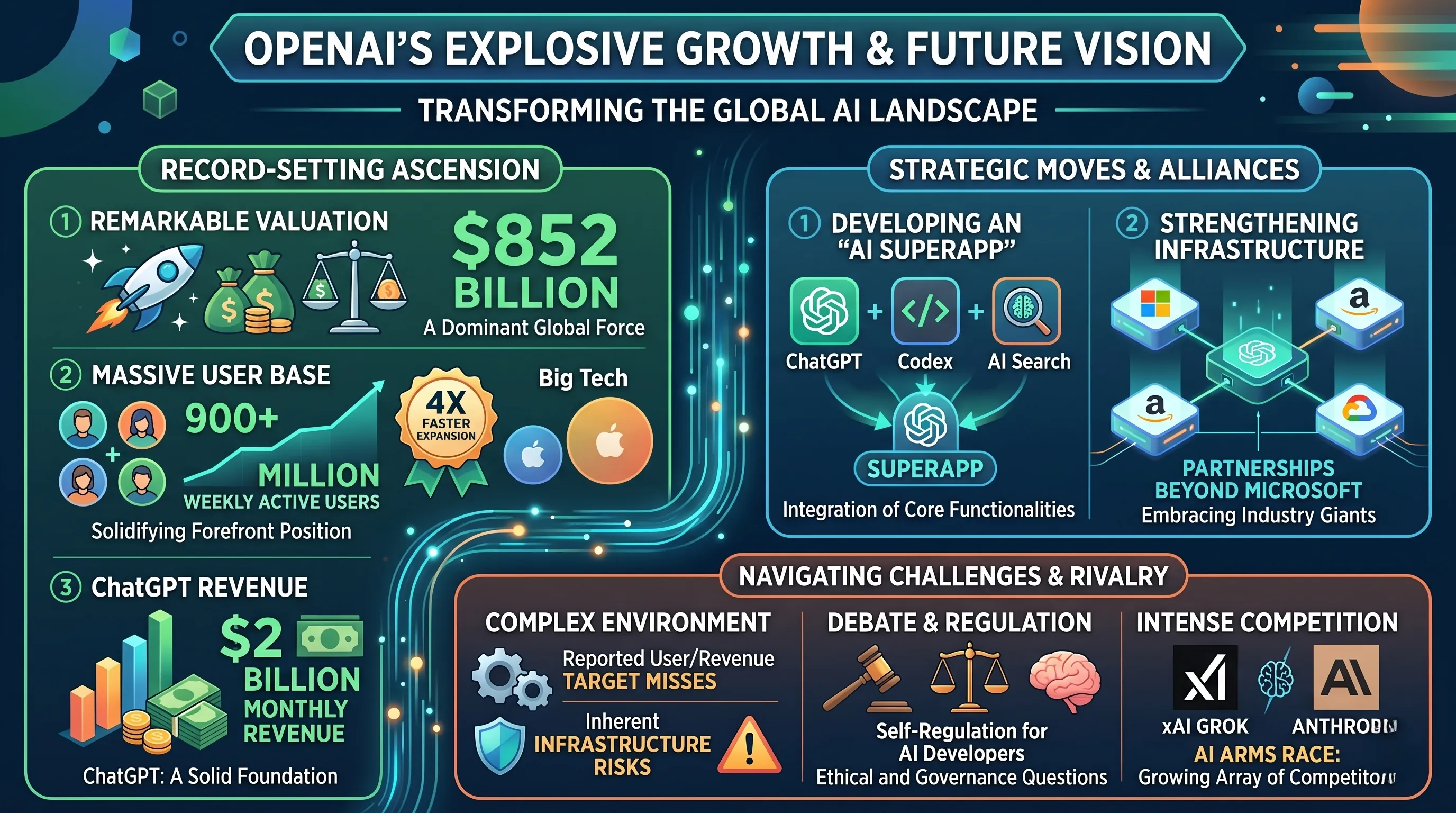
- OpenAI is aggressively reshaping the global AI competitive landscape, marked by its staggering $852 billion valuation, rapid user acquisition exceeding 900 million weekly active users, and a growth trajectory four times faster than established tech giants.
OpenAI has rapidly ascended to become a dominant force, fundamentally altering the global AI competitive landscape.
Its explosive growth is evident in a remarkable $852 billion valuation and an astounding user base that now exceeds 900 million weekly active users, showcasing a pace of expansion four times faster than seasoned big tech companies.
This rapid ascent is further underscored by its flagship product, ChatGPT, which generates an impressive $2 billion in monthly revenue, solidifying OpenAI's position at the forefront of the AI revolution.
Driving this momentum, OpenAI is strategically planning to develop an 'AI Superapp' by integrating its core functionalities like ChatGPT, Codex, and search, alongside strengthening its infrastructure through expanded partnerships beyond Microsoft, now embracing giants such as Amazon and Google Cloud.
This aggressive expansion, however, intensifies the AI arms race, pitting OpenAI against a growing array of competitors and raising critical questions about its unique technological advantages and user engagement amidst such rapid scaling.
Despite its impressive financial backing, including over $3 billion from individual investors, and broad industry adoption, OpenAI navigates a complex environment marked by reported misses on user/revenue targets and inherent infrastructure risks.
The debate surrounding self-regulation for AI developers and the increasing rivalry from chatbots like xAI's Grok and Anthropic's Claude further underscore the dynamic and fiercely contested nature of the AI future OpenAI is helping to forge.
1. OpenAI's Unprecedented Financial Power and Market Dominance
This section directly addresses the main topic, "OpenAI Reshaping the AI Hegemony Race", by dissecting the core engine of its disruptive power: its unparalleled financial and market scale.
The sheer velocity of its capital acquisition, revenue generation, and user adoption is not merely a sign of success; it is the primary weapon OpenAI wields to fundamentally alter the competitive landscape, setting a pace and scale that forces every other player, from legacy tech giants to emerging startups, to react to its moves.
This is how OpenAI is actively redrawing the map of AI dominance.
🔹A Financial Juggernaut Built on Unprecedented Capital
At the heart of OpenAI's disruptive force lies a war chest of almost unimaginable proportions.
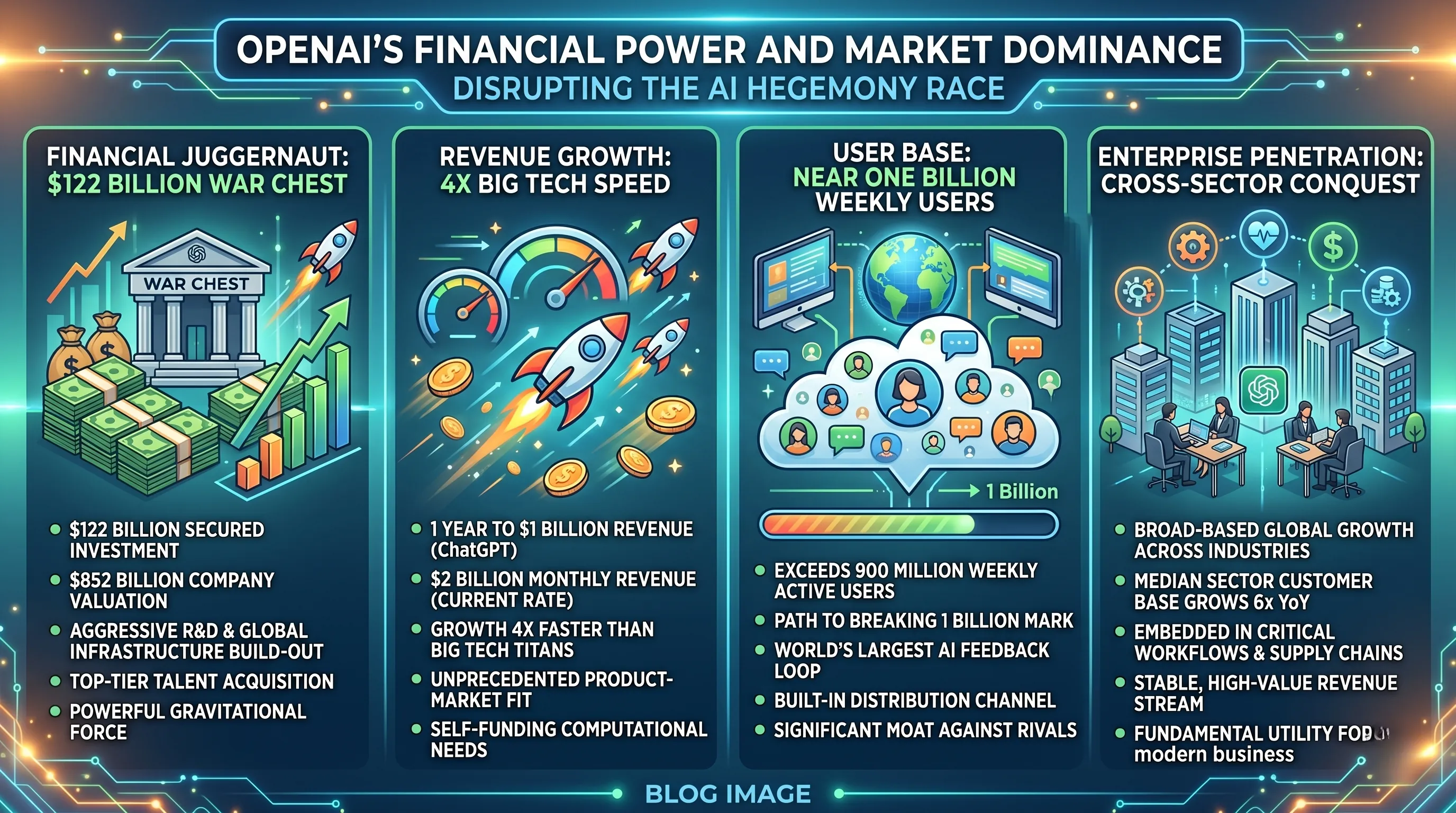
The company has successfully secured a staggering $122 billion in investment, a figure that catapults it beyond the realm of venture-backed startups and into a class of its own.
This massive influx of capital is the bedrock of its aggressive strategy, enabling massive-scale R&D, global infrastructure build-out, and top-tier talent acquisition without the typical constraints faced by competitors.
This financial might has translated into a colossal $852 billion company valuation, placing OpenAI in the same league as the most established and powerful corporations on the planet, all achieved in a fraction of the time.
This valuation is more than a number; it is a declaration of market confidence and a powerful gravitational force, attracting even more investment, talent, and strategic partnerships, creating a virtuous cycle of growth that becomes increasingly difficult for rivals to break.
🔹Revenue Growth at Four Times the Speed of Big Tech
OpenAI's ability to convert technological prowess into revenue is as breathtaking as its fundraising.
Its flagship product, ChatGPT, achieved a milestone that many tech giants took years to reach, generating $1 billion in revenue within its first year of launch.
This already historic pace has only accelerated, with the company now reportedly pulling in $2 billion monthly, an annualized run rate that solidifies its position as a commercial behemoth.
To put this into perspective, the company's growth trajectory is an astonishing 4 times faster than existing big tech titans like Alphabet and Meta during their formative years.
This hyperspeed monetization is not just about profit; it demonstrates an unprecedented product-market fit and an ability to create and capture value at a scale the industry has never witnessed.
This rapid cash flow provides OpenAI with the resources to self-fund its immense computational needs and further entrench its market leadership, widening the gap with every passing month.
🔹A User Base on the Verge of One Billion
Market dominance is ultimately cemented by user adoption, and here OpenAI has built an empire.
The platform now boasts a weekly active user base that exceeds 900 million, a figure that rivals the world's largest social media and search platforms.
This user base is on a clear trajectory to break the 1 billion mark soon, crossing a psychological and strategic threshold that few companies ever reach.
This is not merely a vanity metric.
This vast and engaged audience serves as the world's largest and most diverse feedback loop, providing invaluable data for refining and improving its AI models in real-time.
It also represents a massive, built-in distribution channel for any new product or feature OpenAI releases, from its planned 'AI Superapp' to specialized agent functions.
This scale creates an enormous moat, as competitors must not only build a comparable technology but also find a way to attract a user base of a similar magnitude—a near-impossible task.
🔹Deepening Enterprise Penetration Across All Sectors
While its consumer-facing success is well-documented, OpenAI's silent conquest of the enterprise market is equally profound.
The company is experiencing broad-based customer growth across industries, moving far beyond early tech adopters into core sectors of the global economy.
The data reveals a stunning rate of integration, with the median sector's customer base expanding by more than 6x year-over-year.
This demonstrates that businesses are not just experimenting with OpenAI's technology; they are embedding it into their critical workflows, supply chains, and customer service operations.
This deep enterprise penetration secures a stable, high-value revenue stream and makes OpenAI's technology a fundamental utility for modern business, further cementing its role as an indispensable player in the future economy.
2. Strategic Alliances and the Vision for an AI Superapp Ecosystem
OpenAI's strategy to reshape the global AI hegemony race extends far beyond the development of its foundational models; it is a masterclass in building a resilient, multi-layered ecosystem through strategic alliances and a clear vision for platform dominance.
This approach directly addresses the immense capital and infrastructure requirements of leading-edge AI, creating a competitive moat that is as much about partnerships and platform strategy as it is about algorithms.
By weaving together a network of infrastructure giants and aiming for an all-encompassing 'AI Superapp,' OpenAI is not merely participating in the race—it is actively attempting to define the racetrack itself.
🔹Fortifying the Foundation: A Diversified Infrastructure Web
The journey to AI supremacy is built on a foundation of silicon and server farms, a reality that OpenAI has identified as a primary "infrastructure risk."
No single entity can sustainably provide the colossal computational power needed to train and deploy next-generation models at a global scale.
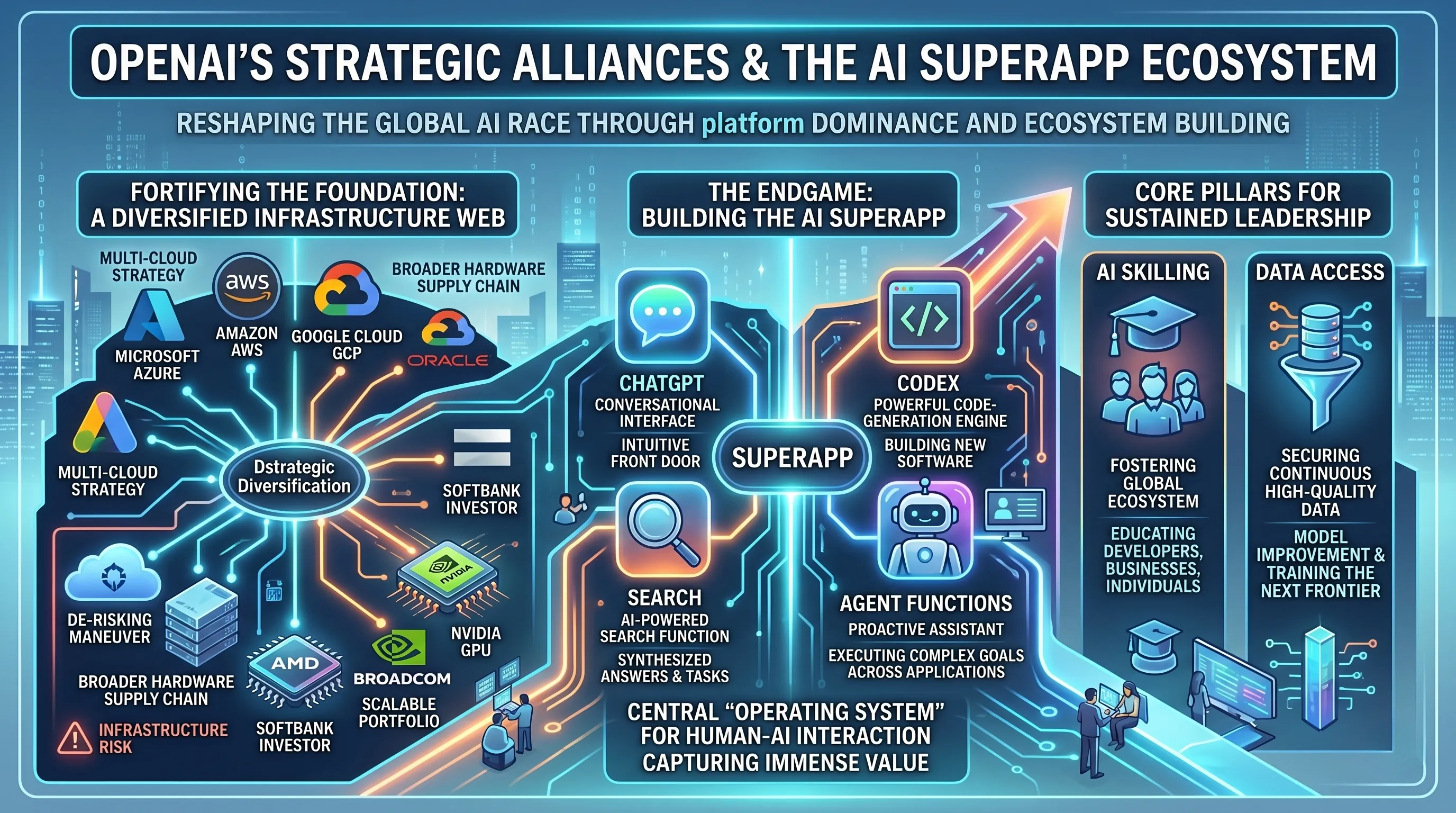
Recognizing this, OpenAI has pivoted from a position of dependency to one of strategic diversification, strengthening its infrastructure competitiveness by assembling an unprecedented coalition of technology titans.
Initially, the deep symbiosis with Microsoft was the cornerstone of OpenAI's ascent, providing the Azure cloud infrastructure that fueled ChatGPT's explosive growth.
However, a strategic shift is underway, marked by the planned conclusion of Microsoft exclusivity in 2026 in San Francisco.
This move is not a break from Microsoft but a crucial expansion, opening the doors to direct partnerships with cloud rivals Amazon and Google Cloud, as well as Oracle.
This multi-cloud strategy is a powerful de-risking maneuver.
It mitigates the danger of relying on a single provider, creates a competitive environment for pricing, and most importantly, makes OpenAI’s models ubiquitously available, meeting enterprise customers on their preferred cloud platforms.
This diversification extends to the very heart of the hardware stack.
While NVIDIA remains a critical partner for its industry-leading GPUs, OpenAI is actively engaging with AMD and Broadcom.
This secures a broader supply chain for the essential processing units that power AI, insulating the company from potential bottlenecks and giving it access to a wider array of chip architectures.
Furthermore, the inclusion of a strategic investor like SoftBank injects not just capital but access to a sprawling global portfolio of companies, creating fertile ground for new applications and integrations of OpenAI's technology.
This web of alliances—spanning cloud providers, chip manufacturers, and global investors—forms a resilient and scalable foundation that competitors will find exceedingly difficult and expensive to replicate.
🔹The Endgame: Building the AI Superapp
With its infrastructure fortified, OpenAI's ambition crystallizes into a single, transformative vision: the creation of an 'AI Superapp.'
This is the company's answer to moving beyond a popular but potentially replaceable chatbot to becoming an indispensable and integrated part of a user's digital life.
This superapp is envisioned as a seamless integration of four powerful pillars:
1. ChatGPT:
The conversational interface remains the core, serving as the intuitive front door for hundreds of millions of users, with weekly active users already exceeding 900 million.
2. Codex:
By integrating its powerful code-generation engine, the superapp targets the lucrative and influential developer and enterprise markets, embedding AI directly into the creation of new software and digital tools.
3. Search:
The inclusion of a native, AI-powered search function is a direct challenge to the existing search paradigm dominated by Google.
It aims to transform the user journey from asking a question to receiving a comprehensive, synthesized answer and executing tasks, all within a single environment.
4. Agent Functions:
This is the most profound component of the vision.
By enabling AI agents, OpenAI seeks to evolve its platform from a passive tool that responds to queries into a proactive assistant that can understand complex goals and execute multi-step tasks across various applications on the user's behalf.
This superapp strategy is how OpenAI plans to fundamentally reshape the competitive landscape.
It is a direct play for user ownership, aiming to become the central "operating system" for how humans interact with AI, thereby capturing the immense value currently distributed across search engines, productivity suites, and specialized software.
🔹The Core Pillars for Sustained Leadership
OpenAI recognizes that even with superior technology and infrastructure, long-term dominance in the AI race is not guaranteed.
The company has identified and recommends two core pillars essential for sustained leadership in this new era.
First is a relentless focus on AI skilling.
This involves fostering a global ecosystem where developers, businesses, and individuals are educated and empowered to build upon and effectively utilize OpenAI's platform, ensuring deep and lasting market penetration.
Second is securing continuous data access.
High-quality, diverse data is the lifeblood of model improvement, and guaranteeing access to these vast datasets is non-negotiable for maintaining a competitive edge and training the next frontier of AI models.
Together, these pillars ensure that as the technology evolves, the world is ready, willing, and able to evolve with it on OpenAI's terms.
3. Navigating Intense Competition and Addressing Foundational Challenges
This section directly addresses the core theme of "OPENAI, Reshaping the AI Supremacy Race" by examining the formidable obstacles that threaten to halt its momentum.
While OpenAI's meteoric rise has indeed reset the competitive landscape, its journey forward is not an uncontested coronation.
Instead, its very success has catalyzed a global arms race, exposing internal weaknesses and creating a high-stakes environment where its leadership is under constant assault.
Understanding these intense pressures and foundational challenges is critical to evaluating whether OpenAI can sustain its position at the apex of the AI revolution or if it will be surpassed by a new wave of rivals it helped create.
🔹The New Battleground: A Surge of Formidable Competitors
OpenAI's expansion from a research-focused entity to a global product powerhouse has placed it in direct competition with a rapidly growing roster of companies.
The initial monopoly-like hold on public consciousness enjoyed by ChatGPT is definitively over.
The competitive landscape is no longer a simple race against established tech giants; it's a multi-front war against both incumbents and agile, well-funded newcomers.
A prime example of this new threat is the explosive growth of challengers in the AI chatbot market.
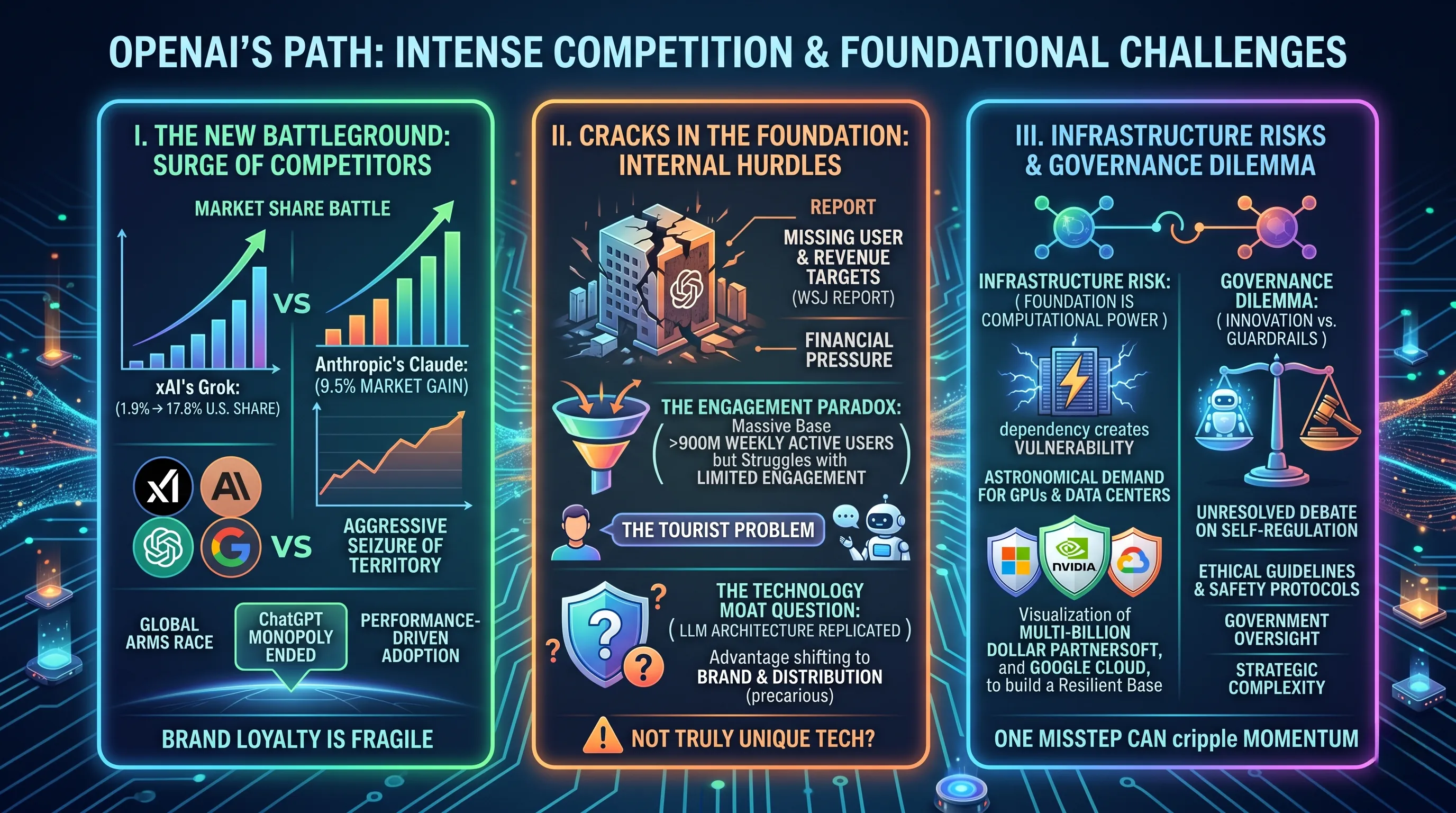
xAI's Grok, for instance, has demonstrated staggering momentum, capturing a 17.8% U.S. share, a meteoric rise from a previous market position of just 1.9%.
This isn't a slow erosion of market share; it's an aggressive seizure of territory, indicating that users are actively seeking and adopting alternatives.
Similarly, Anthropic's Claude has made significant inroads, securing a 9.5% gain in the market.
These figures are not just statistics; they represent a fundamental shift in user behavior and a clear signal that brand loyalty in the AI space is fragile and performance-driven.
OpenAI's head start is a powerful asset, but it is not an insurmountable moat.
🔹Cracks in the Foundation: Internal and Structural Hurdles
Beyond the external pressure from rivals, OpenAI faces significant internal and structural challenges that question the long-term sustainability of its model.
According to a report from The Wall Street Journal citing anonymous sources, the company has reportedly missed its own user and revenue targets.
This revelation cuts against the public narrative of unqualified, exponential growth and suggests that converting massive initial hype into predictable, recurring revenue is more difficult than anticipated.
This financial pressure is compounded by two fundamental user-level issues:
- The Engagement Paradox: While OpenAI boasts a massive user base, with weekly active users exceeding 900 million, sources report that it struggles with limited engagement.
This points to a potential "tourist" problem, where millions of users experiment with the technology out of curiosity but fail to integrate it deeply into their daily workflows or business processes.
A large but shallow user base is far less valuable and more difficult to monetize than a smaller, deeply engaged one, posing a direct threat to long-term profitability and product development. - The Technology Moat Question: A more existential question looms over the company's core offering: the assertion that it does not possess truly unique technology.
While OpenAI's engineering and execution have been world-class, the underlying large language model (LLM) architecture is becoming increasingly understood and replicated.
If competitors can achieve similar or superior performance, OpenAI's primary advantage shifts from defensible technology to brand and distribution—a far more precarious position in a fast-moving market.
🔹The Achilles' Heel: Infrastructure Risks and the Governance Dilemma
The very foundation of advanced AI is computational power, and here, OpenAI faces an identified infrastructure risk.
The demand for GPUs and specialized data centers is astronomical, and any disruption, bottleneck, or dependency in this supply chain can cripple a developer's ability to train, deploy, and scale its models.
This risk is a primary driver behind OpenAI's extensive, multi-billion dollar partnerships with a wide array of infrastructure players like Microsoft, NVIDIA, Oracle, and Google Cloud, as it attempts to build a resilient foundation to support its towering ambitions.
Finally, the entire industry, with OpenAI at its center, is navigating a complex and unresolved debate regarding self-regulation for AI developers.
The immense power of this technology brings with it immense responsibility.
The push for ethical guidelines, safety protocols, and potential government oversight creates a tightrope walk for OpenAI.
It must innovate at a breakneck pace to stay ahead of competitors while simultaneously building guardrails that satisfy public and regulatory concerns.
This governance challenge adds a layer of strategic complexity, where a single misstep could lead to significant reputational damage or restrictive legislation, fundamentally altering its path to market dominance.
📚 Related Posts
OpenAI's Trust Crisis Fuels Ethical AI Alternative Claude's Ascent
🚀 Key TakeawaysOpenAI's ChatGPT has faced significant user backlash and trust erosion, primarily due to its involvement in military cooperation and controversial policy stances, leading to a surge in app deletions (295%) and 1-star reviews (775%) in a s
tech.dragon-story.com
OpenAI Unveils GPT-5.4: A New Era of Autonomous AI for Professional Work
🚀 Key TakeawaysGPT-5.4 is a next-generation frontier model released on March 5, 2026, specifically engineered for professional work and targeting corporate and developer markets.It introduces a revolutionary "thinking" function for structured reasoning
tech.dragon-story.com
NVIDIA NemoClaw: The Secure, Policy-Controlled Stack & OpenClaw OS Driving the Personal AI Agent Era
🚀 Key TakeawaysNVIDIA's NemoClaw significantly advances the personal AI era by enhancing the OpenClaw platform with a secure, policy-controlled, and enterprise-ready software stack that enables the easy deployment and operation of always-on, autonomous
tech.dragon-story.com


