🚀 Key Takeaways
- Microsoft has launched three next-generation MAI models—MAI-Transcribe-1, MAI-Voice-1, and MAI-Image-2—offering groundbreaking advancements in speech recognition, voice generation, and image creation with unparalleled accuracy, speed, and realism. These models are immediately available to developers via Microsoft Foundry and Playground, aiming to build a human-centered AI ecosystem.
Microsoft has officially unveiled its cutting-edge trio of next-generation MAI models, marking a significant milestone in artificial intelligence development.
These three innovative services—MAI-Transcribe-1 for advanced speech recognition, MAI-Voice-1 for natural voice generation, and MAI-Image-2 for high-speed image creation—are now immediately accessible to developers through Microsoft Foundry and Playground.
This strategic release reinforces Microsoft's commitment to delivering powerful and integrated AI capabilities across various domains.
The newly introduced MAI models boast exceptional performance, setting new industry benchmarks.
MAI-Transcribe-1 achieves the world's highest speech recognition accuracy across 25 major languages, demonstrating an astonishingly low 3.9% average Word Error Rate and processing speeds up to 2.5 times faster than current market offerings.
Similarly, MAI-Voice-1 excels in generating natural, emotionally rich voices and can even create personalized voices from just a few seconds of audio samples, while MAI-Image-2 generates realistic images over two times faster than existing models.
Microsoft's vision extends beyond raw capability, aiming to foster a "human-centered AI" ecosystem that prioritizes safety and scalability.
These competitively priced models are designed to make advanced AI more accessible for developers and businesses, expanding the scope of potential applications.
The global marketing powerhouse WPP is already leveraging MAI-Image-2 for content creation, highlighting the immediate real-world impact and strong market confidence in Microsoft's latest AI innovations.

1. Microsoft Unveils Three Next-Gen MAI Models: An Overview
As the centerpiece of its major announcement, "Microsoft Unveils 3 Next-Gen AI Models," the company has pulled back the curtain on a trio of powerful, specialized generative AI models. These are not incremental updates; they represent a significant leap forward in their respective domains. The three models—MAI-Transcribe-1, MAI-Voice-1, and MAI-Image-2—form a new pillar in Microsoft's AI strategy, targeting core human interaction modalities: speech-to-text, text-to-speech, and text-to-image. Critically, Microsoft is not just announcing these models as research projects; they are being made immediately available via Microsoft Foundry and Playground for developers, signaling a clear intent to get these tools into the hands of builders and accelerate a new wave of application development.
🔹MAI-Transcribe-1: Redefining the Standard for Speech Recognition
MAI-Transcribe-1 addresses the foundational need for converting spoken language into accurate text. Microsoft claims it has achieved the world's highest speech recognition accuracy in 25 major languages, a bold statement backed by formidable performance metrics. The model boasts an average Word Error Rate (WER) of just 3.9%, the lowest figure when compared against direct competitors. For developers and businesses, this isn't just a minor improvement; a lower WER translates directly into higher quality, more reliable transcriptions that require significantly less manual correction. This is a game-changer for industries like healthcare, legal services, and media, where transcription accuracy is paramount.
Beyond its precision, MAI-Transcribe-1 is engineered for real-world chaos. One of its key features is its capability for stable operation in noisy environments. This moves the technology out of the quiet office and into the unpredictable reality of call centers, public events, or factory floors, dramatically expanding its viable use cases. Performance is further enhanced by its speed, which is reportedly up to 2.5 times faster than existing services. This leap in processing speed unlocks the potential for seamless, real-time captioning and analysis that doesn't lag behind the conversation. Tying this all together is an aggressive pricing model of $0.36 per hour for speech recognition, making this state-of-the-art technology highly accessible and positioning it as the new default choice for developers building global services.
🔹MAI-Voice-1: Giving AI an Authentic, Emotional Voice
Where MAI-Transcribe-1 deconstructs speech, MAI-Voice-1 masterfully reconstructs it. This speech generation model is designed to overcome the robotic, monotonous quality that has long plagued text-to-speech systems. Its core strength lies in its ability to generate natural voices complete with emotions and intonation. This capability transforms the user experience, allowing for the creation of virtual assistants that sound genuinely helpful, audiobook narrators that sound engaged, and accessibility tools that are more pleasant and human-like to interact with.
Perhaps its most revolutionary feature is the ability to create personalized voices from only a few seconds of voice samples. This dramatically lowers the barrier for creating unique, custom voice identities. Brands can develop a distinctive audio persona, applications can offer users a choice of personalized voices, and it opens up profound possibilities in areas like voice restoration for individuals. By making this advanced, emotionally resonant voice generation technology competitively priced, Microsoft is empowering developers to build applications that don't just speak, but truly communicate.
🔹MAI-Image-2: Photorealistic Imagery at Unprecedented Speed
Completing the trifecta is MAI-Image-2, Microsoft's next-generation model for image generation. This model tackles two of the biggest challenges in the space: speed and realism. It delivers an image generation speed over 2 times faster than existing models, a critical advantage that allows for rapid iteration and a more fluid creative process for designers and marketers. Waiting minutes for a prompt to render is replaced by a near-instant workflow, boosting productivity and experimentation.
The output quality is equally impressive, with the model engineered to produce natural results similar to real photos. This pushes the technology beyond stylized or clearly "AI-generated" art toward photorealism, making it invaluable for creating commercial-grade assets like product mockups, marketing materials, and conceptual art. The model's power is not just theoretical; it's already being validated in the field. Global marketing company WPP is already utilizing MAI-Image-2 for content creation, a powerful endorsement of its readiness for high-stakes, professional workflows. Offered at a competitively priced rate, MAI-Image-2 is positioned to become an essential tool for any organization focused on visual content creation.
Ultimately, the launch of these three models, all integrated within the same ecosystem, underscores Microsoft's strategic vision for a 'human-centered AI' that is not only powerful and scalable but also accessible and intuitive.

2. Breakthrough Performance and Features Across the MAI Suite
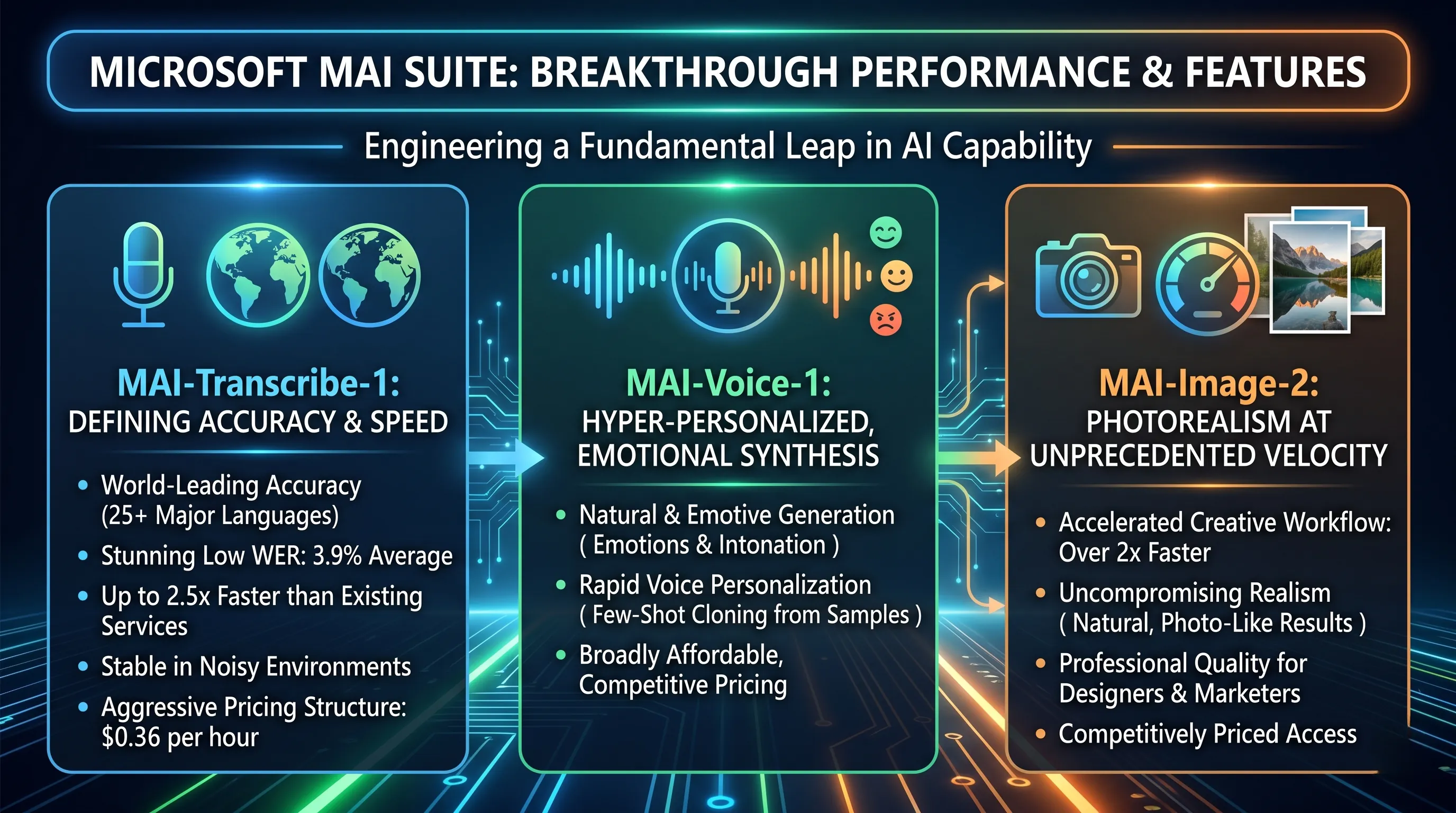
The announcement of Microsoft's new MAI suite is not merely an update; it represents a fundamental leap in AI capability, directly substantiating the main article's theme of "Microsoft Unveils 3 Next-Gen AI Models." The "next-generation" claim is backed by a trinity of models, each establishing new benchmarks in its respective domain—speech recognition, voice synthesis, and image generation.
The following technical breakdown reveals how MAI-Transcribe-1, MAI-Voice-1, and MAI-Image-2 are engineered to dominate the market through superior accuracy, unprecedented speed, and disruptive pricing.
🔹MAI-Transcribe-1: Redefining Accuracy and Speed in Speech Recognition
Microsoft has positioned MAI-Transcribe-1 as the new gold standard for converting spoken language into text, built on a foundation of measurable, world-class performance metrics.
World-Leading Accuracy: The model achieves the world's highest speech recognition accuracy across 25 major languages, a critical feature for any organization operating on a global scale.
This isn't just about understanding a single language well; it's about providing a consistent, reliable transcription service for multinational corporations, content creators, and developers targeting diverse audiences.
This global optimization means a single, integrated solution can replace a patchwork of regional, often inconsistent, transcription services.
Industry-Lowest Error Rate: The performance is quantified by a stunningly low Word Error Rate (WER) of 3.9% on average.
This figure is not just a number; it represents a profound reduction in the need for human correction.
In a professional context, a low WER translates directly into saved labor hours, faster workflow completion, and increased trust in automated outputs for mission-critical tasks like medical dictation, legal documentation, and meeting minutes.
Breakneck Speed and Stability: MAI-Transcribe-1 operates at a velocity that is up to 2.5 times faster than existing services.
This dramatic speed increase unlocks new possibilities for real-time applications, such as live captioning for broadcasts or instantaneous transcription in customer service calls, enabling immediate analysis and response.
Crucially, this speed is paired with stable operation even in noisy environments, a feature that addresses a major real-world pain point.
The model can reliably isolate and transcribe speech in chaotic settings like call centers or public events, ensuring its utility extends far beyond pristine studio recordings.
Aggressive Pricing Structure: Tying this technological superiority together is an aggressive price point of $0.36 per hour for speech recognition.
This pricing makes state-of-the-art accuracy and speed accessible not just to large enterprises but to startups and individual developers, effectively democratizing access to elite-level AI transcription and stimulating widespread adoption.
🔹MAI-Voice-1: The Advent of Hyper-Personalized, Emotional Voice Synthesis
MAI-Voice-1 moves beyond the robotic monotone of previous-generation text-to-speech (TTS) systems, focusing on the nuanced and personal aspects of the human voice.
Natural and Emotive Generation: The model's core strength is its ability to generate natural voices complete with emotions and intonation.
This allows for the creation of audio content—from virtual assistants to audiobooks—that is not just understandable but genuinely engaging and human-like.
The capacity to convey subtlety and feeling dramatically enhances user experience and opens up creative applications previously impossible with synthetic voices.
Rapid Voice Personalization: Perhaps its most revolutionary feature is the ability to create personalized voices from only a few seconds of voice samples.
This drastically lowers the barrier to creating unique, branded digital voices.
Companies can clone a spokesperson's voice for their AI assistant, or individuals can create a digital replica of their own voice for accessibility purposes with minimal effort and data.
This capability for "few-shot" voice cloning represents a massive leap in efficiency and accessibility.
Market-Driven Pricing: While a specific number is not provided, MAI-Voice-1 is described as being competitively priced, signaling Microsoft's intent to capture a significant share of the voice synthesis market by making these advanced features broadly affordable.
🔹MAI-Image-2: Photorealism at Unprecedented Velocity
MAI-Image-2 tackles the dual challenges of speed and quality in AI image generation, delivering a tool optimized for professional creative workflows.
Accelerated Creative Workflow: The model boasts an image generation speed that is over 2 times faster compared to existing models.
For designers, marketers, and content creators, this is a direct productivity multiplier.
It means more creative iterations, faster concept development, and a reduced timeline from idea to final asset. This speed is a crucial competitive advantage in fast-paced industries like advertising and media, a fact underscored by its adoption by the global marketing firm WPP for its content creation pipelines.
Uncompromising Realism: Speed is not achieved at the expense of quality.
MAI-Image-2 is engineered to produce natural results that are similar to real photos.
This focus on photorealism makes it an invaluable tool for generating marketing collateral, product mockups, and stock imagery that is both high-quality and free from the tell-tale artifacts of lesser AI generators.
Competitive Accessibility: Echoing the strategy across the suite, MAI-Image-2 is also competitively priced.
This ensures that high-speed, high-fidelity image generation is not a luxury reserved for a select few but a practical tool available to a wide range of creative professionals and businesses, poised to accelerate the integration of AI into visual content creation.
3. Strategic Vision, Ecosystem Integration, and Market Adoption
The announcement of MAI-Transcribe-1, MAI-Voice-1, and MAI-Image-2 is far more than a simple product launch; it is a tangible manifestation of Microsoft's meticulously crafted strategic vision for the future of artificial intelligence.
This strategy is not about creating isolated, high-performance models but about architecting a cohesive, accessible, and powerful platform.
At its core, Microsoft aims to build a 'human-centered AI' ecosystem, an environment where advanced AI serves as a practical, reliable tool for human creativity and productivity, built upon the non-negotiable foundations of safety and scalability.
🔹The 'Human-Centered' Ecosystem in Practice
Microsoft's vision materializes in how these three distinct AI functions are not siloed but are deeply woven into a single, integrated ecosystem.
The release of a world-class transcription model, a natural voice generator, and a rapid image creator simultaneously is a deliberate move to provide a complete, end-to-end workflow for developers and businesses.
A developer working within this ecosystem can now seamlessly pipe the output from one service into another.
For instance, one could use MAI-Transcribe-1 to capture meeting notes with its world-leading accuracy (an average Word Error Rate of only 3.9%), then use that text to have MAI-Voice-1 generate a natural-sounding audio summary with appropriate emotion and intonation.
Subsequently, key concepts from that summary could be used as prompts for MAI-Image-2 to generate custom visuals for a presentation, all within a unified development environment.
This integration transforms AI from a series of disjointed tools into a fluid, interconnected creative suite, dramatically reducing friction and accelerating development cycles.
The immediate availability of these models via the Microsoft Foundry and Playground underscores this commitment, providing developers with instant access to experiment, build, and deploy.
🔹Democratizing AI for Developers and Businesses
A key pillar of Microsoft's strategy is lowering the barrier to entry for AI adoption, and the new MAI models are engineered to do precisely that.
The strategic decision to make these models price competitive is a direct challenge to the market status quo, where cutting-edge performance often comes with prohibitive costs.
With MAI-Transcribe-1 priced at just $0.36 per hour for speech recognition, Microsoft is not just offering best-in-class accuracy; it's making that accuracy economically viable for startups and large enterprises alike.
This combination of low cost and high performance—being up to 2.5 times faster than existing services—delivers an undeniable value proposition.
For businesses, this translates into tangible benefits:客服 centers can deploy highly accurate, stable transcription even in noisy environments, global companies can create localized marketing with authentic voices, and creative agencies can accelerate their content pipelines.
The ability of MAI-Voice-1 to create personalized voices from just a few seconds of audio samples opens unprecedented opportunities for unique branding and hyper-personalized user experiences.
Similarly, MAI-Image-2's speed, which is over 2 times faster than competing models, combined with its ability to produce photorealistic results, directly addresses the enterprise need for rapid, high-quality content generation at scale.
🔹Early Adoption: A Powerful Market Endorsement
Microsoft’s strategy is not merely theoretical; it is already being validated in the real world.
The fact that a global marketing titan like WPP is already utilizing MAI-Image-2 for content creation serves as a powerful proof point for the entire ecosystem.
WPP's adoption is significant because it operates in an industry where speed, quality, and cost-efficiency are paramount.
Their use of MAI-Image-2 validates Microsoft's claims of producing natural, realistic results that meet professional standards.
This early adoption by an industry leader signals strong market confidence and demonstrates a clear, immediate, and high-value use case for Microsoft’s new AI suite, affirming that the vision of a human-centered, integrated, and accessible AI platform is already delivering tangible business impact.

📚 Related Posts
Microsoft's MAI-Image-2: Unveiling the AI Image Generator Setting New Standards for Photorealism and Professional Creativity
🚀 Key TakeawaysMAI-Image-2, developed by Microsoft, has rapidly ascended to become a global top 3 contender in text-to-image generation, provisionally holding the #5 model slot on Arena.ai.It delivers greatly enhanced photorealism, with nuanced natural
tech.dragon-story.com
NVIDIA NemoClaw: The Secure, Policy-Controlled Stack & OpenClaw OS Driving the Personal AI Agent Era
🚀 Key TakeawaysNVIDIA's NemoClaw significantly advances the personal AI era by enhancing the OpenClaw platform with a secure, policy-controlled, and enterprise-ready software stack that enables the easy deployment and operation of always-on, autonomous
tech.dragon-story.com
Google's Personal Intelligence: Your Next-Gen AI Assistant for Hyper-Personalized, Private Digital Life
🚀 Key TakeawaysGoogle's "Personal Intelligence" marks a pivotal shift, evolving AI from a mere search tool into a true personal assistant that deeply understands individual user context, preferences, and history.This advancement promises to significantl
tech.dragon-story.com


