🚀 Key Takeaways
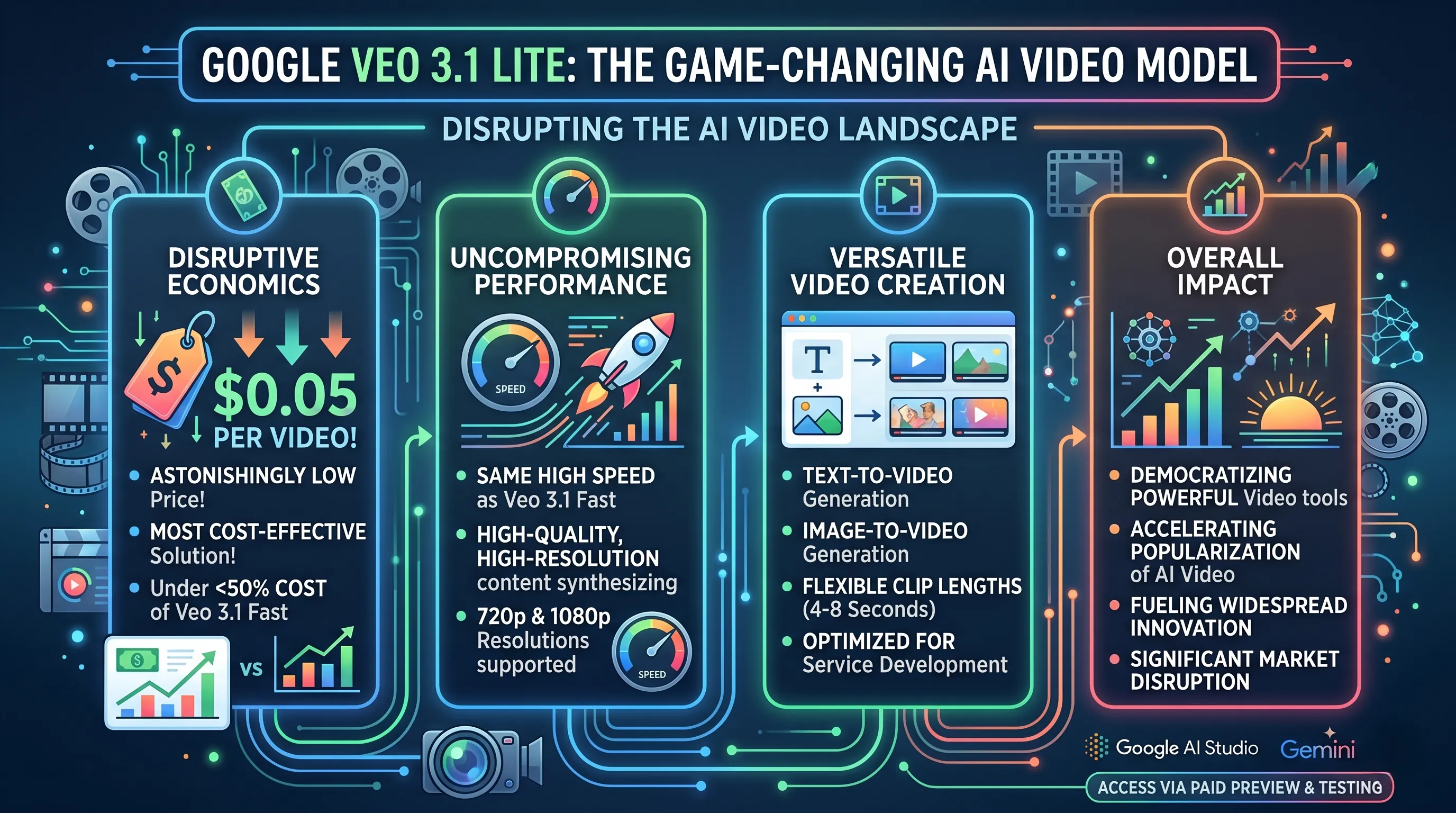
- Google's Veo 3.1 Lite redefines AI video generation pricing at an unprecedented $0.05 per video, making it the most cost-effective model available.
- It significantly lowers the barrier to entry for developers, enabling the creation of high-volume video applications and rapid iteration without heavy cost burdens.
- Despite its low price, Veo 3.1 Lite offers robust text-to-video and image-to-video capabilities, supporting 720p and 1080p resolutions with flexible 4-8 second clips.
- The model is designed for actual service development and maintains the same speed as Veo 3.1 Fast while being less than half the price.
- Available now in paid preview via the Gemini API and for testing in Google AI Studio, Veo 3.1 Lite is poised to accelerate the popularization of AI video across industries.
Google is set to significantly disrupt the AI video generation landscape with the launch of its new model, Veo 3.1 Lite. This groundbreaking release fundamentally redefines affordability in generative AI video, positioning itself as a game-changer for developers and businesses alike.
Priced at an astonishingly low $0.05 per video, Veo 3.1 Lite stands out as the most cost-effective solution in Google's advanced Veo 3.1 family, offering the same high speed as the Veo 3.1 Fast model for less than half its cost.
Designed with high-volume video applications in mind, Veo 3.1 Lite empowers creators to rapidly iterate and scale their projects without the prohibitive financial burden typically associated with advanced AI services. It supports versatile text-to-video and image-to-video generation, capable of synthesizing high-quality, high-resolution content at both 720p and 1080p with flexible clip lengths of 4 to 8 seconds.
This optimization for actual service development means that complex video production can now be integrated into workflows with unprecedented ease and efficiency.
The strategic rollout of Veo 3.1 Lite, which began with availability in paid preview through the Gemini API and for testing in Google AI Studio, is expected to dramatically accelerate the popularization of AI video, mirroring the transformative impact seen in AI text and image generation. By significantly lowering the barrier to entry, Google is not just introducing a new product; it is democratizing access to powerful video creation tools, thereby fueling widespread innovation in the generative AI space and truly shaking up the market.
1. Google's Game-Changer: Veo 3.1 Lite's Disruptive Price and Broad Accessibility
Google is not merely entering the AI video generation market; it is fundamentally reshaping its economic landscape, and Veo 3.1 Lite is its chosen instrument for this disruption.
This section directly addresses the core thesis of our main topic, "Google Shakes the Market with Veo 3.1 Lite", by dissecting the primary mechanism of this market-shaking strategy: an aggressive, multi-layered approach to pricing and accessibility that aims to commoditize AI video creation on a scale previously unseen.
The strategy is not a future promise but an immediate reality.
As of this Tuesday, Veo 3.1 Lite has begun its rollout, and developers can access it immediately in a paid preview through the Gemini API.
For those looking to experiment and prototype, it is also readily available for testing in Google AI Studio, ensuring that the barrier to entry is not just financially low but also technically accessible from day one.
🔹The Five-Cent Shockwave: Redefining "Cost-Effective"
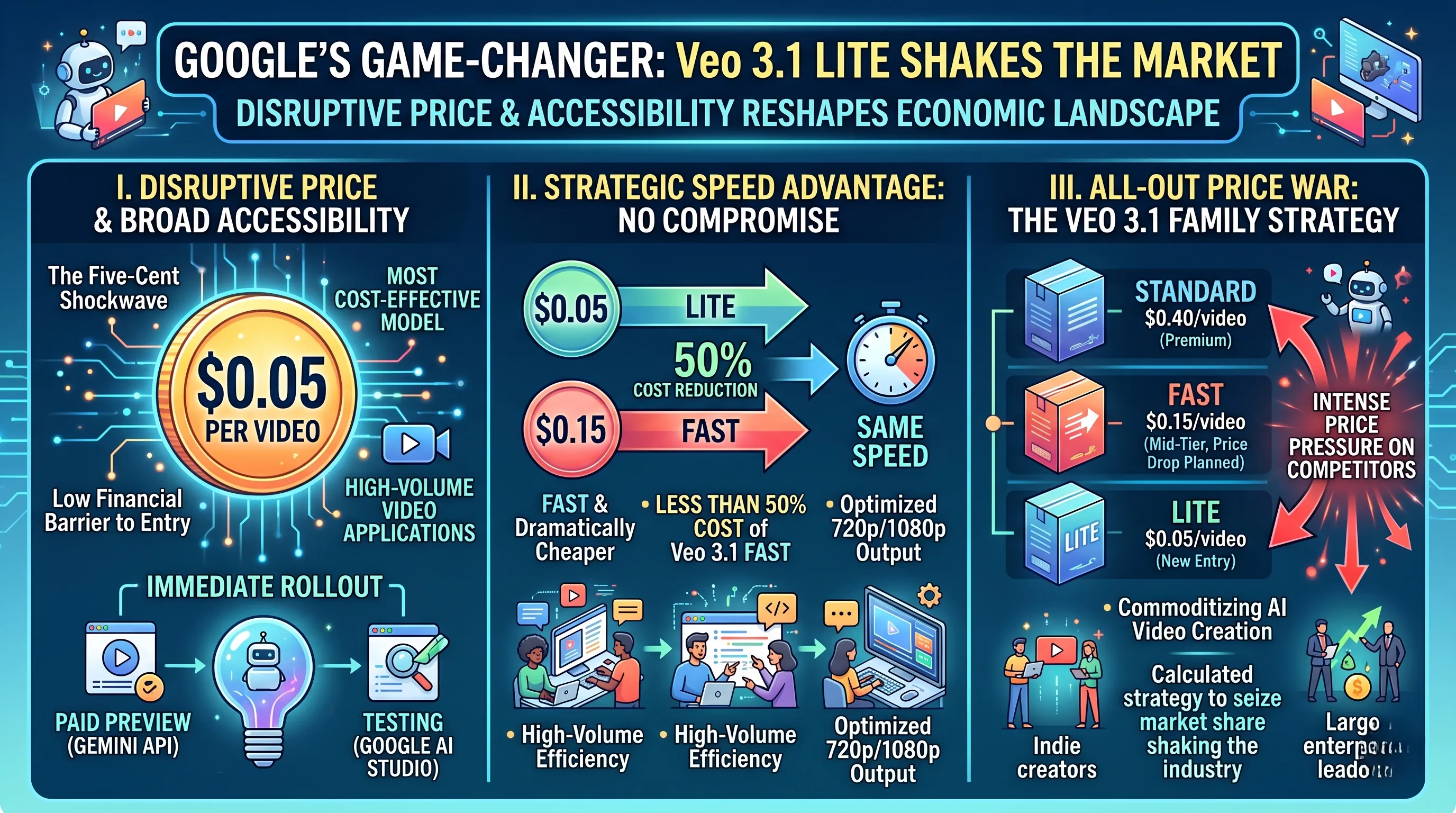
The centerpiece of Google's aggressive push is a single, staggering number: $0.05 per video.
This is not simply a competitive price; it is a declaration of intent to make AI video generation a ubiquitous, high-volume utility, much like text or image generation.
At five cents, creating a short video clip becomes a trivial expense, empowering businesses and developers to think in terms of scale and rapid iteration rather than cost-per-unit.
This pricing establishes Veo 3.1 Lite as the most cost-effective model on the market, a title that significantly understates its impact.
It unlocks use cases that were previously economically unviable, from programmatic social media ad campaigns generating thousands of variations to dynamic video elements embedded within applications.
This price point is a direct enabler for the model's design purpose: to power high-volume video applications without imposing a heavy cost burden on developers.
🔹No Compromise on Speed: The Strategic Advantage
Crucially, Veo 3.1 Lite's radical affordability does not come at the expense of performance where it matters most for iteration: speed.
Google has engineered this model to be less than 50% of Veo 3.1 Fast's cost while offering the same speed.
This is a critical distinction.
Developers are not being forced into a "slow and cheap" tier.
Instead, they are being offered a "fast and dramatically cheaper" option, perfect for the rapid prototyping and scaling that defines modern service development.
The cost of the existing Fast model is $0.15 per video; achieving identical speed for a third of that price with Veo 3.1 Lite is a game-changing value proposition that will force competitors to re-evaluate their entire pricing structure.
While the model supports both 720p and 1080p resolutions, the explicit mention of 720p output for Veo 3.1 Lite highlights its optimization for efficiency and the most common use cases on web and mobile platforms where this resolution is more than sufficient.
🔹An All-Out Price War: The Veo 3.1 Family Strategy
Veo 3.1 Lite does not exist in a vacuum.
It is the new entry point for a clearly defined product family, which includes the mid-tier Veo 3.1 Fast at $0.15 per video and the premium Veo 3.1 Standard at $0.40 per video.
However, Google is not stopping at just introducing a low-cost option.
In a move that signals a full-scale assault on market pricing, the company has announced that it also plans to lower the price of the existing Veo 3.1 Fast model.
This two-pronged strategy is designed to create immense pressure across the entire market.
By introducing an aggressively low floor with Lite and simultaneously compressing the price of its mid-tier Fast model, Google is leaving very little room for competitors to maneuver.
This is a clear, calculated strategy to seize market share by making Google's ecosystem the most economically attractive option for nearly every tier of developer, from indie creators to large enterprises, effectively shaking the industry to its core.
2. Powering the Next Wave: Veo 3.1 Lite's High-Volume, High-Resolution Video Generation
The core reason why Google is poised to disrupt the entire AI video market with Veo 3.1 Lite lies not in a single groundbreaking feature, but in a meticulously calibrated set of technical capabilities designed for one purpose: mass adoption through high-volume generation.
This section connects directly to the overarching theme of "Google is shaking up the market with Veo 3.1 Lite" by deconstructing the specific technical specifications that transform AI video from a novel-but-expensive tool into a scalable, affordable utility for developers and businesses worldwide.
The model's resolution, length, and format flexibility are the very engine driving this market-shaking potential.
🔹The Foundational Pillars: Text-to-Video and Image-to-Video
At its core, Veo 3.1 Lite operates on two fundamental and powerful generation modalities: Text-to-Video and Image-to-Video.
This dual-input system provides immense creative and practical flexibility.
With Text-to-Video, users can bring a purely conceptual idea to life, describing a scene, action, or mood and watching the model synthesize it into motion.
This is the bedrock for rapid prototyping and creative exploration.
Simultaneously, the Image-to-Video capability allows developers to animate existing static assets, transforming product photos, illustrations, or keyframes into dynamic clips.
This feature is a game-changer for e-commerce, advertising, and content marketing, enabling businesses to add a layer of engagement to their visual libraries with minimal effort.
🔹The Resolution Sweet Spot: Quality Optimized for Scale
Veo 3.1 Lite offers support for both 720p and 1080p resolutions, a specification that represents a masterful strategic decision by Google.
While other models may chase higher 4K resolutions, Veo 3.1 Lite focuses on the true workhorse formats of the digital world.
Experientially, 720p and 1080p provide more than enough clarity and quality for the vast majority of online applications—from social media feeds and web embeds to digital advertisements.
This pragmatic approach has a profound impact on scalability.
By avoiding the immense computational overhead of 4K, Veo 3.1 Lite can generate videos faster and, crucially, at a significantly lower cost.
This isn't a compromise on quality; it's an optimization for volume, ensuring that developers can build services that generate thousands of videos without being crippled by processing time or expense.
🔹Designed for the Digital Moment: Flexible Formats and Lengths
Veo 3.1 Lite is engineered for the modern content landscape, offering precise control over video duration and orientation.
The model supports flexible video lengths, allowing users to generate clips of 4, 6, or 8 seconds, or specify a range of 5-8 second clips.
This short-form focus is perfectly aligned with the "attention economy," directly catering to the content formats that dominate platforms like TikTok, Instagram Reels, and YouTube Shorts.
For a developer, this means the ability to programmatically create vast libraries of bite-sized, engaging content ideal for social media campaigns or as preview clips within an application.
This flexibility is powerfully complemented by its support for versatile aspect ratios: 16:9 (horizontal) and 9:16 (vertical).
This is not a minor feature; it is a critical workflow accelerator.
It empowers creators and automated systems to produce content natively for both traditional landscape screens (like YouTube) and vertical mobile-first platforms without awkward cropping or re-rendering.
A single creative concept can be efficiently adapted for multiple channels, maximizing reach and engagement.
This built-in versatility is a cornerstone of scalable service development, removing friction and enabling high-volume, multi-platform content pipelines.

3. Accelerating the AI Video Revolution: Veo 3.1 Lite's Market Impact and Practical Considerations
The introduction of Google's Veo 3.1 Lite is the central mechanism behind the overarching theme that "Google is shaking up the market with Veo 3.1 Lite".
This section delves into precisely how this new model acts as a disruptive force by fundamentally altering the economics and accessibility of AI video generation, setting the stage for its widespread adoption while acknowledging its current, practical boundaries.
🔹The Economic Catalyst: Democratizing High-Volume Video Generation
The most potent weapon in Veo 3.1 Lite's arsenal is its price point.
At a mere $0.05 per video, Google has not just lowered the barrier to entry; it has effectively demolished it for a vast range of applications.
This pricing is a strategic masterstroke, positioning Veo 3.1 Lite as the most cost-effective model in its class.
To put this in perspective, its cost is less than 50% of its sibling model, Veo 3.1 Fast ($0.15 per video), while astonishingly maintaining the same generation speed.
This isn't just an incremental improvement; it's a paradigm shift that changes the entire financial equation for developers and businesses.
Previously, AI video generation was a high-stakes investment, reserved for well-funded projects or experimental R&D.
Now, the ability to generate thousands of video clips for the cost of a single professional stock video license empowers businesses to rapidly iterate and scale in ways that were previously unimaginable.
This model is explicitly designed for high-volume video applications, freeing developers from the heavy cost burden that has stifled mass implementation.
The experiential value is profound: companies can now afford to A/B test hundreds of video ad variations, dynamically generate personalized product showcases, or create an endless stream of visual content for social media marketing without risking their entire budget.
This economic accessibility is the primary driver of the market disruption.
🔹Paving the Path for Mass Adoption
Veo 3.1 Lite is engineered to accelerate the popularization of AI video, mirroring the trajectory previously seen with text and image generation AI.
Its availability is immediate and practical, offered in a paid preview through the Gemini API and available for testing in Google AI Studio, with the rollout having begun on Tuesday.
This direct access through established developer platforms is crucial, as it allows for immediate integration into existing workflows and new applications.
The model's specifications are perfectly tailored for the most common digital use cases.
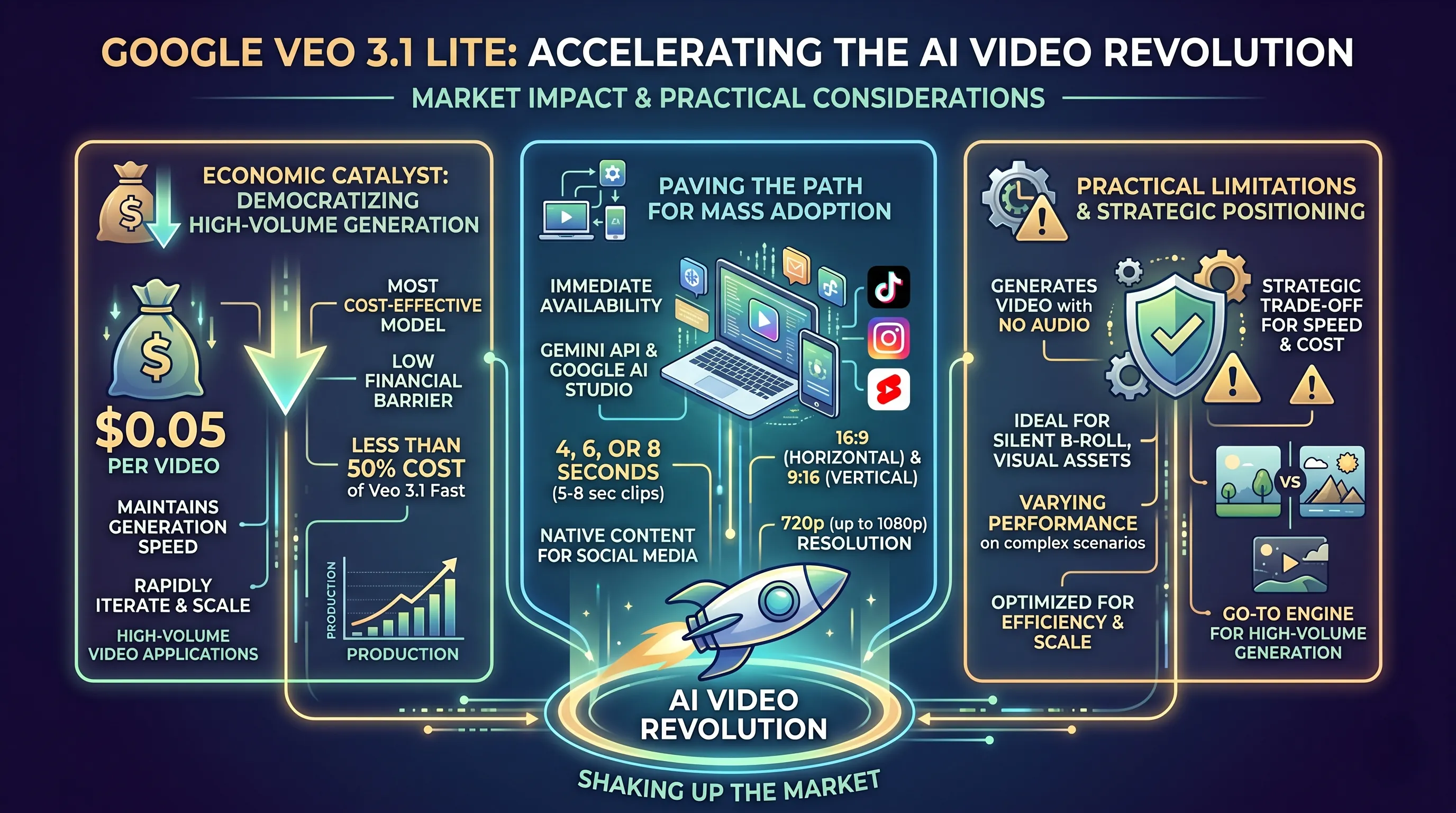
It supports flexible video lengths of 4, 6, or 8 seconds (also described as 5-8 second clips), which is the sweet spot for engagement on social media and digital advertising platforms.
Crucially, it supports both 16:9 (horizontal) and 9:16 (vertical) aspect ratios, eliminating the need for awkward cropping and ensuring content is native to both traditional screens and mobile-first platforms like TikTok, Instagram Reels, and YouTube Shorts.
With the capability to synthesize high-quality video at 720p resolution (and support for up to 1080p), the output is more than sufficient for the vast majority of online applications, where bandwidth and loading speed are often prioritized over 4K fidelity.
This combination of low cost, developer-friendly access, and practical output formats is the formula that will transition AI video from a niche technology to a ubiquitous creative tool.
🔹Practical Limitations and Strategic Positioning
While its potential is immense, it is crucial for developers and businesses to understand Veo 3.1 Lite's current limitations, which are not flaws but rather deliberate design choices that define its strategic role.
The most significant of these is that the model generates video with no audio.
This is a strategic trade-off to optimize for speed and cost.
It positions Veo 3.1 Lite as a premier tool for creating silent B-roll, visual assets for websites, or social media content where music or trending sounds are typically added in a separate, post-production step within other applications.
Furthermore, Google acknowledges that the model exhibits varying performance on complex multi-subject scenarios.
This is a typical characteristic of a "Lite" model, which is optimized for efficiency and scale over handling every conceivable edge case with perfect fidelity.
For developers, this means that prompts involving simple subjects and actions are likely to yield excellent results consistently, while more ambitious scenes with multiple interacting characters or objects may require more experimentation and prompt refinement.
This is not a deal-breaker but a critical consideration for application design.
By understanding these boundaries, creators can leverage Veo 3.1 Lite for what it excels at: becoming the go-to engine for cost-effective, high-volume, and high-quality video generation, thereby truly shaking up the market and accelerating the AI video revolution.
📚 Related Posts
Google's Personal Intelligence: Your Next-Gen AI Assistant for Hyper-Personalized, Private Digital Life
🚀 Key TakeawaysGoogle's "Personal Intelligence" marks a pivotal shift, evolving AI from a mere search tool into a true personal assistant that deeply understands individual user context, preferences, and history.This advancement promises to significantl
tech.dragon-story.com
Google's Stitch: How AI 'Vibe Design' Will Revolutionize UI Creation by 2026 – A Deep Dive
🚀 Key TakeawaysStitch is an AI-native design canvas from Google Labs, launching March 18, 2026, that will revolutionize UI creation by allowing users to generate high-quality designs using natural language, embodying 'vibe design' focused on emotion and
tech.dragon-story.com


