🚀 Key Takeaways
- Stitch is an AI-native design canvas from Google Labs, launching March 18, 2026, that will revolutionize UI creation by allowing users to generate high-quality designs using natural language, embodying 'vibe design' focused on emotion and purpose.
- It dramatically lowers design entry barriers for both professionals and general users, accelerating the 'idea to product' timeline by instantly visualizing concepts, rapidly generating UI drafts, and transforming designs directly into interactive prototypes and code.
- This innovative tool enhances efficiency and collaboration with features like an Infinite Canvas, Design Agents for workflow automation, real-time modification via voice commands, and an initial capability to convert hand-drawn sketches to digital UI.
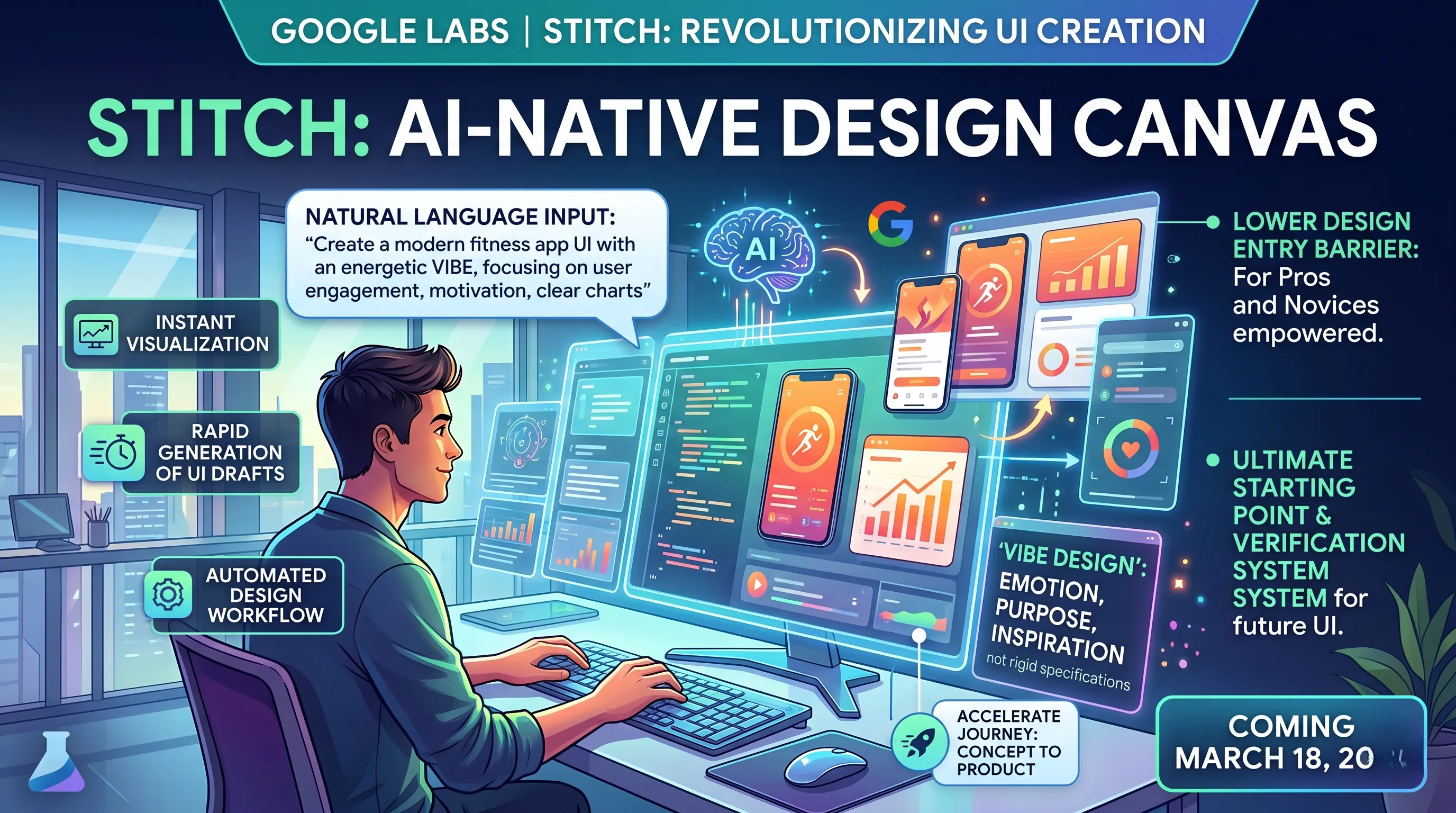
Get ready to witness a monumental shift in how user interfaces are conceived and crafted! Google Labs is set to unleash Stitch, an revolutionary AI-native design canvas that promises to completely transform UI creation.
Slated for release on March 18, 2026, Stitch introduces a groundbreaking approach dubbed 'vibe design,' moving beyond rigid specifications to focus on the emotion, purpose, and inspiration behind every user experience.
At its core, Stitch empowers users to generate high-quality UI designs using nothing more than natural language descriptions, making complex design accessible to everyone.
This platform is engineered to instantly visualize ideas, rapidly generate and refine UI drafts, and automate significant portions of the design workflow, accelerating the journey from a nascent concept to a tangible, interactive product.
By lowering the design entry barrier for both seasoned professionals and complete novices, Stitch is poised to become the ultimate starting point and verification system for future UI development.
1. Unveiling Stitch's AI Core: How Natural Language Transforms UI Creation
🔹 From Abstract Vibes to Concrete Vectors: The AI Engine
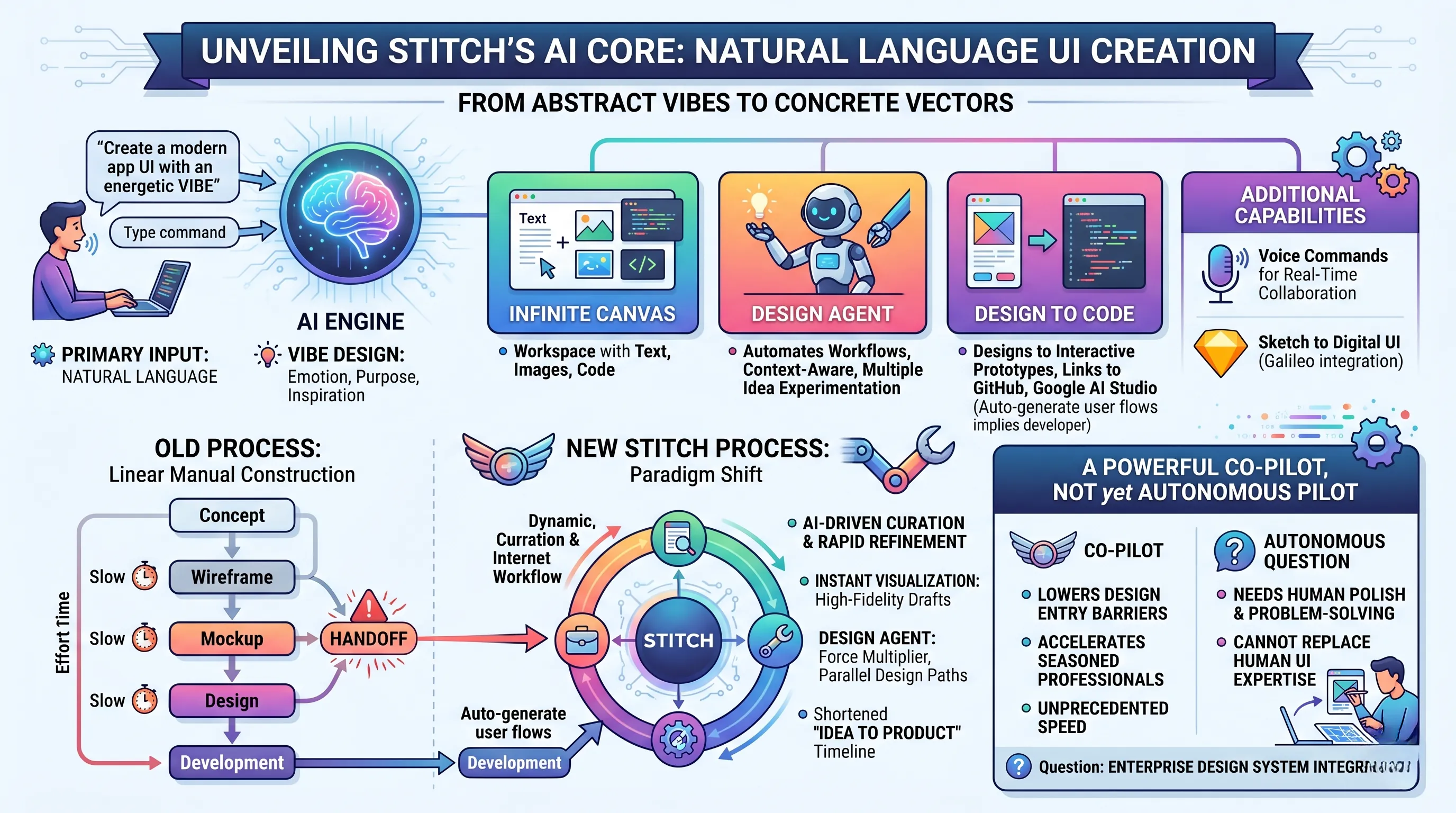
At its heart, Stitch operates as an AI Native Design Canvas, fundamentally engineered to interpret natural language as its primary input.
This is driven by a core concept Google Labs calls 'vibe design'—an approach where abstract inputs like emotion, purpose, or inspiration are used to generate high-quality UI.
Its technological foundation includes several key features: an Infinite Canvas for integrating text, images, and code in a single workspace; a context-aware Design Agent that automates workflows and supports simultaneous idea experimentation; and a powerful Design to Code engine that transforms static designs into interactive prototypes.
The system further supports real-time collaboration via voice commands and can even convert hand-drawn sketches into polished digital UI through its integration with Galileo, bridging the physical and digital realms.
🔹 The End of the Linear Workflow: A Paradigm Shift in Production
These integrated technologies don't just accelerate the old process; they establish an entirely new one.
The concept of 'vibe design' means designers can instantly visualize multiple high-fidelity drafts based on a simple description, bypassing hours of manual wireframing and drastically shortening the 'idea to product' timeline.
The Design Agent functions as a force multiplier, allowing a single user to explore parallel design paths that would traditionally require a full team, thereby making experimentation faster and more accessible.
Most critically, the Design to Code functionality directly challenges the conventional, often fraught, handoff between design and development by auto-generating user flows and connecting directly to platforms like Google AI Studio and GitHub.
This represents a monumental shift from a method of manual construction to a workflow of AI-driven curation and rapid refinement, which is the very mechanism by which Stitch will completely change UI production.
🔹 A Powerful Co-Pilot, Not Yet an Autonomous Pilot
Expert and community analysis acknowledges Stitch as a game-changing tool for initiating projects and verifying concepts with unprecedented speed.
Its ability to lower design entry barriers while simultaneously accelerating the work of seasoned professionals is widely cited as its most significant immediate benefit.
However, the prevailing sentiment is that while Stitch is an exceptional co-pilot, it is not yet 'good enough' to fully replace the nuanced expertise of a human UI designer.
It is positioned as the ultimate tool for starting a project and a powerful system for verification, but the final stages of detailed polish and complex problem-solving still demand human intervention.
A lingering question for enterprise users is how seamlessly this new paradigm will integrate with existing, deeply embedded design systems, a key factor for its long-term adoption.
2. The Seismic Shift: How Stitch Will Reshape the UI/UX Industry Landscape
🔹 The End of the Blank Canvas Paralysis
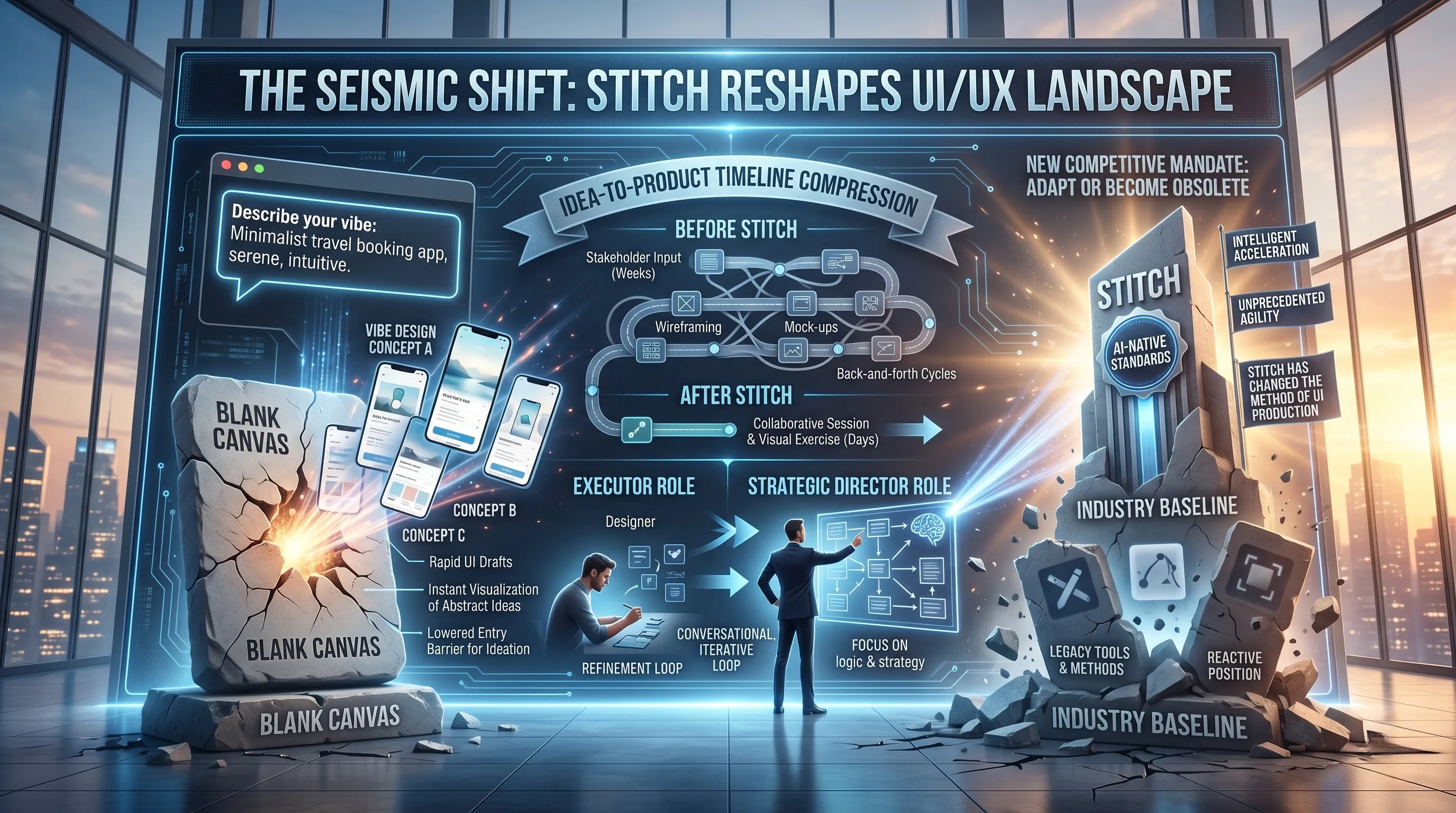
Stitch fundamentally dismantles the traditional starting point of UI design by enabling rapid UI draft generation and refinement based on simple descriptive language.
Leveraging its 'vibe design' concept, the platform instantly visualizes abstract ideas, effectively eliminating the time-consuming initial wireframing and mock-up stages.
This core functionality allows any team member, from product managers to developers, to generate high-fidelity concepts without needing specialized design software skills, thus lowering the entry barrier for professional-grade ideation.
The system is designed to accelerate design automation, moving the process from a manual, step-by-step creation to a conversational, iterative refinement loop.
🔹 Redefining Roles and Compressing Timelines
The most significant impact of Stitch's approach is the radical compression of the 'idea to product' timeline.
What once took days or weeks of back-and-forth between stakeholders and designers can now be accomplished in a single collaborative session, turning brainstorming into a live, visual exercise.
This supercharged productivity doesn't replace designers but rather elevates their role from executors to strategic directors, allowing them to focus on user experience logic and high-level strategy instead of repetitive component creation.
For the industry, this represents a monumental shift; it democratizes the initial design phase and forces a re-evaluation of established workflows, demanding a new level of agility and speed from product teams.
🔹 The New Competitive Mandate: Adapt or Become Obsolete
The consensus is clear: Stitch establishes a new baseline for what a design tool should be.
While initial user sentiment suggests it is not yet "good enough" to fully replace a seasoned UI designer for final, polished products, its power as a starting point and verification system is undeniable.
This forces legacy platforms like Figma and Adobe XD into a reactive position, where failing to integrate comparable AI-native, natural language capabilities will be a significant competitive disadvantage.
The industry landscape is now irrevocably altered; tools will no longer be judged solely on their vector manipulation or prototyping features, but on their ability to intelligently accelerate the journey from a vague concept to a tangible, interactive product, proving that Stitch has indeed changed the very method of UI production.
3. Initial Verdicts & User Whispers: Is Stitch Truly the UI Revolution We Need?
🔹 The Starting Gun, Not the Finish Line
Early analysis from industry experts positions Stitch not as a complete end-to-end solution, but as an unparalleled catalyst for the initial phases of design.
The consensus is that it's unequivocally the 'best tool for starting and a verification system,' armed with powerful features like the 'Redesign Agent' and 'Predictive Heat' to test and iterate on concepts.
However, this praise is tempered by community sentiment suggesting that, in its current anticipated form, it is 'not yet 'good enough' to fully replace UI design' from conception to final delivery.
🔹 From Ideation to Validation in Minutes
This positioning radically redefines the front end of the UI production pipeline.
Instead of days spent on wireframes and mockups, Stitch empowers teams to move from a natural language prompt to a visually validated concept almost instantaneously.
The 'Predictive Heat' feature, for example, allows for a form of pre-emptive user testing, identifying potential usability issues before a single line of traditional design work has begun.
This ability to rapidly start, verify, and pivot doesn't just shorten timelines; it fundamentally changes how products are conceived, allowing for more experimentation and data-backed decisions at the project's most critical stage.
🔹 A Force Multiplier, Not a Replacement
With a Google Labs release date set for March 18, 2026, the current discourse is one of strategic anticipation rather than final judgment.
The prevailing view among designers is that Stitch is not a threat but a profound force multiplier.
The tool's true revolutionary potential lies in its ability to automate the laborious, time-consuming aspects of initial UI creation, freeing human designers to focus on complex problem-solving, user experience strategy, and creative innovation.
The critique of it not being a full replacement is less a complaint and more a clarification of its role: to be the most powerful co-pilot a UI designer has ever had, completely transforming the workflow from day one.

4. Navigating the New Frontier: Stitch's Potential Hurdles and Design System Compatibility
🔹 The 'Good Enough' Gap and the Integration Question
Despite its groundbreaking features, early user sentiment highlights a critical challenge: Stitch is currently perceived as "not yet 'good enough' to fully replace UI design" in professional environments.
Furthermore, a significant implied concern revolves around its compatibility with the complex, established design systems that govern product development at most tech companies.
🔹 Bridging the Gap from 'Vibe' to Version Control
This presents a substantial roadblock to Stitch's goal of completely changing UI production.
For enterprise teams, a design system is the non-negotiable source of truth, containing predefined components, tokens, and brand guidelines.
If Stitch's "Design Agent" cannot ingest and strictly adhere to these existing systems, its output, however creative, remains isolated from the production pipeline.
This forces designers into a manual, time-consuming process of translating Stitch’s concepts back into their company's official component library, directly undermining the promise of a shortened "idea to product" timeline.
The powerful "Design to Code" feature, which connects to tools like GitHub, loses much of its revolutionary impact if the code it generates doesn't align with the organization's pre-approved, system-compliant codebases.
🔹 The Current Verdict: An Unmatched Ideation Partner, Not a Full Replacement
The community consensus positions Stitch not as a complete workflow replacement, but as an unparalleled co-pilot for the initial stages of creation.
It is lauded as the "best tool for starting", capable of instantly visualizing abstract ideas and accelerating the generation of UI drafts far beyond human speed.
However, until it masters seamless integration with existing design systems, its primary role in a professional setting will be to augment, rather than replace, traditional tools.
Designers will leverage Stitch for its incredible ideation power, then pivot to their established workflows to ensure the final product meets the rigorous standards of consistency and scalability demanded by a mature design system.

5. Beyond 2026: Stitch's Trajectory and the Future of AI-Powered UI Design
🔹 The ‘Vibe Design’ Philosophy as a Developmental Roadmap
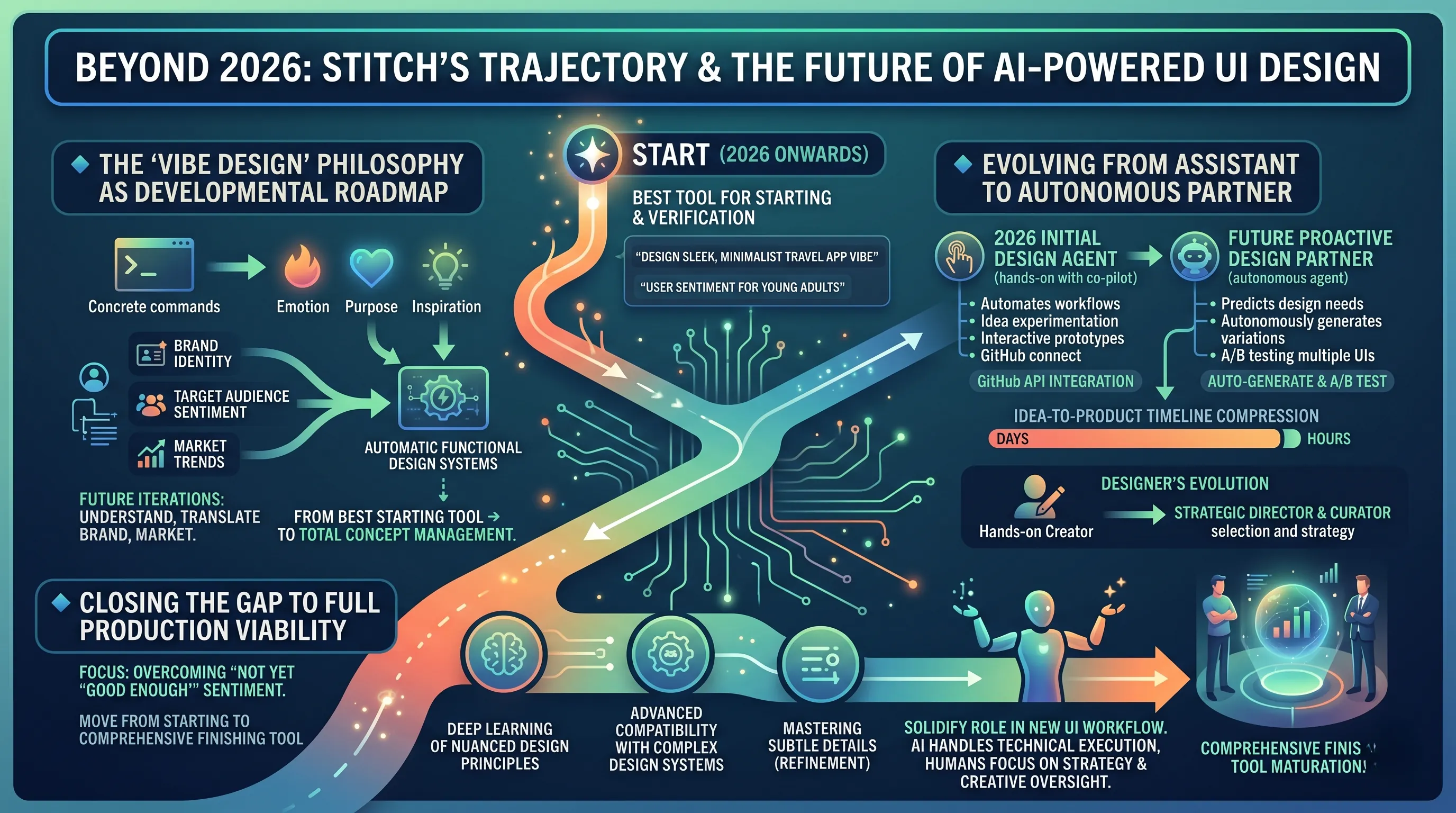
Stitch's foundational concept of 'vibe design' is more than a marketing term; it's a clear indicator of its long-term trajectory.
By prioritizing abstract inputs like emotion, purpose, and inspiration over concrete commands, Google Labs is establishing a new paradigm where the AI's primary function is interpretation, not just execution.
This philosophy suggests future iterations will move beyond simply generating UI from natural language and delve into understanding and translating brand identity, target audience sentiment, and market trends into functional design systems automatically.
Its initial positioning as the 'best tool for starting and a verification system' is merely the entry point for a system designed to eventually manage the entire conceptual phase of product development.
🔹 Evolving from Assistant to Autonomous Partner
The initial 2026 version of the 'Design Agent' automates workflows and supports idea experimentation, but its evolution is what will truly revolutionize the UI production process.
Given its current ability to transform designs into interactive prototypes and connect to development environments like GitHub, the logical progression is toward a fully proactive design partner.
Post-2026, we can anticipate an agent that doesn't just respond but predicts design needs, autonomously generating and A/B testing multiple UI variations based on a single 'vibe' prompt.
This leap will further compress the 'idea to product' timeline from days to mere hours, shifting the designer's role from a hands-on creator to a strategic director who curates the AI's best outputs.
🔹 Closing the Gap to Full Production Viability
The prevailing user sentiment that Stitch is "not yet 'good enough' to fully replace UI design" defines the platform's primary challenge and developmental goal for the coming years.
To overcome this, Stitch must evolve from a powerful starting tool into a comprehensive finishing tool.
Future development will likely focus on deep learning of nuanced design principles, advanced compatibility with complex existing design systems, and mastering the subtle details that currently separate competent AI generation from expert human craftsmanship.
As the AI's capabilities for refinement and contextual understanding mature, it will solidify its role in the new UI production workflow, handling nearly all technical execution and allowing human talent to focus exclusively on strategy and creative oversight.
6. 💡 Tech Talk: Making Sense of the Jargon
- Vibe Design: Imagine designing a room not just by picking furniture, but by describing the feeling you want the room to evoke – cozy, energetic, calm. Stitch's "vibe design" does this for UIs, letting you describe the emotion or purpose rather than just technical specs.
- AI Native Design Canvas: Think of a blank canvas that isn't just a drawing tool, but has a super-smart AI brain built right into it. This AI actively helps you design, understands your needs, and even suggests things.
- Infinite Canvas: Picture a whiteboard that never runs out of space, where you can paste sticky notes, draw, write text, and even embed videos, all seamlessly connected. It's a boundless digital workspace for all your ideas.
- Design Agent: Like having a personal design assistant inside your computer. This smart helper understands your project, automates repetitive tasks, and even helps you test different ideas at the same time without extra effort.
- Design to Code: It's like having a translator who can turn your beautiful drawings directly into the building blocks (code) for a real website or app. You design it visually, and Stitch writes much of the underlying code for you.
- Redesign Agent: Imagine asking an AI to instantly give you new versions or improvements of your current design based on new goals or feedback, without you having to manually move things around.
- Predictive Heat: Think of it like a weather forecast for your UI. This feature predicts where users will look or click most often, showing you the "hot spots" before anyone even uses your design, helping you make it more effective.
📚 Related Posts
Midjourney V8 Alpha: The Next Evolution in AI Image Generation
🚀 Key TakeawaysUnprecedented Speed & Quality: Experience image generation that is approximately 5 times faster than previous versions, combined with significantly improved detail and consistency across all outputs.Advanced Style Personalization: Leverag
tech.dragon-story.com
Revolutionizing Financial Analysis: GPT-5.4 AI Transforms Excel Workflows
🚀 Key TakeawaysThis solution automates complex financial tasks like model generation, data analysis, and scenario execution directly within Microsoft Excel, eliminating manual drudgery.It revolutionizes user interaction by allowing natural language requ
tech.dragon-story.com
Google Maps with Gemini AI: The Intelligent Lifestyle Platform
🚀 Key TakeawaysGoogle Maps transforms into an intelligent lifestyle platform by integrating with the powerful Gemini AI model, moving beyond simple navigation.Experience conversational exploration, where you can ask natural language questions for highly
tech.dragon-story.com


