🚀 Key Takeaways
- Google's "Personal Intelligence" marks a pivotal shift, evolving AI from a mere search tool into a true personal assistant that deeply understands individual user context, preferences, and history.
- This advancement promises to significantly elevate user experience by delivering highly customized, proactive solutions across Gemini, Search AI, and Chrome, effectively solving problems without complex instructions.
- Despite its deep personalization capabilities, Google is prioritizing robust privacy protection and user control, allowing users to explicitly manage data linkage and ensuring personal information isn't directly used for core AI learning.
Google is spearheading a transformative era with the official launch of its "Personal Intelligence" initiative, moving beyond generic AI responses to deliver a truly customized digital experience.
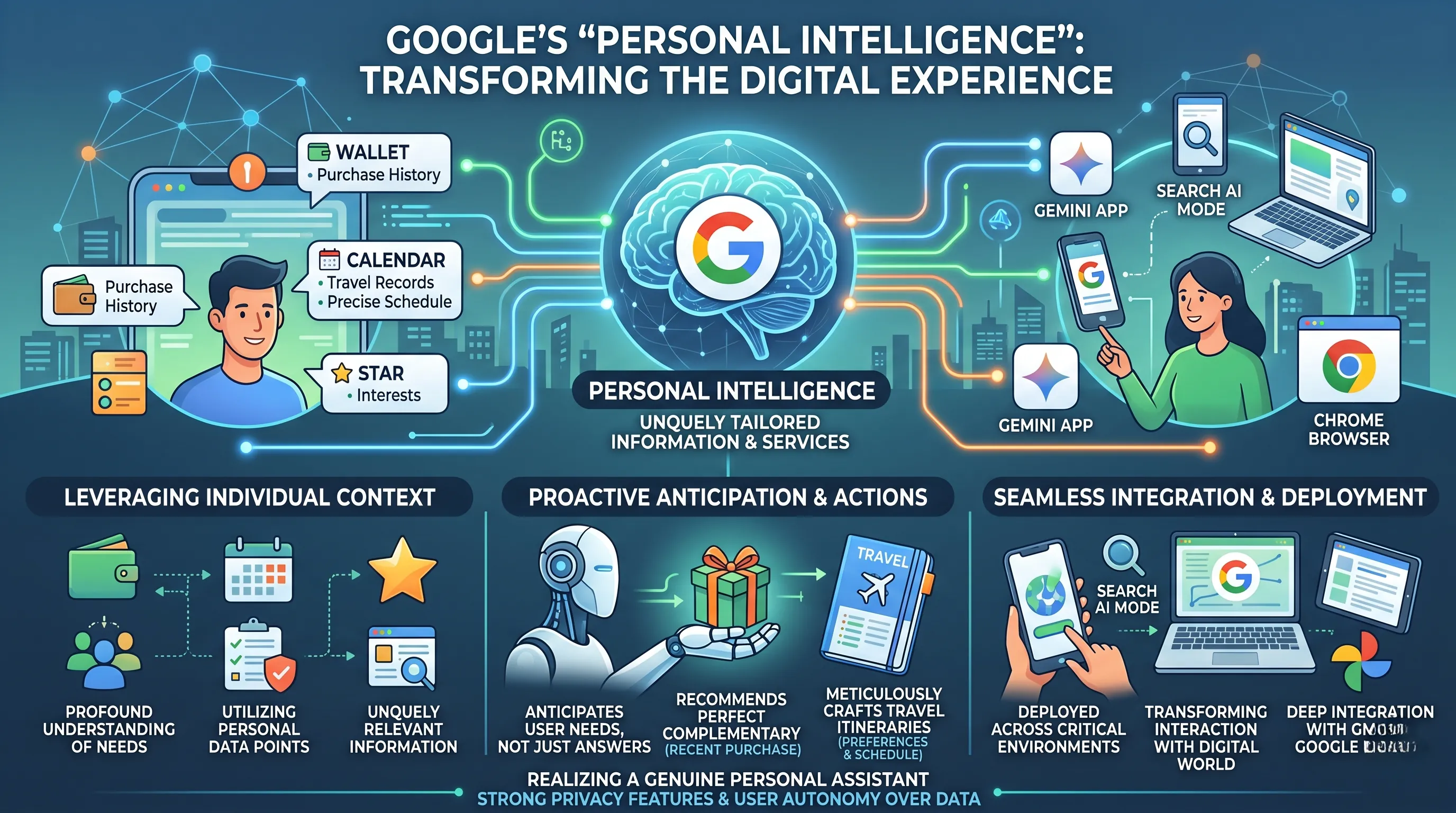
This groundbreaking feature aims to profoundly understand individual user context, leveraging personal data points like purchase history, travel records, and interests to provide uniquely tailored and highly relevant information and services.
Imagine an AI that doesn't just answer queries but anticipates your needs, recommends the perfect complementary item for a recent purchase, or meticulously crafts a travel itinerary based on your precise preferences and schedule.
This is the promise of Google's Personal Intelligence, designed to integrate seamlessly across critical environments such as the Gemini app, Search AI mode, and the Chrome browser.
The scope of this personalized AI extends across numerous Google applications, including deep integration points with Gmail and Google Photos, transforming how users interact with their digital world.
Rather than merely evolving search, Google is positioning this as the realization of a genuine personal assistant, offering solutions from diagnosing device issues to suggesting new hobbies, all while emphasizing strong privacy features and user autonomy over data.
1. Behind the Scenes: How Google's 'Personal Intelligence' Learns You
🔹 The Digital Tapestry: Weaving Context from Your Data
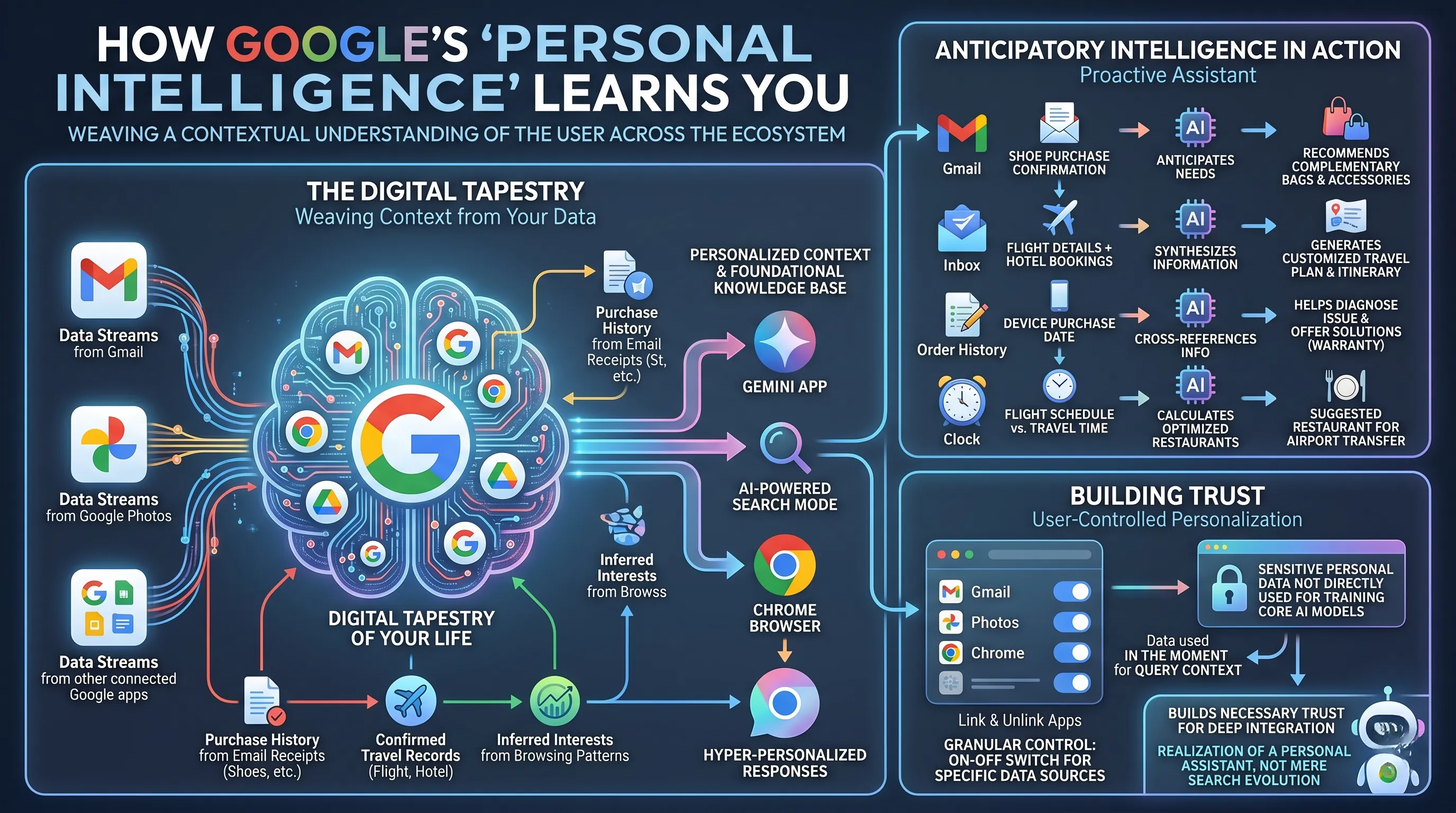
Google's approach to personal intelligence hinges on creating a unified, contextual understanding of the user across its vast ecosystem.
It achieves this by integrating data streams from core services like Gmail, Google Photos, and other connected Google apps, effectively weaving a digital tapestry of your life.
The system is designed to analyze specific data points such as user purchase history from email receipts, confirmed travel records, and inferred interests based on browsing patterns.
This contextual information is then surfaced and actioned within the Gemini app, the AI-powered Search mode, and the Chrome environment, forming the foundational knowledge base for its hyper-personalized responses.
🔹 Anticipatory Intelligence in Action
This deep data integration allows the AI to move from being a reactive tool to a proactive assistant, directly fulfilling the promise of a truly ‘Personalized AI’ era.
For instance, by referencing a shoe purchase confirmation in your Gmail, the system can anticipate your needs and recommend complementary bags or accessories without a single prompt.
It can automatically synthesize flight details from your inbox with hotel bookings to generate a customized travel plan, transforming scattered information into a coherent itinerary.
This utility even extends to problem-solving; the AI can help diagnose a device issue by cross-referencing its purchase date from your order history, offering solutions relevant to its warranty or age.
This enables a new class of convenience, like suggesting restaurants perfectly optimized for an airport transfer, by calculating travel time against your flight schedule.
🔹 Building Trust: The 'On-Off' Switch for Personalization
Crucially, Google emphasizes that this powerful personalization is not a forced default but a user-controlled feature.
Users retain granular control, possessing the ability to directly link and unlink apps at will, effectively giving them an 'on-off' switch for specific data sources.
The company states that this sensitive personal data is not directly used for training its core AI models; instead, it's used in the moment to provide context for a query, with only limited information leveraged for general service improvement.
This architectural focus on privacy is central to its evaluation as the ‘realization of a personal assistant’ rather than a mere search evolution, as it builds the necessary trust for users to deeply integrate AI into their daily planning and decision-making.
2. The Personalized AI Arms Race: How Google's Move Reshapes the Landscape
🔹 Redrawing the Battlefield: From Public Data to Private Context
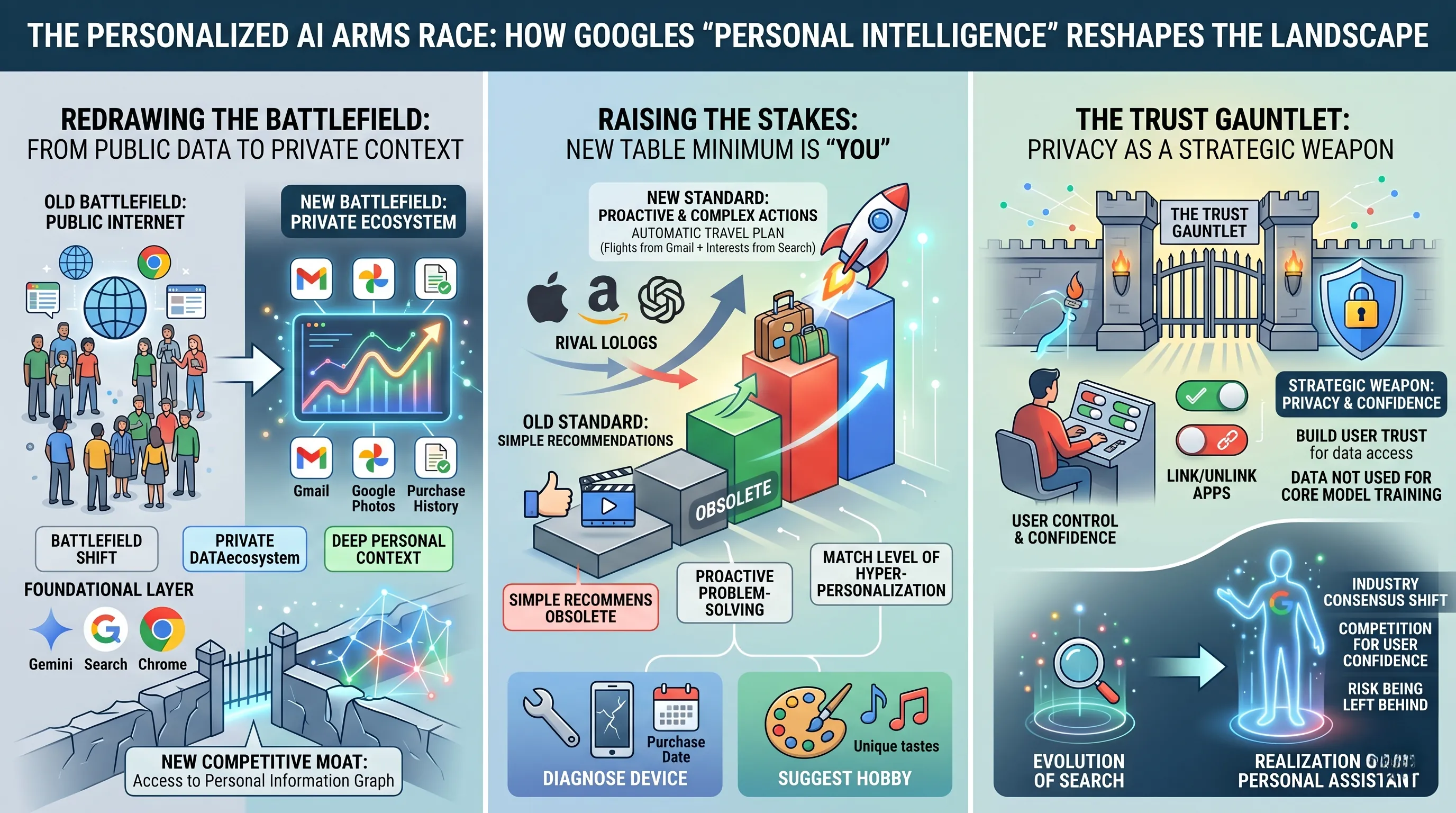
Google’s strategy with ‘Personal Intelligence’ fundamentally shifts the AI competition away from models trained on the public internet to models that leverage a user's private data ecosystem.
By integrating directly with core services like Gmail, Google Photos, and even user purchase histories, the AI's operational scope extends deep into an individual's personal context.
This feature is not a standalone app but a foundational layer woven into the Gemini app, Search's AI mode, and the Chrome environment, creating a pervasive, context-aware intelligence network.
This move establishes a new competitive moat, where the key to a superior AI is no longer just processing power or a larger language model, but rather the depth and breadth of access to a user's personal information graph.
🔹 Raising the Stakes: The New Table Minimum is 'You'
The immediate implication is a dramatic increase in the expected capabilities of a consumer AI.
Simple recommendations are now obsolete; the new standard involves proactive, complex problem-solving tailored to the individual.
For instance, the AI’s ability to automatically generate a travel plan by cross-referencing flight itineraries from Gmail with personal interests gleaned from Search history sets a high bar for competitors.
This forces rivals like Apple, Amazon, and OpenAI to reconsider their own data integration strategies, as they must now find ways to match this level of hyper-personalization to remain relevant.
An AI that can diagnose a device issue using purchase history or suggest a new hobby based on a user's unique tastes is no longer a futuristic concept but a present-day feature to be matched.
🔹 The Trust Gauntlet: Privacy as a Strategic Weapon
Google's pre-emptive focus on privacy is a calculated move in this new arms race.
By offering users explicit control to link and unlink apps and stating that personal data is not directly used for model training, Google is attempting to build the user trust necessary for this level of data access.
This frames the industry challenge not just as a technological race, but also as a competition for user confidence.
Competitors will be pressured to offer not only similar personalized features but also equally robust and transparent privacy controls.
Consequently, the industry consensus is shifting, viewing this not merely as an 'evolution of search' but as the tangible 'realization of a personal assistant,' compelling the entire market to follow suit or risk being left behind in a new, more intimate AI era.
3. Beyond Search: Experts Hailing Google's AI as the 'True Personal Assistant'
🔹 Context is King: The Mechanics of True Personalization
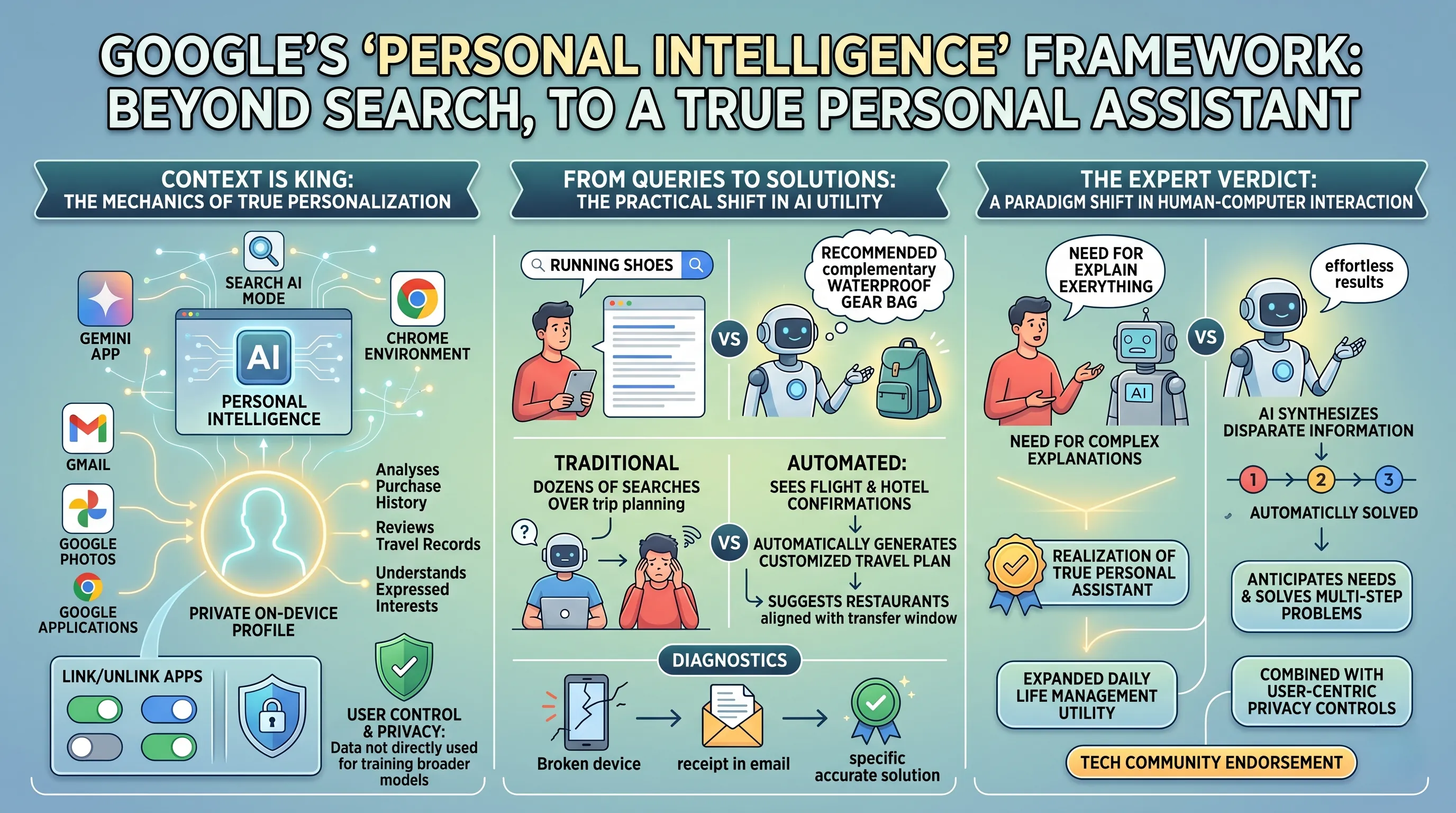
At the core of this evolution is Google's 'Personal Intelligence' framework, a system designed to operate across the Gemini app, Search's AI mode, and the Chrome environment.
Unlike traditional search which processes isolated queries, this AI gains a deep, contextual understanding by integrating with a user's personal data ecosystem, including Gmail, Google Photos, and other Google applications.
It analyzes a user's purchase history, travel records, and expressed interests to build a private, on-device profile of their life's logistics and preferences.
Crucially, Google emphasizes user control, allowing individuals to explicitly link or unlink specific apps and ensuring that this sensitive personal data is not directly used for training the broader AI models.
🔹 From Queries to Solutions: The Practical Shift in AI Utility
The real-world impact of this contextual awareness is a fundamental shift from information retrieval to active problem-solving.
Instead of a user simply searching for "running shoes," the AI, knowing from a Gmail receipt that you just purchased a specific pair, can proactively recommend a perfectly complementary waterproof gear bag when you next browse an online store.
Planning a trip no longer requires dozens of separate searches; the system can see your flight and hotel confirmations and automatically generate a customized travel plan, even suggesting restaurants with service times that align with your airport transfer window.
This capability extends to diagnostics, where the AI can help troubleshoot a device issue by cross-referencing its exact model and purchase date from your email history, providing a far more accurate solution than a generic web search.
🔹 The Expert Verdict: A Paradigm Shift in Human-Computer Interaction
Industry analysts are widely framing this not as an incremental update to search, but as the realization of the long-promised true personal assistant.
The key distinction highlighted by experts is the move away from the user needing to provide complex, detailed explanations to get a desired result.
The AI's ability to synthesize disparate pieces of personal information allows it to anticipate needs and solve multi-step problems, expanding its utility from simple recommendations into the fabric of daily life management.
This leap, combined with user-centric privacy controls, is why many in the tech community believe Google is finally delivering a system that works less like a search engine and more like a genuine, helpful assistant.
4. Navigating the Future: Unpacking the Challenges and Privacy Paradox of Personalized AI
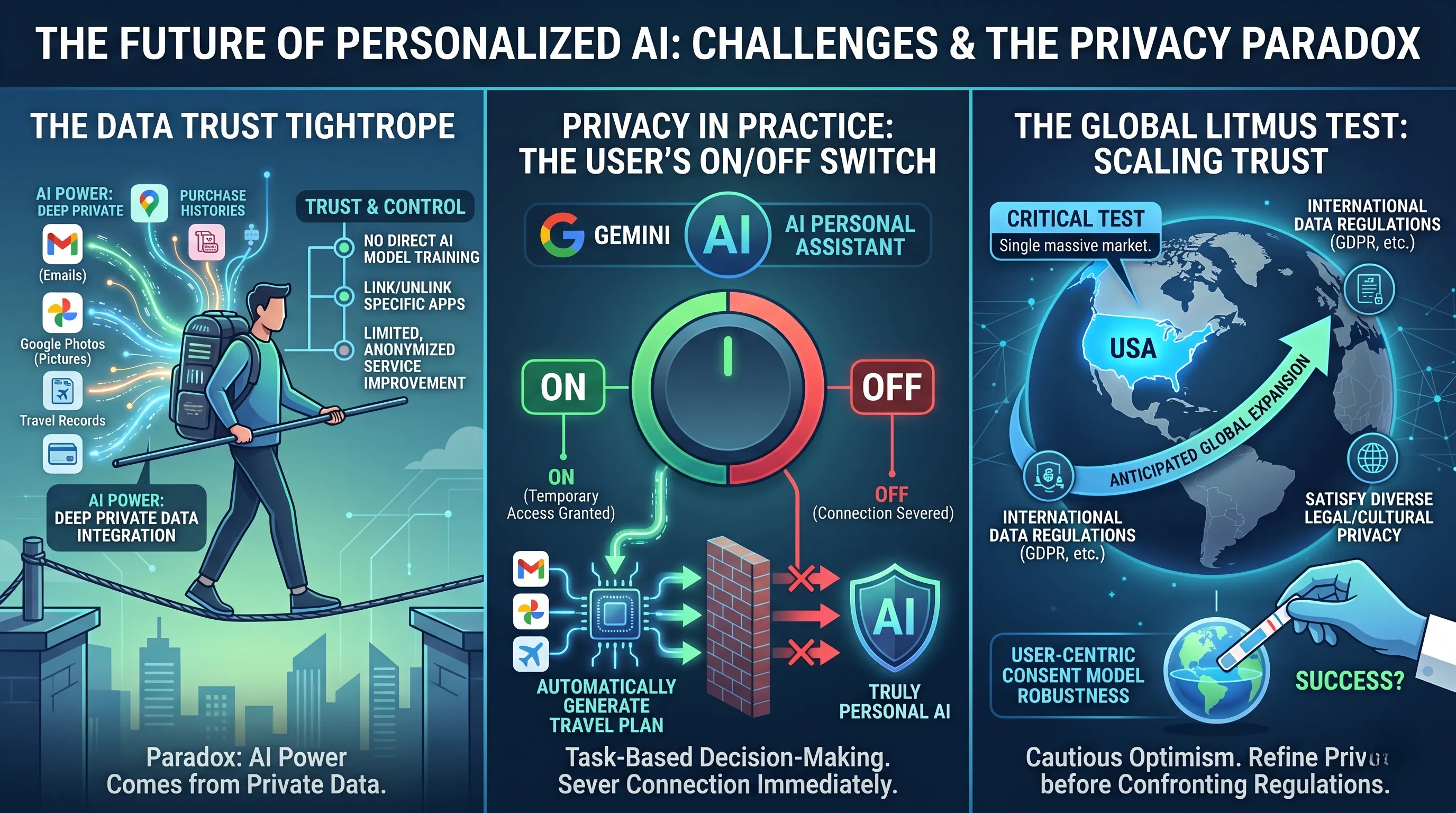
🔹 The Data Trust Tightrope
While the official specifications list no "Cons," the architecture of Personal Intelligence presents a significant paradox for the new era of personalized AI.
Its power is derived from deep integration with a user's most private data silos, including Gmail, Google Photos, travel records, and even purchase histories.
To counter the inherent risks, Google has built a specific framework of controls: personal data is explicitly not used for direct AI model training, users are given direct authority to link or unlink specific apps, and only limited, anonymized information is leveraged for general service improvement.
🔹 Privacy in Practice: The User's On/Off Switch
This framework moves the concept of data privacy from a static settings page to a dynamic, task-based decision for the user.
In practice, a user can grant Gemini temporary access to their Gmail to automatically generate a detailed travel plan, and then immediately sever that connection once the task is complete, effectively putting their private communications back behind a wall.
This means the personalized AI isn't perpetually "reading" your life; rather, it's a powerful tool you grant temporary permission to, creating a foundation of trust essential for widespread adoption of truly personal AI.
The benefit is a feeling of control, mitigating the fear that your entire digital history is being consumed to train a faceless algorithm.
🔹 The Global Litmus Test: Scaling Trust Beyond Borders
The current US-only availability is more than a standard staged rollout; it's a critical test of this new privacy model in a single, massive market.
Industry analysts view this as a strategic decision to refine the system before confronting the complex web of international data regulations, most notably the EU's GDPR.
The central challenge for Google in kicking off this global 'Personalized AI' era will be proving that its user-centric consent model is robust enough to satisfy diverse legal and cultural expectations of privacy.
The consensus is one of cautious optimism: the on-paper controls are strong, but their real-world resilience and user comprehension during the anticipated global expansion will ultimately determine the success of this ambitious initiative.
5. The Horizon of Personalization: Google's AI Roadmap and What Comes Next
🔹 From Proactive Suggestions to a Predictive Blueprint
The current implementation of Personal Intelligence offers a clear roadmap for Google's next steps in the personal AI era.
Its core function relies on deep integration with a user's data ecosystem, analyzing information from Gmail, Google Photos, and purchase histories to provide context-aware support.
This manifests in concrete use cases like recommending a matching bag for recently purchased shoes, diagnosing a device issue based on its purchase record, or suggesting a new hobby based on demonstrated interests.
Critically, it also tackles complex, multi-variable problems, such as automatically generating a complete travel plan or finding a restaurant perfectly optimized for the time required to get to an airport gate.
🔹 The Shift from Manual Tasks to Automated Life Management
This functionality signals a future where the AI transitions from a reactive tool to a proactive life-management partner.
Instead of just building a travel plan on command, the system is designed to eventually anticipate the need for one based on a flight confirmation in Gmail, then propose it complete with personalized activities.
The diagnostic capability points toward a future where the AI could preemptively flag that a device's warranty is expiring and suggest support options before a problem occurs.
As the service expands globally from its current US-only phase, its ability to deliver this personalized experience will become exponentially more powerful, learning from diverse cultural and logistical contexts to refine its recommendations.
🔹 Fulfilling the Promise of a True Digital Assistant
The consensus is that this strategy finally realizes the long-promised vision of a true personal assistant, rather than just a smarter search engine.
The trajectory shows an AI designed not just to answer questions but to anticipate needs and solve logistical challenges in the background of a user's life.
By building this on a foundation of user-controlled privacy—where data is not used for model training and app connections can be toggled—Google is aiming to build the trust necessary for deeper integration.
This evolution beyond simple recommendations is the core of what defines the "era of personal AI," making technology a collaborative partner rather than a passive tool.

6. 💡 Tech Talk: Making Sense of the Jargon
- Personalized AI: Imagine having a personal butler who remembers everything you like, every place you've been, and every item you've bought, and then uses that knowledge to anticipate your every need and perfectly suggest what's next. That's Personalized AI – an intelligent system that understands *you* specifically, not just general users.
- Contextual Understanding: This is like the AI having a photographic memory and deep comprehension skills combined. It doesn't just see a single word; it understands the entire conversation, your current location, your past activities, and your future plans to grasp the full "context" of your needs. So, "shoes" might mean running shoes for a marathon training plan, not just any shoes.
- Integration Points: Think of these as secret doorways connecting different rooms (Google apps like Gmail, Photos, Search). When the AI wants to offer a personalized suggestion, it can smoothly pass through these doors to gather relevant information from your email, photos, or browsing history, all with your permission, to build a complete picture.
- User Control & Privacy Features: This is like having a master switchboard where you decide exactly which "lights" (your personal data) are turned on for the AI to see, and which remain off. Google emphasizes that you can link/unlink apps, and your core personal data isn't used to teach the AI itself, ensuring your privacy is paramount while still getting a personalized experience.
📚 Related Posts
Midjourney V8 Alpha: The Next Evolution in AI Image Generation
🚀 Key TakeawaysUnprecedented Speed & Quality: Experience image generation that is approximately 5 times faster than previous versions, combined with significantly improved detail and consistency across all outputs.Advanced Style Personalization: Leverag
tech.dragon-story.com
Revolutionizing Financial Analysis: GPT-5.4 AI Transforms Excel Workflows
🚀 Key TakeawaysThis solution automates complex financial tasks like model generation, data analysis, and scenario execution directly within Microsoft Excel, eliminating manual drudgery.It revolutionizes user interaction by allowing natural language requ
tech.dragon-story.com
Google Maps with Gemini AI: The Intelligent Lifestyle Platform
🚀 Key TakeawaysGoogle Maps transforms into an intelligent lifestyle platform by integrating with the powerful Gemini AI model, moving beyond simple navigation.Experience conversational exploration, where you can ask natural language questions for highly
tech.dragon-story.com


