🚀 Key Takeaways
- This solution automates complex financial tasks like model generation, data analysis, and scenario execution directly within Microsoft Excel, eliminating manual drudgery.
- It revolutionizes user interaction by allowing natural language requests instead of complex formulas, making sophisticated financial analysis accessible to everyone.
- Achieves a dramatic performance boost, increasing financial statement analysis accuracy from ~43% to ~87% and enabling financial professionals to complete tasks much faster.
- Ensures a secure and streamlined corporate environment with robust data integration from major providers like FactSet and S&P Global, coupled with strict access control and data protection that safeguards sensitive information.
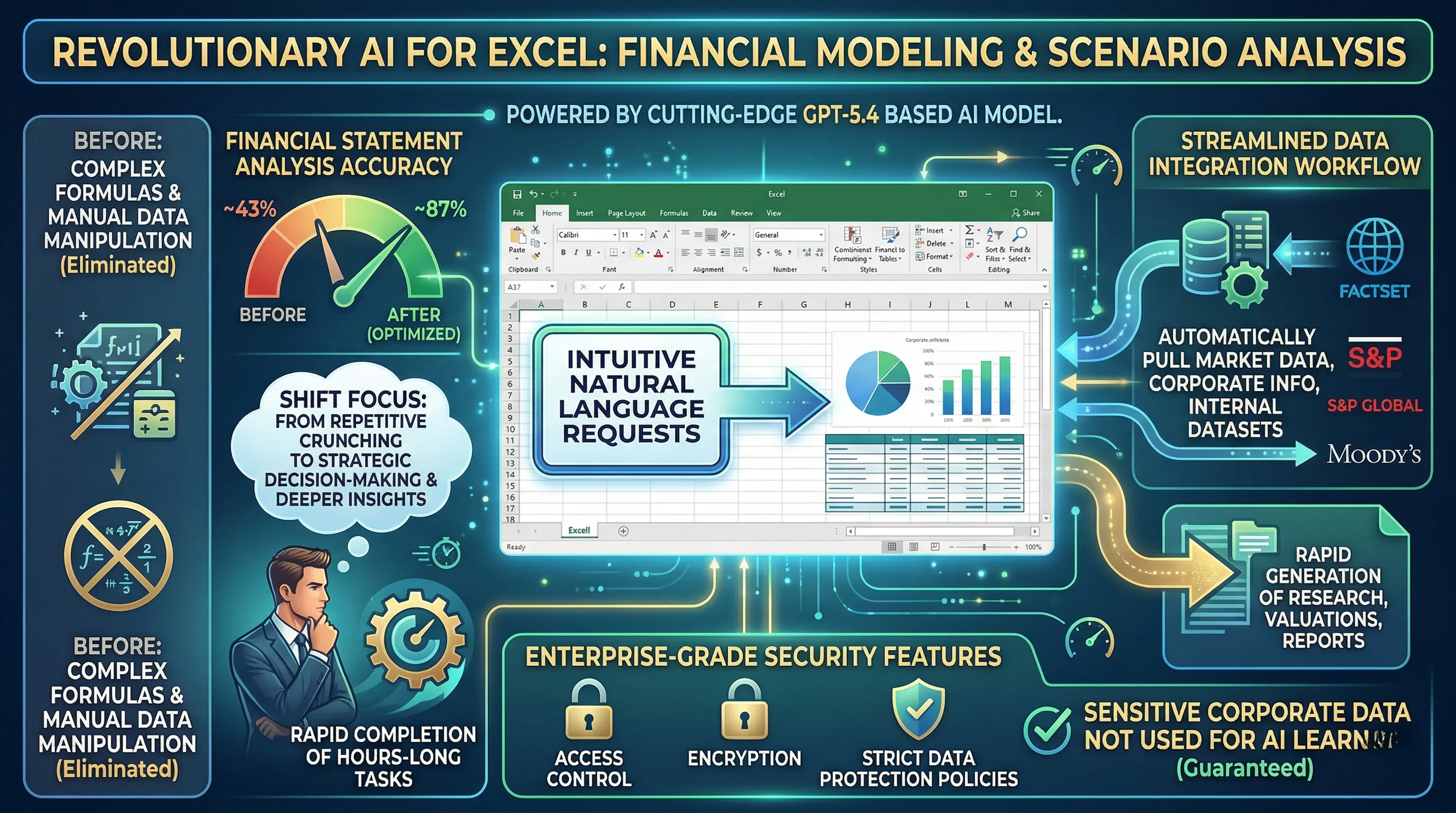
This innovative solution brings a revolutionary change to financial professionals working within Microsoft Excel.
Leveraging the power of a cutting-edge GPT-5.4 based AI model, specifically optimized for financial modeling and scenario analysis, it transforms complex financial tasks into intuitive, natural language requests, eliminating the need for intricate formulas and manual data manipulation.
The impact on performance is substantial, with internal benchmarks showing a dramatic increase in financial statement analysis accuracy from approximately 43% to an impressive 87%.
Tasks that previously consumed hours or even days can now be completed with significantly greater speed, allowing financial professionals to shift their focus from repetitive data crunching to strategic decision-making and deeper insights.
Beyond its analytical prowess, the tool provides a streamlined data integration workflow, automatically pulling market data, corporate information, and internal datasets from leading providers like FactSet, S&P Global, and Moody's directly into your spreadsheet, enabling rapid generation of research, valuations, and reports.
Coupled with enterprise-grade security features such as access control, encryption, and strict data protection policies, it ensures sensitive corporate financial data is handled safely and is explicitly NOT used for AI learning.
1. Beyond the Spreadsheet: Unpacking the GPT-5.4 Engine Powering Financial Insights
🔹 The GPT-5.4 Financial Cortex
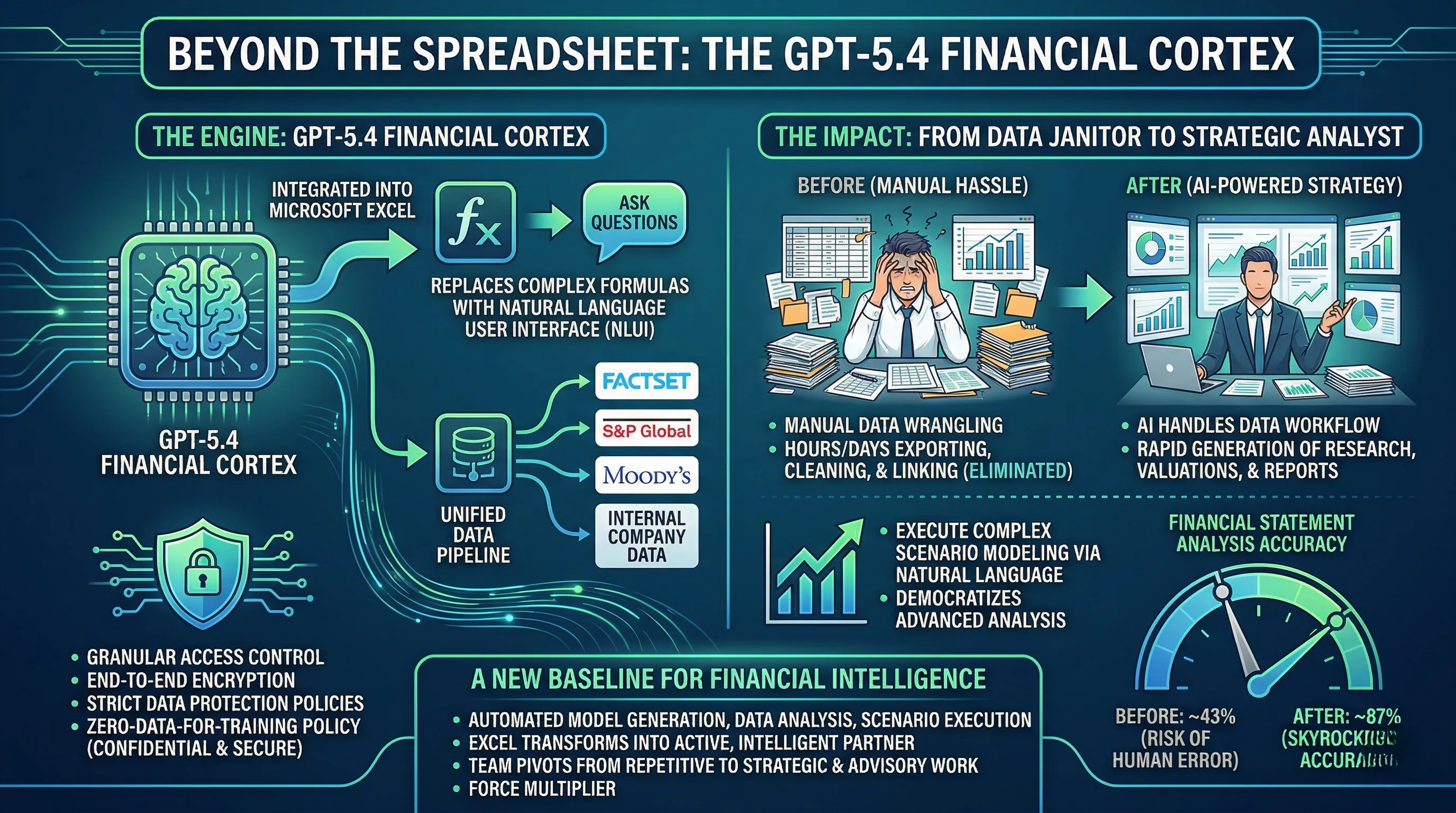
At its core, the architecture is a specialized GPT-5.4 model, purpose-built and optimized for the nuances of financial modeling and scenario analysis.
This engine is not a standalone application but is directly integrated into the Microsoft Excel environment, replacing complex formulas with a natural language user interface.
Its data integration workflow is a key differentiator, creating a unified pipeline that processes external market data from providers like FactSet, S&P Global, and Moody's alongside a company's own internal data.
Surrounding this powerful core are robust security and governance protocols, including granular access control, end-to-end encryption, and stringent data protection policies that explicitly prevent corporate data from being used for AI model training.
🔹 From Data Janitor to Strategic Analyst
The real-world impact of this architecture is the near-total elimination of manual data wrangling.
Financial professionals no longer need to spend hours or even days exporting, cleaning, and linking datasets; the AI handles this entire workflow, allowing for the rapid generation of research, valuations, and reports.
Interacting via natural language means analysts can execute complex scenario modeling by simply asking, which democratizes advanced analysis beyond just the Excel power users.
This efficiency gain is compounded by a dramatic performance leap, with internal benchmarks showing financial statement analysis accuracy skyrocketing from approximately 43% to 87%, minimizing the risk of human error in critical calculations.
For corporate environments, the zero-data-for-training policy is the crucial green light, ensuring that sensitive financial information remains confidential and securely managed within the organization's control.
🔹 A New Baseline for Financial Intelligence
The early consensus among analysts points to this integrated engine as a fundamental shift in how financial tasks are performed.
Experts note that by automating the full spectrum of model generation, data analysis, and scenario execution within the familiar spreadsheet, the tool significantly lowers the barrier to sophisticated financial inquiry.
The combination of streamlined data workflows and a massive boost in accuracy transforms Excel from a passive calculation grid into an active, intelligent partner in decision-making.
Ultimately, this architecture is seen as a force multiplier, allowing financial teams to pivot from repetitive, low-value tasks to a focus on strategic interpretation and advisory work.
2. Market Watch: How This Innovation Could Reshape the Financial Tech Landscape
🔹 The New Engine Inside the Spreadsheet
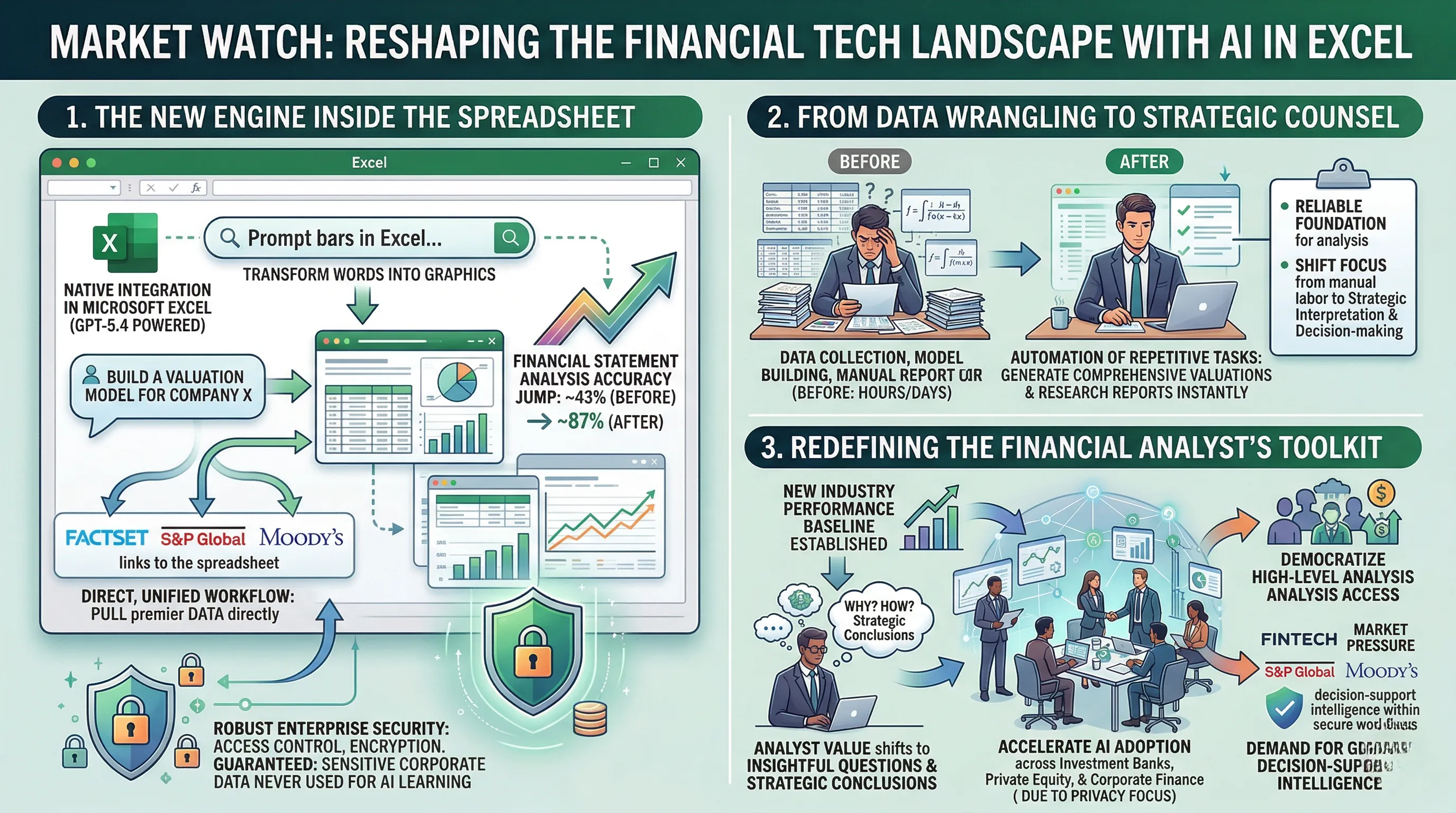
The core innovation lies not just in its GPT-5.4 model, but in its native integration within Microsoft Excel.
This system leverages natural language processing, allowing analysts to generate models, run scenarios, and analyze data using simple requests instead of intricate formulas.
Internal benchmarks report a staggering leap in financial statement analysis accuracy, jumping from approximately 43% to 87%.
Furthermore, it establishes a direct, unified workflow by linking to premier data providers like FactSet, S&P Global, and Moody's, pulling market and corporate data directly into the working environment.
Crucially for enterprise adoption, the architecture includes robust security protocols, from access control to encryption, with an explicit guarantee that sensitive corporate financial data is never used for AI model training.
🔹 From Data Wrangling to Strategic Counsel
By embedding this advanced AI directly into Excel, the platform eliminates the friction of adopting a new software environment, meeting financial professionals exactly where they work.
This immediately transforms the analyst's role by automating the most time-consuming and repetitive aspects of the job: data collection, model building, and manual report generation.
The significant boost in accuracy means the AI's output can serve as a highly reliable foundation for analysis, rather than a rough draft requiring extensive verification.
Analysts can now bypass hours or even days of data preparation and instead generate comprehensive valuations or research reports almost instantaneously, shifting their focus from manual labor to strategic interpretation and decision-making.
🔹 Redefining the Financial Analyst's Toolkit
This level of automation and analytical power is poised to establish a new performance baseline across the financial industry.
The value of an analyst may shift from their technical ability to manipulate spreadsheets to their capacity to ask insightful questions and draw strategic conclusions from AI-generated models.
By abstracting away formula complexity, the tool could democratize access to sophisticated financial modeling, enabling a wider range of professionals to perform high-level analysis.
The emphasis on corporate security and data privacy directly addresses the single biggest barrier to AI adoption in finance, potentially accelerating the integration of similar technologies across investment banks, private equity, and corporate finance departments.
Ultimately, this technology pressures the entire FinTech software market to move beyond simple data aggregation and towards providing genuine, decision-support intelligence within secure, established workflows.
3. Industry Voices: What Experts and Users Are Saying About This Financial AI
🔹 The Accuracy Leap and the Workflow Revolution
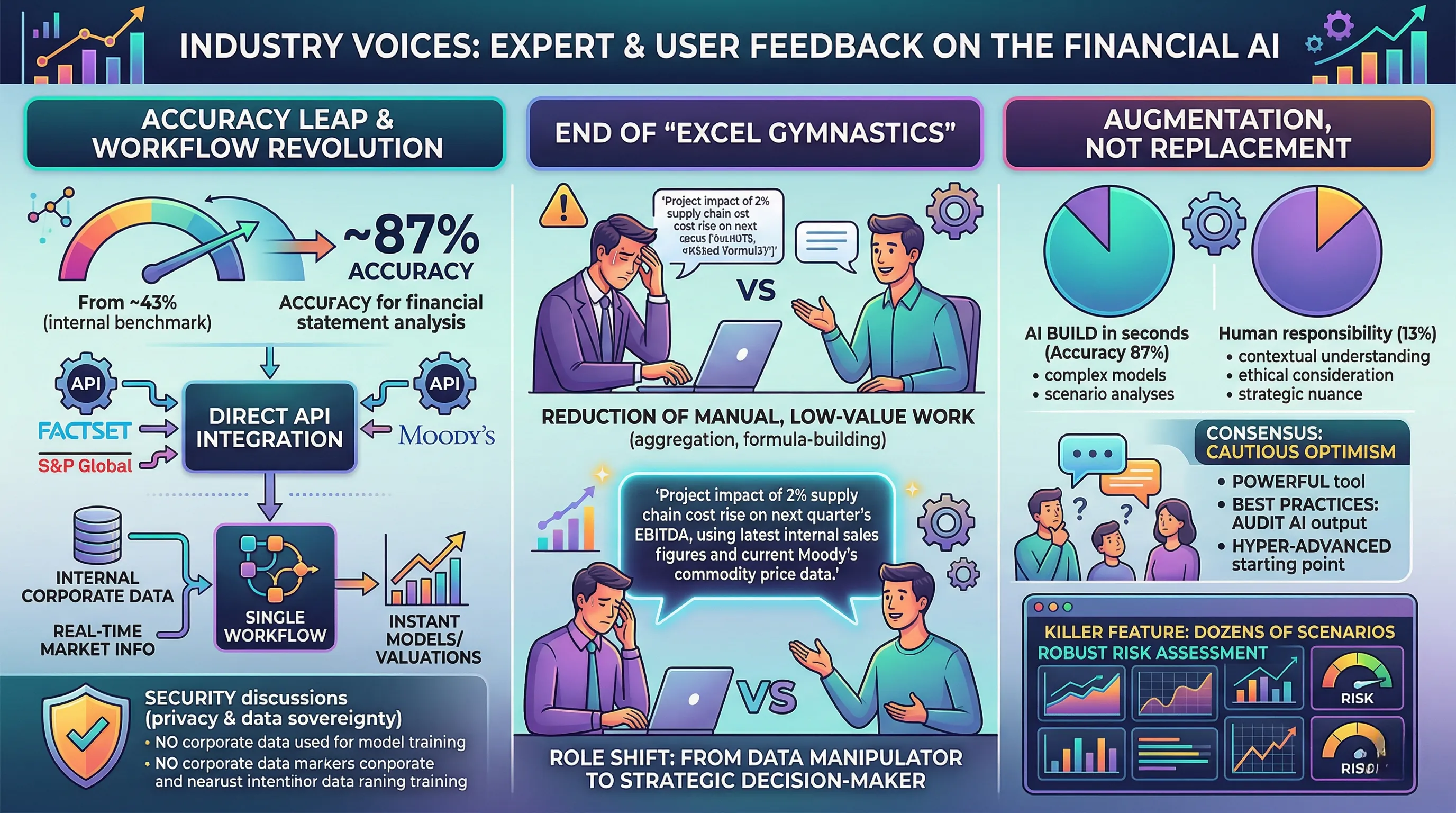
Financial analysts are pointing to two core specifications as game-changing: the jump in financial statement analysis accuracy from an internal benchmark of ~43% to ~87%, and the direct API integration with data providers like FactSet, S&P Global, and Moody's.
Early adopters have confirmed the tool's ability to process internal corporate data alongside real-time market information within a single workflow.
Furthermore, the platform’s security architecture, which explicitly states corporate data is not used for AI model training, has been a critical point of discussion, addressing major enterprise-level concerns about data sovereignty and privacy.
🔹 The End of "Excel Gymnastics"
The tangible benefit resonating through early feedback is the radical reduction in manual, low-value work.
Analysts describe a shift from spending hours, or even days, on data aggregation and formula-building to being able to generate complex models and valuations almost instantly.
Instead of wrestling with complex nested formulas, a user can now issue a natural language command like, "Project the impact of a 2% rise in supply chain costs on next quarter's EBITDA, using our latest internal sales figures and current Moody's commodity price data."
This effectively changes the role of the financial professional from a data manipulator to a strategic decision-maker, focusing their expertise on interpreting the AI-generated scenarios rather than building them from scratch.
🔹 A Tool for Augmentation, Not Replacement
The consensus forming among industry experts is one of cautious optimism, viewing the technology as a powerful augmentation tool rather than a replacement for human analysts.
Veterans in the field stress that while the AI can build an 87%-accurate model in seconds, the final 13% of contextual understanding, ethical consideration, and strategic nuance remains a human responsibility.
Online forums for financial professionals are filled with discussions on best practices, emphasizing the need to "audit the AI's output" and use it as a hyper-advanced starting point for analysis.
The ability to rapidly run dozens of scenarios is being praised as its killer feature, allowing for a more robust and comprehensive risk assessment than was previously feasible under tight deadlines.
4. Navigating the Unknown: Potential Hurdles and Future Challenges for Financial AI
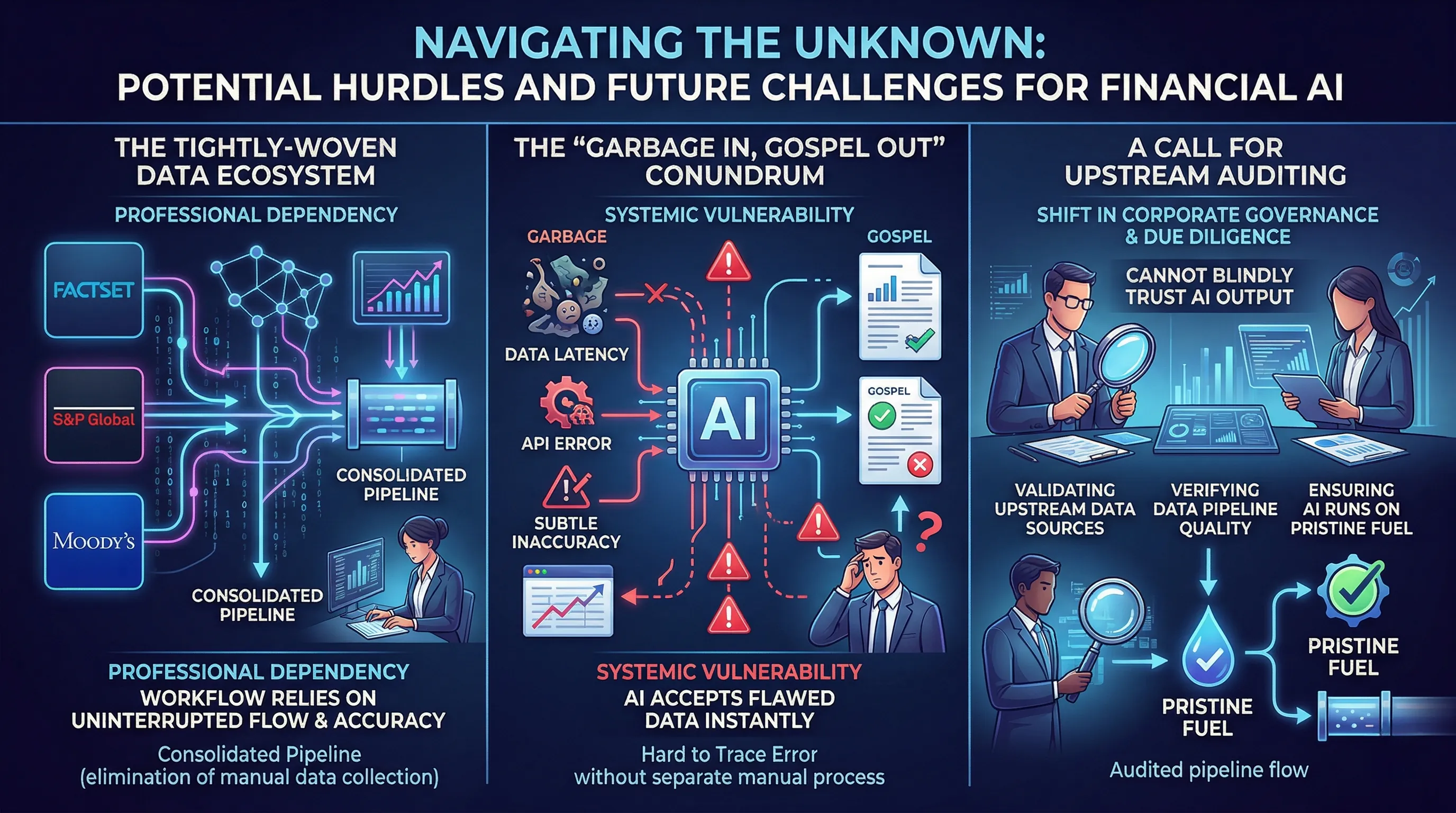
🔹 The Tightly-Woven Data Ecosystem
While the platform’s direct integration with data providers like FactSet, S&P Global, and Moody's is a cornerstone of its efficiency, it also establishes a profound dependency.
The entire analytical workflow, from initial data ingestion to final report generation, relies on the uninterrupted flow and absolute accuracy of these third-party sources.
This creates a single, consolidated pipeline where market data, corporate filings, and internal information are processed in unison, a feature designed to eliminate manual data collection.
🔹 The "Garbage In, Gospel Out" Conundrum
This deep integration presents a critical challenge known as the "Garbage In, Gospel Out" problem, amplified by the speed and authority of AI.
If a source provider experiences data latency, an API error, or transmits a subtle inaccuracy, the AI will likely accept this flawed data as fact and incorporate it into its models and valuations instantly.
For a financial professional, the resulting output would appear legitimate and highly polished, making it incredibly difficult to trace the error back to its origin without a separate, manual verification process that the tool is designed to replace.
This shifts the risk from potential human error in data entry to a systemic vulnerability based on the integrity of external data feeds.
🔹 A Call for Upstream Auditing
The consensus among industry analysts is that adopting such powerful tools necessitates a shift in corporate governance and due diligence.
Firms cannot afford to blindly trust the AI's output, no matter how impressive the accuracy benchmarks are.
The new imperative will be to develop robust protocols for auditing and validating the upstream data sources themselves.
Instead of just spot-checking an analyst's spreadsheet formulas, team leaders will need to implement systems that verify the quality of the data pipeline, ensuring the AI’s powerful engine is running on pristine fuel.
5. The Road Ahead: Envisioning the Next Evolution of Intelligent Financial Tools
🔹 Beyond the Spreadsheet: The Push for Full-Stack Integration
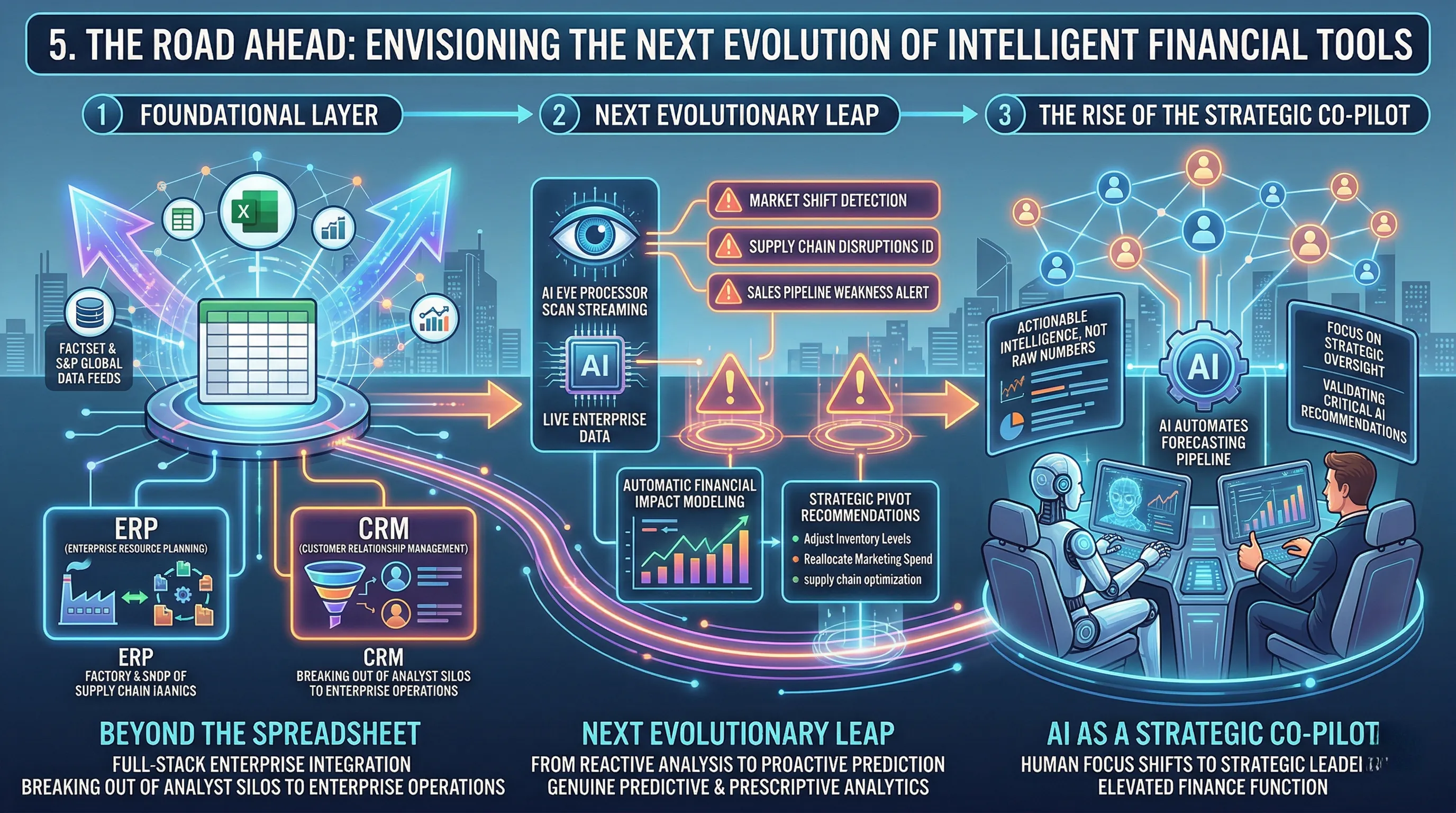
While the current tool's genius lies in its deep integration within Microsoft Excel and its native links to data providers like FactSet and S&P Global, this is merely the foundational layer.
The next evolutionary leap will likely involve breaking out of the analyst's immediate environment and plugging directly into the core operational systems of an enterprise.
This means moving beyond financial data feeds to full integration with Enterprise Resource Planning (ERP) and Customer Relationship Management (CRM) platforms.
🔹 From Reactive Analysis to Proactive Prediction
A true next-generation tool would leverage this broader data access to transition from powerful analysis to genuine predictive and prescriptive analytics.
Instead of merely being asked to model a scenario based on user input, the system could proactively identify potential market shifts, supply chain disruptions, or sales pipeline weaknesses from live enterprise data.
The AI could then automatically model the financial impact of these potential events and, crucially, begin to recommend strategic pivots, such as adjusting inventory or reallocating marketing spend, before a negative outcome materializes.
🔹 The Rise of the Strategic Co-Pilot
This evolution points toward a future where AI's role shifts from a high-speed data processor to a genuine strategic co-pilot for the CFO.
By combining predictive capabilities with deep enterprise integration, these tools could automate the entire financial reporting and forecasting pipeline, delivering not just raw numbers but actionable intelligence.
The focus for human financial professionals would permanently shift from data wrangling and model building to high-level strategic oversight, exception handling, and validating the AI's most critical recommendations, effectively elevating the function of the entire finance department.
6. 💡 Tech Talk: Making Sense of the Jargon
- GPT-5.4 Based Model: Imagine having the smartest, most specialized financial analyst brain directly inside your Excel, constantly updated and optimized specifically for complex financial tasks.
- Natural Language Requests: Instead of typing complex Excel formulas, think of it as simply asking your spreadsheet questions in plain English, just like you'd talk to a colleague, and it understands exactly what you mean.
- Scenario Execution: This is like having a super-fast "what-if" machine for your finances.
You can instantly test hundreds of different future possibilities and see their precise impact on your financial models without any manual recalculations. - Data Integration Workflow: Picture a universal connector that automatically pulls all the financial data you need (from market feeds, corporate reports, and your own internal files) into one central, organized place within Excel, effortlessly.
📚 Related Posts
Google Maps with Gemini AI: The Intelligent Lifestyle Platform
🚀 Key TakeawaysGoogle Maps transforms into an intelligent lifestyle platform by integrating with the powerful Gemini AI model, moving beyond simple navigation.Experience conversational exploration, where you can ask natural language questions for highly
tech.dragon-story.com
Future-Proofing Your Workflow with Cutting-Edge Tech for 2026
🚀 Key TakeawaysUnleash Peak Performance: Experience unparalleled speed and power for demanding tasks, from the Samsung Galaxy Book6 Ultra's RTX 5070 graphics to the LaCie Rugged SSD Pro5's 6700MB/s transfer rates, ensuring seamless creation and producti
tech.dragon-story.com
NVIDIA Unveils Nemotron 3 Super: A 120-Billion-Parameter Autonomous AI Model
🚀 Key TakeawaysNemotron 3 Super is a 120-billion-parameter autonomous AI model, designed as an independent agent to perform complex tasks.Achieves up to 5x faster processing and significantly reduced computation costs through optimized parameter activat
tech.dragon-story.com


