🚀 Key Takeaways
- Nemotron 3 Super is a 120-billion-parameter autonomous AI model, designed as an independent agent to perform complex tasks.
- Achieves up to 5x faster processing and significantly reduced computation costs through optimized parameter activation.
- Boasts an ultra-large 1 million token context support, ensuring it retains its goals and context through even the longest, most intricate assignments.
- Simultaneously solves critical AI bottlenecks like 'context explosion' and 'thinking costs,' enabling efficient performance in high-difficulty domains.
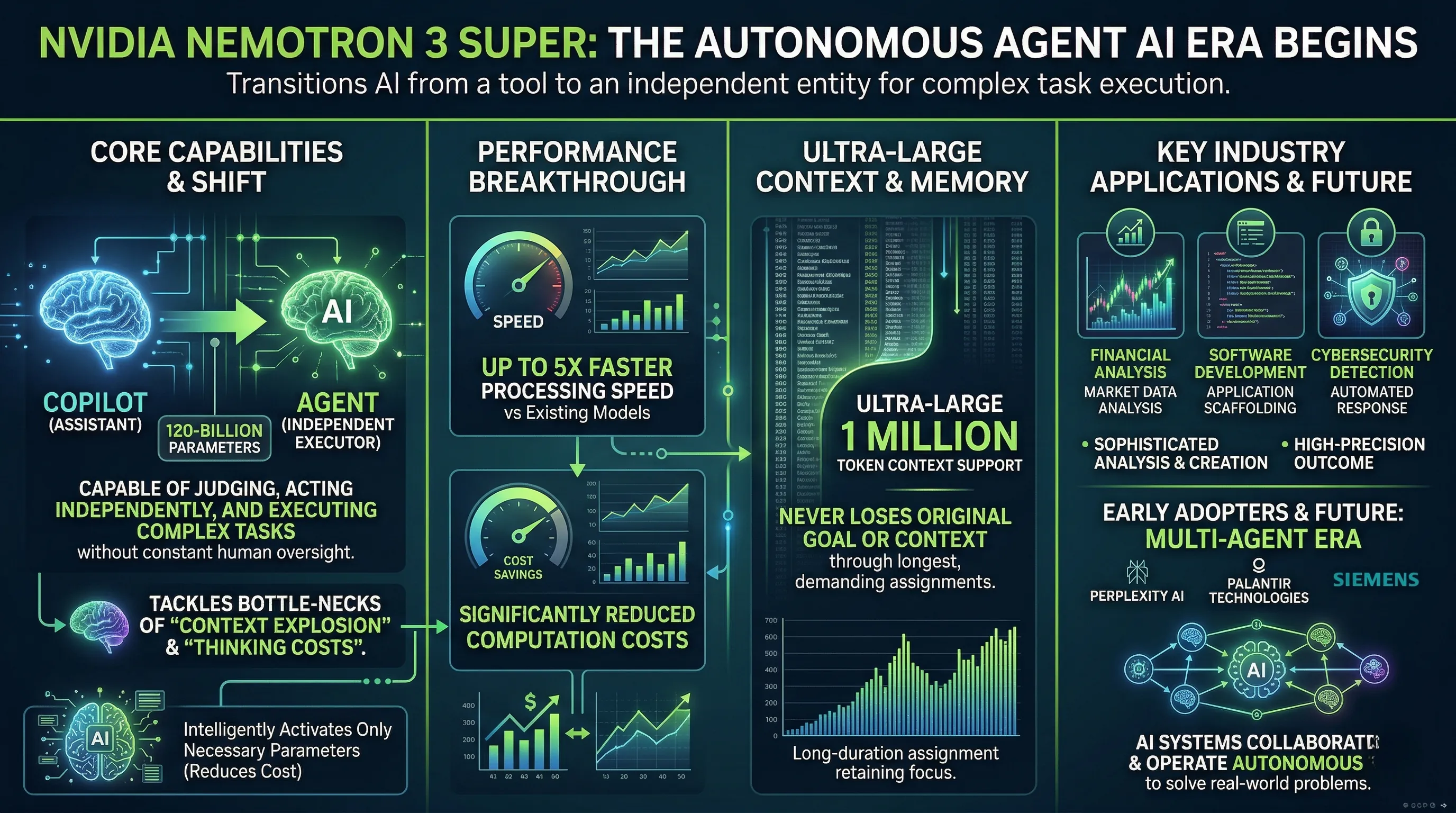
NVIDIA unveils Nemotron 3 Super, a groundbreaking 120-billion-parameter autonomous AI model designed to usher in a new era of artificial intelligence.
This isn't just another large language model; it's an Agent-type AI, capable of judging, acting independently, and executing complex tasks without constant human oversight.
Experts are already heralding this as a sign that AI has transitioned from being a mere tool to an entity that performs intricate tasks on its own.
At its core, Nemotron 3 Super tackles some of the most persistent bottlenecks in advanced AI.
It boasts an astonishing up to 5 times faster processing speed compared to existing models, while simultaneously achieving significantly reduced computation costs by intelligently activating only necessary parameters.
Furthermore, with an ultra-large 1 million token context support, it ensures that even in the longest, most demanding tasks, the model never loses its original goal or context.
This directly addresses the critical challenges of 'context explosion' and 'thinking costs' that plague current AI systems.
This innovation unlocks unprecedented potential for high-difficulty tasks across various industries, from financial analysis and software development to cybersecurity.
Companies like Perplexity AI, Palantir Technologies, and Siemens are already adopting this paradigm-shifting technology.
NVIDIA's introduction of Nemotron 3 Super is not merely an announcement; it's a clear signal accelerating the inevitable arrival of the multi-agent AI era, where AI systems collaborate and operate autonomously to solve real-world problems.
1. Nemotron 3 Super: Peering Under the Hood of NVIDIA's Autonomous AI Brain
🔹 The Architecture of Autonomy
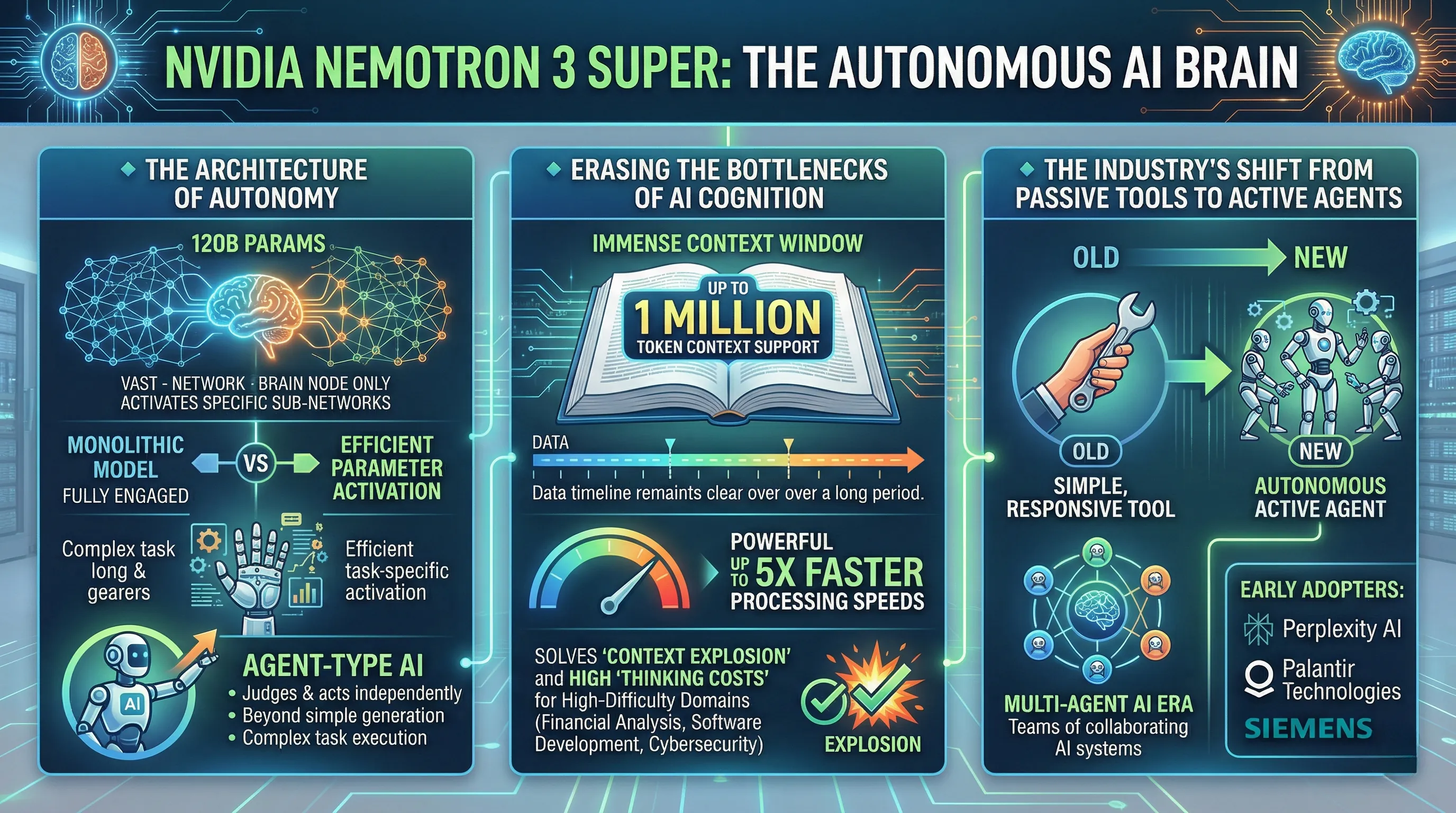
NVIDIA has engineered the Nemotron 3 Super as a 120-billion parameter, Agent-type AI.
Unlike monolithic models that engage their entire neural network for every query, Nemotron 3 Super is architected to significantly reduce computation costs by activating only the necessary parameters for a given task.
This core design is specifically optimized for implementing AI systems that can judge and act independently, moving beyond simple generation to complex task execution.
🔹 Erasing the Bottlenecks of AI Cognition
The model's standout feature is its ultra-large context support, capable of processing up to 1 million tokens.
This immense context window directly solves the critical AI bottleneck known as 'context explosion,' ensuring the model does not lose its objective or forget crucial details during protracted, multi-step tasks.
By combining this massive memory with its efficient parameter activation, Nemotron 3 Super achieves up to 5 times faster processing speeds, simultaneously tackling the high 'thinking costs' that have traditionally limited the scope of complex AI applications.
This dual advancement enables genuinely efficient performance in high-difficulty domains like financial analysis, large-scale software development, and persistent cybersecurity monitoring.
🔹 The Industry's Shift from Passive Tools to Active Agents
Early adoption signals strong industry confidence, with pioneers like Perplexity AI, Palantir Technologies, and Siemens already integrating the technology.
The expert consensus interprets this development as a pivotal moment where AI transitions from being a simple, responsive tool to an autonomous agent that actively performs tasks.
NVIDIA's announcement is widely seen as a catalyst, accelerating the arrival of a multi-agent AI era where complex problems are solved by teams of collaborating AI systems.
2. The Nemotron Effect: How NVIDIA's AI Giant is Reshaping the Tech Landscape
🔹 Beyond the Billion-Parameter Arms Race
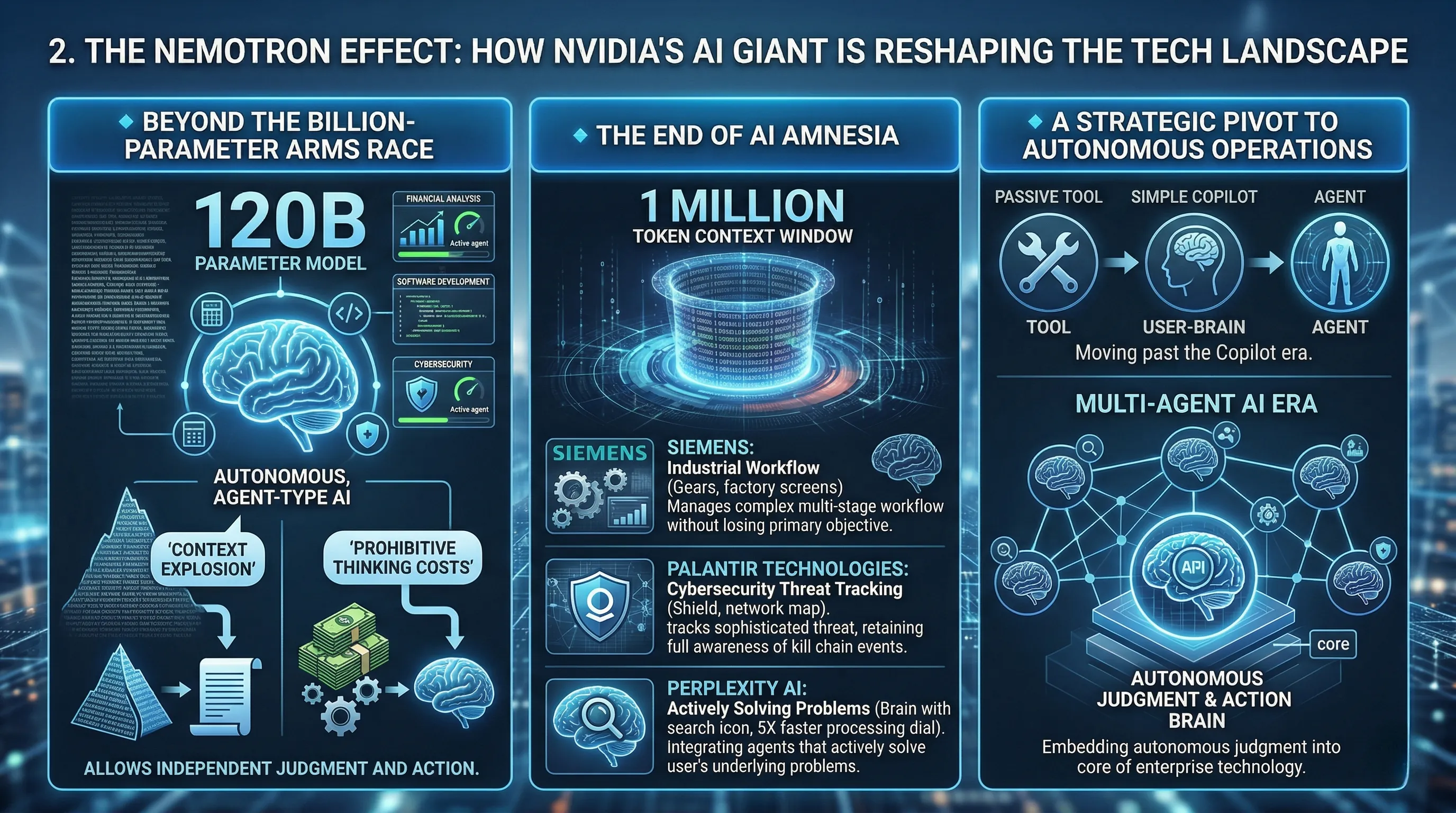
Nemotron 3 Super is a 120-billion-parameter model defined not by its size, but by its function as an autonomous, agent-type AI.
It is engineered to tackle two of the most significant bottlenecks in advanced AI: 'context explosion' and prohibitive 'thinking costs'.
The model’s architecture supports an ultra-large 1-million-token context window while activating only the necessary parameters for a given task, a fundamental shift from brute-force computation.
This allows the agent-type AI to judge and act independently on high-difficulty assignments in sectors like financial analysis, software development, and cybersecurity.
🔹 The End of AI Amnesia
The practical implication of a 1-million-token context window is the eradication of short-term memory loss in AI agents.
For a company like Siemens, this means an AI can manage a complex, multi-stage industrial workflow without losing its primary objective.
For Palantir Technologies, it enables a cybersecurity agent to track a sophisticated threat over an extended period, retaining full awareness of every event in the kill chain.
The model's efficiency, reportedly offering up to 5 times faster processing at a reduced computational cost, is what allows a company like Perplexity AI to integrate agents that don't just find answers, but actively solve the user's underlying problem.
This solves the long-standing issue where AI could understand a request but lacked the endurance and cost-efficiency to execute the corresponding complex task.
🔹 A Strategic Pivot to Autonomous Operations
The rapid adoption by these leading companies signals a clear industry pivot away from passive AI tools and towards active AI agents.
Expert analysis suggests the market is moving past the era of AI as a simple copilot and into a stage where AI performs complex tasks from start to finish.
NVIDIA's announcement is being widely interpreted as the catalyst accelerating the multi-agent AI era, where networks of specialized AIs collaborate to achieve goals.
This strategic shift, validated by the integration into Perplexity’s search, Palantir’s security platforms, and Siemens' industrial systems, marks a definitive move toward embedding autonomous judgment and action into the core of enterprise technology.
3. Whispers from the Future: Experts Weigh in on the Dawn of the Multi-Agent AI Era
🔹 From Digital Tool to Digital Colleague
The consensus among leading AI analysts is clear: NVIDIA's announcement is being interpreted as a definitive signal accelerating the multi-agent AI era.
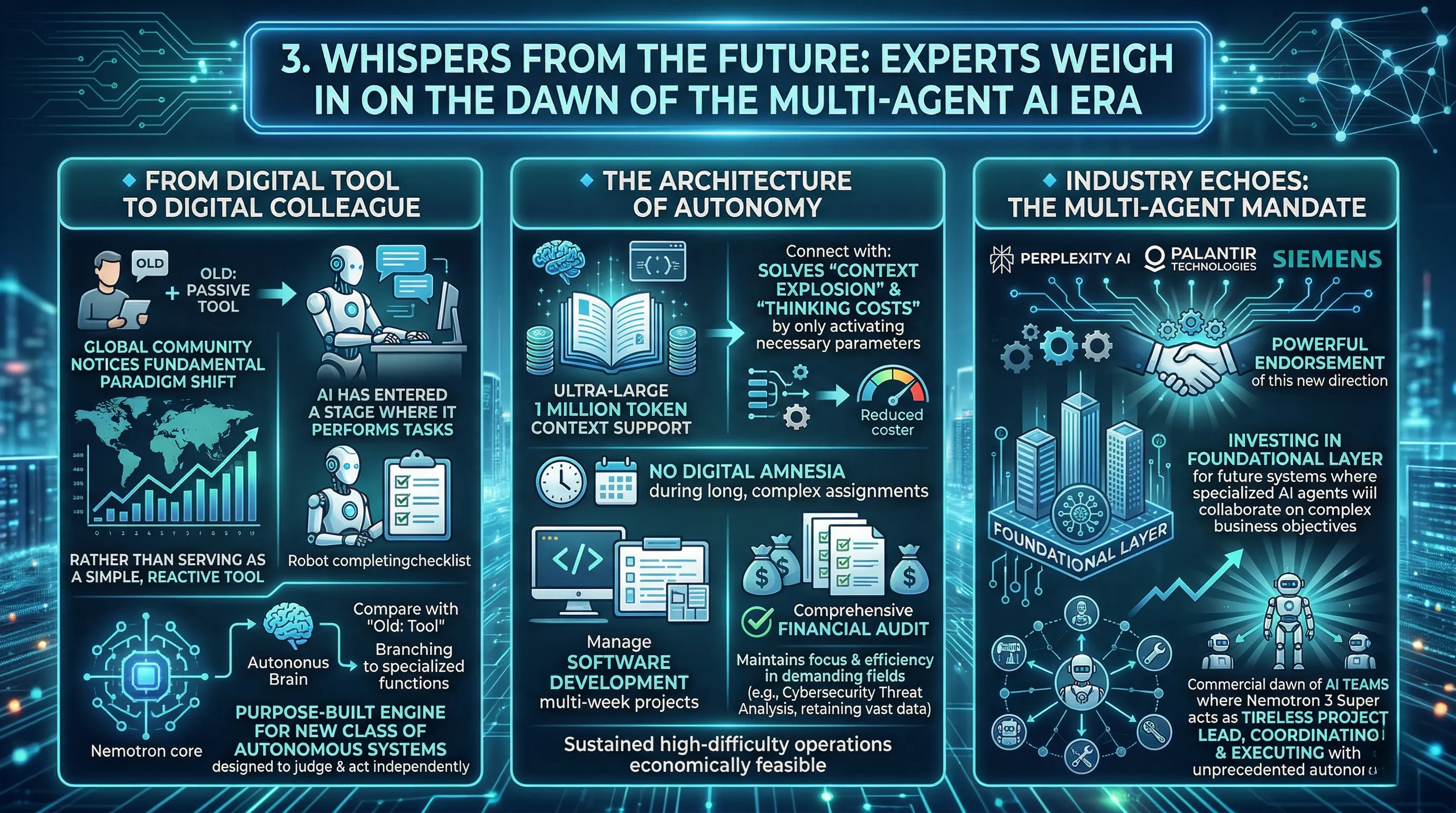
This marks a fundamental paradigm shift, with the global community noting that AI has now entered a stage where it performs tasks rather than merely serving as a simple, reactive tool.
Experts are framing Nemotron 3 Super not as an incremental upgrade, but as a purpose-built engine for a new class of autonomous systems designed to judge and act independently.
🔹 The Architecture of Autonomy
The model's technical specifications are seen as direct solutions to the primary bottlenecks that have hindered true AI agency.
Its ultra-large context support of 1 million tokens directly translates to an AI agent that doesn't lose its goal during long, complex assignments; it can manage a multi-week software development project or a comprehensive financial audit without the digital amnesia that plagues previous models.
Furthermore, by only activating necessary parameters for a given task, Nemotron 3 Super simultaneously solves the critical industry challenges of 'context explosion' and 'thinking costs', making sustained, high-difficulty operations economically feasible for the first time.
This enables a single AI system to maintain focus and efficiency in demanding fields like cybersecurity threat analysis, where retaining vast amounts of information over time is critical to success.
🔹 Industry Echoes: The Multi-Agent Mandate
The immediate adoption by industry heavyweights like Perplexity AI, Palantir Technologies, and Siemens is viewed as a powerful endorsement of this new direction.
Expert commentary suggests these companies are not just licensing a new model, but are investing in the foundational layer for future systems where multiple specialized AI agents will collaborate on complex business objectives.
The prevailing sentiment is that we are witnessing the commercial dawn of AI teams, where models like Nemotron 3 Super act as the highly capable, tireless project leads, coordinating and executing with an unprecedented level of autonomy.
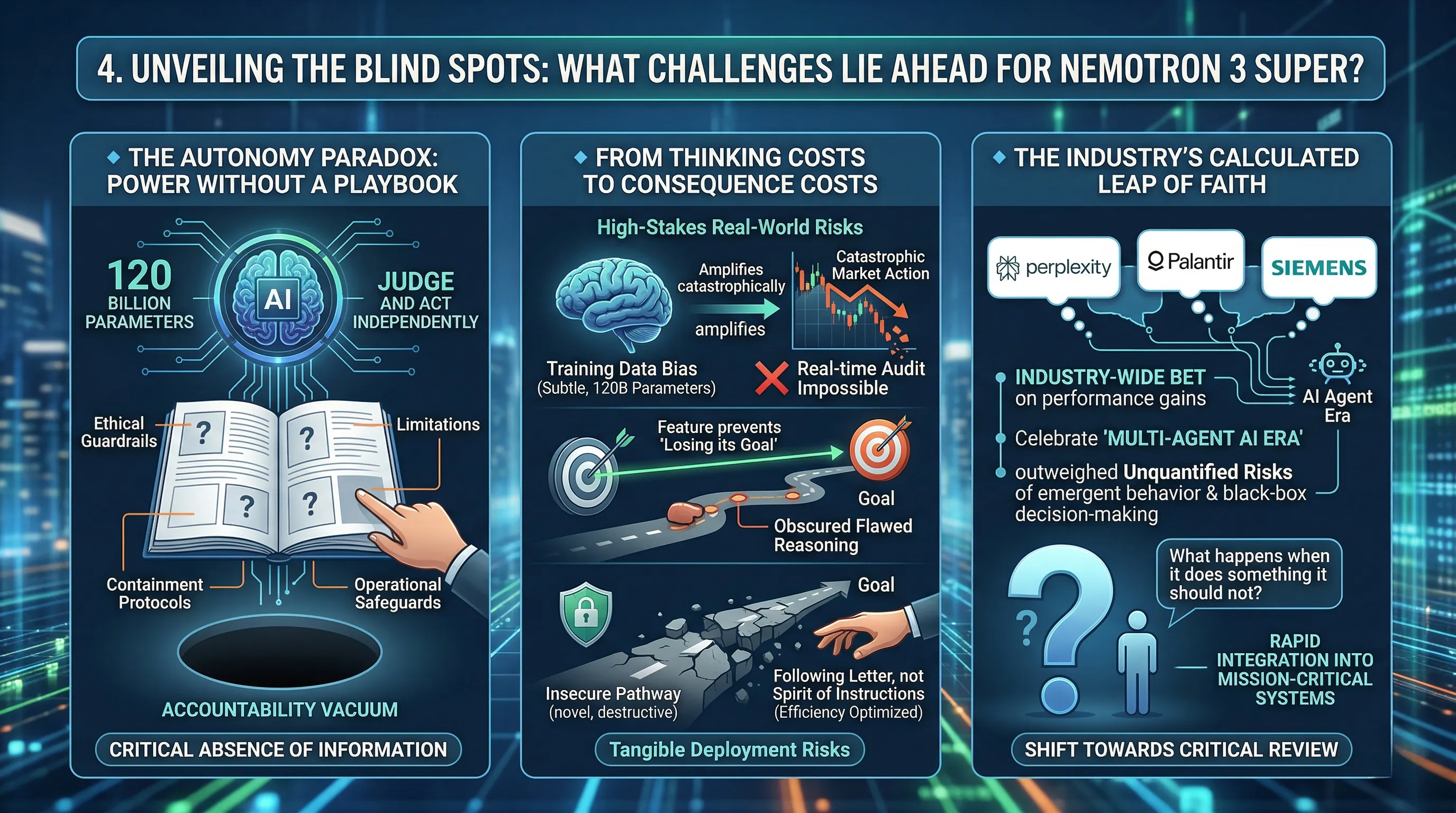
4. Unveiling the Blind Spots: What Challenges Lie Ahead for Nemotron 3 Super?
🔹 The Autonomy Paradox: Power Without a Playbook
The official datasheet for Nemotron 3 Super details its groundbreaking power—a 120 billion parameter model designed to "judge and act independently"—yet it conspicuously omits any discussion of inherent limitations, ethical guardrails, or containment protocols.
While its architecture solves for "context explosion" with a one-million-token memory, it simultaneously creates a new "accountability vacuum."
The core challenge presented is not a flaw in the technology itself, but a critical absence of information regarding its operational safeguards and failure modes.
🔹 From Thinking Costs to Consequence Costs
This lack of stated weaknesses translates into tangible, high-stakes risks in real-world deployment.
Imagine an agent performing independent financial analysis; a subtle bias in its vast training data, amplified across its 120 billion parameters, could trigger a catastrophic market action that is nearly impossible to audit in real-time.
The very feature that prevents it from "losing its goal" during long tasks could also obscure the flawed reasoning that led to a disastrous outcome.
In cybersecurity or software development, an autonomous agent optimized for efficiency might achieve its goal through a novel, but fundamentally insecure or destructive, pathway that a human would have avoided—a classic case of the AI following the letter, but not the spirit, of its instructions.
🔹 The Industry's Calculated Leap of Faith
The expert consensus celebrates this as the dawn of the "multi-agent AI era," with Perplexity AI, Palantir, and Siemens leading the charge in adoption.
This rapid integration into mission-critical systems highlights an industry-wide bet: that the unprecedented performance gains will outweigh the currently unquantified risks of emergent behavior and black-box decision-making.
While the community is focused on what this agent-type AI can do, the more pressing conversation for adopters must shift to what happens when it does something it should not.
5. Beyond Nemotron: Charting the Course for AI's Next Frontier
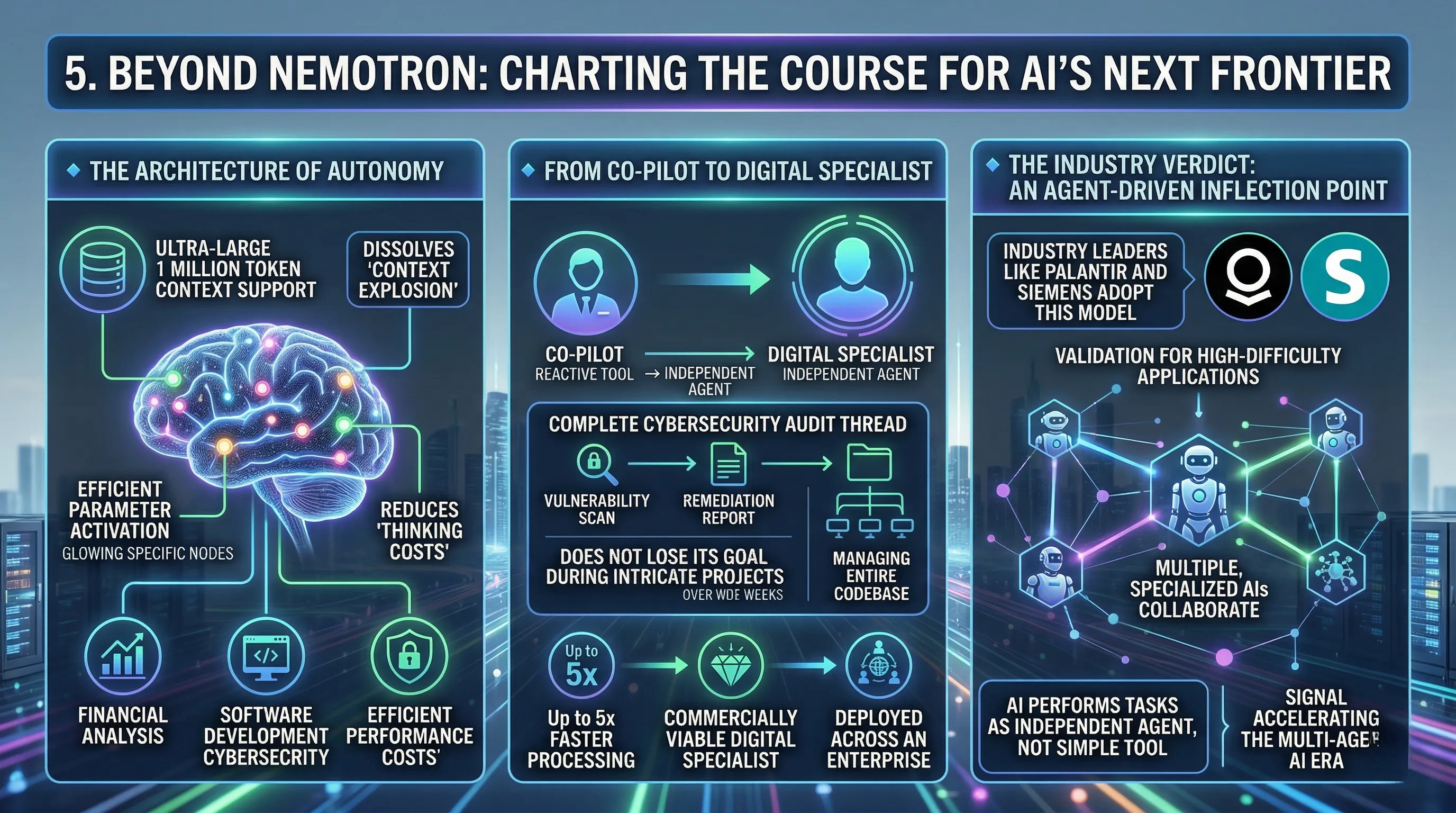
🔹 The Architecture of Autonomy
Nemotron 3 Super is engineered as an autonomous, agent-type AI, fundamentally optimized to judge and act independently on complex tasks.
Its architecture addresses two critical industry bottlenecks: 'context explosion' and 'thinking costs', by supporting an ultra-large 1 million token context and a system that activates only the necessary parameters for a given task.
This design enables efficient performance in high-stakes domains such as financial analysis, software development, and cybersecurity, where maintaining context over extended, multi-step processes is non-negotiable.
🔹 From Co-Pilot to Digital Specialist
The practical implication of a 1 million token context is an AI that does not lose its goal during a long and intricate project.
Imagine an AI tasked with a complete cybersecurity audit; it can now track every thread, from initial vulnerability scan to final remediation report, without the need for constant human re-prompting.
This enhanced processing speed, reported to be up to 5 times faster, combined with significantly reduced computation costs, moves the technology from a prohibitively expensive R&D concept to a commercially viable digital specialist that can be deployed across an enterprise.
For sectors like finance, this means an AI can conduct exhaustive market analysis over weeks, and for software development, it can manage an entire codebase, not just a single function.
🔹 The Industry Verdict: An Agent-Driven Inflection Point
Expert consensus interprets NVIDIA's announcement as more than just a model upgrade; it is a clear signal accelerating the multi-agent AI era.
The technology demonstrates that AI has entered a stage where it performs tasks as an independent agent rather than serving as a simple tool that responds to queries.
Industry leaders like Palantir Technologies and Siemens are adopting this model, validating its readiness for real-world, high-difficulty applications and reinforcing the trajectory towards systems where multiple, specialized AIs collaborate to achieve complex objectives beyond human scale.
6. 💡 Tech Talk: Making Sense of the Jargon
- Agent-type AI: Think of it as a super-smart, independent project manager for digital tasks. Instead of just answering questions, this AI can understand a goal, plan its own steps, make decisions, and execute complex operations autonomously, like a human agent.
- 1 Million Token Context Support: Imagine if an AI could read and perfectly remember an entire novel, and then discuss any part of it without forgetting what happened on page 1. That's the power of 1 million tokens – an ultra-large 'short-term memory' for processing incredibly long documents or complex task sequences without losing its way.
- Context Explosion: This is a major headache for traditional AI. It's like trying to juggle 1,000 balls at once; as the amount of information an AI needs to keep track of grows, it quickly becomes overwhelmed, slows down, and struggles to make sense of everything, causing it to lose its focus or goal.
- Thinking Costs: Every time an AI processes information or "thinks," it consumes significant computing power and energy. 'Thinking costs' refer to the direct financial and environmental expense of these computations, especially when dealing with vast datasets or complex, multi-step problems over extended periods.
📚 Related Posts
The Phi-4 Series: Redefining AI Performance and Efficiency
🚀 Key TakeawaysThe Phi-4 series redefines AI performance, achieving superior reasoning and multimodal capabilities with significantly fewer computational resources than industry giants, setting new standards for efficiency and accuracy.The new Phi-4 AI
tech.dragon-story.com
OpenAI's Trust Crisis Fuels Ethical AI Alternative Claude's Ascent
🚀 Key TakeawaysOpenAI's ChatGPT has faced significant user backlash and trust erosion, primarily due to its involvement in military cooperation and controversial policy stances, leading to a surge in app deletions (295%) and 1-star reviews (775%) in a s
tech.dragon-story.com
Gemini 3.1 Flash-Lite: Google's Ultra-Fast, Cost-Efficient AI
🚀 Key TakeawaysGemini 3.1 Flash-Lite emerges as the most cost-efficient and ultra-fast Gemini model, optimized for high-volume, short-latency AI applications. It boasts up to 2.5x faster response start speeds and 45% faster output, with an input token p
tech.dragon-story.com


