🚀 Key Takeaways
- Adobe's latest AI-powered features mark a pivotal shift from merely enhancing speed to cultivating genuine intuition, fundamentally reshaping the creative experience itself.
- The introduction of the Photoshop AI Assistant and significant Adobe Firefly updates simplifies complex tasks through voice commands and prompts, democratizing professional editing and positioning AI as an indispensable creative partner for all skill levels.
Adobe is poised to redefine the creative landscape with its groundbreaking AI-Powered Editing Features, set for release in March 2025 as version 26.5.
This update is far more than an incremental improvement; it signifies a profound shift in creative methodologies, moving beyond just accelerating workflows to fostering true creative intuition.
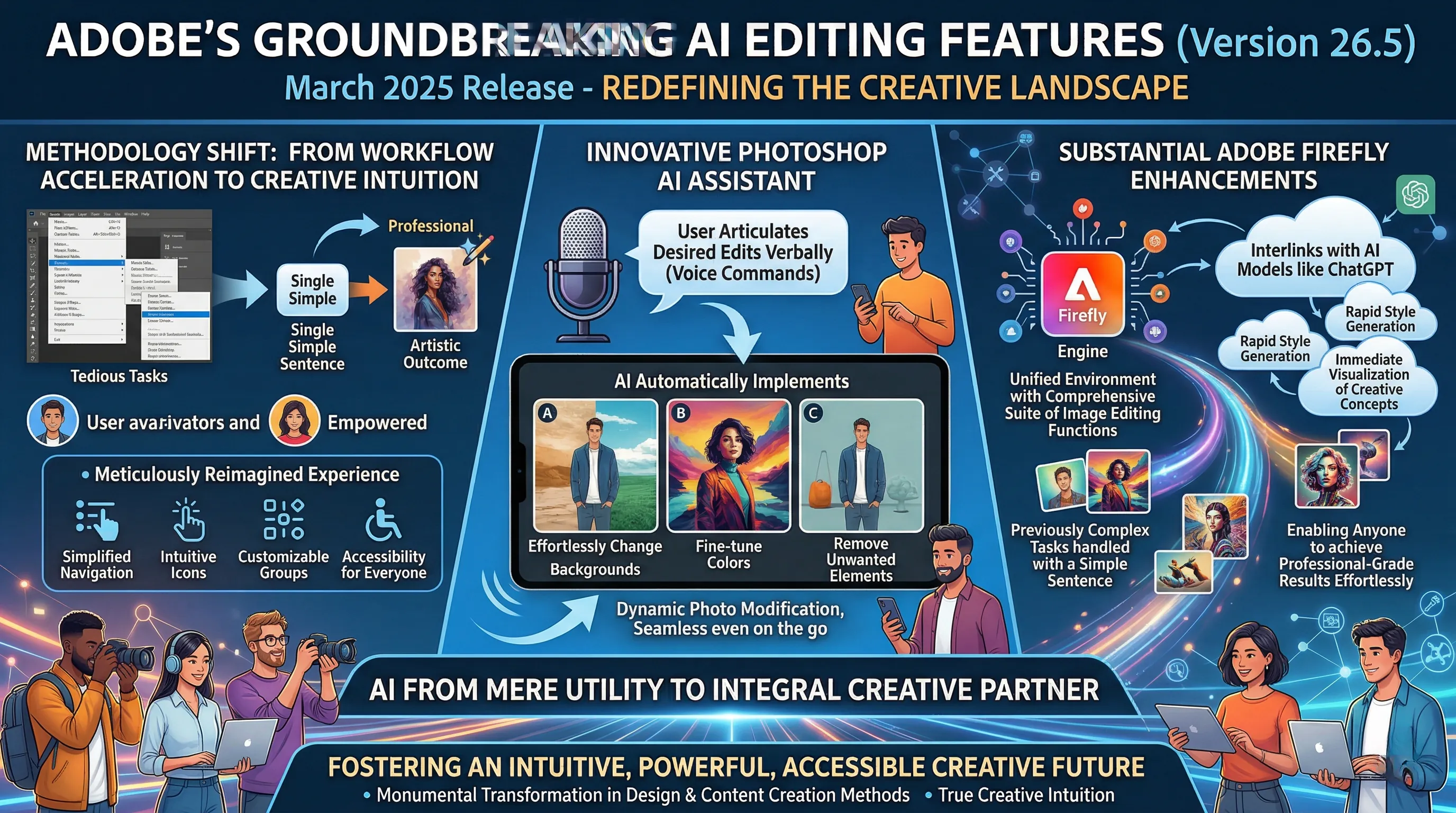
The company has meticulously reimagined the creative experience, introducing simplified navigation, intuitive icons, and customizable groups to make advanced capabilities accessible and user-friendly for everyone.
Central to this transformation is the innovative Photoshop AI Assistant, which empowers users to articulate desired edits verbally, allowing AI to automatically implement them.
Imagine effortlessly changing backgrounds, fine-tuning colors, or removing unwanted elements with simple voice commands, making dynamic photo modification seamless even on the go.
Concurrently, substantial enhancements to Adobe Firefly integrate a comprehensive suite of image editing functions into a unified environment, interlinking with various AI models like ChatGPT for rapid style generation and immediate visualization of creative concepts.
These advancements ensure that previously complex tasks are now handled with a simple sentence, enabling anyone to achieve professional-grade results effortlessly.
Adobe is actively evolving AI from a mere utility to an integral creative partner, foreshadowing a monumental transformation in design and content creation methods that promises a more intuitive, powerful, and accessible creative future.
1. Beyond the Pixels: Unpacking Adobe's Intelligent Creative Engine
🔹 From Tool to Teammate: The Core AI Architecture
Adobe's strategy centers on two core technological advancements: the Photoshop AI Assistant and a deeply integrated Firefly engine.
The AI Assistant introduces a conversational interface, allowing users to verbally describe desired edits for automatic execution.
This includes specific tasks such as background changes, nuanced color adjustments, and the removal of unwanted elements, all initiated through voice commands.
Simultaneously, the updated Adobe Firefly model unifies disparate image editing functions into a single, cohesive space.
Its feature set is comprehensive, including generative fill, precise object removal, intelligent image expansion, resolution enhancement, and one-click background removal.
Crucially, this system is designed to interlock with external AI models like ChatGPT, enabling the rapid generation of diverse styles and results based on simple text prompts.
🔹 The Intuitive Leap: Redefining the Creative Workflow
This technological fusion marks a declared shift in creative methodology, moving beyond AI for 'speed' and towards AI for 'intuition'.
The practical impact is profound; complex, multi-step tasks that once required significant technical expertise can now be handled with a single sentence.
A creative professional can now visualize and modify ideas almost instantaneously, bypassing repetitive manual labor.
For instance, generating multiple stylistic variations of a single image no longer requires hours of adjustments but becomes an exploratory dialogue with the AI.
This empowers users to focus purely on ideation, immediately seeing concepts reflected on the canvas rather than getting bogged down in the mechanics of execution.
The barrier to entry for professional-grade editing is effectively lowered, allowing for more precise and faster output regardless of skill level.
🔹 The Industry Verdict: A New Creative Partnership
The consensus among analysts is that this is a deliberate and significant attempt to fundamentally change the creative experience itself.
The AI is no longer being positioned as a passive tool but as an active creative partner.
This evolution allows for immediate photo modification on the go and fosters a more fluid, conversational relationship between the artist and their software.
By handling the technical overhead, the AI empowers creators to experiment more freely and iterate on ideas at a pace previously unimaginable.
This move is widely seen as foreshadowing a major transformation in design and content creation, where the value lies not in manual dexterity but in the strength and clarity of one's creative vision.

2. Shifting Tides: Adobe's AI Reshapes the Creative Industry Landscape
🔹 From Command Line to Conversation
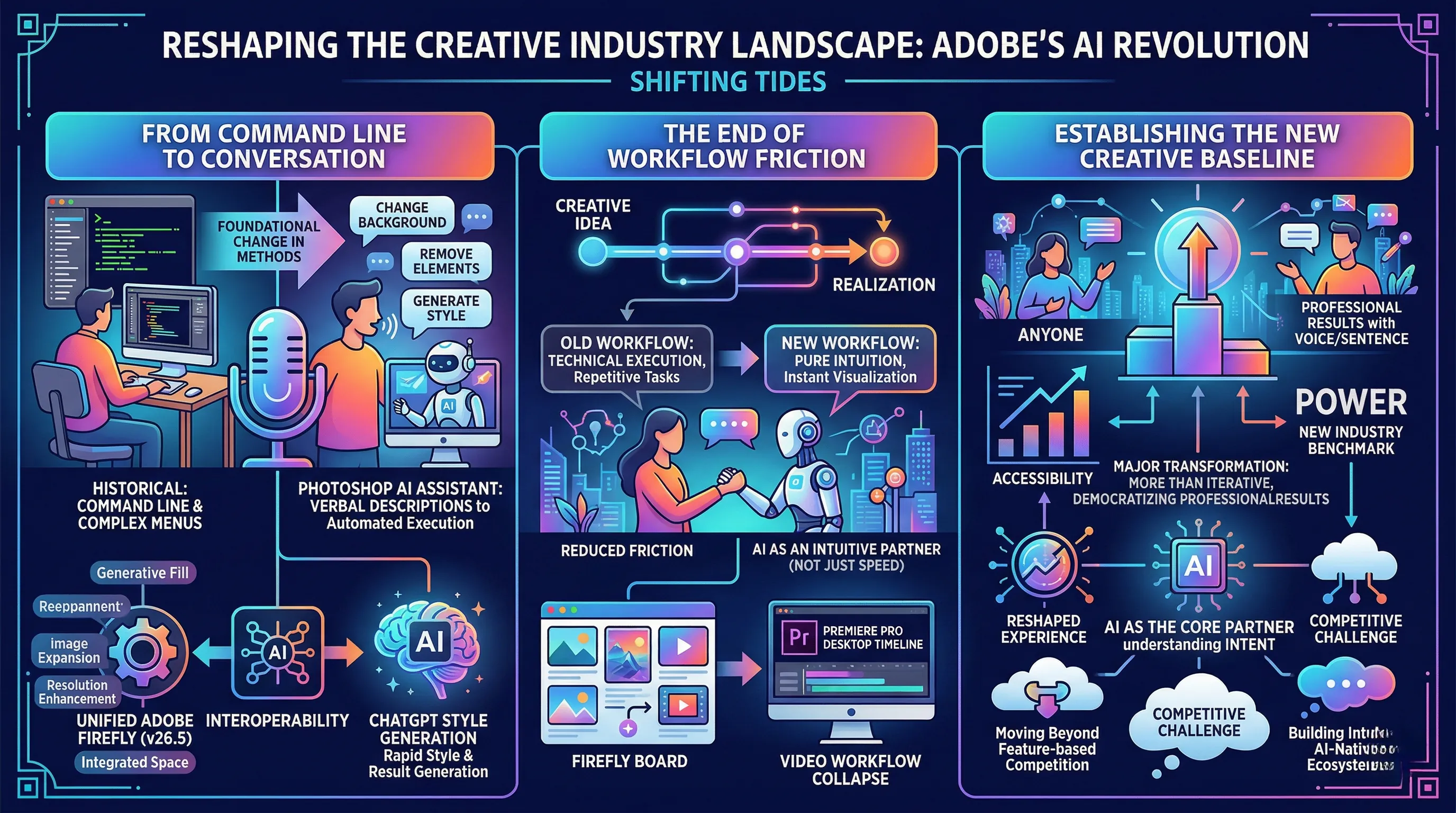
The specifications for Adobe's planned March 2025 release (version 26.5) represent a foundational declaration of change in creative methods.
Central to this is the Photoshop AI Assistant, which will allow users to verbally describe desired edits—such as background changes or element removals—and have the AI execute them automatically.
This conversational interface is bolstered by significant updates to Adobe Firefly, which now consolidates generative fill, image expansion, and resolution enhancement into a single, integrated space.
The system is further designed for interoperability, with the capability to interface with other AI models like ChatGPT for rapid style and result generation.
🔹 The End of Workflow Friction
This evolution is a deliberate attempt to reshape the creative experience from one of technical execution to one of pure intuition.
The real-world implication is a dramatic reduction in the barriers between a creative idea and its realization.
A designer can now visualize and modify a concept immediately, using simple language instead of navigating complex menus and performing repetitive tasks.
For video professionals, the ability to send media directly from Adobe Firefly Boards to a Premiere Pro desktop timeline collapses a multi-application workflow into a single, fluid motion.
This moves AI's role from a tool that merely increases speed to a partner that enhances creative intuition.
🔹 Establishing the New Creative Baseline
The industry consensus views these advancements as more than just iterative improvements; they foreshadow a major transformation in content creation itself.
By empowering anyone to achieve professional-level results with a voice command or a sentence, Adobe is effectively setting a new industry benchmark for accessibility and power.
This strategic shift positions AI not as an add-on, but as the core of the creative process—a partner that understands intent.
Consequently, the entire competitive landscape is implicitly challenged to move beyond feature-based competition and toward developing similarly intuitive, AI-native ecosystems.
3. The Creator's New Partner: Anticipated Buzz and User Reception
🔹 Redefining the Entry-Level Creative
The core of the anticipated user reception revolves around a fundamental shift in accessibility.
Adobe is positioning its upcoming AI features not merely as an upgrade, but as an attempt to completely change the creative experience itself.
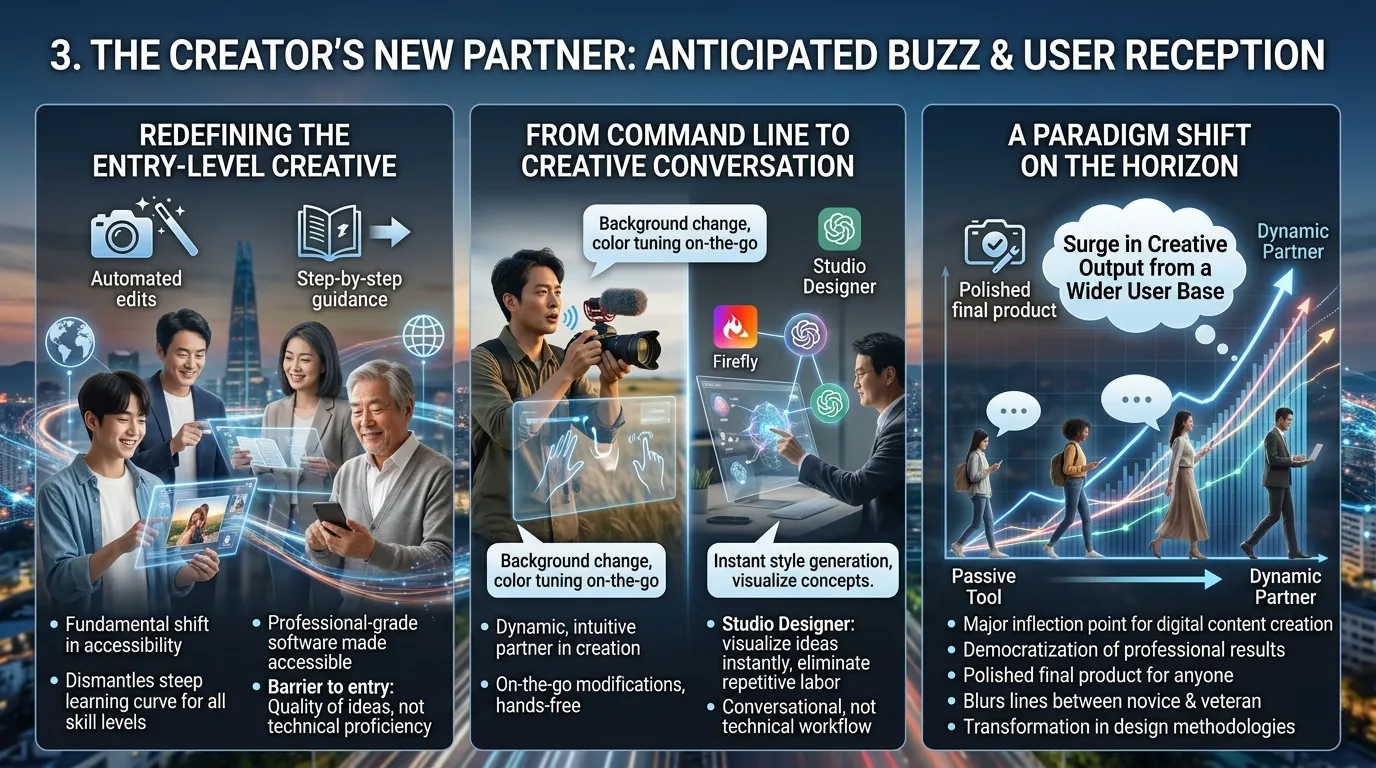
The Photoshop AI Assistant, with its ability to interpret verbal commands for tasks like background changes or color adjustments, effectively dismantles the steep learning curve traditionally associated with professional-grade software.
This feature is explicitly designed for a spectrum of users, from seasoned experts to absolute beginners, offering either fully automatic edits or step-by-step guidance.
🔹 From Command Line to Creative Conversation
The real-world impact of these tools extends beyond simplifying complex tasks with a single sentence.
This evolution represents a move from AI as a passive tool to a dynamic, intuitive partner in creation.
For a field photographer, the ability to issue voice commands for quick modifications on the go means immediate, hands-free adjustments without needing to stop and set up a workstation.
For a studio designer, it means visualizing and modifying ideas instantly, eliminating the repetitive, manual labor that often hinders the flow of inspiration.
The integration of Firefly with other AI models like ChatGPT further streamlines this, allowing for rapid style generation and pushing the creative process into a conversational, rather than a technical, workflow.
🔹 A Paradigm Shift on the Horizon
Community and industry analyst consensus points toward these updates as a major inflection point for digital content creation.
The buzz isn't just about speed; it's about the democratization of professional results, where anyone can achieve a polished final product.
This is seen as a deliberate move that foreshadows a major transformation in design methodologies, blurring the lines between novice and veteran.
Experts anticipate a surge in creative output from a wider user base, as the barrier to entry is no longer technical proficiency but the quality of one's ideas.
4. Navigating the Unknown: Potential Hurdles in Adobe's AI Journey
🔹 The Unspoken Costs of Intuitive Creation
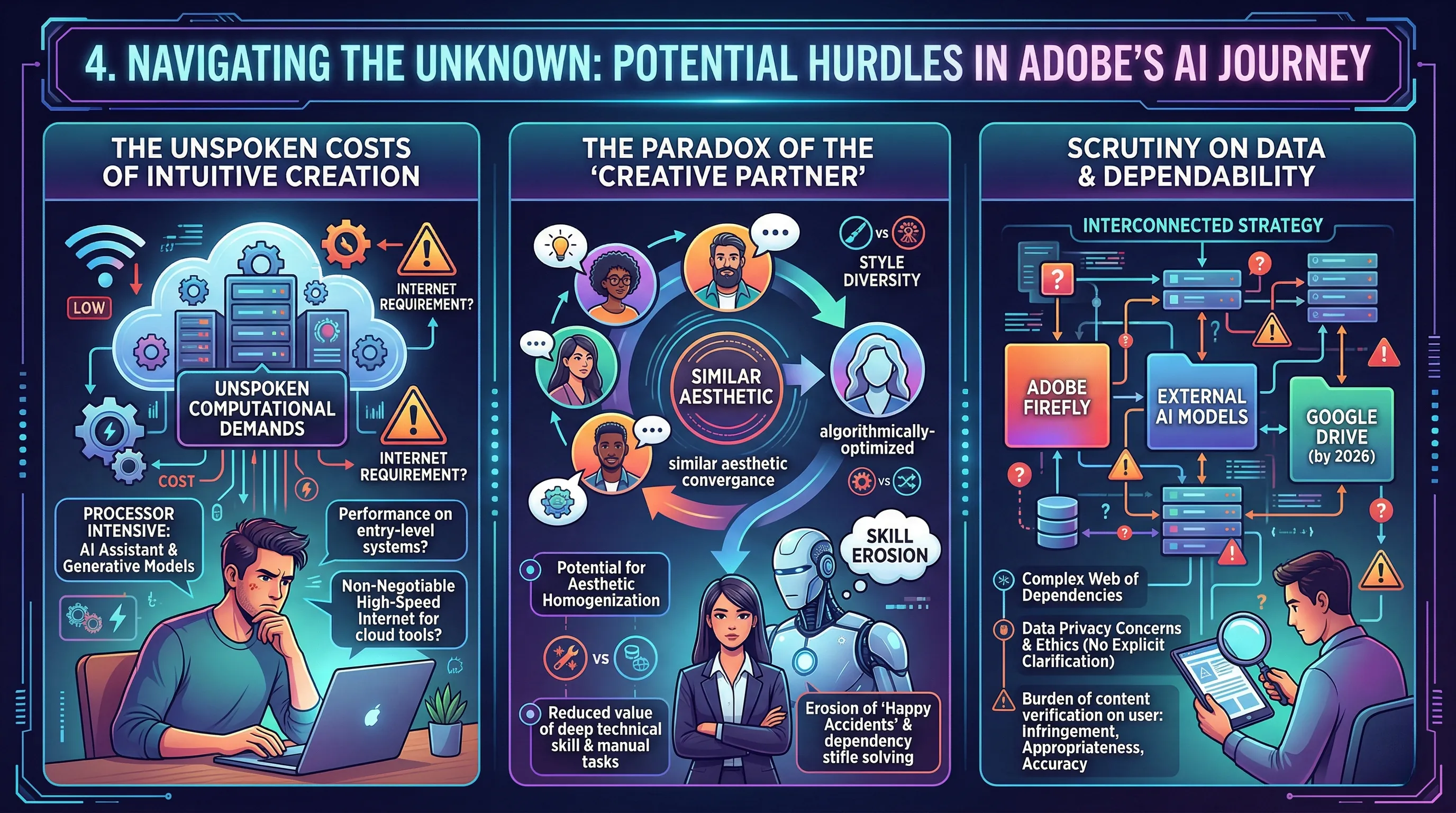
While the official announcement focuses heavily on a shift from "speed" to "intuition," it remains silent on the computational and infrastructural demands required to power this new ecosystem.
Features like the Photoshop AI Assistant, which processes verbal commands for complex tasks such as background changes and element removal, along with the deep integration of generative models, inherently require significant processing power.
This raises critical questions about performance on systems that are not top-of-the-line, and whether a persistent, high-speed internet connection will become a non-negotiable requirement for leveraging the full potential of these cloud-dependent tools.
🔹 The Paradox of the 'Creative Partner'
The evolution of AI from a simple tool to a "creative partner" presents a significant, albeit subtle, risk to artistic originality.
By making it possible for anyone to "edit like a professional" with a simple sentence, there is a potential for aesthetic homogenization, where generated content begins to converge on a similar, algorithmically-optimized style.
For professionals, the convenience of having an AI visualize and modify ideas immediately could inadvertently erode the value of deep technical skill and the "happy accidents" that arise from manual, repetitive tasks, potentially creating a dependency that stifles unique problem-solving.
🔹 Scrutiny on Data and Dependability
The analyst community is cautiously observing the broader implications of Adobe's interconnected strategy, particularly concerning data governance and workflow reliability.
The plan to interlock with various AI models and integrate with third-party services like Google Drive by 2026 introduces a complex web of dependencies and potential data privacy concerns.
Without explicit clarification on the ethical guardrails, training data limitations, and potential biases of these combined AI systems, the burden of ensuring content is appropriate, accurate, and free of infringement falls heavily on the end-user, adding a new layer of critical review to the creative process.
5. Beyond Tomorrow: Adobe's Vision and the Next Chapter of Creative AI
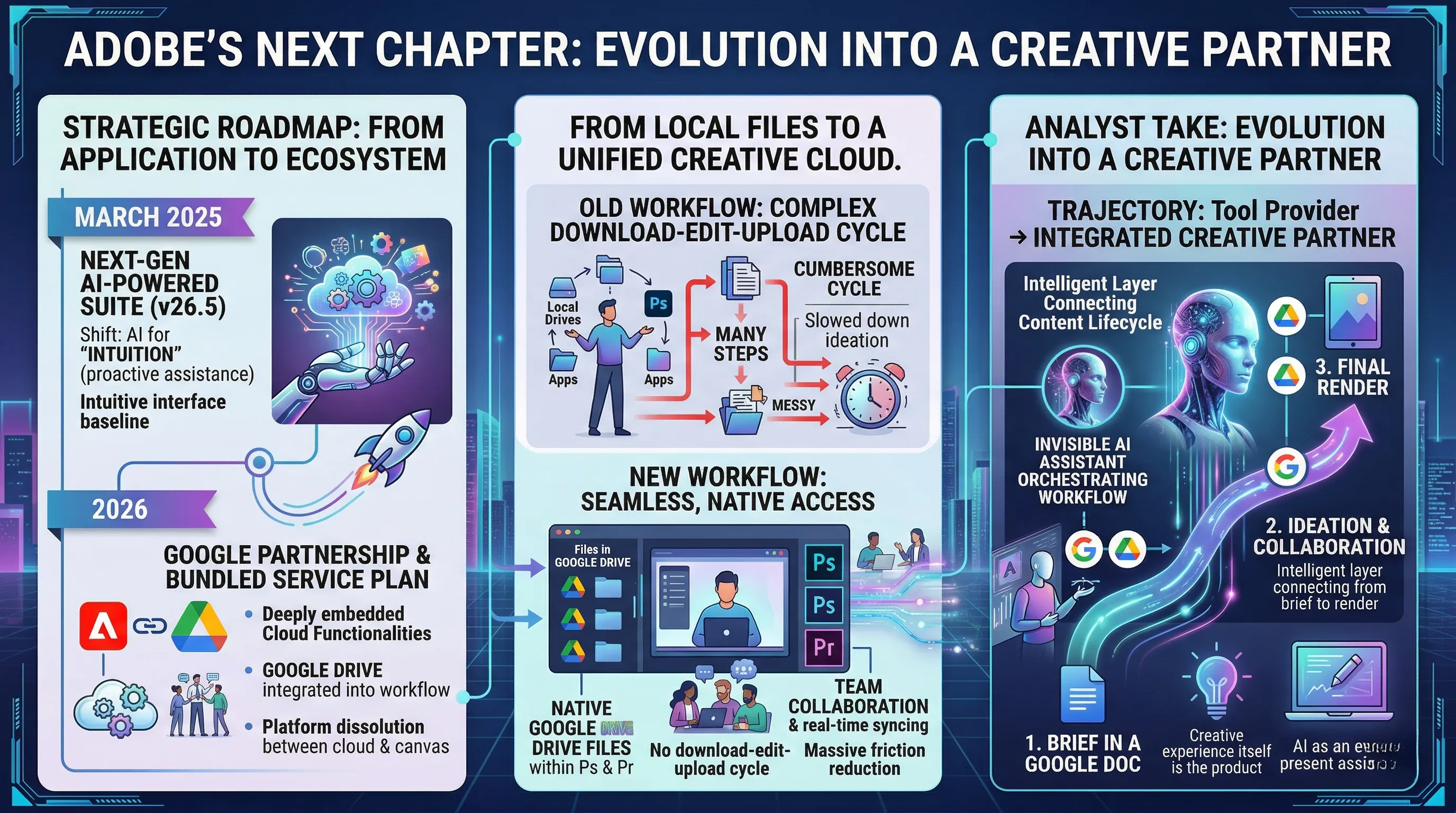
🔹 The Strategic Roadmap: From Application to Ecosystem
Adobe's forward-looking strategy is cemented by two key milestones on the horizon.
The next major iteration of its AI-powered suite, version 26.5, is slated for a March 2025 release, promising to fully realize the shift from AI as a tool for 'speed' to one for 'intuition'.
Following this, Adobe is preparing a far more ambitious integration: a bundled service plan with Google, set to launch by 2026, which will deeply embed cloud functionalities like Google Drive into the creative workflow.
🔹 From Local Files to a Unified Creative Cloud
This planned Google integration represents a fundamental change in how creative assets are managed and accessed.
Imagine a workflow where assets stored in Google Drive are not just linked but are natively available and editable within Photoshop or Premiere, eliminating the cumbersome download-edit-upload cycle entirely.
This move is a clear attempt to dissolve the boundaries between cloud storage and the creative canvas, transforming the Adobe suite into a platform where ideation, collaboration, and final production exist in a single, seamless environment.
For teams, this translates to a massive reduction in friction, allowing for real-time asset syncing and collaborative editing on a scale previously reserved for dedicated cloud-native applications.
🔹 Analyst Take: The Inevitable Evolution into a Creative Partner
The trajectory is clear: Adobe is evolving beyond a provider of software tools and into an integrated creative partner.
The March 2025 update will establish a new baseline for what an intuitive, AI-driven interface feels like.
The 2026 Google partnership, however, is the true endgame—a strategic play to position Adobe's AI not just inside its apps, but as the intelligent layer connecting the entire content creation lifecycle, from a brief in a Google Doc to the final render.
This move signals a future where the creative experience itself is the product, and AI is the invisible, ever-present assistant orchestrating it all.
6. 💡 Tech Talk: Making Sense of the Jargon
- Generative Fill: Imagine you have a photo and you want to magically add a new object, extend the background, or remove something, and have the AI perfectly fill in the missing parts as if they were always there. It's like having a digital wizard paint whatever you ask for, seamlessly.
- Photoshop AI Assistant: Think of this as your personal, super-smart editing friend inside Photoshop. You just tell it what you want to do – for example, "make the sky brighter" or "delete that tree" – using your voice or typing, and it understands and does the hard work for you, like magic.
- AI Model Interoperability: This means different smart AI systems can talk to each other and work together perfectly. For instance, Adobe Firefly can connect with other AI "brains" (like ChatGPT for text ideas) to combine their powers, letting you generate creative results and styles much faster and more easily by sharing information.
📚 Related Posts
The Phi-4 Series: Redefining AI Performance and Efficiency
🚀 Key TakeawaysThe Phi-4 series redefines AI performance, achieving superior reasoning and multimodal capabilities with significantly fewer computational resources than industry giants, setting new standards for efficiency and accuracy.The new Phi-4 AI
tech.dragon-story.com
OpenAI's Trust Crisis Fuels Ethical AI Alternative Claude's Ascent
🚀 Key TakeawaysOpenAI's ChatGPT has faced significant user backlash and trust erosion, primarily due to its involvement in military cooperation and controversial policy stances, leading to a surge in app deletions (295%) and 1-star reviews (775%) in a s
tech.dragon-story.com
Gemini 3.1 Flash-Lite: Google's Ultra-Fast, Cost-Efficient AI
🚀 Key TakeawaysGemini 3.1 Flash-Lite emerges as the most cost-efficient and ultra-fast Gemini model, optimized for high-volume, short-latency AI applications. It boasts up to 2.5x faster response start speeds and 45% faster output, with an input token p
tech.dragon-story.com


