🚀 Key Takeaways
- Google Maps transforms into an intelligent lifestyle platform by integrating with the powerful Gemini AI model, moving beyond simple navigation.
- Experience conversational exploration, where you can ask natural language questions for highly personalized, context-aware recommendations based on vast place data and user reviews.
- Navigate with unprecedented realism and precision using Immersive Navigation, featuring stunning 3D maps, real-time traffic updates, and detailed "last 1m" guidance to parking and building entrances.
- The updated Maps acts as a surprisingly useful AI assistant, capable of getting things done across integrated Google apps like Calendar and Gmail, saving time and solving practical problems.
Google Maps is undergoing its most significant transformation yet, integrating with the powerful Gemini AI model to redefine how we interact with the world around us. This pivotal update expands the map service from a mere information tool into an intelligent lifestyle platform, offering a new era of dynamic and personalized exploration.
At its core, the update introduces "conversational exploration," allowing users to interact with Maps using natural language. Instead of just searching for 'restaurants,' you can now ask complex, context-aware questions like 'places to charge my phone without waiting' or 'tennis court with night lighting,' receiving personalized recommendations informed by hundreds of millions of place data points and user reviews. This feature goes beyond traditional search, reflecting your personal history and preferences, and even acts as an effective AI assistant by integrating with other Google apps like Calendar and Gmail to help you get things done.
Complementing this intelligence is the largest navigation overhaul in a decade: Immersive Navigation. This feature brings a breathtaking 3D-based map that realistically displays buildings, road structures, and terrain, significantly enhancing spatial understanding. With guidance elements like lanes, traffic lights, and crosswalks emphasized, and utilizing 5 million real-time traffic updates per second, it ensures optimal routes and intuitive driving, even on complex roads. Users can also compare routes based on toll fees and traffic volume, culminating in precise "last 1m" guidance directly to parking locations and building entrances, providing truly comprehensive assistance.
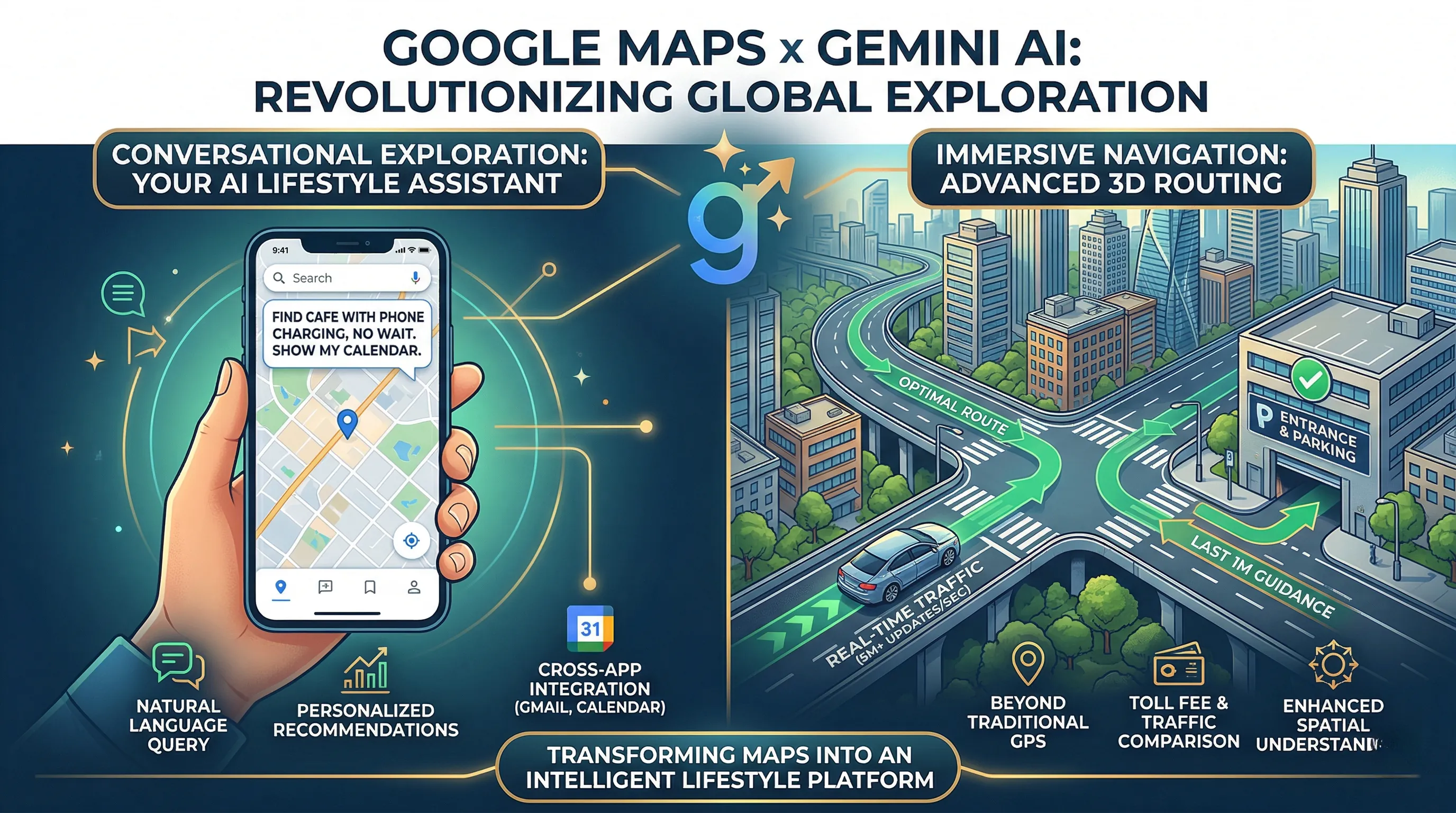
1. Gemini's Intelligent Core: Unveiling the AI Architecture Behind Google Maps' Revolution
🔹 The Foundational Blueprint: Conversational AI and 3D Rendering
Google's overhaul of Maps is powered by a dual-pronged technical integration: the Gemini AI model and a revamped 3D navigation engine.
At its core, the new experience introduces 'conversational exploration' (대화형 탐색), allowing the system to process natural language queries far beyond simple keyword searches.
This functionality is built upon a colossal dataset, analyzing approximately 300 million place data points and 500 million user reviews to understand context and nuance.
Simultaneously, 'Immersive Navigation' represents the most significant navigation update in a decade, rendering a 3D-based map that realistically models buildings, terrain, and complex road structures.
This visual fidelity is supported by a constant stream of real-time traffic data, processing an estimated 5 million updates per second on a global scale.
🔹 From Information Tool to Intelligent Co-Pilot
The real-world impact of this architecture is a fundamental shift in how users interact with mapping technology.
Instead of being forced to think like a search engine ("restaurants near me"), users can now ask "What to do?" and receive tailored recommendations based on personal history and preferences.
This solves practical, everyday dilemmas, from finding a "place to charge phone without waiting" to locating a "tennis court with night lighting".
For drivers, Immersive Navigation enhances spatial understanding, demystifying complex interchanges by visually emphasizing crucial elements like lanes, traffic lights, and crosswalks.
The system’s precision extends to the final moments of a journey, with ‘last 1m’ guidance that directs you not just to an address, but to the specific parking location and building entrance, eliminating a common point of frustration.
🔹 The Analyst's Take: A Genuinely Useful AI Assistant
Community and expert consensus points to the Gemini integration being more than a gimmick; it's a surprisingly practical AI assistant that handles vague or complex requests with remarkable effectiveness.
The cross-app integration is a standout feature, saving significant time by allowing users to locate a flight confirmation in Gmail, add it to their Calendar, and then navigate to the airport, all within a cohesive ecosystem.
This transformation elevates Google Maps from a utilitarian information tool to an intelligent lifestyle platform.
It anticipates user needs and solves problems many might not have articulated, acting less like a map and more like an indispensable co-pilot for daily life.

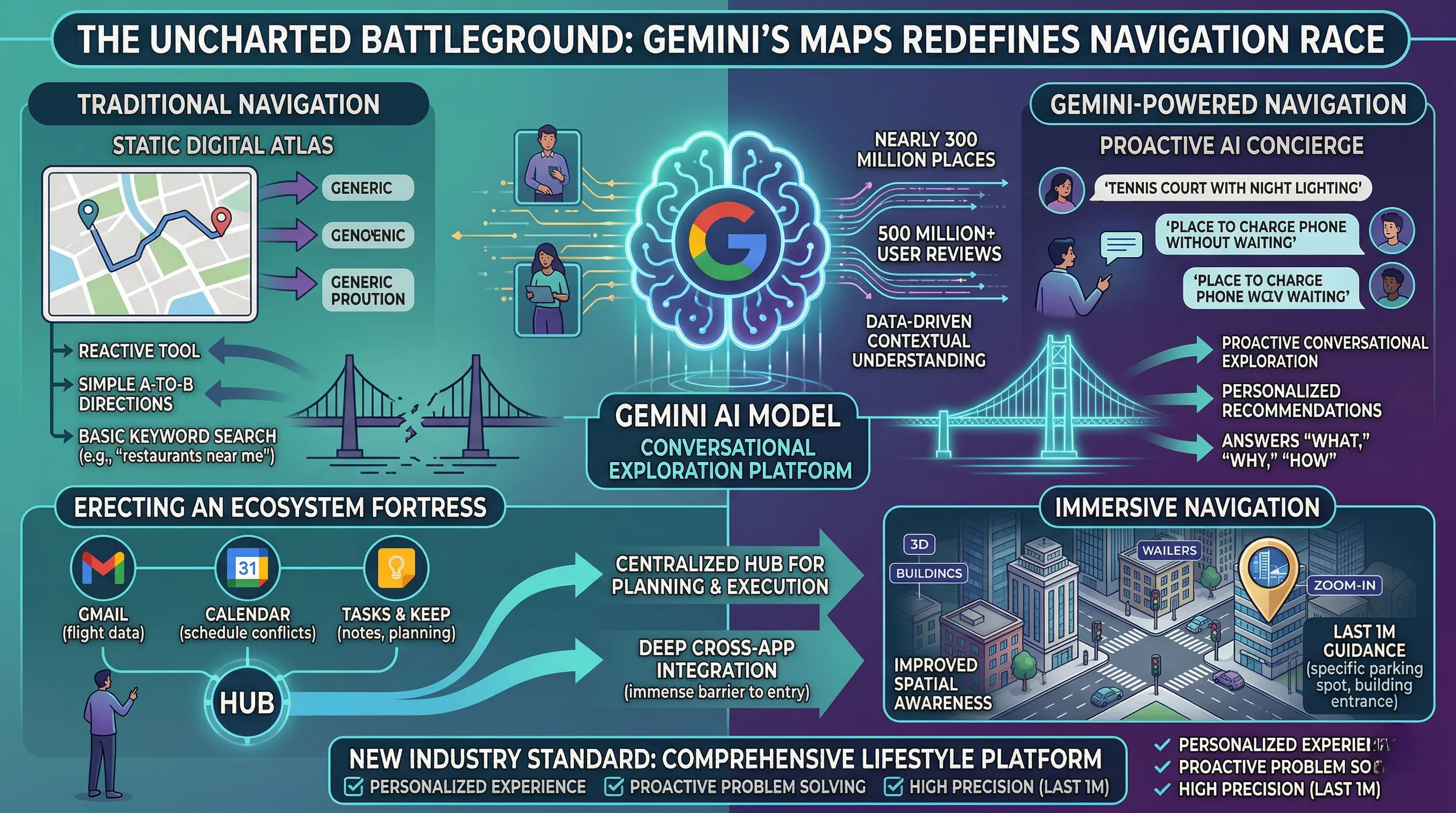
2. The Uncharted Battleground: How Gemini's Maps Update Redefines the Navigation Race
🔹 From Digital Atlas to AI Concierge
The fundamental proposition of a navigation app is being aggressively rewritten.
Google's integration of the Gemini model transforms Maps from a reactive information tool into a proactive, conversational exploration platform.
Instead of users needing to know precisely what to search for, the "Ask Maps" feature leverages natural language to solve vague, real-world problems like finding a "tennis court with night lighting" or a place to "charge a phone without waiting".
This is powered by a colossal dataset of nearly 300 million places and 500 million user reviews, creating a foundation for contextual understanding that static maps cannot match.
Simultaneously, the "Immersive Navigation" overhaul, the largest in a decade, moves beyond flat lines on a screen to a realistic 3D world, rendering buildings, lanes, and traffic lights to improve a driver's spatial awareness on complex roads.
🔹 Erecting an Ecosystem Fortress
This update represents a strategic move to create a significant competitive moat, shifting the battleground from route accuracy to platform intelligence.
The true differentiator lies not just in answering questions, but in the deep, cross-app integration with a user's digital life.
By pulling data from Gmail to find a flight, checking Calendar for scheduling conflicts, or interacting with Tasks and Keep, Gemini in Maps becomes a centralized hub for planning and execution.
This creates an immense barrier to entry for rivals, who may offer competent navigation but lack the integrated ecosystem to provide such a seamless, personalized experience.
The system is designed to solve problems users may not have even realized a map could handle, effectively making the service indispensable and dramatically increasing user stickiness.
🔹 The New Standard for Digital Wayfinding
The industry benchmark for a "good" navigation experience has now been elevated.
Users will increasingly expect their map applications to understand not just "where," but "what," "why," and "how," much like a human assistant.
The ability to receive personalized recommendations that reflect past search history and preferences will make generic, one-size-fits-all results feel antiquated.
Furthermore, the "last 1m" guidance—directing users from the street to the specific parking spot or building entrance—sets a new precedent for precision.
Competitors are now faced with a choice: either develop their own sophisticated AI and data integration strategies or risk being relegated to a utility for simple A-to-B directions in an era that demands a comprehensive lifestyle platform.
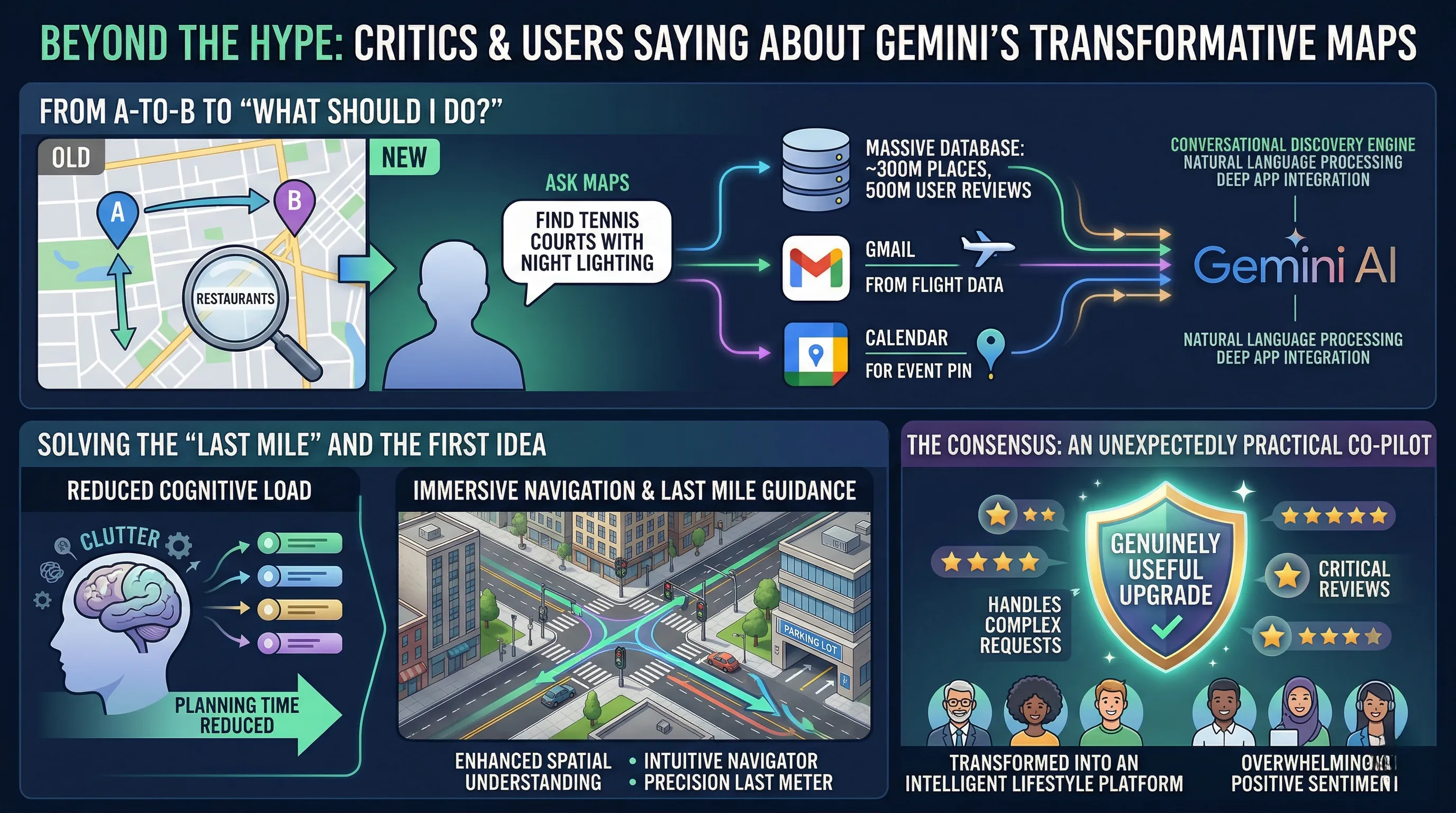
3. Beyond the Hype: What Critics & Users Are Saying About Gemini's Transformative Maps
🔹 From A-to-B to 'What Should I Do?'
The foundational shift analysts are highlighting is Google Maps' evolution from a purely navigational tool into a conversational discovery engine.
Powered by Gemini, the new 'Ask Maps' feature leverages natural language processing to handle queries that are both vague and highly specific, such as "find a tennis court with night lighting" or simply asking an area "What to do?".
This functionality is built upon a massive database of approximately 300 million places and 500 million user reviews, allowing the AI to synthesize recommendations.
Critically, early feedback notes the deep integration across other Google apps, where Gemini can locate a flight in Gmail or reference your Calendar to suggest relevant stops, centralizing trip planning within a single interface.
🔹 Solving the 'Last Mile' and the First Idea
The real-world benefit users are reporting is a significant reduction in cognitive load and planning time.
Instead of juggling multiple apps for reviews, reservations, and directions, users can now articulate a complex need and receive a curated list of options, effectively solving problems many didn't realize could be streamlined.
For drivers, the revamped Immersive Navigation is being lauded for enhancing spatial understanding on complex roads; the realistic 3D rendering of buildings and the clear highlighting of lanes and traffic lights are said to make navigation more intuitive.
This precision extends to the end of a trip, with comprehensive guidance that directs drivers not just to an address, but to specific parking locations and building entrances—solving the frustrating "last meter" problem.
🔹 The Consensus: An Unexpectedly Practical Co-Pilot
The initial consensus from both tech critics and early adopters is that this is far more than a gimmick; it’s a genuinely useful upgrade.
The integration is consistently described as a surprisingly useful AI assistant that excels at handling practical, real-world questions with impressive ease.
Experts note that by combining personalized, context-aware suggestions with optimal routing based on millions of real-time data points, Google has successfully transformed Maps from an information utility into an intelligent lifestyle platform.
The overwhelming sentiment is that Gemini finally bridges the gap between knowing your destination and discovering your next experience.
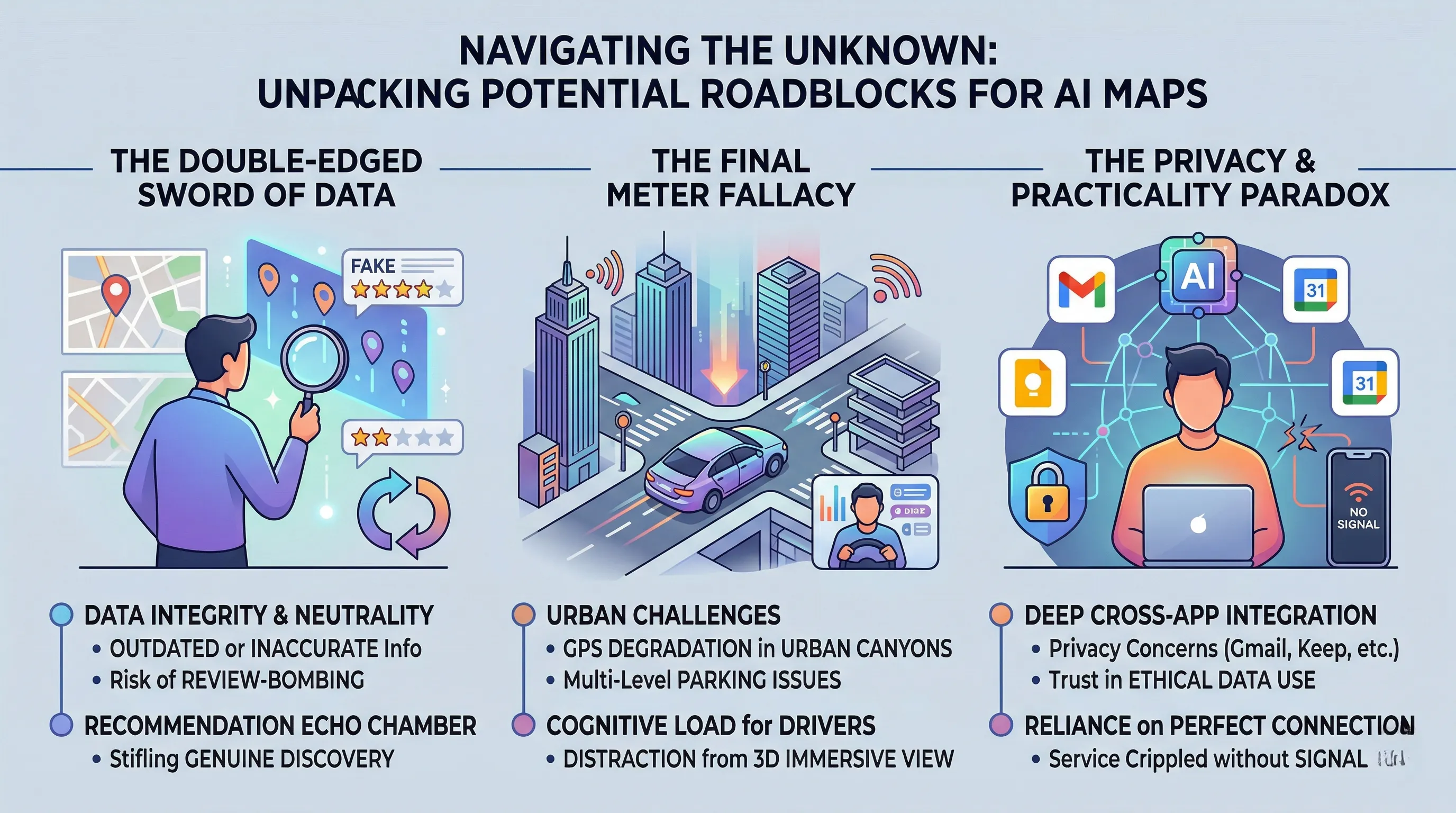
4. Navigating the Unknown: Unpacking the Potential Roadblocks and Limitations of AI Maps
🔹 The Double-Edged Sword of Data
While the Gemini integration leans on a massive dataset of ~300 million places and ~500 million user reviews, the quality and neutrality of this information present a significant hurdle.
This data is not infallible; it can be outdated, skewed by review-bombing, or simply reflect the most popular—not necessarily the best—options.
Furthermore, the feature’s deep personalization, which pulls from a user's search history, risks creating a "recommendation echo chamber," potentially stifling genuine discovery by repeatedly suggesting familiar types of places.
The success of "conversational exploration" hinges entirely on the integrity and comprehensiveness of its underlying data, which remains a variable.
🔹 The Final Meter Fallacy
Google's ambition to provide "last 1m" guidance to specific building entrances and parking spots faces immense technical and logistical challenges in the real world.
GPS accuracy notoriously degrades in dense urban environments with tall buildings—so-called "urban canyons"—or in multi-level parking structures, which could render precision guidance unreliable when it's needed most.
Similarly, the new Immersive View, while visually impressive, could introduce a new layer of cognitive load for drivers.
Displaying 3D buildings, complex road structures, and highlighted lanes simultaneously might become more of a distraction than a driving aid on already complex routes.
🔹 The Privacy and Practicality Paradox
The deep cross-app integration, allowing Gemini to pull flight details from Gmail or tasks from Keep, represents a significant trade-off between convenience and data privacy.
Users must implicitly trust that this expanded access to highly personal information is secure and used ethically, a point of friction for a growing segment of privacy-conscious consumers.
From a practical standpoint, the system's effectiveness relies on a perfect, uninterrupted data connection.
Any loss of connectivity could cripple not just the navigation but the entire "intelligent lifestyle platform," leaving a user without access to recommendations or integrated plans at a critical moment.
5. The Road Ahead: Google Maps with Gemini's Vision for an Intelligent Future
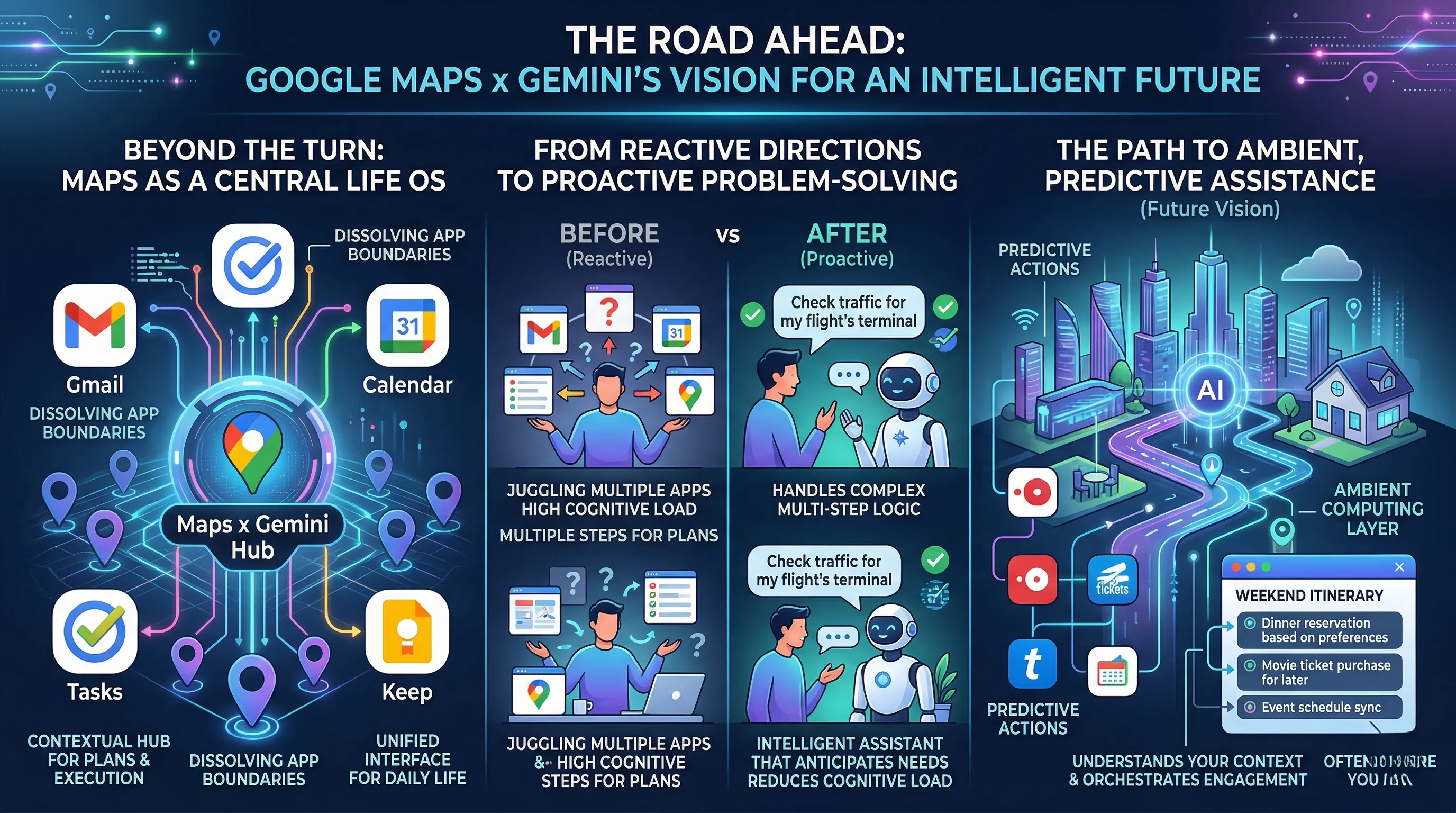
🔹 Beyond the Turn: Maps as a Central Life OS
The integration of Gemini across Google’s ecosystem represents a fundamental strategic pivot for Google Maps.
This is not merely about adding a chatbot; it's about re-architecting the service from a digital atlas into the central operating system for a user's daily life.
By embedding conversational AI that can access and action data from Gmail, Calendar, Tasks, and Keep, Google is positioning Maps as the contextual hub where digital plans meet physical execution.
The core strategy is to dissolve the boundaries between separate applications, using location as the common thread to create a single, unified interface for managing one's day.
🔹 From Reactive Directions to Proactive Problem-Solving
This shift transforms the user's relationship with the app from reactive to proactive.
Previously, a user would have to juggle multiple apps: find a flight confirmation in Gmail, add the airport drive to Calendar, and then open Maps for directions.
Now, the user can simply ask a natural language question, and Gemini can locate the flight, check traffic, and recommend a departure time, effectively acting as an intelligent assistant that anticipates needs.
The real-world benefit is a massive reduction in cognitive load and logistical friction; Maps is no longer just providing data but is actively solving the complex, multi-step problems of daily planning and scheduling.
🔹 The Path to Ambient, Predictive Assistance
Looking ahead, this foundation enables a future where Google Maps becomes a truly predictive and ambient tool.
The next logical step is deeper integration with third-party services, allowing Gemini to not just find a restaurant but also book the reservation or purchase movie tickets directly from the conversational interface.
We can project a future where Maps handles even more complex, multi-day planning, suggesting an entire weekend itinerary by synthesizing personal preferences, real-time weather, and event schedules.
This trajectory suggests Google’s ultimate ambition is for Maps to become the primary interface for ambient computing—a constant, intelligent layer that understands your context and proactively orchestrates your engagement with the world around you, often before you even think to ask.
6. 💡 Tech Talk: Making Sense of the Jargon
- Conversational Exploration: Imagine asking Google Maps a question like you would a knowledgeable friend – 'What's fun to do around here tonight?' or 'Find me a quiet coffee shop where I can work,' and getting smart, personalized answers that go beyond simple directions.
- Immersive Navigation: Think of your map as a super-realistic 3D video game, showing every building, road structure, and even terrain exactly as they are in real life, making it much easier to understand complex junctions and your surroundings at a glance.
- Last 1m Guidance: This is like having a personal valet who not only gets you to the correct address but precisely tells you which specific parking spot to aim for or which exact building entrance to use, eliminating that final frustrating search.
- Intelligent Lifestyle Platform: No longer just a map, it's becoming your personal AI assistant for everything outside your home – planning activities, finding specific amenities, or even checking flight details in Gmail, making your daily life smoother and smarter.
📚 Related Posts
Gemini 3.1 Flash-Lite: Google's Ultra-Fast, Cost-Efficient AI
🚀 Key TakeawaysGemini 3.1 Flash-Lite emerges as the most cost-efficient and ultra-fast Gemini model, optimized for high-volume, short-latency AI applications. It boasts up to 2.5x faster response start speeds and 45% faster output, with an input token p
tech.dragon-story.com
Google Gemini 3.1 Flash Live: Real-time Voice AI Revolution
🚀 Key TakeawaysGemini 3.1 Flash Live is Google's highest-quality audio and voice model, engineered for real-time, natural dialogue and exceptionally reliable voice-first AI interactions.It features unprecedented tonal understanding, dynamically adjustin
tech.dragon-story.com
Google's February AI Blitz: New Gemini Models, Creative Tools, and a Global Vision
🚀 Key TakeawaysGoogle's February AI Blitz unveiled a significant push for more capable and specialized AI, focusing on empowering both advanced problem-solving and creative expression across diverse applications.This included the release of Gemini 3.1 P
tech.dragon-story.com


