🚀 Key Takeaways
- Anthropic Claude's new functionality introduces real-time, interactive visualization, transforming AI into a dynamic thought assistant that aids immediate understanding and supports visual thinking.
- The Claude 3 model family sets new industry benchmarks across a wide range of cognitive tasks, delivering near-instant results with enhanced accuracy and powerful vision capabilities.
- This integration of visuals and high-performance AI fosters a seamless professional workflow, making complex data digestible and expanding AI beyond traditional text-only interactions.
Anthropic's latest advancements in Claude are redefining what's possible in AI interaction, particularly with its groundbreaking Visualization Functionality.
This innovative feature allows Claude to generate charts, diagrams, and other visual materials directly within your conversation, acting as a "temporary tool" that appears precisely when needed to enhance clarity and comprehension.
Imagine discussing complex data and having an interactive graph instantly materialize to illustrate your points, making insights more immediate and engaging.
This capability transforms Claude from a mere result-generation tool into a real-time thought assistant, fostering a new dimension of visual thinking.
Beyond the visual prowess, the Claude 3 model family, including the powerful Claude 3.5 Sonnet, continues to set industry benchmarks, offering near-instant results, strong vision capabilities for multimodal interaction, improved accuracy, and fewer refusals.
These models demonstrate exceptional performance across a wide array of cognitive tasks, enabling more sophisticated analysis and interaction.
Claude's seamless integration with professional tools like Figma, Canva, and Slack further solidifies its role as an indispensable component in modern workflows, making advanced AI capabilities more accessible and practical.

1. The Brains Behind the Brilliance: Deconstructing Claude's Core AI & Visual Prowess
🔹 An Architecture of Immediacy: The Vision Engine and Ephemeral Tools
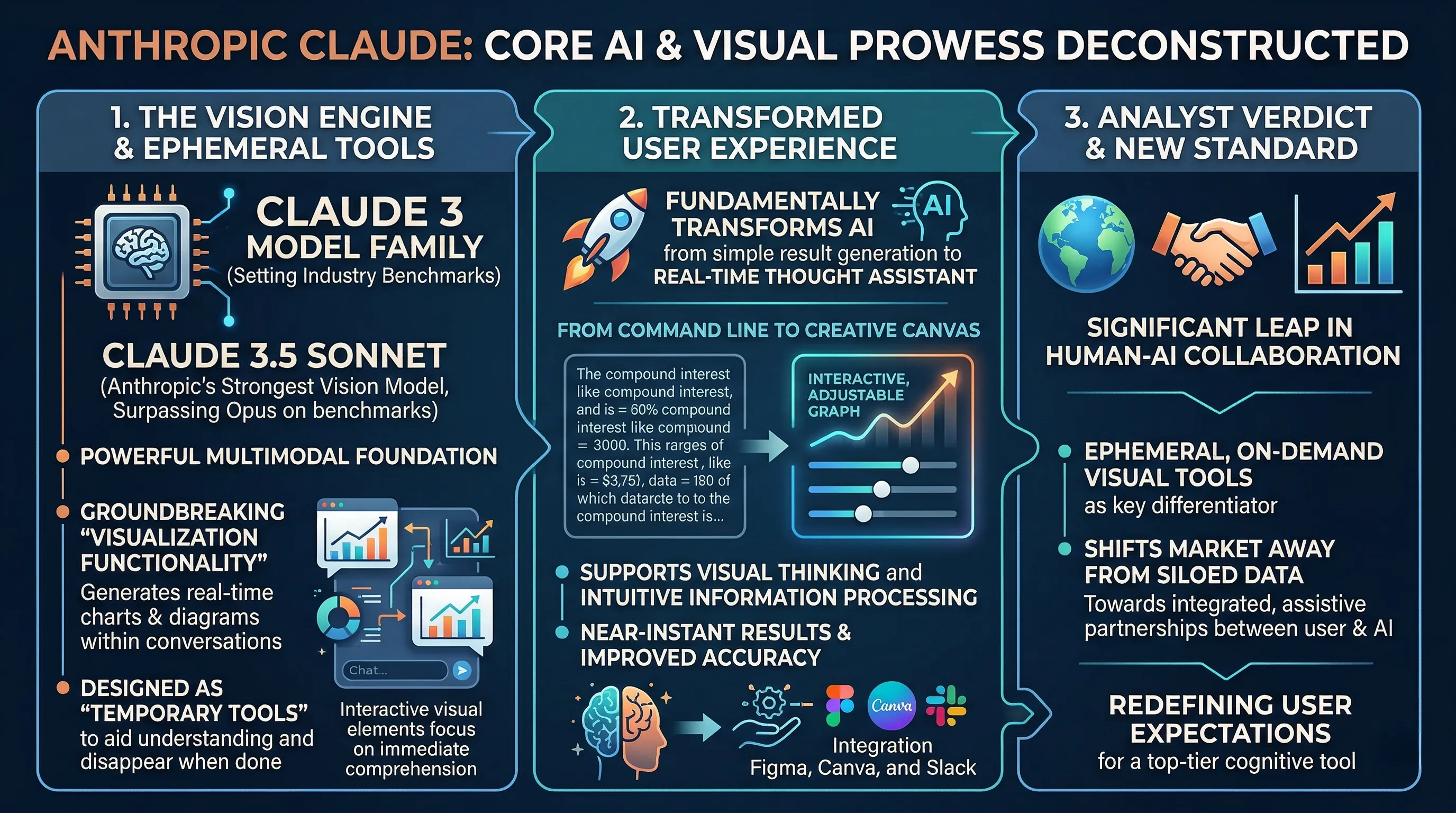
At the core of Claude's visual intelligence lies the Claude 3 model family, which has established new industry benchmarks across a wide range of cognitive tasks.
The most recent iteration, Claude 3.5 Sonnet, stands out as Anthropic's strongest vision model to date, officially surpassing the formidable Claude 3 Opus on standard vision benchmarks.
This powerful multimodal foundation enables a groundbreaking feature known as Visualization Functionality, which generates real-time charts and diagrams directly within the conversation.
Crucially, these visuals require no separate code for generation and are designed as 'temporary tools' that appear to aid understanding and disappear when no longer needed.
They are not static artifacts meant to be saved, but rather interactive elements focused on immediate comprehension, generated and modified entirely within the conversational flow.
🔹 From Command Line to Creative Canvas: The User Experience Transformed
This technical architecture fundamentally transforms the AI from a simple result-generation tool into a real-time thought assistant.
Instead of receiving a block of text describing compound interest, a user can now be presented with an interactive, adjustable graph to explore different scenarios on the fly.
This pivot supports visual thinking and expands AI interaction beyond the traditional text-only paradigm, offering a more intuitive way to process complex information.
The impact is magnified by seamless integration into professional workflows with tools like Figma, Canva, and Slack, embedding this dynamic visual aid where creative and collaborative work already happens.
The near-instant results and improved accuracy of the underlying model ensure this process feels fluid, not disruptive.
🔹 The Analyst Verdict: Setting a New Standard for Interactive AI
Industry analysis and community consensus point to this as a significant leap in human-AI collaboration.
The combination of a high-performance vision model and on-demand interactive visuals directly enhances user understanding in a way static text outputs cannot.
By reducing model refusals and sharpening accuracy, the Claude 3 family provides a reliable foundation for these advanced features.
Experts view this shift toward ephemeral, in-flow visual tools as a key differentiator, moving the entire market away from siloed data outputs and toward a more integrated, assistive partnership between user and AI.
This feature set is not merely an addition; it is a redefinition of what a user should expect from a top-tier cognitive tool.
2. Shifting AI Tides: How Claude Reshapes the Landscape
🔹 Beyond Text: The Rise of In-Conversation Tooling
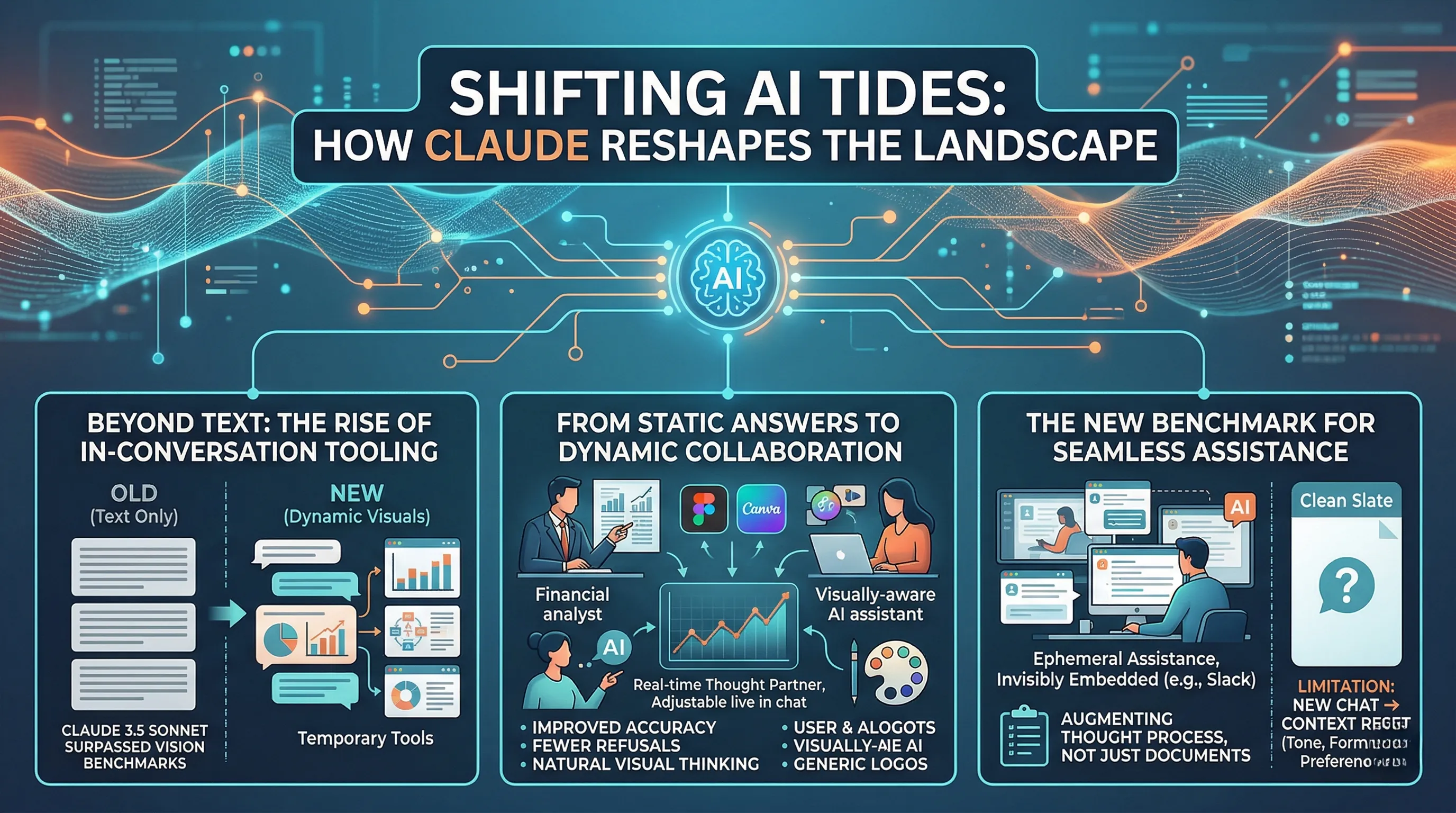
Anthropic is fundamentally altering the user-AI interaction model by introducing dynamic, on-the-fly visualization capabilities.
Unlike traditional methods that require separate code execution, this functionality generates charts, diagrams, and other visual materials directly within the conversational interface.
These visuals function as 'temporary tools,' appearing to clarify a point or fulfill a user request and then disappearing, keeping the focus on the immediate cognitive task.
This is complemented by the Claude 3 model family, which has established new industry benchmarks for performance, featuring near-instant response times and robust vision capabilities for multimodal analysis.
Specifically, Claude 3.5 Sonnet has surpassed its predecessors on standard vision benchmarks, demonstrating a significant leap in understanding and interpreting images.
🔹 From Static Answers to Dynamic Collaboration
The real-world impact of this shift is profound; it transforms the AI from a simple result-generator into a real-time thought partner.
For a financial analyst, an interactive graph demonstrating compound interest can be adjusted live in the chat, providing far more insight than a static table of numbers.
Designers using integrations with tools like Figma and Canva can now leverage a visually-aware AI assistant directly within their established creative workflows.
The model's improved accuracy and significant reduction in refusals foster greater user trust, encouraging reliance on the AI for more complex and mission-critical cognitive tasks.
This move beyond text-only interaction supports a more natural, visual style of thinking, dramatically expanding the user base for whom AI is a practical and intuitive tool.
🔹 The New Benchmark for Seamless Assistance
Industry analysis suggests this approach sets a new competitive standard, prioritizing ephemeral, in-the-moment assistance over the creation of static, shareable artifacts.
The emphasis is on augmenting the user's thought process, not just delivering a final document.
This paradigm is reinforced by deep integrations into existing professional ecosystems like Slack, signaling a strategy of embedding AI invisibly into daily work rather than positioning it as a separate destination.
While the platform’s performance is a clear advantage, expert consensus notes a significant workflow friction point: the model's inability to retain context like tone or formatting preferences when a new chat is initiated.
Despite this limitation, the move towards an integrated, visually capable, and collaborative assistant redefines user expectations for what a next-generation AI should be able to do.
3. The AI Conversation: What the Experts and Community are Saying
🔹 From Text Generator to Visual Collaborator
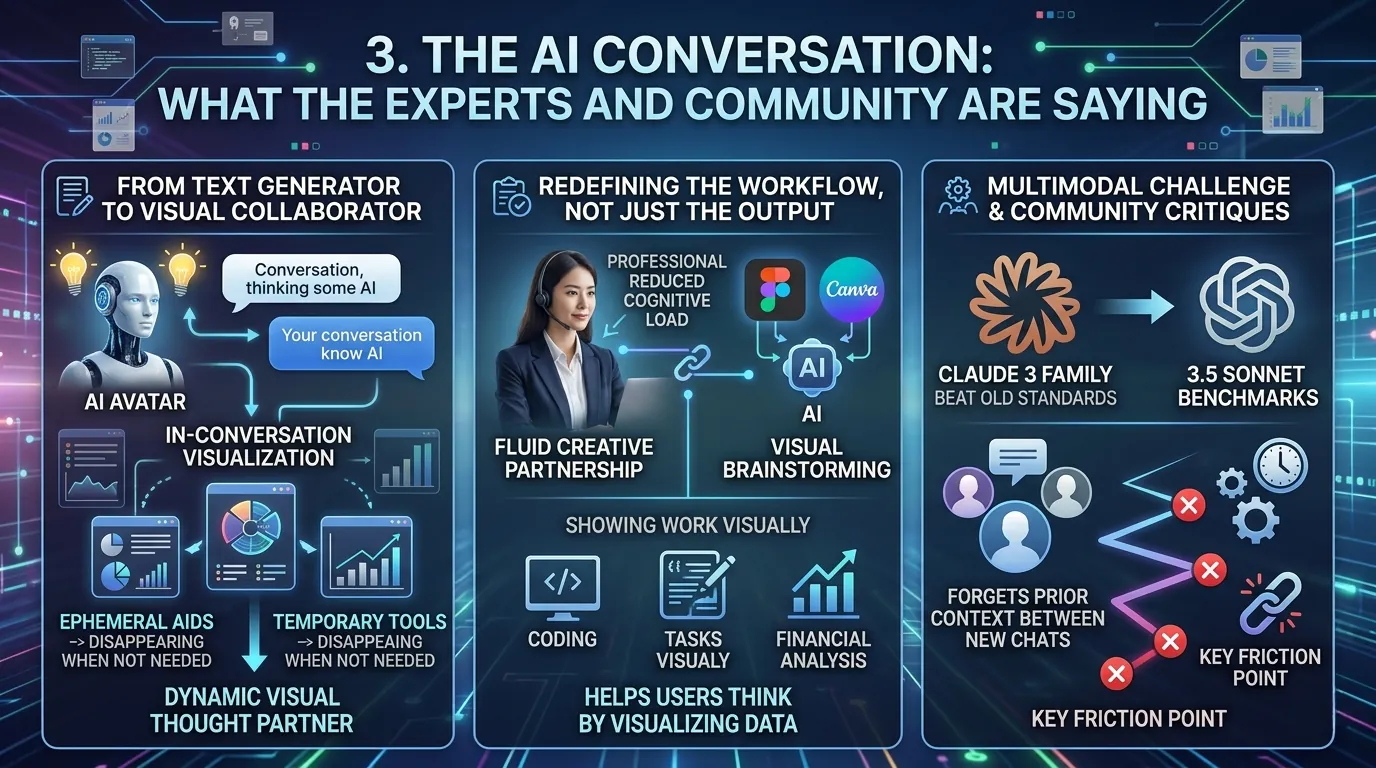
The core of the conversation centers on Claude's fundamental shift from a text-based result generator to a dynamic, visual thought partner.
Analysts note that the platform’s ability to generate real-time, interactive charts and diagrams directly within a conversation is a significant architectural distinction.
Unlike systems that output static files, Claude's visuals are framed as "temporary tools"—ephemeral aids that appear to clarify a point and disappear when no longer needed, focusing entirely on in-the-moment comprehension.
🔹 Redefining the Workflow, Not Just the Output
The potential impact on professional workflows is where most speculation is currently focused.
This feature could drastically reduce the cognitive load for users, transforming the AI from a tool you ask for answers into an assistant that helps you think by visualizing data on the fly.
For professionals using integrated tools like Figma or Canva, this represents a move toward a more fluid, creative partnership where the AI doesn't just provide suggestions but actively participates in the visual brainstorming process.
The implication is a future where complex tasks, from coding to financial analysis, are supported by an AI that can show its work visually and interactively.
🔹 A Challenge to the Multimodal Status Quo
While widespread community sentiment is still forming, the initial expert take is that this represents a direct challenge to the prevailing standards for multimodal AI.
By establishing new industry benchmarks with its Claude 3 family—and specifically positioning Claude 3.5 Sonnet as its strongest vision model yet—Anthropic is clearly targeting users who require more than text-based interaction.
However, online forums and early adopters will likely balance this praise with ongoing critiques, particularly the noted limitation that the AI forgets prior context and workflow when a new chat is initiated.
This persistent usability issue is seen as a key friction point preventing the AI from becoming a truly seamless, long-term project collaborator.
4. Navigating the New Frontier: Claude's Current Hurdles and Limitations
🔹 The Clean Slate Conundrum
Despite its advanced cognitive abilities, Claude currently operates with a significant contextual limitation.
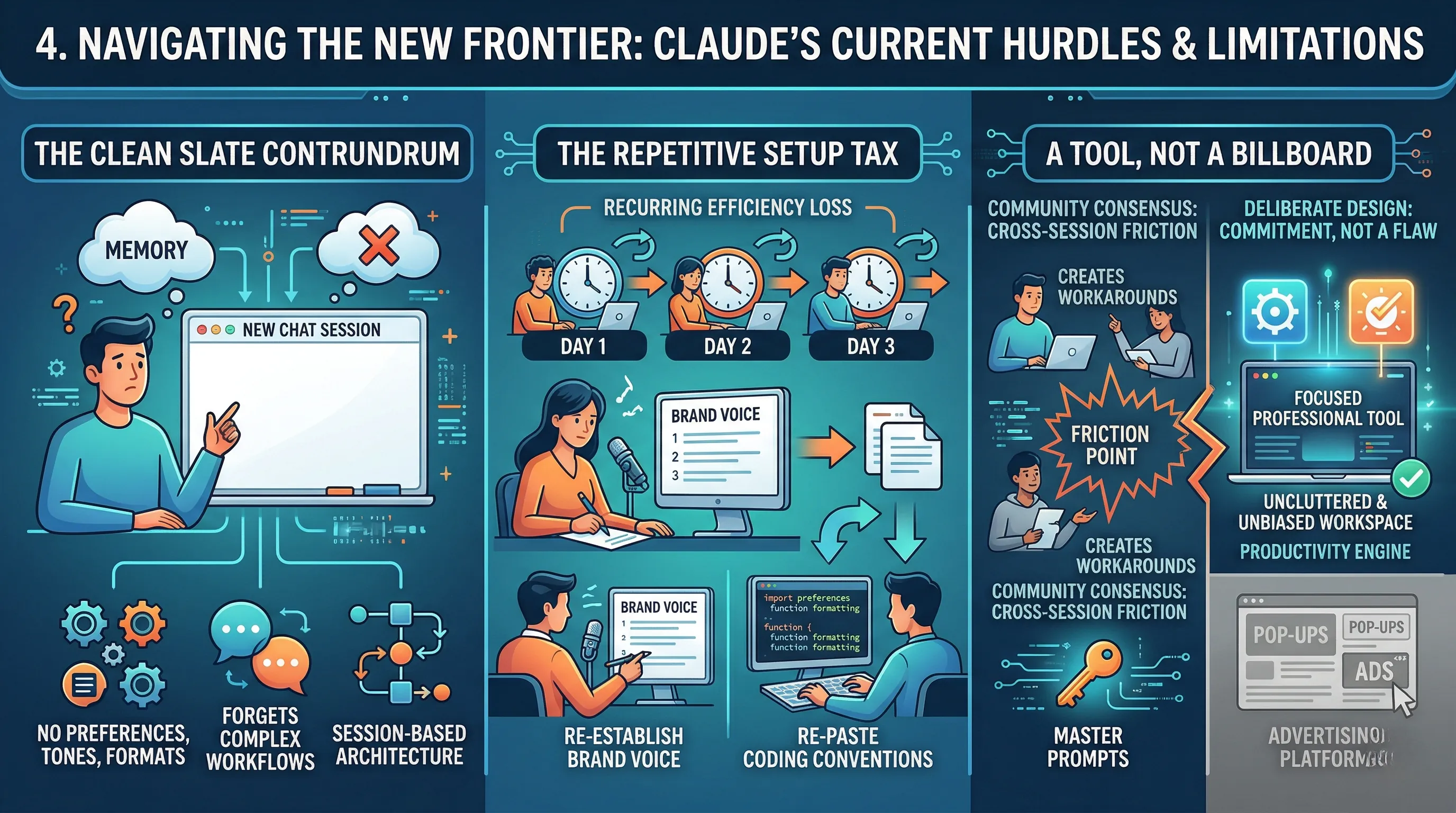
Each new chat session begins as a completely blank slate, meaning the model does not retain memory of user preferences, established tones, specific formatting rules, or complex workflow instructions from previous interactions.
This session-based memory is a core architectural characteristic that users must actively manage.
🔹 The Repetitive Setup Tax
In practical terms, this "context reset" imposes a recurring efficiency tax on users engaged in long-term or iterative projects.
A content creator who spent an entire session refining a specific brand voice must re-establish those guidelines from scratch the next day.
Similarly, a developer must re-paste their preferred coding conventions and project context at the start of every new chat, preventing the development of a truly persistent, personalized assistant that learns and adapts to an individual's workflow over time.
🔹 A Tool, Not a Billboard
The most prominent limitations are a mix of technical hurdles and deliberate design philosophy.
The community consensus identifies the lack of cross-session memory as a genuine friction point requiring workarounds, such as maintaining detailed "master prompts" to kickstart new conversations.
However, another inherent limitation—that Claude is not designed as an advertising platform—is widely interpreted not as a flaw, but as a commitment to its role as a focused, professional tool.
This principled boundary ensures an uncluttered, unbiased workspace, reinforcing its identity as a productivity engine rather than a consumer-facing media channel.
5. Beyond Tomorrow: Claude's Ambitious Roadmap for AI Evolution
🔹 The Opus 4.6 Blueprint
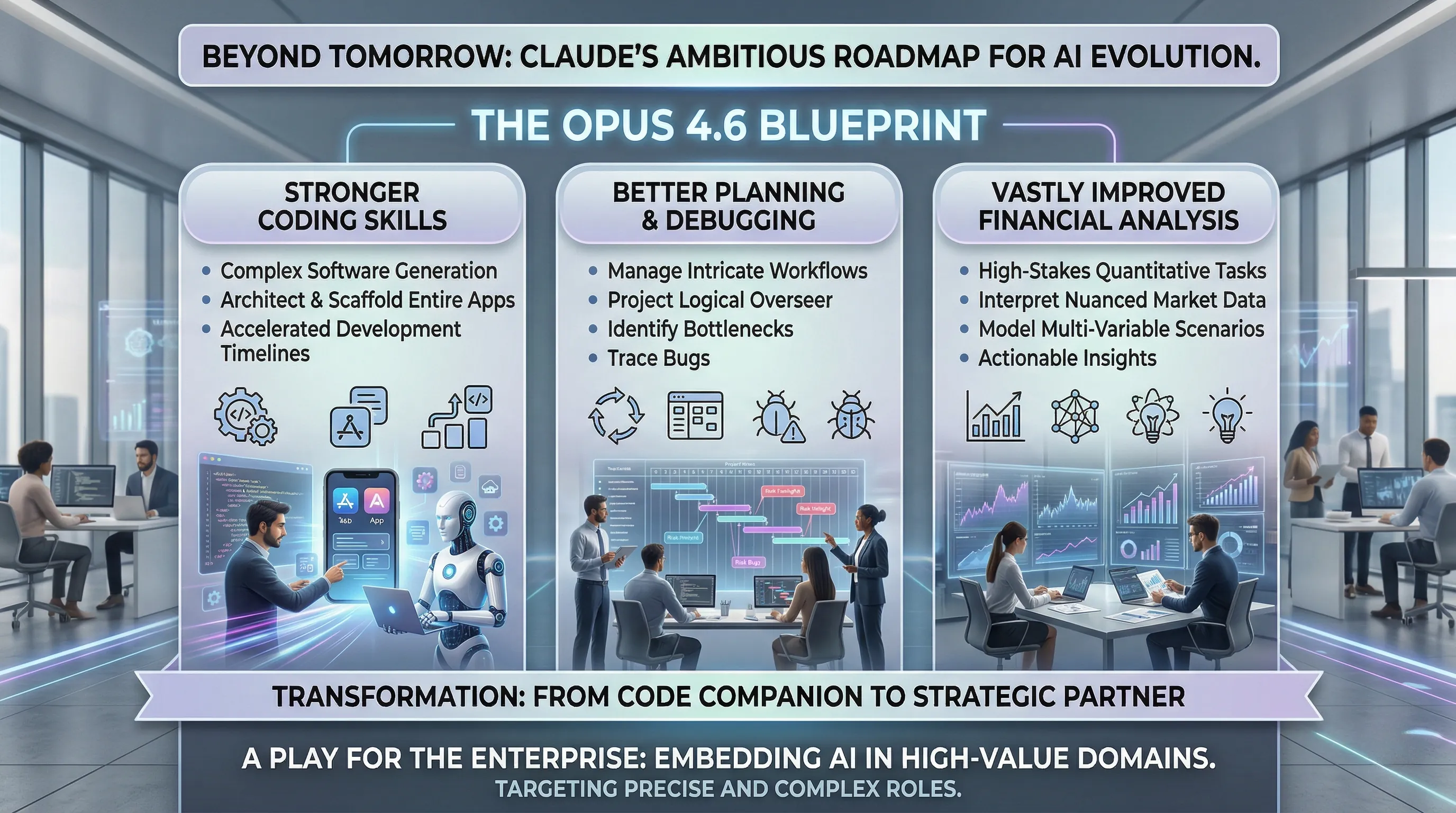
Anthropic's forward-looking roadmap for its next flagship model, provisionally named Claude Opus 4.6, targets a deliberate and significant enhancement of its technical capabilities.
The development focus is squarely on three core pillars: delivering stronger coding skills for more complex software generation, enabling better planning and debugging to manage intricate project workflows, and providing vastly improved financial analysis abilities for high-stakes quantitative tasks.
This trajectory indicates a strategic move away from generalist improvements toward mastering specialized, high-value professional domains.
🔹 From Code Companion to Strategic Partner
These planned upgrades are poised to transform how professionals interact with AI assistants.
Enhanced coding proficiency means the AI could move from generating isolated functions to architecting and scaffolding entire applications, dramatically accelerating development timelines.
Superior planning and debugging capabilities would allow Claude to act as a project's logical overseer, identifying potential bottlenecks in a complex plan or tracing elusive bugs across an entire codebase before a human developer even starts.
For finance professionals, this evolution translates to an AI capable of not just processing spreadsheets, but interpreting nuanced market data, modeling multi-variable economic scenarios, and generating actionable insights from raw financial statements.
🔹 Analysis: A Play for the Enterprise
This roadmap is a clear signal of Anthropic's ambition to deeply embed Claude within the enterprise ecosystem, targeting roles where precision and complexity are non-negotiable.
By concentrating on the demanding fields of software engineering and finance, the company is positioning its next-generation model as an essential tool rather than a mere convenience.
The community consensus is that this strategic focus aims to solve mission-critical business problems, making the AI indispensable for technical teams and financial analysts who require more than just conversational fluency; they require a reliable, analytical partner.
6. 💡 Tech Talk: Making Sense of the Jargon
- Visualization Functionality: Imagine explaining a complex financial concept, and suddenly, a graph pops up showing the numbers changing as you discuss them, right there in your chat. It's like having a dynamic whiteboard built into your conversation, bringing abstract ideas to life instantly.
- Multimodal Interaction: Instead of just typing messages, imagine showing Claude a picture of a broken engine part and asking it how to fix it, or sharing a diagram and having it explain the components. You're communicating with words, images, and more, all at once, making the AI truly understand your world.
- Cognitive Tasks: Think of "cognitive tasks" as all the different ways a super-smart student can think and solve problems: writing essays, doing advanced math, understanding history, or even analyzing a poem. Claude 3 is setting new records in how well it performs across all these "mental exercises," demonstrating its impressive "brainpower."
- Real-time Thought Assistant: This isn't just an AI that gives you answers; it's like having a co-pilot for your brain. As you think and brainstorm, Claude is right there, generating visuals or refining ideas instantly, helping you process information and develop thoughts in real-time.
📚 Related Posts
OpenAI's Trust Crisis Fuels Ethical AI Alternative Claude's Ascent
🚀 Key TakeawaysOpenAI's ChatGPT has faced significant user backlash and trust erosion, primarily due to its involvement in military cooperation and controversial policy stances, leading to a surge in app deletions (295%) and 1-star reviews (775%) in a s
tech.dragon-story.com
The Phi-4 Series: Redefining AI Performance and Efficiency
🚀 Key TakeawaysThe Phi-4 series redefines AI performance, achieving superior reasoning and multimodal capabilities with significantly fewer computational resources than industry giants, setting new standards for efficiency and accuracy.The new Phi-4 AI
tech.dragon-story.com
Gemini 3.1 Flash-Lite: Google's Ultra-Fast, Cost-Efficient AI
🚀 Key TakeawaysGemini 3.1 Flash-Lite emerges as the most cost-efficient and ultra-fast Gemini model, optimized for high-volume, short-latency AI applications. It boasts up to 2.5x faster response start speeds and 45% faster output, with an input token p
tech.dragon-story.com


