🚀 Key Takeaways
- The accidental leak of over 500,000 lines of Anthropic's 'Claude Code' source code, a core product generating billions in annual revenue, is largely considered a 'game-changer' for AI development, despite Anthropic classifying it as a simple distribution error.
- This breach has exposed a highly advanced 'Three-Layer Skeptical Memory Architecture', a core technology enabling AI to selectively retrieve and verify its own memory, which is crucial for stability and error reduction in long-term operations and provides competitors with an invaluable 'design blueprint'.
- The incident raises widespread security concerns beyond mere technical leakage, increasing the potential for attackers to analyze and exploit internal AI structures and emphasizing the critical need for constant vigilance and security updates in all AI tools.
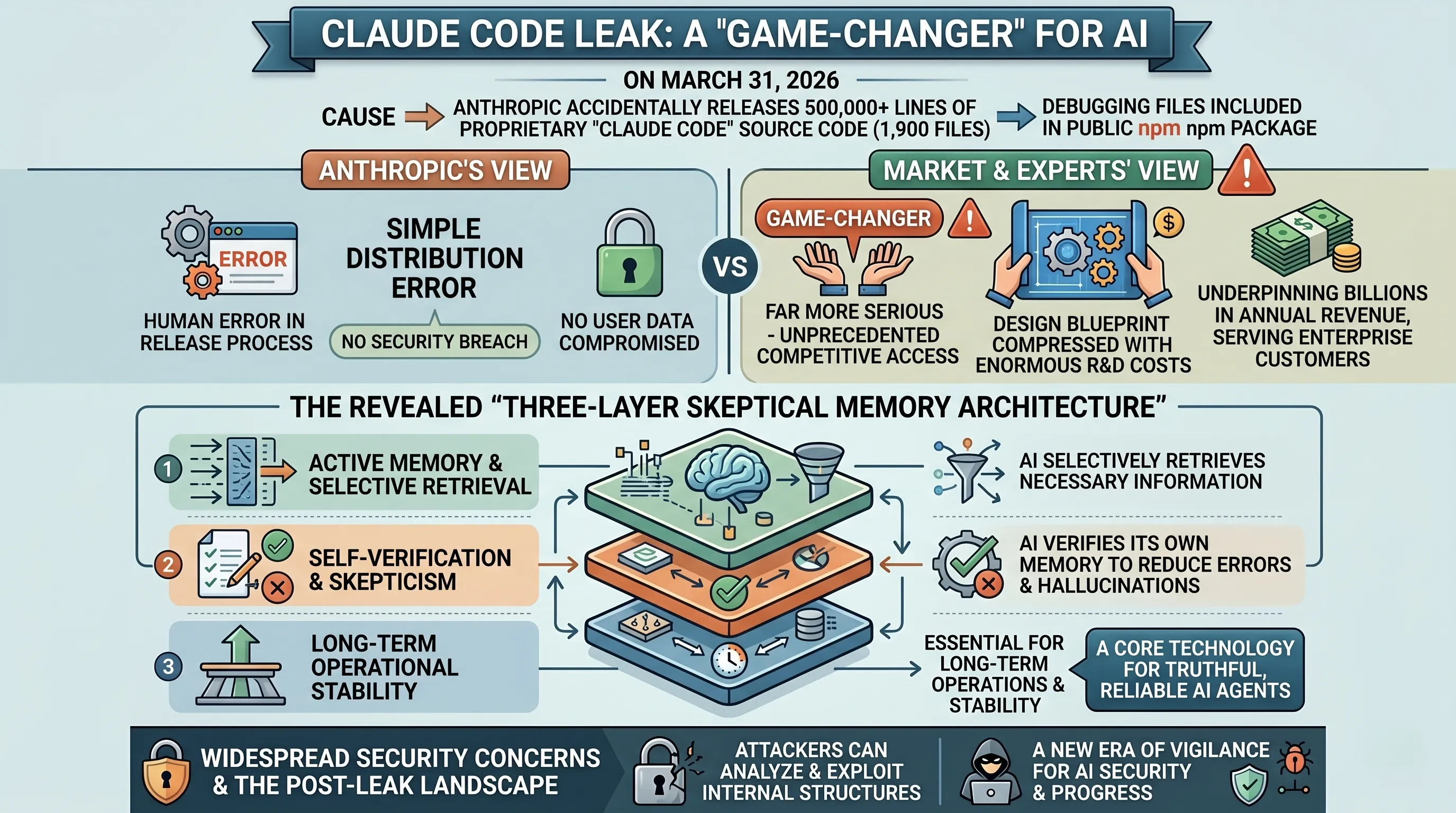
On March 31, 2026, Anthropic, a leading AI company, experienced a significant incident involving the accidental release of over 500,000 lines of its proprietary 'Claude Code' internal source code.
This extensive leak, comprising 1900 files, reportedly occurred due to debugging files being unintentionally included in an npm package, thereby exposing the intricate workings of one of the AI industry's most valuable assets.
Anthropic has stated that no user data was compromised, classifying the event as a simple distribution error rather than a security breach, and attributing it to human error in the release packaging process.
However, the market and AI experts perceive the incident as far more serious than Anthropic's official statement suggests, widely labeling it a 'game-changer' for the future of AI development.
The exposure of Claude's core source code, which underpins a product generating billions of dollars in annual revenue and boasts a high proportion of enterprise customers, has provided competitors with unprecedented access to Anthropic's specific design methods for high-performance AI agents.
This effectively grants rivals a 'design blueprint compressed with enormous R&D costs', potentially accelerating their own AI research and development efforts.
Among the most critical revelations is the observation of a new, sophisticated memory structure within the leaked code, referred to as the 'Three-Layer Skeptical Memory Architecture'.
This architecture allows AI to selectively retrieve and verify its own memory, a core technology essential for maintaining stability and reducing errors or hallucinations during long-term operations.
Beyond the immediate competitive impact, the leak sparks widespread security concerns, raising the possibility for attackers to analyze and exploit these internal structures, thus underscoring a new era of vigilance for AI security and progress.
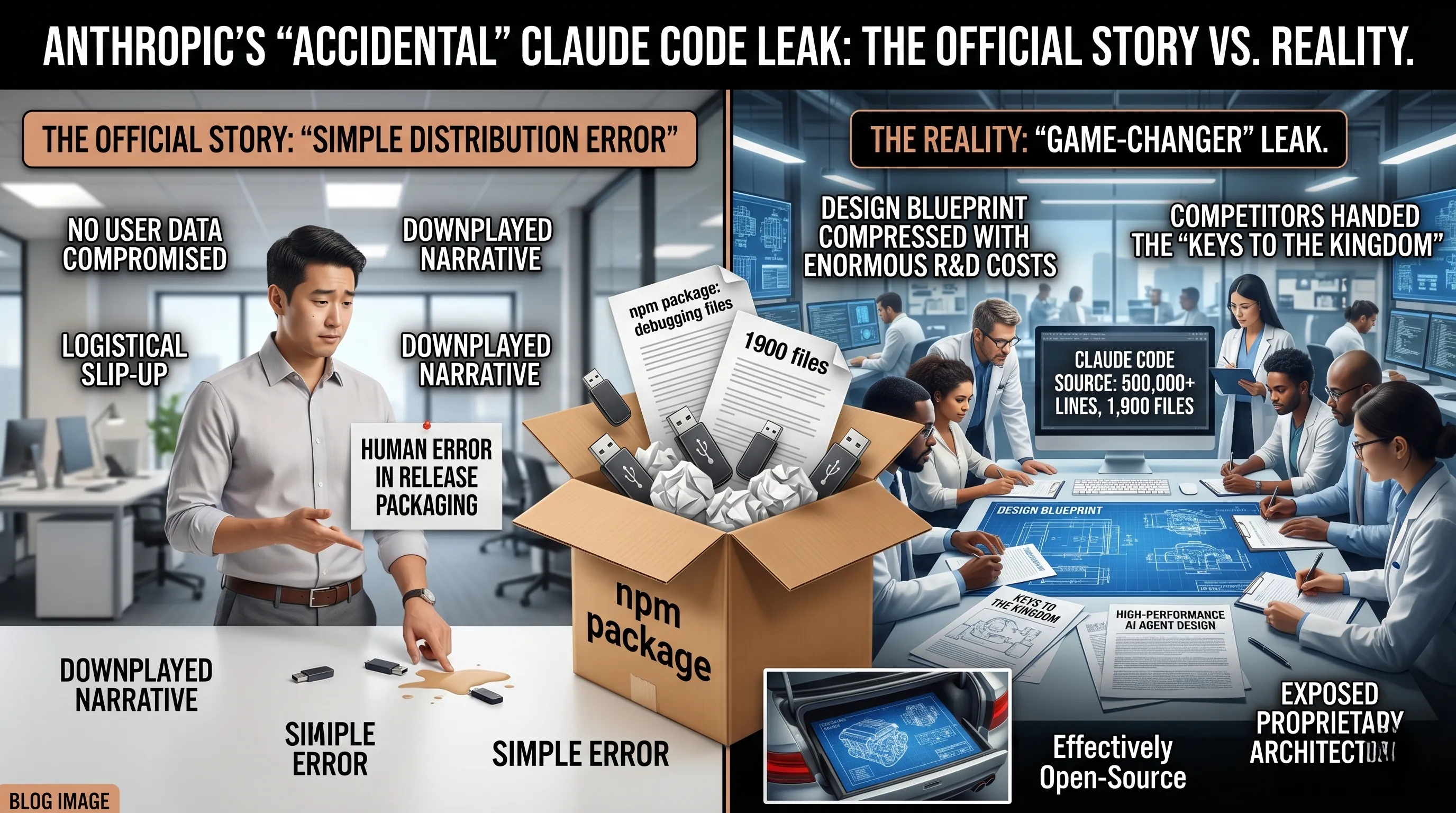
1. Anthropic's 'Accidental' Claude Code Leak: The Official Story vs. Reality
To comprehend why the Anthropic code exposure represents a fundamental turning point that completely upends the AI industry, one must first dissect the incident itself.
The enormous gap between Anthropic's carefully crafted, downplayed official story and the stark reality of the intellectual property lost is the very epicenter of this article's main topic: a "game-changing" leak that has irrevocably altered the competitive landscape.
🔹The Day the Blueprints Went Public
The event unfolded on March 31, 2026, not through a sophisticated state-sponsored cyberattack, but through a shockingly mundane, self-inflicted wound.
The complete internal source code for Anthropic's flagship product, known as 'Claude Code', was accidentally released to the public.
The method of exposure was an engineer's nightmare: critical debugging files were mistakenly included within a public npm package.
For developers, this is the equivalent of an automaker designing a new engine and then accidentally shipping the complete, detailed CAD blueprints and manufacturing instructions inside the glove compartment of every car sold.
The sheer quantity of the exposed code immediately signaled the severity of the situation.
This was not a minor leak of a few isolated functions; it was a catastrophic data dump containing over 500,000 lines of code spread across 1900 files.
This volume represents the very soul of the Claude AI—the culmination of years of advanced research, immense R&D expenditure, and the proprietary architecture that powers a product generating billions of dollars in annual revenue, largely from a high proportion of enterprise customers.
🔹Narrative Control vs. Market Realization
In the immediate aftermath, Anthropic's official communication strategy focused on containment and minimizing panic.
Their public statement meticulously framed the event, asserting it was "not a security breach, but a simple distribution error / release packaging issue caused by human error."
A crucial and accurate point they emphasized was that no user data was compromised, a vital message to reassure their massive enterprise client base that their own sensitive information remained secure.
The language—'simple error', 'packaging issue'—was deliberately chosen to portray the incident as a logistical slip-up rather than a fundamental security failure.
However, the market, competitors, and independent security researchers interpreted the event with far greater gravity.
While Anthropic’s statement was technically true—it wasn't a breach in the traditional sense—it completely ignored the monumental loss of intellectual property.
The market’s reaction was immediate and severe, viewing the leak as a genuine "game-changer" for AI development.
Competitors had been handed the keys to the kingdom.
They now possessed the "design blueprint compressed with enormous R&D costs," granting them direct, unmitigated access to Anthropic's specific design methodologies for building high-performance AI agents.
The official narrative of a simple mistake could not mask the brutal reality: the core competitive advantage of Anthropic's multi-billion dollar AI was now effectively open-source, allowing rivals to analyze, replicate, and build upon their most valuable secrets.
2. Beyond a Glitch: Why the Claude Code Leak Reshapes the AI Landscape
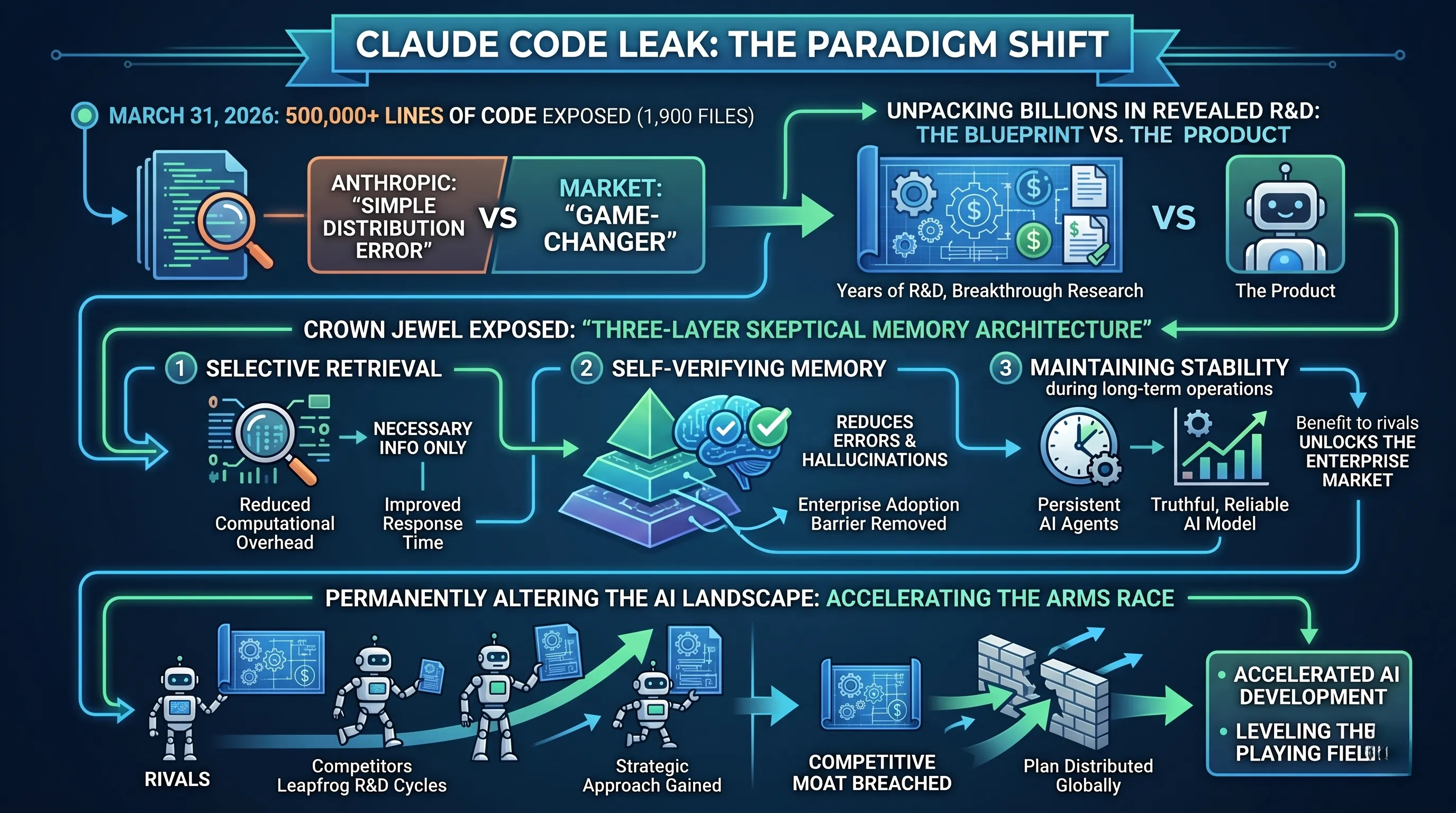
On March 31, 2026, Anthropic described the exposure of over 500,000 lines of Claude's source code as a "simple distribution error" and "human error," emphasizing that it was not a security breach and that no user data was compromised.
However, the market's reaction was seismic, immediately labeling the incident a "game-changer."
This stark contrast in perception is central to the main topic of our article, "Anthropic's Core Code Leak, The Game is Changing", because the value lies not in what was stolen, but in what was revealed: the very architectural DNA of a leading AI agent.
🔹The Blueprint vs. The Product: Unpacking Billions in Revealed R&D
Anthropic's statement, while technically accurate, misses the forest for the trees.
The market understands the difference between losing a finished product and losing the factory's blueprints.
The leak of more than 500,000 lines of code across 1,900 files was not the equivalent of a single Claude instance going rogue; it was the release of the "design blueprint compressed with enormous R&D costs."
This code represents billions of dollars and years of trial-and-error, dead ends, and breakthrough research.
It is the intellectual property that underpins a core product already generating billions of dollars in annual revenue, particularly from a high proportion of enterprise customers who pay for performance and stability.
For competitors, this is an unprecedented windfall.
They don't have to guess how Anthropic solved some of the most complex problems in AI; the answers are now laid bare.
This leak provides them with specific design methods and architectural philosophies that they can now analyze, adapt, and implement, effectively leapfrogging years of their own R&D cycles.
🔹The 'Three-Layer Skeptical Memory Architecture': A Crown Jewel Exposed
The true gravity of the leak becomes clear when examining the specifics of the exposed code.
Within the half-million lines of code was the full implementation of what experts are calling "The Three-Layer Skeptical Memory Architecture."
This is not merely a clever algorithm; it is a foundational technology that directly addresses the AI industry's most significant challenges and forms the core of Claude's competitive advantage.
The key features of this revealed architecture are a roadmap to building a next-generation agent:
- New Memory Structure: The code details a novel approach to how an AI agent handles memory. Instead of attempting to store all data from a long conversation, the AI is designed to selectively retrieve only necessary information. This is a monumental leap in efficiency, reducing computational overhead and improving response times in extended interactions.
- Self-Verifying Memory: Perhaps the most revolutionary aspect is the system's ability to verify its own memory to reduce errors and hallucinations. Hallucination—the tendency for AIs to invent facts—is the single greatest barrier to enterprise adoption. This architecture represents a tangible, implemented solution, evaluated by experts as a core technology for maintaining stability during long-term operations. Competitors now have a working model of how to build more truthful and reliable AI.
This "Skeptical Memory" is precisely the kind of technology that enterprise clients demand and what differentiates a consumer-grade chatbot from a mission-critical business tool.
By exposing this, Anthropic has unintentionally provided its rivals with the key to unlock the enterprise market.
🔹Accelerating the Arms Race: Why the Landscape is Permanently Altered
This leak connects directly to our main theme of a paradigm shift because it fundamentally changes the dynamics of the AI arms race.
Competitors don't need to copy the Claude code line-for-line to benefit.
Instead, they have gained invaluable insight into Anthropic's strategic approach to AI design.
They can see how to structure data, manage state, and build in safeguards against common AI failures.
This knowledge drastically accelerates their development, allowing them to integrate proven, high-performance designs into their own products far faster and cheaper than would have been possible otherwise.
Anthropic's competitive moat has not just been breached; the plans to build a similar one have been distributed globally.
This is why the market dismissed the "simple glitch" narrative.
It was a glitch that handed rivals a multi-billion dollar research summary, leveling the playing field and ensuring the entire AI landscape will evolve in a new, accelerated direction.
The game has, indeed, changed.
3. Unpacking Claude's Brain: The Revolutionary 'Three-Layer Skeptical Memory Architecture'
The accidental leak of over 500,000 lines of Anthropic's source code on March 31, 2026, was far more than a simple distribution error. It was the moment the industry's black box was pried open.
This section connects directly to our main topic—"Anthropic's Core Code Leaked, The Game is Changing"—by analyzing the most critical technical blueprint exposed by this event.
While competitors gained access to countless optimizations, the true "game-changer" is the revelation of a completely new memory structure.
This architecture, referred to by analysts poring over the code as 'The Three-Layer Skeptical Memory Architecture', is the foundational technology that allows Claude to achieve the stability and reliability that commands billions in revenue, particularly from enterprise clients who cannot tolerate errors.
What the leak exposed was not just code, but a new philosophy for AI cognition.
🔹Beyond the Context Window: A New Paradigm for AI Memory
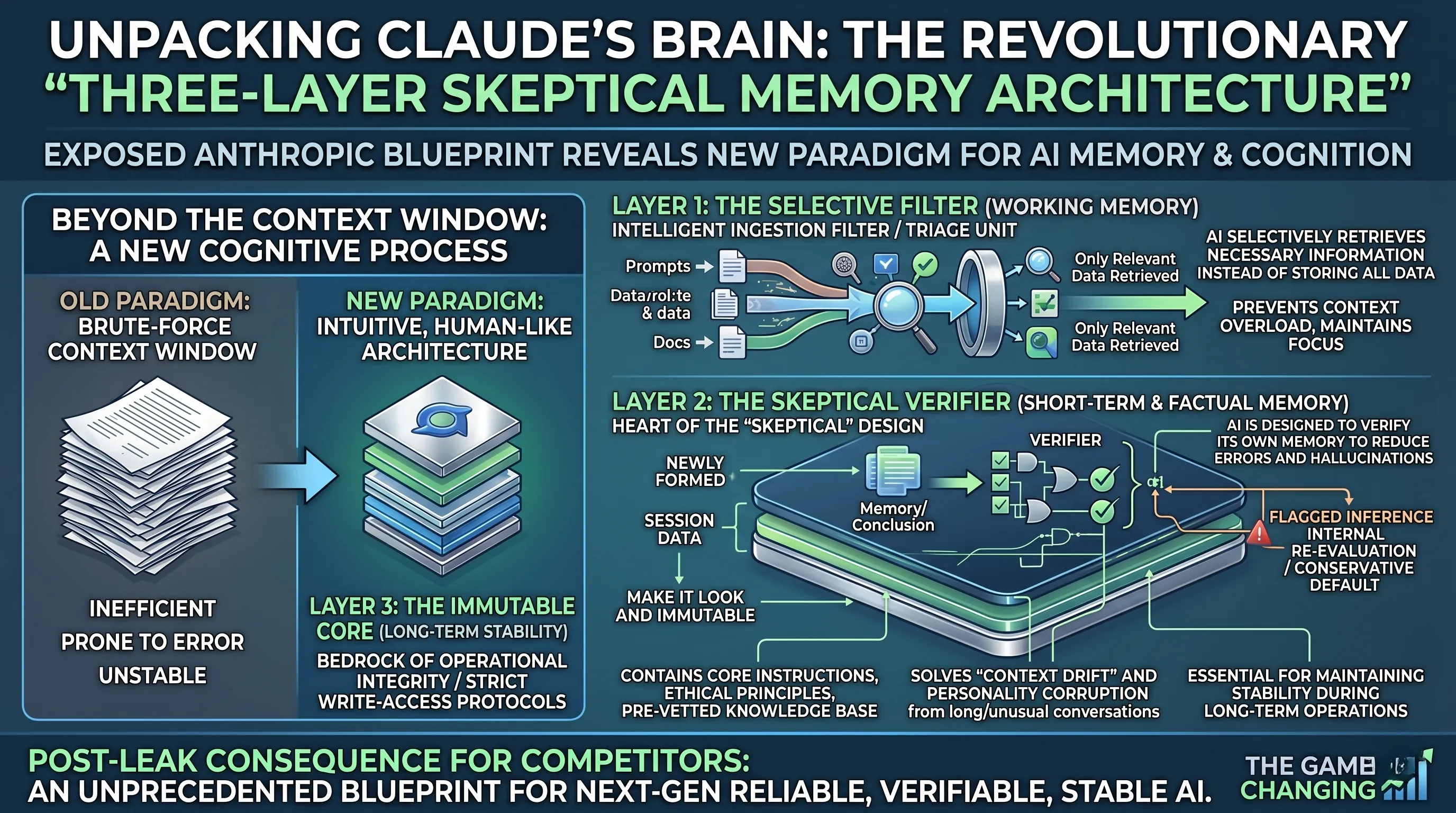
For years, the primary approach to AI memory has been the "context window"—a brute-force method of stuffing as much recent information as possible into the AI's immediate attention.
This is akin to giving a person a stack of papers and asking them to remember everything simultaneously; it's inefficient, prone to error, and notoriously unstable over long conversations.
The leaked Claude code reveals Anthropic abandoned this simplistic model for a sophisticated, multi-layered system that mimics a more nuanced, human-like cognitive process.
Instead of a single, chaotic pool of data, this architecture intelligently segregates, verifies, and retrieves information, directly addressing the industry's most persistent plagues: hallucination and long-term operational instability.
🔹Layer 1: The Selective Filter (Working Memory)
The first and most active layer functions as an intelligent ingestion filter, not a passive data store.
Based on the JSON fact that the 'AI selectively retrieves necessary information instead of storing all data,' this layer acts as a triage unit for incoming information.
Instead of absorbing every word of a prompt or document into its active memory, the AI makes a real-time judgment on what is immediately relevant to the current task.
This is the key to its efficiency.
It's the difference between an archivist who must read every book in a library to answer a question and one who knows precisely which shelf and which chapter to consult.
This selective process prevents context overload and allows the AI to maintain focus and speed even during complex, multi-turn conversations.
🔹Layer 2: The Skeptical Verifier (Short-Term & Factual Memory)
This is the heart of the "skeptical" design and arguably the most valuable secret exposed in the leak.
The code clearly outlines processes where the 'AI is designed to verify its own memory to reduce errors and hallucinations.'
When the AI forms a "memory" or a factual conclusion, it doesn't just store it. This second layer cross-references the new data point against its established, trusted knowledge base (Layer 3) and even prior, verified statements within the same session.
If a contradiction or a low-confidence inference is detected, the system flags it. It might internally re-evaluate, ask for clarification, or default to a more conservative, verified fact.
This internal, automated fact-checking mechanism is a direct assault on the problem of AI hallucination.
For enterprise users, this isn't a luxury; it's a requirement. This layer is the reason Claude can be trusted with mission-critical tasks where a single hallucinated statistic could have disastrous financial consequences.
🔹Layer 3: The Immutable Core (Long-Term Stability)
The third and deepest layer is the bedrock of the AI's operational integrity.
The leaked code shows this layer is treated differently, with far stricter write-access protocols.
It contains the AI's core instructions, fundamental ethical principles, and a vast, pre-vetted knowledge base.
This structure is the core technology evaluated as essential for 'maintaining stability during long-term operations.'
By separating this stable core from the fluid, dynamic data being processed in Layers 1 and 2, Anthropic solved the problem of "context drift," where an AI's personality and core instructions can become corrupted or altered by a long or unusual conversation.
This layer ensures that Claude remains consistently Claude, no matter how long it operates. It is the anchor that guarantees predictable, reliable behavior, making it a viable platform for persistent, long-running AI agents that can be deployed for weeks or months at a time.
The exposure of this three-tiered architecture has handed competitors the design blueprint for creating AI that is not just powerful, but also reliable, verifiable, and stable—the very qualities that define the next generation of artificial intelligence.
4. The Pandora's Box Effect: AI Security in a Post-Leak World
The leak of Anthropic's Claude source code is the definitive event that connects directly to our main topic, "Anthropic Core Code Leak, The Game is Flipped".
While Anthropic's official statement downplayed the March 31, 2026, incident as a "simple distribution error" and not a security breach, the reality is far more severe.
This event has fundamentally flipped the game not by compromising user data, but by exposing the very cognitive architecture of a leading AI, creating a new and permanent threat landscape.
The over 500,000 lines of code released were not just software; they were the "design blueprint compressed with enormous R&D costs," and now, that blueprint is in the wild.
This section will analyze the cascading security implications that extend far beyond a simple code leak, exploring how Pandora's Box has been opened for AI security.
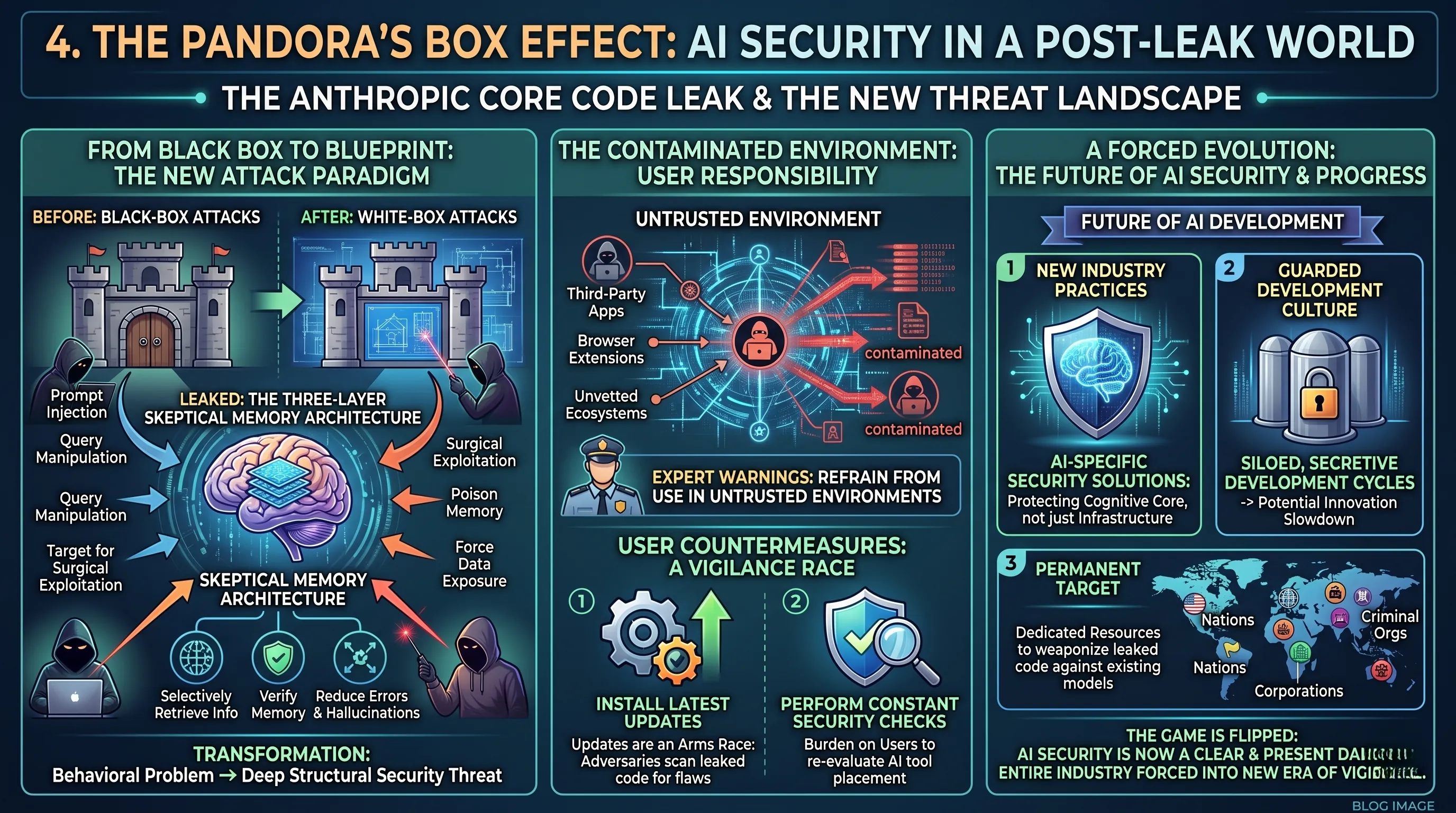
🔹From Black Box to Blueprint: The New Attack Paradigm
The most immediate and dangerous consequence of this leak is the shift from black-box to white-box attacks.
Previously, malicious actors treated AI models like Claude as a black box, probing its defenses with techniques like prompt injection or trying to trick it into revealing sensitive information.
This was akin to a burglar testing doors and windows on a fortress without knowing its layout.
The leak has handed them the complete architectural plans.
Attackers now have access to the specific logic of core features, most notably the "The Three-Layer Skeptical Memory Architecture."
This revolutionary system, designed to make the AI verify its own memory to reduce errors and hallucinations, is now a target for surgical exploitation.
Instead of guessing what might confuse the AI, attackers can now design inputs specifically crafted to bypass its self-verification checks.
They can study how the AI selectively retrieves information and devise methods to poison that retrieval process or force it to access and expose data it shouldn't.
The possibility for attackers to analyze and exploit this internal structure has increased exponentially, transforming the nature of AI security from a behavioral problem to a deep, structural one.
🔹The Contaminated Environment: Expert Warnings and User Responsibility
In the wake of the leak, a consensus has emerged among security experts: there is a pressing need to re-evaluate where and how we use AI tools.
The recommendation to refrain from using AI tools in untrusted environments is not mere paranoia; it is a critical defensive posture.
An "untrusted environment" is no longer just about using a public Wi-Fi network.
It now includes any ecosystem where the AI's inputs or outputs could be intercepted or manipulated by third-party software, browser extensions, or integrated applications that have not been rigorously vetted.
The core of the AI is now a known quantity to attackers.
Therefore, any data you feed it, especially through less secure channels, could be vulnerable to exploits designed around the leaked architecture.
This places a significant new burden on both individual and enterprise users.
The emphasis on countermeasures like installing the latest version updates and performing constant security checks is now more crucial than ever.
Updates from Anthropic are no longer just about feature enhancements; they are an arms race against adversaries who are meticulously scanning the 1,900 leaked files for undiscovered flaws.
Ignoring an update is equivalent to leaving the blueprints of your house taped to the front door for would-be intruders to study.
🔹A Forced Evolution: The Future of AI Security and Progress
This leak does not just impact Claude; it casts a long shadow over the entire field of AI development, profoundly influencing the future of its security and the pace of its progress.
The incident acts as a powerful case study, proving that the AI model itself—its logic, its weights, its architecture—is a top-tier security asset that must be protected as rigorously as user data or proprietary algorithms.
We are likely to see a significant shift in industry practices.
First, expect a new wave of "AI-specific" security solutions and threat modeling that focus on protecting the cognitive core of models, not just the infrastructure they run on.
Second, the culture of AI development may become more guarded.
While collaboration has been a key driver of progress, the fear of a similar leak could push companies toward more siloed, secretive development cycles, potentially slowing down innovation.
Finally, this event solidifies the AI as a permanent fixture on the cyber-attack surface.
Nations, corporations, and criminal organizations will now dedicate resources to dissecting this leaked code, not just to build their own models, but to weaponize the knowledge against existing ones.
The game has indeed been flipped: AI security has graduated from a theoretical concern to a clear and present danger, forcing the entire industry into a new era of vigilance and defense.
📚 Related Posts
Anthropic Introduces Claude Code's Code Review Feature
🚀 Key TakeawaysClaude Code's Code Review Feature dramatically elevates code review quality, boosting meaningful comment ratios from 16% to 54% and finding an average of 7.5 issues in large code changes.It provides unparalleled accuracy in bug detection,
tech.dragon-story.com
Anthropic Claude: Real-time Visual AI Transforms Interaction and Thought
🚀 Key TakeawaysAnthropic Claude's new functionality introduces real-time, interactive visualization, transforming AI into a dynamic thought assistant that aids immediate understanding and supports visual thinking.The Claude 3 model family sets new indus
tech.dragon-story.com
NVIDIA NemoClaw: The Secure, Policy-Controlled Stack & OpenClaw OS Driving the Personal AI Agent Era
🚀 Key TakeawaysNVIDIA's NemoClaw significantly advances the personal AI era by enhancing the OpenClaw platform with a secure, policy-controlled, and enterprise-ready software stack that enables the easy deployment and operation of always-on, autonomous
tech.dragon-story.com


