🚀 Key Takeaways
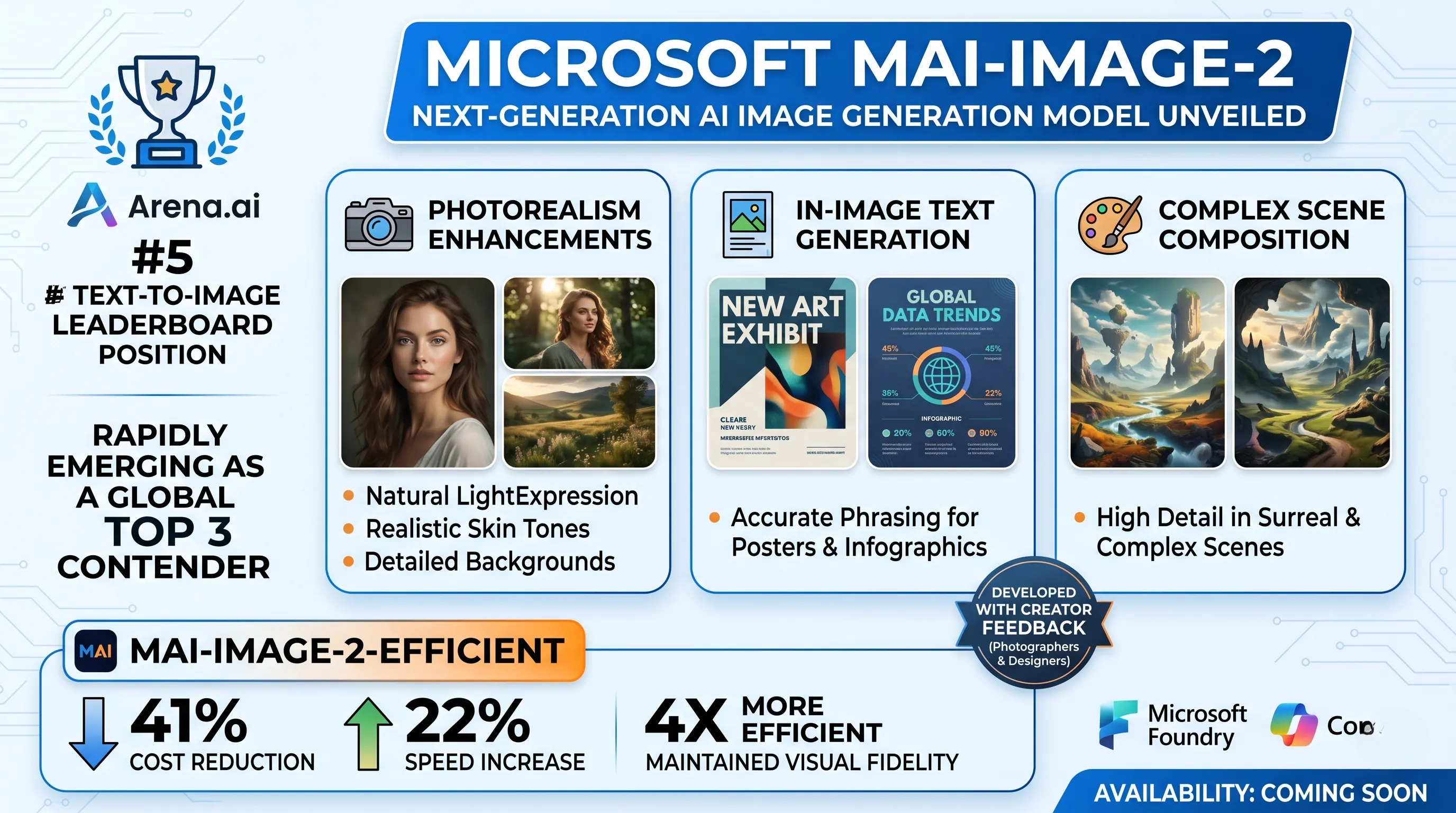
- MAI-Image-2, developed by Microsoft, has rapidly ascended to become a global top 3 contender in text-to-image generation, provisionally holding the #5 model slot on Arena.ai.
- It delivers greatly enhanced photorealism, with nuanced natural light expression, realistic skin tones, and backgrounds, directly reflecting feedback from photographers and designers.
- A significant breakthrough is its improved in-image text generation, ensuring accurate phrasing for posters and infographics, alongside exceptional detail in surreal and complex scene compositions.
- Microsoft also introduced MAI-Image-2-Efficient, a variant that slashes costs by 41% and boosts speed by 22% (4x more efficient) while maintaining quality for production-ready image generation.
Microsoft has made a significant leap forward in the artificial intelligence landscape with the unveiling of MAI-Image-2, its next-generation image generation model.
Rapidly emerging as a global top 3 contender, MAI-Image-2 is quickly setting new benchmarks for realism and utility in the highly competitive AI content creation domain.
This cutting-edge model, which has provisionally secured the #5 model slot on Arena.ai's text-to-image leaderboard, was developed with a keen focus on creator feedback, particularly from photographers and designers.
Its core enhancements include greatly enhanced photorealism, boasting natural light expression, realistic skin tones, and background details that make AI-generated images almost indistinguishable from real photographs. Furthermore, MAI-Image-2 tackles a major AI challenge with its improved in-image text generation, ensuring accurate and contextual phrasing for everything from posters to infographics, alongside its remarkable ability to handle high detail in surreal and complex scene compositions.
Beyond its flagship capabilities, Microsoft is also rolling out MAI-Image-2-Efficient.
This optimized variant promises to make high-quality AI image generation even more accessible by offering a 41% cost reduction and a 22% speed increase, making it four times more efficient while maintaining its impressive visual fidelity for production-ready content, with availability in platforms like Microsoft Foundry and planned integration into Copilot.
1. Unveiling the Genius: The Core Innovations Powering MAI-Image-2's Photorealistic Dominance
🔹 The Engineering Leap Beyond Uncanny Valley
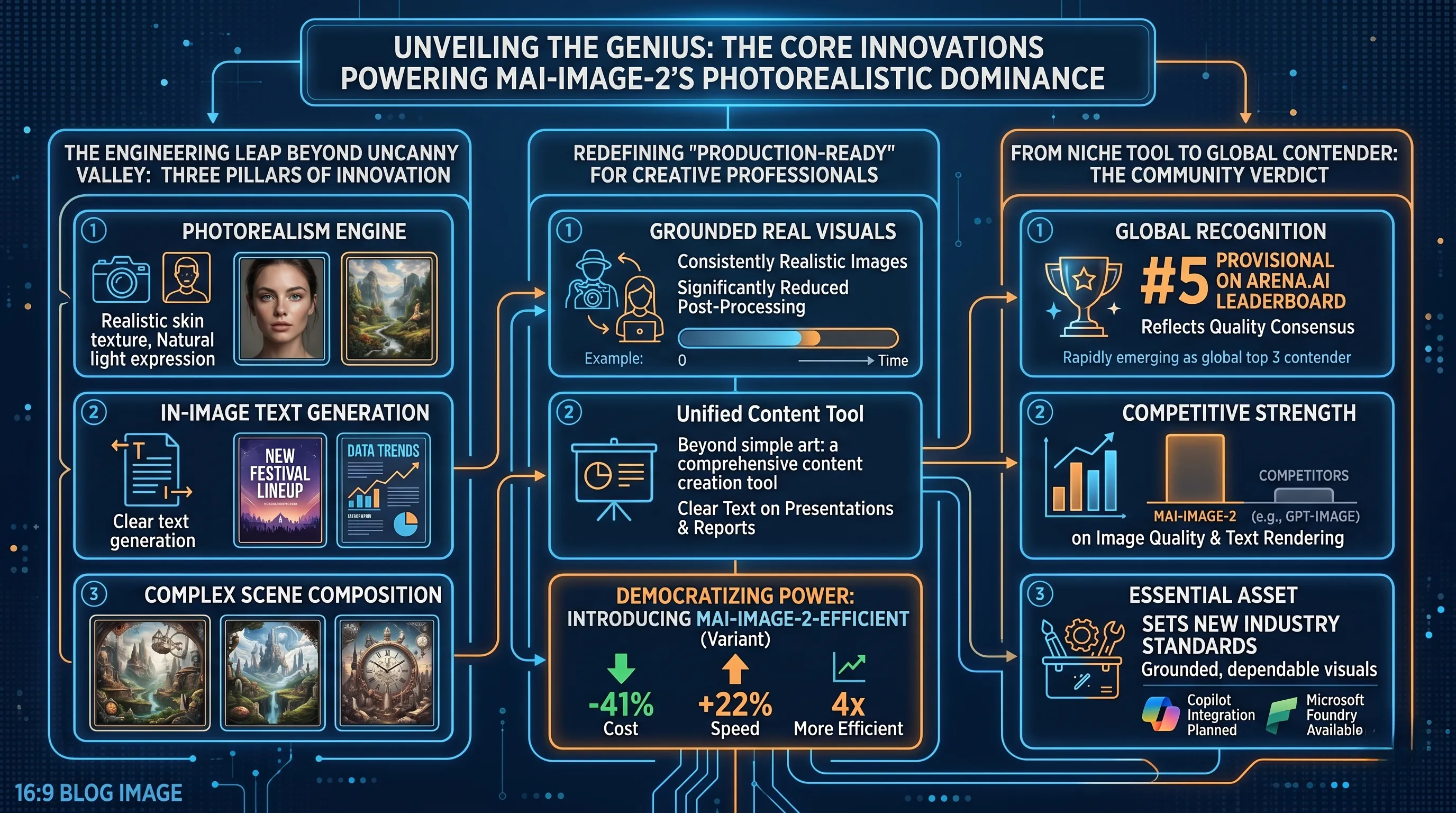
MAI-Image-2's architecture is built on three pillars of innovation that directly address the previous generation's shortcomings.
First, its photorealism engine has been fundamentally enhanced, moving beyond generic lighting to master the nuances of natural light expression, authentic skin tones, and realistic backgrounds.
Second, the model exhibits vastly improved in-image text generation, capable of rendering accurate, coherent phrasing suitable for professional assets like posters, infographics, and presentation slides.
Finally, it demonstrates a superior capacity for composing scenes of high complexity, maintaining exceptional detail even in surreal or intricate compositions.
🔹 Redefining 'Production-Ready' for Creative Professionals
These technical advancements translate directly into a paradigm shift for professional workflows, which is the core driver of its global ascent.
The evolution from 'fake-like results' to consistently 'realistic images' means photographers and designers can now generate grounded, reliable visuals, significantly reducing the burden of post-processing and allowing a greater focus on creative ideation.
The ability to generate clear text within an image expands the model's utility from a simple art generator to a comprehensive content creation tool.
Furthermore, the introduction of the MAI-Image-2-Efficient variant—which cuts costs by 41% and boosts speed by 22%—democratizes this power, making high-quality, scalable AI image generation accessible to a much broader market and fueling its rapid adoption.
🔹 From Niche Tool to Global Contender: The Community Verdict
This deliberate focus on practical, professional-grade output is precisely why MAI-Image-2 is rapidly climbing to a top-3 global position.
Its preliminary ranking as the #5 model on the influential Arena.ai leaderboard is not an isolated metric; it is a direct reflection of community consensus that the model delivers on its promises of quality and reliability.
By developing a tool that reflects direct feedback from creators, Microsoft has engineered a model that outperforms competitors like GPT-Image on critical benchmarks such as image quality and text rendering.
This strategy of delivering grounded, dependable visuals is what solidifies MAI-Image-2's status not just as a technical marvel, but as an essential asset in the modern creative toolkit, setting new standards for the entire industry.
2. The AI Art Arena: How MAI-Image-2 is Reshaping the Global Competitive Landscape
🔹 Benchmarking the Ascent: MAI-Image-2's Leaderboard Conquest
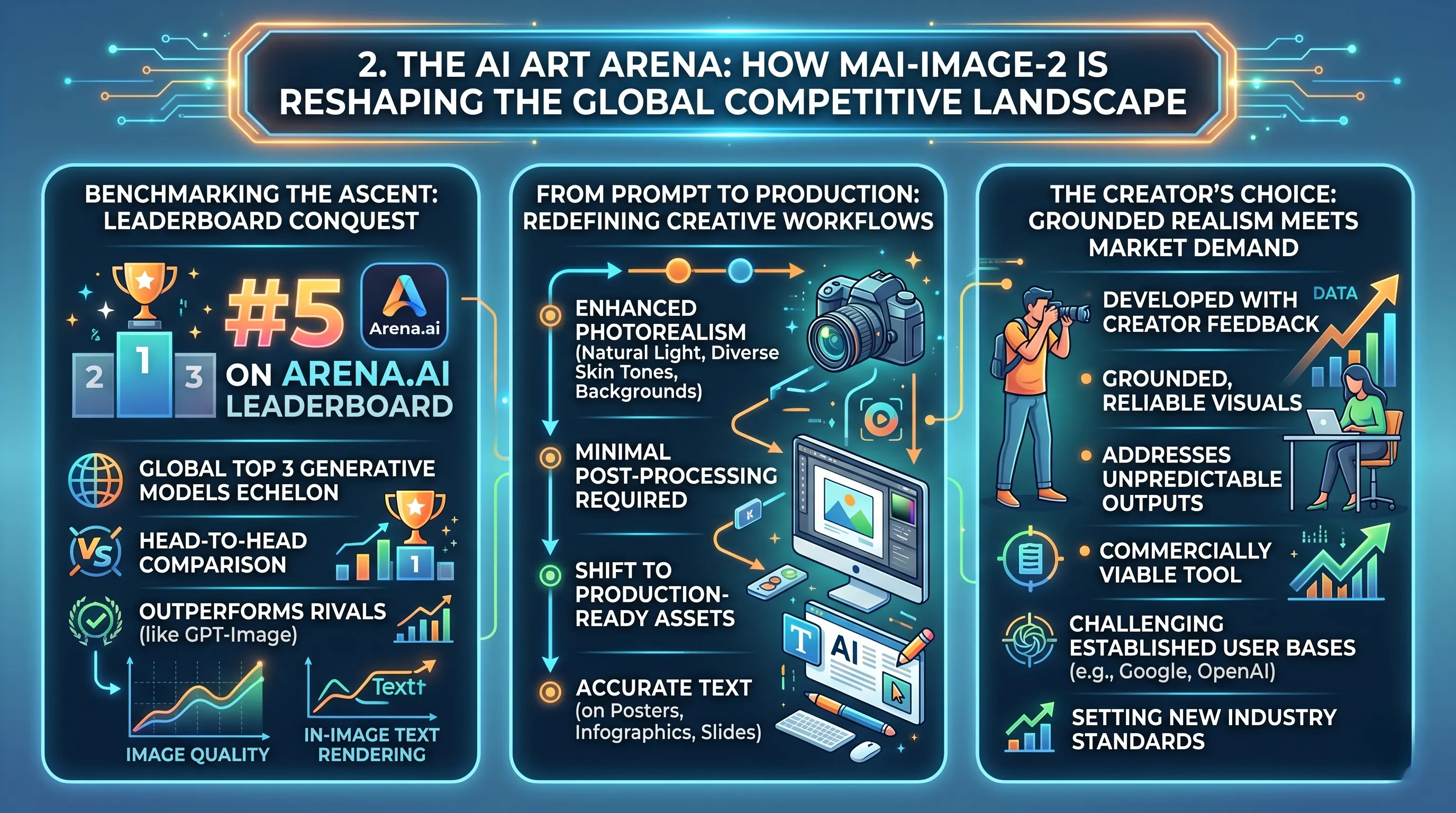
MAI-Image-2's rapid emergence as a global contender is substantiated by its performance on recognized industry benchmarks.
It has secured a preliminary #5 model slot on the highly competitive Arena.ai text-to-image leaderboard, a position that firmly places it within the global top 3 echelon of generative models.
Direct head-to-head comparisons reveal its technical superiority, particularly where it outperforms established rivals like GPT-Image on two critical fronts: overall image quality and the notoriously difficult task of accurate in-image text rendering.
This empirical evidence forms the bedrock of its claim as a new leader, shifting the competitive balance of power.
🔹 From Prompt to Production: Redefining Creative Workflows
The technical specifications of MAI-Image-2 translate directly into a tangible reduction of friction for creative professionals.
Its greatly enhanced photorealism, particularly in rendering natural light, diverse skin tones, and realistic backgrounds, means users can generate visuals that require minimal to no post-processing.
This allows creators to focus on ideation rather than correction, moving the industry standard from "fake-like" results to production-ready assets.
Furthermore, its proficiency in generating accurate text on posters, infographics, and slides expands its utility far beyond simple art generation, positioning it as an end-to-end content creation tool and a direct challenger for practical business applications.
🔹 The Creator's Choice: Grounded Realism Meets Market Demand
Industry analysis indicates that MAI-Image-2's success stems from a development focus that explicitly incorporated feedback from photographers and designers.
The result is a model that delivers grounded, reliable visuals, addressing the common user frustration of unpredictable and surreal outputs when photorealism is required.
This deliberate focus on professional needs is what elevates it from a technical marvel to a commercially viable tool.
While facing the inherent market challenge of catching up to the established user bases of Google and OpenAI, the consensus is that MAI-Image-2’s superior quality and practical text capabilities are setting a new standard that competitors will be forced to meet, cementing its role in shaping the industry's future direction.
3. Creator's New Canvas: How MAI-Image-2 Empowers Global Photographers and Designers
🔹 Engineered for the Artist's Eye
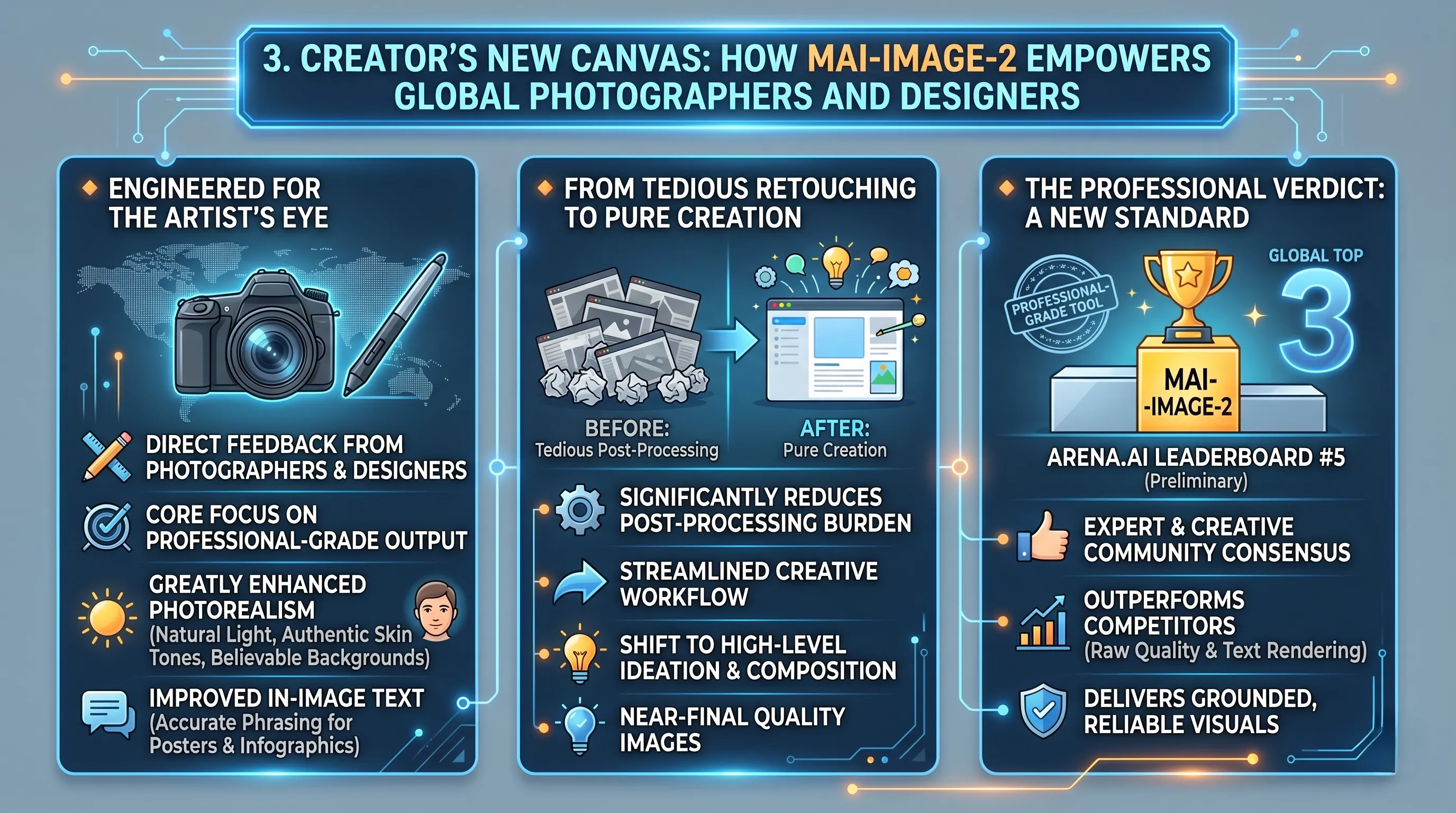
Microsoft's development focus for MAI-Image-2 was explicitly shaped by direct feedback from photographers and designers, targeting professional-grade output.
The model's core architecture prioritizes greatly enhanced photorealism, with specific advancements in rendering natural light expression, authentic skin tones, and believable backgrounds.
This foundational emphasis on realism is complemented by improved in-image text generation, enabling accurate phrasing for practical design assets like posters and infographics.
🔹 From Tedious Retouching to Pure Creation
For creative professionals, these enhancements translate directly into a radically streamlined workflow.
The model's ability to produce grounded and reliable visuals significantly reduces the post-processing burden, freeing designers and photographers from hours of manual correction in external software.
This shift allows creators to focus on high-level ideation and composition, using the AI as a powerful tool for content creation rather than just a generator of raw, 'fake-like' assets.
By delivering near-final quality images, MAI-Image-2 evolves from a simple generator into a foundational platform for professional content, a key factor in its rapid market ascent.
🔹 The Professional Verdict: A New Standard in Reliability
The expert and creative community consensus is that MAI-Image-2 sets a new standard for AI-based visual content creation.
Analysts note its ability to outperform competitors like GPT-Image on both raw image quality and text rendering solidifies its position as a professional-grade tool.
This reputation for delivering grounded, reliable visuals is precisely what attracts professionals and is fueling its climb into the global top 3, as seen in its preliminary ranking on the Arena.ai leaderboard.
The model's acclaim is built not on novelty, but on its tangible utility in demanding creative workflows.
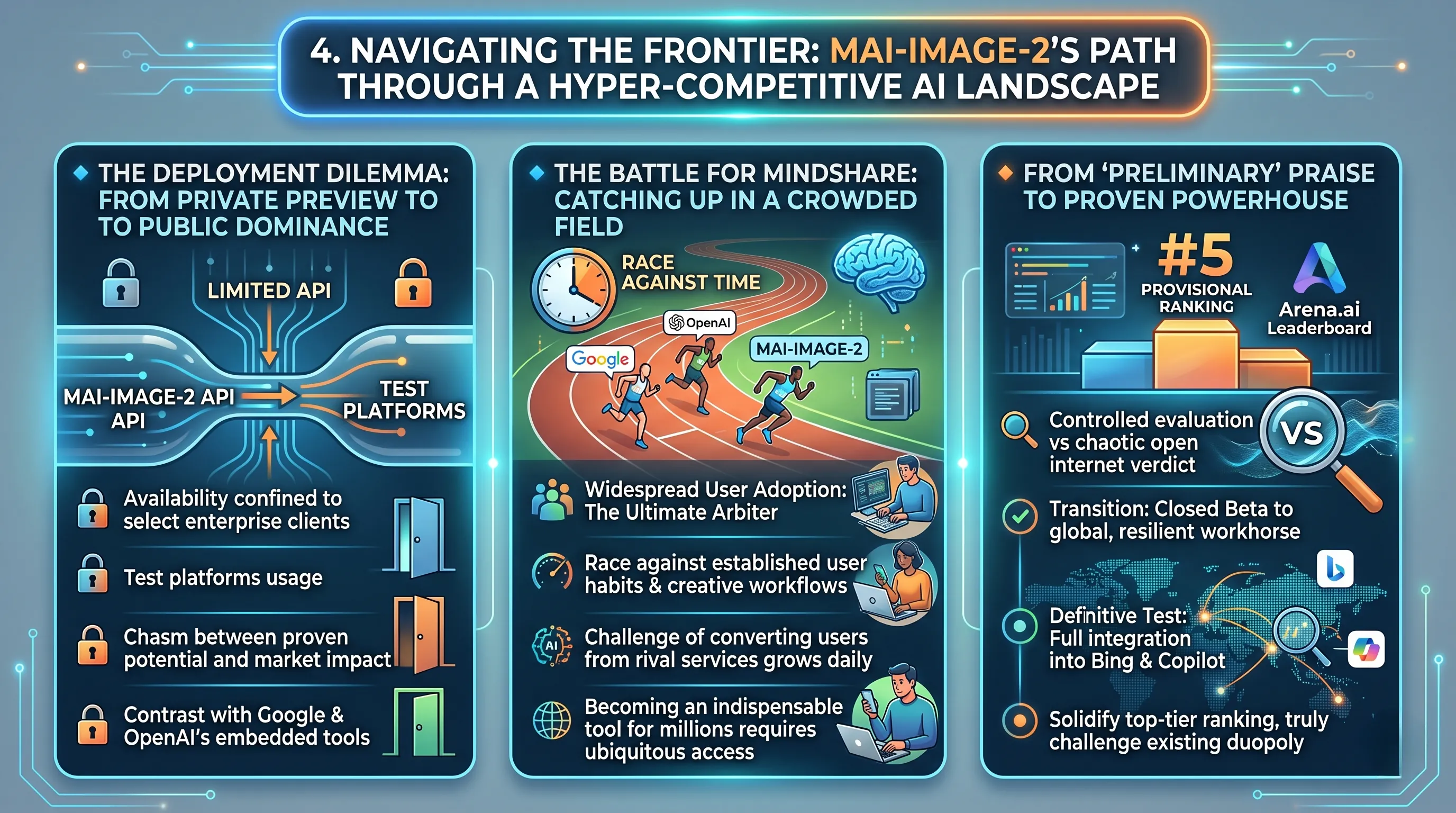
4. Navigating the Frontier: MAI-Image-2's Path Through a Hyper-Competitive AI Landscape
🔹 The Deployment Dilemma: From Private Preview to Public Dominance
MAI-Image-2’s path to the top is currently throttled by a significant deployment bottleneck.
While its performance metrics are impressive, its availability is largely confined to test platforms and a limited API for select enterprise clients.
The planned integrations into mainstream Microsoft products like Copilot and Bing Image Creator have not yet been fully realized, creating a chasm between its proven potential and its current market impact.
This contrasts sharply with entrenched competitors from Google and OpenAI, whose models are already deeply embedded in widely accessible public-facing tools.
🔹 The Battle for Mindshare: Catching Up in a Crowded Field
Technical superiority alone does not guarantee market leadership; widespread user adoption is the ultimate arbiter.
By being late to full-scale public deployment, MAI-Image-2 is in a race against time to capture the user habits and creative workflows already established around competitor platforms.
Every day that a designer, marketer, or casual user defaults to a rival service, the challenge of converting them grows.
Securing a "global top 3" position requires not just outperforming competitors on a leaderboard, but becoming an indispensable tool in the daily creative process for millions, a status that can only be achieved through ubiquitous access.
🔹 From "Preliminary" Praise to Proven Powerhouse
The model's preliminary #5 slot on the Arena.ai leaderboard is a powerful signal, but the keyword is "preliminary".
This initial ranking reflects a controlled evaluation, not a verdict from the chaotic, high-volume environment of the open internet.
The primary challenge for Microsoft is to transition MAI-Image-2 from a critically acclaimed contender in a closed beta to a resilient, reliable workhorse at global scale.
Analysts concur that the speed and success of its full integration into Bing and Copilot will be the definitive test of whether MAI-Image-2 can solidify its top-tier ranking and truly challenge the existing duopoly for market supremacy.
5. Beyond the Canvas: MAI-Image-2's Vision for Ubiquitous AI-Powered Creativity
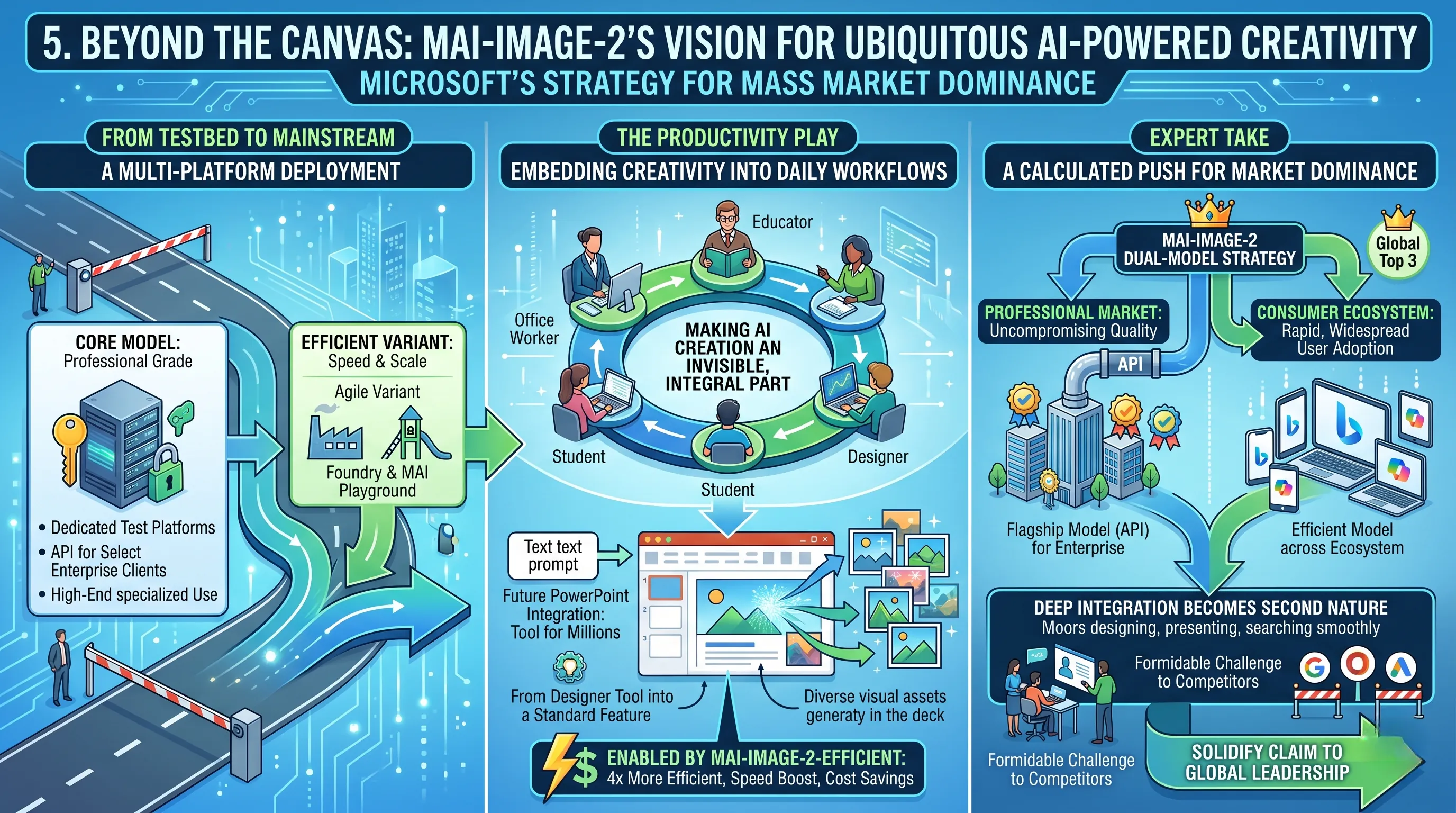
🔹 From Testbed to Mainstream: A Multi-Platform Deployment
Microsoft's rollout strategy for MAI-Image-2 is structured for maximum market penetration, beginning with controlled access and scaling towards mass adoption.
The core MAI-Image-2 model is currently accessible via dedicated test platforms and through an API for select enterprise clients, allowing for high-end, specialized use.
Simultaneously, the more agile MAI-Image-2-Efficient variant is available in Microsoft's Foundry and MAI playground.
The critical next phase involves integrating both models into flagship consumer products, with planned rollouts for Copilot and Bing image generation on the immediate horizon.
🔹 The Productivity Play: Embedding Creativity into Daily Workflows
This integration plan reveals a strategy that extends far beyond a simple image generator; it's an effort to make high-quality AI creation an invisible, integral part of the modern productivity suite.
The future integration into PowerPoint is a clear signal of this ambition, transforming the model from a tool for designers into a standard feature for millions of office workers, educators, and students.
This is made economically and technically feasible by MAI-Image-2-Efficient, a model engineered to be 4x more efficient while cutting costs and boosting speed.
This efficiency is the key that unlocks the potential for on-demand, high-quality visual asset generation directly within a slide deck, fundamentally changing content creation for the mass market.
🔹 Expert Take: A Calculated Push for Market Dominance
The dual-model strategy is a clear and aggressive move to solidify MAI-Image-2's position among the global top three.
By offering the flagship model to high-value enterprise customers via API, Microsoft caters to the professional market that demands uncompromising quality.
Simultaneously, deploying the 'Efficient' model across its vast consumer ecosystem—Bing, Copilot, and eventually Office—ensures rapid, widespread user adoption at a sustainable cost.
This two-pronged approach is designed to embed MAI-Image-2 so deeply into both professional and consumer workflows that its use becomes second nature, presenting a formidable challenge to competitors and substantiating its claim to global leadership.
6. 💡 Tech Talk: Making Sense of the Jargon
- Photorealism: The ability of an AI model to generate images that look incredibly lifelike, just like a photograph taken by a camera, complete with realistic lighting, textures, and details.
- In-image Text Generation: When an AI can accurately and legibly place words and sentences directly onto the images it creates, like putting a clear slogan on a poster or text on a sign within the image, which has historically been a challenge for AI.
- Complex Scene Composition: An AI's advanced skill in arranging many different objects, people, and environments within a single generated image in a way that makes sense and looks harmonious, even for very intricate or imaginary scenarios.
- AI Model Efficiency: Refers to how well an AI model performs tasks (like generating an image) using fewer computational resources (e.g., less electricity) or in less time, like MAI-Image-2-Efficient cutting costs and boosting speed without sacrificing quality.
📚 Related Posts
Midjourney V8 Alpha: The Next Evolution in AI Image Generation
🚀 Key TakeawaysUnprecedented Speed & Quality: Experience image generation that is approximately 5 times faster than previous versions, combined with significantly improved detail and consistency across all outputs.Advanced Style Personalization: Leverag
tech.dragon-story.com
Step into the Future's Past: Crafting the Ultimate Retro-Futuristic Desk Setup
🚀 Key TakeawaysAchieve the perfect Retro-Futuristic aesthetic by seamlessly integrating vintage designs with cutting-edge smart technology, creating a workspace that is both nostalgic and highly functional.Enhance your desk with iconic pieces like the C
tech.dragon-story.com
Ergotron HX vs. AmazonBasics: Which Monitor Arm Safely Supports Your Ultrawide Display?
🚀 Key TakeawaysFor true ultrawide screens (e.g., 49-inch models), the Ergotron HX Heavy Duty Monitor Arm is the unequivocal choice, specifically engineered to support displays up to 49 inches and 42 pounds with exceptional stability and a full range of
tech.dragon-story.com


