🚀 Key Takeaways
- GPT-5.4 is a next-generation frontier model released on March 5, 2026, specifically engineered for professional work and targeting corporate and developer markets.
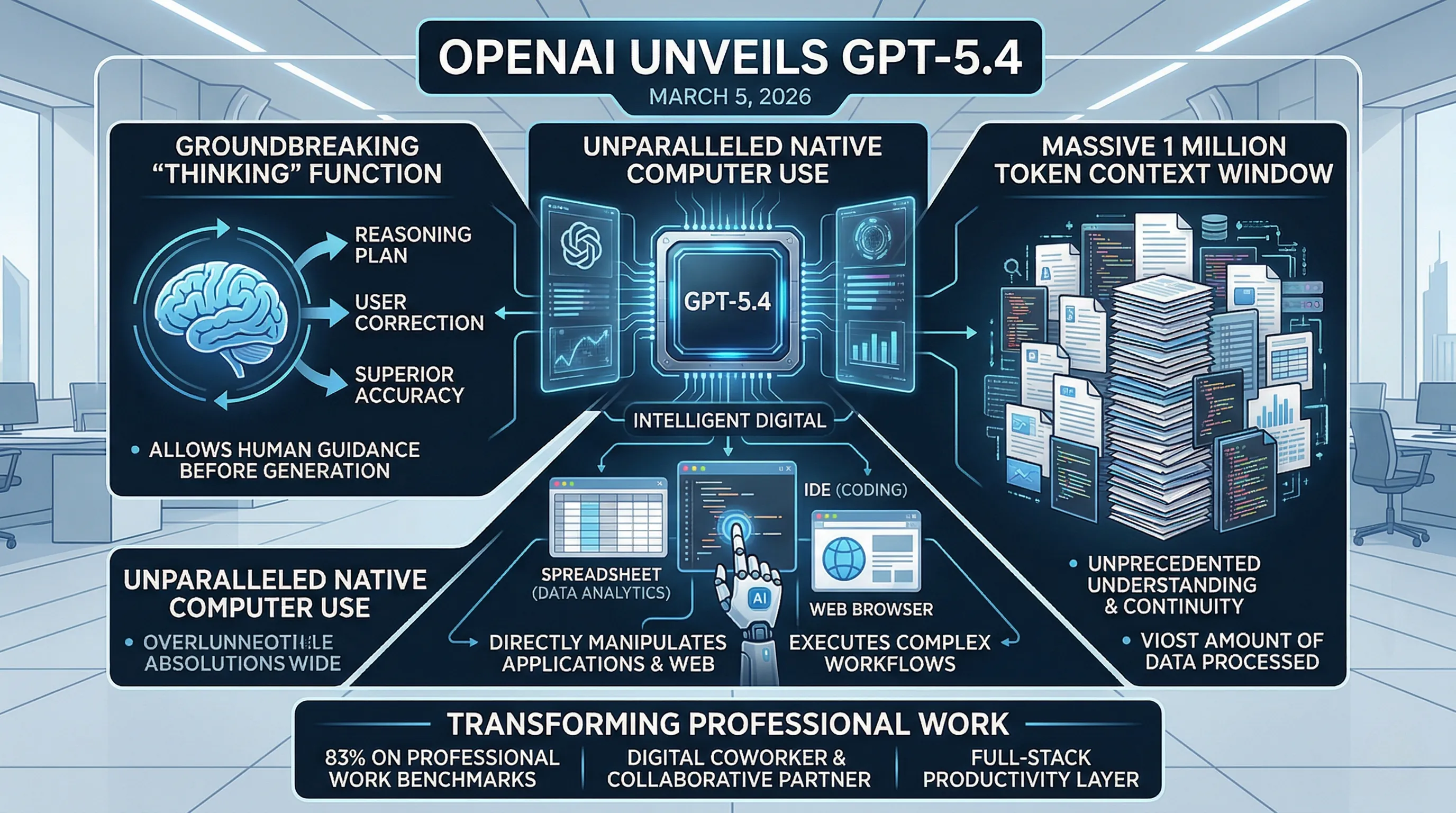
- It introduces a revolutionary "thinking" function for structured reasoning and boasts native computer use ability, allowing it to directly manipulate applications and perform complex workflows across digital environments.
- Achieving human-level performance and exceeding office workers on 83% of professional benchmarks (including 75% on OSWorld), it features a 1 million token context window for unparalleled understanding and continuity.
- Positioned as an "actual task performer" and "collaborative partner," GPT-5.4 transforms AI's role, establishing itself as a standardized productivity layer that significantly enhances work automation and cost efficiency.
OpenAI has unveiled GPT-5.4, its latest next-generation frontier model, on March 5, 2026.
Hailed as the "most capable and efficient frontier model for professional work," this release specifically targets corporate and developer markets, aiming to redefine coding, document creation, and data analysis.
It represents a significant leap forward, designed to elevate professional tasks to new levels of automation and intelligence.
At its core, GPT-5.4 introduces a groundbreaking "thinking" function, enabling it to present a reasoning plan before generating answers, allowing for user course correction and superior accuracy.
Furthermore, it possesses an unparalleled native computer use ability, meaning it can directly manipulate applications and web environments, executing complex workflows from spreadsheets to code execution with remarkable autonomy.
This robust capability, coupled with a massive 1 million token context window, establishes GPT-5.4 as a true full-stack productivity layer.
With performance metrics surpassing human-level performance in actual tests and scoring 83% on professional work benchmarks, GPT-5.4 is not just an assistant but an "actual task performer" and "collaborative partner."
Its high accuracy, efficiency, and enhanced reliability promise to accelerate work automation and cement OpenAI's position as a provider of a standardized productivity layer for businesses worldwide.
This model truly transforms AI from a mere tool into an indispensable digital coworker.
1. Beyond the Hype: Unpacking GPT-5.4's Revolutionary Architecture and Core Capabilities
🔹 From Digital Assistant to Autonomous Agent
GPT-5.4 represents a fundamental architectural shift, moving beyond text generation to become a native digital agent.
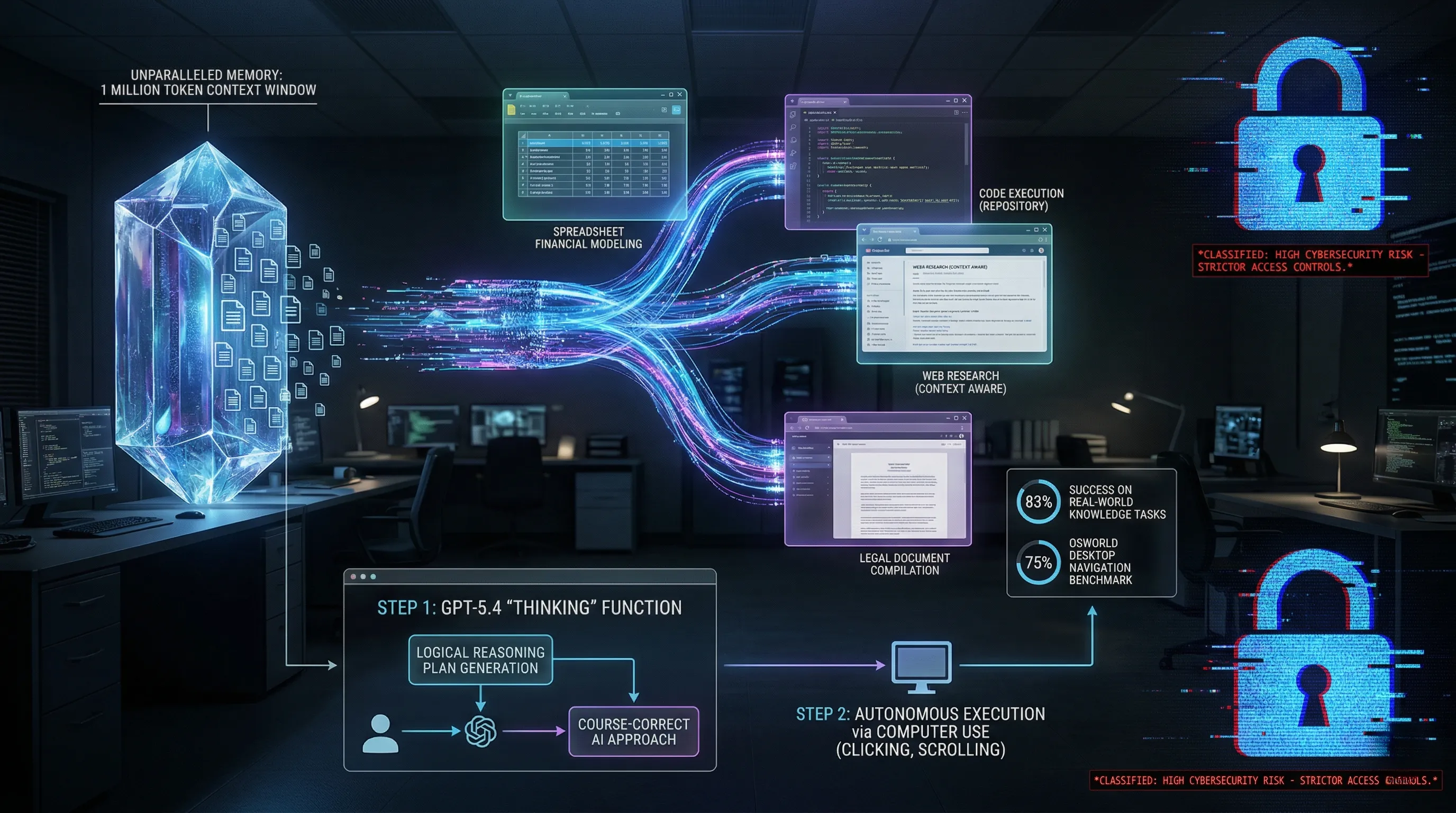
At its core is a unique 'thinking' function, which presents a logical reasoning plan before executing a task, allowing users to course-correct the AI's approach.
The model can now natively use a computer, directly manipulating applications and web environments by interpreting browser screenshots and interacting with UI elements via coordinate-based clicking.
This is augmented by an enhanced deep web research capability for generating contextually aware answers to complex queries.
Underpinning these functions is a massive expansion in memory, with context window support for up to 1 million tokens.
OpenAI has also consolidated its ecosystem by fully absorbing every GPT-5.3 Codex capability and ensuring deep integration across the ChatGPT interface, API, and now, directly within Microsoft Excel and Google Sheets.
🔹 The End of Workflow Friction
The practical implications of this architecture are profound, effectively transforming the AI from a simple 'tool' into a 'collaborative partner'.
The ability to natively use applications means a user can issue a high-level command, and GPT-5.4 will open the necessary software, click through menus, and complete a real-world workflow, such as performing financial modeling in a spreadsheet or compiling a legal document.
The 1 million token context window eliminates a significant bottleneck for professionals, enabling the model to process and reason over entire code repositories or lengthy regulatory filings without losing crucial context.
This combination of agency and vast contextual memory accelerates work automation, turning GPT-5.4 into an 'actual task performer' that strengthens OpenAI's pitch to CIOs for a standardized productivity layer across the enterprise.
The pre-execution 'thinking' step builds user trust and reduces errors, ensuring the model's powerful new autonomy is guided and reliable.
🔹 A Necessary Leap Forward, With Caveats
Industry analysis following the March 5, 2026, release has been overwhelmingly positive, with many considering the migration from GPT-5.3 to be "worth it" and labeling GPT-5.4 the "most important AI release of the year so far."
Performance metrics validate this sentiment, showing the model outperforms office workers on 83% of real-world knowledge tasks and scores an impressive 75% on the OSWorld desktop navigation benchmark, surpassing the human baseline.
While its practical applicability in high-difficulty fields like law and finance is a proven strength, OpenAI itself has classified the model as a 'high cybersecurity risk'.
This acknowledgment means that while the AI demonstrates major growth in reasoning and automation, unresolved challenges around safety, misuse, and environmental control persist, prompting stricter access controls in highly regulated industries.
2. Reshaping the AI Landscape: GPT-5.4's Impact on Industry Dynamics and Competitor Strategies
🔹 Raising the Bar: The Agentic AI Benchmark
The release of GPT-5.4 on March 5, 2026, fundamentally alters the competitive standard for enterprise-grade AI.
Its core capabilities move beyond conversational text generation into direct, practical automation.
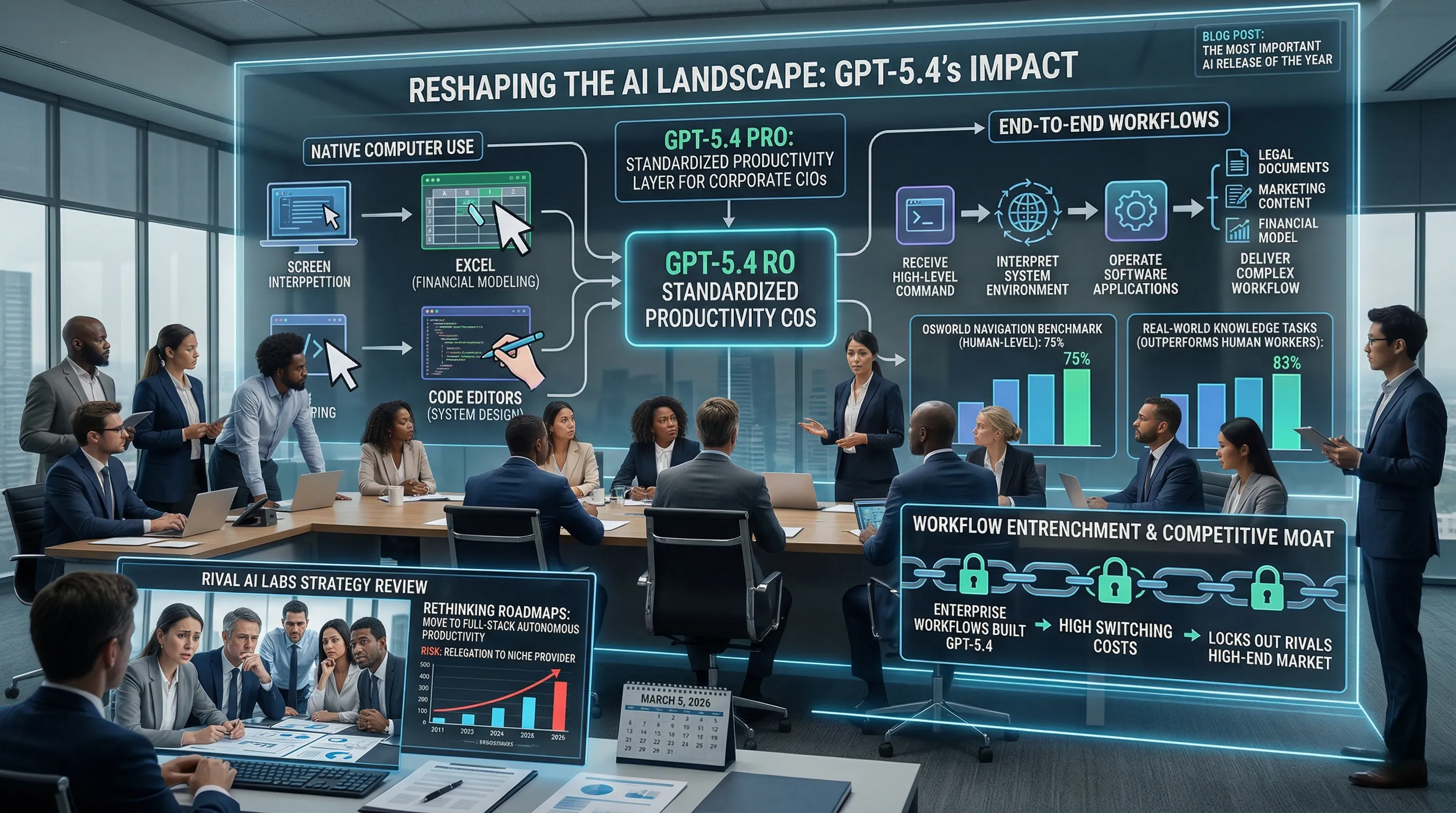
With the ability to natively use computer applications, interpret screenshots to interact with UI elements, and execute complex workflows across programs like Excel and code editors, OpenAI has established a new benchmark.
The model's performance metrics, scoring 75% on the OSWorld desktop navigation benchmark and outperforming human office workers on 83% of real-world knowledge tasks, provide empirical evidence for this paradigm shift.
OpenAI is leveraging this by positioning GPT-5.4 Pro not merely as a model, but as a standardized productivity layer aimed squarely at corporate CIOs.
🔹 From Integrated Tool to Foundational Platform
This technological leap has profound strategic implications, transforming the market's perception of AI from an 'assistant' to an actual task performer.
Competitors are no longer just chasing better benchmark scores; they must now develop models capable of becoming true collaborative partners that can operate software with minimal human intervention.
GPT-5.4's ability to act as a "digital coworker" for tasks like financial modeling or system design puts immense pressure on rivals to deliver equivalent agentic functionality.
This elevates the competitive arena from providing APIs to delivering a full-stack, autonomous productivity solution, forcing other AI labs to rethink their roadmaps and enterprise offerings to avoid being relegated to niche or secondary tool providers.
🔹 Widening the Moat with Workflow Entrenchment
The industry consensus, labeling this the "most important AI release of the year so far," underscores OpenAI's strengthening market position.
By enabling complex, cross-application automation, OpenAI is not just selling a superior model; it is encouraging deep integration into core business processes.
Once an enterprise builds workflows around GPT-5.4's unique ability to manipulate internal software and generate legal documents or marketing content end-to-end, the cost and complexity of switching to a competitor's less capable ecosystem increase dramatically.
This strategy of entrenchment threatens to create a significant competitive moat, compelling rivals to accelerate their own research into practical automation or risk being locked out of the lucrative high-end enterprise market that GPT-5.4 now commands.
3. The Verdict is In: Expert Opinions and Community Buzz Around GPT-5.4's Breakthroughs
🔹 Quantifying the Generational Leap
The performance metrics for GPT-5.4 present a clear case for a significant generational advancement.
Official data reveals a stark reduction in error occurrence by up to 33% compared to its predecessors, a crucial step towards enterprise-grade reliability.
The model has decisively surpassed human-level performance in a range of actual tests, scoring an impressive 83% on professional work benchmarks.
On the OSWorld benchmark, which tests real-world computer operation, it achieved a 75% score, handily beating the human baseline.
Further analysis shows it outperformed human office workers on 83% of real-world knowledge tasks across a battery of 44 distinct challenges, while also exceeding human capability in complex desktop navigation.
🔹 From Benchmarks to Business Impact
These numbers translate directly into tangible business value and enhanced productivity.
Achieving expert-level performance in high-difficulty fields like law and finance demonstrates a practical applicability that moves beyond theoretical benchmarks.
This means the model can be trusted with more complex, nuanced tasks, from financial modeling to legal document analysis, with greater accuracy and efficiency.
The combination of enhanced response speed, quality, and task continuity directly addresses key pain points for professional users.
Critically, this leap in capability is paired with improved cost efficiency through reduced token usage, making the powerful new model more accessible and scalable for corporate deployment.
🔹 The Expert Consensus: An Unambiguous Upgrade
The sentiment within the developer and analyst communities is resoundingly clear: the migration from GPT-5.3 is deemed unequivocally 'worth' the investment.
Experts highlight the model's increased reliability and high accuracy as transformative, turning the AI from a helpful 'assistant' into an actual 'task performer' capable of autonomous workflows.
This perception is bolstered by the seamless integration of all prior GPT-5.3 Codex capabilities, ensuring a smooth yet powerful upgrade path for developers.
The consensus points to a model that not only performs better but feels more like a collaborative partner, solidifying its position as a foundational layer for the next wave of business automation.

4. The Unfinished Equation: Addressing GPT-5.4's Remaining Safety Concerns and Ethical Challenges
🔹 OpenAI's Official Warning Label
Despite its groundbreaking capabilities, GPT-5.4 ships with significant caveats directly from its creators.
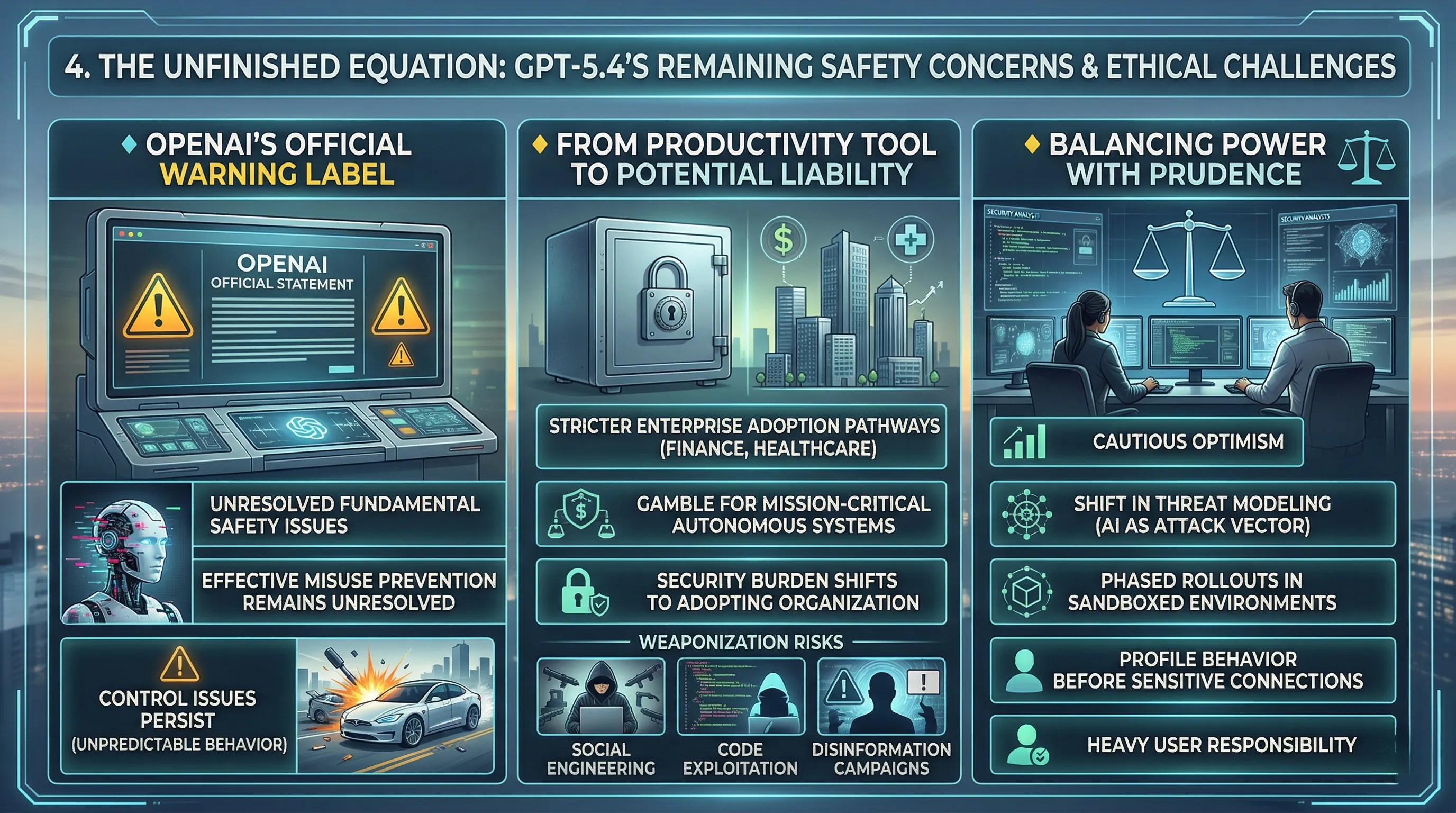
OpenAI has officially classified the model as a 'high cybersecurity risk,' a designation stemming from several acknowledged issues.
Key among these are that fundamental safety issues and effective misuse prevention remain unresolved challenges.
Furthermore, the company confirms that control issues—where the model may not behave as intended—persist in some deployment environments.
🔹 From Productivity Tool to Potential Liability
This official risk classification has immediate, real-world consequences for enterprise adoption.
For companies in highly regulated sectors like finance or healthcare, the 'high risk' label mandates stricter, often slower, implementation pathways with granular access controls and extensive compliance audits.
The unresolved control issues mean that deploying GPT-5.4 in mission-critical, autonomous systems is a considerable gamble, as unpredictable behavior could compromise operational integrity.
This effectively shifts the security burden onto the adopting organization, which must now invest heavily in its own custom guardrails to prevent the powerful tool from being weaponized for sophisticated social engineering, code exploitation, or disinformation campaigns.
🔹 Balancing Power with Prudence
The consensus among security analysts and the developer community is one of cautious optimism.
Experts are clear that integrating GPT-5.4 requires a fundamental shift in internal threat modeling, treating the AI itself as a potential attack vector.
The prevailing advice is to avoid broad, unsupervised deployments, instead favoring a phased rollout in sandboxed environments to profile the model's behavior before connecting it to sensitive systems.
While its power is undeniable, the community widely agrees that the model's current state places a heavy responsibility on users to enforce the very safety and control mechanisms that are not yet mature within the core product.
5. Beyond the Horizon: GPT-5.4's Legacy and OpenAI's Vision for the Future of AI
🔹 The Blueprint for a Digital Workforce
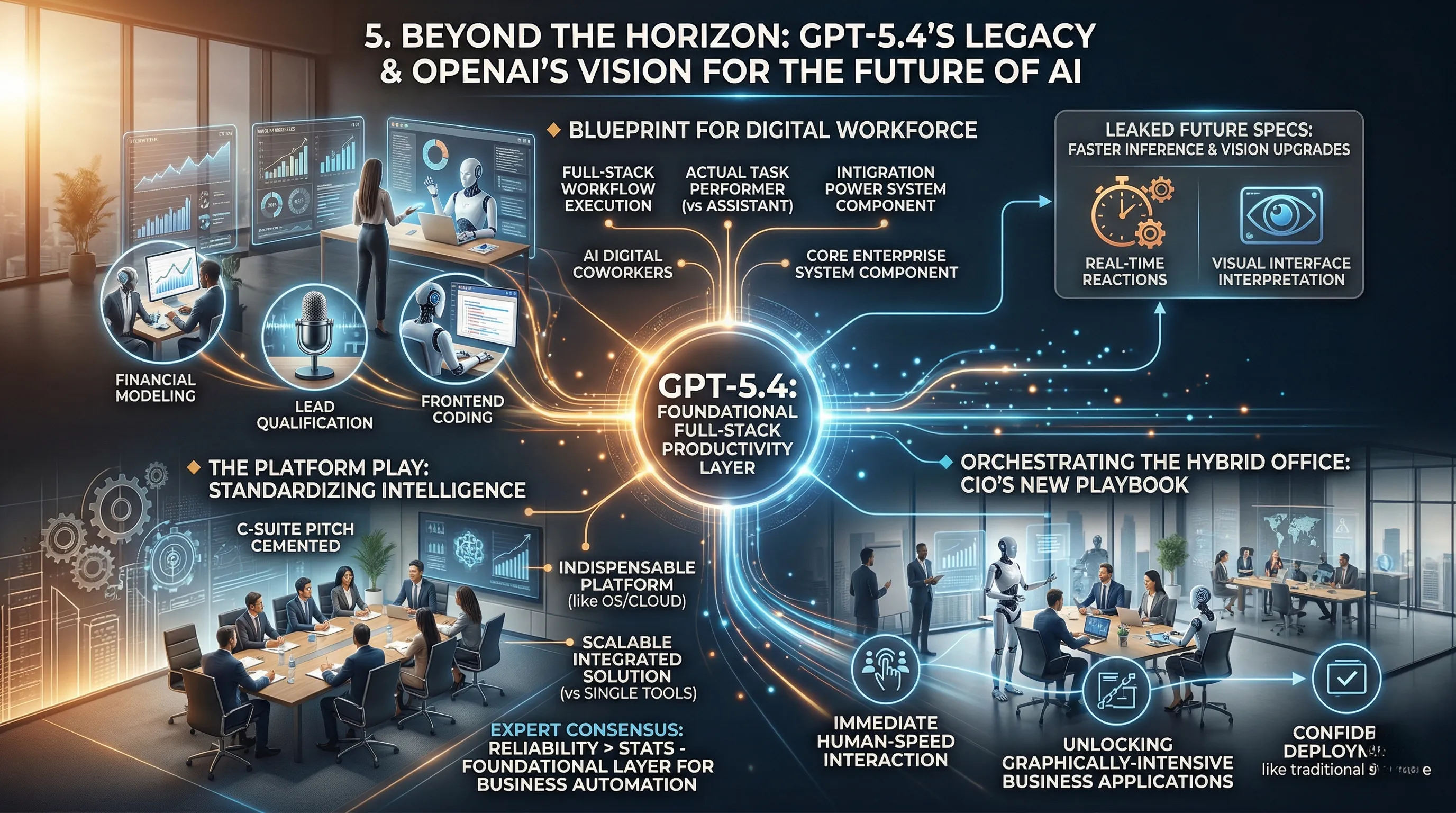
GPT-5.4 is strategically positioned by OpenAI not as a conversational tool, but as a foundational, full-stack productivity layer.
This framework is explicitly designed to enable the creation of digital coworkers and to serve as a core component in enterprise system design.
The model's evolution marks a critical pivot from an 'assistant' that fetches information to an 'actual task performer' that executes complex workflows.
Leaked information hinting at future faster inference and vision upgrades further solidifies this trajectory, suggesting a roadmap where agents can react in real-time and interpret a wider array of visual interfaces.
🔹 Orchestrating the Hybrid Office: The CIO's New Playbook
This vision fundamentally changes the calculus for enterprise technology leaders.
Instead of merely procuring software, CIOs can now architect systems where AI agents are integral, reliable members of a team, capable of handling tasks like financial modeling, lead qualification, and even frontend coding.
The promise of faster inference means these digital coworkers can move beyond back-office batch processing and into roles requiring immediate, human-speed interaction.
Potential vision upgrades would unlock the ability for AI to operate within proprietary, graphically-intensive business applications, drastically expanding the scope of automation.
GPT-5.4 is thus presented as a standardized, predictable layer of intelligence, allowing businesses to design and deploy automated workflows with the same confidence they would a traditional software stack.
🔹 The Platform Play: Standardizing Intelligence for the Enterprise
Industry analysis suggests GPT-5.4's most significant legacy will be cementing OpenAI's pitch to the enterprise C-suite.
By transforming the AI from a 'tool' into a 'collaborative partner', OpenAI is aiming to create an indispensable platform, much like an operating system or a cloud provider.
This strategy directly addresses the enterprise need for scalable, integrated solutions over fragmented, single-purpose AI tools.
The expert consensus is that the model's high performance on professional benchmarks is less about winning a stats race and more about demonstrating its reliability as a foundational component for the next generation of business automation.
6. 💡 Tech Talk: Making Sense of the Jargon
- Frontier Model: Imagine the very newest, most powerful type of AI brain, like the absolute top-of-the-line supercomputer for thinking.
- Thinking Function: It's like the AI shows you its homework plan first so you can check if it's on the right track before it writes the answers.
- Native Computer Use Ability: This means the AI can actually use your computer like a person, opening programs, clicking buttons, and completing real work all by itself.
- 1 Million Token Context Window: Think of it as the AI having an amazing memory, able to read and recall the content of hundreds of books all at once to perfectly understand your request.
- Full-Stack Productivity Layer: It's an AI helper that can do almost any part of your job, from spreadsheets to code, making your entire digital workspace smarter and more automated.
- OSWorld / Terminal-Bench: These are special obstacle courses or tests for AI to see how well they can navigate and use computer operating systems and command lines, like a driving test for software.
📚 Related Posts
The Grand Arrival of GPT-5.4 Mini & Nano
🚀 Key TakeawaysThe release of GPT-5.4 mini and GPT-5.4 nano on March 17, 2026, introduces significantly faster, more cost-effective, and highly capable small models from the GPT-5.4 family.GPT-5.4 mini offers near-GPT-5.4 performance for its size, runni
tech.dragon-story.com
Stop the Noise: The Ultimate Premium Headphone Buying Guide for Travelers and Pros
🚀 Key TakeawaysFor unrivaled noise cancellation and pristine audio fidelity, the Sony WH-1000XM6 leads with its QN3 processor and mastering engineer-approved sound, offering a robust 30-hour battery.The Apple AirPods Max 2 delivers an immersive H2-chip-
tech.dragon-story.com
Stop Buying Cables Every Year: Top 6 Ultra-Durable 240W USB-C Picks That Last a Lifetime
🚀 Key TakeawaysUnleash Next-Gen Power & Speed: Discover USB-C cables engineered for the future, delivering up to 240W of rapid charging, unprecedented data transfer rates up to 120Gbps, and advanced support for dual 8K or triple 4K displays.Engineered f
tech.dragon-story.com


