🚀 Key Takeaways
- ChatGPT is now officially available on Apple CarPlay globally, marking a significant advancement in integrating conversational AI directly into the driving experience.
- This groundbreaking integration requires a supported iPhone on iOS 26.4 or later and the latest ChatGPT app version, emphasizing a voice-first and safety-focused design to minimize screen display.
- Drivers can engage in natural language-based conversations with ChatGPT, allowing them to ask questions, make requests, and continue recent chats or projects, expanding the in-car experience to a "conversational interface."
- ChatGPT is among the first major AI services to launch a dedicated app for CarPlay, establishing a new standard for intelligent interaction and functionality while driving.
The highly anticipated integration of ChatGPT into Apple CarPlay has been officially announced, heralding a new era for artificial intelligence accessibility within vehicles globally.
This pivotal development enables drivers to leverage the power of advanced conversational AI directly through their car's infotainment system, promising to redefine interaction during commutes and road trips.
To take advantage of this new feature, users must possess a supported iPhone running iOS 26.4 or later and ensure they have the latest version of the ChatGPT app installed.
Designed with a paramount focus on safety and minimal driver distraction, the CarPlay integration for ChatGPT operates primarily as a voice-first system, reducing the need for visual interaction.
Drivers can now engage in natural language conversations with the AI, effortlessly asking questions, making various requests, and even continuing ongoing conversations or projects from their car screen.
The interface allows users to start and end AI conversations with just a few simple buttons, effectively transforming the traditional in-car experience into a sophisticated "conversational interface."
This launch positions ChatGPT as one of the pioneering major AI services to offer a dedicated and fully supported application for Apple CarPlay, setting a significant benchmark for in-vehicle technology.
While the initial release focuses exclusively on voice chats with ChatGPT, all transcribed conversations will be conveniently saved and accessible within the Recents tab of the ChatGPT app, ensuring seamless continuity.
The future also hints at further advancements with Apple's announcement of "CarPlay Ultra," signifying a continuous evolution of deeply integrated AI within the driving experience.
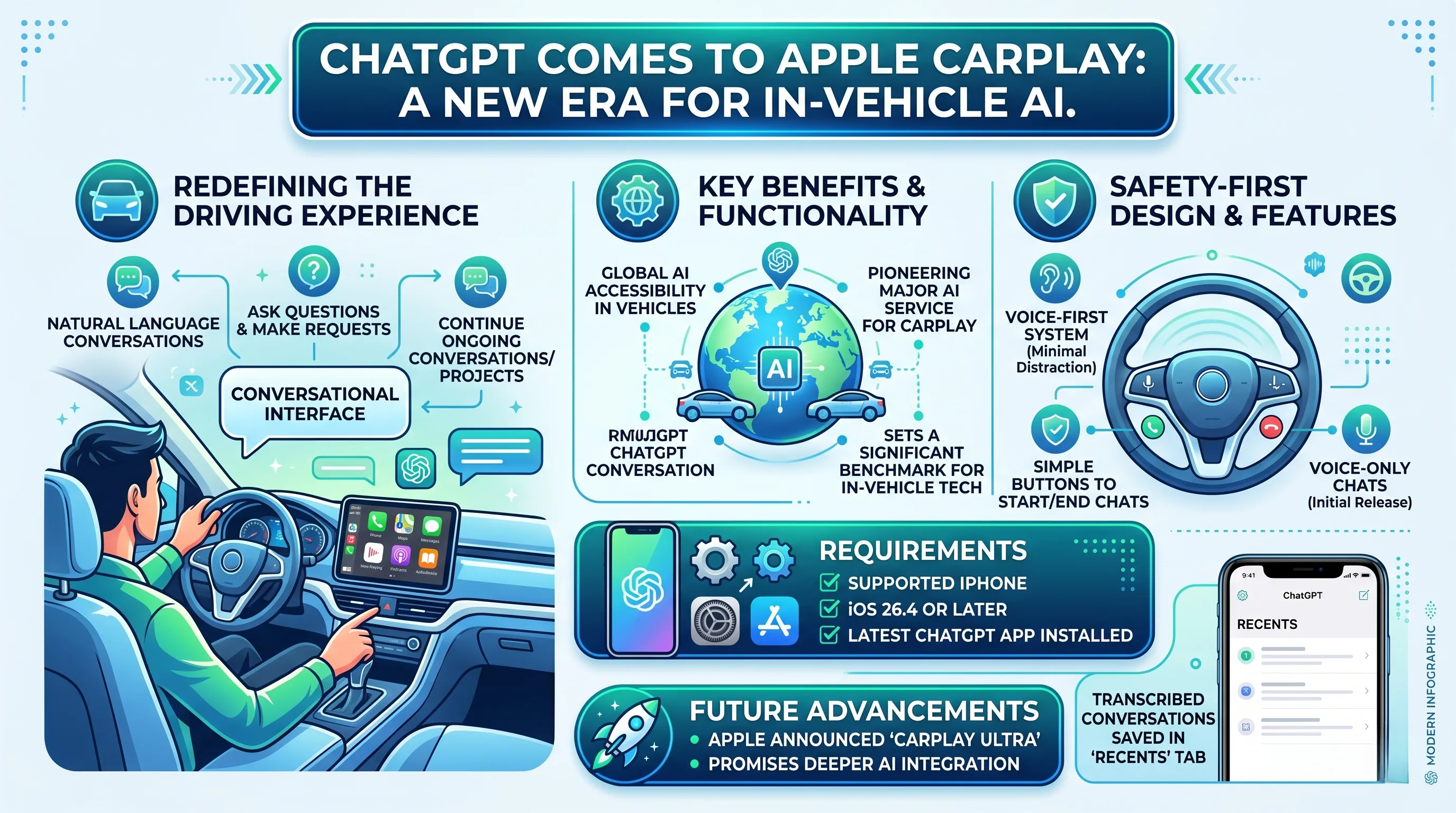
1. ChatGPT's Official CarPlay Launch: Requirements and the Rise of CarPlay Ultra
The official debut of ChatGPT on Apple's CarPlay platform represents a landmark moment in the evolution of the in-car digital experience, directly fulfilling the promise of our main topic: ChatGPT's Official CarPlay Debut.
This section drills down into the practical realities of this integration, detailing the specific technical prerequisites for users to access this new functionality and contextualizing it within Apple’s broader, forward-looking strategy for its in-vehicle interface, now rebranded as CarPlay Ultra.
Understanding these requirements and Apple's strategic vision is crucial to grasping not just how we can use ChatGPT in our cars today, but where this AI-driven revolution is headed tomorrow.
The Technical Gateway: Unpacking the Requirements
Access to this new era of in-car AI is not automatic; it is gated by specific software and hardware prerequisites that ensure a stable and optimized experience.
The global rollout supports all tiers of ChatGPT plans, from free to paid subscribers, but hinges on two key components.
First, the foundational requirement is a supported iPhone running iOS 26.4 or a later version.
This specific version number, iOS 26.4, is not arbitrary.
It represents the operating system update where Apple explicitly enabled the framework for voice-based AI applications to function within the CarPlay environment.
This makes iOS 26.4 the essential software key that unlocks the door for developers like OpenAI to build and deploy their services safely and effectively on the car's dashboard.
Users with older iOS versions will find the ChatGPT icon simply does not appear on their CarPlay screen, making this update non-negotiable.
Second, users must have the latest version of the ChatGPT app installed on their iPhone.
This is standard practice for any app integration, but it is particularly critical here.
The "latest version" ensures that the app contains the necessary code and assets specifically designed for the CarPlay interface, which prioritizes a voice-first, minimal-display interaction model.
Running an outdated version would lack the CarPlay entitlement and the specific UI elements, rendering the feature inaccessible.
This requirement guarantees that users benefit from the most recent bug fixes, performance enhancements, and safety features tailored for the driving experience.
Beyond a Rebrand: The Strategic Vision of 'CarPlay Ultra'
Coinciding with the rise of powerful AI integrations like ChatGPT, Apple has strategically set the stage for the next chapter of its in-vehicle platform by officially announcing the name 'CarPlay Ultra' for its next-generation system.
This is far more than a simple marketing rebrand; it signals a fundamental shift in ambition and capability.
The "Ultra" moniker, consistent with Apple's branding for its most powerful chips and premium products, implies a system designed for deeper integration with a vehicle's core functions—like climate control, instrument clusters, and multi-display setups.
The launch of the ChatGPT app serves as a powerful proof-of-concept for the kind of advanced, intelligent applications that CarPlay Ultra is being built to support.
While the current ChatGPT integration operates within the confines of the existing CarPlay framework, its presence validates the demand for sophisticated conversational AI in the car.
The announcement of CarPlay Ultra creates a clear future roadmap, suggesting a platform where AI won't just be an add-on app but could potentially be woven into the very fabric of the vehicle's operating system, offering proactive assistance, deeper vehicle control, and a more context-aware conversational interface.
ChatGPT's arrival is the first major step, but CarPlay Ultra is the destination.
Safety by Design: The Voice-First Mandate
A core tenet of the ChatGPT on CarPlay experience is an unwavering focus on driver safety, achieved through a specific design philosophy: a voice-first, minimal screen display.
This is a deliberate and critical choice.
The interface is designed to prevent, rather than invite, physical interaction with the screen.
When a conversation is active, the display might only show a simple listening or processing animation, ensuring the driver's eyes remain on the road.
The primary mode of interaction is entirely through natural language voice commands.
Users can initiate and conclude conversations with simple button presses on the steering wheel or a tap on the screen, but the substance of the interaction—the questions, requests, and AI's responses—is purely auditory.
This design effectively transforms the powerful, text-heavy ChatGPT from a visual tool into a safe, hands-free conversational partner for the road.
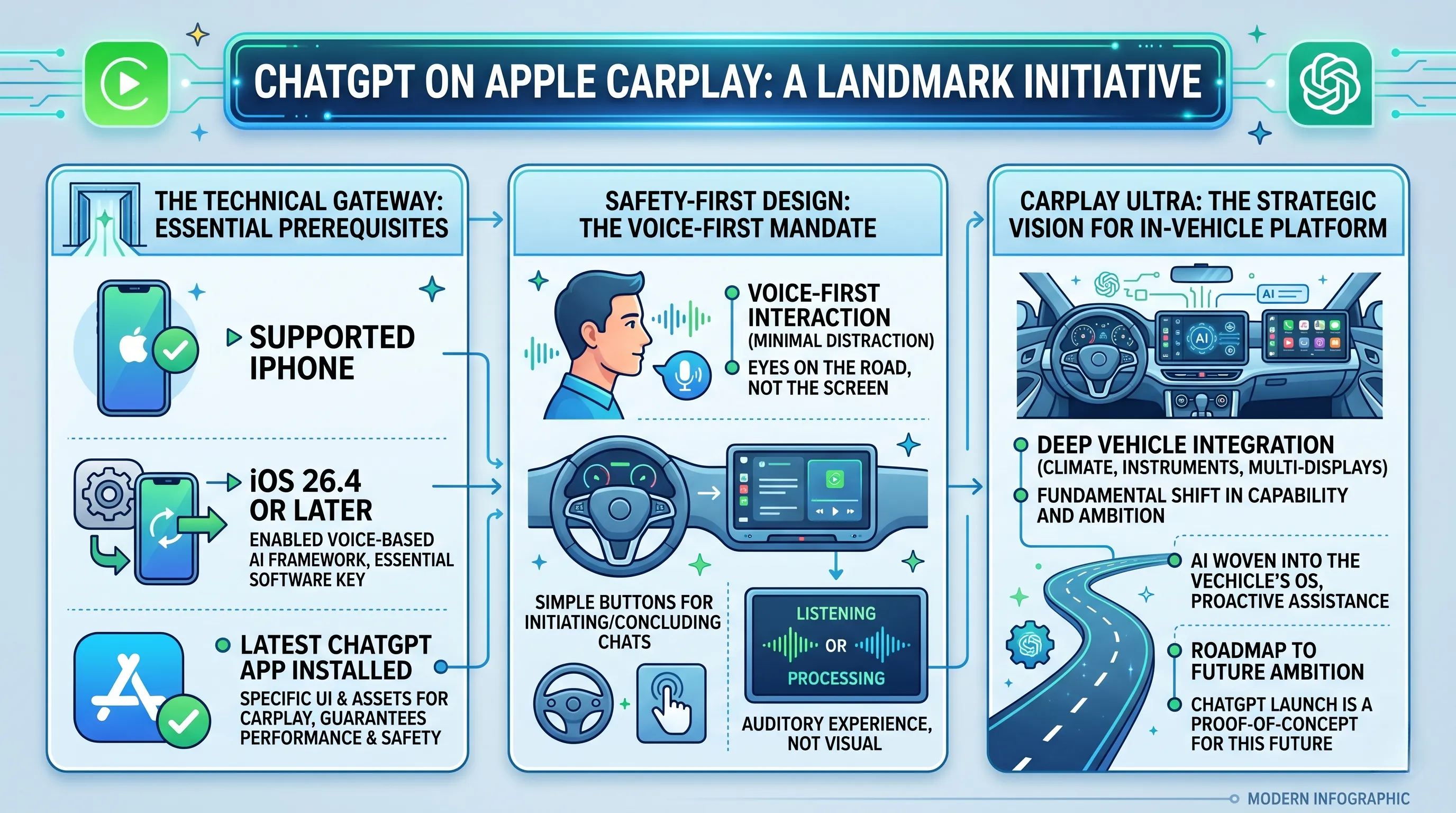
2. Transforming Driving: ChatGPT's Conversational AI Features in CarPlay
This section directly addresses the core user experience of ChatGPT's Official Entry into CarPlay by dissecting precisely what this integration means for the driver.
It moves beyond the announcement itself to explain how the technology fundamentally transforms the vehicle's dashboard from a simple control panel into a dynamic, conversational partner, detailing the new capabilities that are now available behind the wheel.
From Commands to Conversation: A New In-Car Paradigm
The arrival of ChatGPT in CarPlay signals a monumental shift in human-vehicle interaction.
For years, in-car voice assistants have operated on a rigid command-and-response structure ("Call home," "Navigate to the nearest gas station").
The official integration of ChatGPT, however, introduces a true 'conversational interface' into the car.
This isn't about issuing predefined commands; it's about engaging in natural, fluid dialogue.
The system is designed to understand context, nuance, and follow-up questions, turning the driver's seat into a mobile think tank.
This evolution is a core pillar of Apple's next-generation vision, recently branded as 'CarPlay Ultra', where the car becomes an extension of our digital and cognitive lives, not just a tool for navigation and media playback.
The ability to have a genuine back-and-forth conversation with an AI while driving is the primary value proposition of this official launch.
The Anatomy of a Drive-Time Chat: Safety-First Design
OpenAI and Apple have meticulously engineered the experience with a voice-first, minimal screen display philosophy to prioritize driver safety.
Accessing this powerful tool doesn't require navigating complex menus.
Instead, users can start and end their AI conversations with just a few buttons on the CarPlay interface.
Once initiated, the interaction is almost entirely auditory.
This design is a deliberate choice to prevent distraction, ensuring the driver's eyes remain on the road.
The on-screen information is kept to a bare minimum, likely showing only a visual cue that the AI is listening or processing.
It's important to note a key limitation in this initial release: for now, CarPlay users can only have voice chats with ChatGPT.
There is no on-screen text input or image generation, reinforcing the focus on safe, voice-centric operation.
All conversation transcripts are automatically saved in the app's Recents tab, making the interaction accessible for later review once the user is no longer driving.
The technical requirements are straightforward: a supported iPhone running iOS 26.4 or later and the latest version of the ChatGPT app.
Unlocking Productivity and Creativity on the Go
The true power of this integration lies in its ability to reclaim the often-unproductive time spent commuting.
A standout feature is the capability to not only start new conversations but to continue recent chats or projects directly from the car screen.
Imagine starting to draft a complex business proposal at your desk, getting into the car, and seamlessly picking up where you left off by saying, "Let's continue brainstorming ideas for the marketing section."
The AI retains the context from your previous session, allowing for uninterrupted creative or analytical thought.
Drivers can now ask complex questions and make requests that far exceed the scope of traditional voice assistants.
You could ask ChatGPT to help you structure a difficult email, practice a presentation, explain a complex scientific concept you heard on a podcast, or even generate creative ideas for a weekend project with the family—all through natural conversation.
This feature effectively expands the car into a mobile office or creative studio, making ChatGPT one of the first major AI services to launch a dedicated CarPlay app that offers such profound utility.
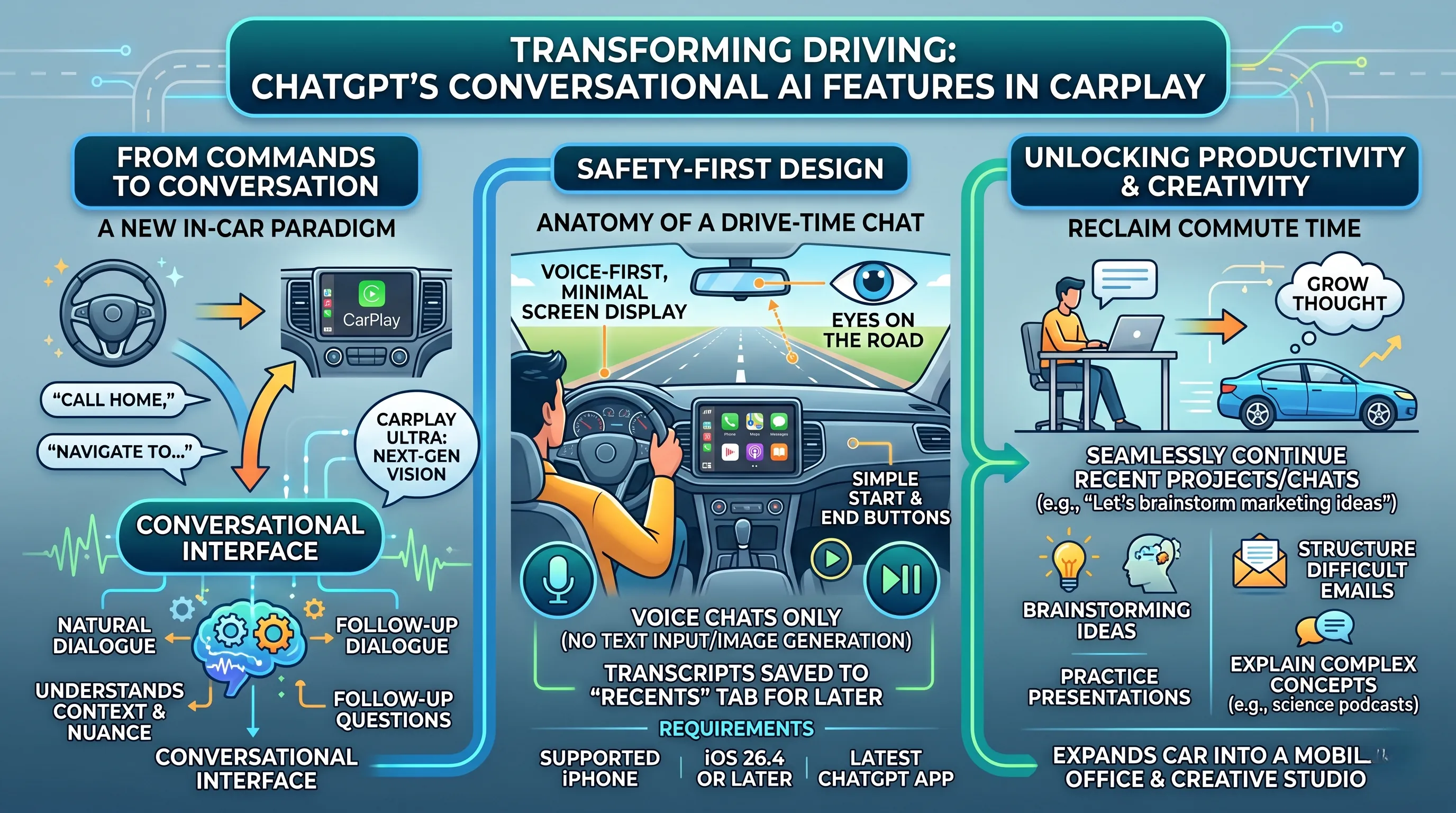
3. Safety-First Design: The Voice-Centric Future and Current Limitations of In-Car AI
The official entry of ChatGPT into the automotive world via CarPlay is a landmark event, but its significance extends far beyond simply adding another app to the dashboard.
This section directly connects to the main topic of ChatGPT's Official CarPlay Debut by analyzing the foundational design philosophy that dictates *how* this powerful AI is implemented in a moving vehicle.
Apple's rigid, safety-first approach to CarPlay dictates a voice-centric, minimalist interaction model, and ChatGPT’s new app is the first large-scale test case for this vision of in-car conversational AI.
The "Eyes on the Road, Hands on the Wheel" Mandate
Apple's core design philosophy for CarPlay has always been uncompromisingly focused on driver safety.
This is explicitly manifested in its 'Voice-first, minimal screen display' strategy.
Unlike a smartphone interface, which is designed for rich visual engagement, the CarPlay environment is intentionally restrictive.
The goal is to minimize cognitive load and eliminate distractions that could divert a driver's attention from the road.
With the introduction of complex AI like ChatGPT, this philosophy becomes more critical than ever.
Instead of attempting to replicate the text-heavy, visual interface of the mobile app, the CarPlay version strips the experience down to its auditory essence.
The user experience is transformed from typing and reading to simply speaking and listening, allowing for natural language-based conversations with the AI without ever needing to look at a complex screen.
ChatGPT: Pioneering the Conversational Interface in Cars
ChatGPT's arrival is a watershed moment because it is among the first major AI services to launch a dedicated CarPlay app, effectively setting the standard for future AI integrations.
This isn't just about asking for directions or playing a song; it's about expanding the in-car experience into a true 'conversational interface'.
Drivers can now start new brainstorming sessions, ask complex follow-up questions, or continue recent projects and chats directly from the car's screen, all initiated with a few simple, large button presses.
This functionality is enabled on any supported iPhone running the newly released iOS 26.4 (or later) with the latest version of the ChatGPT app.
The integration showcases a future where the car is not just a mode of transport but a mobile thinking space, a transition made possible only by adhering to the strict safety parameters of a voice-centric design.
This direction is further underscored by Apple's official announcement of 'CarPlay Ultra' for next-generation vehicles, signaling a deeper, more integrated future where such AI interactions will become even more seamless.
The Necessary Limitations: Safety as a Feature
The current limitations of the ChatGPT CarPlay app are not bugs or oversights; they are intentional design choices born from the safety-first mandate.
1. Voice-Only Chat:
The most significant limitation is that, for now, CarPlay users can only have voice chats with ChatGPT.
There is no option to read long text responses on the screen.
This is a critical safety feature.
Presenting a wall of text would be dangerously distracting, so the system forces an auditory-only exchange, ensuring the driver's eyes remain focused on the road.
The AI's response is delivered through the car's speakers, just like a phone call or podcast.
2. Delayed Gratification for Transcripts:
The second key design choice is how conversation history is handled.
While the full transcription of the conversation is saved for later reference, it is not displayed during the drive.
Instead, the transcription of conversations will be saved in the Recents tab of the mobile ChatGPT app.
This is a brilliant compromise: it provides the full utility and record of the AI interaction but "safety-gates" access to it until the user is no longer driving and can safely review the text on their iPhone.
It acknowledges the need to capture complex information while refusing to compromise on in-the-moment safety.
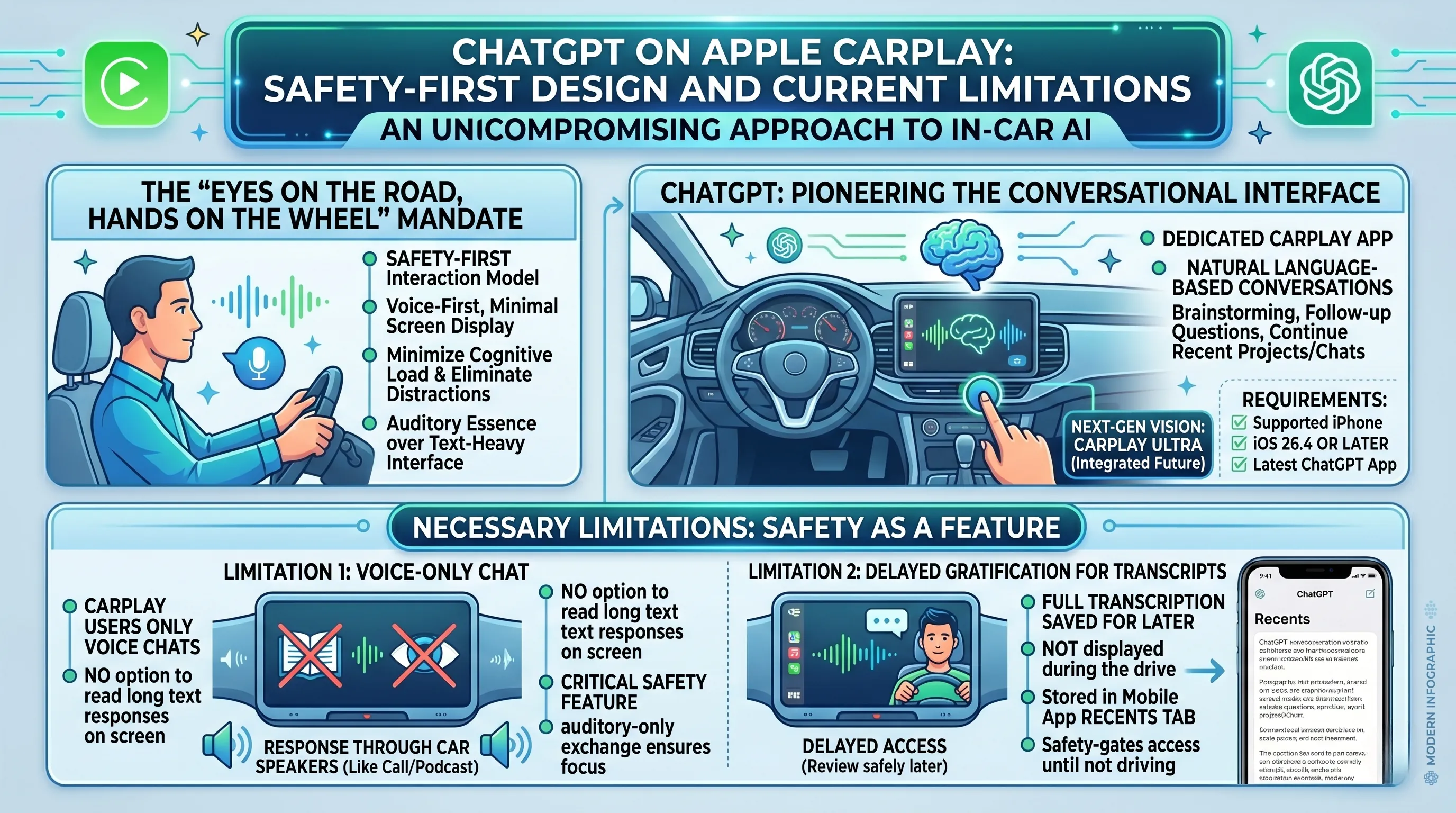
📚 Related Posts
Invisible Tech: Top Smart Devices That Automate Your Home Life, Security & Chores Effortlessly
🚀 Key Takeaways"Invisible Tech" products are engineered to seamlessly integrate into daily life, automating mundane tasks and enhancing security or well-being without demanding constant user attention.In an increasingly connected world, the most revolut
tech.dragon-story.com
Retro Meets AI: Old-School Gadgets Reinvented with Cutting-Edge Smart Features – Vinyl Players, Pixel Speakers & Gaming Keyboa
🚀 Key TakeawaysThe "Retro Meets AI" trend successfully merges classic aesthetics with modern smart features, enhancing beloved old-school gadgets like vinyl players, mini speakers, and cameras with advanced functionality such as Bluetooth connectivity,
tech.dragon-story.com
Trinity-Large-Thinking: Arcee AI's 400B Open-Source AI Agent Redefines the Agent Era with Unmatched Performance and 96% Cost Sav
🚀 Key TakeawaysTrinity-Large-Thinking, an open-source 400B-parameter AI model from Arcee AI, is specifically engineered for advanced agent-type AI, capable of complex reasoning and long-horizon tasks, setting a new benchmark for performance in multi-sta
tech.dragon-story.com


