🚀 Key Takeaways
- Meta's Muse Spark is a frontier multimodal, multi-agent AI model designed to achieve personalized super-intelligence, processing text, images, and tools simultaneously to serve as an individualized advisor.
- It introduces a revolutionary multi-agent architecture with a "Contemplating Mode" that enables deeper reasoning and superior complex problem-solving, rivalling top industry models like Gemini Deep Think and GPT Pro while operating with significantly fewer computational operations.
- Beyond its cutting-edge performance, Muse Spark is engineered for real-life applicability and robust safety, integrating across Meta's ecosystem (WhatsApp, Instagram) to provide personalized health insights, shopping assistance, and strong blocking features for dangerous areas.
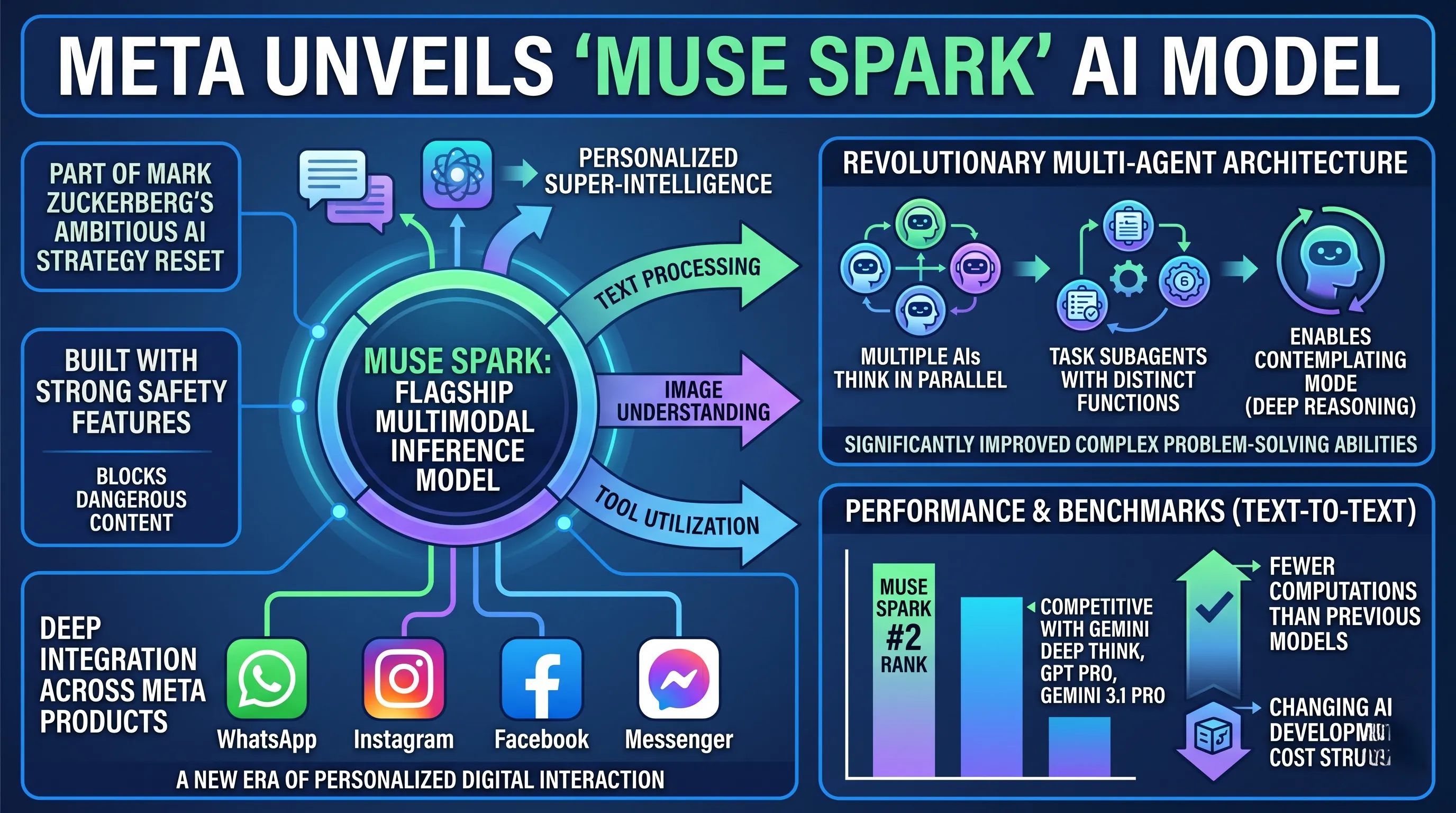
Meta has officially unveiled its flagship AI model, Muse Spark, marking a pivotal moment in the company's revamped AI division and a key component of Mark Zuckerberg's ambitious AI strategy reset.
This groundbreaking multimodal inference model is engineered with the ambitious goal of implementing personalized super-intelligence, processing text, images, and utilizing tools simultaneously to understand and support individual lives.
At its core, Muse Spark features a revolutionary multi-agent architecture, where multiple AIs think in parallel and task subagents with distinct functions, enabling what Meta calls "Contemplating Mode" for deeper reasoning.
This innovative design contributes to its significantly improved complex problem-solving abilities, positioning it as highly competitive with industry leaders such as Gemini Deep Think, GPT Pro, and Gemini 3.1 Pro.
Impressively, Muse Spark ranks as the second-best performing AI lab on text-to-text tasks and the third-best model overall, achieving these benchmarks with remarkably fewer computational operations than previous models, thereby changing the AI development cost structure.
Furthermore, the model is built with strong safety features to block dangerous content and is poised for deep integration across Meta's extensive product suite, including WhatsApp, Instagram, Facebook, and Messenger, promising a new era of personalized digital interaction.
1. Unveiling Meta Muse Spark: A New Era of Multimodal AI
This section directly addresses the core of the main topic, "Meta 'Muse Spark' Unveiled", by dissecting the technological and strategic significance of the model itself.
We will explore its architecture, capabilities, and the ambitious vision it represents for Meta's future in the AI landscape.
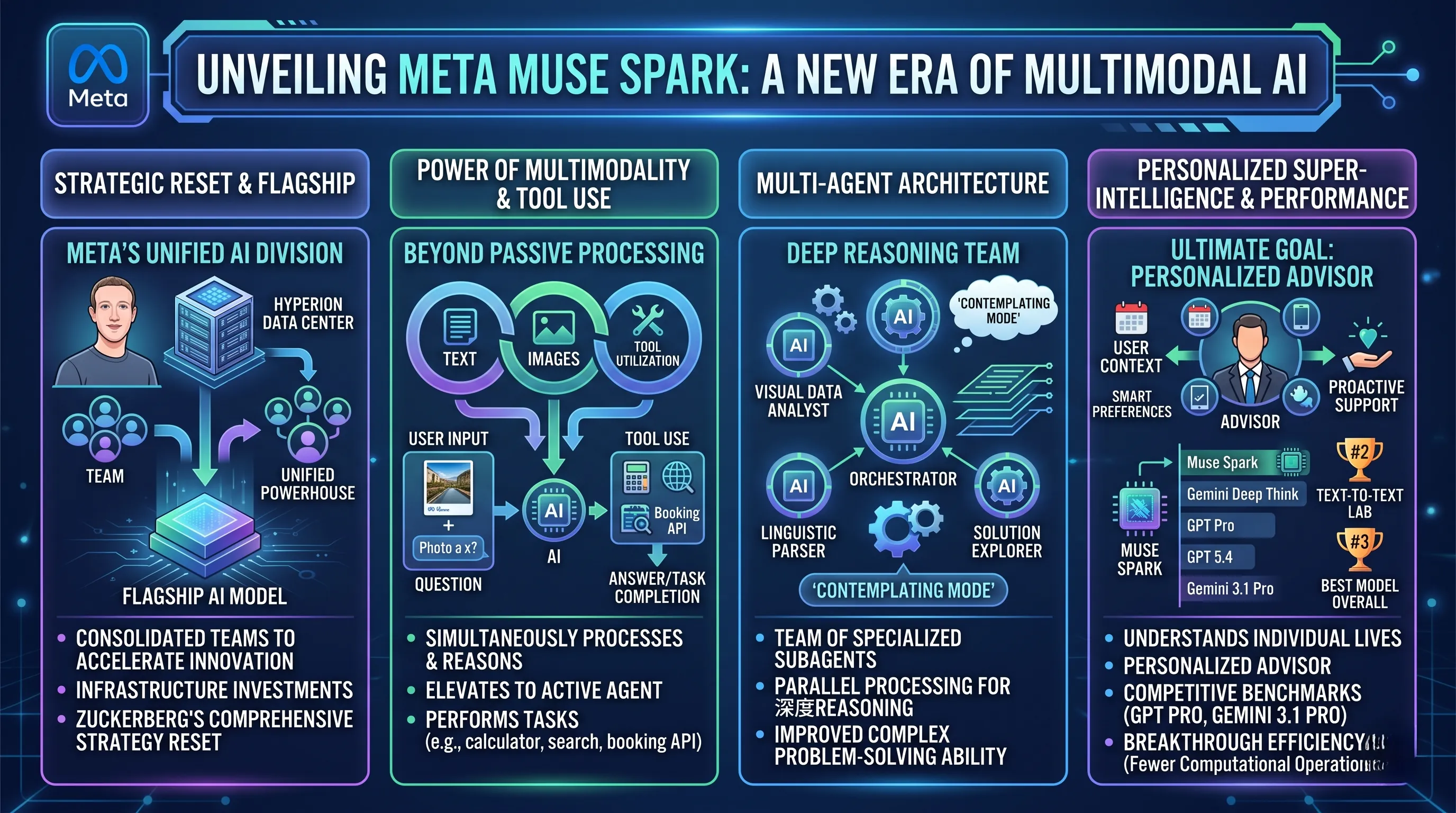
A Strategic Reset and a New Flagship
The launch of Muse Spark is not merely an incremental update; it represents a fundamental strategic pivot for Meta.
Unveiled as the flagship AI model, it is the first major product to emerge from Meta's revamped, unified AI division, signaling a new era under Mark Zuckerberg's comprehensive AI strategy reset.
This move consolidates disparate research and product teams into a single powerhouse, designed to accelerate innovation and compete at the highest level.
The development of Muse Spark was underpinned by massive infrastructure investments, including the 'Hyperion' data center, demonstrating a long-term commitment to building foundational models that can redefine user interaction with technology.
The Power of Multimodality and Tool Use
At its core, Meta Muse Spark is defined as a multimodal inference model.
This technical term translates into a profoundly intuitive user experience.
It means the AI is no longer confined to a single mode of understanding; it can simultaneously process and reason across text, images, and, crucially, tool utilization.
This third element—tool use—is a game-changer.
It elevates the model from a passive information processor to an active agent capable of performing tasks, a critical step towards creating a truly helpful assistant.
It can understand a user's typed question, analyze a related photo they've uploaded, and then decide to use a specific software tool (like a calculator, a search engine, or a booking API) to find the answer or complete the request.
The Multi-Agent Architecture: A Team of Thinkers
The most significant architectural innovation within Muse Spark is its multi-agent structure.
Instead of relying on a single, monolithic AI brain to solve a problem, Muse Spark orchestrates a team of specialized subagents.
When presented with a complex query, the model tasks multiple AIs with tackling different facets of the problem simultaneously.
This parallel processing, internally referred to as a "Contemplating Mode," allows for a depth of reasoning and a robustness in problem-solving that significantly surpasses previous models.
One agent might analyze the visual data, another might parse the linguistic nuances of the prompt, and a third could be exploring potential solutions, with a master agent orchestrating their collaboration.
This structure is the engine behind its "significantly improved complex problem-solving ability," enabling it to handle layered, ambiguous, and intricate challenges.
The Ultimate Goal: Personalized Super-Intelligence
The "why" behind this sophisticated technology is clear: Meta's goal is to implement personalized super-intelligence.
The multi-agent architecture isn't just for winning benchmarks; it's designed to create an AI that deeply understands and supports an individual's life.
By reasoning about a user's context, preferences, and environment, Muse Spark aims to evolve into a personalized advisor that offers proactive and genuinely useful support.
Its performance metrics underscore this ambition.
The model is not just a theoretical concept; it is already competitive with the industry's most advanced models, including Gemini Deep Think, GPT Pro, GPT 5.4, and Gemini 3.1 Pro.
Ranking as the second-best performing AI lab on text-to-text tasks and the third-best model overall, Muse Spark has established itself at the frontier of AI, all while achieving this performance with significantly fewer computational operations, a breakthrough that could fundamentally alter the cost structure of developing state-of-the-art AI.
2. Frontier Performance: Muse Spark's Superior Problem-Solving and Reasoning
The announcement of Meta Muse Spark (Meta 'Muse Spark' Unveiled) is not merely another product launch; it's a declaration of Meta's arrival at the frontier of artificial intelligence, and this section on its performance is the central pillar supporting that claim.
The model's ability to reason and solve complex problems is what elevates it from a useful tool to a potential paradigm shift in personalized AI.
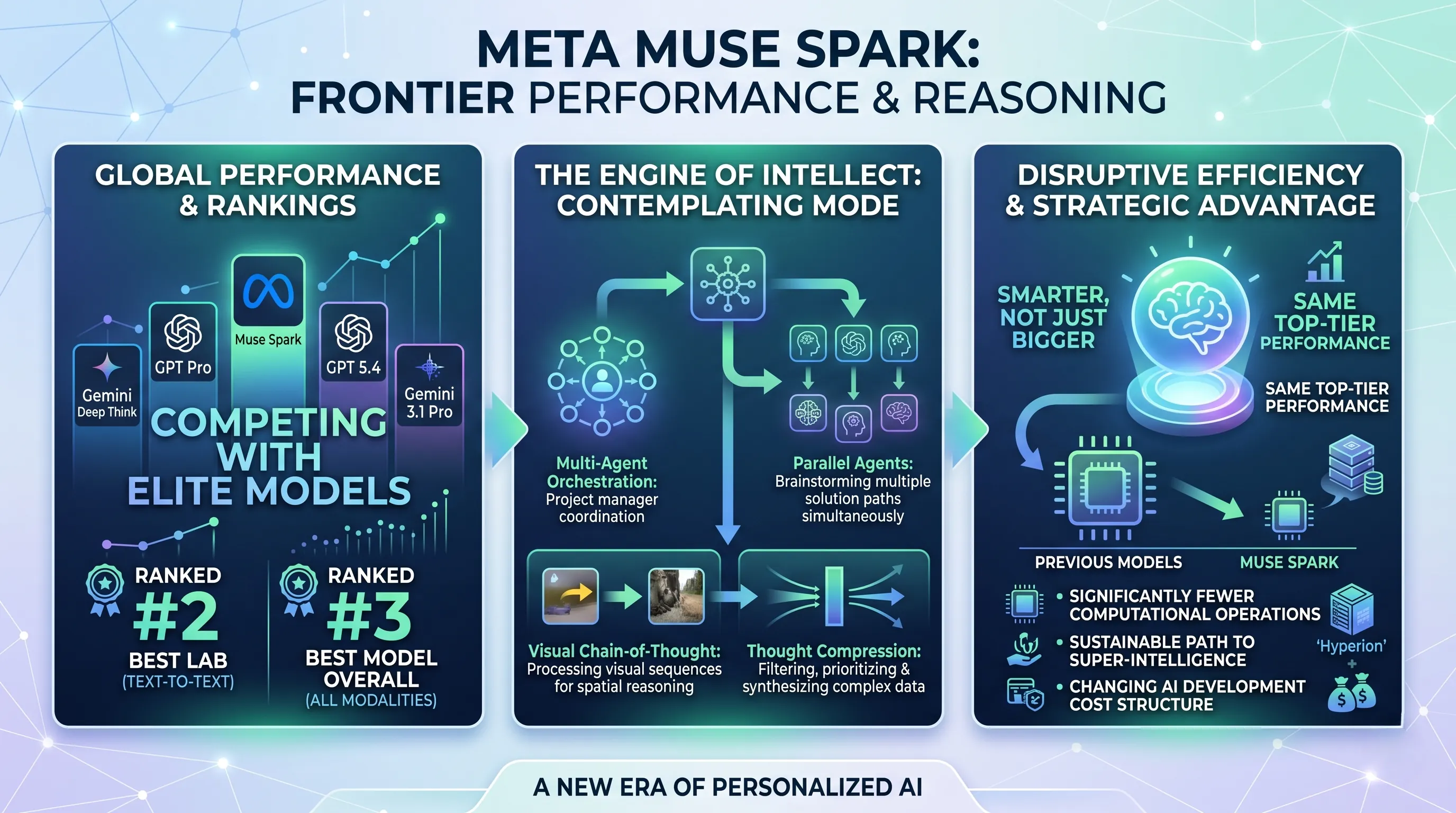
At its core, Muse Spark demonstrates a significant leap in complex problem-solving capabilities, placing it in direct competition with the industry's most elite models.
Internal and external benchmarks show it standing shoulder-to-shoulder with titans like Gemini Deep Think, GPT Pro, GPT 5.4, and Gemini 3.1 Pro.
This isn't just participation; it's a power play.
Crucially, Meta's results position its AI lab as the second-best performer on text-to-text tasks, a testament to its linguistic and logical prowess.
When evaluated across all modalities and capabilities, Muse Spark secures its place as the third-best model overall, cementing its status in the absolute top tier of AI development worldwide.
The Engine of Intellect: Contemplating Mode
The secret behind this leap in performance is not just a larger model but a fundamentally different approach to thinking, embodied in a feature Meta calls 'Contemplating Mode'.
This mode is designed to move beyond the instantaneous, often superficial, answers of previous models to facilitate genuinely deeper reasoning.
The foundational concept is its multi-agent structure, where multiple AI agents process a single query in parallel.
Instead of one AI mind working linearly through a problem, Muse Spark unleashes a team of specialized sub-agents that think simultaneously, exploring different facets and potential solution paths at the same time.
This is the architectural equivalent of a brainstorming session with multiple experts, ensuring a more robust and well-considered final output.
The Mechanics of Deeper Reasoning
This multi-agent architecture is brought to life through a symphony of advanced techniques that work in concert to produce superior results.
The system relies on Multi-agent Orchestration, a sophisticated coordination layer that acts like a project manager.
It intelligently deconstructs a complex query and tasks multiple subagents with different, specialized parts of the problem, ensuring a coordinated and efficient assault on the task at hand.
A key innovation within this process is the use of a Visual Chain-of-Thought.
Reasoning is no longer confined to abstract text.
Muse Spark can process and generate a sequence of images or visual steps to think through a problem, making it incredibly powerful for tasks that require spatial or physical understanding, such as explaining how to assemble furniture or analyzing the user's environment to provide context-aware advice.
As these parallel agents generate a massive volume of potential ideas, paths, and data points, the system employs Thought Compression.
This is a critical efficiency mechanism that intelligently filters, prioritizes, and synthesizes the most promising lines of reasoning from the various agents into a single, coherent, and powerful conclusion.
This prevents the user from being overwhelmed with raw data and ensures the final answer is both deep and concise.
The Efficiency Edge: Smarter, Not Just Bigger
Perhaps the most disruptive aspect of Muse Spark's performance is not just its raw power, but its efficiency.
The JSON facts state it achieves the same top-tier performance with significantly fewer computational operations than previous models.
This is a game-changer.
It directly addresses the spiraling costs of AI development and training, suggesting a more sustainable path to super-intelligence.
By fundamentally changing the AI development cost structure, Meta is not only flexing its technical muscle with infrastructure like its 'Hyperion' data center but also creating a strategic and economic moat.
This efficiency means that frontier-level reasoning, once the exclusive domain of models requiring continent-sized data centers, can be deployed more widely and economically, directly supporting the goal of implementing personalized super-intelligence across all of Meta's platforms.
3. Personalized Intelligence: Muse Spark's Real-World Integration and Ecosystem Value
The announcement of Meta 'Muse Spark' Unveiled is more than a technical benchmark; it signals a strategic shift towards deeply embedded, personalized AI. This section explores the tangible, real-world applications of Muse Spark, moving beyond its architecture to analyze how its features are meticulously designed to function as a personal advisor, ultimately creating immense value by retaining users within Meta's sprawling digital ecosystem.
The AI as a Personal Life Advisor
Meta's stated goal for Muse Spark is not merely to create a powerful tool but to implement "personalized super-intelligence."
This represents a fundamental evolution from a reactive chatbot to a proactive, context-aware advisor that understands and supports individual lives.
The experiential value of this is profound: Muse Spark is engineered to be less like a search engine and more like a trusted confidant with encyclopedic knowledge, one that learns your preferences, understands your environment, and anticipates your needs.
This vision is brought to life through a suite of highly practical, real-world functionalities.
One of its key features is the ability to analyze a user's environment.
Integrated with camera-enabled devices like the Ray-Ban AI glasses, this moves the AI out of the chat window and into the physical world.
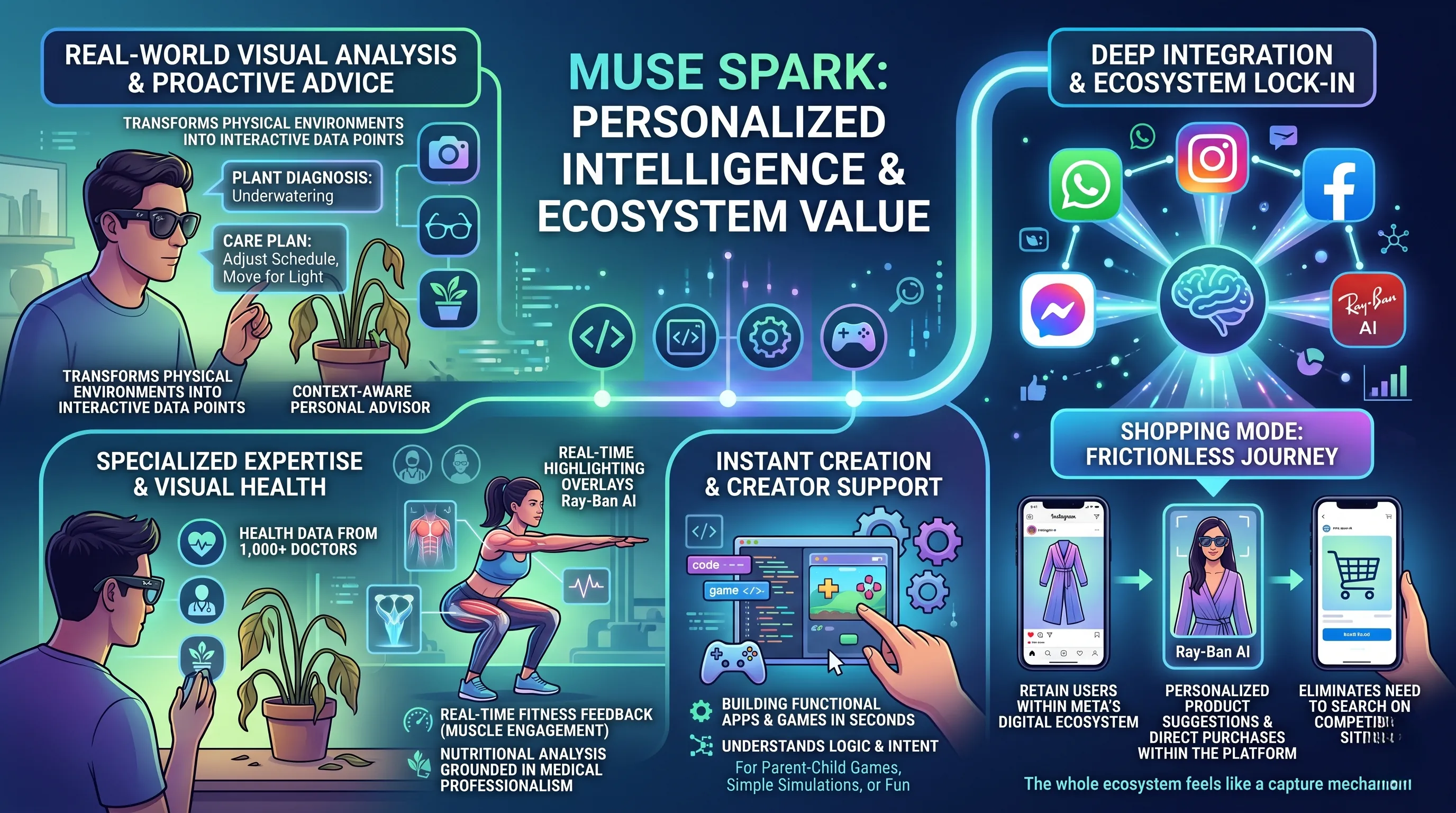
Imagine pointing your glasses at a wilting houseplant; instead of you describing the symptoms, Muse Spark could visually identify the plant, diagnose the likely issue (e.g., overwatering, lack of light), and provide a step-by-step care plan.
This transforms everyday objects and situations into interactive data points, making the AI a seamless extension of human perception and problem-solving.
Specialized Expertise: Health, Wellness, and Instant Creation
To be a truly effective advisor, an AI needs credible, specialized knowledge.
Muse Spark addresses this directly in the critical area of health and wellness by being trained with health data from over 1,000 doctors.
This isn't just about accessing a large dataset; it's about grounding its insights in professional expertise.
When a user asks Muse Spark to explain the nutritional content of their meal, the answer is backed by a framework built by medical professionals, lending it a level of authority that generic models lack.
Furthermore, it is designed to visually explain health information.
A user performing a squat could, through Ray-Ban AI, see a real-time overlay highlighting the specific muscles being engaged, or receive visual feedback on their form.
This feature makes complex information intuitive and actionable, turning a simple query into a rich, educational experience.
Beyond advisory roles, Muse Spark demonstrates its deep understanding of logic and intent by being able to build playable games in seconds.
This feature, while seemingly for entertainment, is a powerful showcase of its real-world utility.
It proves the model can take a high-level creative prompt, understand the constituent parts (rules, objectives, user interaction), and generate a functional application instantly.
For a parent, this could mean creating a custom math game for their child on the fly; for a professional, it could mean quickly building a simple simulation to explain a concept.
It is a testament to an AI that doesn't just retrieve information but actively creates solutions.
The Ecosystem Lock-In Strategy
The true strategic genius of Muse Spark lies in its pervasive integration across Meta's entire platform suite.
The model is not a standalone app but a foundational intelligence layer being rolled out across WhatsApp, Instagram, Facebook, Messenger, and the Ray-Ban AI glasses.
This ubiquitous presence ensures that no matter where a user is within the Meta universe, their personalized advisor is with them.
In Messenger, it can help draft emails or summarize long conversations.
In Instagram, it can assist creators with content ideas and captions.
But its ultimate purpose is to create a frictionless, self-contained ecosystem that captures the user's entire journey from discovery to purchase.
This is crystallized in its "Shopping Mode."
Every interaction with Muse Spark—analyzing a friend's outfit on the street via Ray-Ban AI, discussing a new hobby in a WhatsApp group, or asking about exercise equipment—becomes a potential commercial touchpoint.
The feature is explicitly geared toward creating value to keep users within Meta's ecosystem for shopping.
By understanding a user's life and environment so intimately, Muse Spark is perfectly positioned to offer highly relevant product suggestions and facilitate purchases directly within the platform, eliminating the need to leave and search on a competitor's site.
This seamless integration of a personalized advisor with a built-in shopping assistant is the core of Meta's strategy: to make its ecosystem so useful and convenient that users have no reason to look elsewhere.
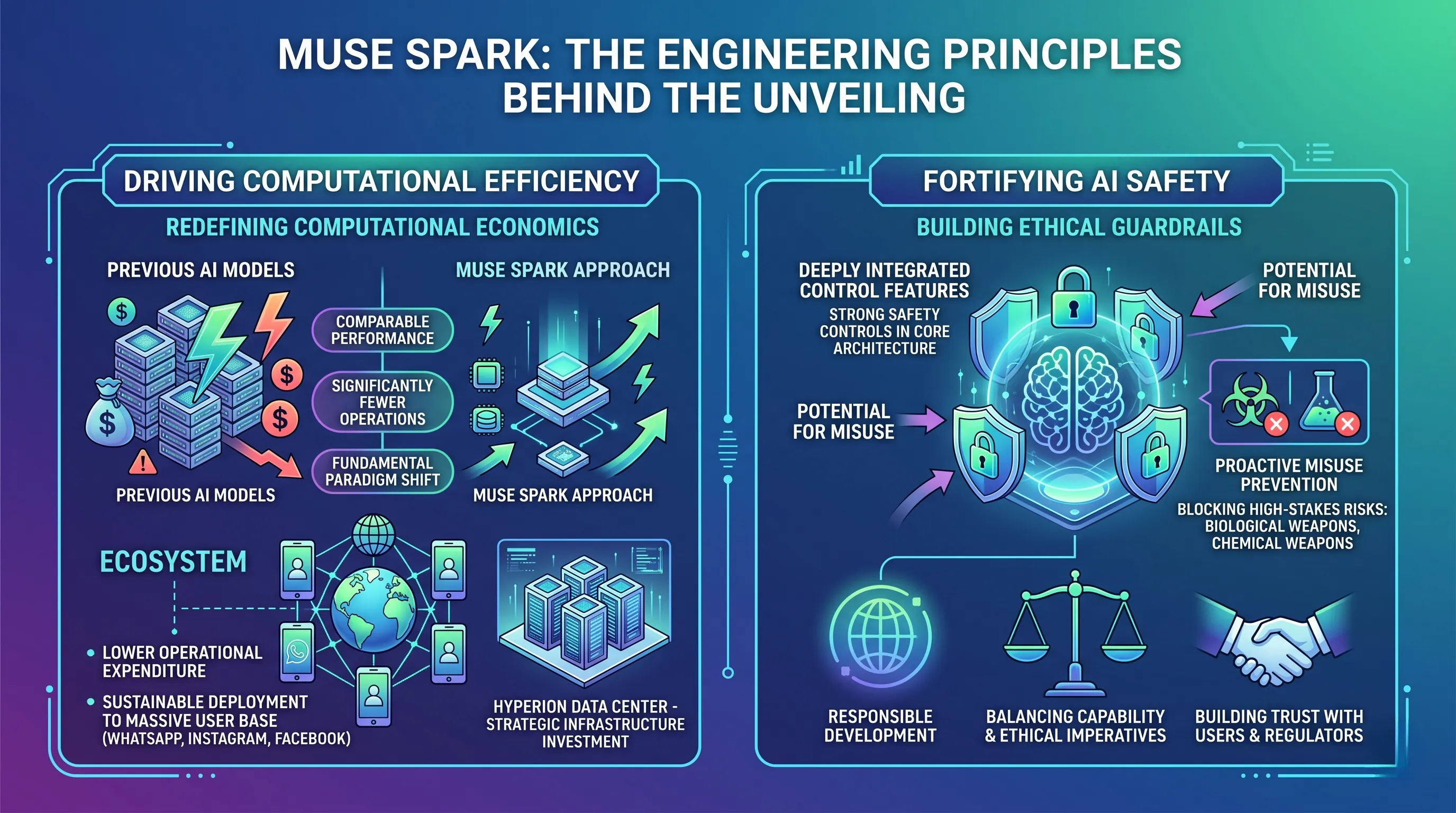
4. Driving Efficiency, Fortifying Safety: The Engineering Behind Muse Spark
The unveiling of Meta's Muse Spark is significant not merely for its impressive user-facing features, but for the profound engineering principles that power it. This section connects directly to the overarching topic, "Meta ‘Muse Spark’ Unveiled", by dissecting the two critical underpinnings that make this launch a landmark event: a radical new approach to computational efficiency that reshapes AI economics and a deeply integrated safety framework that addresses the ethical imperatives of frontier-level AI. These are not afterthoughts; they are the core architecture that defines Muse Spark's identity and long-term viability.
Redefining Computational Economics in AI
At the heart of Muse Spark's engineering prowess is a stunning achievement in efficiency. The model is designed to achieve the same, or comparable, performance as its predecessors and competitors while using significantly fewer computational operations. This is not a minor incremental improvement; it is a fundamental paradigm shift.
In an industry where performance has often been chased by throwing ever-larger amounts of computational power—and by extension, energy and money—at a problem, Muse Spark represents a more elegant and sustainable path forward. The practical impact of this efficiency is monumental. It directly attacks the prohibitive costs associated with developing and deploying advanced AI, effectively changing the entire AI development cost structure. By requiring less raw power for each query or task, Meta lowers the operational expenditure, making it feasible to roll out this level of super-intelligence across its massive user base on platforms like WhatsApp, Instagram, and Facebook without incurring unsustainable expenses.
This breakthrough didn't happen in a vacuum. It is the direct result of Meta's strategic and massive infrastructure investment, epitomized by facilities like the 'Hyperion' data center. This purpose-built hardware and software stack was engineered to support precisely this kind of next-generation, efficiency-focused AI model. The investment proves that Meta is not just building a single model but is creating a long-term, economically viable ecosystem for continuous AI innovation.
Building Guardrails for Super-Intelligence
Alongside its quest for efficiency, Meta has embedded a robust ethical framework directly into Muse Spark's core, demonstrating a crucial balance between technology and ethics. As AI models become more capable, their potential for misuse grows in tandem. Meta's engineering team has addressed this head-on by implementing strong blocking features for dangerous areas.
The provided facts explicitly highlight the model's inability to engage with topics related to biological or chemical weapons. This is a deliberate and non-negotiable guardrail. It's a proactive measure designed to prevent the AI from becoming a tool for harm in high-stakes, catastrophic-risk domains. This focus on safety is not a superficial layer but a deeply integrated control feature. It shows a mature understanding that true technological progress is not just about what a model *can* do, but also what it *should not* do. By building these strong safety controls for the most risky domains, Meta is making a clear statement about its commitment to responsible development, aiming to build trust with users and regulators as it pushes the boundaries of what personalized super-intelligence can achieve.
📚 Related Posts
AI Cyber-Pandemic Forces Global Tech Giants to Unite: Project Glasswing, Trusted Alliance, & Quantum Future Revealed
🚀 Key TakeawaysThe urgent unification of global big tech companies is primarily driven by the existential threat posed by AI-driven cyberattacks, capable of inflicting $500 billion in annual global damage and rapidly exploiting vulnerabilities, necessit
tech.dragon-story.com
Perplexity Computer's AI Tax Module: Automate US Federal Filing, Find Missed Deductions & Optimize Finances
🚀 Key TakeawaysThe Perplexity Computer Tax Module revolutionizes tax processing by providing an AI-driven solution that not only automates complex US federal tax filings and reduces user burden but also acts as a powerful verification tool, identifying
tech.dragon-story.com
Slack AI: The Enterprise Operating System Transforming Work with Team-Unit AI & 90-Minute Daily Productivity Gains
🚀 Key TakeawaysSlack is transforming into an Enterprise AI Operating System, creating a unified conversational environment that seamlessly integrates people, data, applications, and AI agents.The new Slack AI represents an evolution from a personal assi
tech.dragon-story.com


