🚀 Key Takeaways
- Claude Managed Agents dramatically accelerate AI agent development from months to days by automating complex technical infrastructure challenges and significantly improving task success rates, enabling developers to focus purely on core services and user experience.
Claude Managed Agents represent a groundbreaking API set designed to revolutionize the construction and deployment of AI agents, drastically shortening development timelines from months to mere days.
This innovative platform effectively automates intricate technical infrastructure challenges, including security, permission management, and state maintenance, thereby allowing developers to concentrate solely on actual services and enhancing the overall user experience.
Internal tests have already demonstrated a significant over 10% improvement in task success rates compared to prior development methods, underscoring its powerful efficiency.
Available across Claude.ai, Claude Code, and the Claude Agent SDK—supporting Pro, Max, Team, and Enterprise tiers—Claude Managed Agents offer a comprehensive suite of features.
These include the capacity for autonomous task execution for several hours, the ability to maintain progress and state even after interruptions, and robust support for multi-agent collaboration, which facilitates parallel processing and role division for tackling complex tasks.
Furthermore, the platform integrates self-evaluation and iterative improvement capabilities for task results, alongside 'Agent Skills' as reusable modules for consistent agent behavior in production environments.
The real-world impact of Claude Managed Agents is already evident, with companies like Notion, Rakuten, and Asana leveraging the technology for automating code writing, document analysis, and project management tasks, reporting productivity innovation within a week of application.
The updated Claude Agent SDK has also empowered companies like Bolt to build autonomous design system agents and assisted numerous business owners in creating semi-autonomous AI Agents.
Experts widely view this advancement as a crucial step towards AI evolving into collaborative partners, forecasting a rapid increase in sophisticated human-AI collaboration across corporate environments, despite some initial user feedback on the SDK.

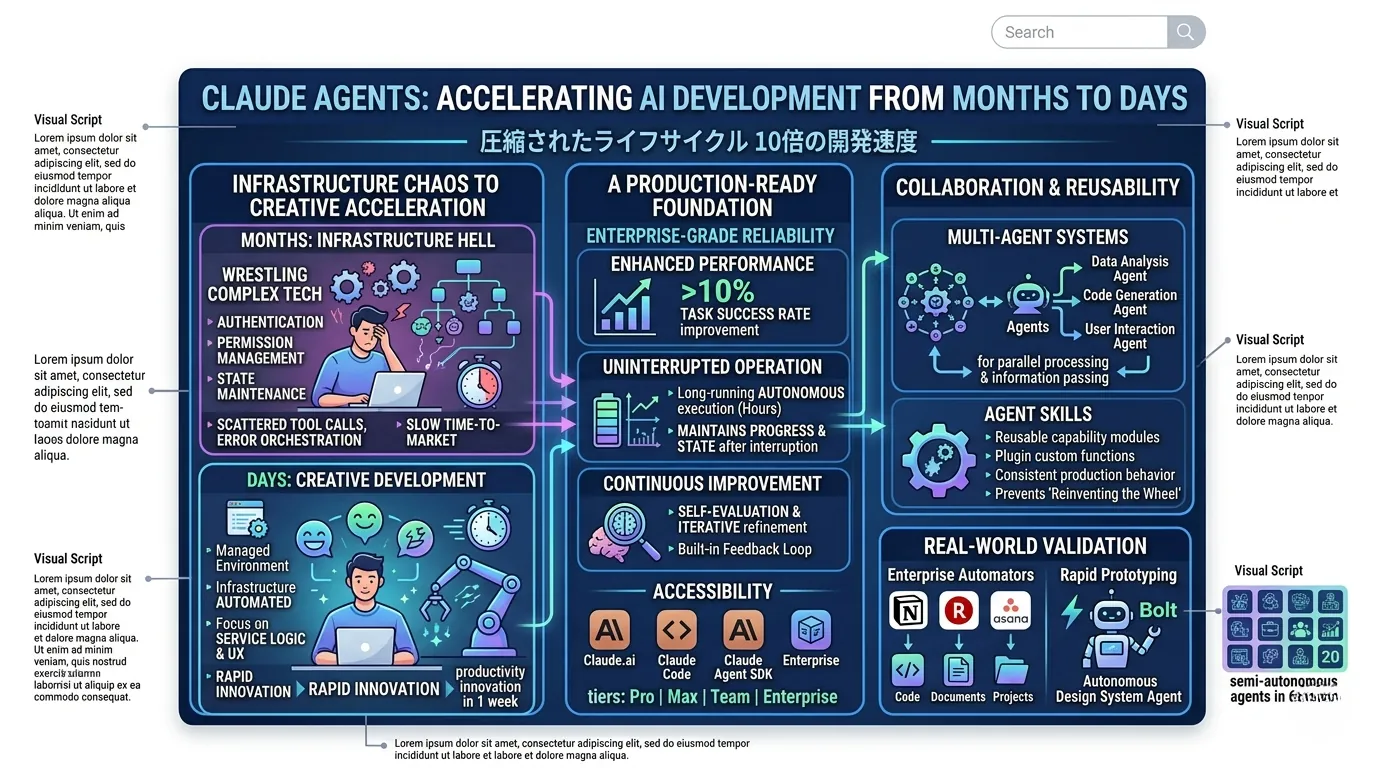
1. Claude Agents: Accelerating AI Development from Months to Days
The central promise of the main topic, "The Emergence of 'Claude Agents' That Boost Development Speed 10x," is not merely a theoretical claim but a practical reality enabled by Claude Managed Agents.
This section delves into the specific mechanisms and architectural choices that transform the AI agent development lifecycle, compressing a process that traditionally took months of painstaking infrastructure work into a matter of days focused on innovation.
From Months of Infrastructure Hell to Days of Creative Development
The most significant bottleneck in deploying robust AI agents has never been the core idea, but the colossal underlying infrastructure required to make it work reliably.
Developers would spend the majority of their time wrestling with complex technical challenges: implementing secure authentication, designing intricate permission management systems, and building resilient state maintenance protocols to handle interruptions and errors.
Claude Managed Agents, an API set for AI agent construction and deployment on a cloud-based platform, systematically dismantles this bottleneck.
It provides a managed environment where these foundational, yet time-consuming, infrastructure challenges are completely automated.
The system itself handles the intricate dance of tool calls, orchestrates error recovery routines, and manages the agent's workflow based on the high-level roles and goals defined by the developer.
This automation is a game-changer.
By abstracting away the low-level plumbing, the platform liberates developers from the undifferentiated heavy lifting of infrastructure management.
Their focus can pivot entirely to what actually creates value: designing the core service logic and perfecting the user experience.
This shift is the primary driver behind the dramatic reduction in development timelines, allowing teams to move from concept to functional agent in a fraction of the time.
We see this validated by businesses reporting tangible productivity innovation within a single week of applying the technology.
A Production-Ready Foundation: More Than Just a Prototype
The speed offered by Claude Agents is not at the expense of quality or reliability; it is built upon it.
The platform is underpinned by a production-ready Claude Agent Architecture, meticulously designed with a focus on real-world operational needs like robustness, cost-efficiency, and observability.
This is not a framework for building fragile prototypes; it's a foundation for deploying dependable, enterprise-grade services.
Key features underscore this production focus:
- Enhanced Performance:
Internal testing has demonstrated a tangible leap in effectiveness, with the new agent-building methods showing over a 10% improvement in task success rate compared to previous approaches.
This means agents are not just built faster, they are more capable and reliable at completing their assigned tasks. - Uninterrupted Operation:
The agents are engineered for long-running, autonomous execution, capable of performing tasks for several hours without human intervention.
Crucially, the system is designed to maintain progress and state even after interruptions, ensuring that a temporary glitch doesn't derail a complex, hours-long process. - Continuous Improvement:
The agents possess capabilities for self-evaluation and iterative improvement, allowing them to refine the quality of their own output.
This built-in feedback loop is essential for tasks requiring high degrees of accuracy and polish.
This robust foundation is made broadly accessible, supported across Claude.ai, Claude Code, and the Claude Agent SDK, with availability spanning the Pro, Max, Team, and Enterprise tiers.
The Claude Agent SDK itself is a mature tool, having received updates for over six months specifically to enhance the agent building and design experience.
The Power of Collaboration and Reusability: Multi-Agent Systems and Skills
Modern challenges are often too complex for a single, monolithic AI.
Recognizing this, Claude Agents are designed for collaboration.
The system can be integrated with powerful orchestration frameworks like LangGraph, enabling the creation of sophisticated multi-agent systems.
This allows developers to assign specialized roles to different agents—one might handle data analysis, another code generation, and a third user interaction—and have them work in parallel, passing information and tasks between them.
This division of labor mirrors a human expert team and is key to tackling multifaceted problems efficiently.
To further accelerate development and ensure consistency, the platform introduces the concept of 'Agent Skills'.
These are reusable capability modules that encapsulate a specific function or behavior.
Instead of reinventing the wheel for every new agent, developers can plug in pre-built or custom-made Skills to ensure consistent, predictable behavior in a production environment.
This modular approach not only speeds up the initial build but also simplifies maintenance and updates over the agent's lifecycle.
Real-World Validation: From Enterprise Giants to Rapid Prototyping
The impact of this accelerated development cycle is not hypothetical; it is being actively demonstrated in the market.
Industry leaders like Notion, Rakuten, and Asana are already leveraging Claude Agents to automate critical business processes, including code writing, complex document analysis, and dynamic project management.
The Claude Agent SDK, despite receiving some critical user feedback such as one user commenting it was "by far my least favorite of them," has also been the catalyst for rapid innovation.
The company Bolt successfully utilized the SDK to build an autonomous design system agent, a highly complex task.
In another powerful example of rapid deployment, a program assisted 20 business owners in building their own semi-autonomous AI Agents within just 6 weeks using the SDK.
These cases validate the core premise: Claude Agents are transforming AI from a long-term research project into a practical tool that can be built, deployed, and deliver value in weeks, not years, directly fueling the expert forecast of a rapid increase in human-AI collaboration within corporate environments.
2. Intelligent Orchestration: Empowering Advanced AI Collaboration and Autonomy
The claim of boosting development speed tenfold is not merely about faster code generation; it's fundamentally rooted in a paradigm shift from simple automation to intelligent, autonomous orchestration. The features within this section are the very mechanisms that transform Claude Agents from a simple tool into a tireless, collaborative digital workforce. By automating not just the tasks but the complex coordination, error handling, and quality control surrounding them, Claude Agents directly address the most time-consuming aspects of development, allowing humans to focus on high-level strategy and user experience. This is how the ambitious goal of shortening development cycles from months to days becomes a tangible reality.
From Solo Workers to a Coordinated Team: Multi-Agent Collaboration
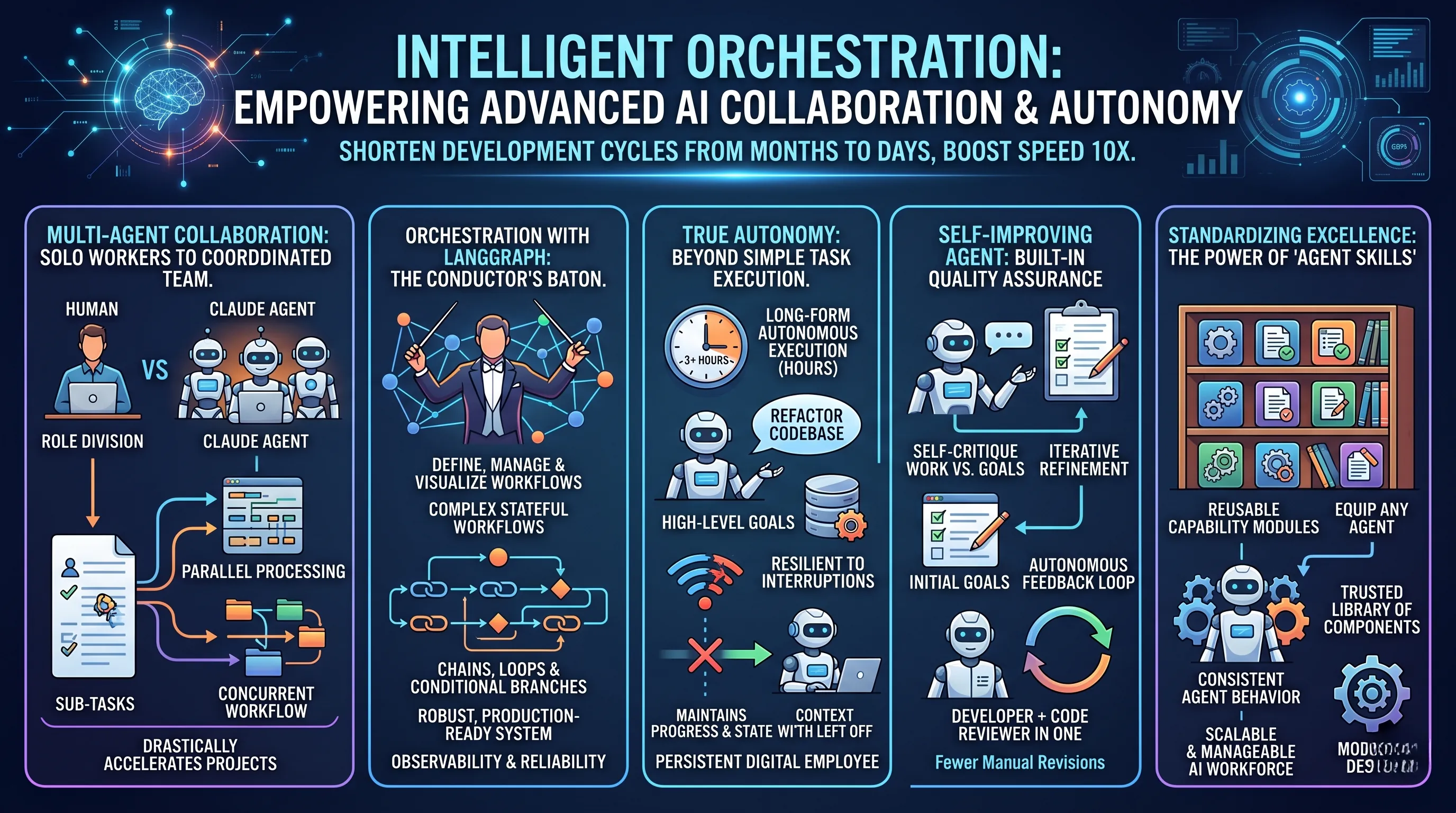
Claude Agents transcend the limitations of single-threaded, monolithic AI. The platform's architecture is built to support sophisticated multi-agent collaboration, a capability that mirrors how high-performing human teams operate. This isn't just about running multiple instances of an agent; it's about creating a synergistic system where different agents can be assigned specific roles, dividing a complex problem into manageable sub-tasks.
Imagine building a new software feature. One Claude Agent could act as the 'Researcher,' scouring technical documentation and user feedback. Simultaneously, another 'Developer' agent could begin scaffolding the code based on initial requirements. A third 'QA' agent could then be tasked with analyzing the code for bugs and inconsistencies. This ability to enable parallel processing and role division is a game-changer. It drastically cuts down the time required to complete complex projects by tackling multiple facets at once, moving away from a linear, step-by-step process to a dynamic, concurrent workflow that dramatically accelerates progress.
The Conductor's Baton: Orchestration with LangGraph
A team of powerful agents is only as effective as its coordination. This is where the platform's native integration capability with LangGraph becomes critical. LangGraph acts as the conductor of this AI orchestra, providing a powerful framework for defining, managing, and visualizing the flow of information and control between different agents. Developers can map out complex, stateful workflows where the output of one agent becomes the input for another, creating sophisticated chains of logic, loops, and conditional branches. This integration moves beyond simple API chaining; it provides a robust, production-ready system for multi-agent orchestration that ensures complex processes are executed reliably and predictably, a cornerstone of the system's enterprise-grade architecture which emphasizes robustness and observability.
True Autonomy: Beyond Simple Task Execution
A key differentiator for Claude Agents is their capacity for genuine, long-form autonomy. The system is engineered for autonomous task execution lasting for several hours. This is a monumental leap from the typical request-response model of most AI interactions. An agent can be given a high-level goal, such as "refactor this entire codebase for performance," and it will work independently for an extended period, methodically executing the necessary steps without constant human intervention.
Even more critically, the system is designed to be resilient. It possesses the crucial ability to maintain progress and state even after interruptions. If a connection drops, a system reboots, or a process is paused, the agent doesn't lose its work. It can resume exactly where it left off, preserving its context and intermediate results. Experientially, this eliminates one of the biggest frustrations of working with automated systems—the fear of losing hours of progress due to a minor glitch. This state maintenance is a core component of its production-ready design, transforming the agent from a fragile script into a persistent, reliable digital employee.
The Self-Improving Agent: Built-in Quality Assurance
To accelerate development, one must also accelerate the quality assurance cycle. Claude Agents internalize this principle through their built-in self-evaluation and iterative improvement capabilities. After producing a result—be it a block of code, a document analysis, or a project plan—the agent can be configured to critique its own work against the initial goals and predefined quality standards. If it identifies shortcomings, it can autonomously initiate another cycle to refine the output. This creates a powerful feedback loop that happens entirely without human involvement, ensuring that the final deliverable is of a higher quality and requires fewer manual revisions. This is like having a developer and a code reviewer in one, a feature that directly compresses the time between initial draft and final product.
Standardizing Excellence: The Power of 'Agent Skills'
As organizations scale their use of AI agents, ensuring consistency and reusability becomes paramount. The introduction of 'Agent Skills' directly addresses this production-level need. 'Agent Skills' are essentially reusable capability modules that can be defined once and then equipped to any agent. For example, a company could create a skill for "generating a quarterly report in the official corporate format" or "performing a security audit on Python code."
By using these pre-built, pre-vetted skills, developers can ensure consistent agent behavior in production environments. It eliminates redundant work and reduces the chance of errors, as new agents can be assembled from a library of trusted components. This is the AI equivalent of software libraries or functions; it promotes modular design, accelerates the development of new, specialized agents, and allows businesses to build a scalable and manageable AI workforce where core competencies are standardized and reliable. This focus on reusability is a key driver in making the construction of complex, production-grade agents a matter of days, not months.
3. Real-World Impact: Driving Business Innovation and Productivity Gains
The promise of accelerating development speed by a factor of ten, as presented by Claude Agents, is not merely a technical benchmark; it is the catalyst for a seismic shift in real-world business operations.
This section delves into the tangible outcomes of that acceleration, showcasing how the ability to rapidly build and deploy sophisticated AI agents translates directly into measurable productivity gains and unlocks new avenues for innovation across the corporate landscape.
The speed isn't the end goal—it's the enabler of immediate, transformative impact.
From Global Giants to Rapid Prototypers: Immediate Productivity Surges
The adoption of Claude Agents is already demonstrating profound effects in established enterprises.
Tech leaders like Notion, Rakuten, and Asana are actively leveraging this technology to redefine their internal workflows.
They are deploying agents for tasks that were once significant drains on human capital, such as automating repetitive code writing, performing deep analysis of vast document repositories, and streamlining complex project management logistics.
The most compelling evidence of this technology's impact is the speed at which it delivers value.
Some businesses have reported experiencing significant productivity innovation within a single week of application.
This represents a paradigm shift from traditional software implementation cycles that often span months or quarters to a new reality where transformative tools can be deployed and yield returns almost instantaneously.
The Autonomous Agent in Action: Bolt's Design System Revolution
Beyond general productivity, Claude Agents are enabling the creation of highly specialized, autonomous systems that solve specific, high-value business problems.
A prime example is Bolt, which utilized the Claude Agent SDK to build an autonomous design system agent.
This is not simply a chatbot; it's a sophisticated agent capable of independently managing and enforcing design consistency across a company's digital products.
Experientially, this means a developer or designer could request a new UI component, and the agent would not only generate the correct code but also ensure it adheres to all brand guidelines, accessibility standards, and existing system architecture—a task that previously required hours of meticulous cross-team collaboration and review.
Bolt's success demonstrates the SDK's power to move beyond simple task automation and into the realm of creating truly autonomous, domain-expert collaborators.
Democratizing AI: From Business Owners to Agent Builders in Weeks
The accelerated development timeline facilitated by Claude Agents is also democratizing access to AI development.
In one notable initiative, 20 business owners were assisted in building semi-autonomous AI Agents within a mere 6 weeks using the Claude Agent SDK.
This is a crucial data point, as it shows the technology is not confined to elite AI research labs.
Instead, it empowers individuals with deep business context—but not necessarily deep coding expertise—to construct functional agents that solve their specific operational bottlenecks.
This rapid, accessible development cycle allows for a level of agility and customization previously unimaginable, turning business leaders into the architects of their own AI-powered solutions.
The Evolving Partnership: AI as Collaborator and Acknowledging the Road Ahead
These real-world applications underscore a broader trend identified by industry experts: the evolution of AI from a passive tool into an active, collaborative partner.
The forecast is for a rapid and substantial increase in human-AI collaboration within corporate environments, where agents take on roles as project managers, researchers, and creative assistants.
However, the path to this future is not without its challenges.
While the outcomes are impressive, the developer experience is still maturing.
Critical user feedback on the Claude Agent SDK, with one developer describing it as "by far my least favorite of them," highlights a crucial area for improvement.
This candid feedback suggests that while the underlying agentic capabilities are powerful, Anthropic has work to do in refining the SDK's usability and ergonomics to truly match the seamlessness of the results it can produce.
This acknowledgment of growing pains is vital, as it frames the technology as a powerful but evolving platform on its way to fulfilling its ultimate promise.

📚 Related Posts
AI Cyber-Pandemic Forces Global Tech Giants to Unite: Project Glasswing, Trusted Alliance, & Quantum Future Revealed
🚀 Key TakeawaysThe urgent unification of global big tech companies is primarily driven by the existential threat posed by AI-driven cyberattacks, capable of inflicting $500 billion in annual global damage and rapidly exploiting vulnerabilities, necessit
tech.dragon-story.com
Perplexity Computer's AI Tax Module: Automate US Federal Filing, Find Missed Deductions & Optimize Finances
🚀 Key TakeawaysThe Perplexity Computer Tax Module revolutionizes tax processing by providing an AI-driven solution that not only automates complex US federal tax filings and reduces user burden but also acts as a powerful verification tool, identifying
tech.dragon-story.com
Slack AI: The Enterprise Operating System Transforming Work with Team-Unit AI & 90-Minute Daily Productivity Gains
🚀 Key TakeawaysSlack is transforming into an Enterprise AI Operating System, creating a unified conversational environment that seamlessly integrates people, data, applications, and AI agents.The new Slack AI represents an evolution from a personal assi
tech.dragon-story.com


