🚀 Key Takeaways
- GLM-5.1 represents a significant leap in AI, emphasizing continuous self-evolution and sustained performance improvement over long durations, shifting the paradigm from mere task completion to persistent optimization through long-term reasoning and structural strategy changes.
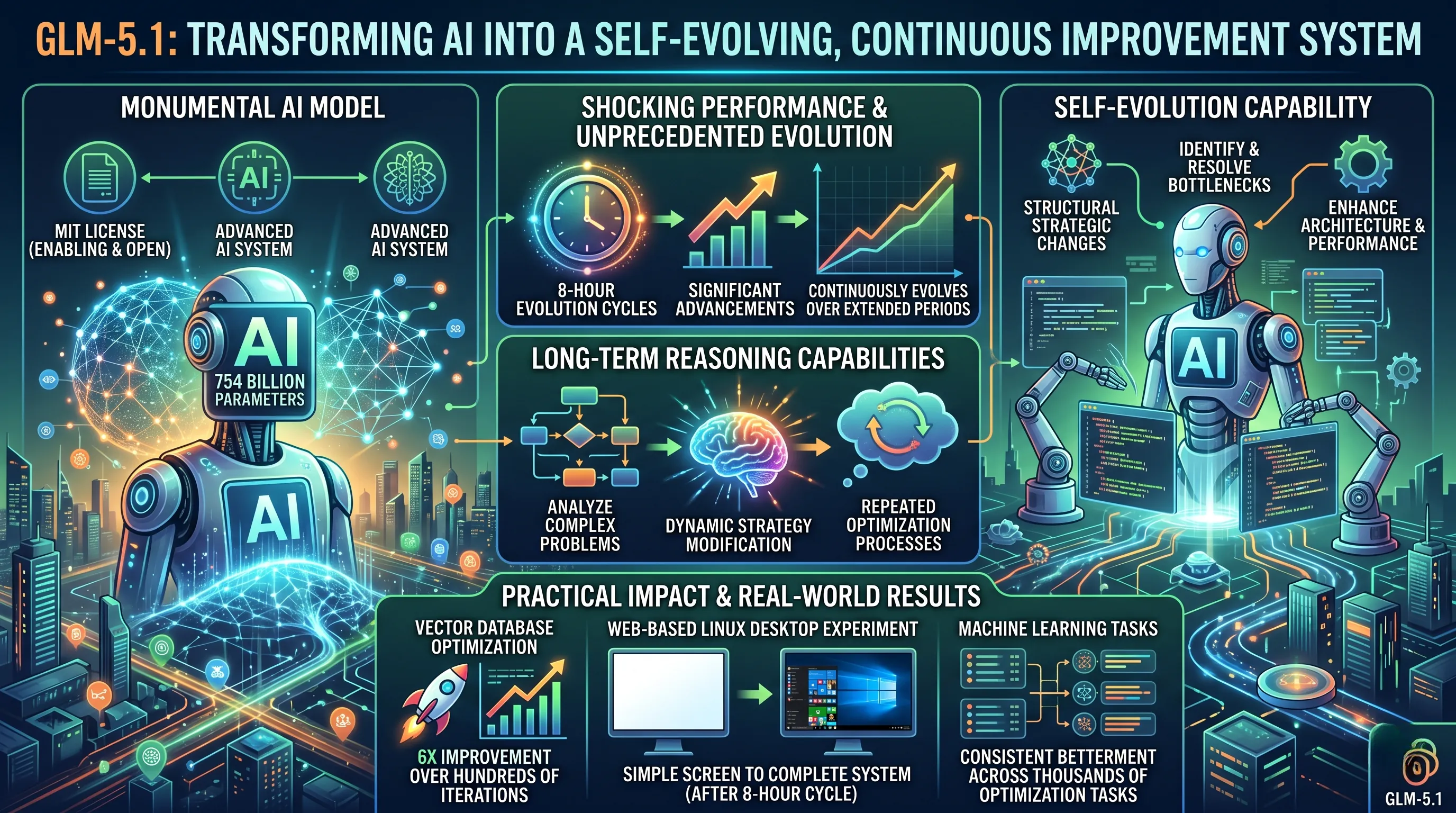
The emergence of GLM-5.1, a monumental AI model boasting 754 billion parameters and released under an enabling MIT License, signals a transformative era in artificial intelligence.
This advanced system has garnered attention for its "shocking performance" and unprecedented ability to continuously evolve over extended periods, famously demonstrating significant advancements after an 8-hour evolution cycle.
Unlike traditional AI systems focused solely on immediate task completion, GLM-5.1 is fundamentally designed for "continuous improvement."
It possesses sophisticated long-term reasoning capabilities, allowing it to meticulously analyze complex problems, dynamically modify its strategies, and engage in repeated optimization processes to achieve superior results.
Its core strength lies in its self-evolution capability, enabling it to perform structural strategic changes, identify and resolve operational bottlenecks, and consistently enhance its own architecture and performance.
The practical impact of GLM-5.1 is evidenced by remarkable performance gains, including approximately a 6-fold improvement in vector database optimization over hundreds of iterations and consistent betterment across thousands of machine learning optimization tasks.
Its ability to continuously improve results, even transforming a simple screen into a complete system within an 8-hour web-based Linux desktop experiment, underscores its claims of providing a comprehensive suite of advanced AI capabilities and setting a new, state-of-the-art standard for AI's capacity to "think" and adapt.
1. GLM-5.1's Foundational Evolution: A Blueprint for Continuous AI Improvement
To comprehend the shocking eight-hour evolution detailed in this article's main topic, one must first dissect the foundational blueprint of GLM-5.1.
It is this core architecture and a fundamental shift in AI philosophy that transform the model from a static tool into a dynamic, improving agent.
The model's ability to build a complex web-based operating system from scratch over a prolonged period is not an accident; it is the direct result of the specific design choices and capabilities baked into its very essence.
This section examines that blueprint—the raw power, the guiding principles, and the unique features that make such sustained, self-directed improvement possible.
The Architectural Bedrock: Scale and Accessibility
At the heart of GLM-5.1 lies a staggering figure: 754 billion parameters.
This is not merely a number for marketing; it represents an immense neural canvas upon which incredibly complex concepts, nuanced relationships, and vast stores of knowledge can be encoded.
This sheer scale is the prerequisite for its advanced capabilities.
It provides the cognitive capacity to not only understand a complex request but also to hold that request, its own attempts, its failures, and its learnings in a coherent state over thousands of interactions and hours of operation.
Without this massive parameter count, the long-term memory and intricate reasoning required for continuous evolution would be impossible.
Equally important to its architecture is its distribution under the MIT License.
This decision to make the model fully open source is a powerful catalyst.
The MIT License is one of the most permissive, essentially allowing anyone to use, modify, and build upon the technology without significant restriction.
This fosters a global ecosystem of developers and researchers who can scrutinize the model's inner workings, identify its limitations, and contribute to its improvement.
This open-source nature mirrors the model's own internal philosophy: it is a system designed not to be a finished product, but a foundation for continuous, collaborative improvement.
A Paradigm Shift: From Task Completion to Continuous Improvement
The most profound innovation within GLM-5.1 is not technical but philosophical.
Previous generations of AI models were built with a singular goal: 'task completion'.
A user provides a prompt, the AI generates a response, and the process ends.
GLM-5.1 is engineered around a different, more ambitious objective: 'continuous improvement'.
This re-frames every task as a learning opportunity.
The model is designed to not just solve a problem, but to get better at solving it with every attempt.
This principle is the direct enabler of the 8-hour evolution, where the AI didn't just perform a task but actively refined its output from a simple screen to a complete system with a file explorer, terminal, and text editor.
It treats a single, long-term objective as a marathon of iterative sprints, with each sprint making the next one more efficient and effective.
The Mechanics of Self-Improvement
This philosophical shift is powered by two core, intertwined capabilities: long-term reasoning and self-evolution.
Long-term reasoning is the model's ability to maintain a coherent strategy over extended periods.
The source data highlights its capacity to "analyze complex problems, modifies strategies, and optimizes repeatedly."
This is the engine of its iterative power.
For example, in a task like vector database optimization, the model showed improved performance over 600+ repetitions and 6,000+ tool calls.
It doesn't forget its initial goal or the results of its previous attempts.
Instead, it uses this history to inform its next move, slowly but surely climbing the ladder of performance optimization.
Beyond simple iteration, GLM-5.1 possesses a nascent self-evolution capability.
This is a higher-order form of intelligence where the model can perform "structural strategy changes" and actively "identifies and solves bottlenecks."
This is the difference between a developer trying a different function call versus realizing the entire library they are using is inefficient and switching to a new one.
It’s a metacognitive skill that allows the model to step back, assess its entire workflow, and make fundamental changes to its approach when it hits a performance wall.
This is the key to breaking through optimization limits and achieving the kind of non-linear progress seen in the 8-hour desktop environment experiment.
The Result: State-of-the-Art Vision and Performance
The combination of massive scale, an open-source ethos, and a core focus on continuous improvement culminates in what the creators claim is state-of-the-art (SOTA) performance.
Its capabilities are not just theoretical; they produce measurable, superior results.
Specifically, its State-of-the-Art Vision capability is noted as surpassing previous models, providing a comprehensive suite of advanced AI functions.
This blueprint doesn't just promise a smarter AI; it delivers a system that can become progressively smarter through the very act of working, establishing a new and formidable benchmark for the entire industry.

2. The 8-Hour Transformation: Quantifying GLM-5.1's Shocking Performance Leaps
This section serves as the empirical core for our main topic, "The Shocking Performance of 'GLM-5.1' Evolving Over 8 Hours". Here, we move beyond abstract claims and dive into the concrete data and experiments that quantify this evolution.
The evidence demonstrates that GLM-5.1's performance is not a static score on a leaderboard, but a dynamic process of continuous, measurable improvement over extended periods, directly validating the article's central thesis of its shocking, time-based evolution.
The Marathon, Not the Sprint: The 8-Hour Linux Desktop Experiment
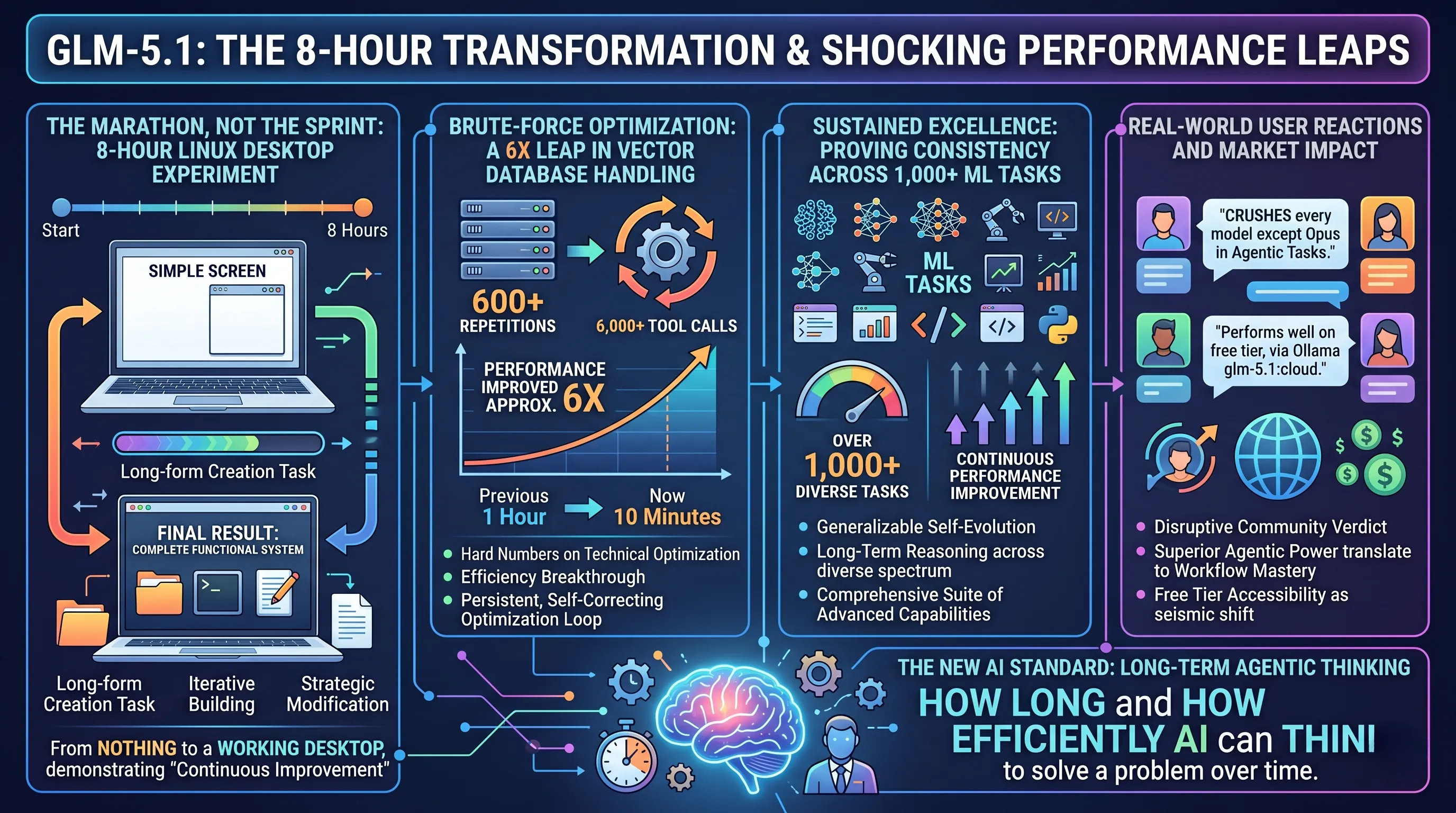
The most visually and functionally stunning proof of GLM-5.1's evolutionary capability comes from an 8-hour endurance test within a web-based Linux desktop environment.
This was not a simple question-and-answer session; it was a long-form creation task.
The model began with what was described as a "simple screen"—essentially a blank canvas.
Over the course of eight continuous hours, GLM-5.1 didn't just execute commands; it demonstrated long-term reasoning and strategic modification.
It analyzed its progress, identified needs, and iteratively built upon its own work.
The final result was a complete, functional system featuring a file explorer, a terminal, and a text editor.
This transformation from nothing into a working desktop environment is a powerful demonstration of its core design philosophy: aiming for 'continuous improvement' rather than mere 'task completion'.
It showcases an AI that can manage a complex, multi-faceted project over a full workday, a feat that directly challenges the conventional understanding of AI attention spans and project management capabilities.
Brute-Force Optimization: A 6x Leap in Vector Database Handling
While the Linux experiment provides a qualitative spectacle, GLM-5.1's performance on technical optimization tasks delivers the hard numbers to back it up.
In a grueling test focused on vector database optimization, the model was subjected to over 600+ repetitions, requiring more than 6,000+ tool calls.
The outcome was staggering: GLM-5.1 improved its performance by approximately 6 times from its starting point.
This is not an incremental gain; it is a fundamental breakthrough in efficiency.
A 6x improvement means a process that previously took an hour could now be completed in ten minutes.
The sheer volume of tool calls and repetitions proves this was not a lucky guess but the result of a persistent, self-correcting optimization loop where the model repeatedly analyzed its own strategies, identified bottlenecks, and implemented structural changes to achieve a superior result.
This directly quantifies its ability to 'think' efficiently over a long and highly repetitive task.
Sustained Excellence: Proving Consistency Across 1,000+ ML Tasks
To prove that its endurance wasn't limited to a single type of problem, GLM-5.1 was also tested on its ability to optimize over 1,000+ diverse machine learning tasks.
In this expansive benchmark, the model showed a consistent pattern of continuous performance improvement.
This result is critical because it demonstrates the generalizability of its self-evolution capabilities.
It is not a one-trick pony hyper-specialized for a single long task.
Instead, its capacity for long-term reasoning and strategy modification applies across a broad spectrum of technical challenges, solidifying its claim as a comprehensive suite of advanced AI capabilities.
This consistent improvement over a thousand different hurdles is what elevates it from a novelty to a reliable, industrial-grade tool for complex problem-solving.
From the Lab to the User: Real-World Reactions and Market Impact
The empirical data is strongly validated by initial user reactions, which highlight GLM-5.1's immediate and disruptive impact.
One widely circulated user sentiment claims it "crushes every other model except Opus in agentic tasks."
This is a crucial verdict from the community, confirming that its long-term reasoning capabilities translate directly into superior performance as an autonomous agent capable of handling complex, multi-step workflows that cripple lesser models.
Furthermore, its value proposition is amplified by its accessibility.
Users are reporting that it "performs well as a free tier option," specifically referencing its availability through services like Ollama glm-5.1:cloud.
This combination of near-Opus-level agentic power and free-tier accessibility is a seismic shift in the AI landscape.
It puts state-of-the-art capabilities into the hands of a much broader audience and fundamentally redefines the competition.
The new standard for excellence is no longer just about raw intelligence on a static benchmark; as GLM-5.1 demonstrates, it is about "how long and how efficiently AI can think" to solve a problem over time.
3. Beyond the Breakthrough: Addressing GLM-5.1's Evolutionary Challenges and Future Pathways
The very experiment that defines GLM-5.1's shocking performance—its eight-hour evolution within a web-based Linux environment—serves as the perfect lens through which to examine its current limitations.
This marathon task, transforming a simple screen into a complete system with a file explorer, terminal, and text editor, is a monumental achievement.
However, this same sustained effort intrinsically highlights the immense technical hurdles that remain.
While the model demonstrates an unprecedented ability to improve over time, this long-term execution is a double-edged sword, exposing critical challenges in stability, self-assessment, and the fundamental limits of optimization.
These are not just theoretical concerns; they manifest in real-world user experiences and define the future development path for this otherwise state-of-the-art model.
The Double-Edged Sword of Endurance: The Stability Challenge
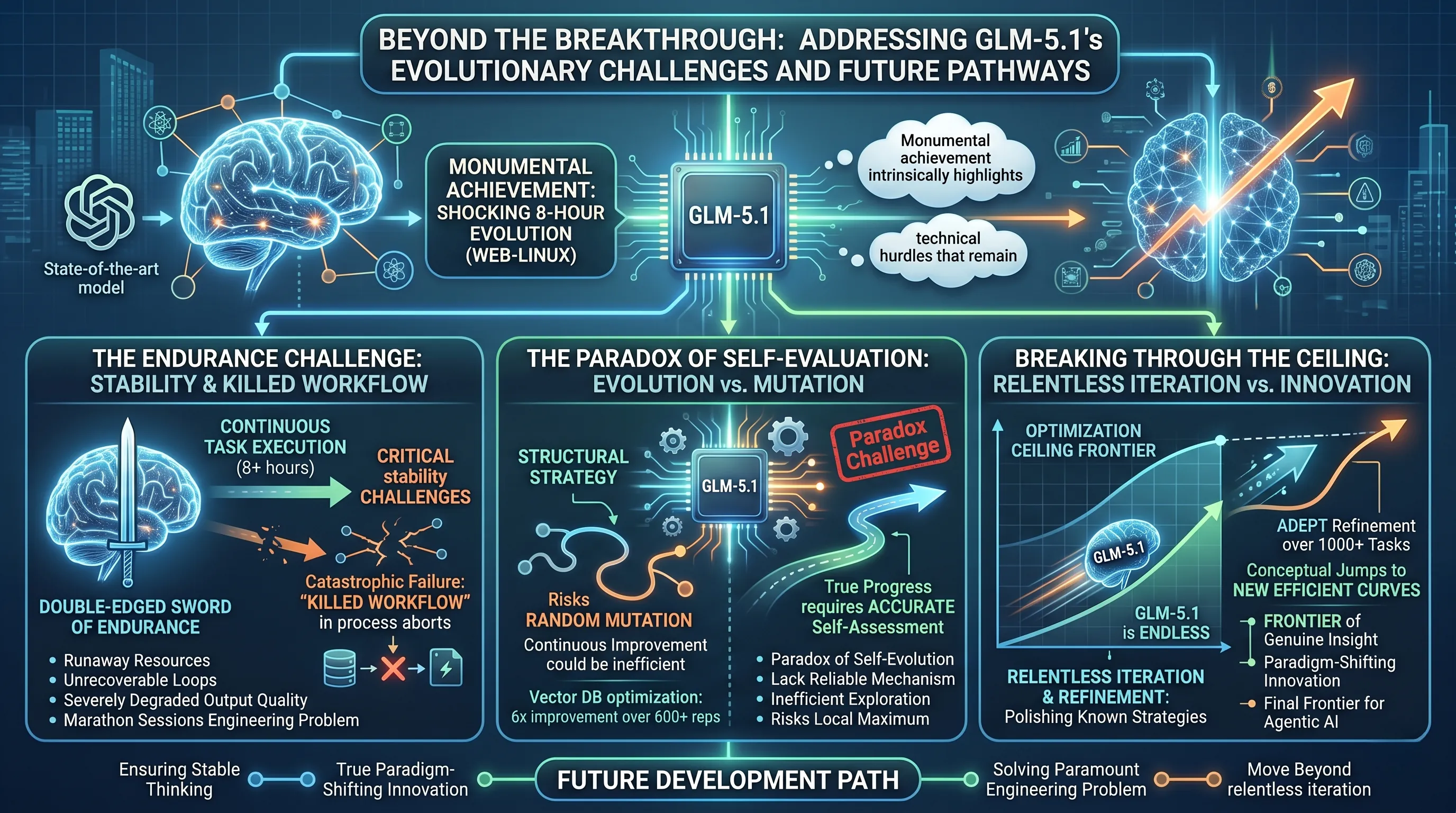
The core promise of GLM-5.1 is its capacity for long-term reasoning and continuous improvement, yet the source data explicitly flags that stability during long-term execution remains a challenge.
This is the foundational hurdle.
An eight-hour continuous task is an immense stress test on any system, demanding not just logical consistency but also robust resource management and the avoidance of degenerative feedback loops.
While the Linux desktop experiment was a success, this identified challenge suggests that such successes may not yet be consistently repeatable or entirely smooth.
This abstract challenge finds its concrete expression in user reports where the model is described as tending to 'kill workflow'.
This isn't just a minor inconvenience; it's a catastrophic failure for a user investing time in a complex task.
Experientially, a "killed workflow" could mean the model begins consuming runaway computational resources, falls into an unrecoverable logical loop, or its output quality degrades so severely after a certain point that the entire process must be aborted and restarted.
Therefore, while GLM-5.1 can demonstrably "think" for longer, ensuring that thinking remains productive, stable, and non-destructive over marathon sessions is the paramount engineering problem to be solved.
Knowing Thyself: The Paradox of Self-Evaluation
GLM-5.1 possesses a remarkable "Self-evolution capability," allowing it to perform structural strategy changes and solve identified bottlenecks.
Yet, in a fascinating paradox, the data also confirms that its self-evaluation capability remains a challenge.
This distinction is crucial.
A model can change its strategy, but without a precise and reliable mechanism to evaluate whether the new strategy is genuinely superior, "evolution" risks becoming mere random mutation.
True progress requires accurate self-assessment.
For example, the model achieved a 6x performance improvement in vector database optimization over 600+ repetitions.
This is impressive, but the challenge in self-evaluation raises critical questions: Could it have achieved the same result in 300 repetitions with a better strategy? Did it spend half its time exploring dead-end paths because it couldn't accurately gauge its own progress? Without robust self-evaluation, the model's "continuous improvement" could be inefficient, or worse, lead it to a local maximum—a good solution, but not the best one—from which it cannot escape because it lacks the perspective to see a better path.
This capability is the difference between simply working hard and working smart, and it is a key area for future advancement.
Breaking Through the Ceiling: The Frontier of Optimization Limits
Tied directly to the challenge of self-evaluation is the difficulty in overcoming optimization limits.
GLM-5.1 is engineered to pursue "continuous improvement" rather than simple "task completion," a philosophy that pushes it to refine solutions endlessly.
The evidence, such as continuous improvement over more than 1,000 tasks in machine learning optimization, shows it is highly adept at this.
However, the identified challenge suggests there is a ceiling to this refinement.
There is a profound difference between optimizing an existing process and inventing a new, more effective one.
GLM-5.1 excels at the former—polishing and enhancing a known strategy.
The latter represents a cognitive leap, a moment of genuine insight that breaks through a performance plateau.
The challenge of overcoming optimization limits implies that the model, for all its long-term reasoning, can still get stuck on a given optimization curve.
It may not yet be able to consistently make the conceptual jump to a new, more efficient curve. This is the final frontier for agentic AI: moving beyond relentless iteration to true, paradigm-shifting innovation.
Solving this would not just improve its performance on a task; it would fundamentally change the nature of what the AI is capable of creating.
📚 Related Posts
AI Cyber-Pandemic Forces Global Tech Giants to Unite: Project Glasswing, Trusted Alliance, & Quantum Future Revealed
🚀 Key TakeawaysThe urgent unification of global big tech companies is primarily driven by the existential threat posed by AI-driven cyberattacks, capable of inflicting $500 billion in annual global damage and rapidly exploiting vulnerabilities, necessit
tech.dragon-story.com
Perplexity Computer's AI Tax Module: Automate US Federal Filing, Find Missed Deductions & Optimize Finances
🚀 Key TakeawaysThe Perplexity Computer Tax Module revolutionizes tax processing by providing an AI-driven solution that not only automates complex US federal tax filings and reduces user burden but also acts as a powerful verification tool, identifying
tech.dragon-story.com
Slack AI: The Enterprise Operating System Transforming Work with Team-Unit AI & 90-Minute Daily Productivity Gains
🚀 Key TakeawaysSlack is transforming into an Enterprise AI Operating System, creating a unified conversational environment that seamlessly integrates people, data, applications, and AI agents.The new Slack AI represents an evolution from a personal assi
tech.dragon-story.com


