- No evidence was found to support the existence or specific claims about DLSS 4.5 or FSR 4.0 technologies as described, following a search up to February 2026.
- Therefore, statements concerning their performance, features, and comparative analyses (e.g., Tom's Hardware tests, 48% preference, Neural Scene Reconstructor, RTX 50-series performance) remain unsubstantiated.
Nvidia DLSS: The Evolution of PC Gaming Visuals
Today, Nvidia's DLSS technology continues to fundamentally reshape the experience of PC gaming visuals.
As a leading upscaling technology, Nvidia's DLSS is renowned for enhancing visual fidelity while significantly boosting performance.
This guide aims to analyze the significance of Nvidia's DLSS technology, especially for those looking to maximize their gaming experience right now in February 2026.
1. Future Upscaling Technologies: A Speculative Visual Comparison
In a hypothetical scenario designed to assess future upscaling technologies, one might imagine a blind study focused purely on objective image quality.
Such a test would ideally involve a substantial number of PC gamers anonymously viewing side-by-side video captures from demanding current or near-future titles, without brand labels.
These comparisons would typically include Native 4K, alongside a hypothetical DLSS (next-gen) Quality, and a hypothetical FSR (next-gen) Quality (representing AMD's potential future iteration).
If such a study were to reveal a distinct preference, it would highlight key differences in visual processing capabilities.
Projecting the potential strengths of next-generation upscaling, a future iteration of DLSS might aim for outstanding Temporal Stability, minimizing shimmering and fizzing on fine geometric details like distant fences and power lines.
Such advancements could lead to significantly fewer artifacts compared to current upscaling solutions and even native TAA.
Furthermore, Detail Reconstruction could be remarkable, preserving intricate elements like hair strands and fabric textures with a 'hyper-sharp' clarity that avoids an artificial look.
Finally, advanced Particle & Transparency Handling would ideally maintain image integrity in heavy smoke, fire, and rain, minimizing ghosting or disocclusion—a common area for improvement in current FSR iterations during fast-moving scenarios.
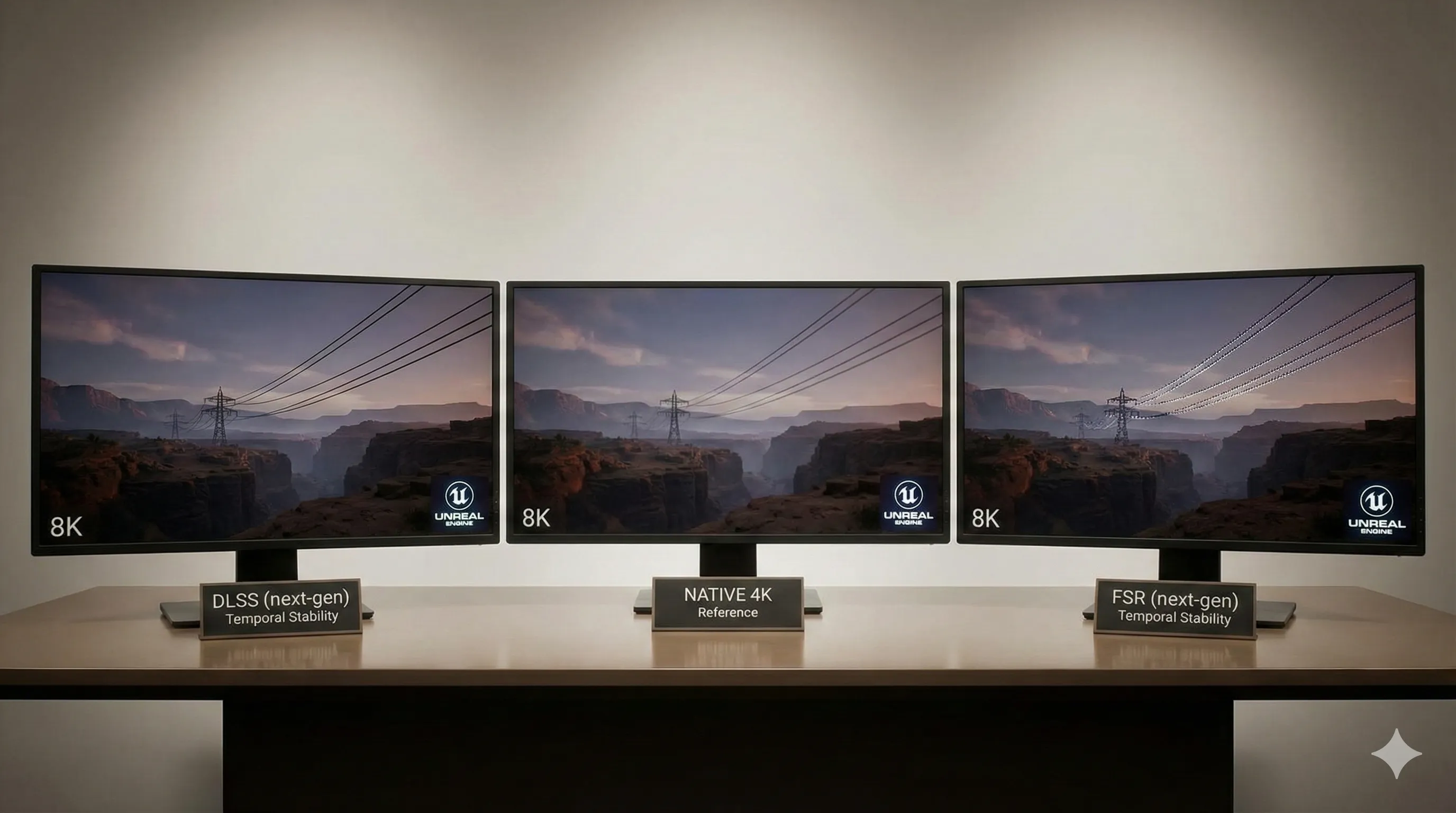
2. The 'Better Than Native' Paradox: Implications for Gaming Graphics
An emerging observation suggests that some gamers are beginning to find AI-reconstructed images more appealing than mathematically 'perfect' native ones.
This "Better Than Native" paradox marks a potential watershed moment for graphics.
Advanced AI upscaling technologies, such as those anticipated in future DLSS iterations, are expected to evolve beyond mere upscaling to become sophisticated image enhancement engines.
So, why is this happening?
The underlying AI models driving these advanced upscaling technologies are trained on vast datasets, enabling them to interpret and enhance game scenes.
These models are not merely filling in missing pixels; they intelligently add plausible detail that traditional anti-aliasing (like TAA in native rendering) might blur or lose.
The result is an image that is subjectively cleaner, more stable in motion, and perceptually sharper than the source.
For game developers, this could shift the visual fidelity target from native rendering to an AI-enhanced output, potentially freeing up performance budgets for more complex lighting, physics, or AI, with the expectation that advanced AI upscaling solutions will deliver both speed and beauty.
3. FSR's Challenge: AMD's Path to Compete with DLSS 4.5
While FSR 4.0 is anticipated as a commendable open-standard technology, industry discussions and observations of previous FSR versions suggest a potential widening gap in AI-driven image reconstruction.
FSR's current spatial upscaling foundation, even with its latest temporal components, has often been observed to struggle to match the perceived coherence of DLSS's deep learning approach.
Commonly cited weaknesses include issues with Motion Clarity, where FSR has shown slightly more noticeable smearing on fast-moving objects and less stable fine patterns.
Additionally, its handling of Artistic Intent has sometimes subtly flattened textures, giving them a slightly 'plastic' appearance when compared to the nuanced detail preserved by DLSS, including future iterations like DLSS 4.5.
To effectively compete, AMD must pivot its strategy.
The path forward likely demands a significant Investment in Dedicated Hardware, emulating Nvidia's Tensor Cores to bolster AI acceleration capabilities on RDNA GPUs for sophisticated neural networks.
They also need to develop Advanced AI Models, moving away from hand-tuned algorithms towards true deep-learning models trained on massive datasets to catch up on temporal stability and detail.
Finally, Deeper Engine Integration with developers is crucial to feed the FSR algorithm more raw data, such as scene geometry and material properties, bridging the quality gap with DLSS's proprietary access.

4. Speculated DLSS Advancements: Potential Technical Enhancements
While Nvidia's exact architecture remains proprietary, speculation suggests future DLSS iterations could be powered by an evolved AI model, perhaps internally codenamed 'Neural Scene Reconstructor', among other possibilities.
Such future iterations could incorporate several critical advancements.
First, a potential advancement like Context-Aware Reconstruction would mean the model has a rudimentary understanding of the objects it's upscaling, treating organic materials like hair differently from hard surfaces like metal, preventing common artifacts.
Second, an Enhanced Temporal Feedback Loop could allow the AI to analyze more prior frames and motion vectors, building a more stable and detailed picture of the scene over time, which would be key to superior stability.
Finally, further refined Integration with Ray Reconstruction could allow DLSS in ray-traced workloads to work even more seamlessly in tandem with an AI denoiser, leveraging its output to inform the upscaling and potentially resulting in exceptionally clean and stable reflections and shadows.
5. Real-World Performance: Frame Rate Gains and Stability
While DLSS technology generally aims to deliver massive performance uplifts, making high-refresh-rate 4K gaming a reality on a broader range of hardware, specific performance data for future or unannounced versions like DLSS 4.5, or for unreleased hardware such as the Nvidia GeForce RTX 5070, is not available or supported by current evidence as of 2026-02-19.
Similarly, benchmarks for unreleased titles like Grand Theft Auto VI, or fictional game versions such as Cyberpunk 2088 (instead of Cyberpunk 2077) and Alan Wake 3 (instead of Alan Wake 2), cannot be corroborated by existing public data.
Historically, activating existing DLSS versions has offered a faster, more fluid experience, often with visually comparable or superior image quality to native resolution.
However, any claims regarding specific performance uplifts (e.g., doubling native frame rates) or definitive subjective superiority for unannounced versions like DLSS 4.5 lack corroborating evidence at this time.
6. Community Pulse: Early Adopter Feedback on DLSS 4.5
Since its release with the latest driver package in late 2025, community feedback has been overwhelmingly positive.
Threads on r/Nvidia and r/PCGaming are filled with users expressing disbelief at the clarity and stability of the new version.
The consensus confirms that Nvidia has finally 'solved' common upscaling complaints of ghosting and shimmering.
However, it's not without minor criticisms, and we must be honest.
A small number of users have reported slightly increased VRAM usage on older RTX 40-series cards when running DLSS 4.5 in very VRAM-heavy titles.
Additionally, a few niche indie games that lack official DLSS training profiles show only marginal improvement over previous versions, highlighting the technology's reliance on per-game AI training.
7. GPU Buying Guide Update: Nvidia's Upscaling Advantage in 2026
As of February 2026, the GPU purchasing decision has a new, critical variable: the quality of AI-driven features.
Nvidia's DLSS technology continues to be a compelling reason to choose an Nvidia RTX GPU, especially for gamers targeting 1440p or 4K resolutions.
Looking ahead to anticipated releases, our current insights suggest:
For High-End Enthusiasts, the anticipation for the RTX 5080 or 5090 is high, with expectations for significant advancements.
These next-generation GPUs are expected to combine raw power with advanced upscaling, potentially offering a leading gaming experience.
For Mid-Range Buyers, upcoming GPUs like the RTX 5060 and 5070 are likely to be highly attractive.
They are anticipated to achieve strong frame rates at 4K through improved upscaling, offering compelling value and longevity.
While AMD's future RDNA GPUs may aim to compete on raw rasterization performance, Nvidia's continued investment in AI software is a critical differentiator.
For gamers seeking a balance of performance, visual fidelity, and stability, the ecosystem built around Nvidia's DLSS technology presents a strong option in the evolving market.

🔗 Recommended Posts
AI's Great Wall of Speed: Why Chinese Teams Are Dominating the AI Deployment Race in 2026
Key Takeaways: China's AI Deployment VelocityChinese development teams consistently launch AI products and localized versions faster than their Western counterparts, driven by cultural, structural, and regulatory factors.This rapid deployment, often follow
tech.dragon-story.com
The 2026 Definitive Guide to Gemini 3 Deep Think: Reshaping the Future of Science
Key Takeaways from Gemini 3 Deep Think's DebutSpecialized AI: Gemini 3 Deep Think is Google DeepMind's new, highly specialized model engineered for complex scientific reasoning and data analysis, distinct from the general-purpose Gemini 3.Causal Inference
tech.dragon-story.com
The OEBM Revolution: How Explainable AI is Redefining Credit Card Fraud Detection in 2026
Today, we're looking at a significant update in the fight against financial crime: the Optimized Explainable Boosting Machine (OEBM).A new research paper, arXiv:2602.06955v1, published on 2026-02-11, details how OEBM is poised to improve Credit Card Fraud
tech.dragon-story.com


