🚀 Key Takeaways
- OpenAI has unveiled three new real-time voice AI models (GPT-Realtime-2, GPT-Realtime-Translate, and GPT-Realtime-Whisper) designed to significantly elevate AI capabilities from simple chatbots to intelligent agents capable of understanding, reasoning, and performing complex tasks through natural voice interactions.
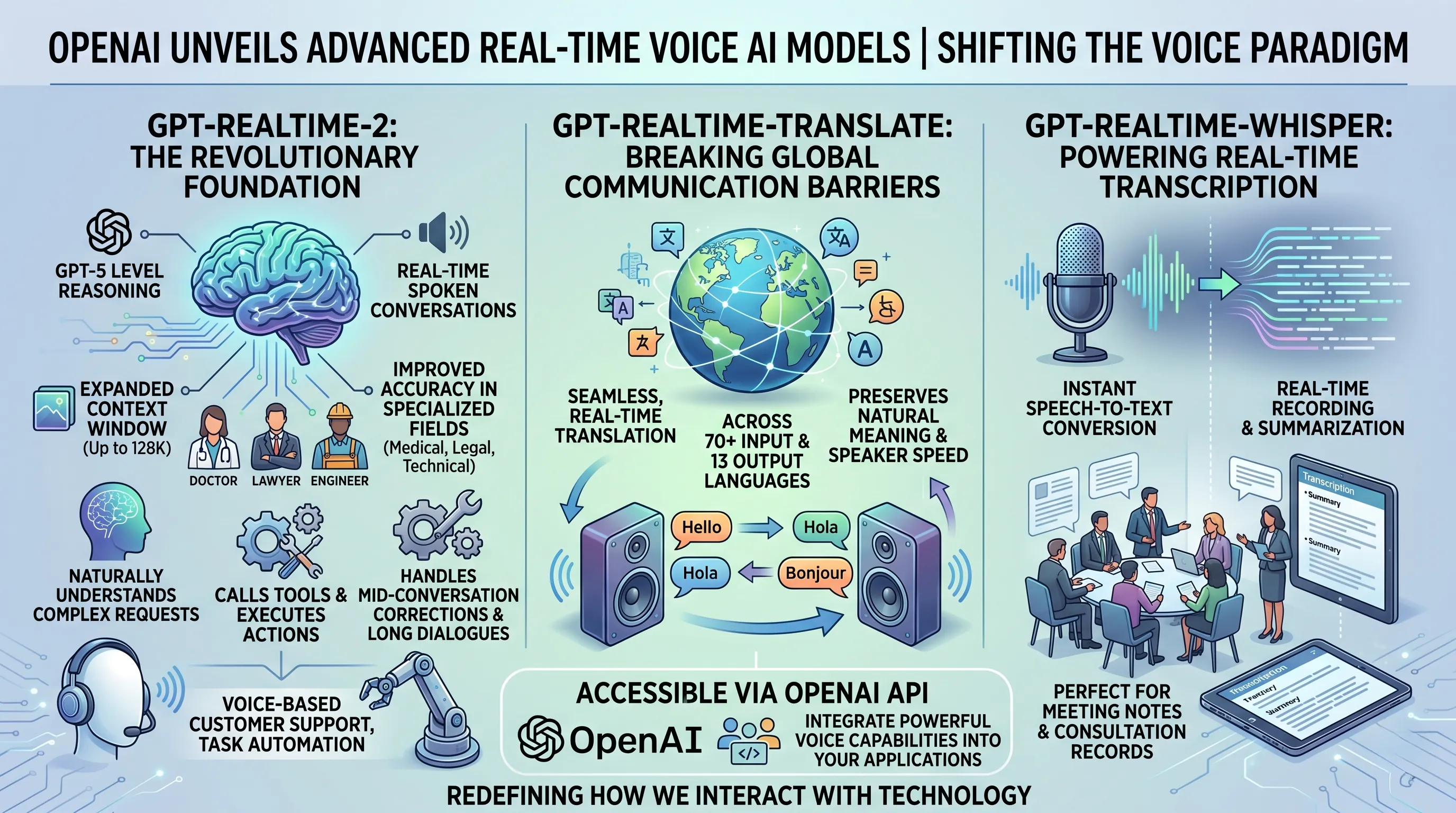
OpenAI has made a groundbreaking announcement, unveiling three advanced real-time voice AI models: GPT-Realtime-2, GPT-Realtime-Translate, and GPT-Realtime-Whisper.
This release marks a pivotal moment, shifting the paradigm of voice AI from basic chatbot interactions to sophisticated agents capable of real-time reasoning, translation, transcription, and action execution.
These innovations are poised to fundamentally transform human-AI interaction, establishing voice as a primary interface for intelligent systems to comprehend, evaluate, and fulfill user requests.
At the forefront is GPT-Realtime-2, a revolutionary voice model that brings GPT-5 level reasoning capabilities directly into real-time spoken conversations.
It boasts an expanded context window of up to 128K and significantly improved accuracy in specialized fields such as medical, legal, and technical domains.
This allows the model to naturally understand complex user requests, call various tools, handle mid-conversation corrections, and maintain long, coherent dialogues, enabling advanced applications like voice-based customer support and task automation.
Complementing this, GPT-Realtime-Translate offers seamless, real-time translation across 70+ input and 13 output languages, preserving natural meaning and speaker speed, thus breaking down global communication barriers.
Simultaneously, GPT-Realtime-Whisper provides instant speech-to-text conversion, enabling real-time recording and summarization of conversations, perfect for meeting notes or consultation records.
Together, these models are accessible via the OpenAI API, inviting developers worldwide to integrate these powerful, natural, and intelligent voice capabilities into their applications and redefine how we interact with technology.
1. OpenAI's New Real-time Voice AI Trio: A Paradigm Shift for Agents
This section delves into the very heart of the main topic, "OpenAI, Unveils 3 Next-Generation Real-time Voice AI Models".
We will break down the three revolutionary models that constitute this announcement: GPT-Realtime-2, GPT-Realtime-Translate, and GPT-Realtime-Whisper.
This trio represents more than an incremental update; it signals a fundamental evolution of voice AI, elevating it from the level of a conversational chatbot to a true, task-oriented agent.
OpenAI is making this groundbreaking technology available to developers worldwide via its API, setting the stage for a new generation of voice-first applications.
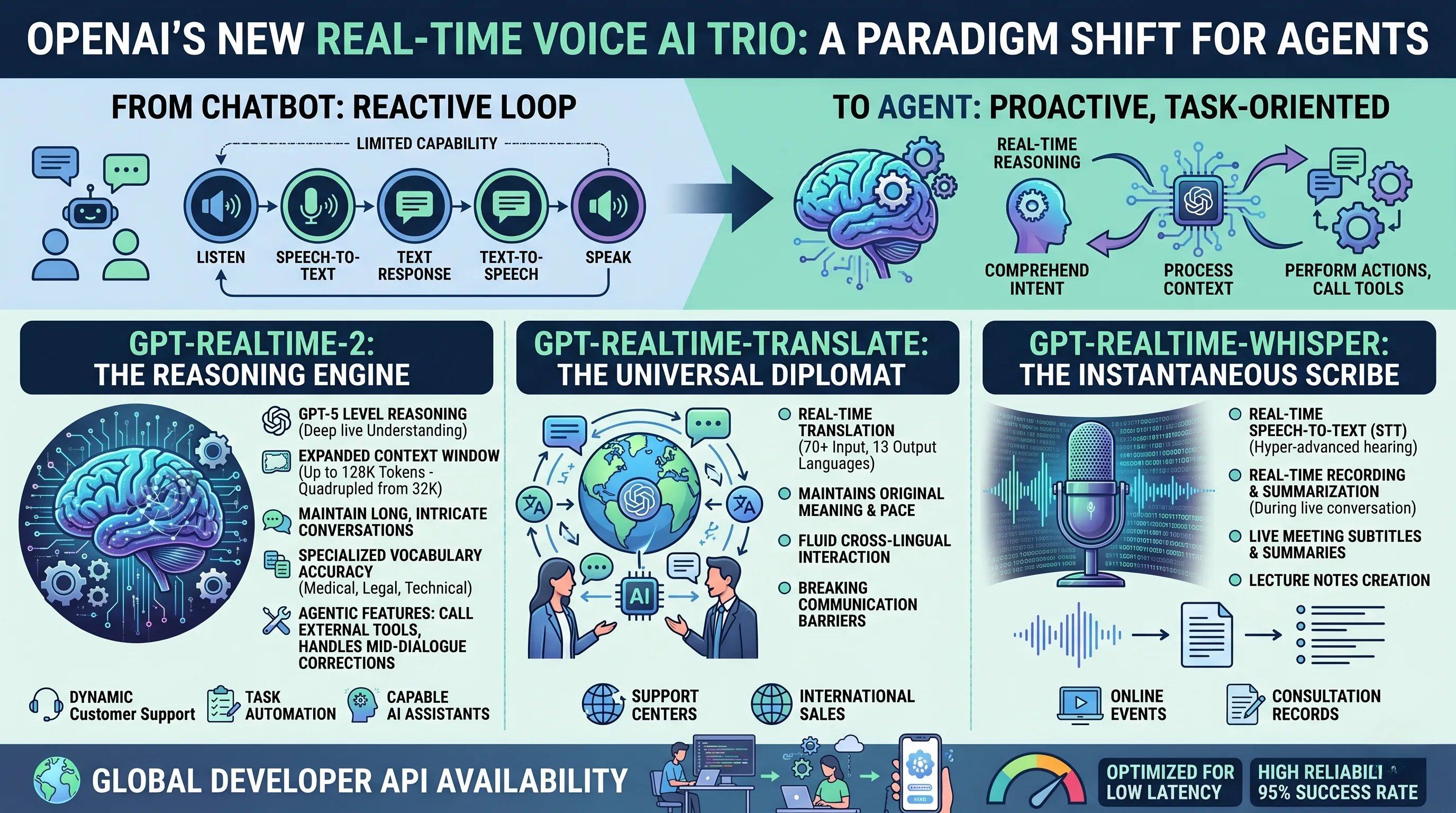
From Chatbot to Agent: The Core Revolution
The most significant leap forward presented by this new suite is the transition from a simple "chatbot" to a functional "agent".
A traditional voice chatbot listens, converts speech to text, generates a text response, and converts it back to speech.
It's a reactive loop.
An AI "agent," powered by this new real-time trio, does far more.
It engages in real-time reasoning, understands complex user intent, processes information contextually, and, most importantly, can perform actions by calling tools or APIs.
This is the difference between asking an AI "What is the weather?" and saying, "It looks like it's going to rain, please book me a taxi to the office in 15 minutes and add the cost to my expense report." The latter requires understanding, planning, and execution—the hallmarks of an agent.
GPT-Realtime-2: The Reasoning Engine
At the core of this new agent-like capability is GPT-Realtime-2.
It is the first real-time voice model to possess a reasoning ability on par with GPT-5, allowing for an unprecedented depth of understanding in live conversation.
Its power is further amplified by a massively expanded context window, which has been quadrupled from 32K to 128K tokens.
Experientially, this means the AI can maintain long, intricate conversations without losing track of details mentioned minutes earlier, making interactions feel far more human and less prone to frustrating "memory lapses".
Furthermore, GPT-Realtime-2 has been trained to have a more accurate understanding of specialized vocabularies in the medical, legal, and technical fields, opening the door for professional-grade voice agents.
Its key agent-like features include the ability to not just understand a user's request, but to call external tools to fulfill it, naturally handle mid-conversation corrections, and process additional instructions without breaking the conversational flow.
This makes it ideal for sophisticated applications like dynamic voice-based customer support, hands-free task automation, and truly capable personal AI assistants.
GPT-Realtime-Translate: The Universal Diplomat
Breaking down language barriers in real-time is the mission of GPT-Realtime-Translate.
This model functions as a real-time translation engine, capable of processing over 70 input languages and converting them into 13 output languages.
Its true strength lies not just in its breadth but in its quality.
The model is engineered to maintain the original sentence's meaning and nuance, translating naturally at the speaker's own pace.
This eliminates the awkward, stilted pauses common in older translation technologies, creating fluid, uninterrupted cross-lingual conversations.
The applications are immense, ranging from global customer support centers and international sales calls to multilingual education and live online events where language is no longer a barrier to participation.
GPT-Realtime-Whisper: The Instantaneous Scribe
The foundation of any voice AI is its ability to hear accurately, and GPT-Realtime-Whisper serves as the system's hyper-advanced ears.
As a real-time Speech-to-Text (STT) model, it instantly converts spoken words into written text.
However, its capabilities extend beyond simple transcription.
GPT-Realtime-Whisper can perform real-time recording and summarization *during* a conversation.
Imagine a world where meeting subtitles are generated live, lecture notes are automatically created and summarized as the professor speaks, and customer consultation summaries are ready the moment a call ends.
This functionality makes it an indispensable tool for generating live broadcast subtitles and any application requiring immediate, accurate documentation of spoken language.
Performance and Real-World Viability
For any real-time system, latency is paramount.
OpenAI reports that a well-optimized pipeline using these models can achieve an end-to-end latency of typically 500-800ms, a range that feels natural and responsive in human interaction.
In tested benchmarks, the OpenAI Realtime API itself clocked a latency of 1313 ms, which, while highly functional, is higher than some competitors like Dasha (975 ms) and Telnyx (1070 ms).
However, the effectiveness of the underlying intelligence is staggering.
After prompt optimization on OpenAI's hardest adversarial benchmark, the models achieved a 95% call success rate, a monumental 26-point lift from the previous 69%.
This single statistic demonstrates a dramatic increase in reliability and task completion, proving these models are not just a technical curiosity but a robust solution ready for deployment.
2. Deep Dive into Each Model's Capabilities and Specifications
Connecting directly to the main announcement of "OpenAI, Unveils 3 Next-Generation Real-time Voice AI Models," this section will dissect the technical specifications and unique capabilities of each of the three groundbreaking models. Understanding these details is crucial to grasping why this release represents a significant leap from simple voice assistants to sophisticated, task-oriented AI agents capable of performing actual tasks.
GPT-Realtime-2: The Conversational Brain with GPT-5 Level Reasoning
At the heart of this new suite is GPT-Realtime-2, a model that fundamentally redefines the intelligence ceiling for voice AI.
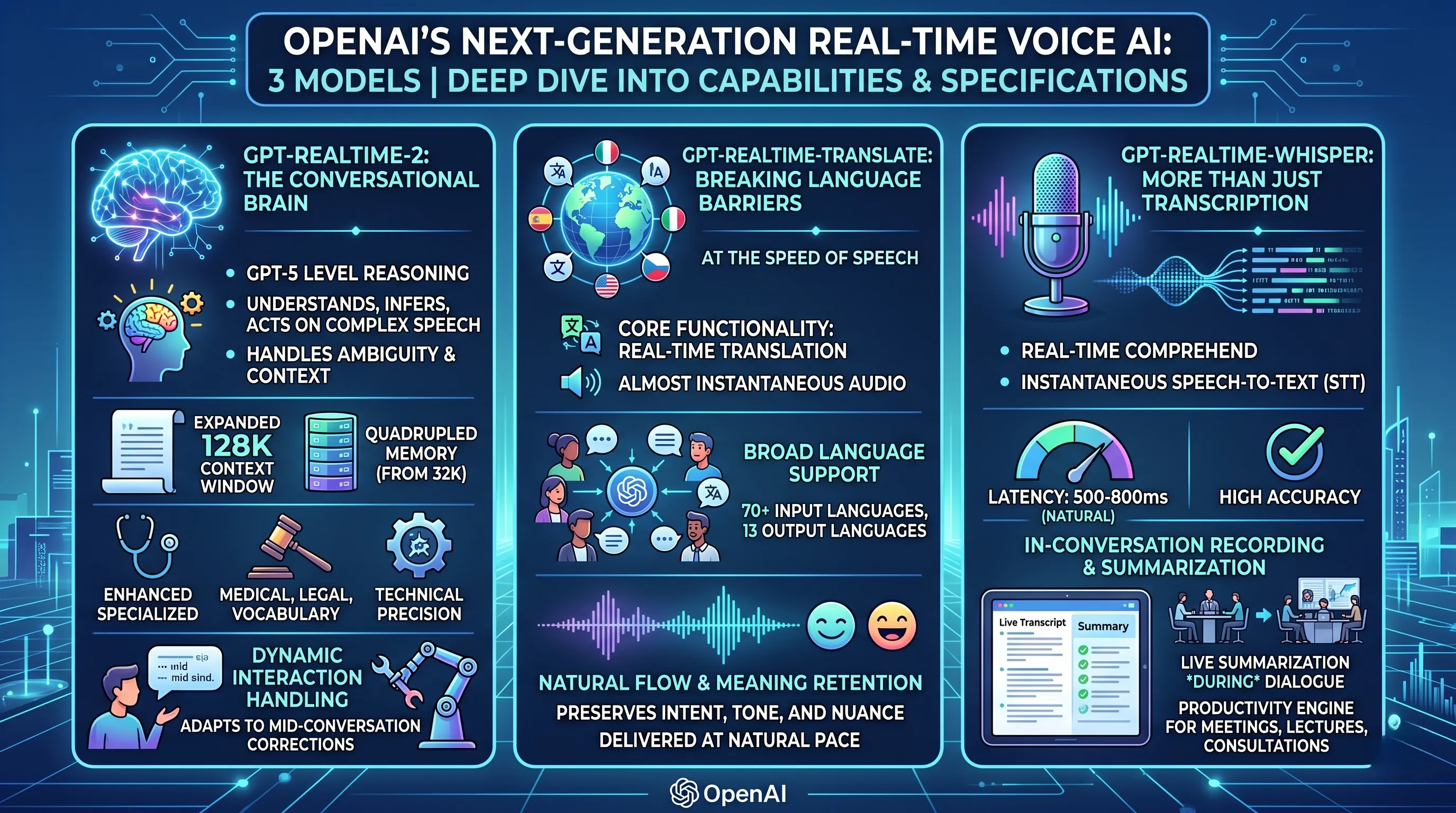
GPT-5 Level Reasoning: This is not merely an incremental update.
GPT-Realtime-2 is the first real-time voice model to be equipped with what OpenAI describes as "GPT-5 level" reasoning.
This signifies a monumental shift from a system that simply transcribes and responds to one that can understand, infer, and act upon complex, multi-layered human speech in real time.
It can handle ambiguity, grasp context, and perform tasks that require genuine cognitive processing, not just pattern matching.
Expanded 128K Context Window: The model’s memory has been quadrupled, expanding from a previous 32K context window to a massive 128K.
Experientially, this eliminates the frustrating conversational 'amnesia' common in older AI.
Users can engage in long, winding conversations without the need to repeat information, as the AI maintains a coherent thread of the entire interaction, remembering details from much earlier in the dialogue.
This allows for more natural, human-like exchanges and is essential for complex problem-solving sessions.
Enhanced Specialized Vocabulary: GPT-Realtime-2 demonstrates significantly more accurate understanding in specialized domains such as the medical, legal, and technical fields.
This precision is critical for professional applications where misunderstanding a single term could have serious consequences, making the AI a more reliable tool for experts.
Dynamic Interaction Handling: Beyond its raw intelligence, the model's key feature is its ability to function as a true agent.
It can understand user requests, call upon external tools to execute tasks, and—most impressively—handle mid-conversation corrections and additional instructions naturally.
If a user changes their mind or adds a new constraint halfway through a request, the AI doesn't get confused; it adapts seamlessly, mirroring a truly collaborative partner.
GPT-Realtime-Translate: Breaking Language Barriers at the Speed of Speech
This model is purpose-built to dissolve communication friction in a globalized world.
Core Functionality: GPT-Realtime-Translate is a dedicated real-time translation model.
It is engineered to listen to a speaker in one language and deliver a translated audio stream in another, almost instantaneously.
Broad Language Support: The model boasts impressive reach, supporting over 70 input languages and translating them into 13 distinct output languages.
This opens the door for real-time multilingual communication in a vast number of scenarios, from global customer support to international online events.
Natural Flow and Meaning Retention: Its most significant advantage over traditional translation tools is its focus on naturalness.
The translation is delivered at the speaker's natural pace, avoiding awkward pauses.
Critically, it is designed to maintain the original sentence's meaning and nuance, rather than providing a rigid, literal translation.
This ensures that the intent, tone, and cultural context of the conversation are preserved, leading to more effective and empathetic communication.
GPT-Realtime-Whisper: More Than Just Transcription, It's Real-Time Comprehension
Building on the legacy of its predecessor, GPT-Realtime-Whisper transforms speech-to-text from a passive utility into an active, intelligent process.
Instantaneous Speech-to-Text (STT): As its name implies, the model’s primary function is to instantly convert spoken words into written text with high accuracy.
The well-optimized processing pipeline allows for a typical end-to-end latency of just 500-800ms for natural interactions, making it feel truly instantaneous for the user.
In-Conversation Recording and Summarization: This is where GPT-Realtime-Whisper truly shines and moves beyond simple STT.
It is capable of performing real-time recording and summarization *during* a conversation.
Imagine a business meeting where a live transcript is being generated, and simultaneously, a concise summary of key decisions and action items is being created on the fly.
This feature transforms the model from a simple dictation tool into a powerful productivity engine for meetings, lectures, and customer consultations.
3. Transformative Applications, Performance, and Latency Analysis
The release of OpenAI's three next-generation real-time voice AI models—GPT-Realtime-2, GPT-Realtime-Translate, and GPT-Realtime-Whisper—is not merely an incremental update; it signals a fundamental shift in how we interact with technology.
This section directly connects to the overarching announcement by analyzing the practical impact of these models, moving beyond specifications to explore the transformative applications they enable, their real-world performance metrics, and the critical factor of latency that will determine their adoption.
The Dawn of Voice as a Core Interface
The introduction of these models is poised to significantly change human-AI interaction, elevating voice from a supplementary command method to a core, primary interface.
For the first time, we are seeing a suite of tools that allows an AI not just to hear words, but to understand context, reason in real-time at a GPT-5 level, and perform complex tasks based on fluid, natural conversation.
This elevates voice AI from the level of a simple chatbot to that of a true agent—a digital entity capable of understanding nuanced requests, judging the best course of action, and executing tasks on a user's behalf, all through spoken language.
The ability of GPT-Realtime-2 to handle mid-conversation corrections and additional instructions without losing context is a monumental leap, mirroring the adaptability of human conversation rather than the rigidity of command-based systems.
Transformative Applications Across Industries
Each model in this new suite unlocks specific, high-value applications that were previously impractical or impossible with older voice technology.
GPT-Realtime-2: The Conversational Taskmaster
With its expanded 128K context window and superior reasoning, GPT-Realtime-2 is the engine for a new generation of autonomous agents.
- Voice-Based Customer Support: Imagine a support line where the AI can understand a complex technical problem, access user account data, call external tools to run diagnostics, and guide the user through a solution, all without placing them on hold or escalating to a human. Its specialized vocabulary understanding in medical, legal, and technical fields makes it uniquely qualified for high-stakes support roles.
- Hands-Free Task Automation: Professionals in labs, workshops, or operating rooms can issue complex, multi-step instructions, log data, and retrieve information without ever touching a keyboard. The AI can maintain long conversations, acting as a true assistant throughout an entire procedure or project.
GPT-Realtime-Translate: Erasing Language Barriers
This model moves beyond simple word-for-word translation to preserve meaning and intent, delivered naturally at the speaker's own pace.
- Global Business Operations: A sales team in New York can negotiate a deal in real-time with a client in Tokyo, with the AI serving as a seamless, invisible interpreter. This dismantles communication barriers in international sales and global customer support, making a worldwide talent pool and customer base truly accessible.
- Inclusive Education and Events: Online lectures and international conferences can be made universally accessible. A professor's speech can be translated and delivered in real-time to 13 different output languages, allowing students from around the world to participate fully and without the cognitive load of reading subtitles.
GPT-Realtime-Whisper: The Ubiquitous Scribe
This real-time Speech-to-Text (STT) model serves as the foundation for perfect digital memory, instantly converting spoken words into structured text.
- Corporate and Legal Intelligence: Meetings are no longer just conversations; they become searchable, summarizable data streams. GPT-Realtime-Whisper can provide live subtitles, but more importantly, it can create an instant transcript and summary of a customer consultation or a legal deposition, capturing every detail accurately.
- Media and Accessibility: Broadcasters can generate highly accurate live subtitles for news and sports events instantly. In educational settings, lecture notes are created automatically, freeing students to focus on understanding the material rather than transcribing it.
Performance and Reliability: The 26-Point Leap
Perhaps the most compelling evidence of this technology's maturity is its dramatic performance improvement.
In tests conducted on the hardest adversarial benchmark—designed specifically to trip up and confuse AI systems—OpenAI achieved a 26-point lift in call success rate after prompt optimization.
The success rate soared from 69% to 95%.
This is not a minor enhancement; it is the difference between a frustrating beta product and a reliable, enterprise-grade solution.
A 69% success rate means nearly one in three interactions fail, making it unsuitable for mission-critical applications like customer support or sales.
A 95% success rate means the system works reliably and consistently, building user trust and delivering tangible business value. This leap is what will convince organizations to deploy these voice agents in customer-facing roles.
A Sobering Look at Latency
For a voice interaction to feel natural, latency—the delay between speaking and receiving a response—is the most critical factor.
OpenAI reports that a well-optimized pipeline can achieve an end-to-end latency of 500-800ms, which is within the threshold for a fluid, natural-feeling conversation.
However, developers using the standard API must contend with a different reality.
In tested benchmarks, the OpenAI Realtime API latency was measured at 1313 ms.
While groundbreaking in its reasoning capabilities, this performance is currently slower than more specialized competitors. For comparison, the same benchmarks showed Dasha at 975 ms and Telnyx at 1070 ms.
This presents a crucial trade-off for developers: choosing OpenAI's models grants access to unparalleled GPT-5 level reasoning and context handling, but at the cost of a perceptible delay that could impact the user experience in fast-paced conversations. In contrast, competitors may offer a snappier response time but lack the deep cognitive power of GPT-Realtime-2.

📚 Related Posts
GPT-5.5 Instant: OpenAI's Dramatic AI Upgrade | 52.5% Less Hallucinations, Personal Memory & 400K Codex
🚀 Key TakeawaysGPT-5.5 Instant represents a massive leap in AI capability, offering drastically reduced hallucinations (52.5% in high-risk fields) and significantly enhanced factuality, propelling the vision of a truly reliable personal AI assistant for
tech.dragon-story.com
OpenAI's GPT-5.5 & Frontier Models Now Native on AWS Bedrock: Transform Enterprise AI, Coding & Autonomous Agents
🚀 Key TakeawaysAWS customers can now directly access and deploy OpenAI's cutting-edge models, including the flagship GPT-5.5, GPT-5.4, and Codex, natively within their Amazon Web Services (AWS) environment.This strategic partnership enables enterprises
tech.dragon-story.com
OpenAI's Free 'ChatGPT for Clinicians' (GPT-5.4): 99.6% Accurate AI Outperforms Doctors, Redefining US Healthcare
🚀 Key TakeawaysOpenAI's "ChatGPT for Clinicians" is a free, advanced AI tool leveraging the latest GPT-5.4 model, specifically designed for US medical professionals to enhance efficiency and patient focus.It has demonstrated exceptional performance, wit
tech.dragon-story.com


