🚀 Key Takeaways
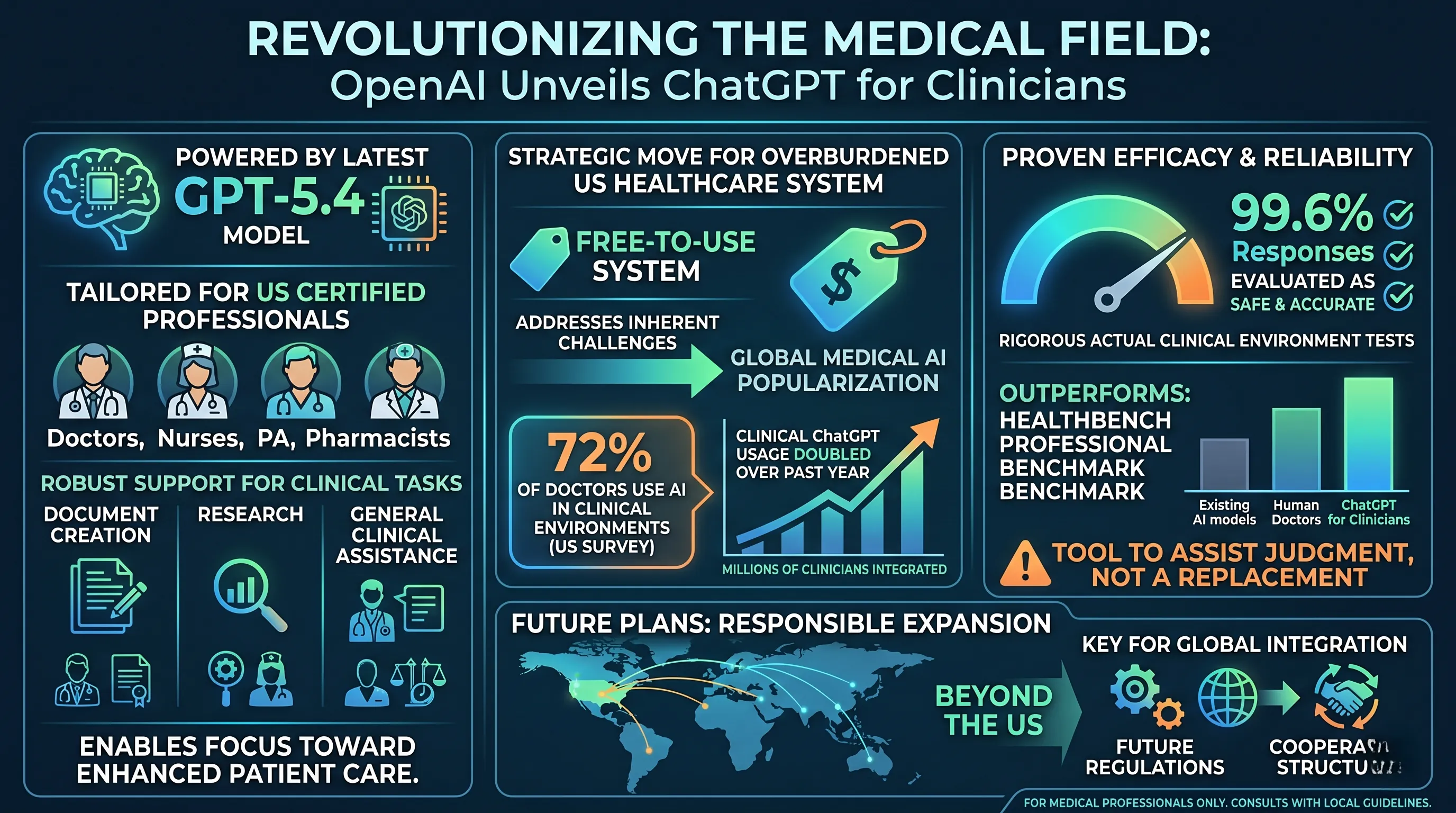
- OpenAI's "ChatGPT for Clinicians" is a free, advanced AI tool leveraging the latest GPT-5.4 model, specifically designed for US medical professionals to enhance efficiency and patient focus.
- It has demonstrated exceptional performance, with 99.6% safety and accuracy in clinical tests and outperforming existing AI models and human doctors on the HealthBench Professional benchmark.
- The launch signifies a major step towards the full-scale popularization of medical AI, addressing the overburdened US healthcare system, with plans for responsible global expansion.
- Current trends show 72% of US doctors use AI in clinical settings, and global ChatGPT clinical usage has more than doubled in the last year, with millions of clinicians already benefiting.
OpenAI has unveiled "ChatGPT for Clinicians," a groundbreaking new platform set to revolutionize the medical field.
Tailored specifically for certified medical professionals in the United States, including doctors, nurses, physician assistants, and pharmacists, this innovative tool is designed to provide robust support for various clinical tasks.
Powered by the latest GPT-5.4 model, it aims to assist with essential functions such as document creation, research, and general clinical assistance, thereby enabling healthcare providers to redirect their focus toward enhanced patient care.
The introduction of this free-to-use system represents a significant strategic move to address the inherent challenges within the overburdened US healthcare system.
Industry experts widely regard this launch as a clear signal for the impending full-scale popularization of medical AI, a trend already underscored by a recent US survey indicating that 72% of doctors currently utilize AI in their clinical environments.
Globally, millions of clinicians have already integrated ChatGPT into their practice, with its clinical usage experiencing a dramatic increase of more than double over the past year.
Crucially, "ChatGPT for Clinicians" has proven its efficacy and reliability, achieving an impressive 99.6% of responses evaluated as safe and accurate during rigorous actual clinical environment tests.
Furthermore, it has recorded higher performance metrics compared to both existing AI models and even human doctors on the challenging HealthBench Professional benchmark.
While positioned as a powerful aid to clinicians' judgment, it is important to note that the system is a tool to assist and does not replace professional expertise.
OpenAI has announced future plans for its responsible expansion beyond the US, emphasizing that future regulations and cooperation structures in each country will be pivotal for its successful global integration.
1. Unveiling 'ChatGPT for Clinicians': Specifications and Initial Market Impact
The emergence of 'ChatGPT for Clinicians' is not merely an incremental update to existing software; it is the introduction of a fundamentally new category of tool poised to shake the foundations of clinical practice. To truly grasp how this technology will disrupt the medical field, as our main topic suggests, we must first dissect its core architecture and analyze its initial, explosive entry into the market.
This section provides that essential blueprint, detailing the specifications that define its power and the early adoption metrics that prove its immediate and profound relevance.
The Technical and Strategic Blueprint of a New Clinical Partner
At its heart, 'ChatGPT for Clinicians' is a meticulously engineered tool from OpenAI, the undisputed leader in the generative AI space.
This origin is significant, as it lends the platform immense credibility and signals a serious, long-term commitment to the healthcare sector.
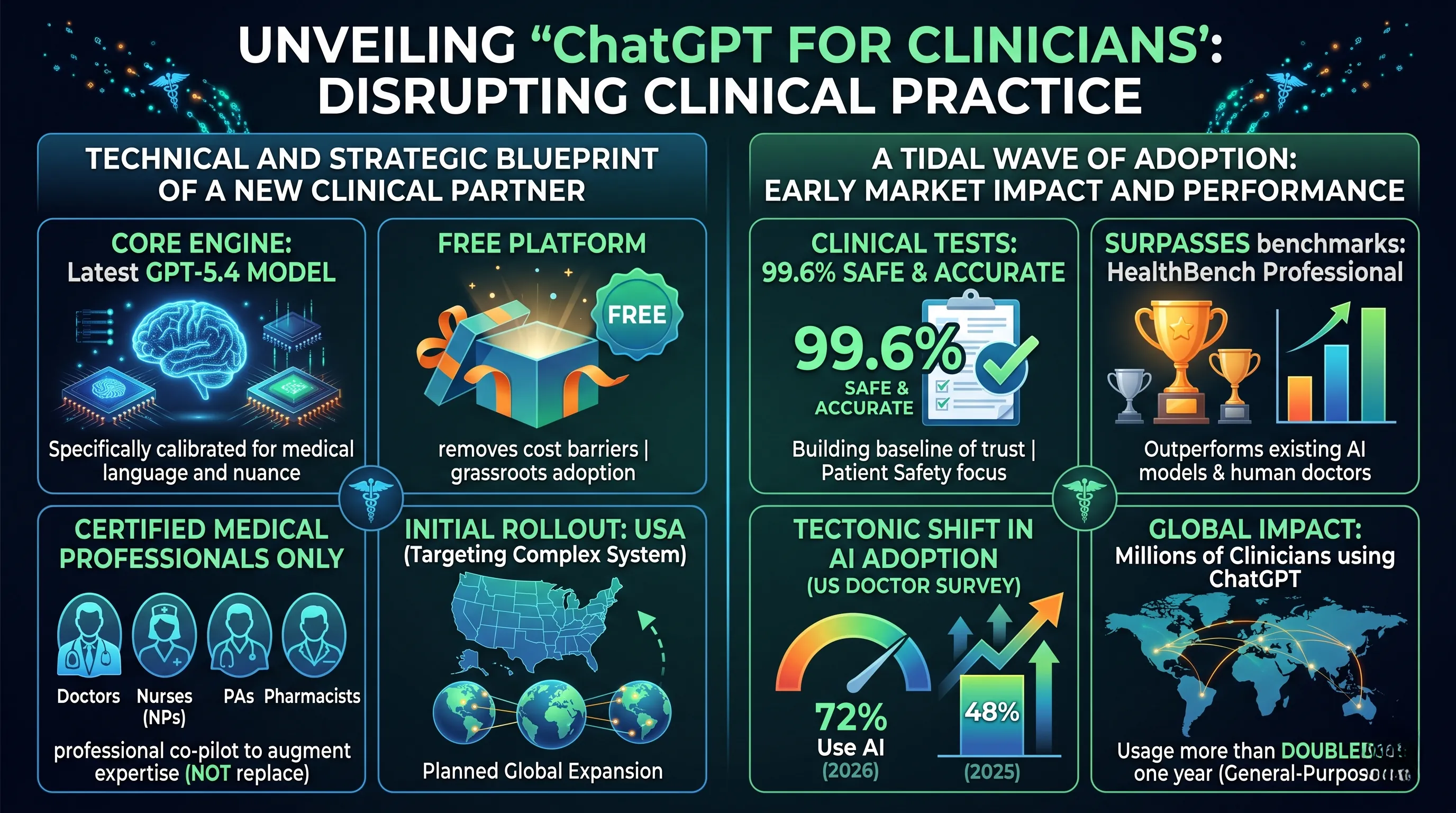
The core engine driving this platform is the Latest GPT-5.4 model, a specification that immediately sets it apart.
This is not a repurposed or older version of their technology; it is the pinnacle of their current AI architecture, specifically calibrated for the nuances and high stakes of medical language and decision-making.
OpenAI's market entry strategy is just as disruptive as its technology.
The platform is being offered for Free, a decision that effectively removes the single greatest barrier to widespread adoption in a cost-sensitive healthcare environment.
This allows individual clinicians to experiment and integrate the tool without bureaucratic budget approvals, ensuring a grassroots adoption that can spread with unprecedented speed.
The target audience is sharply defined, focusing exclusively on certified medical professionals, including Doctors, Nurses (NP), Physician Assistants (PA), and Pharmacists.
This focus underscores its role as a professional co-pilot, designed to augment the expertise of trained clinicians rather than replace it or cater to patients directly.
Initially, this powerful tool is being rolled out with a specific focus on the United States, a strategic choice that targets one of the world's most complex and overburdened healthcare systems, where the need for efficiency gains is most acute.
However, OpenAI has already announced plans for expansion to other countries, making it clear that the US launch is the first phase of an intended global transformation.
A Tidal Wave of Adoption: Early Market Impact and Performance
The theoretical potential of 'ChatGPT for Clinicians' is already being validated by staggering real-world performance metrics and adoption trends.
In rigorous clinical environment tests, the system's output was evaluated as 99.6% safe and accurate.
This figure is more than a statistic; it is a direct address to the medical community's primary concern of patient safety, establishing a baseline of trust that is critical for any new clinical tool.
Furthermore, its performance on the 'HealthBench Professional' benchmark—surpassing both existing AI models and human doctors—is a clear statement of its superior capability and a signal of the new standard it aims to set.
This high level of performance is fueling an adoption rate that can only be described as a tectonic shift.
A 2026 survey in the US reveals that 72% of doctors are now using AI in clinical settings, a dramatic leap from 48% just the previous year.
This is not a gradual trend; it is a wildfire of adoption, indicating that the tipping point has been crossed and AI is rapidly becoming a standard component of the modern clinical workflow.
This phenomenon is not confined to the US.
Globally, millions of clinicians are already using the general-purpose ChatGPT for professional tasks, with this usage having more than doubled in the last year alone.
The launch of a specialized, free, and more powerful version for clinicians is therefore not creating a new market but rather pouring fuel on an already massive, established, and exponentially growing demand.
These figures collectively signal that the advent of 'ChatGPT for Clinicians' is not a future event to be anticipated; it is a present reality unfolding at an extraordinary pace.
2. Revolutionizing Clinical Practice: Unprecedented Performance and Key Features
The very reason 'ChatGPT for Clinicians' is poised to fundamentally shake up the clinical field, as our main topic suggests, lies in its verifiable, next-generation performance and a feature set meticulously designed to alleviate the core pressures of modern medicine. This is not an incremental update to existing tools; it is a paradigm shift validated by rigorous testing and benchmark supremacy.
A New Benchmark in Clinical Reliability and Accuracy
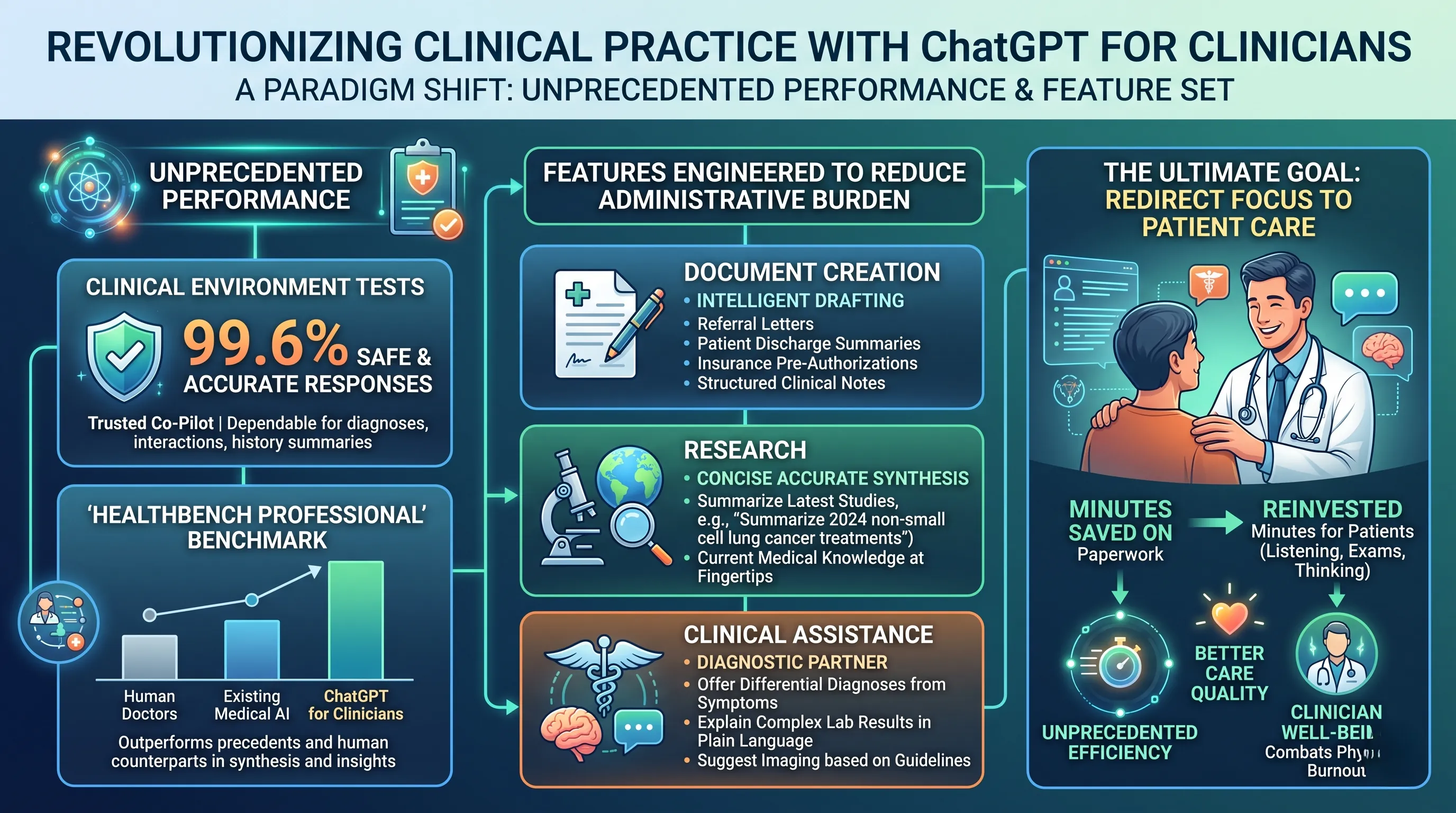
The most significant barrier to AI adoption in medicine has always been trust. In a field where errors can have life-altering consequences, a "mostly accurate" tool is insufficient. OpenAI's 'ChatGPT for Clinicians' directly confronts this challenge with staggering performance metrics. In extensive tests conducted within actual clinical environments, a remarkable 99.6% of the AI's responses were evaluated as safe and accurate.
This figure is more than just a number; it represents a new threshold of reliability. For a doctor or nurse practitioner, this level of accuracy transforms the AI from a curious gadget into a dependable co-pilot. It means they can query the system for differential diagnoses, medication interactions, or summaries of patient histories with a degree of confidence previously reserved for human colleagues. This near-flawless performance, underpinned by the latest GPT-5.4 model, is the foundation upon which its revolutionary potential is built.
Further cementing its elite status, 'ChatGPT for Clinicians' was benchmarked against both existing medical AI models and human doctors on the 'HealthBench Professional' benchmark. The result was unequivocal: it recorded higher performance than both its AI predecessors and its human counterparts. Surpassing other AI is an expected step in technological evolution, but outperforming certified medical professionals on a standardized benchmark signifies a pivotal moment. It suggests an ability to synthesize vast amounts of medical literature and patient data at a speed and scale beyond human capacity, offering insights that may not be immediately obvious and acting as a powerful tool to augment, not replace, clinical judgment.
Features Engineered to Restore Focus on Patient Care
The power of this new platform is not just in its raw intelligence, but in how that intelligence is applied to solve real-world problems. The features are not designed for technological novelty but are purpose-built to address the crushing administrative burden that defines the modern US healthcare system.
The system is designed to support a wide spectrum of critical tasks, including:
- Document Creation: This goes beyond simple transcription. It involves intelligently drafting referral letters, patient discharge summaries, insurance pre-authorizations, and clinical notes, freeing the clinician from hours of tedious paperwork. The AI can synthesize a patient's visit into a coherent, structured note, allowing the doctor to simply review and approve.
- Research: A clinician can ask the tool to "summarize the latest 2024 studies on novel treatments for non-small cell lung cancer" and receive a concise, accurate synthesis in seconds. This puts the most current medical knowledge at their fingertips without them having to spend hours sifting through journals, directly impacting the quality of care.
- Clinical Assistance: This function acts as an interactive medical encyclopedia and diagnostic partner. It can provide a list of potential diagnoses based on symptoms, explain complex lab results in plain language for patient communication, or suggest appropriate imaging studies based on clinical guidelines.
By automating and accelerating these cognitive-heavy tasks, 'ChatGPT for Clinicians' directly serves its primary objective: to help medical professionals focus more on patient care. Every minute saved on administrative work is a minute that can be reinvested in listening to a patient, performing a more thorough physical exam, or simply thinking deeply about a complex case. In an overburdened healthcare system where physician burnout is rampant, this tool offers a tangible pathway to improving both the quality of care and the well-being of the clinicians who provide it.
3. The Path Forward: Addressing Limitations and Strategizing Global Expansion
The emergence of 'ChatGPT for Clinicians' signals a seismic shift, poised to shake up the clinical field as the main topic of this article suggests.
However, for this revolution to be both successful and global, it's critical to understand the tool's current boundaries and the strategic path OpenAI is charting for its future.
This section delves into the essential limitations that define its present use and the complex, collaborative roadmap required for its international deployment, which will ultimately determine the true scale of its impact on clinical practice worldwide.
Current Boundaries: Understanding the Guardrails of a Revolutionary Tool
While the capabilities powered by the latest GPT-5.4 model are formidable, OpenAI has been explicit about the operational guardrails surrounding its use.
These are not weaknesses, but rather deliberate design choices that prioritize patient safety and underscore the irreplaceable value of human medical professionals.
The Clinician's Co-Pilot, Not an Autonomous Doctor
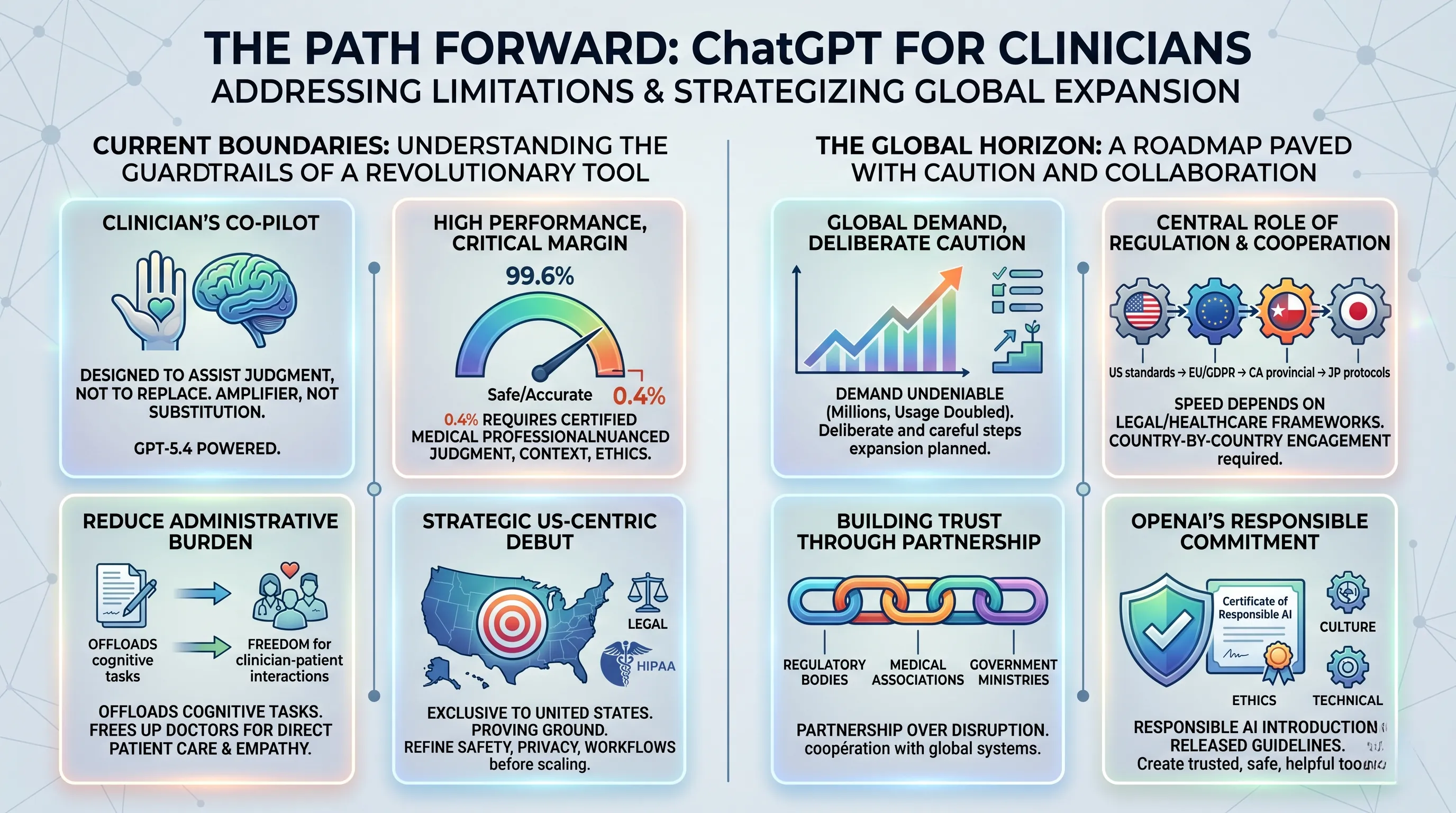
The most crucial caveat is that the system is designed as a tool to assist a clinician's judgment, not to replace professional expertise.
Even with a remarkable performance in clinical environment tests, where 99.6% of responses were evaluated as safe and accurate, the system is not intended for autonomous decision-making.
This 0.4% margin, however small, represents scenarios where the nuanced, context-aware, and ethically-grounded judgment of a certified medical professional is non-negotiable.
It is built to handle the heavy lifting of tasks like document creation and research, thereby reducing the administrative burden that contributes to burnout.
By offloading these cognitive tasks, 'ChatGPT for Clinicians' aims to free up doctors, nurses, and pharmacists to focus on the core of their profession: direct patient care, complex diagnostics, and empathetic communication.
It is an amplifier of human skill, not a substitute for it.
A Strategic, US-Centric Debut
Currently, the service is exclusively available to certified medical professionals in the United States.
This geographic limitation is a strategic decision, not a technical one.
The US healthcare system represents one of the world's most complex and stringent regulatory environments, governed by laws like HIPAA.
By launching here first, OpenAI is effectively using the US market as a high-stakes proving ground to refine the tool's safety protocols, data privacy measures, and integration workflows.
Successfully navigating this landscape will provide a robust blueprint and invaluable lessons before attempting to scale into the diverse regulatory ecosystems of other nations.
The Global Horizon: A Roadmap Paved with Caution and Collaboration
With millions of clinicians already using the general ChatGPT and usage having more than doubled in the last year, the global demand is undeniable.
OpenAI has officially announced plans for expansion to other countries, but the path forward is one of deliberate and careful steps rather than a rapid, universal rollout.
The Central Role of Regulation and Cooperation
The primary variable governing the speed and success of global expansion will be navigating the unique legal and healthcare frameworks of each individual country.
Future regulations and cooperation structures will be key variables.
A model trained and validated under US healthcare standards cannot be simply "plugged in" to Europe's GDPR-centric data privacy landscape, Canada's provincial health systems, or Japan's distinct medical protocols.
This expansion will require bespoke, country-by-country engagement with regulatory bodies, medical associations, and government health ministries to ensure compliance and build trust.
OpenAI's Commitment to Responsible Introduction
Recognizing these challenges, OpenAI is not pursuing an aggressive, market-first approach.
Instead, the company has stated its plan is to responsibly introduce AI through cooperation with global healthcare systems and has already released guidelines to this effect.
This signals a commitment to partnership over disruption.
This strategy involves working alongside international healthcare leaders to co-develop deployment frameworks that are ethically sound, culturally competent, and technically secure.
By prioritizing collaboration and establishing clear guidelines from the outset, OpenAI aims to ensure that when 'ChatGPT for Clinicians' arrives in new countries, it does so as a trusted, safe, and genuinely helpful tool for a global medical community.
📚 Related Posts
OpenAI ChatGPT Images 2.0 Unveiled: First Inferential AI Model Transforms Visuals, Text & Multilingual Design for Production on
🚀 Key TakeawaysOpenAI's ChatGPT Images 2.0 (GPT-Image-2), officially released on April 21, 2026, represents a transformative leap as the first inferential image model.It excels in executing complex visual tasks, generating highly practical outputs such
tech.dragon-story.com
Google Deep Research Max: Gemini 3.1 Pro AI Agent Redefines Autonomous Enterprise Investigations & Report Generation for Regulat
🚀 Key TakeawaysGoogle's Deep Research Max is an autonomous AI agent, built on Gemini 3.1 Pro, designed to self-perform complex investigation and analysis tasks, effectively automating the entire research workflow from data exploration to report writing.
tech.dragon-story.com
Google Gemini Notebooks: Transform AI into Your Personal Knowledge Base & Project Hub for Unrivaled Productivity
🚀 Key TakeawaysGoogle's new Gemini 'Notebook' feature transforms the AI app into a personal knowledge base and continuously learning assistant, providing a unified, organized space to manage complex projects and tasks, which leads to more accurate and p
tech.dragon-story.com


