🚀 Key Takeaways
- Claude's latest evolution, driven by the innovative 'Connector' function, profoundly integrates advanced AI into daily life by seamlessly linking with over 200 everyday applications, enabling users to manage complex, multi-step tasks with unprecedented efficiency and personalized convenience while ensuring strong user data control.
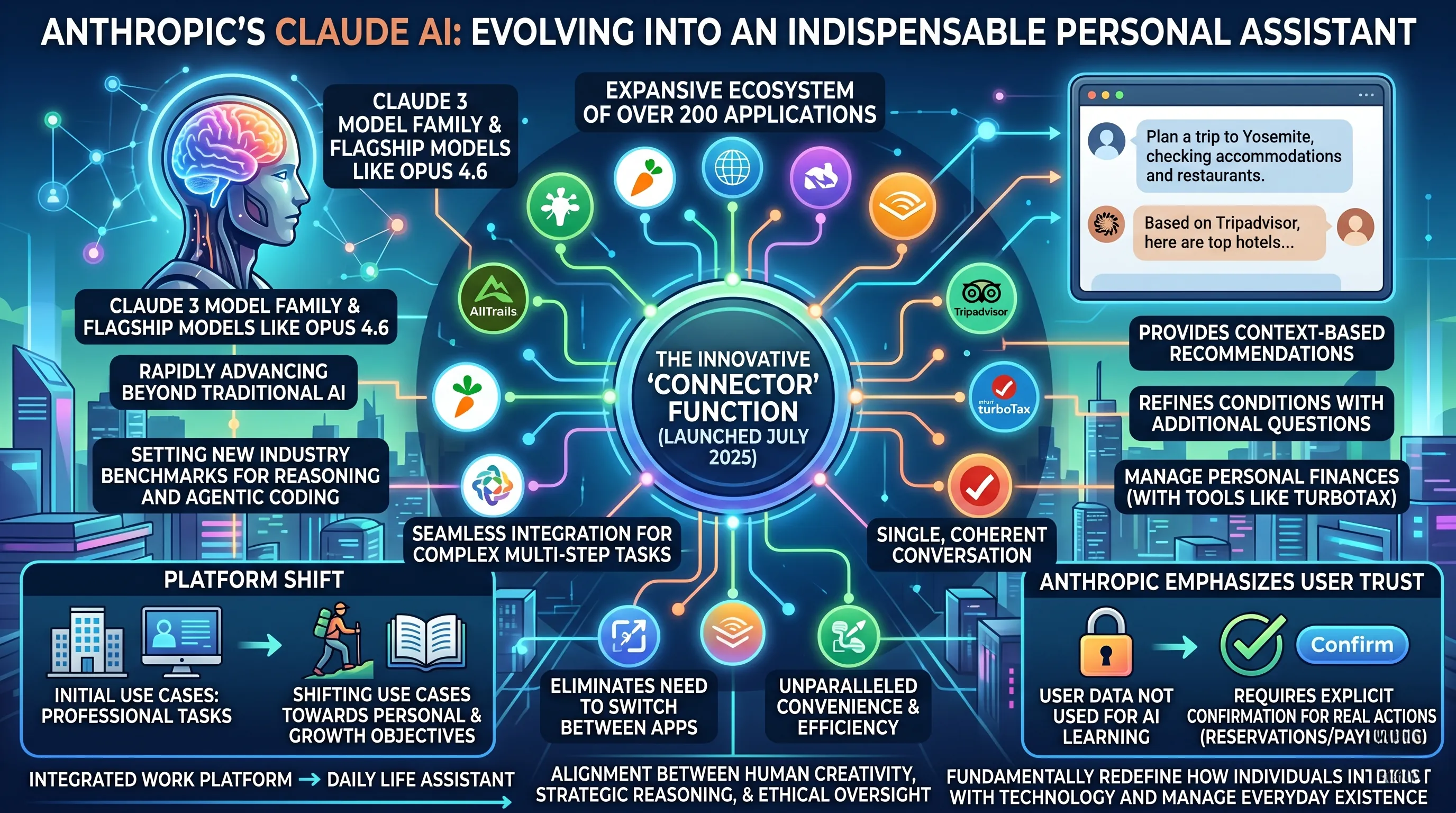
Anthropic's Claude AI, particularly through its groundbreaking Claude 3 model family and flagship models like Opus 4.6, is rapidly advancing beyond traditional AI capabilities, setting new industry benchmarks for reasoning and agentic coding.
Initially recognized for its robust performance in work-related functions, Claude's latest developments signify a pivotal shift towards deeply embedding artificial intelligence into every aspect of daily life, promising a future where AI is an indispensable personal assistant.
At the forefront of this transformation is Claude's innovative 'Connector' function, launched in July 2025 (as stated in raw data), which enables seamless integration with an expansive ecosystem of over 200 applications, including popular services like AllTrails, Instacart, Audible, and Tripadvisor.
This allows users to execute complex, multi-step tasks—from planning a trip by checking accommodations and restaurants to managing personal finances with tools like Intuit TurboTax—all within a single, coherent conversation.
The 'Connector' eliminates the need to switch between apps, providing context-based recommendations and refining conditions with additional questions, thus delivering unparalleled convenience and efficiency.
This evolution positions Claude not merely as a tool but as an 'integrated work platform' that extends its utility far beyond professional tasks, shifting its top use cases towards personal and growth-oriented objectives.
Crucially, Anthropic emphasizes user trust through features such as ensuring user data is not used for AI learning and requiring explicit confirmation for real actions like reservations or payments, thereby building confidence in AI services.
As Claude continues to advance, fostering an alignment between human creativity, strategic reasoning, and ethical oversight with AI's capabilities, it is poised to fundamentally redefine how individuals interact with technology and manage their everyday existence.
1. The Genesis of Transformation: Claude's Advanced AI Architecture
To comprehend how an AI like Claude can fundamentally reshape the fabric of our daily lives, we must first look under the hood at its core architecture and the relentless evolutionary pace set by its creator, Anthropic.
This technological foundation is not merely a collection of features; it is the very engine of the transformation discussed in this article, providing the raw power, accessibility, and intelligence required to move from a niche tool to an integrated life platform.
From Inception to Ubiquity: A Strategic Rollout
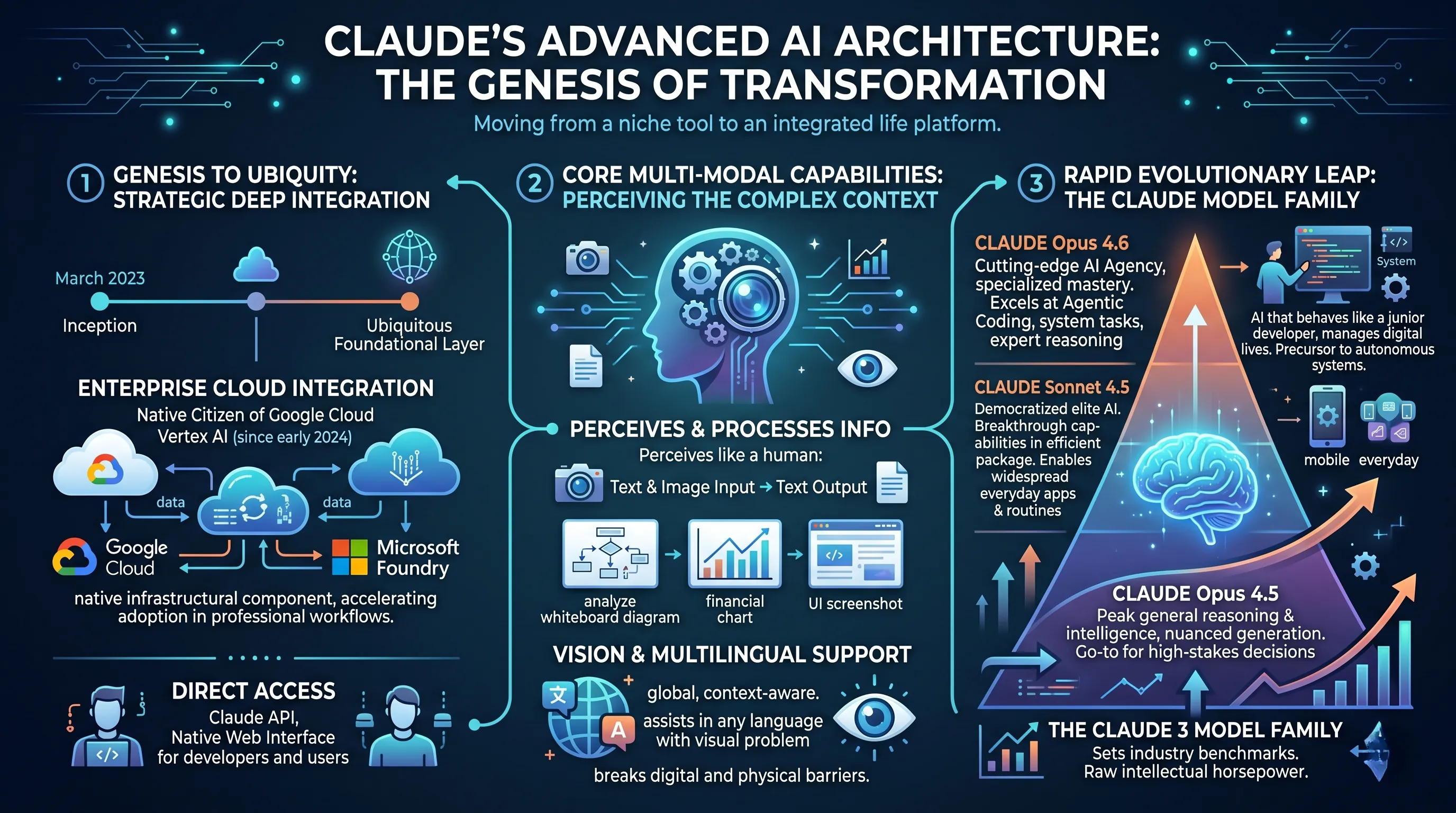
Claude’s public journey began with the launch of its chatbot in March 2023, but its potential for widespread impact was truly unlocked by a strategy of deep, multi-platform integration.
It is not confined to a single website or application but is engineered to be a foundational layer of intelligence available wherever developers and businesses operate.
This availability is a critical factor in its ability to change our lives, as it ensures Claude can be woven into the tools we already use.
The distribution strategy includes:
- Direct Access:
The Claude API and its native web interface provide a direct line for developers to build innovative applications and for end-users to experience its power firsthand. - Enterprise Cloud Integration:
Claude’s inclusion in Google Cloud Vertex AI (since early 2024) and Microsoft Foundry represents a monumental step.
This is not simply about being available; it’s about becoming a native citizen of the two largest enterprise ecosystems on the planet.
By embedding itself within the platforms where global business, data science, and application development already happen, Claude transitions from a third-party tool to a core infrastructural component, drastically accelerating its adoption and integration into professional workflows.
The Core Capabilities: More Than Just Words
The architectural prowess of Claude is most evident in its versatile, multi-modal capabilities that allow it to perceive and process information in a human-like manner.
These are the senses that enable it to understand the complex, messy context of our work and lives.
- Text and Image Input, Text Output:
This multi-modal design is the gateway to real-world problem-solving.
Claude doesn't just read text; it can see.
It can analyze a complex financial chart, interpret a handwritten diagram on a whiteboard, or understand the user interface of a software application from a screenshot.
This ability to process both visual and textual data simultaneously is fundamental to its capacity to assist with tasks that exist beyond simple text queries, directly impacting everything from data analysis to creative design. - Vision and Multilingual Support:
The dedicated Vision capability, combined with its multilingual prowess, makes Claude a truly global and context-aware tool.
It breaks down not only language barriers but also the barrier between the digital and physical worlds, laying the groundwork for an AI that can assist a user in any language, with any visually represented problem.
A Rapid Evolutionary Leap: The Claude Model Family
The most compelling evidence of Claude's transformative potential lies in its astonishingly rapid evolution, showcased by a series of model releases that continuously redefine the boundaries of AI performance.
This is not a static technology but a dynamic, rapidly improving intelligence.
- The Claude 3 Model Family:
This family of models marked a pivotal moment, establishing Claude as a leader in the field by setting new industry benchmarks across a wide range of cognitive tasks.
This benchmark-setting performance provides the raw intellectual horsepower needed to tackle complex, real-world challenges, making its integration into daily life not just possible, but powerful. - Claude Opus 4.5:
As the flagship LLM model, Opus 4.5 represents the pinnacle of general-purpose reasoning and intelligence within the family.
It is the go-to engine for tasks requiring deep understanding, nuanced generation, and sophisticated problem-solving, acting as the bedrock for high-stakes professional and personal applications. - Claude Sonnet 4.5:
This model is a testament to the democratization of elite AI.
By delivering breakthrough capabilities, likely in a more efficient and accessible package, Sonnet 4.5 ensures that top-tier AI is not relegated to research labs or high-budget enterprises.
Its existence is crucial for enabling the widespread, everyday applications—the very apps that will reshape our daily routines. - Claude Opus 4.6:
Representing the cutting edge of AI agency, Opus 4.6 demonstrates a specialized mastery that hints at the future of autonomous systems.
It excels at agentic coding, system tasks, and expert-level reasoning.
This isn't just an AI that can write code; it's an AI that can behave like a junior developer, interacting with systems, debugging problems, and executing complex workflows. This capability is the direct precursor to AI agents that can manage our digital lives, a core component of the life-altering potential explored in this article.
2. Redefining Daily Living: Claude's Seamless App Integration and Intelligent Assistance
The evolution of Claude from a sophisticated language model to an integrated life assistant is most tangibly felt in its deliberate expansion into our personal lives, demonstrating precisely how (Claude's evolution is changing all aspects of life) by moving beyond the workplace and into the very fabric of our daily routines.
This monumental shift is powered by the revolutionary 'Connector' function, a feature that transforms Claude from a conversationalist into a central command hub for a user's entire digital ecosystem.
The 'Connector': A Bridge to Your Digital Life
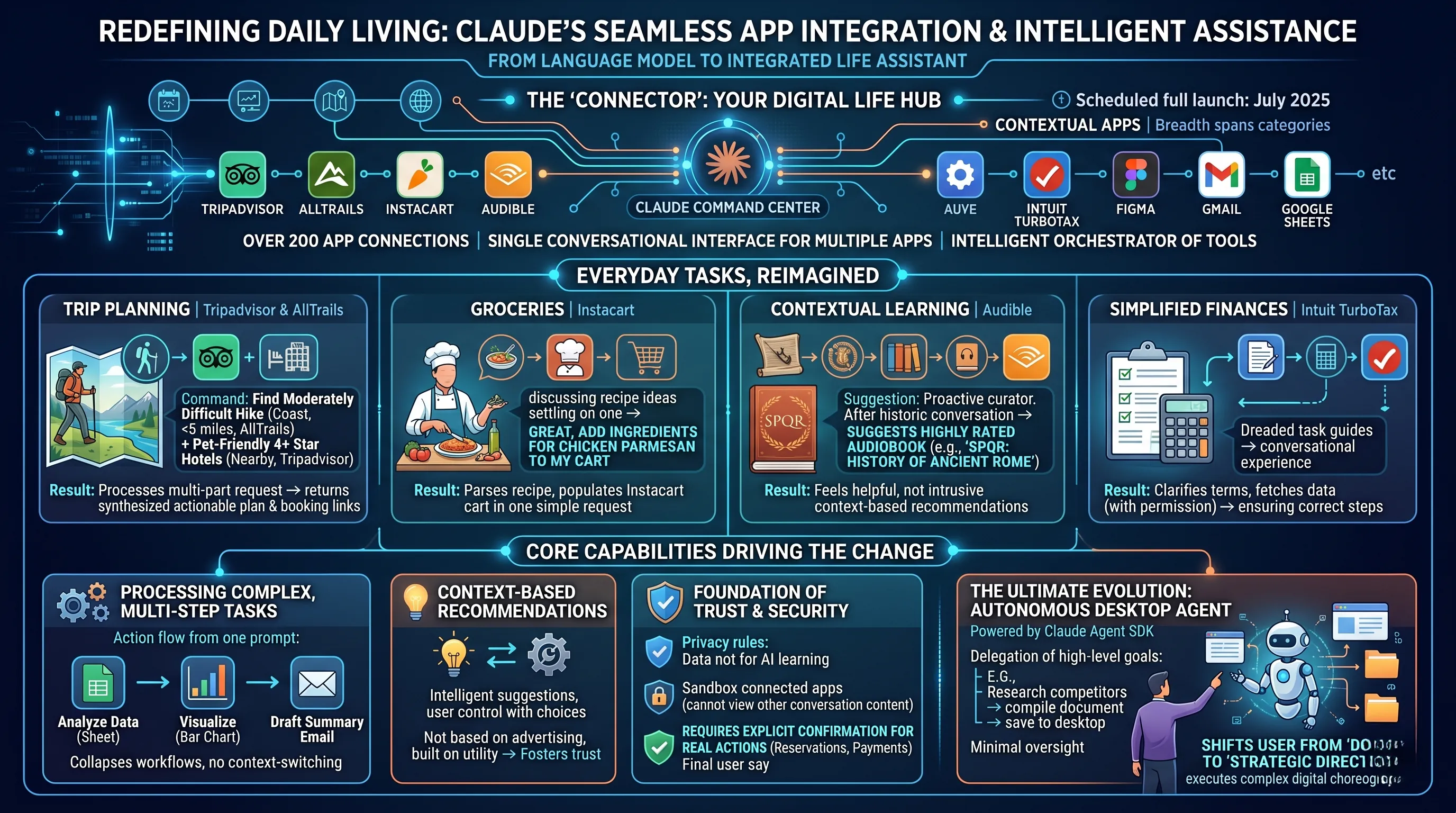
Scheduled for a full launch in July 2025, the Connector function is already a mature ecosystem, boasting connections to over 200 applications.
This is not a narrow integration limited to productivity suites; it spans a vast array of categories including Design, Finance, Productivity, Health, and daily life.
This breadth is the key to its transformative potential, creating a single, conversational interface for tasks that previously required navigating a dozen different apps.
Instead of being just another tool, Claude positions itself as the 'integrated platform' through which other tools are intelligently orchestrated.
Everyday Tasks, Reimagined
The true power of this integration becomes clear when examining its application in daily life, fundamentally reshaping how we plan, shop, learn, and manage our finances.
Consider these practical scenarios enabled by Claude’s connection to popular apps:
- Trip Planning with Tripadvisor and AllTrails:
The friction of planning a weekend getaway evaporates.
A user can issue a complex command like, "Find a moderately difficult hiking trail near the coast that's under 5 miles using AllTrails, and then find three available, pet-friendly hotels nearby with a 4-star rating or higher on Tripadvisor."
Claude processes this multi-part request, accesses both services, and returns a synthesized, actionable plan, complete with options and booking links, all within the same conversation. - Effortless Groceries with Instacart:
The gap between culinary inspiration and a stocked kitchen disappears.
A user could be discussing dinner ideas with Claude, settle on a recipe, and simply say, "Great, add all the ingredients for that chicken parmesan to my Instacart shopping cart."
Claude handles the entire process of parsing the recipe, identifying ingredients, and populating the cart, turning a multi-step chore into a single, simple request. - Contextual Learning with Audible:
Claude becomes a proactive curator of knowledge.
Following a lengthy conversation about Roman history, Claude might observe, "Your interest in the Roman Empire is clear.
The audiobook 'SPQR: A History of Ancient Rome' is highly rated on Audible.
Would you like me to pull it up for you?"
This demonstrates context-based recommendations that feel helpful, not intrusive. - Simplified Finances with Intuit TurboTax:
The universally dreaded task of filing taxes becomes a guided, conversational experience.
By connecting to services like Intuit TurboTax, Claude can walk a user through the process, clarifying confusing terminology, fetching necessary data from connected financial apps (with explicit permission), and ensuring all steps are completed correctly.
Core Capabilities Driving the Change
This seamless experience is not magic; it is built upon a set of sophisticated core features that differentiate Claude's approach:
Processing Complex, Multi-Step Tasks:
Claude can chain together actions across multiple applications from a single prompt.
A command to "analyze sales data from this sheet, visualize it as a bar chart, and draft a summary email to the team" is executed in one fluid motion, without the user ever leaving the Claude interface.
This capability collapses workflows that once took significant time and context-switching into a matter of seconds.
Context-Based Recommendations:
Claude doesn't just wait for a command to use a specific app; it intelligently anticipates user needs.
Based on the context of the conversation, it will automatically suggest relevant apps to complete a task.
Crucially, if multiple apps could be helpful, it presents the user with choices, putting them in control.
This recommendation engine is built on utility, not advertising, as Anthropic ensures there is no paid exposure, fostering trust in the suggestions provided.
A Foundation of Trust and Security:
Integrating an AI this deeply into one's life requires immense trust.
Anthropic has built this foundation with clear, user-centric privacy rules.
User data from these interactions is not used for AI learning.
Connected apps are sandboxed; they cannot view any other content from the conversation.
Most importantly, for any real-world action like making a reservation or a payment, Claude requires explicit user confirmation, ensuring the user always has the final say.
The Ultimate Evolution: The Autonomous Desktop Agent
The culmination of this evolution is Claude’s capability to function as an autonomous desktop agent, powered by the new Claude Agent SDK.
This moves beyond simple app integration into the realm of true delegation.
A user can assign a high-level, complex goal—such as "research the top three competitors for our new product, compile their key features and pricing into a document, and save it to my desktop"—and the Claude agent can orchestrate the necessary browser actions, application usage, and file management to complete the task with minimal oversight.
This is the ultimate fulfillment of changing our daily routines, shifting the human role from a task 'doer' to a strategic 'director,' with Claude executing the complex digital choreography on our behalf.
3. Trust, Productivity, and Growth: Claude's Broader Societal and Personal Impact
The evolution of Claude AI is not merely a technological leap; it is a fundamental re-engineering of the relationship between humans and artificial intelligence, directly addressing the core question of whether this technology will change all aspects of life.
The answer lies not just in its capabilities but in how it fosters trust, supercharges productivity, and enables personal growth, transforming it from a peripheral tool into an integral part of our daily fabric.
This section explores the tangible benefits—the pros—that are driving this profound societal and personal shift.
The Bedrock of Adoption: Engineering Trust into the Core
For any technology to become truly ubiquitous, it must first earn the user's trust, especially when it interfaces with sensitive personal and professional data.
Anthropic has engineered Claude with this principle at its forefront, creating what can be described as a digital pact with the user.
This goes beyond mere promises of security; it's built into the operational logic of the system.
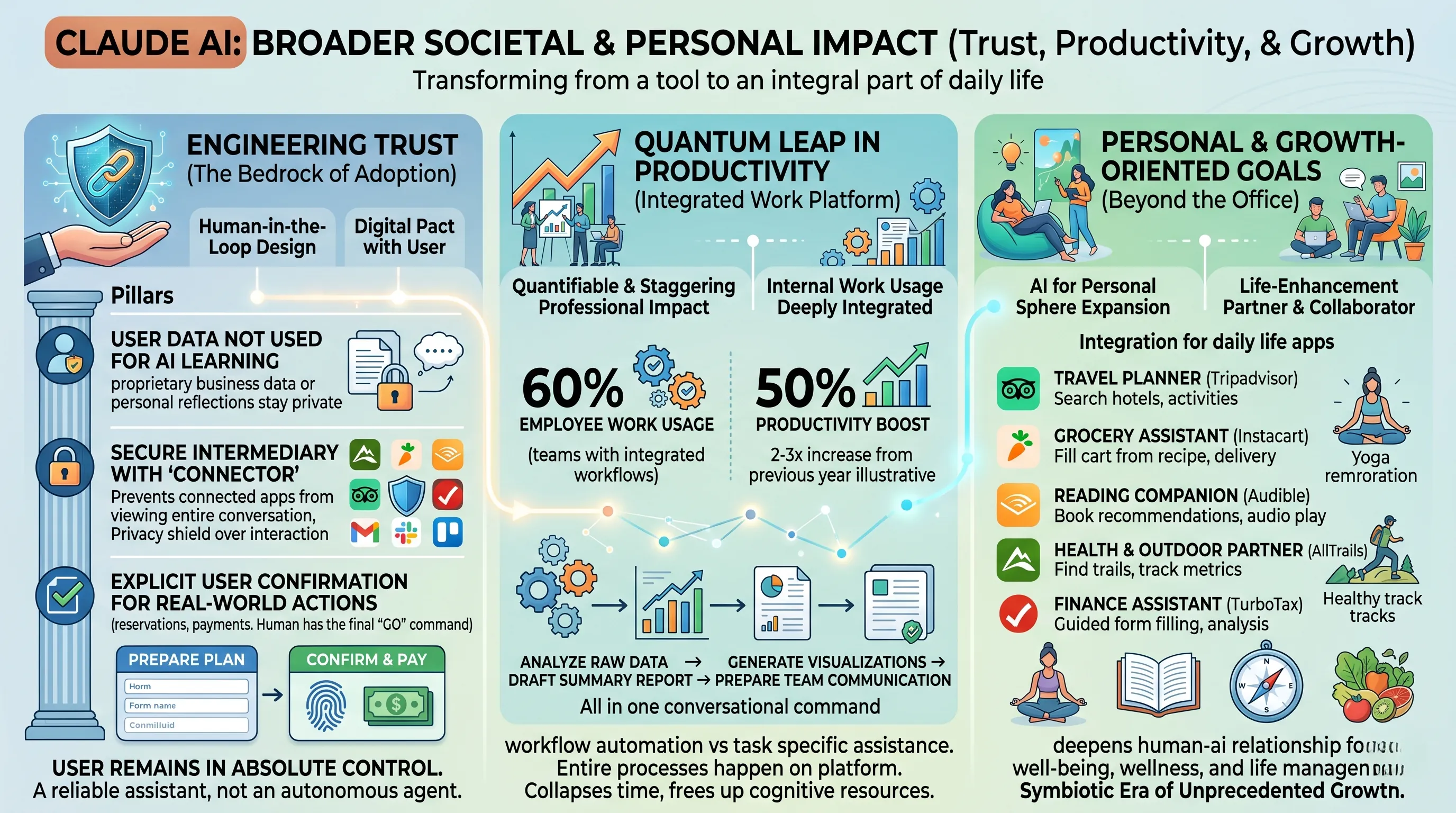
A key pillar of this trust is the explicit guarantee that user data is not used for AI learning.
This simple but profound policy means users can interact with Claude, feeding it proprietary business data or personal reflections, without the fear that their information will be absorbed into a collective training model.
Furthermore, when Claude utilizes its 'Connector' function to interact with over 200 external applications, it acts as a secure intermediary.
The architecture prevents connected apps from viewing the content of other parts of the conversation, creating a privacy shield around the user's interaction.
The most critical trust-building feature, however, is the requirement for explicit user confirmation for any real-world action, such as making a reservation or processing a payment.
Claude will assemble the plan, fill out the forms, and prepare the transaction, but the final "go" command rests solely with the human.
This "human-in-the-loop" design is not a limitation but a deliberate choice that increases trust, ensuring the user remains in absolute control and positioning Claude as a reliable assistant rather than an unpredictable autonomous agent.
It is this foundation of trust that makes its deeper integration into life not just possible, but desirable.
From Tool to Platform: A Quantum Leap in Productivity
The impact of Claude in the professional sphere is quantifiable and staggering.
Internal insights reveal that employees are not just dabbling with the technology; they are deeply integrating it into their workflows, with 60% reporting work usage and, more significantly, a 50% boost in productivity.
This figure, which represents a 2-3x increase from the previous year, is not just about doing existing work faster.
A 50% productivity increase signifies a transformation in capability—it empowers individuals and teams to undertake entirely new types of tasks that were previously impractical due to time or complexity constraints.
This is because Claude is evolving beyond a simple "tool" and becoming what can be best described as an 'integrated work platform'.
A tool helps with one step of a process; a platform is where the entire process happens.
Through its 'Connector' function and its ability to perform agentic tasks, Claude can now handle complex, multi-step workflows in a single conversational command.
For example, a user can ask Claude to analyze a raw data file from a finance app, generate visualizations using a design app, draft a summary report, and then prepare a communication to be shared with the team—all in one seamless sequence.
This collapses the time spent switching between applications and manually transferring information, freeing up the user's cognitive resources for higher-level strategic thinking.
This shift from task-specific assistance to workflow automation is the very definition of a platform, and it is fundamentally changing the nature of modern work.
Beyond the Office: The Shift to Personal and Growth-Oriented Goals
Crucially, Claude's evolution demonstrates that its impact is not confined to the workplace.
A key indicator of its potential to change "all aspects of life" is the observable trend of its top use cases shifting towards personal and growth-oriented objectives.
The integration with daily life applications like AllTrails, Instacart, Audible, Tripadvisor, and even Intuit TurboTax shows a deliberate expansion into the personal sphere.
It can now act as a travel planner, a grocery assistant, a reading companion, and a health partner.
This expansion signifies that users are beginning to view AI not just as a work assistant but as a life-enhancement partner.
This deepens the human-AI relationship, positioning Claude as a collaborator in personal development, wellness, and life management.
This shift is a direct consequence of the trust and efficiency it has demonstrated in professional settings.
As users grow comfortable with Claude managing complex work projects, they become more willing to entrust it with planning personal projects and goals.
This movement from the professional to the personal is the final and most crucial step in AI becoming a truly transformative force in daily life.
Ultimately, the future of work and personal development will increasingly depend on this symbiotic relationship—aligning human creativity, strategic reasoning, and ethical oversight with the powerful execution capabilities of AI like Claude, ushering in an era of unprecedented growth and potential.
📚 Related Posts
Google Deep Research Max: Gemini 3.1 Pro AI Agent Redefines Autonomous Enterprise Investigations & Report Generation for Regulat
🚀 Key TakeawaysGoogle's Deep Research Max is an autonomous AI agent, built on Gemini 3.1 Pro, designed to self-perform complex investigation and analysis tasks, effectively automating the entire research workflow from data exploration to report writing.
tech.dragon-story.com
OpenAI ChatGPT Images 2.0 Unveiled: First Inferential AI Model Transforms Visuals, Text & Multilingual Design for Production on
🚀 Key TakeawaysOpenAI's ChatGPT Images 2.0 (GPT-Image-2), officially released on April 21, 2026, represents a transformative leap as the first inferential image model.It excels in executing complex visual tasks, generating highly practical outputs such
tech.dragon-story.com
OpenAI GPT-5.5 Unveiled: Autonomous AI Redefines Coding, Research & Enterprise Productivity with Advanced Security & New API Pri
🚀 Key TakeawaysOpenAI's GPT-5.5 redefines AI by autonomously planning and executing complex multi-step tasks across coding, office work, and scientific research, boasting unprecedented intelligence, intuition, and advanced security measures.OpenAI has o
tech.dragon-story.com


