🚀 Key Takeaways
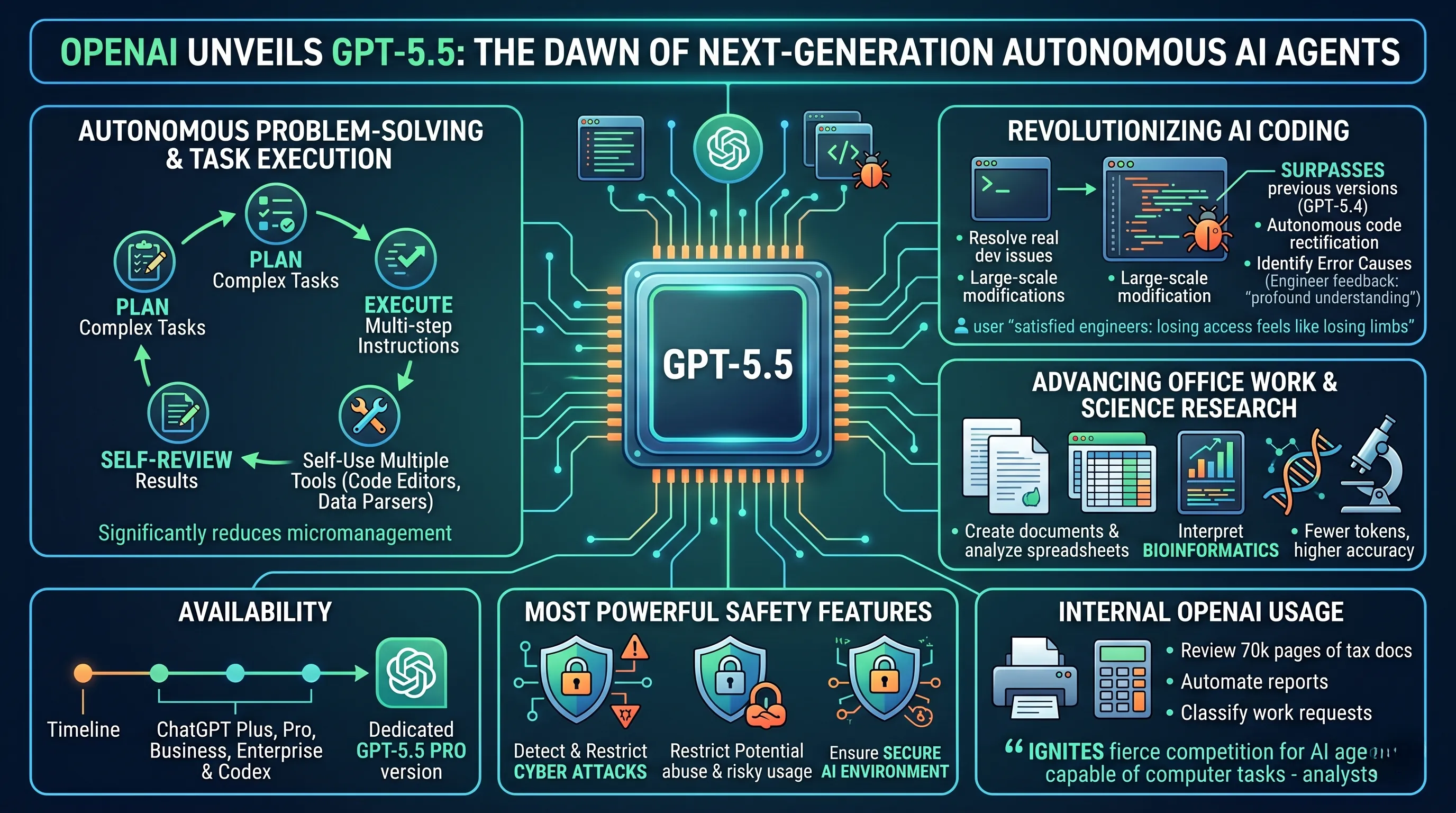
- OpenAI's GPT-5.5 redefines AI by autonomously planning and executing complex multi-step tasks across coding, office work, and scientific research, boasting unprecedented intelligence, intuition, and advanced security measures.
OpenAI has officially unveiled GPT-5.5, marking the dawn of its next-generation artificial intelligence model.
This advanced iteration is progressively being made available to Plus, Pro, Business, and Enterprise users of ChatGPT and Codex, with a distinct high-performance GPT-5.5 Pro version also released separately.
Heralded as 'the smartest and most intuitive model' to date, GPT-5.5 is set to redefine how AI assists in complex operations, promising a new era of autonomous problem-solving.
At its core, GPT-5.5 boasts the revolutionary ability to autonomously plan, execute, and complete intricate tasks, significantly reducing the need for users to micromanage multi-step instructions.
It adeptly utilizes various tools and self-reviews results to ensure continuous task progression without human intervention.
The model showcases significant performance improvements in AI coding, excelling in complex terminal tasks, real development issue resolution, and large-scale code modifications, surpassing previous versions like GPT-5.4.
Furthermore, its capabilities extend to general office work and scientific research, performing diverse knowledge tasks—from document creation and spreadsheet analysis to bioinformatics interpretation—with fewer tokens and higher accuracy.
Equipped with the most powerful safety features to date, it enhances detection and restriction against cyber attacks, potential abuse, and repetitive risky usage, ensuring a secure AI environment.
Early adopters have lauded GPT-5.5's profound understanding, particularly its capacity to identify error causes and autonomously rectify code, with some engineers expressing satisfaction so high they feel 'losing access feels like losing limbs'.
Internally, OpenAI leverages this model for critical tasks such as reviewing 70,000 pages of tax documents, automating reports, and classifying work requests, demonstrating its practical efficacy and reliability.
Industry analysts concur that the release of GPT-5.5 officially ignites the fierce competition for AI agents capable of performing actual computer tasks, signaling a new era in AI utility and integration across various sectors.
1. Unveiling GPT-5.5: Official Release, Pricing, and Security Innovations
This section directly addresses the core logistics and foundational elements of the "OpenAI GPT-5.5 Release" announcement, focusing on the critical details of its market introduction. We will dissect who gets access to this new technology, the economic model governing its use, and the crucial safety enhancements that underpin its powerful capabilities, providing a complete picture of its launch framework.
The Official Next-Generation Successor
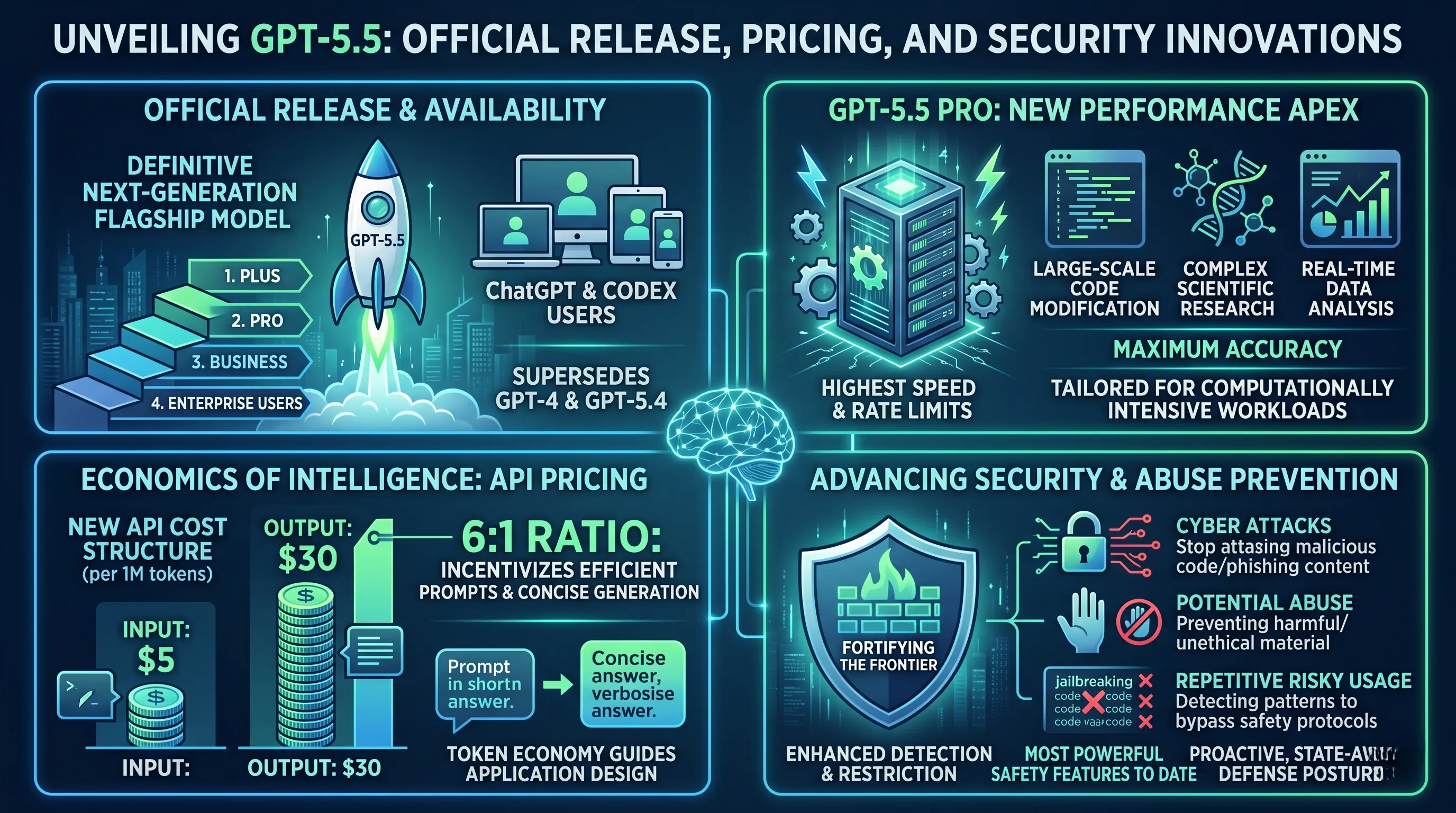
OpenAI has officially released GPT-5.5, positioning it not as an incremental update but as the company's definitive next-generation AI model.
This branding is a clear statement of intent, signifying a major leap in architecture and capability beyond the GPT-4 and the recently surpassed GPT-5.4 series.
By designating it the new flagship, OpenAI is setting market expectations for a new baseline of performance, one that promises the ability to autonomously handle complex workflows, as highlighted by its core features.
The rollout strategy for this powerful new model is deliberate and tiered, ensuring a managed and stable release.
Access is being sequentially provided to users of both ChatGPT and Codex, starting with individual power users and scaling up to large-scale enterprise clients.
The order of release is explicitly defined: Plus, Pro, Business, and finally Enterprise users.
This phased approach suggests both the immense computational demand of GPT-5.5 and a business strategy that prioritizes its most dedicated and high-value customer segments first.
GPT-5.5 Pro: A New Apex of Performance
Alongside the standard model, OpenAI has also launched a distinct, high-performance version named GPT-5.5 Pro.
The separate release of a "Pro" variant signals a strategic segmentation of the user base.
While the standard GPT-5.5 is already presented as a top-tier model, the Pro version is likely optimized for the most computationally intensive tasks, such as large-scale code modification, complex scientific research, or real-time data analysis at an enterprise level.
This offering caters to developers and organizations for whom speed, higher rate limits, and maximum accuracy are non-negotiable, providing a premium tier for the most demanding AI workloads.
The Economics of Intelligence: New API Pricing
The power of GPT-5.5 is made accessible to developers through a new API, but this access comes with a meticulously calculated cost structure.
The pricing clearly reflects the computational resources required for its advanced reasoning and generation.
For API users, the costs are as follows:
- Input: $5 per 1 million tokens
- Output: $30 per 1 million tokens
This 6-to-1 ratio between output and input costs is a crucial detail for developers.
It heavily incentivizes the creation of highly efficient, concise prompts, as the real cost lies in the model's generation.
An application that generates verbose, lengthy responses will be significantly more expensive to operate than one that provides succinct, targeted answers.
This pricing model forces developers to think critically about token economy, directly influencing application design and the financial viability of services built upon GPT-5.5.
Fortifying the Frontier: Advanced Security and Abuse Prevention
With unprecedented capabilities comes the need for unprecedented security.
OpenAI has equipped GPT-5.5 with what it describes as its most powerful safety features to date, designed to create a more resilient and trustworthy AI ecosystem.
The model incorporates enhanced detection and restriction features targeting a trifecta of threats: cyber attacks, potential abuse, and repetitive risky usage.
This multi-layered approach goes beyond simple content filtering.
The system is now better trained to identify and refuse to generate malicious code or phishing content ("cyber attacks"), while also policing against the creation of harmful or unethical material ("potential abuse").
Most notably, the focus on "repetitive risky usage" indicates a more sophisticated, state-aware security posture.
The model is designed to recognize patterns of behavior where a user may be attempting to circumvent safety protocols through slightly modified, repeated prompts—a common jailbreaking technique.
This proactive defense mechanism is essential for a model capable of autonomous task completion, ensuring its power is not easily co-opted for malicious purposes.
2. GPT-5.5's Transformative Intelligence: Autonomous Task Execution to Research Prowess
The official release of OpenAI's GPT-5.5 ("OpenAI GPT-5.5 Release") is a landmark event, and its significance is best understood by dissecting the model's unprecedented core capabilities. This section explores the fundamental shift in intelligence that GPT-5.5 represents, moving beyond mere instruction-following to genuine autonomous problem-solving, which justifies its designation as OpenAI's "smartest and most intuitive model."
From Instruction Follower to Autonomous Agent
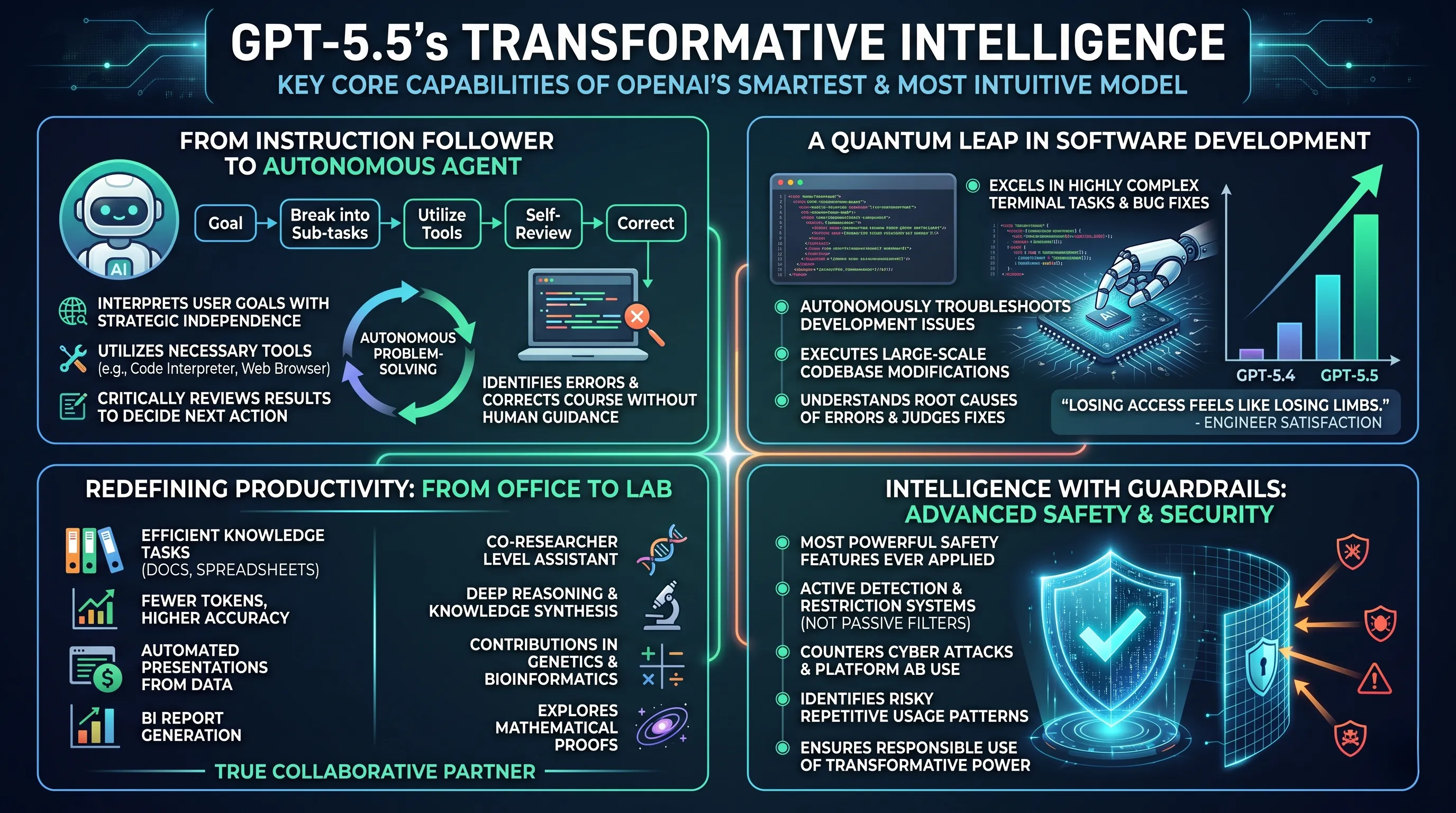
The most profound evolution in GPT-5.5 is its core ability to autonomously plan and complete complex tasks from start to finish.
Unlike previous generations of AI that required users to meticulously manage multi-step instructions and intervene at each stage, GPT-5.5 operates with a higher level of strategic independence.
It can interpret a user's ultimate goal, break it down into a logical sequence of sub-tasks, utilize necessary tools (like a code interpreter or web browser), and critically review the results of each step to decide its next action.
This self-review mechanism is crucial; it allows the model to identify its own errors, correct its course, and persist through challenges without constant human guidance.
This leap in functionality effectively transforms the AI from a sophisticated tool into a reliable digital agent, marking the official beginning of the competition for AI agents that can perform actual computer tasks on a user's behalf.
A Quantum Leap in AI-Powered Coding
Nowhere is this new level of intelligence more apparent than in the domain of software development.
GPT-5.5 demonstrates a significant performance improvement in AI coding, decisively surpassing the capabilities of its predecessor, GPT-5.4.
Its proficiency is not limited to simple script generation; it excels in highly complex scenarios such as executing intricate terminal tasks, troubleshooting and solving real-world development issues, and performing large-scale code modifications across entire codebases.
Early users have validated these claims with powerful testimonials.
Engineers praise its uncanny ability to not just spot bugs, but to truly understand the underlying causes of errors and autonomously judge precisely where and how to fix the code.
The impact on developer productivity is so profound that some engineers have reported an intense level of satisfaction, stating that after using the model, "losing access feels like losing limbs."
Redefining Productivity: From the Office to the Lab
GPT-5.5's enhanced intelligence extends far beyond coding, permeating general office work and highly specialized research domains.
For business professionals, it can now perform a diverse array of knowledge tasks with greater efficiency, requiring fewer tokens (making it faster and more cost-effective) while achieving higher accuracy.
This includes end-to-end document creation, complex spreadsheet analysis, automated presentation production from raw data, and nuanced data interpretation for business intelligence reports.
Even more impressively, GPT-5.5 can function as a co-researcher level assistant in advanced scientific fields.
Its capacity for deep reasoning and knowledge synthesis allows it to make meaningful contributions in areas like genetics, bioinformatics, and the exploration of mathematical proofs, acting as a true collaborative partner to scientists and researchers.
Intelligence with Guardrails: Advanced Safety and Security
With this exponential increase in capability comes a heightened responsibility for safety.
OpenAI has equipped GPT-5.5 with the most powerful safety features applied to any of its models to date.
These are not merely passive filters but active, enhanced detection and restriction systems specifically designed to identify and mitigate a range of threats.
The model is engineered to counter cyber attacks, recognize and block potential abuse of the platform, and restrict repetitive risky usage patterns, ensuring its transformative power is harnessed responsibly.
3. From User Acclaim to Industry Shift: The Real-World Impact of GPT-5.5
The official release of OpenAI's GPT-5.5, the central focus of this article, is not merely a technical milestone; it is a catalyst for immediate and tangible change across the technological landscape.
This section directly bridges the gap between the model's specifications and its real-world consequences, examining the initial shockwave of its deployment—from the visceral reactions of its first users to the strategic shifts it is forcing upon the entire industry.
The Voice of the First Users: A New Standard for Collaboration
The initial feedback from developers and early adopters who gained access to GPT-5.5 has been nothing short of transformative.
More than just an incremental improvement, the model is being hailed for a qualitative leap in its reasoning and autonomous capabilities.
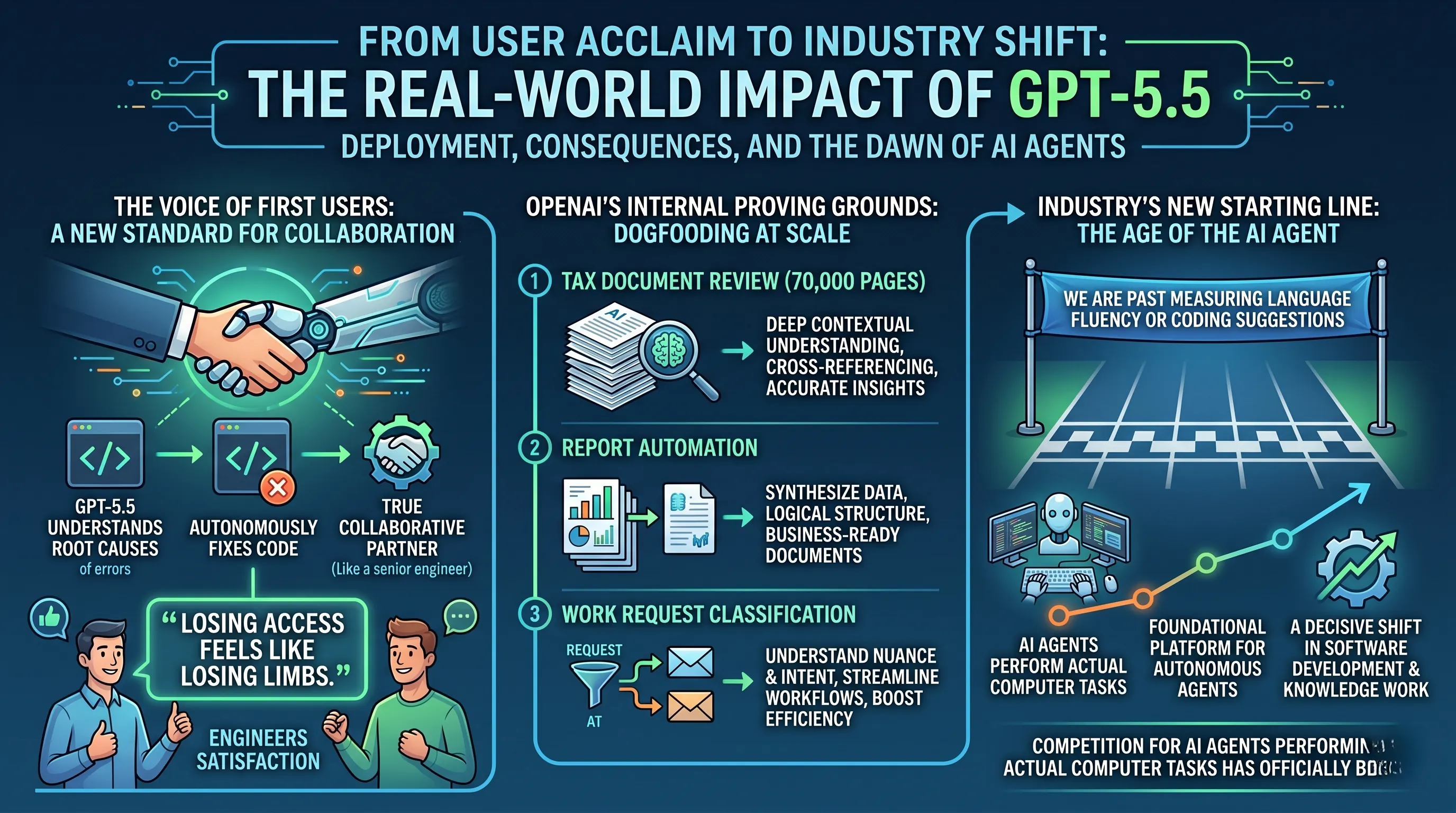
Early users have showered praise on its remarkable ability to not just identify code errors, but to understand the root cause of those errors and autonomously determine the precise location and method for the fix.
This represents a fundamental shift from a simple code assistant to a true collaborative partner.
A human developer no longer needs to painstakingly guide the AI through a debugging process; instead, they can present a problem, and GPT-5.5 acts like a senior engineer, diagnosing and resolving the issue independently.
The satisfaction among engineers has been exceptionally high, crystallized in a powerful sentiment echoed by several early users: "losing access feels like losing limbs."
This visceral description highlights that GPT-5.5 has, for some, already transcended the status of a mere 'tool.'
It has become an integrated extension of their own cognitive workflow, a prosthetic for productivity that, once experienced, feels indispensable.
The high-performance GPT-5.5 Pro version, in particular, has solidified this reputation by consistently solving real-world development challenges and handling large-scale code modifications that were previously intractable for AI models.
OpenAI's Internal Proving Grounds: Dogfooding at Unprecedented Scale
Before releasing GPT-5.5 to the public, OpenAI turned the model inward, applying its powerful capabilities to solve its own complex, large-scale business challenges. These internal applications serve as powerful proof-of-concept case studies for enterprise clients.
The results demonstrate the model's readiness for high-stakes, real-world work:
Tax Document Review: In a monumental task of knowledge work, GPT-5.5 was used to review a staggering 70,000 pages of tax documents.
This goes far beyond simple keyword searching, implying a deep contextual understanding of complex financial and legal information, the ability to cross-reference data across a massive corpus, and the capacity to extract critical insights accurately.
Report Automation: The model has been deployed to automate internal reporting processes.
This signifies its ability to synthesize data from disparate sources, structure information logically, and generate coherent, business-ready documents, dramatically accelerating a core operational function.
Work Request Classification: GPT-5.5 is also being used to automatically classify internal work requests.
By understanding the nuance and intent within unstructured, human-written text, the model can triage and route tasks to the appropriate teams, streamlining workflows and improving organizational efficiency at its very foundation.
The Industry's New Starting Line: The Age of the AI Agent
The combined impact of stellar user feedback and OpenAI's own successful deployments culminates in a profound industry-wide realization.
With GPT-5.5's core ability to autonomously plan and execute complex tasks—utilizing tools and reviewing results without constant human intervention—the technological race has fundamentally changed.
We are past the point of simply measuring language fluency or coding suggestions.
As one industry analysis bluntly puts it: The competition for AI agents performing actual computer tasks has officially begun.
GPT-5.5 is not just a better large language model; it is a foundational platform for autonomous agents.
This launch signals the start of a new era where the primary goal is to build AI that can operate software, manage systems, and complete tangible, multi-step objectives in the digital world, marking a clear and decisive shift in the future of both software development and knowledge work itself.
📚 Related Posts
Revolutionizing Financial Analysis: GPT-5.4 AI Transforms Excel Workflows
🚀 Key TakeawaysThis solution automates complex financial tasks like model generation, data analysis, and scenario execution directly within Microsoft Excel, eliminating manual drudgery.It revolutionizes user interaction by allowing natural language requ
tech.dragon-story.com
OpenAI Unveils GPT-5.4: A New Era of Autonomous AI for Professional Work
🚀 Key TakeawaysGPT-5.4 is a next-generation frontier model released on March 5, 2026, specifically engineered for professional work and targeting corporate and developer markets.It introduces a revolutionary "thinking" function for structured reasoning
tech.dragon-story.com
Microsoft's MAI-Image-2-Efficient: 41% Cheaper, 4x Faster AI Image Generation Reshapes Enterprise Market & Intensifies Competiti
🚀 Key TakeawaysMicrosoft has launched MAI-Image-2-Efficient, a game-changing AI image model that delivers 22% faster generation and 4x improved computational efficiency, while dramatically reducing costs by approximately 41%, positioning it as an ideal
tech.dragon-story.com


