🚀 Key Takeaways
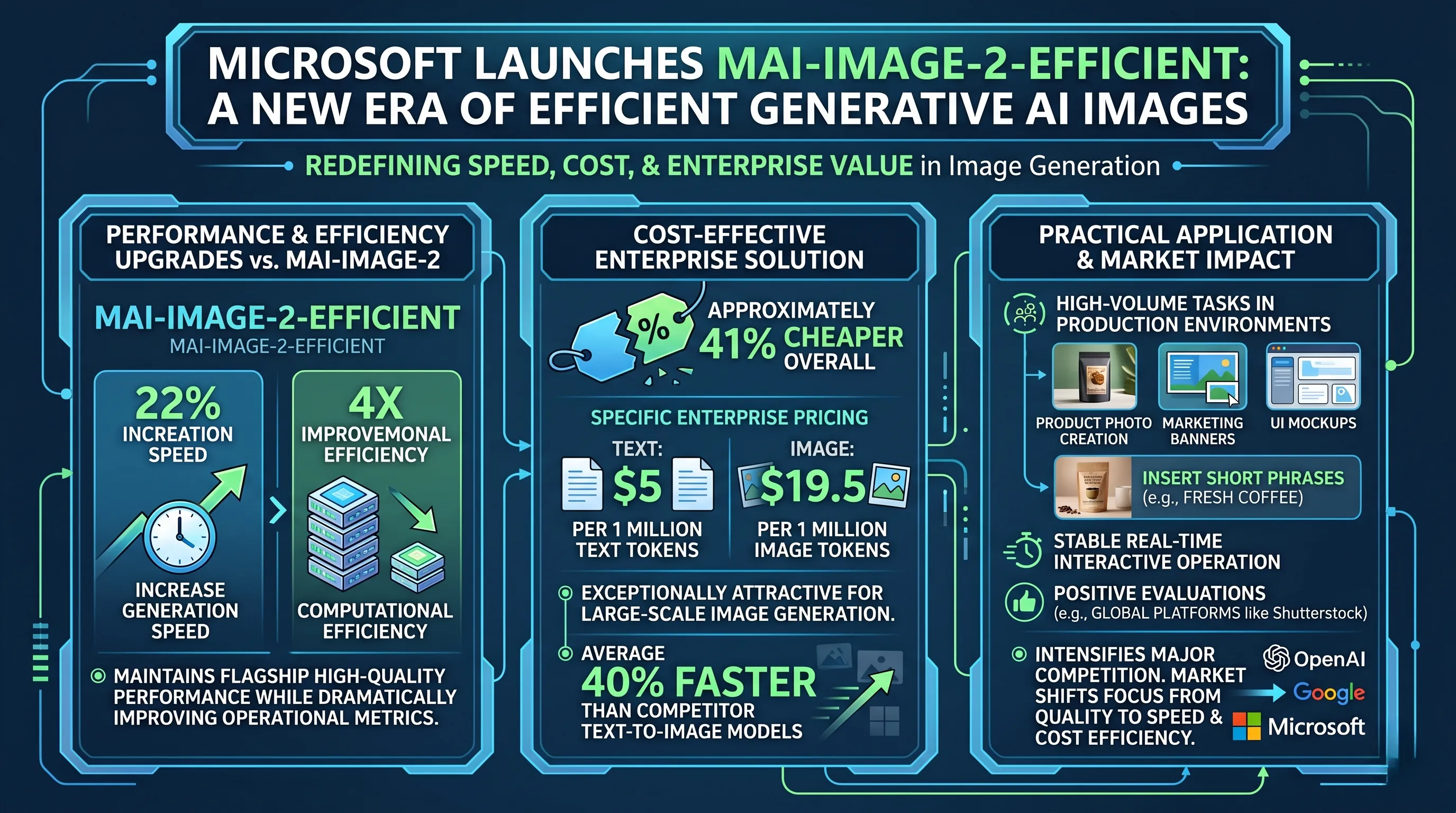
- Microsoft has launched MAI-Image-2-Efficient, a game-changing AI image model that delivers 22% faster generation and 4x improved computational efficiency, while dramatically reducing costs by approximately 41%, positioning it as an ideal solution for high-volume, cost-sensitive production environments.
Microsoft has made a significant move in the competitive generative AI image market, officially launching MAI-Image-2-Efficient, a new model designed to redefine efficiency and cost-effectiveness in image generation.
This strategic release signals Microsoft's intent to capture a larger share of the enterprise market by offering a solution that not only maintains the high-quality performance of its flagship models but also dramatically improves operational metrics.
MAI-Image-2-Efficient stands out with impressive performance upgrades, boasting a 22% increase in generation speed and a remarkable 4x improvement in computational efficiency over its predecessor, MAI-Image-2.
Crucially, these enhancements come with a significant price reduction, making the model approximately 41% cheaper overall, with specific costs like $5 per 1 million text tokens and $19.5 per 1 million image tokens.
This positions it as an exceptionally attractive option for companies requiring large-scale image generation, offering an average of 40% faster performance than competitor text-to-image models.
Designed as a practical model for immediate use in production environments, MAI-Image-2-Efficient is optimized for high-volume tasks such as product photo creation, marketing banners, and UI mockups, and even allows for natural insertion of short phrases within images.
Its stable real-time interactive operation has already garnered positive evaluations from global platforms like Shutterstock, and is expected to drive high enterprise demand.
Industry analysis suggests this launch will intensify competition among major players like OpenAI, Google, and Microsoft, shifting the market focus from mere quality to critical factors like speed and cost efficiency in generative AI image solutions.
1. Microsoft Unleashes MAI-Image-2-Efficient: A Strategic Market Entry
This official launch of a new, highly optimized model is the central pillar of the overarching theme, "Microsoft Throws Down the Gauntlet in Image Generation AI."
The release of MAI-Image-2-Efficient is not merely a product update; it is a meticulously calculated strategic offensive.
Developed in-house by Microsoft, the model's carefully phased rollout across its vast ecosystem—from developer platforms to consumer-facing applications and enterprise software—demonstrates a clear intent to seize a dominant position in the market by making powerful image generation ubiquitous, practical, and deeply integrated.
Phase 1: Seeding the Ecosystem with Immediate Developer Access
Microsoft has confirmed that MAI-Image-2-Efficient is officially launched and immediately operational on two critical platforms: Microsoft Foundry and MAI Playground.
This initial two-pronged deployment is a deliberate strategic choice.
Making the model available on Microsoft Foundry directly targets enterprise customers and professional developers, providing them with the immediate tools to begin building and integrating this efficient AI into their own commercial products and internal workflows.
It signals that Microsoft is providing not just a novelty tool, but a production-ready asset for serious business applications.
Simultaneously, its release on MAI Playground serves the wider community of individual creators, researchers, and early adopters.
This fosters a grassroots movement, generating valuable feedback and demonstrating the model's capabilities to the public, effectively building market momentum from the ground up.
Phase 2: Mass-Market Integration into Core Consumer Products
The strategy extends far beyond the developer community, with a clear roadmap for embedding the technology into the daily digital lives of millions.
Microsoft has announced that a sequential application of the model is planned for its flagship consumer services, Copilot and Bing.
This represents a monumental push to normalize AI image generation as a native function of search and assistance.
Integrating MAI-Image-2-Efficient into Bing will transform the search engine from a tool for finding existing content into a platform for creating new content, a powerful shift in user behavior.
Its inclusion in Copilot will dramatically enhance the AI assistant's value proposition, turning it into a multi-modal creative partner that can visualize ideas, not just process text.
This move is designed to make Microsoft's AI an indispensable part of the average user's workflow, building a massive user base that is deeply engaged with its proprietary technology.
Phase 3: The Enterprise Endgame with Deep Productivity Suite Integration
The most ambitious part of Microsoft's strategic vision is the planned future expansion into PowerPoint.
This move is a direct assault on the heart of the enterprise market.
PowerPoint is a cornerstone of corporate communication worldwide, and by embedding a fast, cost-effective image generator directly within it, Microsoft is poised to fundamentally alter business workflows.
This integration promises a future where a marketing manager can generate brand-specific ad banners, a UX designer can create UI mockups, or a sales team can produce custom product photos for a presentation with a simple text command, all without leaving the application.
This level of seamless integration creates an incredibly sticky ecosystem, making the Microsoft 365 suite not just a set of tools but an all-encompassing creative and productivity environment, cementing its indispensability in the corporate world.

2. Redefining Value: Unmatched Performance and Cost Efficiency
Microsoft's decisive move in the AI image generation market, its "bold move," is not merely a statement of technological prowess but a calculated economic assault designed to reshape the entire landscape. The core of this strategy is revealed not just in the quality of images produced by MAI-Image-2-Efficient, but in the brutal, undeniable mathematics of its performance and cost. This section breaks down the raw numbers that form the foundation of Microsoft's gambit, demonstrating a deliberate shift from a pure quality arms race to a new war fought on the fronts of speed, accessibility, and economic viability for mass enterprise adoption.
A Quantum Leap in Internal Efficiency
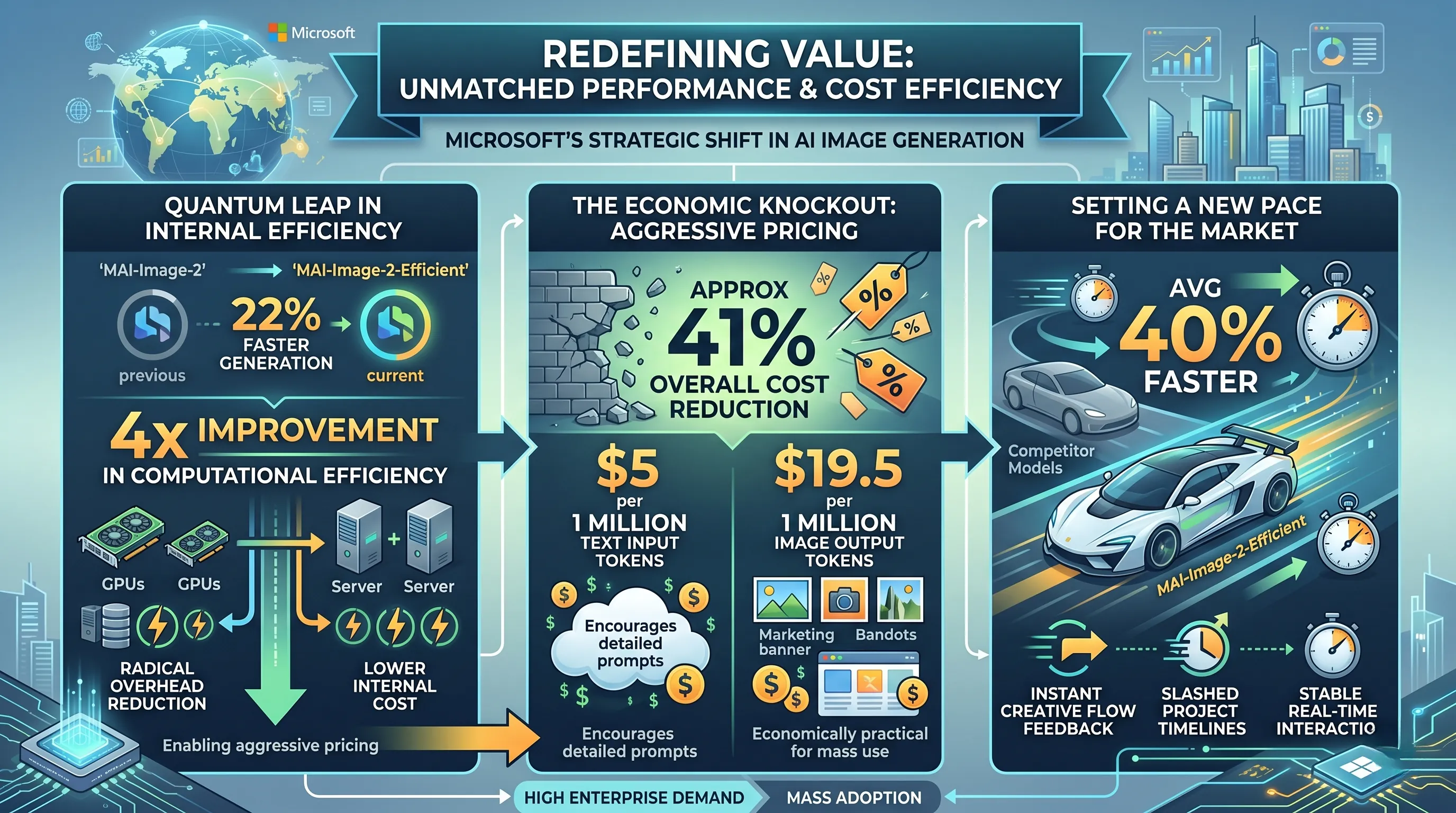
The first pillar of Microsoft's value proposition is a dramatic optimization over its own flagship predecessor. MAI-Image-2-Efficient is engineered to be 22% faster than the already powerful MAI-Image-2.
While a 22% speed boost is a significant engineering achievement, it is utterly dwarfed by the model's gains in raw efficiency. The new model boasts a staggering 4x improvement in computational efficiency. This is not an incremental update; it is a fundamental re-architecture of the process. For an enterprise client, this 4x improvement translates directly into a radical reduction in the required computational overhead. It means lower energy consumption, less demand on expensive GPU clusters, and the ability to serve four times the workload with the same infrastructure, effectively quartering the internal cost of operation. This leap is the key enabler for the model's aggressive pricing, allowing Microsoft to pass these immense savings directly to the customer.
The Economic Knockout: An Aggressive Pricing Structure
Building on its massive efficiency gains, Microsoft has weaponized its pricing model to be intensely competitive. The company has announced an approximate 41% overall price reduction compared to its previous model. This steep drop is a clear signal to the market that the era of prohibitively expensive, high-volume image generation is over. Microsoft is not just lowering the barrier to entry; it is demolishing it.
The specifics of the pricing are meticulously crafted for production environments:
- Text Input Cost: $5 per 1 million tokens.
This exceptionally low input cost encourages users and businesses to create highly detailed, nuanced, and complex prompts without fear of running up a large bill before an image is even generated. It incentivizes quality input for quality output. - Image Output Cost: $19.5 per 1 million tokens.
This output cost is where the strategy becomes crystal clear. It is priced for scale, making it economically feasible for businesses to generate thousands or even millions of images for tasks like product photo creation, A/B testing marketing banners, or generating UI mockups—use cases that were previously financially impractical for many.
These figures are not just numbers on a price sheet; they are a direct challenge to the market, forcing competitors to re-evaluate their own cost structures and value propositions.
Setting a New Pace for the Entire Market
Beyond its internal improvements, MAI-Image-2-Efficient establishes a new performance benchmark against its external rivals. The model is, on average, 40% faster than competitor text-to-image models. This is a crushing advantage in any real-world application where latency matters. For a user in an interactive session, this speed difference means the near-instantaneous feedback required for creative flow. For an automated pipeline generating thousands of brand images, a 40% speed advantage means slashing project timelines, increasing throughput, and gaining a significant operational edge. This speed, combined with its computational efficiency, is what makes stable operation in real-time interactive environments a reality, a crucial factor for high enterprise demand and a key differentiator in a crowded market.
3. Enterprise-Optimized: Practical Applications and Advanced Features
This section directly addresses the core of Microsoft's strategic move—its bold move—by dissecting why MAI-Image-2-Efficient is not just another technological showcase, but a meticulously engineered commercial weapon.
While the flagship model demonstrated high-quality capabilities, this new iteration is laser-focused on overcoming the two primary barriers to widespread enterprise adoption: prohibitive costs and slow production speeds.
It is this pragmatic shift from pure quality competition to a battle for speed, cost, and practicality that defines Microsoft's bold play to dominate the corporate AI imaging market.
A Paradigm Shift: From Experimental Novelty to Production Workhorse
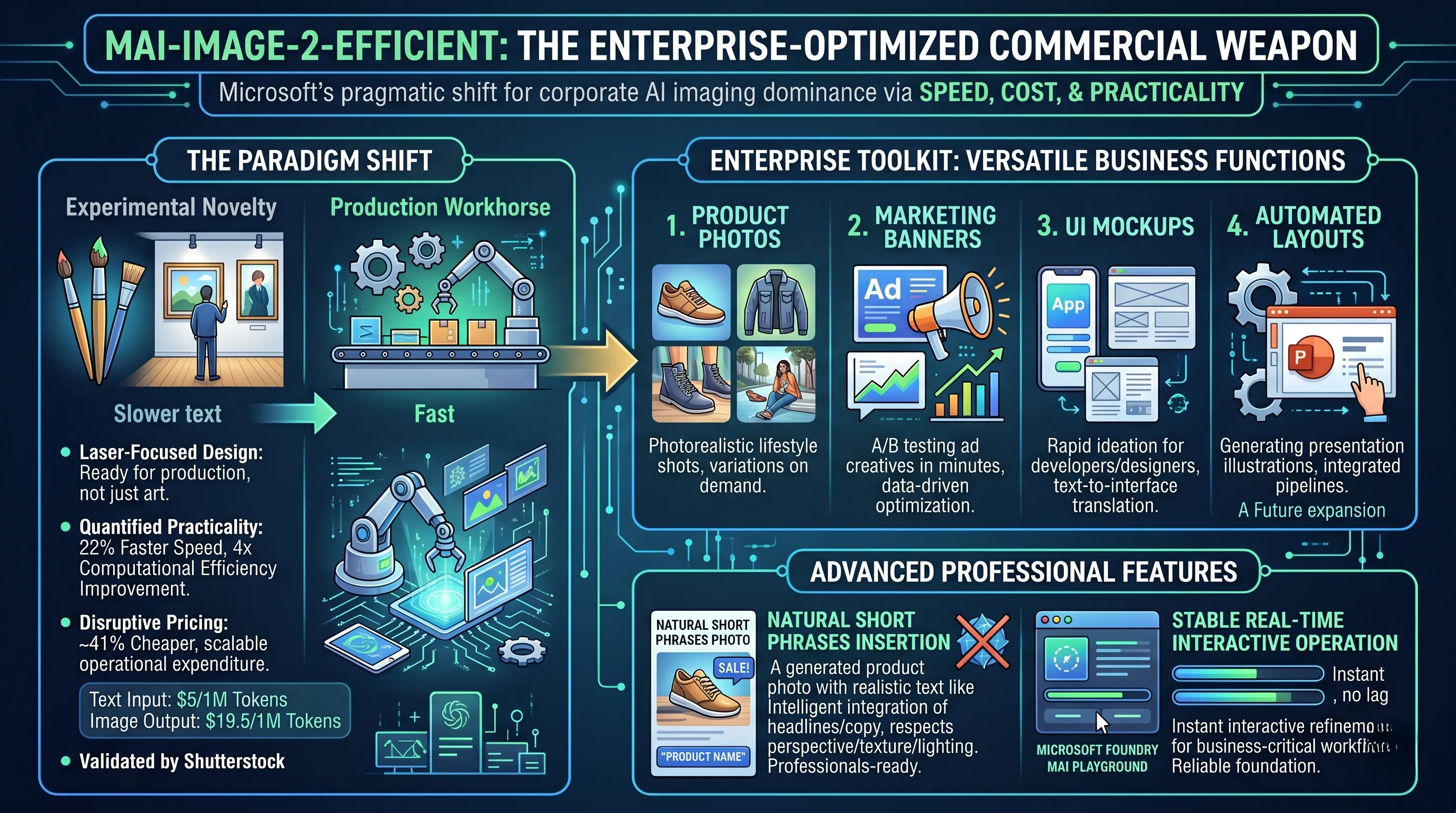
The fundamental design philosophy behind MAI-Image-2-Efficient is its readiness for the assembly line, not just the art gallery.
It is explicitly "designed as a practical model for immediate use in production environments," a statement that pivots the conversation from potential to immediate utility.
This practicality is quantified by dramatic performance enhancements.
With a 22% faster speed and a staggering 4x improvement in computational efficiency compared to its predecessor, the model fundamentally alters workflow dynamics.
Experientially, this isn't just a minor speed bump; it's the difference between a tool that assists a workflow and a tool that becomes the workflow's engine, capable of handling high-volume tasks that were previously impractical.
In a direct competitive landscape, it is on average 40% faster than competitor text-to-image models, offering a tangible advantage in throughput.
This emphasis on production-level efficiency is cemented by a disruptive pricing strategy.
The model is approximately 41% cheaper than the previous version, a cost reduction that moves AI image generation from a line item in an R&D budget to a scalable operational expenditure.
The specific pricing—$5 per 1 million tokens for text input and $19.5 per 1 million tokens for image output—makes large-scale projects financially viable.
For companies requiring massive volumes of images, as validated by positive evaluations from global image platform Shutterstock, these are not just attractive conditions; they are enabling conditions that unlock entirely new business processes.
The Enterprise Toolkit: Versatility for High-Impact Business Functions
MAI-Image-2-Efficient is engineered as a multi-purpose tool, directly addressing a wide spectrum of common enterprise needs with its versatile capabilities.
Its applicability spans across creative, marketing, and product development departments.
- Product Photo Creation:
E-commerce and retail businesses can now generate countless photorealistic lifestyle shots, product mockups, and variations on demand, drastically reducing the time and expense of traditional photoshoots. - Marketing Banners and Brand Images:
Marketing teams can A/B test hundreds of ad creatives in minutes.
The AI can generate a vast array of banners and social media assets, each with unique compositions and messaging, allowing for data-driven optimization at an unprecedented scale. - UI Mockups:
For software developers and UX/UI designers, the model can serve as an incredibly rapid ideation tool.
It can translate textual descriptions of user interface concepts into visual mockups, accelerating the design-feedback loop from days to mere moments. - Automated Layout Generation Pipelines:
This points to a deeper, more integrated future.
The model is not just a standalone image creator but a component that can be plugged into larger automated systems, such as generating illustrations and layouts for presentations in PowerPoint, where it is planned for future expansion.
Advanced Features Forged for Professional Communication
Beyond raw speed and cost, MAI-Image-2-Efficient includes advanced features that solve critical challenges in professional content creation.
First is its enhanced capability for natural insertion of short phrases.
This is a crucial differentiator.
It’s not merely overlaying text onto an image; the model intelligently integrates headlines, labels, and ad copy into the fabric of the generated image, respecting perspective, texture, and lighting.
The result is a cohesive, professionally designed asset that is ready for immediate deployment in an advertisement or on a website, eliminating the need for a separate graphic design step.
Second, and perhaps most critical for enterprise adoption, is its proven ability for stable operation in real-time interactive environments.
This guarantees reliability, a non-negotiable for any business-critical tool.
It means the model can be integrated into applications where a user is actively and interactively refining an image, seeing changes reflected instantly without system crashes or lag.
This stability is the bedrock upon which high enterprise demand is anticipated, assuring businesses that they can build dependable, high-performance workflows on top of Microsoft's AI infrastructure, which is immediately available through Microsoft Foundry and MAI Playground.
4. Catalyzing Market Shift: Industry Reactions and Intensified Generative AI Competition
The launch of Microsoft's MAI-Image-2-Efficient is not just a technological advancement; it is a calculated market maneuver that directly substantiates the overarching theme of this article—that Microsoft has made a decisive and bold move in the generative AI image space.
This section analyzes how the model's release is triggering immediate industry reactions and fundamentally altering the competitive dynamics, shifting the battle from pure quality to pragmatic, large-scale usability.
Industry Validation and Enterprise Gravitation
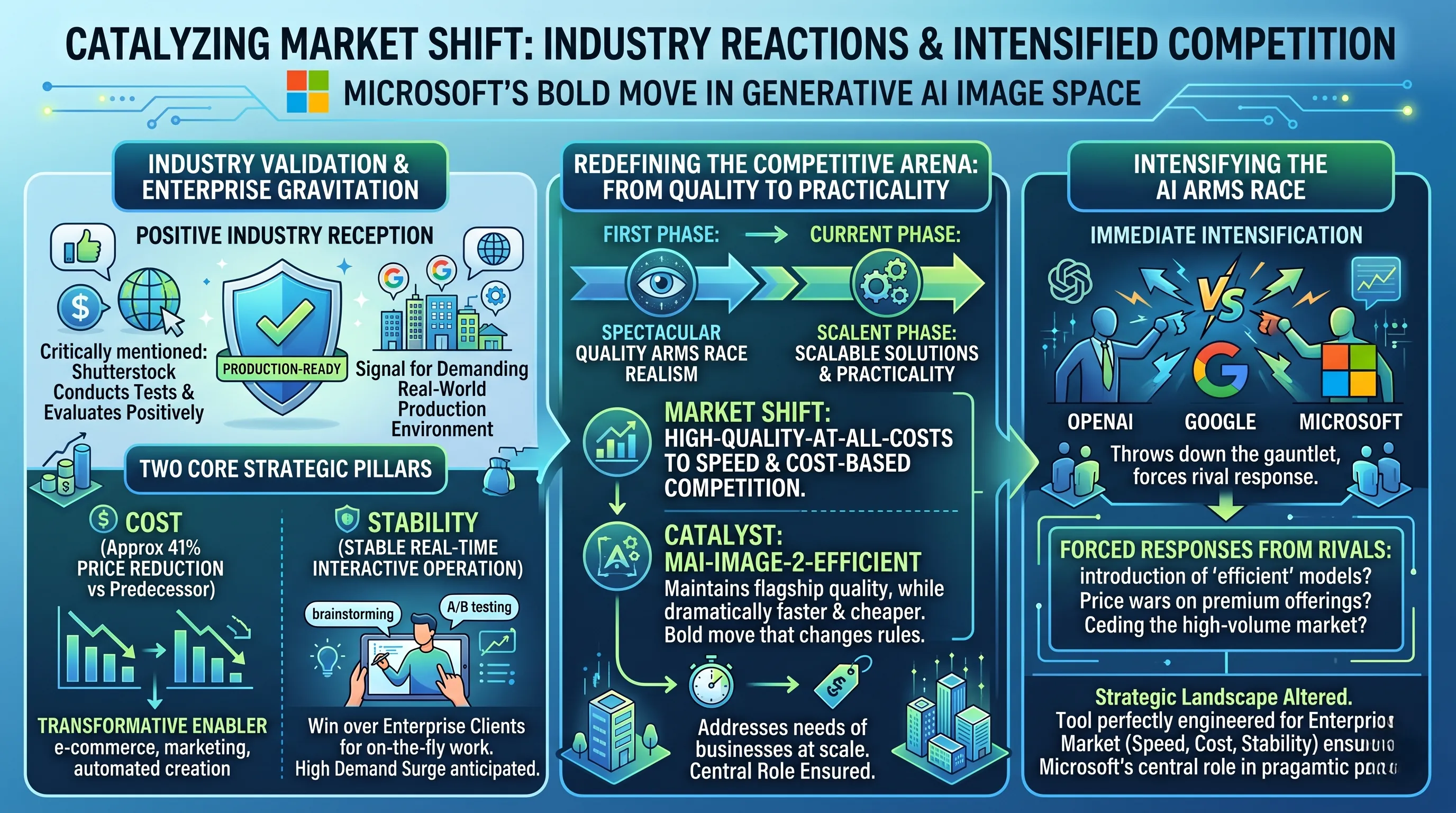
The immediate positive reception from key industry players serves as a powerful testament to the model's production-readiness.
Critically, global image platform Shutterstock, a business whose entire model revolves around the high-volume creation and distribution of quality images, has already conducted tests and provided positive evaluations.
This is not merely academic praise; it is a strong signal from a major potential enterprise customer that MAI-Image-2-Efficient meets the practical demands of a real-world, high-stakes production environment.
This validation is a direct result of two core strategic pillars: cost and stability.
The economic incentive is overwhelming.
With an overall price reduction of approximately 41% compared to its predecessor, Microsoft is making an aggressive play for the enterprise budget.
For companies that require large-scale image generation—for e-commerce product catalogs, dynamic marketing campaigns, or automated content creation pipelines—this cost reduction is not a minor benefit; it is a transformative enabler.
It shifts the conversation from "Can we afford to use generative AI for this project?" to "How can we integrate this cost-effective tool across all of our departments?"
Furthermore, the model's performance characteristics are explicitly designed to win over enterprise clients.
The promise of stable operation in real-time interactive environments is a crucial differentiator.
This isn't about waiting minutes for a single, perfect image.
It's about the ability for a UI designer to generate mockups on the fly during a brainstorming session, or for a marketing team to A/B test dozens of ad banner variations in a single afternoon.
This stability and real-time capability, combined with its significant cost advantage, are creating an irresistible pull, with industry observers anticipating a surge in high enterprise demand.
Redefining the Competitive Arena: From Quality to Practicality
Microsoft's strategy with MAI-Image-2-Efficient confirms a pivotal market shift that industry analysts have begun to observe.
The initial phase of the generative AI image race was a spectacle of quality, a competition to produce the most breathtakingly realistic or artistically complex images possible.
However, Microsoft's move signals a maturation of the market.
The new competitive frontier is no longer just about the "best" image but about the most practical and scalable image generation solution.
Industry analysis now strongly suggests a market shift from a high-quality-at-all-costs competition to one centered on speed and cost.
MAI-Image-2-Efficient is the catalyst for this change.
By delivering a model that maintains the high-quality performance of its flagship predecessor while being dramatically faster and cheaper, Microsoft is directly addressing the core needs of businesses that operate at scale.
This strategic pivot is a 'bold move' precisely because it changes the rules of engagement for the entire industry.
Intensifying the AI Arms Race
The direct consequence of this market shift is an immediate and significant intensification of competition among the primary players: OpenAI, Google, and Microsoft.
Microsoft has effectively thrown down the gauntlet, forcing its rivals to reconsider their product strategies.
It is no longer sufficient to have a model that can win awards for artistic merit; a competitive offering must now also be economically viable and performant for high-volume production tasks.
This move is expected to force responses from both OpenAI and Google.
Will they introduce their own "efficient" or "lite" models? Will they engage in a price war, lowering the cost of their premium offerings to compete? Or will they cede the high-volume enterprise market to Microsoft to focus on the high-fidelity creative niche?
Regardless of their response, Microsoft has successfully altered the strategic landscape.
By launching a tool perfectly engineered for the burgeoning enterprise market's needs for speed, cost-effectiveness, and real-time stability, the company has confirmed its bold, winning move, ensuring its central role in the next, more pragmatic phase of the generative AI image revolution.
📚 Related Posts
Google Gemini 3.1 Flash TTS: Revolutionizing Voice AI with Human-Like Expressiveness, Audio Tags & Responsible AI
🚀 Key TakeawaysGoogle's Gemini 3.1 Flash TTS ushers in a new era of voice AI, generating exceptionally natural, expressive, and human-like voices with unprecedented control through 'Audio Tags' and intuitive prompts, making advanced voice synthesis broa
tech.dragon-story.com
Google Chrome 'Skills' Transforms Web Browsing: Personalized AI Automation, One-Click Workflows & Multi-Tab Power
🚀 Key TakeawaysThe new Google Chrome 'Skills' feature revolutionizes AI interaction by enabling users to save custom prompts as reusable 'Skills', allowing for one-click execution and significantly automating tasks directly within the browser.It transfo
tech.dragon-story.com
Google Gemini macOS App: Always-On AI Revolutionizes Desktop Workflow with Native Integration & Screen Understanding
🚀 Key TakeawaysGemini for macOS acts as an "always-on" AI assistant, deeply integrating into your workflow with a native macOS experience and providing instant, contextual assistance.Leveraging the powerful Gemini 3 model, it uniquely understands screen
tech.dragon-story.com


