🚀 Key Takeaways
- Google's Bold Standalone Entry: Google has officially launched Flow Music, an independent AI music generation platform powered by its advanced Lyria 3 Pro model, marking a significant foray into the creator market.
- Advanced Granular Editing: Flow Music offers unprecedented precise editing capabilities with features like 'Replace' and 'Extend' functions, allowing users to modify specific sections, melodies, and moods without regenerating entire compositions.
- Comprehensive Creator Ecosystem Strategy: Designed for both professional composers and novice users, the platform aims to integrate with Google's future AI video (Veo) and image (Nano Banana) models, fostering a unified creative production environment.
- Intensified AI Music Competition: This strategic launch significantly heightens competition within the AI music industry, positioning Google as a major player against existing startups like Suno and signaling a new phase of 'big tech' engagement in music creation.
Google has made a significant strategic move into the creative technology space with the launch of "Flow Music," a dedicated AI music generation platform.
This new service is designed to empower users to create and refine musical compositions using artificial intelligence.
Powered by Google's latest and most advanced music model, Lyria 3 Pro, Flow Music is poised to transform how music is produced, making sophisticated tools accessible to a broad audience.
Flow Music distinguishes itself with robust features that streamline the music creation process.
Users can generate initial music drafts from simple text descriptions, with the AI automatically crafting the song's atmosphere, rhythm, and beat.
Beyond initial generation, the platform offers innovative editing capabilities, including 'Replace' and 'Extend' functions, allowing for precise modifications to specific sections, melody adjustments, chorus extensions, and mood changes without requiring an entirely new generation.
This level of granular control positions Flow Music as a powerful tool for both professional composers and emerging artists.
The launch of Flow Music is not merely about music generation; it represents a broader vision for Google's integrated creative ecosystem.
It operates as a standalone website and a dedicated iOS mobile app, available to anyone without requiring a separate business account.
Google plans to integrate Flow Music with its upcoming AI video model, Veo, and image model, Nano Banana, to create a comprehensive suite for unified music, video, and image creation.
This ambitious strategy, coupled with partnerships such as with global artist development company Believe, underscores Google's intent to lead the creator market and intensify competition in the rapidly evolving AI music landscape.
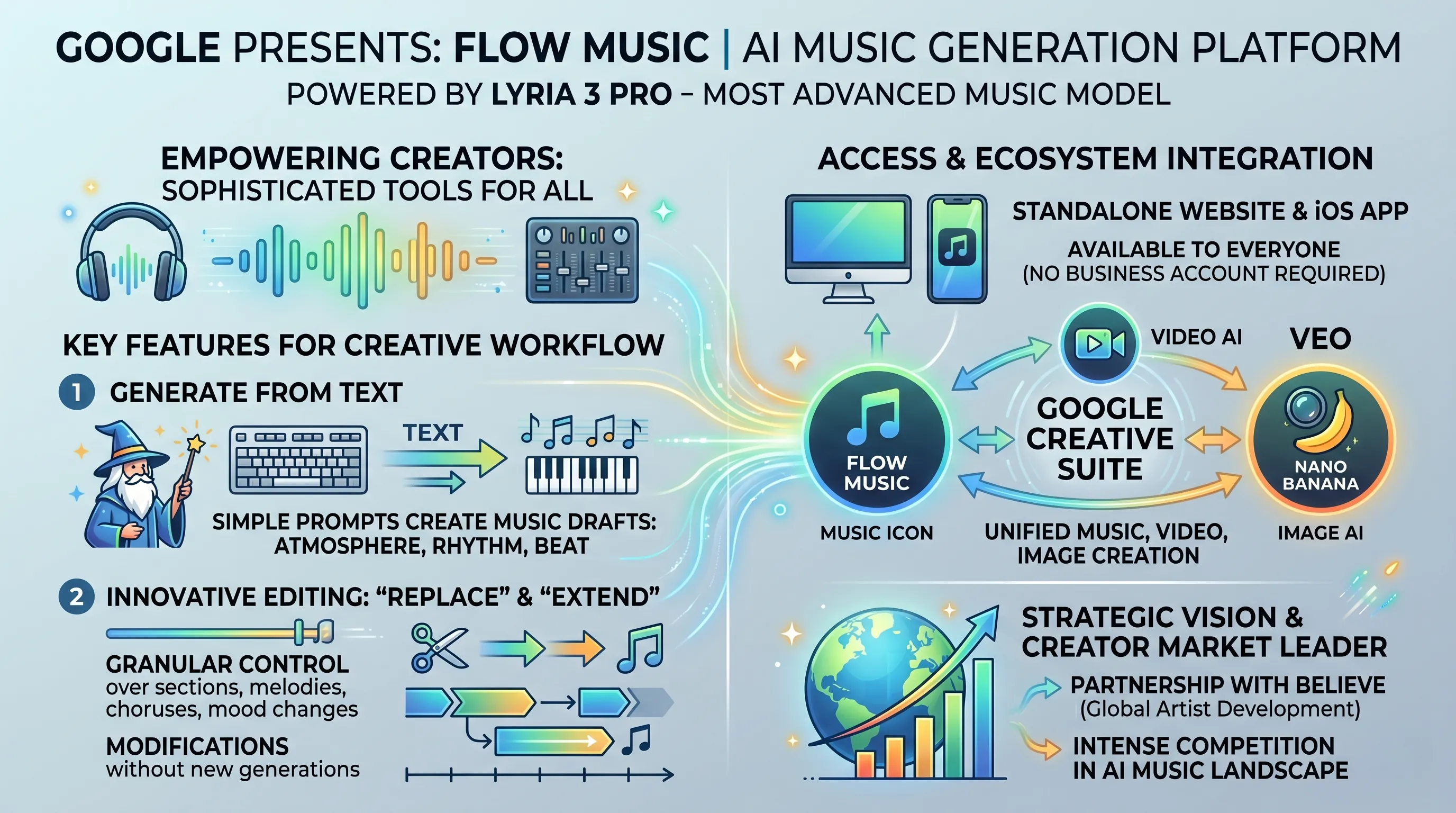
1. Google Flow Music: A Standalone AI Platform Powered by Lyria 3 Pro
This section delves into the fundamental identity of Google Flow Music, a critical component in understanding the main topic of "Google's Game-Changer: The Standalone AI Music Platform 'Flow Music'."
By dissecting its core technology, accessibility, pricing, and strategic alliances, we can clearly see how Google is positioning this platform not as a mere feature, but as a dedicated, competitive force aimed at capturing the creator economy.
This is Google's deliberate unbundling of a powerful creative tool to give it room to grow its own ecosystem.
The Technological Core: Google's Lyria 3 Pro Engine
At the heart of Google Flow Music lies Lyria 3 Pro, Google's latest and most advanced music generation model.
This isn't a repurposed language model; it is a specialized engine designed specifically for the complexities of music composition, arrangement, and production.
The power of Lyria 3 Pro is what enables Flow Music to move beyond simple melody generation into creating comprehensive musical drafts from short text inputs.
It automatically interprets prompts to define a song's atmosphere, rhythm, and beat, providing a rich foundation for creativity.
This technological superiority is Google's primary asset in its attempt to leapfrog earlier market entrants, aiming to reduce any perceived "latecomer" weakness with raw model capability.
The platform empowers users, from professional composers to absolute novices, with granular control through features like 'Replace' to modify specific sections and 'Extend' to lengthen parts of a track, all without needing to regenerate the entire piece from scratch.
A Strategic Breakout: Standalone Availability and Accessibility
In a significant strategic move, Google has launched Flow Music as a standalone platform, separate from its existing AI services like Gemini.
This is a clear signal of intent: Google wants to build a dedicated brand and user community around music creation.
It is accessible via a dedicated website and a mobile app, currently available on iOS, ensuring broad reach.
Crucially, access does not require a separate business account, lowering the barrier to entry for individual creators, hobbyists, and artists.
This approach contrasts with bundling everything into a single AI subscription, suggesting Google recognizes the unique needs and workflows of the creative ecosystem and is willing to invest in a tailored experience.
The long-term vision is to eventually link Flow Music with its video generation model, Veo, and its image model, Nano Banana, to create a unified suite for music, video, and image creation under a cohesive ecosystem.
Democratizing Production: The Credit-Based Pricing Tiers
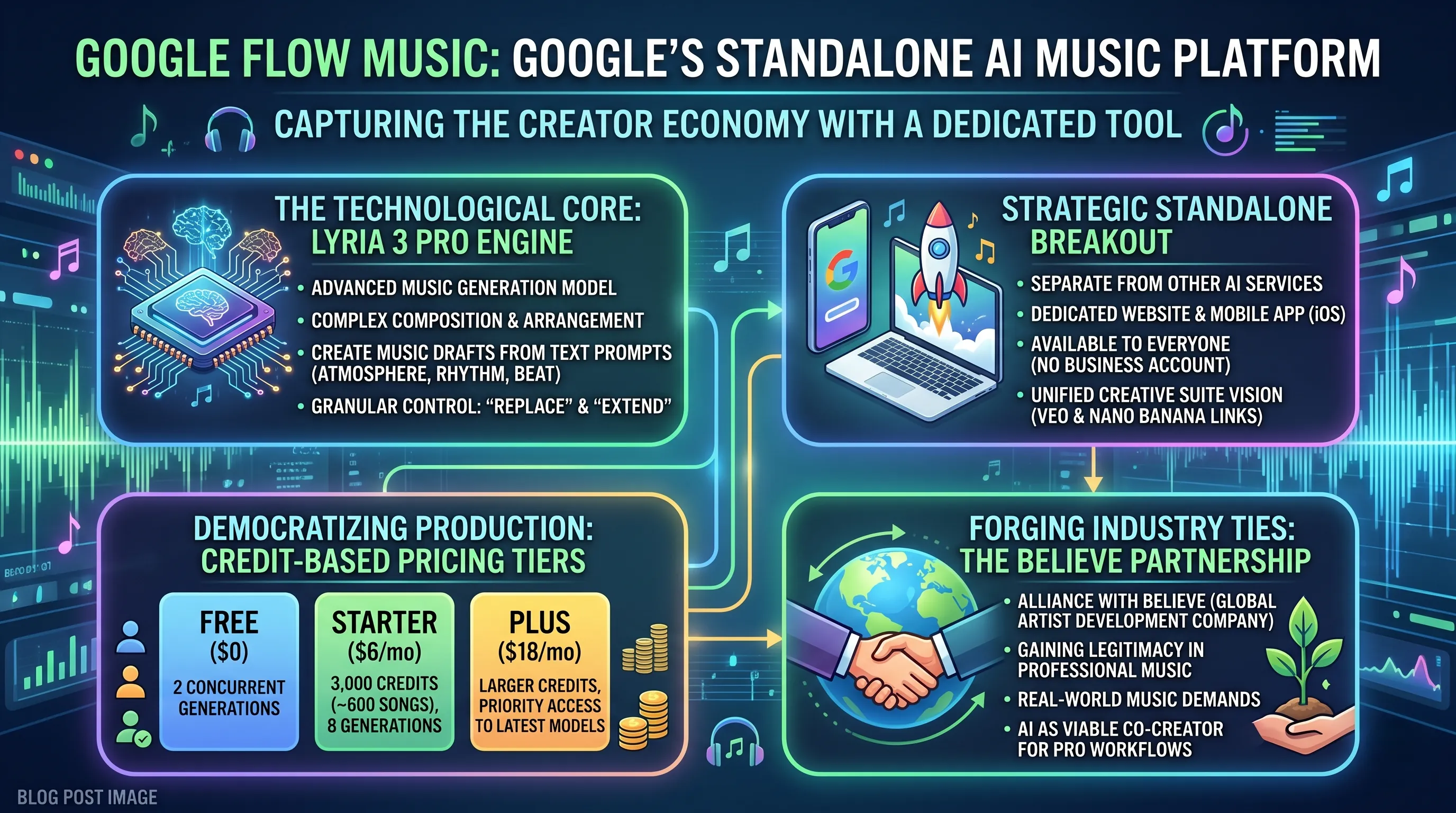
Google is leveraging an aggressive and accessible pricing model to drive adoption, structured around a credit system that directly translates to output.
This model is designed to cater to the entire spectrum of users:
- Free Plan: At $0, this tier serves as a powerful entry point for anyone curious about AI music generation.
It allows for 2 concurrent generations, providing a risk-free way to experiment with the platform's core capabilities. - Starter Plan: Priced at an exceptionally competitive $6 per month, this plan is aimed squarely at serious hobbyists and independent creators.
It provides 3,000 Credits monthly, which Google estimates is enough to generate approximately 600 songs, along with an increase to 8 concurrent generations.
This offers a massive volume of creative potential for a minimal investment. - Plus Plan: For $18, this premium tier offers an even larger pool of credits and generations.
Subscribers to the Plus Plan, which can be accessed via a direct Google Flow Music subscription or the broader Google AI membership plan, also gain priority access to the very latest models, making it the clear choice for professional users who need the most advanced tools available.
Forging Industry Ties: The Believe Partnership
To cement its position as a serious tool for the music industry, Google has strategically teamed up with Believe, a global artist development company.
This partnership is not merely a marketing tactic; it is a crucial step towards gaining legitimacy and fostering adoption within the professional music community.
By collaborating with a company that works directly with artists, Google aims to ensure Flow Music evolves to meet the real-world demands of music production.
This alliance helps bridge the gap between a nascent AI technology and its practical application in the established music world, directly challenging the notion that AI tools are only for amateurs and positioning Flow Music as a viable co-creator for professional workflows.
2. Revolutionizing Music Creation: Granular Editing and Intuitive Features for All Skill Levels
This section directly addresses the core of why Google's "Flow Music" is considered a "game-changing move".
While other platforms exist, Flow Music's strategic advantage lies in its sophisticated yet accessible creation suite, which fundamentally redefines the user's role from a passive prompter to an active director.
It's this deep, granular control, designed for both beginners and professionals, that forms the backbone of Google's strategy to dominate the emerging AI creator market.
From Text Prompt to Usable Draft: Lowering the Barrier to Entry
Flow Music's entry point is deceptively simple, designed to eliminate the initial friction that often paralyzes creativity.
Users can begin with nothing more than a short text input.
From this simple prompt, the platform, powered by Google's cutting-edge Lyria 3 Pro model, automatically generates a foundational music draft, complete with a fitting song atmosphere, rhythm, and beat.
This feature is a monumental leap for novice users or musicians facing creative blocks.
It transforms the intimidating "blank page" into a tangible starting point, providing an immediate musical concept that can be explored and refined.
Unlike earlier tools that might produce a final, unchangeable track, Flow Music treats this initial generation as what it is: a draft, ripe for development.
This initial step alone brings AI music production firmly into the hands of the general user, a key evaluation highlighted by industry analysts.
Surgical Precision: The 'Replace' and 'Extend' Revolution
Herein lies Flow Music's most significant differentiator and the feature set that most excites professional composers.
The platform moves beyond the "reroll until you like it" paradigm of its competitors by offering surgical editing capabilities.
The two flagship functions are 'Replace' and 'Extend'.
The 'Replace' function allows a user to target and modify a specific, isolated section of a song without affecting the rest of the composition.
If a four-bar drum fill is weak or a melodic phrase in the verse doesn't land, the user can regenerate just that part.
Similarly, the 'Extend' function empowers creators to lengthen specific sections, such as adding more bars to a chorus for a bigger impact or extending an instrumental bridge.
The experiential value of this is immense.
It allows for detailed editing such as partial melody replacement, intricate chorus extension, and even subtle mood changes within a track, all without having to discard the parts of the song that already work perfectly.
This is the definition of a non-destructive workflow.
For professionals, this means an unprecedented level of efficiency, eliminating the repetitive and frustrating work of regenerating entire tracks to fix a minor flaw.
This granular and precise editing capability is what analysts identify as Flow Music's clear superiority over previous AI music tools, turning the AI from a unpredictable generator into a responsive co-creator.
Mastering Nuance: Omni Flash and External AI Integration
To further deepen the level of creative control, Flow Music includes a powerful feature called Omni Flash.
Available to all users, Omni Flash acts as a sophisticated style guide, allowing creators to direct the AI with specific guidance on subjects, scenes, and moods to ensure the track's narrative and pacing are perfectly aligned with their vision.
This is particularly crucial for creators working on multimedia projects, where the music must complement video or imagery—a clear nod to its expected integration with Google's video model Veo and image model Nano Banana.
Furthermore, in a move that demonstrates a commitment to an open and powerful ecosystem, Flow Music allows users to leverage external AI tools for prompt creation.
A power user can employ sophisticated language models like ChatGPT, Gemini, or Claude to describe incredibly detailed and nuanced styles for music generation.
Instead of being limited to a few preset tags like "upbeat" or "rock," a creator can write a rich, descriptive paragraph detailing the exact texture of the bass, the emotional arc of the violin, and the rhythmic complexity of the percussion.
This integration unlocks a virtually limitless ceiling for sonic exploration and customization, catering directly to the meticulous demands of professional composers and producers.
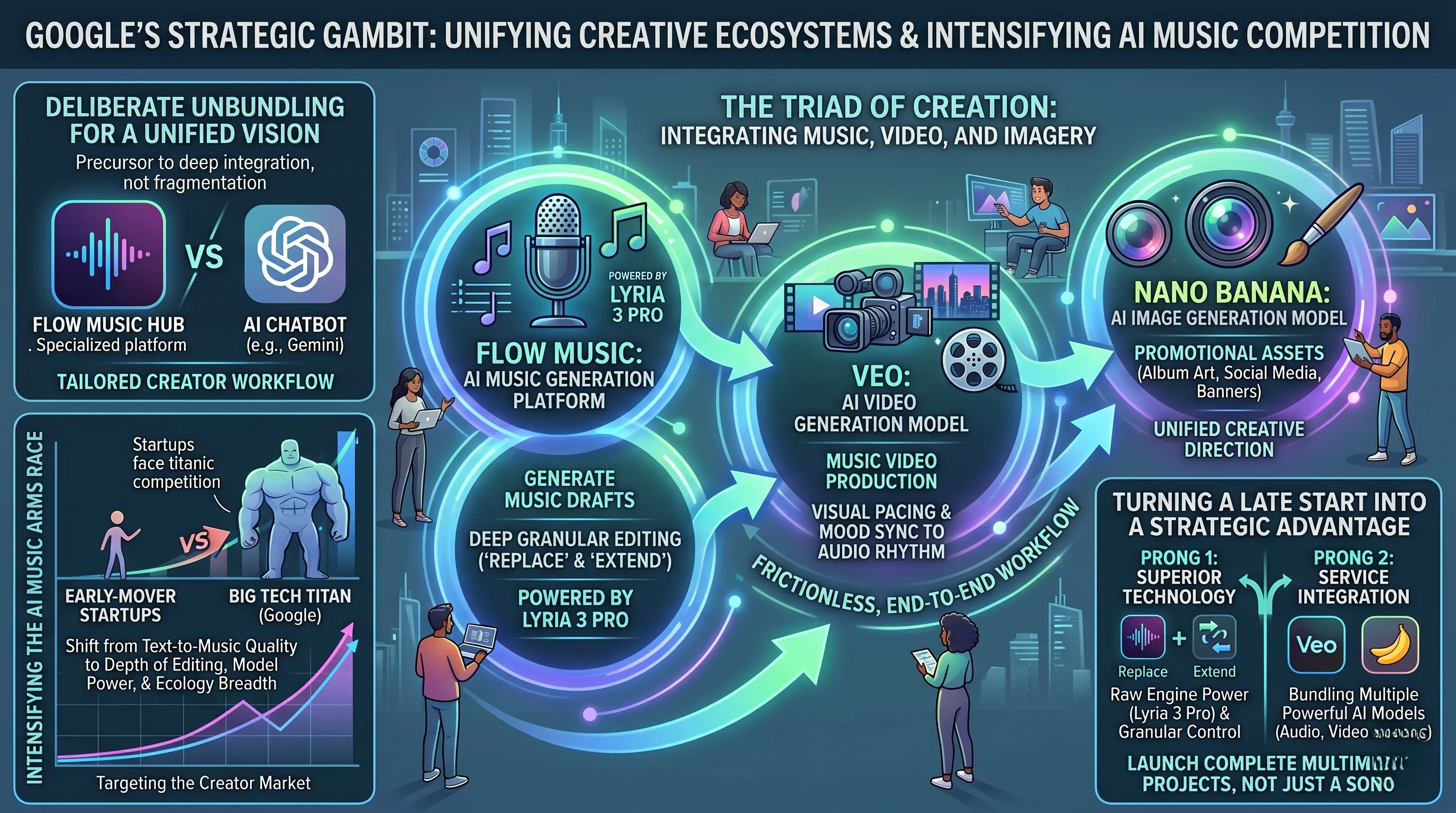
3. Google's Strategic Gambit: Unifying Creative Ecosystems and Intensifying AI Music Competition
The decision to launch Flow Music is central to the overarching theme of "Google's Flow Music Gambit" because it reveals a strategy far more ambitious than simply introducing another AI music generator.
It represents a calculated move to build a self-contained, powerful ecosystem for creators, deliberately separating this initiative from its general-purpose AI services to establish a new, focused front in the AI content creation war.
This strategic separation and planned integration are the core pillars of Google's plan to dominate the burgeoning creator market.
A Deliberate Unbundling for a Unified Vision
Google’s choice to establish Flow Music as a standalone platform, rather than a feature within its existing AI services like Gemini, is a telling strategic decision.
This unbundling is not a sign of fragmentation but a precursor to a more profound integration.
A dedicated platform provides a focused, distraction-free environment tailored specifically to the workflow of musicians and content creators, from novices to professionals.
More importantly, it serves as the foundational hub—the central audio component—for a much larger creative suite.
The source JSON indicates an explicit strategy to "integrate the creative ecosystem," a feat more cleanly achieved by linking specialized, best-in-class applications rather than shoehorning complex creative tools into a generalist chatbot interface.
This approach allows Google to build a powerful brand identity for its creative tools while setting the stage for a seamless, multi-modal production pipeline.
The Triad of Creation: Integrating Music, Video, and Imagery
The long-term vision for this gambit becomes crystal clear with the expected integration of Flow Music with Google's other powerful generative models: the video-generation AI, Veo, and the image model, Nano Banana.
This isn't merely about offering a collection of tools; it's about crafting a frictionless, end-to-end workflow that transforms how content is made.
A user could generate a high-quality song draft in Flow Music, then seamlessly export the audio to Veo to create a music video where the visual pacing, mood, and narrative elements are intelligently synced to the track's rhythm and emotional arc.
Subsequently, Nano Banana could be used to generate a consistent set of promotional assets—album art, social media thumbnails, marketing banners—all unified under the same creative direction.
This creates an experiential value that isolated tools cannot match, dramatically lowering the technical and financial barriers for creators to produce professional, multi-format content.
This unified ecosystem is Google's ultimate strategic objective and its most significant competitive advantage.
Intensifying the AI Music Arms Race
Google's entry with a dedicated, high-powered platform like Flow Music fundamentally alters the competitive landscape and officially signals the beginning of the "big tech competition" in the AI music creation market.
Startups like Suno, which gained significant early-mover advantage, now face a titan with immense resources.
The competition is no longer just about the quality of text-to-music generation.
It has escalated to include the depth of editing capabilities, the power of the underlying AI models (like Google's Lyria 3 Pro), and, most critically, the breadth of the surrounding ecosystem.
As the industry analysis suggests, Google is overtly targeting the creator market, aiming to become the go-to platform for not just a single piece of content, but the entire creative process.
This forces smaller competitors to either hyper-specialize in a niche or seek partnerships to match the scale of Google's integrated offering.
Turning a Late Start into a Strategic Advantage
While Google may be perceived as a "latecomer" to the dedicated AI music generation scene, it plans to mitigate this weakness through a two-pronged assault: superior technology and strategic integration.
The first prong is raw power; Flow Music is powered by the state-of-the-art Lyria 3 Pro model and offers granular editing features like 'Replace' and 'Extend', which provide a level of control that surpasses many early-stage tools.
The second, and more decisive, prong is the service integration strategy.
Google is leveraging its colossal advantage—its ownership of complementary, powerful AI models for video and images.
A startup can build an excellent music tool, but it cannot easily replicate Google's ability to bundle it with a world-class video generator and image creator.
By transforming the proposition from "create a song" to "launch a complete multimedia project," Google effectively leapfrogs the existing market, turning its late entry into an opportunity to redefine the rules of the game entirely.
📚 Related Posts
Microsoft's MAI-Image-2-Efficient: 41% Cheaper, 4x Faster AI Image Generation Reshapes Enterprise Market & Intensifies Competiti
🚀 Key TakeawaysMicrosoft has launched MAI-Image-2-Efficient, a game-changing AI image model that delivers 22% faster generation and 4x improved computational efficiency, while dramatically reducing costs by approximately 41%, positioning it as an ideal
tech.dragon-story.com
Anthropic's Claude Design AI: Generate Branded Visuals Instantly – Revolutionizing Slides, Prototypes & Marketing Images with
🚀 Key TakeawaysAnthropic's Claude Design, launched as a research preview on April 17, 2026, is an AI tool that generates instant, branded visual content—including slides, prototypes, and marketing images—from text input, significantly boosting desig
tech.dragon-story.com
Anthropic's Claude Opus 4.7: Best Coding AI, Enterprise Powerhouse & Global Productivity War Catalyst
🚀 Key TakeawaysClaude Opus 4.7 emerges as Anthropic's most capable model, positioned as the best coding AI alive and a top performer in high-value knowledge work like finance and law, intensifying the global 'practical productivity war' among AI competi
tech.dragon-story.com


