🚀 Key Takeaways
- OpenAI's ChatGPT Images 2.0 (GPT-Image-2), officially released on April 21, 2026, represents a transformative leap as the first inferential image model.
It excels in executing complex visual tasks, generating highly practical outputs such as ad designs, UI drafts, and educational materials with high precision and accurate text insertion, even for multilingual content.
This powerful tool is available to all ChatGPT, Codex, and API users, enabling simultaneous generation of up to 8 linked images per request, fundamentally shifting AI image generation into the practical production stage.
OpenAI has officially rolled out GPT-Image-2, also known as ChatGPT Images 2.0, marking a significant advancement in the realm of artificial intelligence.
This cutting-edge image generation model, introduced by OpenAI, became publicly available on April 21, 2026, and is now accessible to all ChatGPT, Codex, and API users.
It promises to revolutionize how visuals are created, moving beyond simple generation to empower users with unprecedented capabilities for diverse applications.
Distinguishing itself from previous generative AI models, ChatGPT Images 2.0 is lauded as the first inferential image model, capable of tackling complex visual tasks that extend far beyond basic image creation.
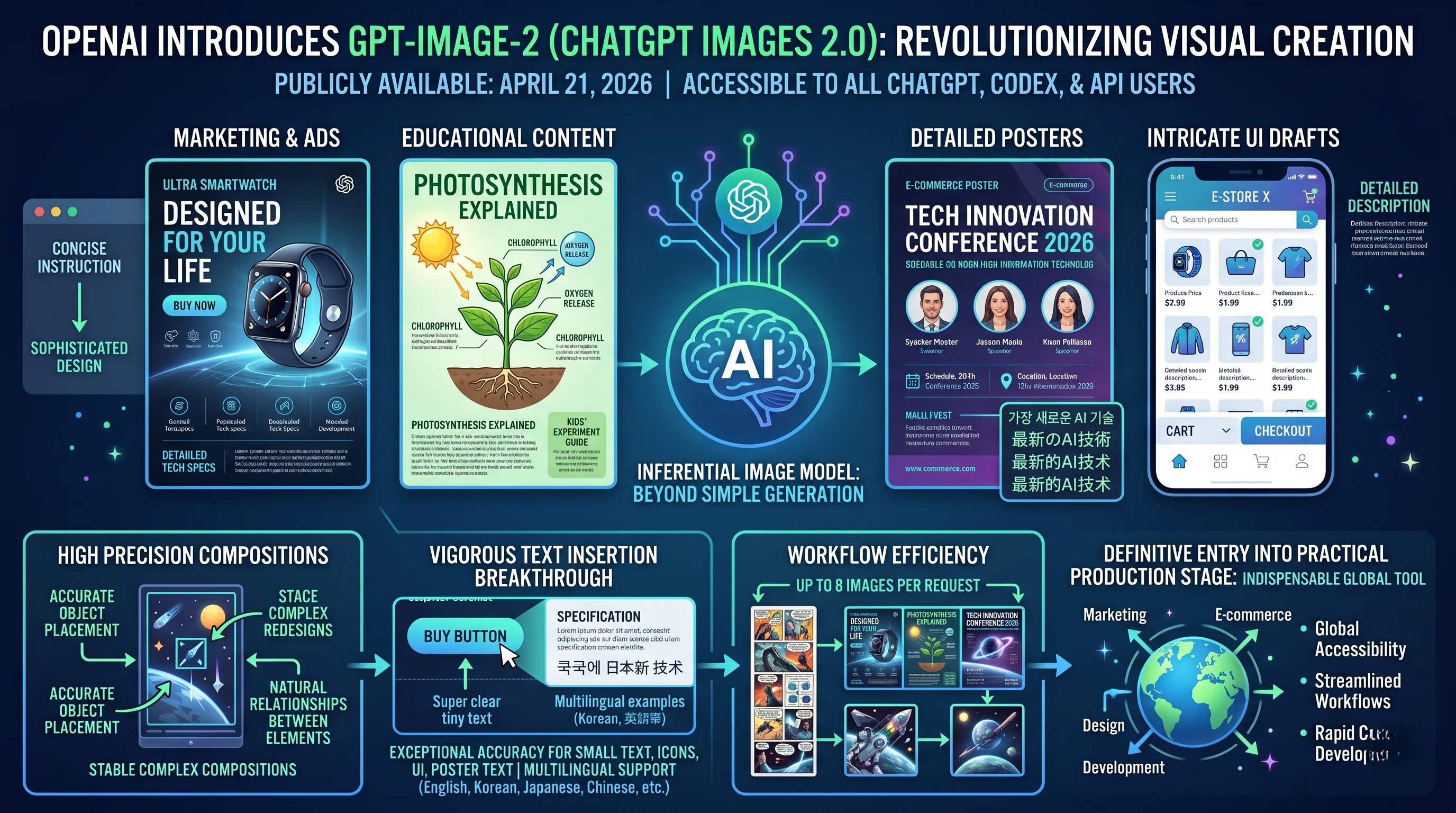
This groundbreaking ability allows it to produce highly practical, production-ready results, including sophisticated ad designs, comprehensive educational content, detailed posters, and intricate UI drafts, all from concise user instructions.
Its core strength lies in its high precision, ensuring accurate object placement, natural relationship expression between elements, and stable, complex compositions, which are crucial for professional applications.
A standout innovation is the model's vastly improved text insertion capabilities, rendering small text, icons, UI elements, and poster text with exceptional accuracy, and offering enhanced multilingual support for non-Latin scripts such as Korean, Japanese, and Chinese.
Furthermore, ChatGPT Images 2.0 supports simultaneous generation of up to 8 linked images per request, streamlining workflows for serial comics, multiple poster drafts, or space redesign concepts.
This release solidifies the industry's view that AI image generation has definitively entered the practical production stage, positioning it as an indispensable tool for marketing, e-commerce, UI/UX design, and rapid concept development globally.
1. OpenAI's Grand Unveiling: ChatGPT Images 2.0's Core Details and Access
As a core component of the main topic, "OpenAI, ChatGPT Images 2.0 Officially Unveiled", this section provides the foundational "who, when, where, and how" of this landmark release.
It details the official announcement, availability, technical specifications, and cost structure, which are the essential pillars upon which the model's revolutionary features are built.
The Landmark Launch: A Calculated Debut
The arrival of ChatGPT Images 2.0 was not a quiet beta test but a decisive market entry orchestrated directly by its creator, OpenAI.
The official rollout commenced in April, with the specific launch date etched into the industry's calendar: April 21, 2026.
This date marks the moment OpenAI transitioned its most advanced visual model from an internal project into a publicly accessible platform, signaling immense confidence in its stability, performance, and readiness for large-scale adoption.
The announcement itself confirms that this is not an incremental update but a full version "2.0" release, intended to set a new benchmark in inferential image AI.
Democratizing Access: A Platform for All Creators
In a move that underscores a strategy of widespread integration, OpenAI has made ChatGPT Images 2.0 available across its entire ecosystem from day one.
This is not a phased rollout limited to premium subscribers or enterprise clients.
Instead, access has been granted simultaneously to all ChatGPT, Codex, and API users.
This decision has profound implications:
- For ChatGPT Users:
Everyday users can now leverage state-of-the-art visual reasoning and generation directly within the familiar chat interface, dramatically expanding the scope of what they can create and analyze. - For Codex Users:
Developers and programmers can now integrate visual generation and understanding directly into their coding workflows, enabling tasks like generating UI drafts from code comments or creating visual assets for an application on the fly. - For API Users:
The broader developer community gains the power to build entirely new applications and services on top of this visual engine, promising a Cambrian explosion of innovation in areas from automated marketing to interactive educational tools.
Technical Foundations: The Leap to Professional-Grade Quality
To meet the demands of practical, real-world applications, ChatGPT Images 2.0 was engineered with specifications that elevate it beyond a mere creative novelty.
The model boasts support for images up to 2K resolution.
This is a critical threshold; it means the generated outputs are not just for screen viewing but are sharp and detailed enough for professional use cases like print advertising, high-fidelity website assets, and detailed product mockups.
Furthermore, the model provides a selection of various screen aspect ratios.
This seemingly simple feature is a massive quality-of-life improvement, allowing users to generate content natively for specific formats—be it a vertical story for social media, a 16:9 thumbnail for a video platform, or a square post for a product feed—eliminating the need for cumbersome and often quality-degrading post-generation cropping and resizing.
A Strategic Pricing Model: Understanding the Token Economy
OpenAI has introduced a clear and tiered pricing structure for API usage, designed to be scalable and encourage efficient implementation.
The cost is broken down based on how the model interacts with visual data:
- Image Inputs:
For processing new, unseen images, the cost is set at $8.00 / 1M tokens. This is the standard rate for when the model must perform a full analysis or "ingestion" of a visual prompt for the first time. - Cached Inputs:
For processing images that have already been analyzed and are stored in the system's cache, the price drops dramatically to $2.00 / 1M tokens. This 75% discount provides a powerful incentive for developers to build applications that reuse or repeatedly reference the same images, making iterative design processes, batch analysis, and multi-step visual tasks significantly more cost-effective.
This two-tier system reflects a sophisticated understanding of developer workflows and is structured to make both initial creation and subsequent refinement economically viable at scale.

2. Redefining Visual AI: ChatGPT Images 2.0's Inferential Capabilities and Advanced Features
The grand reveal of "OpenAI, ChatGPT Images 2.0 Officially Unveiled" signifies more than a mere upgrade; it heralds a new epoch for artificial intelligence.
This section connects directly to that overarching topic by deconstructing the core technological leaps that make ChatGPT Images 2.0 a revolutionary tool.
We will move beyond the headlines to explore how its identity as the first *inferential* image model, combined with a suite of professional-grade features, fundamentally redefines the boundaries of what visual AI can achieve in practical, real-world applications.
The Dawn of Inferential AI in Visuals
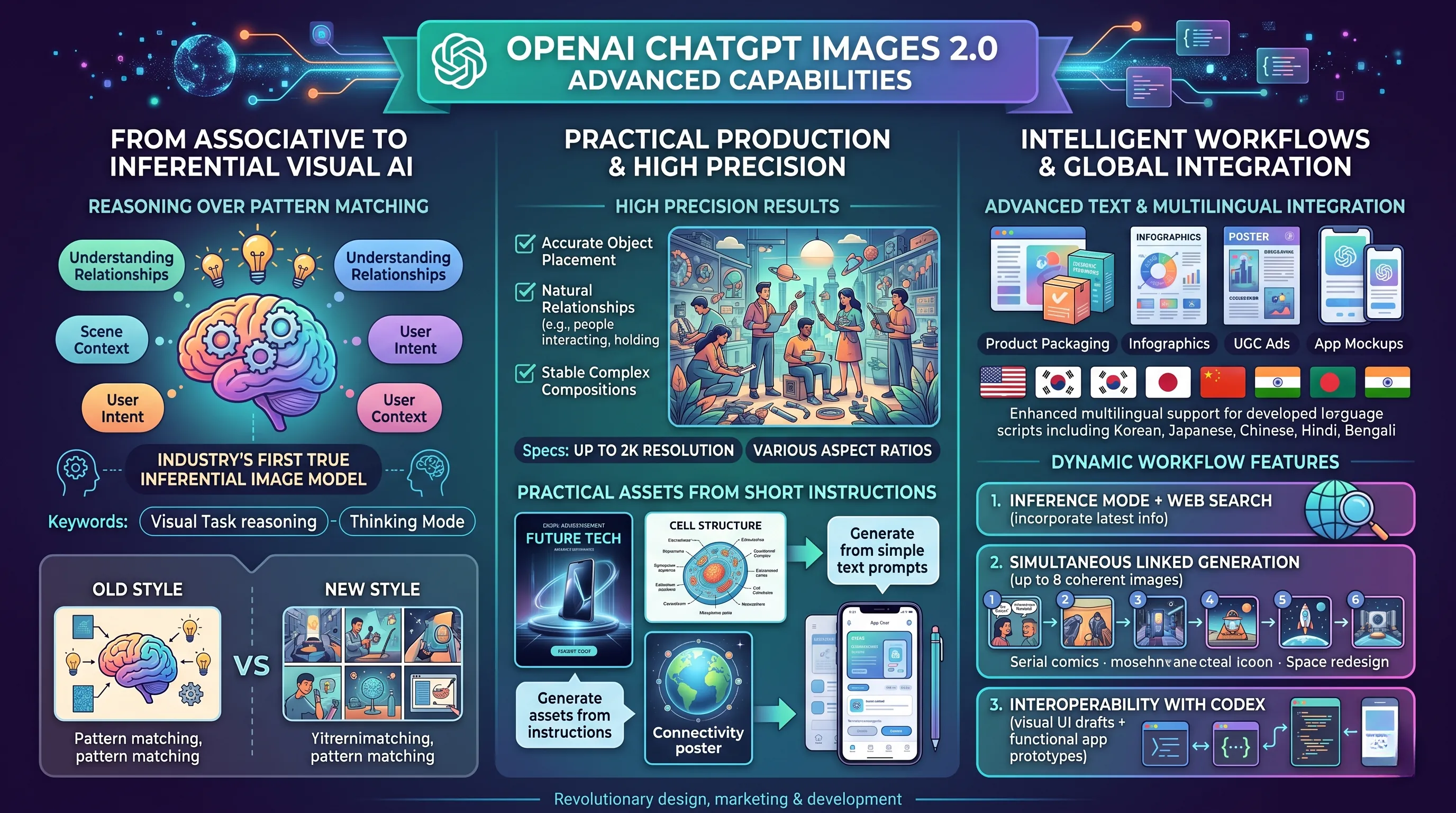
ChatGPT Images 2.0 is not just another image generator; it is the industry's first true inferential image model.
This distinction is critical.
Previous models operated primarily on associative generation—matching text prompts to visual patterns in their training data.
ChatGPT Images 2.0, however, engages in complex visual tasks that require a degree of reasoning.
It understands the *relationships* between objects, the *context* of a scene, and the *intent* behind a user's request.
This is amplified by its "thinking" mode, a feature that allows the model to process and interpret complex instructions before generating a single pixel, moving it from a simple renderer to a visual problem-solver.
Instead of just creating an image "of" something, it can now generate an image "for" a specific purpose, understanding the unstated requirements of a task like creating an effective advertisement versus an educational diagram.
From Creative Assistance to Practical Production
This inferential power translates directly into tangible, high-quality results for professional use.
With nothing more than short, descriptive instructions, users can now generate practical assets like complete ad designs, multi-page educational materials, posters, and detailed UI drafts.
The quality of these outputs is underpinned by a new standard of high precision.
- Accurate Object Placement:
Objects are positioned logically within a scene, respecting physics and perspective, eliminating the frustrating visual artifacts common in earlier models. - Natural Relationships:
The model excels at expressing natural interactions between elements—a person holding a tool, characters in a conversation, or ingredients in a recipe—making scenes feel coherent and believable. - Stable Complex Compositions:
It can handle intricate scenes with multiple subjects and a detailed background without the composition collapsing into chaos, maintaining visual integrity and focus.
This precision is delivered at up to 2K resolution and across various screen aspect ratios, ensuring that the generated assets are ready for professional deployment without significant rework.
This shift is confirmed by industry analysis, which states, "AI image generation has now entered the practical production stage beyond creative assistance."
Unprecedented Text and Multilingual Integration
One of the most significant breakthroughs is the model's dramatically improved text insertion capability.
It flawlessly renders small text, intricate icons, complex UI elements, and bold poster text with high accuracy.
This feature alone solves a major pain point that has historically plagued AI image models.
It can handle product packaging, user-generated content (UGC) style ads, infographics, and app mockups with near-perfect text legibility.
Crucially, this capability is extended with enhanced multilingual support for non-Latin scripts, including Korean, Japanese, Chinese, Hindi, and Bengali.
The system doesn't just overlay translated words; it *naturally places* text within the context of a design, be it a comic book speech bubble, a poster headline, or an explanatory diagram.
This empowers users to produce localized ad images and educational content using native-language prompts effortlessly.
As one industry evaluation noted, "The barrier to creating designs for the global market will be significantly lowered."
Intelligent Workflows and Dynamic Capabilities
ChatGPT Images 2.0 introduces several workflow-accelerating features that solidify its role as a professional tool.
- Inference Mode with Web Search:
In this mode, the model can utilize web search to incorporate the absolute latest information into its visuals.
A prompt to create a marketing image for a new product can reflect its most recent award or a trending news event, making the outputs timely and relevant. - Simultaneous Linked Generation:
Users can request up to 8 linked images at once.
This is not merely eight variations of one idea, but a coherent series of images.
This is a game-changer for creating serial comics with narrative continuity, generating multiple poster drafts that explore a single concept, or visualizing a space redesign from several different angles. - Interoperability with Codex:
The synergy between ChatGPT Images 2.0 and Codex creates a seamless pipeline from concept to prototype.
A user can describe an application, and this integrated system can generate the visual UI drafts and functional app prototypes simultaneously.
This powerful combination drastically shortens the development cycle for creating app UI, interactive prototypes, and even dynamic marketing drafts.
These advanced features, available to all ChatGPT, Codex, and API users since its April 21, 2026 release, suggest a clear evolution towards verifiable AI and sophisticated visual reasoning, fundamentally changing how we design, market, and develop products.
3. Industry Transformation: Real-World Applications and The Future of Practical AI Visuals
The April 21, 2026, release of ChatGPT Images 2.0 is not merely an incremental update; it represents a fundamental inflection point in the practical application of artificial intelligence.
This section delves into how this new technology, as part of the overarching "OpenAI, ChatGPT Images 2.0 Officially Unveiled" announcement, is poised to dismantle existing workflows and create entirely new value chains across multiple industries, moving AI visuals from the realm of novelty to an indispensable production tool.
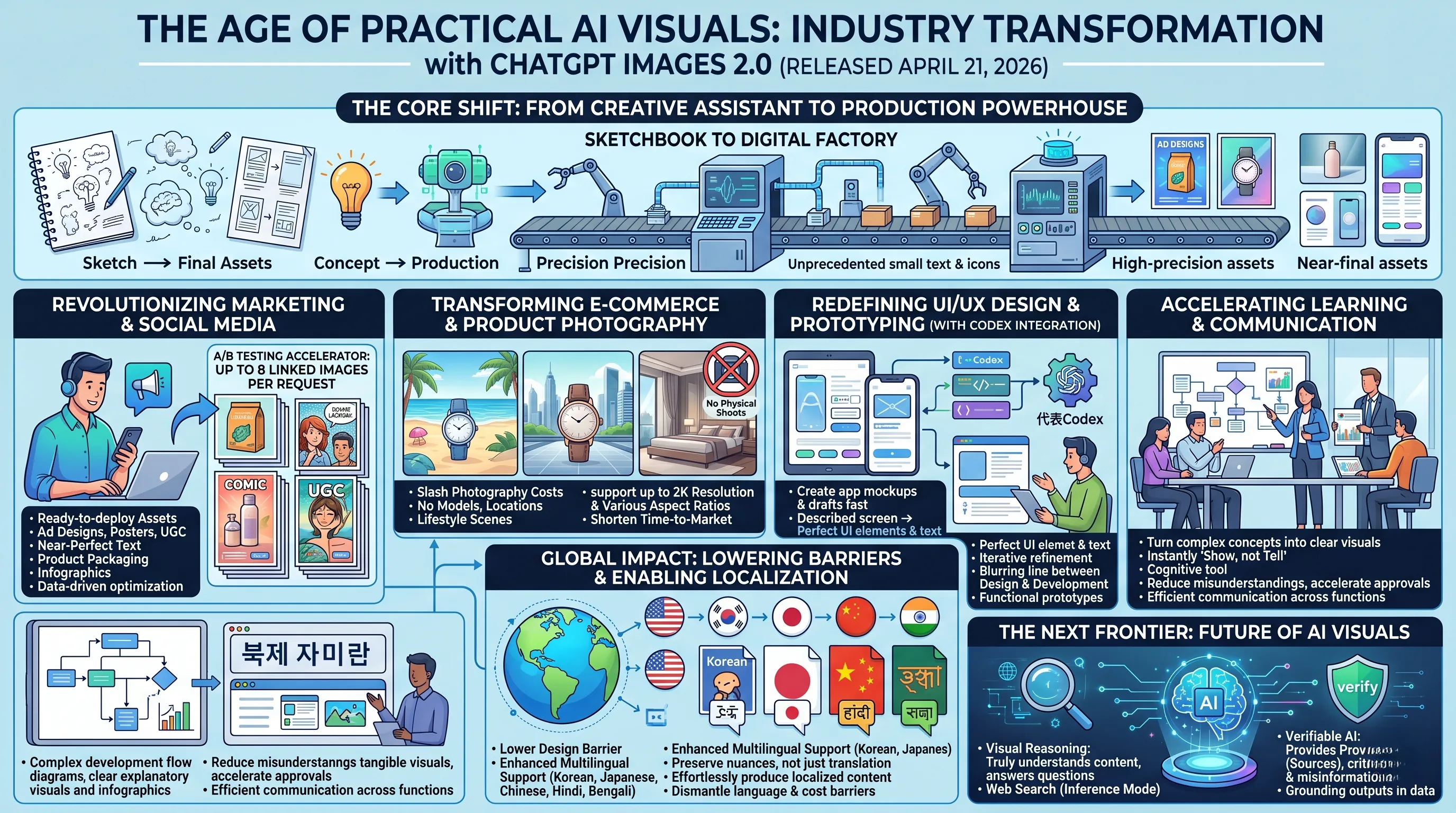
From Creative Assistant to Production Powerhouse
Until now, AI image generation has often been relegated to a role of creative assistance—a tool for brainstorming or generating abstract art.
Industry analysis, however, now declares that with ChatGPT Images 2.0, "AI image generation has now entered the practical production stage."
This shift is driven by the model's unprecedented precision.
Features like accurate object placement, the ability to render stable, complex compositions, and the natural expression of relationships between visual elements mean the outputs are no longer just concepts; they are near-final assets.
The ability to render small text, icons, and UI elements with high accuracy is the final piece of the puzzle, eliminating the tedious manual corrections that made previous models impractical for professional use.
This is the transition from a digital sketchbook to a digital factory.
Revolutionizing Marketing & Social Media
The impact on marketing is immediate and profound.
Professionals can now generate practical, ready-to-deploy assets like ad designs, posters, and user-generated content (UGC) style ads from simple text instructions.
The model's capability to handle product packaging and infographics with near-perfect text integration means a single marketer can now perform the work of an entire creative team—from concept to final render—in a fraction of the time.
Furthermore, the simultaneous generation feature, which allows for up to 8 linked images per request, is a massive accelerator for A/B testing.
A brand can instantly produce multiple ad variations, serial comics for a social media campaign, or different poster drafts, allowing for data-driven creative optimization at a scale and speed previously unimaginable.
Transforming E-commerce & Product Photography
For the e-commerce sector, ChatGPT Images 2.0 offers a direct route to slashing one of its most significant costs: product photography.
The high-precision model can generate photorealistic lifestyle shots, placing products into diverse and compelling scenes without the need for physical photoshoots, models, or locations.
Supporting up to 2K resolution and various screen aspect ratios ensures these generated images are high-quality and versatile enough for everything from website banners to product detail pages.
This dramatically shortens the time-to-market for new products and enables smaller retailers to compete with the polished visual branding of larger corporations.
Redefining UI/UX Design and Prototyping
The integration between ChatGPT Images 2.0 and Codex heralds a new era for UI/UX design and app development.
Designers and developers can now create app mockups, UI drafts, and functional prototypes with astonishing speed.
By simply describing a screen's layout and functionality, a user can receive a high-fidelity visual draft with accurately rendered UI elements and text.
The advanced editing capabilities and "thinking" mode allow for iterative refinement directly within the platform.
This tight loop between visual generation and code-aware logic (via Codex) blurs the line between design and development, allowing for the creation of interactive prototypes and marketing drafts in a single, fluid workflow.
Accelerating Learning and Communication
Beyond commercial design, the model serves as a powerful cognitive tool for learning and communication.
Complex development concepts can be turned into clear, explanatory visuals, making it easier for teams to align and for new members to onboard.
A project manager can now instantly "show, not tell" by turning a verbal explanation for a client into a tangible visual, dramatically reducing misunderstandings and accelerating approval cycles.
This ability to translate abstract ideas into concrete infographics and diagrams makes communication more efficient and effective across all business functions.
Global Impact: Lowering Barriers and Enabling Localization
Perhaps the most significant long-term impact is the democratization of professional design on a global scale.
As one industry evaluation notes, "The barrier to creating designs for the global market will be significantly lowered."
This is powered by the model's enhanced multilingual support, which excels with non-Latin scripts like Korean, Japanese, Chinese, Hindi, and Bengali.
Crucially, it goes beyond simple translation; it naturally places text within the context of a poster, comic, or educational graphic, preserving cultural and design nuances.
A user can now leverage Korean prompts to effortlessly produce localized ad images and infographics for any market, effectively dismantling the language and cost barriers that have long protected incumbent design agencies.
The Next Frontier: Visual Reasoning and Verifiable AI
The launch of ChatGPT Images 2.0 is not an endpoint but a signpost for the future.
The industry suggests an evolution into two critical areas: visual reasoning and verifiable AI.
Visual reasoning implies an AI that doesn't just generate an image but truly understands its content, able to answer complex questions about the scene it created.
Verifiable AI points to a system that can provide provenance for its creations, citing sources or influences, which is critical for navigating intellectual property and combating misinformation.
The current "Inference Mode," which utilizes web search to reflect the latest information in its generations, is a nascent step in this direction, grounding AI's visual output in the verifiable, real world.
📚 Related Posts
ChatGPT's Official CarPlay Debut: Voice AI, iOS 26.4 Requirements & CarPlay Ultra's Future
🚀 Key TakeawaysChatGPT is now officially available on Apple CarPlay globally, marking a significant advancement in integrating conversational AI directly into the driving experience.This groundbreaking integration requires a supported iPhone on iOS 26.4
tech.dragon-story.com
Microsoft's MAI-Image-2-Efficient: 41% Cheaper, 4x Faster AI Image Generation Reshapes Enterprise Market & Intensifies Competiti
🚀 Key TakeawaysMicrosoft has launched MAI-Image-2-Efficient, a game-changing AI image model that delivers 22% faster generation and 4x improved computational efficiency, while dramatically reducing costs by approximately 41%, positioning it as an ideal
tech.dragon-story.com
Anthropic's Claude Design AI: Generate Branded Visuals Instantly – Revolutionizing Slides, Prototypes & Marketing Images with
🚀 Key TakeawaysAnthropic's Claude Design, launched as a research preview on April 17, 2026, is an AI tool that generates instant, branded visual content—including slides, prototypes, and marketing images—from text input, significantly boosting desig
tech.dragon-story.com


