🚀 Key Takeaways
- Google's Deep Research Max is an autonomous AI agent, built on Gemini 3.1 Pro, designed to self-perform complex investigation and analysis tasks, effectively automating the entire research workflow from data exploration to report writing.
- It boasts comprehensive multimodal input capabilities, processing PDF, CSV, images, audio, and video, and integrates with a broad spectrum of data sources including public web search, internal corporate documents, and closed enterprise data via MCP.
- Optimized for long-running, accuracy-critical investigations, Deep Research Max generates highest-level, presentation-quality reports featuring native visualizations and automatic chart/infographic creation, consistently topping every research benchmark.
Google has officially unveiled Deep Research Max, a groundbreaking autonomous AI agent poised to transform how complex investigations and analysis are conducted.
Powered by the advanced Gemini 3.1 Pro technology, this innovative tool is engineered to self-perform intricate research tasks, significantly enhancing efficiency and depth across various industries.
It represents a significant leap forward in AI capabilities, allowing organizations to tackle challenging research questions with unprecedented autonomy.
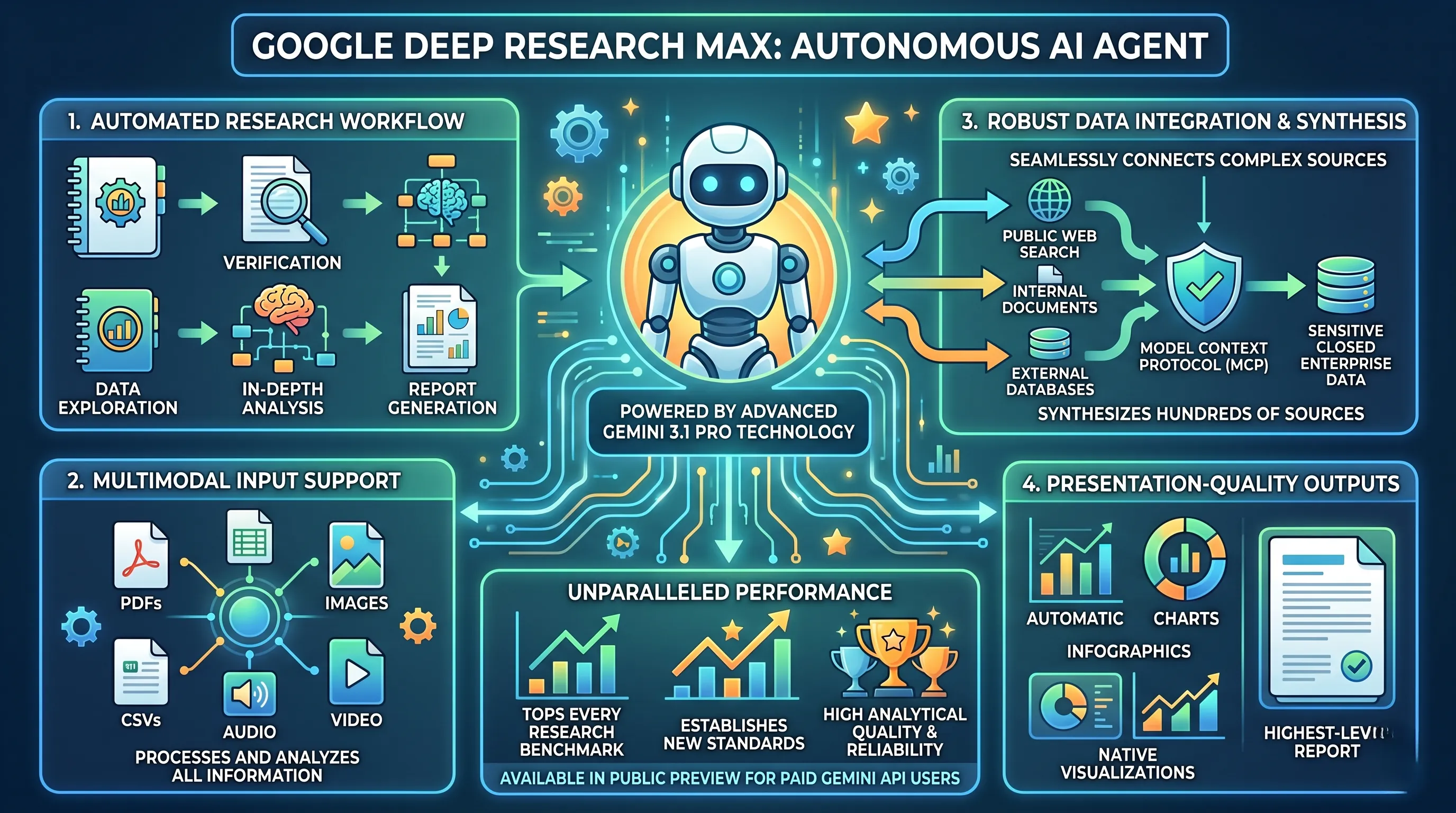
Deep Research Max automates the entire research workflow, encompassing everything from initial data exploration and verification to in-depth analysis and final report generation.
It offers unparalleled capabilities through multimodal input support, allowing it to process and analyze information from PDFs, CSVs, images, audio, and video files.
Furthermore, its robust data integration allows it to connect seamlessly with public web search, corporate internal documents, external databases, and even sensitive closed enterprise data via the Model Context Protocol (MCP).
Designed specifically for long-running and accuracy-critical investigations, Deep Research Max excels at synthesizing complex information from hundreds of sources, producing highest-level, presentation-quality reports complete with automatic charts, infographics, and native visualizations.
Available today in public preview for paid Gemini API users, this agent has already proven its superior performance by topping every research benchmark, establishing a new standard for AI-driven analytical quality and reliability in regulated industries.
1. Deep Research Max: Redefining Autonomous Investigation with Gemini 3.1 Pro
As the centerpiece of Google's announcement of its autonomous research AI, "Deep Research Max" represents the most powerful and comprehensive vision of this new technology. It is not merely an incremental update but a fundamental reimagining of how complex research is conducted, shifting the paradigm from human-led inquiry with AI assistance to AI-led investigation with human oversight. This section delves into the architecture, capabilities, and groundbreaking performance that make Deep Research Max the new flagship for autonomous analysis.
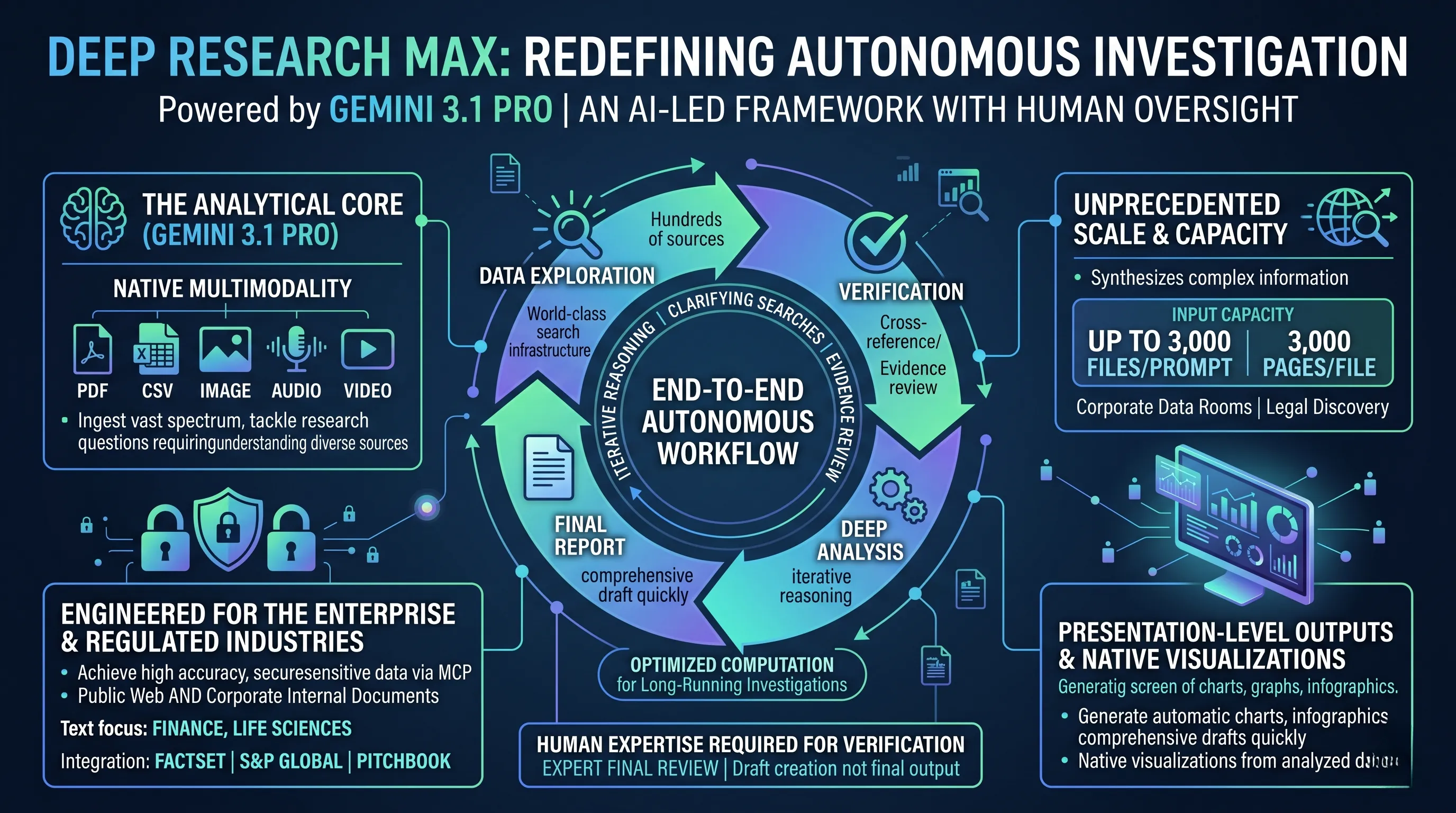
At its core, Deep Research Max is powered by Google's latest foundational model, Gemini 3.1 Pro. This is not just a detail; it is the source of its expansive capabilities. Gemini 3.1 Pro's native multimodality is the bedrock upon which Max builds its analytical prowess, allowing it to ingest and comprehend a vast spectrum of information formats. Unlike previous models that were primarily text-based, Deep Research Max can utilize PDFs, CSV data files, images, audio, and even video as direct inputs for multimodal analysis. This allows the AI to tackle research questions that require understanding data from diverse sources, such as analyzing financial reports (PDFs), correlating sales data (CSVs), interpreting chart images, and even transcribing and analyzing information from a recorded earnings call (audio).
From Prompt to Presentation: An End-to-End Autonomous Workflow
The true revolution offered by Deep Research Max is its core function: to self-perform complex investigation and analysis tasks. This is far beyond simple summarization. It is an agent designed to autonomously plan, execute, and synthesize multi-step research tasks. When given a complex query, Max doesn't just search for an answer; it devises a research plan. This process involves a sophisticated loop of advanced processing techniques, including iterative reasoning, initiating additional searches for clarifying information, and performing evidence review to cross-reference and validate its findings.
This intelligent, self-correcting process automates what was previously a painstaking manual effort. The system methodically moves through the entire research workflow, beginning with broad data exploration across hundreds of public sources, moving to verification and cross-referencing, performing deep analysis, and culminating in the generation of a final report. Because it is optimized for long-running, accuracy-critical investigations, it dedicates significantly more computational resources than its standard counterpart, ensuring a level of depth and rigor required for high-stakes decision-making. The experiential value of this is profound; instead of spending days or weeks gathering and synthesizing data, a researcher can delegate the entire foundational process and receive a comprehensive draft in a fraction of the time.
Unprecedented Scale and Analytical Quality
Deep Research Max operates on a scale previously unimaginable for a single analytical tool. It leverages Google's world-class search infrastructure to synthesize complex information from hundreds of public sources, ensuring a breadth of coverage that is nearly impossible for a human team to replicate manually. The input capacity is equally staggering, with the ability to process up to 3,000 files per prompt, with each file containing up to 3,000 pages. This allows it to analyze entire corporate data rooms, vast repositories of scientific papers, or extensive legal discovery documents in a single, cohesive investigation.
The result of this intensive process is what Google describes as unprecedented analytical quality. This is not just a marketing claim; the model has been shown to top every research benchmark it has been tested against. The output is not a simple block of text but is designed to provide presentation-level results. A key feature is its ability to generate automatic charts, infographics, and other visual materials. These are not just generic illustrations but native visualizations created directly from the analyzed data, transforming raw numbers and text into immediately understandable insights.
Engineered for the Enterprise and Regulated Industries
Google has clearly positioned Deep Research Max for high-value enterprise use, with a particular focus on achieving the high accuracy and reliability demanded by regulated industries like finance and life sciences. It can securely connect not only to the public web but also to corporate internal documents, private file repositories, and external databases. For highly sensitive information, it supports the Model Context Protocol (MCP) for closed data, enabling it to analyze proprietary financial data, confidential market information, and specialized research materials without exposing that data externally. To further cement its utility in the financial sector, Google has announced direct integrations with industry-standard data providers like FactSet, S&P Global, and PitchBook.
While its capabilities are transformative, it's crucial to recognize its current limitations. The model, like all current LLMs, will sometimes hallucinate citations or miss the nuance in contradictory sources. Therefore, it is best understood as an incredibly powerful tool for creating initial drafts or performing deep exploration, which still requires a final layer of human expertise for verification and contextual interpretation. Its public preview begins today for paid Gemini API users, with the underlying Gemini Deep Research agent having been first released to developers via the Interactions API in December.
2. Strategic Deployment and Practical Considerations of Deep Research Max
This section directly addresses the practical implications of Google's announcement of Deep Research Max, moving beyond its theoretical capabilities to discuss how organizations can access it, what its operational framework looks like, and the critical caveats they must consider for responsible implementation.
It provides a grounded, realistic look at deploying this powerful new tool in real-world scenarios.
Access, Availability, and Foundational Infrastructure
Google is making Deep Research Max immediately accessible, a clear signal of its confidence in the agent's enterprise-readiness.
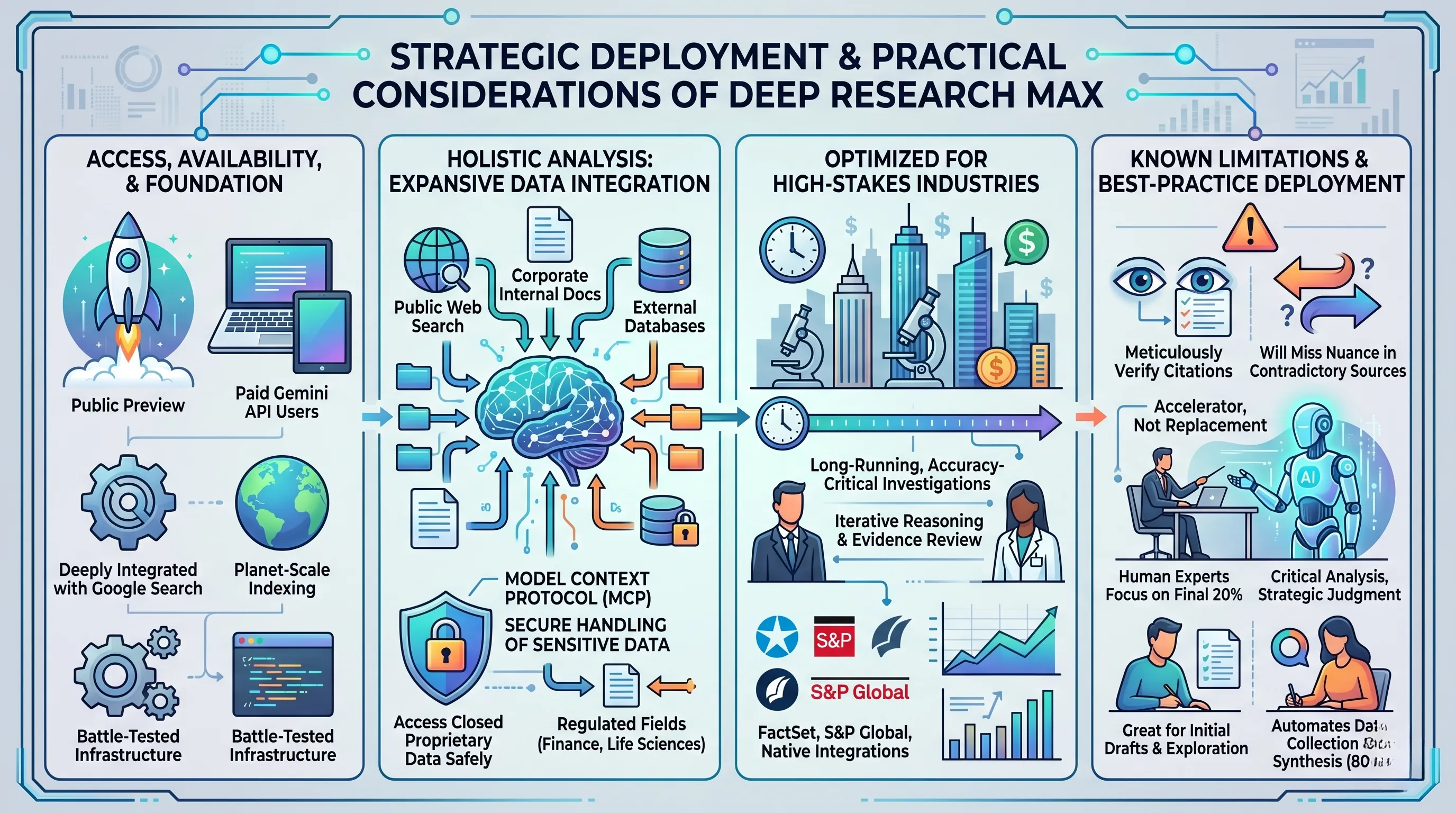
Starting today, it is available as a public preview for all paid Gemini API users.
This go-to-market strategy targets developers and organizations already invested in Google's AI ecosystem, encouraging immediate experimentation and integration into existing workflows.
Fundamentally, Deep Research Max's power is not just in its Gemini 3.1 Pro model but in its deep integration with Google's core competency: search.
The agent benefits directly from Google's unparalleled search infrastructure, which is far more than just a connection to a public search engine.
This leverage implies access to a battle-tested, planetary-scale indexing and information retrieval system, allowing the agent to sift through vast amounts of data with an efficiency and scope that standalone models cannot replicate.
Expansive Data Integration for Holistic Analysis
A key strategic advantage of Deep Research Max is its ability to operate as a central nervous system for information, unifying disparate data sources into a single analytical context.
Its capabilities extend far beyond simple web queries, allowing it to connect to and synthesize information from:
- Public Web Search: The entire indexed internet serves as its foundational knowledge base.
- Corporate Internal Documents: The agent can be pointed at internal knowledge bases, file repositories, and document management systems, enabling it to answer questions with proprietary company context.
- External Databases: It can plug directly into structured external databases, allowing it to perform analysis that combines unstructured text with structured data.
Crucially for enterprise use in regulated fields, Google has implemented support for closed data via the Model Context Protocol (MCP).
This is a game-changer for security-conscious organizations.
MCP allows Deep Research Max to securely access and utilize highly sensitive, proprietary data—such as internal financial data, confidential market information, or specialized research materials—without that data being exposed or used for model training.
This secure data handling is a prerequisite for any serious adoption in finance or life sciences.
Optimization for High-Stakes, Regulated Industries
Deep Research Max is not designed for the quick, conversational queries that consumer chatbots handle.
It is explicitly optimized for long-running, accuracy-critical investigations.
This means it is engineered to undertake complex, multi-step research projects that can take significant time, using its iterative reasoning and evidence review processes to build a high-confidence report.
Google's initial focus is clearly on sectors where the cost of being wrong is extraordinarily high.
The agent includes native integration with premier financial data providers like FactSet, S&P Global, and PitchBook, allowing it to conduct sophisticated financial analysis using trusted, industry-standard sources.
This targeted integration underscores its design goal: to achieve the high accuracy and reliability demanded in regulated industries such as finance and life sciences, where reports and findings are subject to intense scrutiny.
Known Limitations and Best-Practice Positioning
Despite its power, Google is transparent about the agent's current limitations, which are critical for any organization to understand before deployment.
Users must be aware that Deep Research Max will hallucinate citations.
This means that while it generates comprehensive reports, the sources it references must be meticulously verified by a human expert. It cannot be trusted as a final, infallible source of truth.
Furthermore, the agent will miss nuance in contradictory sources.
When faced with conflicting information or complex debates, its synthesis may oversimplify the issue or fail to capture the subtleties of different viewpoints.
Because of these limitations, the most effective way to deploy Deep Research Max today is not as a fully autonomous replacement for human analysts, but as a profoundly powerful accelerator.
It is, as the source data suggests, great for creating initial drafts or for broad-based exploration.
It can automate the grueling 80% of data collection and initial synthesis, allowing human experts to focus their time on the final 20%: verification, critical analysis of nuance, and strategic judgment.
3. Google's Dual Strategy: Deep Research Max vs. the Standard Deep Research
The announcement of Google's autonomous research agent, ‘Deep Research Max,’ is not the story of a single product launch, but rather the unveiling of a sophisticated, two-pronged strategy for AI-powered investigation.
To fully grasp the significance of Deep Research Max, one must view it in direct comparison to its sibling, the standard Deep Research version, which was launched concurrently.
This dual release reveals Google's calculated approach to serving two fundamentally different user needs: the demand for immediate, cost-effective answers and the necessity for deep, accuracy-critical analysis.
The Standard Bearer: Deep Research for Speed and Accessibility
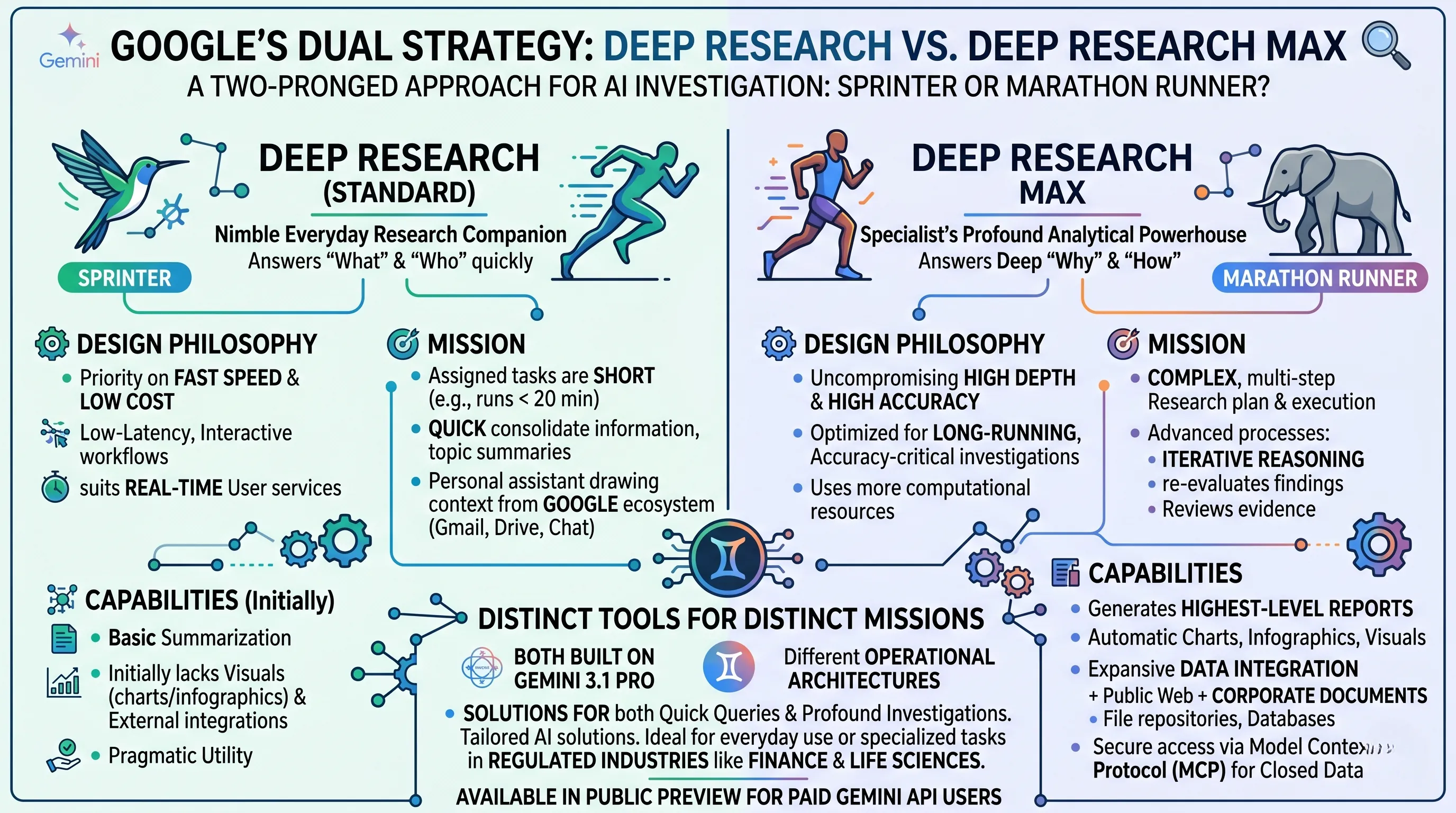
The standard version of Deep Research is engineered with a clear philosophy: prioritize fast speed and low cost.
Its core design is explicitly tuned for low-latency, interactive workflows, making it the ideal tool for real-time user services.
This isn't an agent you assign a week-long project to; it's a rapid-response analyst designed to deliver results with remarkable efficiency.
Most research runs initiated with the standard version are completed in under 20 minutes.
This speed transforms the user experience from a passive waiting game into an active, iterative dialogue, perfect for a professional needing a quick summary of a topic or a personal user looking for consolidated information.
Its suitability for real-time applications is further cemented by its ability to act as a personal research assistant, drawing context directly from a user's Google ecosystem, including Gmail, Drive, and Chat.
However, this focus on speed and accessibility comes with deliberate trade-offs.
At its launch, the standard version was introduced with more basic summarization capabilities and, crucially, initially lacked visuals and external integrations.
It serves as a powerful yet contained tool, optimized for immediate utility over exhaustive depth.
The Heavyweight Champion: Deep Research Max for Uncompromising Depth
In stark contrast, Deep Research Max operates on a completely different set of principles.
Where the standard version is a sprinter, Max is a marathon runner, optimized for long-running, accuracy-critical investigations.
It achieves its "unprecedented analytical quality" by intentionally utilizing more computational resources to perform tasks that are simply out of scope for its faster counterpart.
This additional power fuels advanced processes like iterative reasoning, where the agent re-evaluates its findings, conducts additional searches to fill gaps, and meticulously reviews evidence to build a robust, defensible conclusion.
The result is the creation of the highest-level reports, complete with automatic chart, infographic, and visual material generation—features entirely absent in the standard model's initial release.
Deep Research Max's capabilities are purpose-built for complexity.
It can synthesize complex information from hundreds of public sources and, unlike the standard version, boasts formidable data integration capabilities.
It connects not only to the public web but also to corporate internal documents, file repositories, and external databases.
Its support for the Model Context Protocol (MCP) allows it to securely access closed data sources like financial data, market information, and specialized research materials from providers like FactSet and S&P Global.
Furthermore, its multimodal input system accepts PDFs, CSVs, images, audio, and video, allowing for a far more holistic analysis than a purely text-based tool.
Distinct Tools for Distinct Missions
Ultimately, Google's strategy with Deep Research and Deep Research Max is to provide distinct tools for distinct missions.
The standard version, based on Gemini 3.1 Pro, is the nimble, everyday research companion for tasks where time and cost are primary constraints.
It answers the "what" and "who" quickly and efficiently within a user's personal or immediate context.
Deep Research Max, also built on Gemini 3.1 Pro but with a vastly different operational architecture, is the specialist's tool for missions where accuracy and reliability are non-negotiable.
It is designed for the deep, complex "why" and "how," making it indispensable for regulated industries like finance and life sciences.
While both are available in public preview for paid Gemini API users, they represent two different ends of the research spectrum, ensuring Google has a tailored AI solution for both a quick query and a profound investigation.
📚 Related Posts
Microsoft's MAI-Image-2-Efficient: 41% Cheaper, 4x Faster AI Image Generation Reshapes Enterprise Market & Intensifies Competiti
🚀 Key TakeawaysMicrosoft has launched MAI-Image-2-Efficient, a game-changing AI image model that delivers 22% faster generation and 4x improved computational efficiency, while dramatically reducing costs by approximately 41%, positioning it as an ideal
tech.dragon-story.com
Anthropic's Claude Design AI: Generate Branded Visuals Instantly – Revolutionizing Slides, Prototypes & Marketing Images with
🚀 Key TakeawaysAnthropic's Claude Design, launched as a research preview on April 17, 2026, is an AI tool that generates instant, branded visual content—including slides, prototypes, and marketing images—from text input, significantly boosting desig
tech.dragon-story.com
Anthropic's Claude Opus 4.7: Best Coding AI, Enterprise Powerhouse & Global Productivity War Catalyst
🚀 Key TakeawaysClaude Opus 4.7 emerges as Anthropic's most capable model, positioned as the best coding AI alive and a top performer in high-value knowledge work like finance and law, intensifying the global 'practical productivity war' among AI competi
tech.dragon-story.com


