🚀 Key Takeaways
- Claude Opus 4.7 emerges as Anthropic's most capable model, positioned as the best coding AI alive and a top performer in high-value knowledge work like finance and law, intensifying the global 'practical productivity war' among AI competitors.
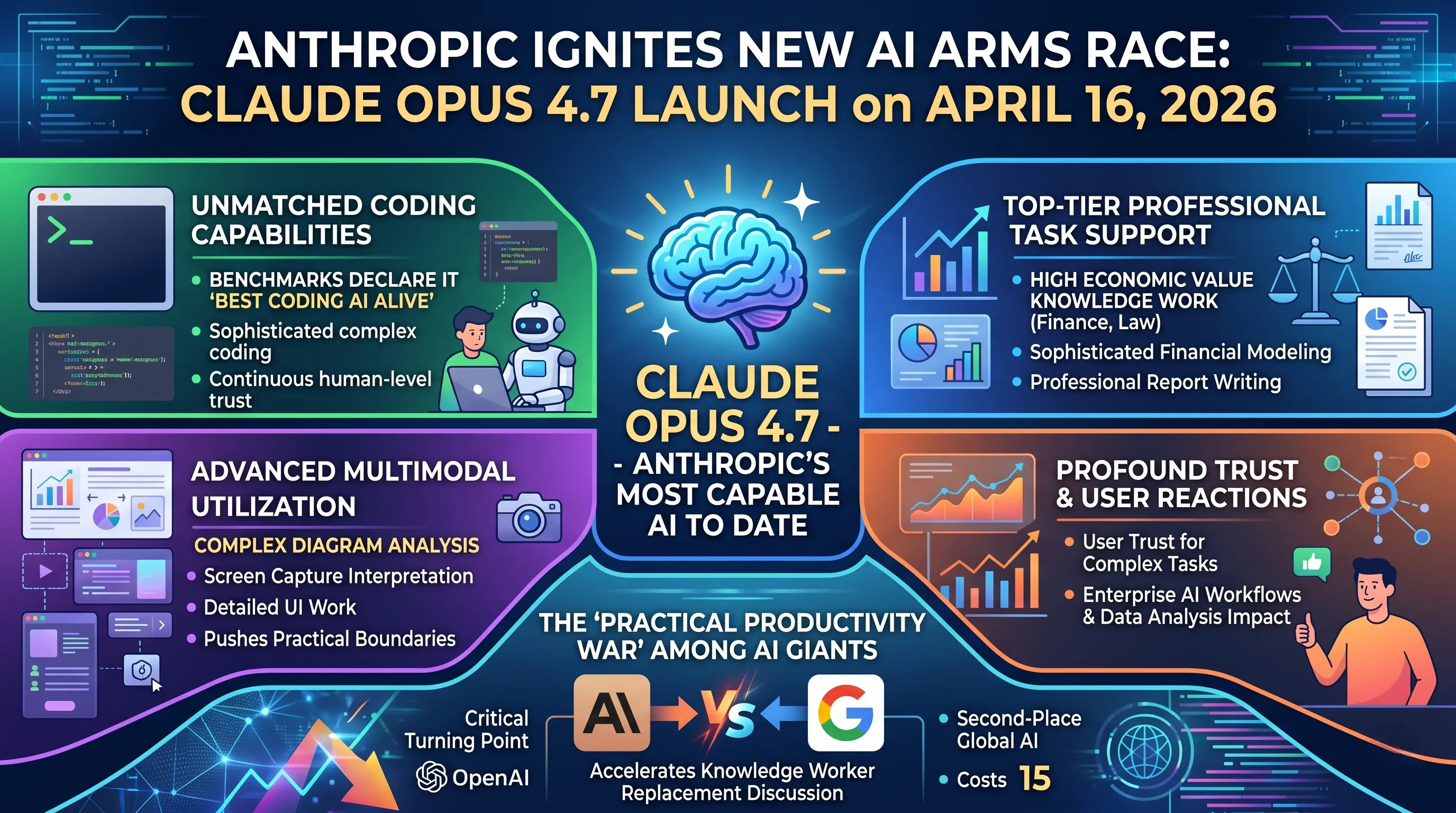
Anthropic is poised to ignite a new chapter in the artificial intelligence arms race with the highly anticipated launch of Claude Opus 4.7 on April 16, 2026.
This groundbreaking model is hailed as Anthropic's most capable generally available AI to date, promising a significant upgrade over its predecessors and aiming to redefine the benchmarks for AI performance across critical sectors.
Its unveiling is expected to send ripples across the industry, potentially shifting the competitive dynamics of the global AI landscape.
Claude Opus 4.7 arrives with an impressive suite of enhancements, particularly in its coding capabilities, where benchmarks declare it the best coding AI alive.
Beyond code, its advanced multimodal utilization allows for complex diagram analysis, screen capture interpretation, and detailed UI work, pushing the boundaries of what AI can achieve in practical, real-world scenarios.
The model also excels in professional task support, demonstrating top-tier performance in high economic value knowledge work fields such as finance and law, offering sophisticated financial modeling and professional report writing.
These formidable advancements are not merely theoretical; user reactions already suggest a profound trust in the model for previously complex coding tasks requiring continuous human oversight.
The release of Claude Opus 4.7 marks a critical turning point, accelerating the discussion around the replacement of knowledge workers and intensifying what is being dubbed a 'practical productivity war' among AI giants like Anthropic, OpenAI, and Google.
As it costs fifteen and is noted as the second-place global AI, its comprehensive features are set to profoundly impact enterprise AI workflows and data analysis.
1. Claude Opus 4.7: Core Capabilities and Its Claim to Global AI Leadership
This section directly addresses the central question of whether Claude Opus 4.7 can shake up the AI competition by dissecting its fundamental capabilities, benchmarked performance, and strategic market placement.
These are the core elements that determine if a new model is merely an incremental update or a genuine paradigm shifter in the AI landscape.
A New Flagship with Enhanced Sensory Perception
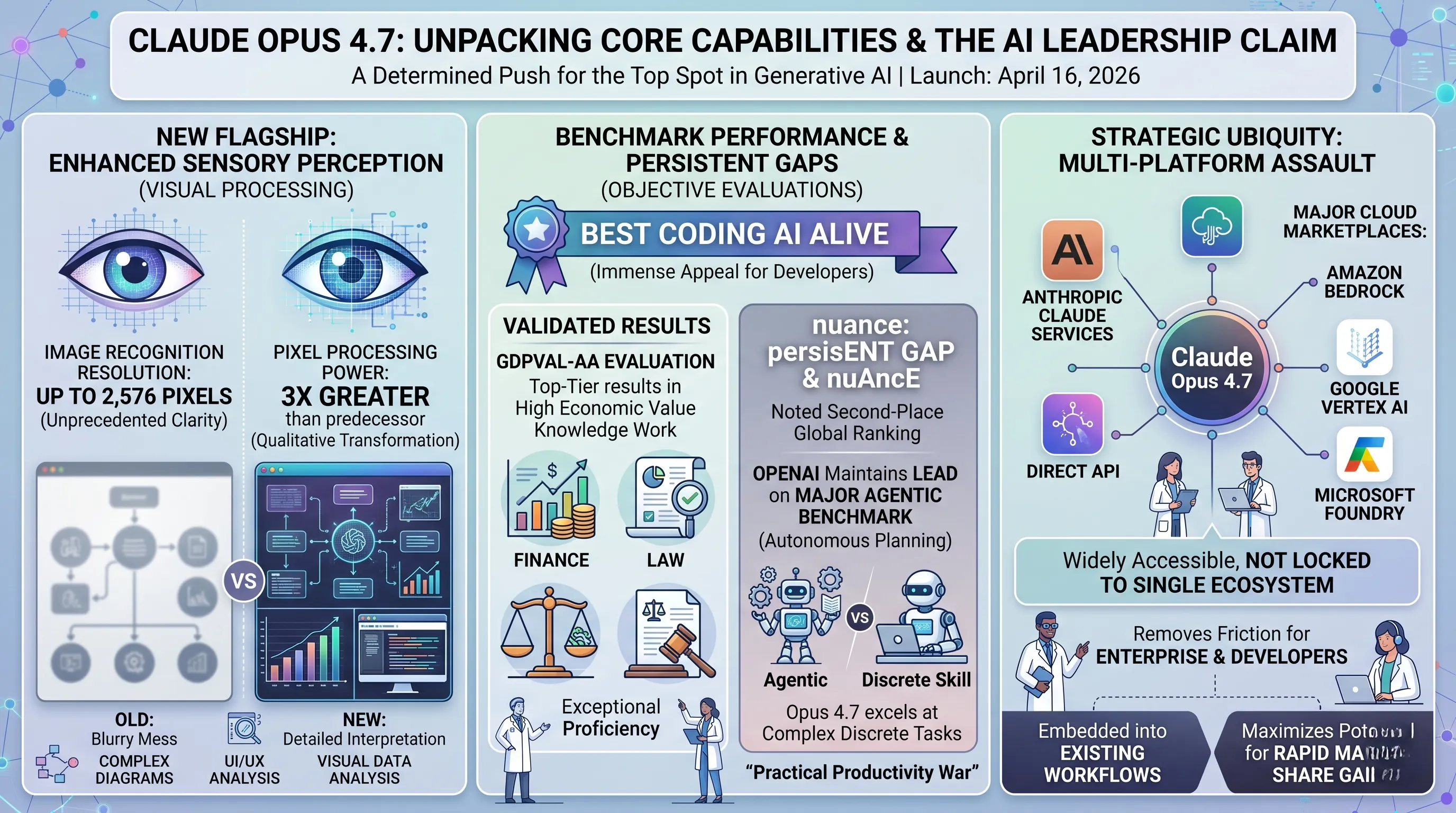
Anthropic has officially launched Claude Opus 4.7 on April 16, 2026, positioning it as their most capable and generally available model to date.
Billed as a significantly improved upgrade from the 4.6 version, Opus 4.7 represents Anthropic's determined push for the top spot in the generative AI race.
A standout improvement lies in its visual processing, a critical component for modern, multimodal AI.
The model's image recognition resolution now supports up to 2,576 pixels, a specification that translates into the ability to analyze high-density visual information with unprecedented clarity.
More impressively, its pixel processing power is 3 times greater than its predecessor.
This isn't just a quantitative leap; it's a qualitative transformation.
It means Opus 4.7 can move beyond simple object recognition to perform detailed interpretation of complex diagrams, intricate screen captures for UI/UX analysis, and granular analysis of visual data that would have been a blurry, indecipherable mess for older models.
Benchmarking Dominance and a Noteworthy Caveat
A model's claim to leadership must be validated by objective, external evaluations.
On this front, Opus 4.7 delivers a powerful statement.
According to the GDPval-AA evaluation, a benchmark specifically designed to measure performance in high economic value knowledge work, Opus 4.7 achieves top-tier results.
This indicates exceptional proficiency in fields like finance and law, where precision, reasoning, and the ability to work with complex, domain-specific information are paramount.
Its prowess is further reflected in benchmarks that declare it the best coding AI alive, a title with immense commercial and developer appeal.
Despite these strengths, the competitive landscape is not without its nuances.
While Opus 4.7 has secured a noted second-place global ranking, the data also reveals a persistent gap.
A crucial competitive benchmark note indicates that OpenAI has maintained a lead over Anthropic on a major agentic benchmark since the era of GPT-4.
This suggests that while Opus 4.7 may excel at executing complex, discrete tasks with superhuman skill (like financial modeling or writing complex code), OpenAI's models may still hold an edge in "agentic" capabilities—the power to autonomously plan, strategize, and execute a sequence of tasks to achieve a broader goal.
This distinction is critical in the ongoing "practical productivity war" among the AI giants.
Strategic Ubiquity: A Multi-Platform Assault
Perhaps one of the most significant factors in Opus 4.7's bid for market leadership is its aggressive and comprehensive availability strategy.
Anthropic has ensured that its flagship model is not locked into a single ecosystem.
Instead, it is widely accessible across a formidable array of platforms, including Anthropic's own Claude services, its direct API, and, crucially, the major cloud marketplaces: Amazon Bedrock, Google Vertex AI, and Microsoft Foundry.
This multi-platform presence is a masterful strategic move.
It removes nearly all friction for adoption by enterprise clients and independent developers, regardless of their existing cloud infrastructure.
By embedding itself directly into the workflows and platforms where businesses already operate, Anthropic is positioning Opus 4.7 not just as a powerful model, but as an unavoidable, high-performance option, directly challenging its competitors on their home turf and maximizing its potential to rapidly gain market share.
2. Opus 4.7's Domain Mastery: From Code to Financial Analysis Excellence
Anthropic's release of Claude Opus 4.7 on April 16, 2026, presents a direct challenge to the established AI hierarchy, and its strategy to shake up the AI competition is not rooted in generalized intelligence alone.
Instead, its most potent threat lies in its profound mastery of specific, high-value professional domains.
This model moves beyond being a versatile assistant to become a specialized, autonomous agent in fields like software development and financial analysis, directly targeting the complex workflows that define modern knowledge work.
This section dissects the specific capabilities that form the bedrock of this specialized excellence, demonstrating how Opus 4.7 is engineered not just to compete, but to dominate in practical, economically significant tasks.
The Undisputed Champion of Code Generation
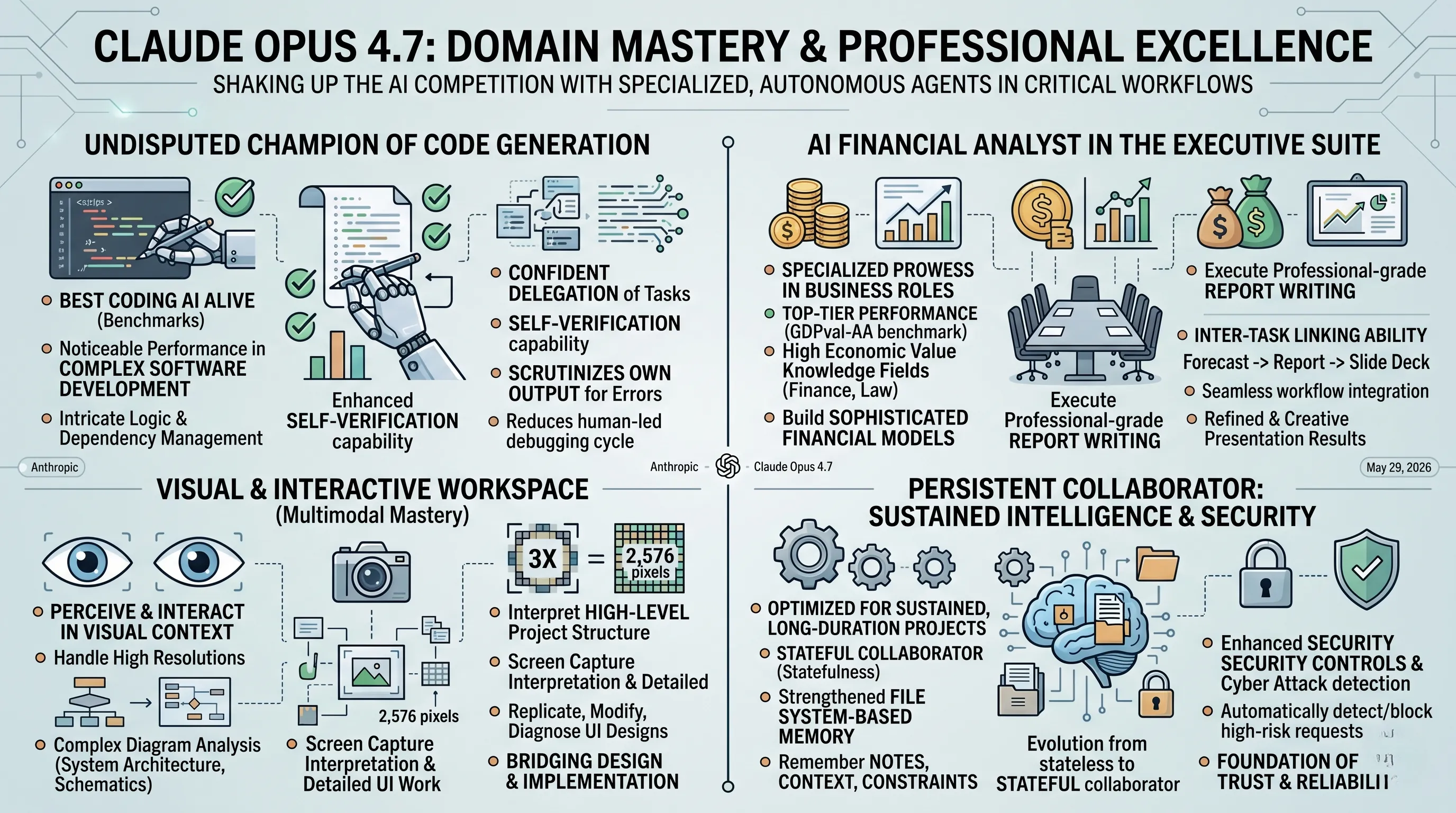
Opus 4.7's most immediate and disruptive impact is in the realm of software development, where benchmarks have already labeled it "the best coding AI alive."
This title is not merely about writing flawless boilerplate code; it reflects a noticeable performance improvement in genuinely complex software development tasks.
Where previous models often faltered on large-scale projects requiring intricate logic and dependency management, Opus 4.7 demonstrates a remarkable ability to maintain accuracy and consistency over long-duration tasks.
The experiential value of this is profound: developers are reporting that tasks which previously demanded continuous human oversight can now be confidently delegated to the model.
This shift from a co-pilot to a trusted lead developer is powered by its enhanced self-verification capability.
The model doesn't just write code; it actively scrutinizes its own output for errors and inconsistencies, drastically reducing the human-led debugging cycle and accelerating the entire development lifecycle.
By targeting these complex, real-world coding challenges, Opus 4.7 directly addresses the productivity bottlenecks that have persisted even in the age of AI-assisted programming.
Beyond Text: A Visual and Interactive Workspace
A significant part of Opus 4.7's domain mastery comes from its greatly expanded multimodal utilization, which allows it to perceive and interact with projects in a visual context.
Its image recognition capabilities have seen a threefold improvement in pixel processing, handling resolutions up to 2,576 pixels.
This technical upgrade translates into a powerful practical skill set: the model can now perform complex diagram analysis, interpreting system architecture charts, flow diagrams, or database schematics to understand the high-level structure of a project before writing a single line of code.
Furthermore, its ability in screen capture interpretation and detailed UI work changes the game for front-end development and design.
A developer can now provide a screenshot of a user interface and instruct Opus 4.7 to replicate it, modify it, or diagnose its flaws, turning a static image into an actionable development task.
This bridges the gap between design and implementation, allowing the AI to function as both a conceptual design partner and a meticulous coder.
The AI Financial Analyst in the Executive Suite
Opus 4.7's specialized prowess is perhaps most evident in its application to professional business roles, particularly that of a financial analyst.
This is not speculation; external evaluations like the GDPval-AA benchmark confirm its top-tier performance in high economic value knowledge fields, including finance and law.
The model excels in tasks that form the core of a financial professional's responsibilities: it can build sophisticated financial models, execute professional-grade report writing, and, crucially, demonstrate an inter-task linking ability.
This linking capability is a force multiplier for productivity.
An analyst can instruct Opus 4.7 to build a complex revenue forecast model, then use the output of that model to automatically generate a detailed quarterly report, and finally transform the key findings of that report into a polished slide deck.
This seamless workflow integration targets the heart of enterprise AI needs, moving beyond single-task execution to holistic project management.
Its ability to create refined and creative results in presentations and document creation further cements its role as a tool capable of producing C-suite-ready deliverables.
The Foundation of Sustained Intelligence: Memory and Security
Underpinning these advanced domain specializations are fundamental improvements in the model's core architecture, specifically its memory and security.
To handle complex, multi-day projects, Opus 4.7 has been optimized for sustained tasks, a feature directly supported by its strengthened file system-based memory.
This system allows the model to remember notes, context, and constraints during long-term projects and intelligently apply them to subsequent tasks.
It is the difference between a tool with a short-term memory and a project partner with a persistent understanding of goals, evolving from a stateless command-executor into a stateful collaborator.
For enterprise adoption in sensitive fields like finance and proprietary software development, this power is matched with enhanced security controls.
The model is designed to automatically detect and block high-risk requests, such as those related to cyber attacks or malicious hacking.
To further bolster this defense, Anthropic operates a separate Cyber Verification Program, allowing legitimate security researchers to responsibly probe the system's defenses.
This dual focus on long-term memory and robust security provides the foundation of trust and reliability necessary for organizations to integrate Opus 4.7 into their most critical and complex workflows.
3. Reshaping the AI Landscape: Market Impact and the Productivity Arms Race
The release of Anthropic's Claude Opus 4.7 on April 16, 2026, is far more than a simple version update; it is a strategic maneuver designed to fundamentally alter the AI competitive landscape.
This section directly addresses the central question of our main topic—"Will Claude Opus 4.7 shake up the AI competition?"—by analyzing its tangible impact on the market, its role in accelerating workplace transformation, and how it intensifies the ongoing rivalry between the industry's titans.
Opus 4.7's capabilities are not just theoretical benchmarks; they are catalysts for a new phase of competition, shifting the focus from abstract capabilities to a fierce 'practical productivity war'.
A New Threshold of Trust in Automation
Perhaps the most significant immediate market impact of Opus 4.7 lies not in a raw benchmark score, but in a qualitative shift in user trust, particularly within the demanding field of software development.
According to initial user reactions, the model has crossed a critical threshold.
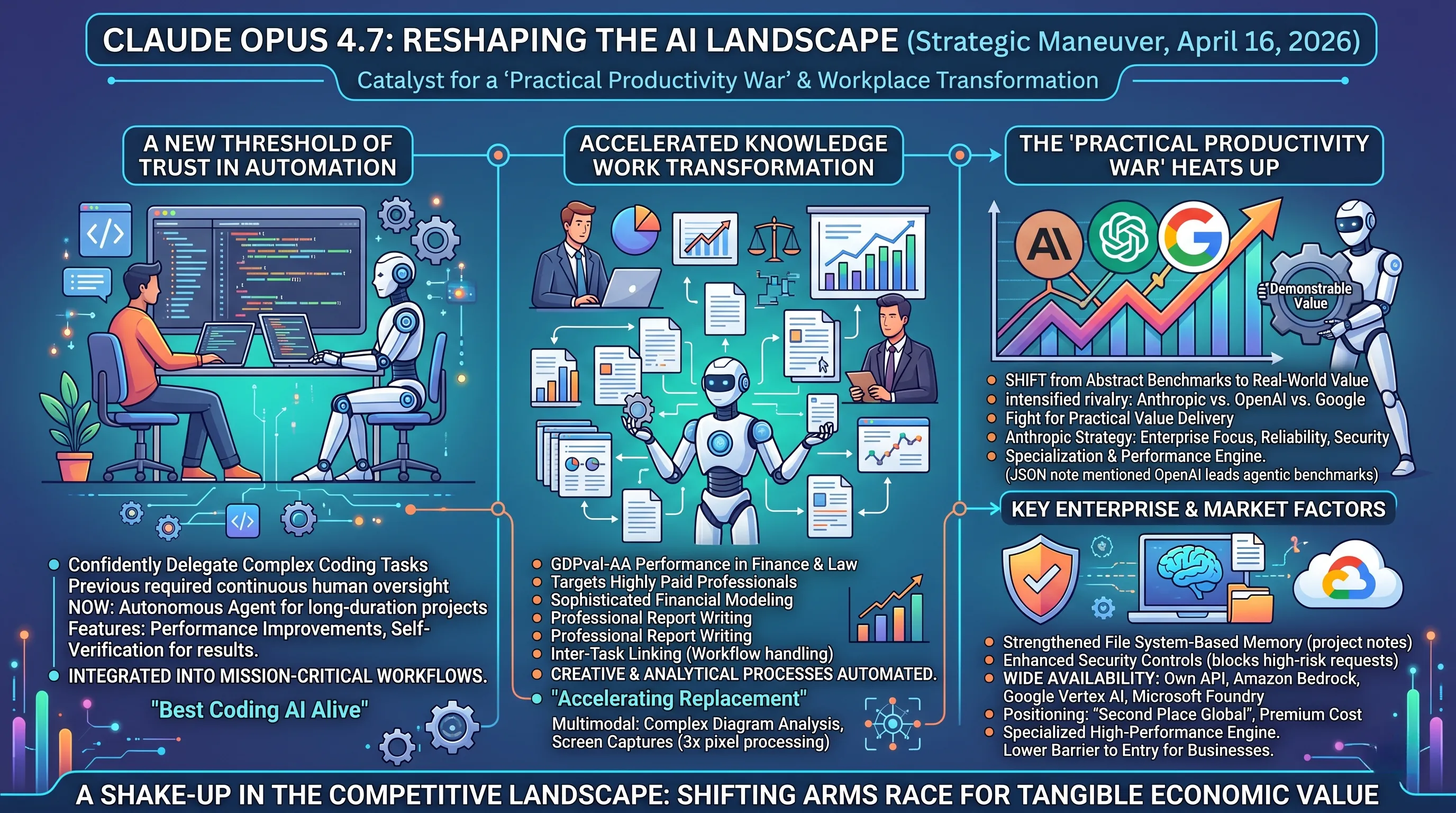
Professionals report that previously complex coding tasks, which invariably required continuous human oversight and validation, can now be confidently delegated to the model.
This isn't merely an improvement in convenience; it's a paradigm shift in the human-AI working relationship.
The AI is no longer just a "copilot" suggesting code snippets; it's becoming an autonomous agent capable of managing long-duration, complex software development projects with accuracy and consistency.
This newfound trust is a direct result of specific technical advancements detailed in the model's features.
Opus 4.7 demonstrates a "noticeable performance improvement in complex software development tasks" and, crucially, an "enhanced self-verification capability for results."
This means the model doesn't just write code; it actively checks its own work, maintaining logical integrity over extended sessions, which drastically reduces the need for human intervention.
This capability, backed by benchmarks proclaiming it the "best coding AI alive," gives enterprises the confidence to integrate it into mission-critical workflows, moving beyond experimentation to genuine production dependency.
The Acceleration of Knowledge Work Transformation
Claude Opus 4.7's impact extends far beyond the developer's terminal, signaling an accelerated timeline for the transformation of high-value knowledge work.
The model's top-tier performance in the GDPval-AA external evaluation, which measures proficiency in fields like finance and law, confirms it is purpose-built to tackle complex, real-world enterprise tasks.
For example, its proficiency as a financial analyst—capable of executing "sophisticated financial modeling," writing professional reports, and demonstrating an "inter-task linking ability"—directly targets the core functions of highly paid professionals.
This is a significant escalation from previous AI generations that automated routine tasks.
Opus 4.7 is designed to reason more precisely and follow intricate instructions, allowing it to handle entire workflows.
Its multimodal capabilities, including the analysis of complex diagrams and screen captures with up to 2,576-pixel resolution (a 3x improvement), mean it can understand and operate within the visual language of business—presentations, financial charts, and software interfaces.
By creating refined results in document creation and interface design, the model is not just assisting knowledge workers; it is beginning to automate the creative and analytical processes that were once considered uniquely human, thereby directly contributing to the "accelerating replacement of knowledge workers."
The 'Practical Productivity War' Heats Up
The launch of Claude Opus 4.7 is a declaration that the AI market competition has officially shifted to a 'practical productivity war' among the key players: OpenAI, Google, and Anthropic.
The battleground is no longer defined solely by agentic benchmarks, where the JSON notes "OpenAI has lead over Anthropic on a major agentic benchmark since GPT-4," but by demonstrable, real-world value delivery.
Anthropic's strategy is clear: focus on sustained, complex enterprise workflows where reliability, security, and accuracy are paramount.
Features like the strengthened file system-based memory, which allows the model to remember project notes over long periods, and enhanced security controls that automatically block high-risk requests are not just technical additions; they are essential for enterprise adoption.
By making the model widely available through its own API, Amazon Bedrock, Google Vertex AI, and Microsoft Foundry, Anthropic is ensuring it can be easily deployed within any existing corporate infrastructure, lowering the barrier to entry for businesses eager to leverage its power.
While it is noted as "second place global" and carries a premium cost, its positioning is that of a specialized, high-performance engine for serious productivity gains.
This release forces competitors to respond not just with better benchmarks, but with equally robust, reliable, and trustworthy solutions tailored for the enterprise, thereby shaking up the competitive landscape by escalating the arms race for tangible, economic value.
📚 Related Posts
Google Gemini 3.1 Flash TTS: Revolutionizing Voice AI with Human-Like Expressiveness, Audio Tags & Responsible AI
🚀 Key TakeawaysGoogle's Gemini 3.1 Flash TTS ushers in a new era of voice AI, generating exceptionally natural, expressive, and human-like voices with unprecedented control through 'Audio Tags' and intuitive prompts, making advanced voice synthesis broa
tech.dragon-story.com
Google Chrome 'Skills' Transforms Web Browsing: Personalized AI Automation, One-Click Workflows & Multi-Tab Power
🚀 Key TakeawaysThe new Google Chrome 'Skills' feature revolutionizes AI interaction by enabling users to save custom prompts as reusable 'Skills', allowing for one-click execution and significantly automating tasks directly within the browser.It transfo
tech.dragon-story.com
Google Gemini macOS App: Always-On AI Revolutionizes Desktop Workflow with Native Integration & Screen Understanding
🚀 Key TakeawaysGemini for macOS acts as an "always-on" AI assistant, deeply integrating into your workflow with a native macOS experience and providing instant, contextual assistance.Leveraging the powerful Gemini 3 model, it uniquely understands screen
tech.dragon-story.com


