🚀 Key Takeaways
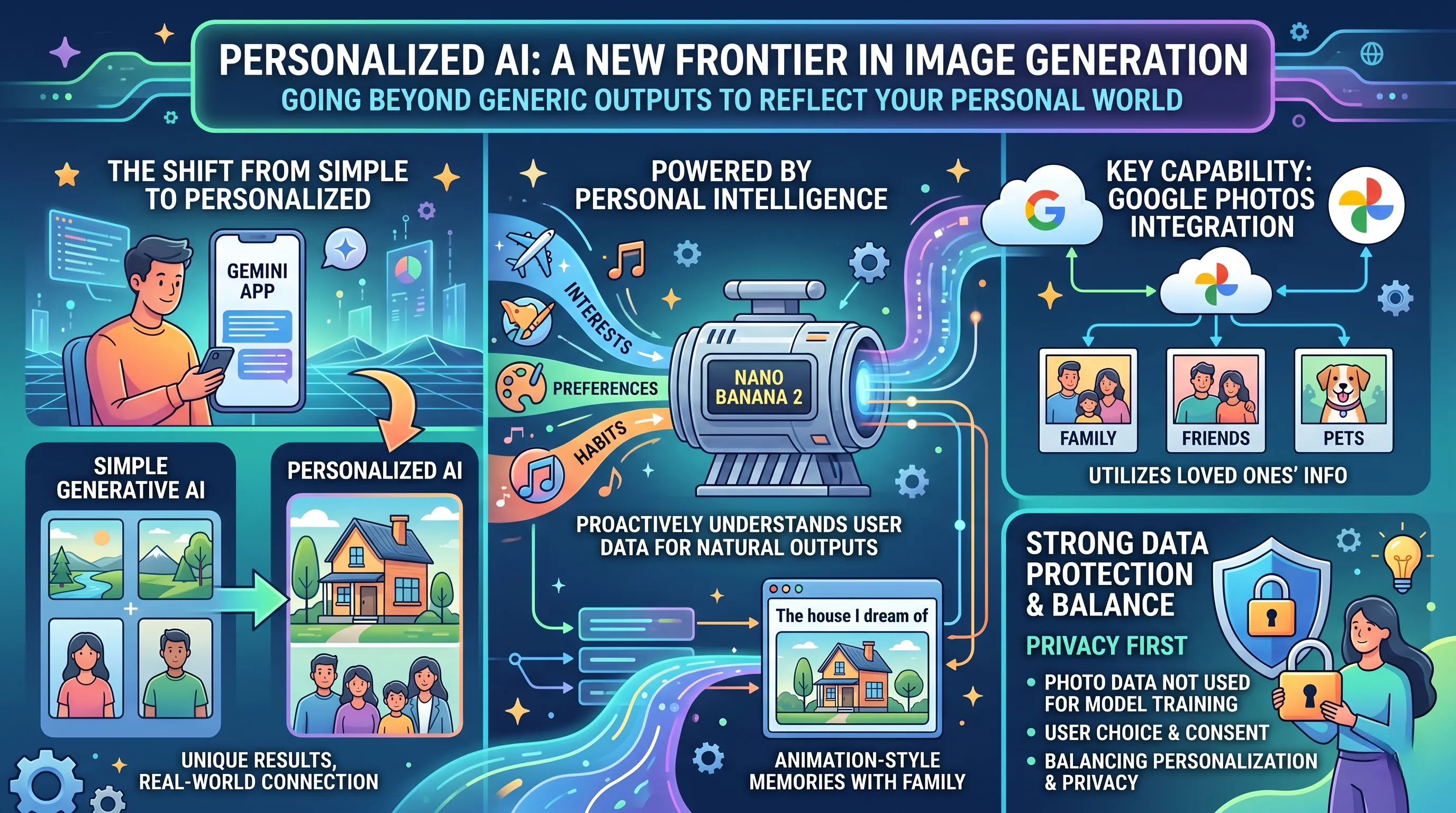
- Google is pioneering a new era of deeply personalized AI image generation, leveraging 'Personal Intelligence' within the Gemini app to create visual content that uniquely reflects individual users' tastes, lifestyles, and memories, moving significantly beyond generic AI outputs.
The landscape of AI image generation is undergoing a profound transformation, with personalization emerging as the next critical frontier. Google is at the forefront of this shift, introducing advanced capabilities that allow AI to generate images uniquely tailored to an individual user's taste and data, primarily through the Gemini app.
This innovation differentiates itself from existing simple generative AI by moving beyond generic outputs, creating visuals that truly resonate with a user's personal world.
At its core, Google's approach is powered by 'Personal Intelligence', an underlying technology linked with Nano Banana 2, designed to proactively understand user interests and preferences, enabling the system to produce personalized results naturally, often without requiring lengthy, explicit descriptions.
This evolution means users can now generate images reflecting their personal taste and lifestyle with simple prompts, such as envisioning "The house I dream of" or creating animation-style recreations of daily life with family based on personal memories.
The system is designed to generate results connected to real life, not just imaginative scenarios, offering functions to modify unsatisfactory images or regenerate them using other personal photos as references.
A key capability is its integration with Google Photos, which allows the AI to utilize information about family, friends, and pets from a user's photo library.
Crucially, Google emphasizes a strong stance on personal data protection, assuring users that photo data is not directly used for model training and all integrations are based strictly on user choice, maintaining a delicate balance between enhanced personalization and privacy.
Experts view Google's strategic move into personalized AI image generation as a significant development, potentially triggering a full-scale AI personalization competition across the tech industry, akin to how Netflix uses AI for personalized content recommendations or how e-commerce platforms tailor user experiences.
While general advancements in AI image generation tools like ChatGPT, Midjourney, and Reve continue to offer improved quality, speed, and creative control, the push towards deeper personalization makes these tools act more like a "personal assistant" rather than just a simple utility.
This shift marks an exciting phase in AI's capabilities, promising more relevant and engaging digital media that reflects the unique world of each individual user, while also posing ongoing challenges in the balance of data utilization and user privacy.
1. Google's Gemini Spearheads Personalized AI Image Creation
Google's Gemini platform represents a pivotal evolutionary leap in the broader landscape of AI, directly addressing the core theme of this article: How far has personalized AI image generation evolved?
While competitors have focused on refining image quality, speed, and stylistic control, Google has shifted the very foundation of creation by introducing 'personalization' as the new frontier.
This move transitions AI image generation from a tool for creating generic or imaginative visuals into a deeply personal co-creator that understands and reflects an individual's life, tastes, and relationships.
The Paradigm Shift: From Generic Prompts to Personal Context
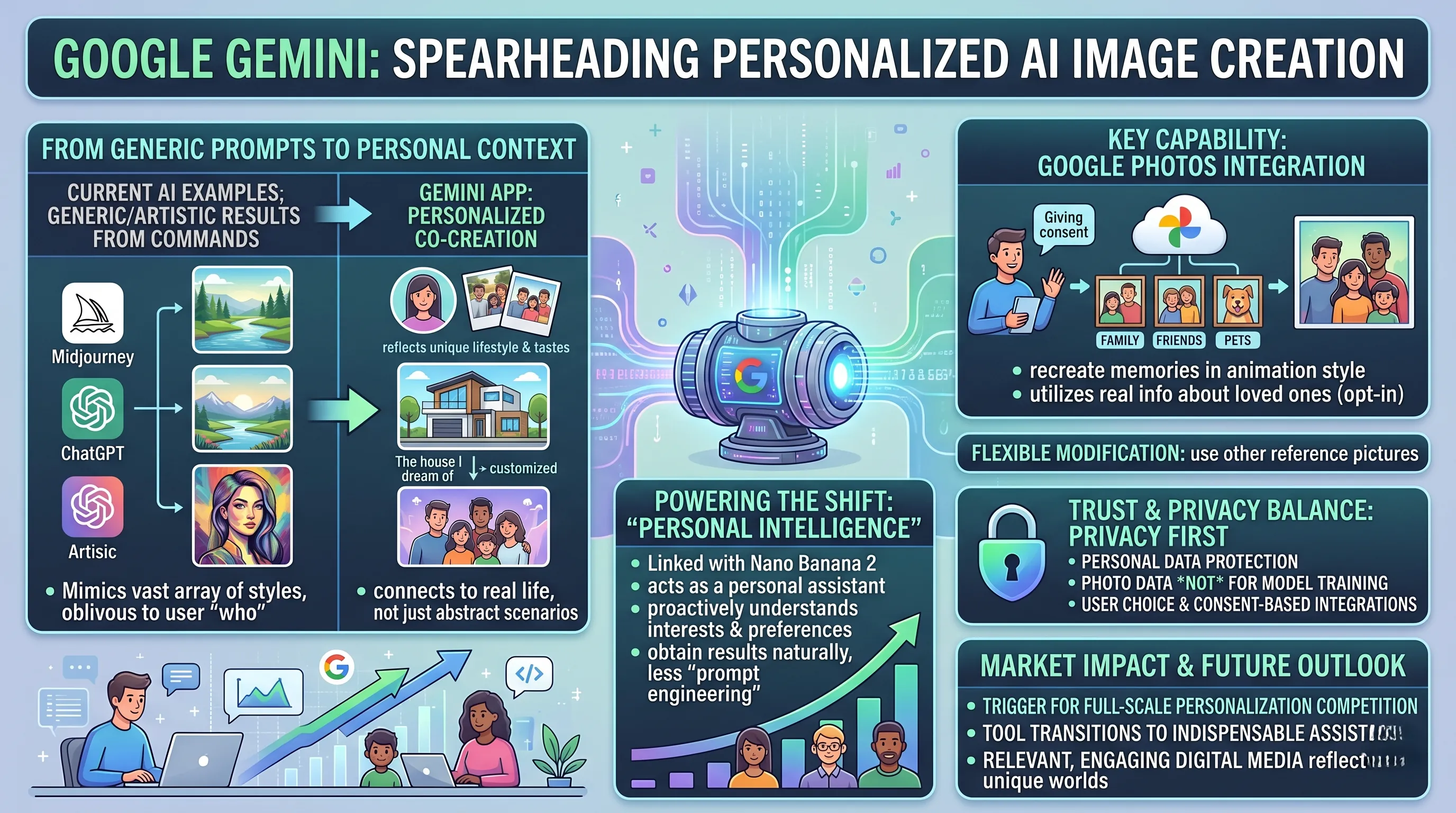
The fundamental differentiation of Google's approach lies in its ability to generate images that reflect a user's unique taste and personal data, a stark contrast to existing generative AI models.
Tools like Midjourney have become renowned for producing highly artistic results, while others such as Reve are recommended for their strict adherence to prompts.
Even the most capable all-around generators, like ChatGPT, excel at mimicking a vast array of styles based on user commands.
However, these systems largely operate in a vacuum of personal context; they respond to the 'what' of a prompt but are oblivious to the 'who'.
Google, through its Gemini app, changes this dynamic.
The system doesn't just process a command like "The house I dream of"; it interprets that command through the lens of the user's known lifestyle and aesthetic preferences, creating a result that feels uniquely theirs, not just a technically proficient interpretation of words.
The Technology Behind the Magic: 'Personal Intelligence' and Google Photos
The engine driving this hyper-personalization is a proprietary technology Google calls 'Personal Intelligence'.
This underlying system, linked with Nano Banana 2, is designed to understand a user's interests and preferences in advance, effectively acting as a 'personal assistant' rather than a simple command-line tool.
It proactively learns what matters to you, creating a model of your world before you even type a single character.
The most powerful manifestation of this technology is its integration capability with Google Photos.
With user consent, Gemini can tap into a person's photo library to utilize information about their family, friends, and even pets.
This allows for unprecedented creative possibilities that are deeply connected to real life.
For instance, a user can ask Gemini to recreate a memory of a day at the park with their family, but rendered in a vibrant animation style.
The AI would not generate generic animated characters; it would create figures that resemble the user's actual family members, capturing a genuine memory and transforming it into a new piece of art.
This blurs the line between pure imagination and personal history, allowing users to engage with their own memories in a novel, creative way.
Effortless Creation: The User Experience Advantage
A direct benefit of this deep personalization is a remarkably intuitive user experience.
Because the AI already possesses a foundational understanding of the user's world, it can obtain highly personalized results naturally, without the need for convoluted, lengthy descriptions or 'prompt engineering'.
A simple sentence is often enough to generate images that reflect an individual's personal taste.
This focus on creating results connected to real life marks a significant departure from the often fantastical or abstract outputs of other AI image generators.
To ensure user control, the platform also provides essential functions to modify unsatisfactory results or regenerate an image entirely using other pictures as a reference point, maintaining a balance between AI-driven intuition and user-directed creativity.
The Trust Equation: Balancing Personalization and Privacy
The use of personal photos and data immediately raises critical questions about privacy, a challenge Google directly addresses.
The company's stated stance is one that emphasizes personal data protection, recognizing that trust is the currency of personalization.
A crucial technical safeguard is the policy that user photo data is not directly used for training the core AI models.
This ensures that personal memories are used for individual generation requests but are not absorbed into the collective intelligence of the model itself.
Furthermore, all integrations are strictly based on user choice.
The connection to Google Photos is not automatic; it is an opt-in feature that puts the user in complete control of what data, if any, the AI can access.
This careful approach represents a conscious effort to maintain the delicate balance between offering a deeply enhanced, personalized experience and upholding stringent privacy standards.
Igniting the Competition: Market Impact and Future Outlook
The introduction of these features is viewed by industry experts as a significant market event, poised to act as a trigger for a full-scale AI personalization competition.
By successfully linking its vast ecosystem of user data (via Google Photos and other services) to its generative AI (Gemini), Google has set a new benchmark for what users can expect from AI tools.
This move forces competitors to look beyond just the quality of image generation and consider how they can create more context-aware, personally relevant experiences.
Google's strategy effectively elevates Gemini from a mere tool to an indispensable personal assistant, one that not only creates but also understands and anticipates, forever changing the landscape of AI image generation.
2. The Broader Evolution of AI Image Generation: Market Dynamics and Future Trajectories
To fully appreciate the significance of personalized AI image generation, as championed by Google, it is essential to first understand the broader technological landscape from which it emerges.
The move towards personalization is not an isolated event but rather the next logical step in a market defined by rapid advancements, fierce competition, and looming technological hurdles.
The entire field is evolving from creating generic, high-quality images to crafting outputs that are deeply contextual and personally resonant, and this section will explore the market dynamics and future trajectories that make personalization the new frontier.
The Maturing Market: From Novelty to Niche Specialization
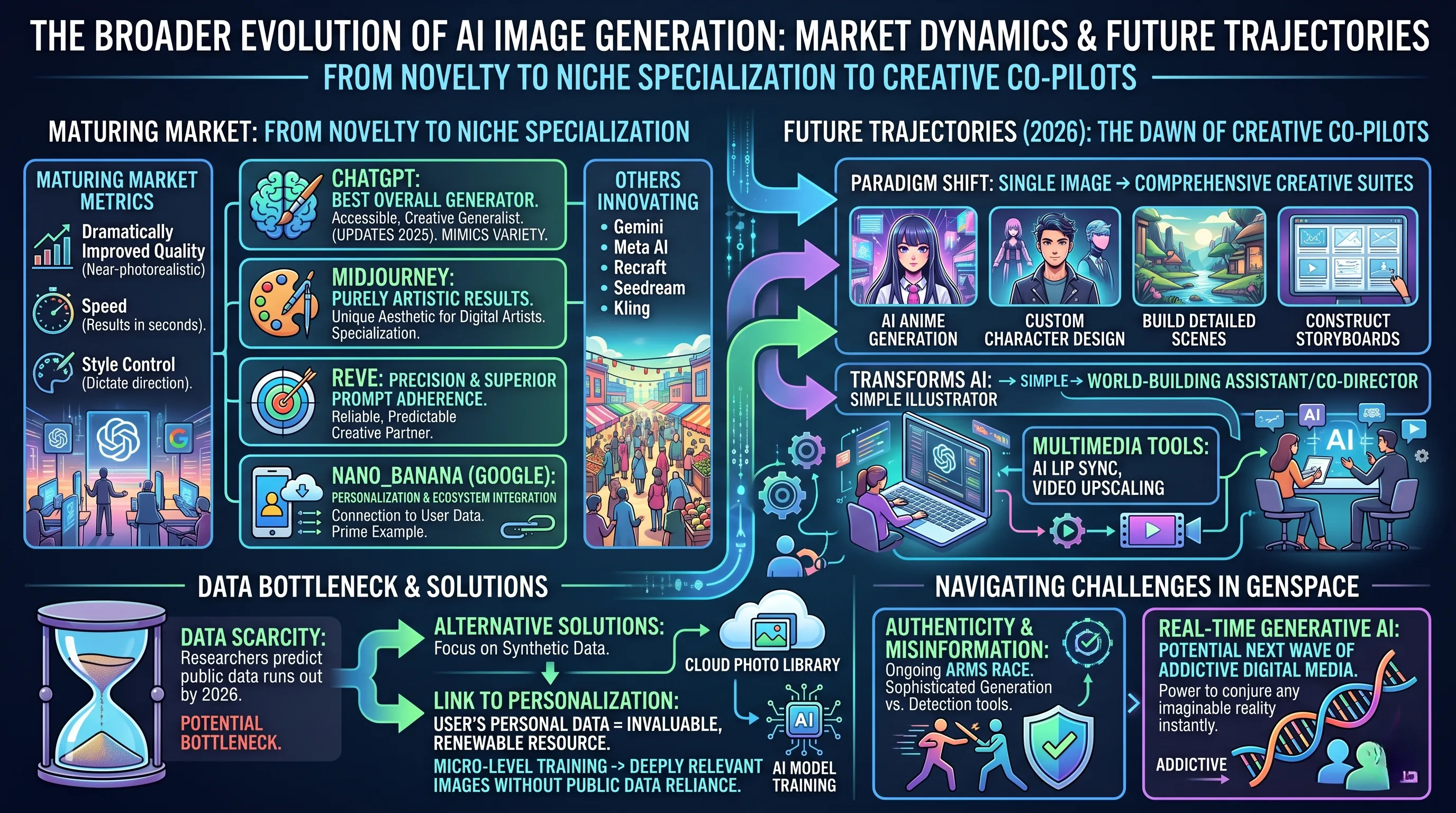
The foundational layer of the current AI image market is a dramatic improvement across core metrics.
General advancements have pushed the technology far beyond its initial, often distorted, outputs.
Today's tools demonstrate remarkable progress in quality, rendering near-photorealistic images; speed, delivering results in seconds; and crucially, style control, allowing users to dictate artistic direction with increasing precision.
This evolution has fostered a competitive ecosystem where different players cater to specific user needs.
The market is populated by several key players, each with distinct strengths that reveal the industry's trajectory:
- ChatGPT:
Often considered the best AI image generator overall, its strength lies in its accessibility and versatility.
After its release in March 2025 and a major upgrade in December 2025, it established itself as a powerful tool for both free and paying users.
Its ability to be creative, engaging, and mimic a vast variety of artistic styles makes it the quintessential generalist tool, setting a high bar for the industry's baseline capabilities. - Midjourney:
This platform carved out a niche by being the top recommendation for purely artistic results.
Its output is often favored by digital artists and creators seeking a unique, aesthetically driven style that prioritizes artistry over literal interpretation.
Midjourney's success proves there is a significant market for specialized, high-fidelity creative tools. - Reve:
For users who prioritize precision, Reve is recommended for its superior prompt adherence.
This addresses a common frustration with earlier generative models, where the AI would often ignore or misinterpret key parts of a user's request.
The existence of a tool known for this specific strength highlights the industry's push towards making AI a more reliable and predictable creative partner. - Nano_Banana (Google):
Recommended specifically for Google users, this tool's value proposition is fundamentally tied to personalization and ecosystem integration.
Unlike others that focus on standalone image generation, its power is amplified by its connection to a user's data, making it a prime example of the shift discussed in this article.
The presence of other significant tools like Gemini, Recraft, Seedream, Kling, and Meta AI further illustrates a vibrant and crowded marketplace where companies are constantly innovating to capture different segments of the creative market.
Future Trajectories: The Dawn of Creative Co-Pilots and the Data Bottleneck
The evolution is set to accelerate dramatically.
Projections for 2026 suggest a paradigm shift from single-image generation to comprehensive creative suites.
It is predicted that AI-powered anime and image generators will empower creators to not just generate a picture, but to design custom characters, build out detailed scenes, and construct complete storyboards.
This leap transforms the AI from a simple illustrator into a world-building assistant or a co-director.
Supplementary features like AI lip sync and video upscaling further point toward a future of integrated, multimedia AI creation tools.
However, this explosive growth faces a critical challenge: a potential data shortage.
Researchers predict that the vast reserves of public data used for training large AI models might run out by 2026.
This data scarcity is forcing the AI community to explore alternatives, with a heavy focus on developing high-quality synthetic data.
This impending data bottleneck paradoxically elevates the importance of personalization.
A user's personal data, like a Google Photos library, becomes an invaluable, renewable resource for training models on a micro, individual level.
It allows for the creation of deeply relevant images without relying on the finite pool of public web data, directly connecting the industry's biggest challenge to the solution offered by personalization.
Contextualizing Personalization and Navigating the Challenges
The push for personalized AI images is not occurring in a vacuum; it mirrors a broader trend across the tech industry.
We see this pattern in Netflix's AI-driven content recommendations and in e-commerce, where AI delivers personalized product suggestions, chatbots, website content, emails, and ad targeting.
Applying this proven model of AI-driven personalization to the act of *creation* is the next logical frontier.
Despite the immense potential, the generative AI space is fraught with challenges that mirror those in text generation.
An ongoing 'arms race' persists between increasingly sophisticated generation techniques and the tools designed to detect them, raising critical questions about authenticity and misinformation.
Furthermore, there is a growing concern that real-time generative AI has the potential to become the next wave of addictive digital media.
The power to instantly conjure any imaginable reality presents a potent, and potentially consuming, new form of digital interaction that society has yet to fully grapple with.
📚 Related Posts
Google Gemini macOS App: Always-On AI Revolutionizes Desktop Workflow with Native Integration & Screen Understanding
🚀 Key TakeawaysGemini for macOS acts as an "always-on" AI assistant, deeply integrating into your workflow with a native macOS experience and providing instant, contextual assistance.Leveraging the powerful Gemini 3 model, it uniquely understands screen
tech.dragon-story.com
Google Chrome 'Skills' Transforms Web Browsing: Personalized AI Automation, One-Click Workflows & Multi-Tab Power
🚀 Key TakeawaysThe new Google Chrome 'Skills' feature revolutionizes AI interaction by enabling users to save custom prompts as reusable 'Skills', allowing for one-click execution and significantly automating tasks directly within the browser.It transfo
tech.dragon-story.com
Google Gemini 3.1 Flash TTS: Revolutionizing Voice AI with Human-Like Expressiveness, Audio Tags & Responsible AI
🚀 Key TakeawaysGoogle's Gemini 3.1 Flash TTS ushers in a new era of voice AI, generating exceptionally natural, expressive, and human-like voices with unprecedented control through 'Audio Tags' and intuitive prompts, making advanced voice synthesis broa
tech.dragon-story.com


