🚀 Key Takeaways
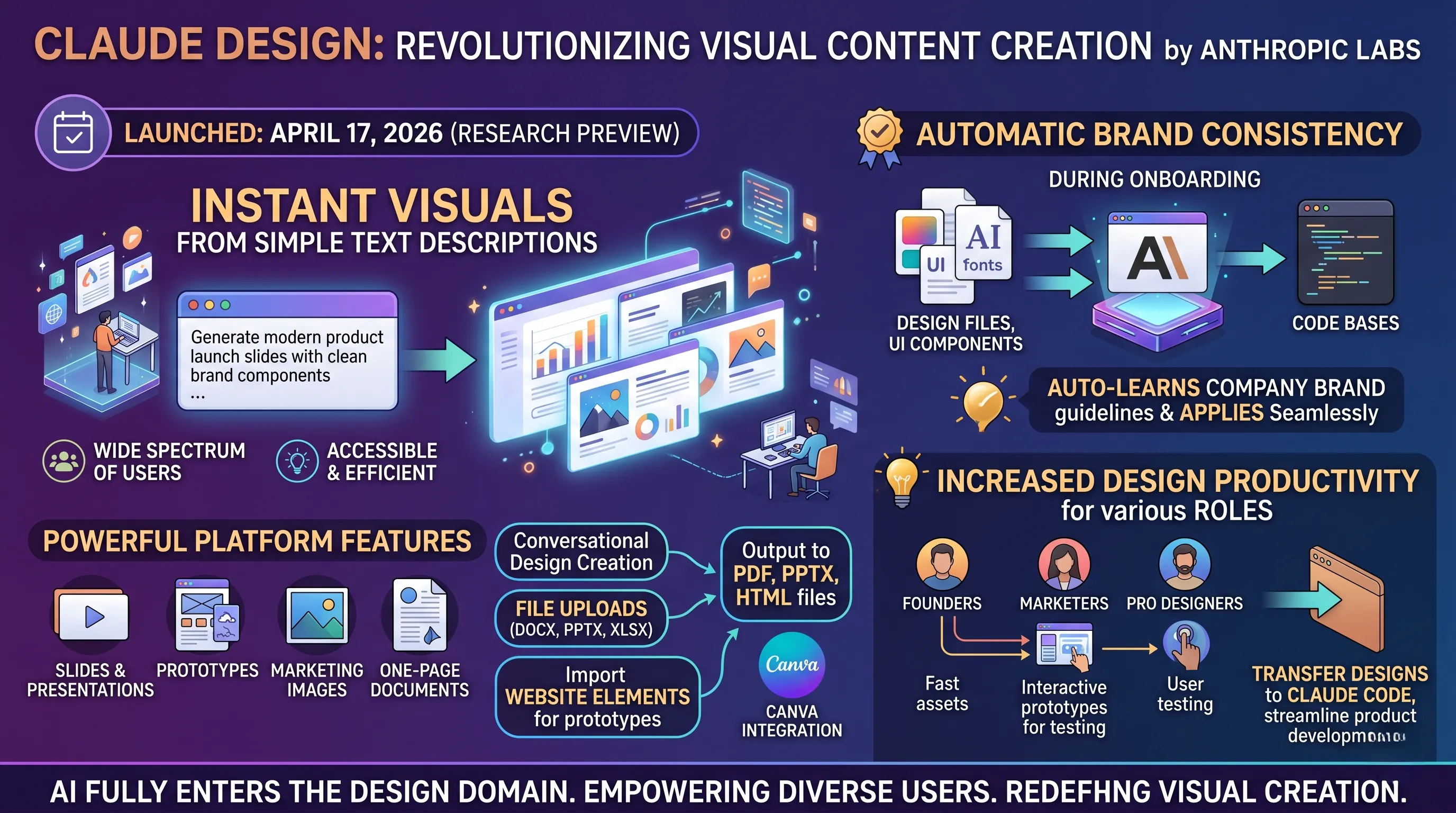
- Anthropic's Claude Design, launched as a research preview on April 17, 2026, is an AI tool that generates instant, branded visual content—including slides, prototypes, and marketing images—from text input, significantly boosting design productivity and ensuring automatic brand consistency across all projects.
Anthropic Labs has unveiled "Claude Design," an innovative AI tool set to revolutionize visual content creation.
Launched on April 17, 2026, as a research preview, Claude Design empowers users to generate stunning visual results instantly from simple text descriptions or inputs.
This powerful platform is designed to produce a wide array of visual outputs, including slides, prototypes, one-page documents, and marketing images, making complex design tasks accessible and efficient for a broad spectrum of users.
A core strength of Claude Design lies in its ability to ensure brand consistency automatically.
During onboarding, it intelligently learns a company's colors, fonts, and UI components from existing codebases and design files, applying these brand guidelines seamlessly to all subsequent projects.
The tool supports conversational-style design creation and offers practical functionalities such as file uploads (DOCX, PPTX, XLSX), direct import of website elements for realistic prototypes, and direct output to PDF, PPTX, or HTML files, further enhanced by Canva integration.
Claude Design is poised to significantly increase design productivity across various roles, from founders and marketers seeking fast assets to professional designers creating interactive prototypes for user testing.
Its ability to transfer designs to Claude Code also streamlines product development workflows.
This launch marks a significant moment, as AI fully enters the design domain, expanding beyond its traditional roles in writing and coding to redefine visual creation and empower diverse users.
1. Claude Design: Launch, Availability, and Pricing Details
This new capacity for creating slides and prototypes, the core of the "Claude Design" announcement, is being managed through a carefully structured release plan by its developer, Anthropic Labs.
Understanding this rollout is critical for any potential user, from an individual founder to a large enterprise, as it dictates who gets access, when, and at what cost.
The company is not pursuing a conventional, wide-scale launch; instead, it has opted for a more deliberate, feedback-oriented approach.
A Deliberate "Research Preview" Status
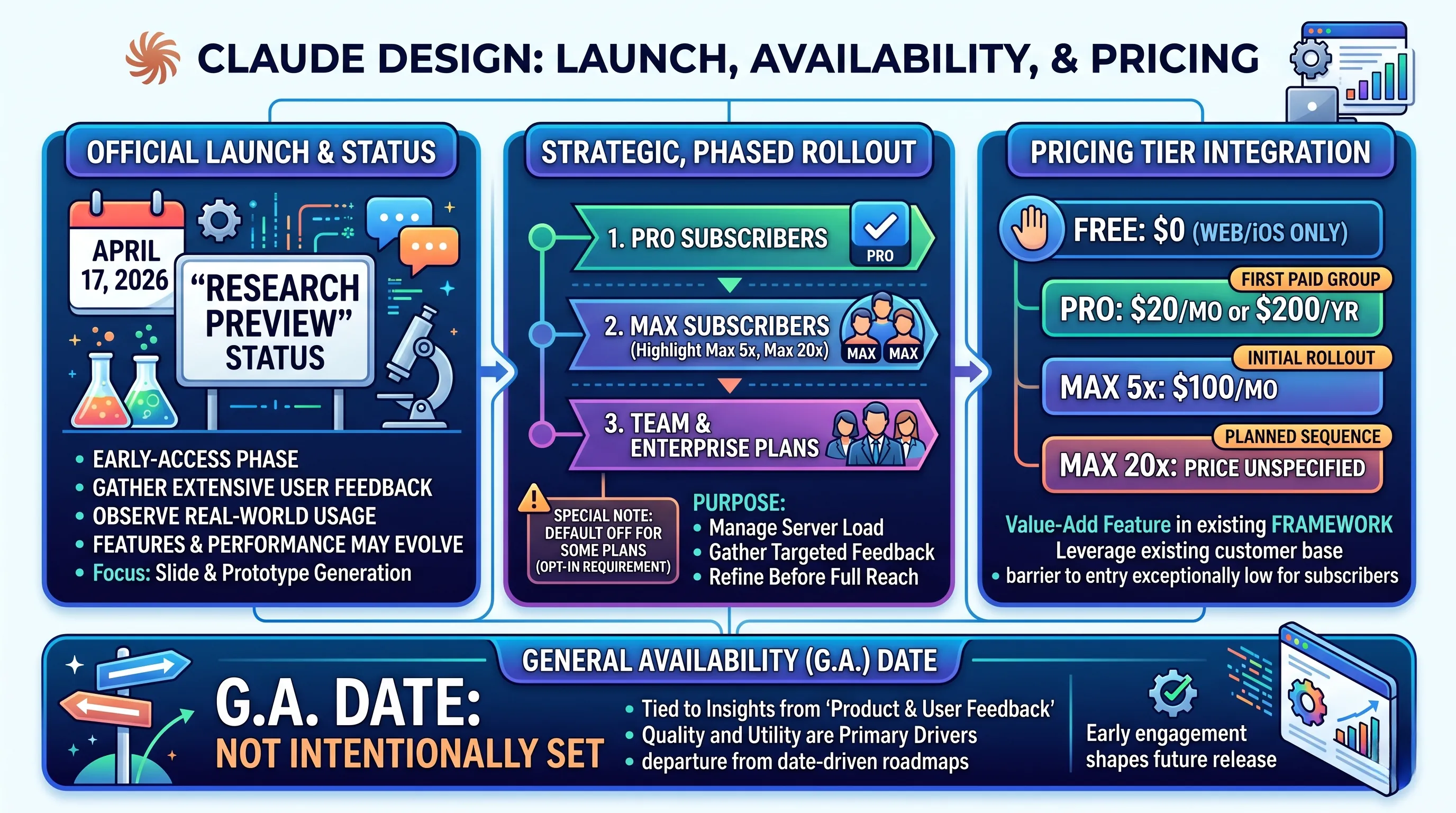
Anthropic Labs officially unveiled Claude Design on April 17, 2026, but it did so by classifying the tool under a specific and important status: 'Research preview'.
This designation is a clear signal that Claude Design is not yet a final, commercially hardened product.
Instead, it represents an early-access phase where the primary goal is to gather extensive user feedback and observe real-world usage patterns.
For users, this means they are gaining access to a cutting-edge tool with the understanding that its features, performance, and even its core interface may evolve significantly based on their input.
This status directly impacts the experience of using the new slide and prototype generation features, positioning early adopters as active participants in the product's development journey rather than just consumers of a finished tool.
The Strategic, Phased Rollout Plan
Access to the Claude Design research preview is not a free-for-all.
Anthropic is implementing a sequential distribution model, granting access to its existing subscriber base in a specific order.
The rollout will prioritize users across its paid tiers, starting with Pro and Max subscribers, and then extending to its business-focused Team and Enterprise plans.
This tiered approach allows Anthropic to manage server load, gather feedback from different user segments with unique needs, and refine the tool before it reaches its largest and most demanding enterprise clients.
Interestingly, the source information notes that for some plans, the feature will be 'default off', implying an opt-in requirement.
This measure likely serves to ensure that only actively interested users engage with the preview, providing more focused feedback while preventing accidental usage from overwhelming systems or confusing users who are not yet ready to experiment.
Integration into Existing Pricing Tiers
Rather than launching as a separate, costly add-on, Claude Design's preview is being integrated as a value-add feature within Anthropic's existing subscription framework.
Access is tied to the standard Claude pricing plans, which provides a clear pathway for interested users.
The current plans into which the preview is being rolled out are:
- Free: $0, which covers web and iOS usage. While the phased rollout starts with paid tiers, the existence of this free tier leaves open the possibility of wider access in the future.
- Pro: $20 per month or a discounted $200 per year, representing the first group of paid users to receive access.
- Max 5x: $100 per month, a higher-tier plan also included in the initial rollout.
- Max 20x: The price for this tier is not specified, but it is part of the planned availability sequence.
This strategy cleverly leverages the existing customer base to test and refine the new visual generation capabilities, making the barrier to entry for current subscribers exceptionally low.
An Undefined Path to General Availability
In a move that underscores its commitment to a feedback-driven development process, Anthropic has stated that the general availability date for Claude Design is 'not set intentionally'.
The company has explicitly tied the final release to the insights gathered from "product and user feedback" during the research preview phase.
This is a significant departure from the date-driven roadmaps common in the tech industry.
It communicates to users that product quality and utility are the primary drivers for a full release, not an arbitrary marketing deadline.
For those eager to use Claude Design to build presentations and prototypes, this means the most effective way to hasten a public launch is to engage with the preview and provide constructive feedback, directly shaping the future of the product.
2. Transforming Visuals: Key Generative Features and Integrations
The announcement of "Claude Design" by Anthropic is significant not just for its existence, but for the profound capabilities it introduces, which form the very core of this new product. This section delves into the specific generative features and integrations that allow Claude Design to transform simple text prompts into a wide array of polished visual assets, directly fulfilling the promise of its name to create everything from slides to prototypes. These features are the engine driving the entire value proposition discussed in the main topic.
From Prompt to Pixel: The Core Generative Engine
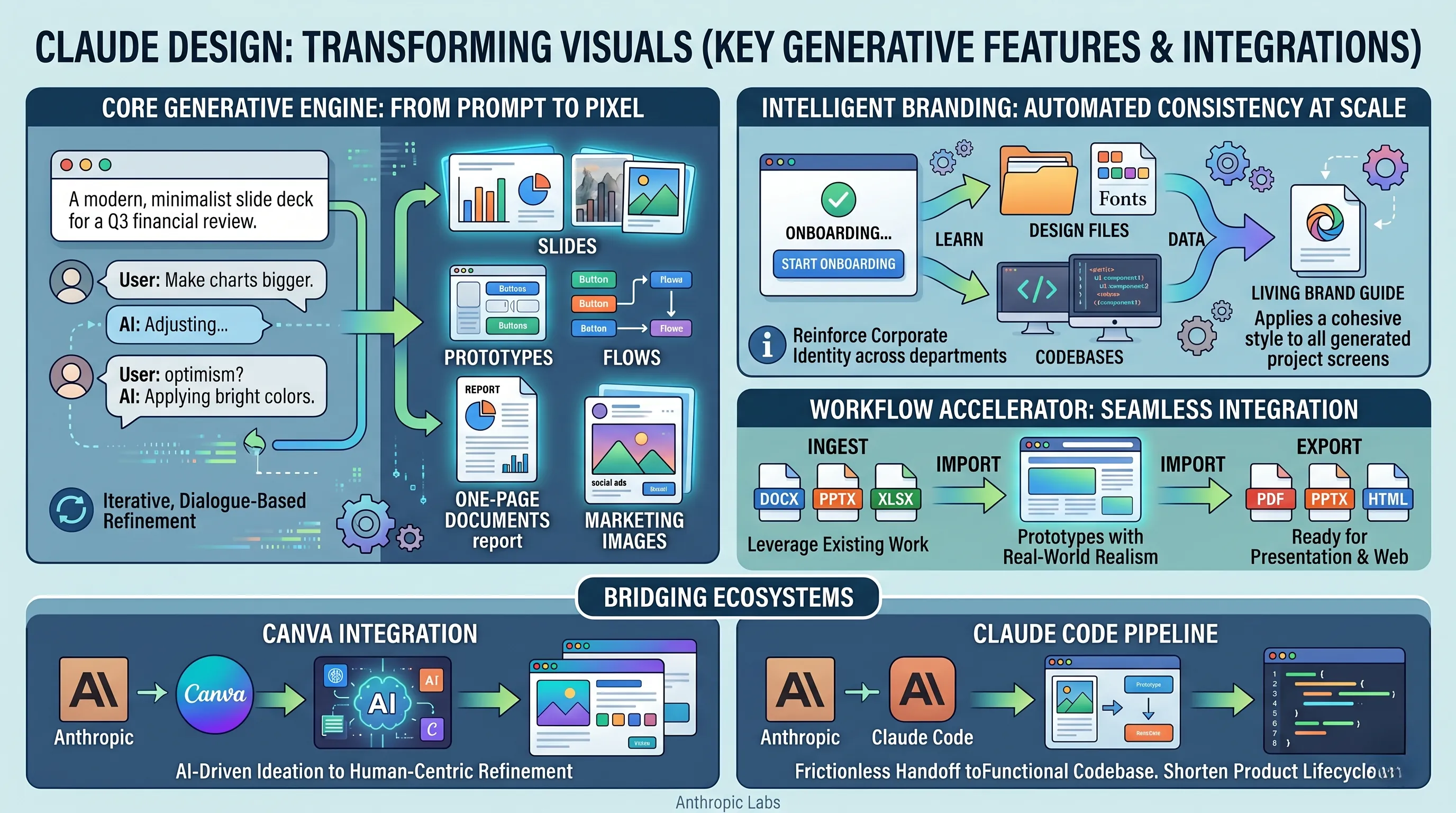
At its heart, Claude Design is built on the ability to generate visual results instantly from text input or natural language descriptions. This is not merely an iterative improvement on existing tools; it represents a fundamental shift in the creation process. Where a project manager might once have spent hours creating a wireframe or a marketer might have struggled with a template, they can now simply describe their vision. The system's versatility is a key pillar of its design, enabling the creation of diverse visual outputs that cater to a wide range of business needs.
These outputs include:
- Slides: For sales teams, executives, and planners who need to quickly assemble compelling presentations.
- Prototypes: For product managers and UX/UI designers aiming to visualize user flows and test interactive concepts.
- One-Page Documents: For creating concise reports, datasheets, or internal memos.
- Marketing Images: For social media managers and marketing teams needing rapid asset generation for campaigns.
This multi-faceted capability is powered by a conversational-style design process. Users don't just issue a single command; they engage in a dialogue with the AI. One can ask for a "modern, minimalist slide deck for a Q3 financial review," and then follow up with "make the charts bigger and change the color scheme to be more optimistic." This iterative, dialogue-based refinement process makes design accessible to non-designers and dramatically accelerates the ideation phase for professionals.
Intelligent Branding: Automated Consistency at Scale
Perhaps one of the most powerful enterprise-grade features is Claude Design's ability to automatically understand and apply company branding. This goes far beyond simple color palette uploads. During the onboarding process, the system can learn a company's unique visual identity—including colors, fonts, and even specific UI components—by analyzing existing codebases and design files. This creates a living, intelligent brand guide within the tool.
The result is that all generated projects automatically adhere to these established brand guidelines. For a large organization, this is a transformative capability. It ensures brand consistency across all departments and user-generated content, from a marketer's ad creative to a founder's investor pitch. It effectively eliminates the problem of "off-brand" materials, increasing design productivity while simultaneously reinforcing corporate identity.
Seamless Workflow Integration: Ingesting and Exporting Data
Claude Design is engineered to fit within existing workflows, not disrupt them. A critical aspect of this is its support for various file uploads. Users can provide source material in common formats like DOCX, PPTX, and XLSX. This means you can upload a detailed Word document outline and have Claude Design generate a complete slide deck from it, or provide an Excel sheet and ask it to visualize the data in a one-page report. This feature ensures that users can leverage their existing work, making the tool a powerful accelerator rather than a starting point from scratch.
For prototyping, the system allows for the direct import of website elements, a feature that provides a dramatic boost to realism and speed. Instead of manually recreating buttons, forms, or navigation bars from a live site, a designer can import them directly to build a high-fidelity, interactive prototype for user testing. This allows for rapid experimentation using real-world components.
Once a design is finalized, it is not trapped within the Claude ecosystem. The platform supports direct output to universally accepted formats, including PDF, PPTX, and HTML files, ensuring the generated assets are immediately ready for distribution, presentation, or web deployment.
Bridging Ecosystems: Canva and Claude Code Integrations
Understanding that AI generation is often the first step in a larger creative process, Anthropic has built crucial bridges to other platforms. The integration with Canva is particularly notable. Users can generate a concept or a draft within Claude Design and then seamlessly move it to Canva for fine-tuning, leveraging Canva's vast library of elements, templates, and granular editing tools. This creates a powerful workflow: AI-driven ideation followed by human-centric refinement.
Even more critically, especially for product-focused teams, is the direct pipeline from Claude Design to Claude Code. A design for a new web application feature or a mobile app screen created in Claude Design can be directly transferred to Claude Code. This handoff turns the visual prototype into a functional codebase, dramatically shortening the product development lifecycle. The friction and potential for misinterpretation in the traditional design-to-engineering handoff are virtually eliminated, creating a fluid and continuous path from concept to production-ready code.
3. Boosting Productivity: Impact and Diverse User Benefits
The unveiling of Claude Design by Anthropic Labs, the core subject of our main article, represents more than just a new tool; it's a catalyst for a fundamental re-evaluation of creative and professional workflows.
This section delves into how this new capability is poised to dramatically boost productivity, analyzing its specific impact on a diverse range of users and the broader industry implications.
Empowering the Non-Designer: From Idea to Tangible Asset in Minutes
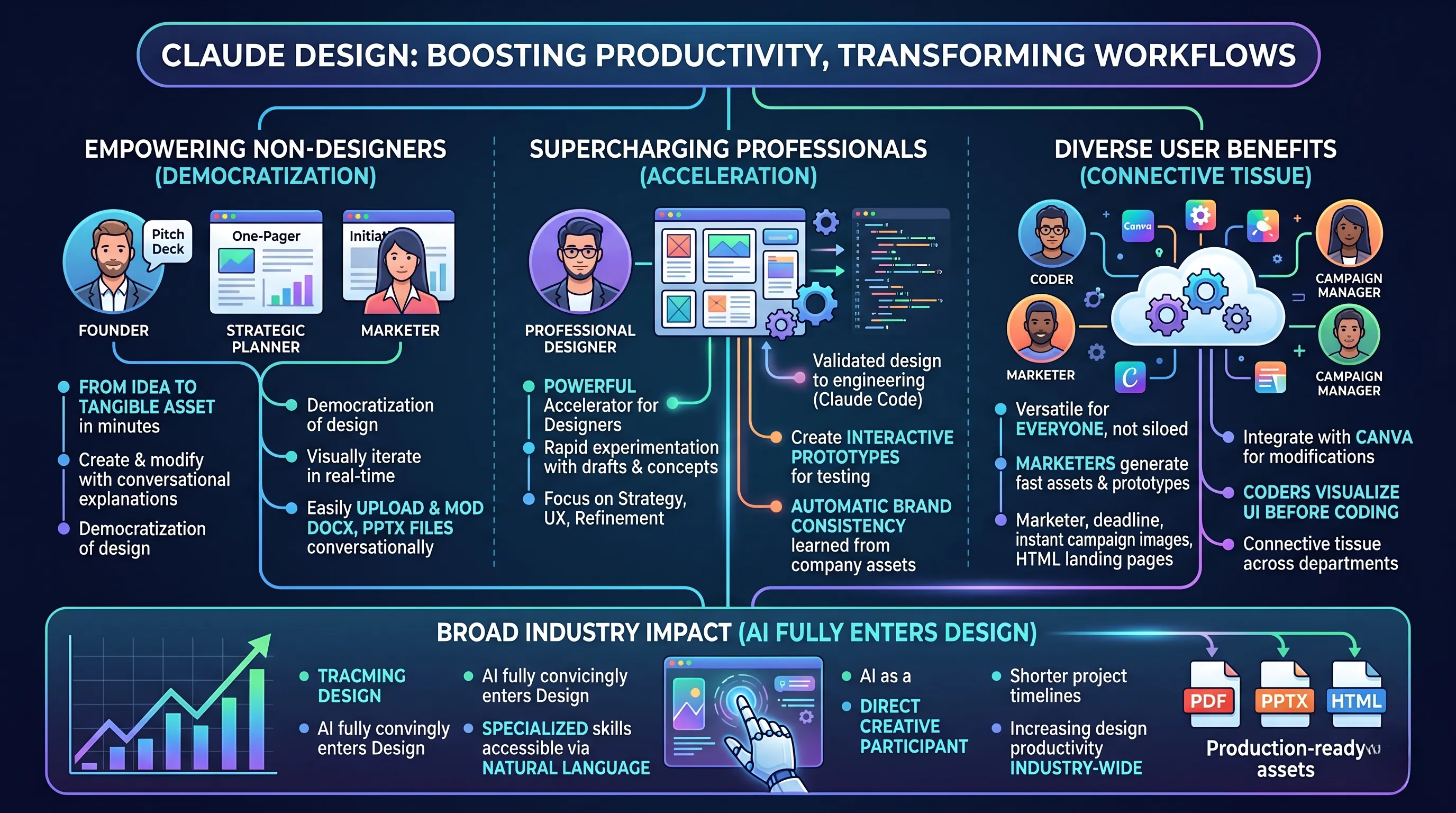
For founders, strategic planners, and marketers, the journey from a concept to a presentable draft has historically been a bottleneck, often requiring reliance on dedicated design teams for even the simplest visualizations.
Claude Design directly addresses this pain point by enabling these professionals to create and modify drafts using nothing more than simple, conversational explanations.
The experiential value of this is profound: a founder can now instantly generate a slide deck for a pitch by describing their business model, or a planner can create a one-page document outlining a new initiative without ever opening a traditional design application.
This democratization of design means ideas can be iterated upon visually and in real-time, fostering faster alignment and decision-making within teams.
The ability to upload existing DOCX or PPTX files for modification further streamlines this process, turning static documents into visually compelling assets with unprecedented ease.
Supercharging the Professional Designer: The New Era of Rapid Experimentation
Contrary to fears of replacement, Claude Design positions itself as a powerful accelerator for professional designers.
The tool allows them to quickly experiment with various drafts and concepts, liberating them from the time-consuming manual labor of initial mockups.
A designer can now generate ten different layout ideas in the time it previously took to create one, allowing them to focus their expertise on refinement, user experience, and high-level strategy.
Furthermore, the capability to create interactive prototypes for user testing is a game-changer.
By directly importing website elements or describing interactions, designers can build realistic, testable prototypes conversationally, drastically shortening the feedback loop.
This seamless flow is capped by the integration with Claude Code; a validated design can be transferred directly for product development, bridging the often-problematic gap between design and engineering.
The automatic application of brand guidelines, learned from company codebases and design files, ensures every experiment remains consistent, saving countless hours previously spent on manual brand compliance.
A Broad Church of Users: From Coders to Campaign Managers
Anthropic has clearly targeted a wide and diverse user base, recognizing that the need for visual assets permeates all corners of an organization.
The platform is built for everyone, from Claude Code power users to marketers seeking fast marketing assets and web prototypes.
A developer using Claude Code can now use Claude Design to quickly visualize a UI component before writing the implementation, ensuring form and function are aligned from the start.
Conversely, a marketer on a tight deadline can instantly generate a set of marketing images for a social media campaign, a quick HTML prototype for a landing page, or even integrate the final designs with Canva for further campaign-specific modifications.
This versatility ensures that Claude Design is not a siloed product but a connective tissue that enhances productivity across different departments and roles.
The Broader Industry Evaluation: AI Enters the Design Domain
The launch of Claude Design is being seen across the industry as a landmark moment.
It signals that AI's capabilities have now fully and convincingly expanded beyond the realms of writing and coding into the nuanced, aesthetic, and interactive world of design.
This expansion is expected to trigger a significant increase in design productivity industry-wide.
The evaluation is clear: tasks that required specialized software and skills are becoming accessible through natural language, fundamentally altering project timelines and the very definition of a "designer."
Claude Design's ability to instantly generate, brand, and output production-ready files (PDF, PPTX, HTML) is a clear indicator that AI is no longer just an assistant but a direct participant in the creative process.
📚 Related Posts
Google Gemini 3.1 Flash TTS: Revolutionizing Voice AI with Human-Like Expressiveness, Audio Tags & Responsible AI
🚀 Key TakeawaysGoogle's Gemini 3.1 Flash TTS ushers in a new era of voice AI, generating exceptionally natural, expressive, and human-like voices with unprecedented control through 'Audio Tags' and intuitive prompts, making advanced voice synthesis broa
tech.dragon-story.com
Google Chrome 'Skills' Transforms Web Browsing: Personalized AI Automation, One-Click Workflows & Multi-Tab Power
🚀 Key TakeawaysThe new Google Chrome 'Skills' feature revolutionizes AI interaction by enabling users to save custom prompts as reusable 'Skills', allowing for one-click execution and significantly automating tasks directly within the browser.It transfo
tech.dragon-story.com
Google Gemini macOS App: Always-On AI Revolutionizes Desktop Workflow with Native Integration & Screen Understanding
🚀 Key TakeawaysGemini for macOS acts as an "always-on" AI assistant, deeply integrating into your workflow with a native macOS experience and providing instant, contextual assistance.Leveraging the powerful Gemini 3 model, it uniquely understands screen
tech.dragon-story.com


