🚀 Key Takeaways
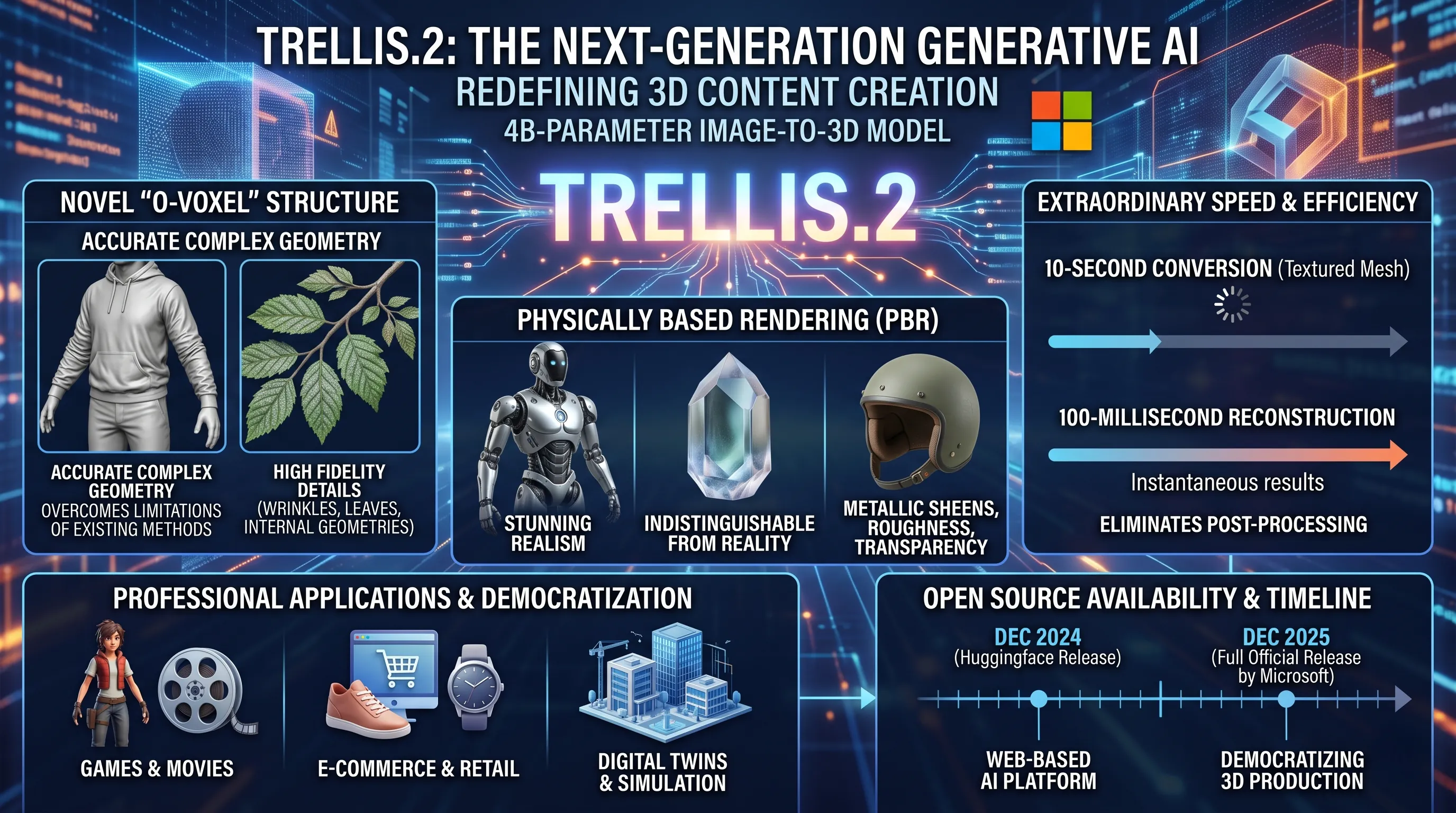
- TRELLIS.2 revolutionizes 3D generation with its innovative O-Voxel technology, enabling the creation of highly complex, thin, and hollow structures with exceptional detail and realism.
This 4B-parameter image-to-3D model offers unprecedented speed in 3D data conversion, delivering professional-grade results that are nearly indistinguishable from reality, thus fundamentally shifting the paradigm of 3D modeling and content creation.
TRELLIS.2 emerges as a pivotal next-generation generative AI, poised to fundamentally redefine the landscape of 3D content creation.
This advanced 4B-parameter image-to-3D model is not just an incremental update but a transformative force, introducing a novel 'O-Voxel' sparse voxel structure that adeptly overcomes the long-standing limitations of existing 3D generation methods.
Its research-driven innovation allows for the accurate creation of highly complex and previously challenging structures, such as delicate clothing wrinkles, intricate leaves, and precise internal geometries, without any loss of detail.
Harnessing Physically Based Rendering (PBR) elements, TRELLIS.2 delivers stunningly realistic texture expression, capable of generating 3D results that are nearly indistinguishable from reality, complete with metallic sheens, roughness, and transparency.
Beyond its exceptional fidelity, the platform boasts extraordinary conversion speeds, transforming textured meshes into 3D data within 10 seconds and reconstructing 3D models in a mere 100 milliseconds, eliminating the need for complex post-processing.
This unparalleled efficiency, combined with support for typography and logos, ensures logical continuity and consistent, high-quality models for professional applications.
As a professional-grade, web-based AI, TRELLIS.2 significantly lowers entry barriers for sophisticated 3D production, democratizing access to cutting-edge tools.
Its open-source availability, with components like the Huggingface release anticipated by December 2024, underscores its commitment to fostering innovation within the community.
With a full official release by Microsoft expected in December 2025, accompanied by its foundational research paper, TRELLIS.2 is not merely a tool but a fundamental shift, accelerating the era of real-time content creation and promising to enhance content quality competitiveness across diverse industries, from games and movies to e-commerce.
1. TRELLIS.2's Revolutionary Core: O-Voxel Technology and Unprecedented Detail
The central reason why the next-generation generative AI, TRELLIS.2, is poised to fundamentally change the game is not just its speed or accessibility, but its very foundation: a revolutionary core technology known as 'O-Voxel'.
This is not merely an incremental improvement on existing methods; it is a ground-up reimagining of how a machine perceives and constructs three-dimensional space.
At its heart, TRELLIS.2 operates as a massive 4B-parameter image-to-3D model, but the parameter count alone doesn't tell the full story.
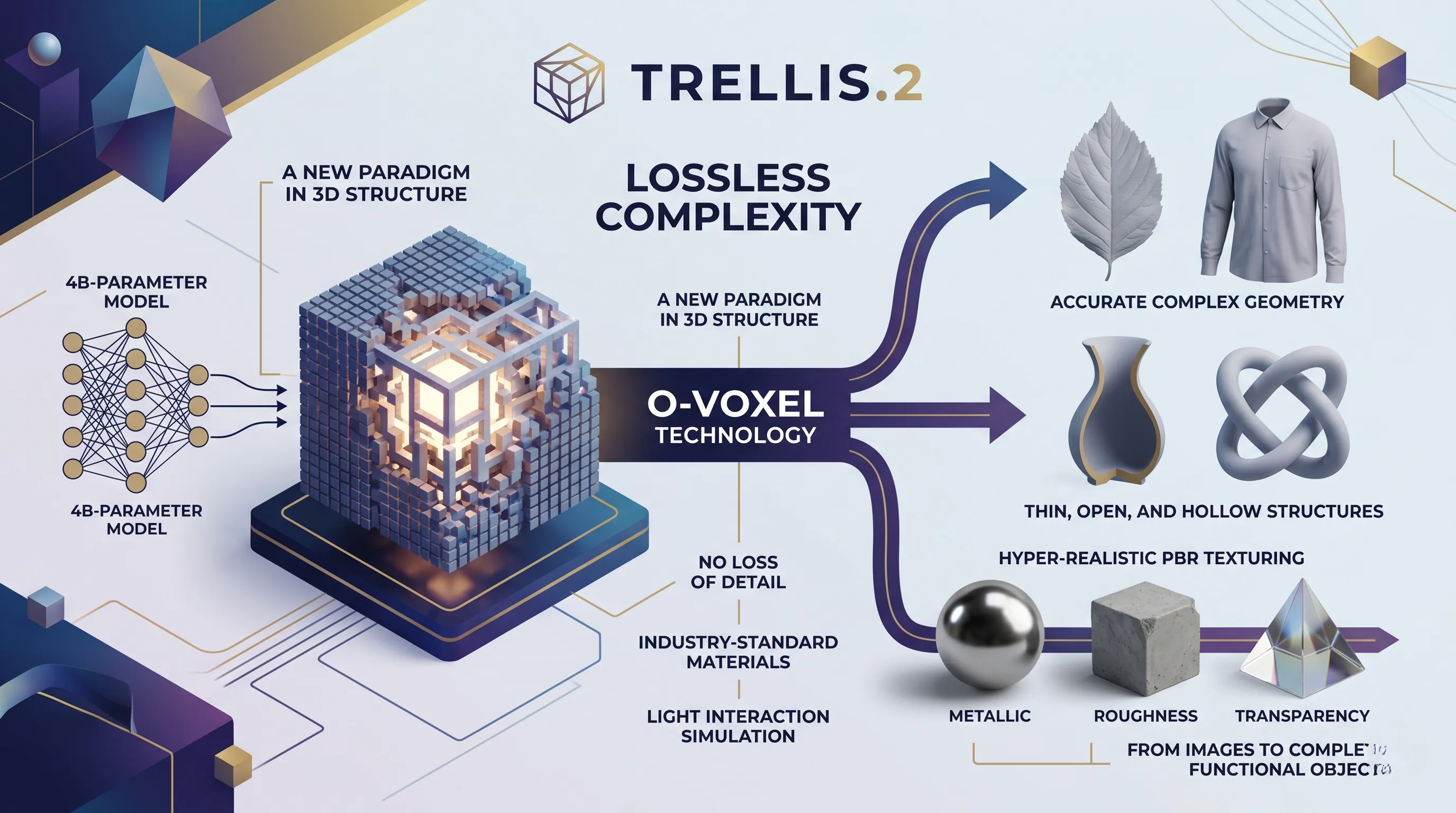
The true innovation lies in how those parameters are leveraged through its new sparse voxel structure, O-Voxel, which serves as the engine for its unprecedented level of detail and realism.
A Paradigm Shift in 3D Structure: Lossless Complexity
Traditional 3D generation models often struggle with a critical trade-off between detail and efficiency, frequently resulting in a "lossy" conversion where intricate details are smoothed over, simplified, or lost entirely.
TRELLIS.2's O-Voxel technology directly confronts and solves this challenge.
The official documentation states that this technology implements complex structures without loss, a claim that represents a monumental leap forward for digital creation.
Experientially, this means the end of the frustrating "melted plastic" look that plagues many AI-generated models.
Instead of approximating a shape, O-Voxel constructs it with startling fidelity, preserving the artist's or the source image's original intent with near-perfect accuracy.
This lossless approach is the key that unlocks a new tier of professional-grade 3D assets generated in seconds.
Mastering the Impossible Geometry: Thin, Open, and Hollow Structures
The true test of a 3D generation system lies in its ability to handle geometries that defy simple, solid-mass representation.
This is where O-Voxel demonstrates its profound superiority.
The system is explicitly designed to support thin and open structures, such as the delicate, paper-thin form of a leaf, the complex and subtle undulations of clothing wrinkles, or the intricate lattice of a chain-link fence.
Where other models would produce a solid, unusable blob, TRELLIS.2 understands and renders the empty space as crucial to the object's identity as the material itself.
Furthermore, it masterfully generates hollow internal shapes.
This capability allows for the creation of complex objects like vases, pipes, or containers with correctly defined interior and exterior surfaces, a task that has historically been a significant stumbling block for automated generation.
This moves the technology from being a mere "sculptor" of external shapes to a true "architect" of complete, functional objects.
The Soul of the Surface: Hyper-Realistic PBR Texturing
A perfect geometric model is incomplete without a convincing surface, and here too, TRELLIS.2 excels by integrating advanced texturing capabilities.
The model achieves realistic texture expression with Physically Based Rendering (PBR) elements, which is the industry standard for creating lifelike materials in modern games and visual effects.
This is not a simple texture map overlay; it's a sophisticated simulation of how light interacts with a surface in the real world.
The O-Voxel structure provides the perfect canvas for PBR materials, allowing for nuanced control over key properties:
- Metallic: The model can distinguish between a dielectric material like plastic and a conductive one like chrome, ensuring metals reflect light with authentic sheen and color.
- Roughness: It can generate surfaces ranging from a perfectly smooth mirror to a coarse, light-diffusing concrete wall, which dictates the sharpness and clarity of reflections.
- Transparency: TRELLIS.2 can create convincing transparent or translucent materials like glass, water, or jade, correctly simulating light passing through, refracting, and reflecting from the object.
This meticulous attention to surface physics is the final, critical element that allows TRELLIS.2 to generate 3D results nearly indistinguishable from reality.
The combination of lossless geometry from O-Voxel and hyper-realistic PBR materials creates an output that doesn't just look like a 3D model, but like a digital photograph of a real-world object.
This is the technological core that will empower creators across all industries—from film and gaming to e-commerce and industrial design—to build worlds with a fidelity and speed that were previously unimaginable.
2. Transforming 3D Production: Speed, Accessibility, and Industry Impact
This section directly addresses the core theme of "Next-gen Generative AI ‘TRELLIS.2’ is a Game Changer" by dissecting the practical mechanisms through which this change is occurring.
It is TRELLIS.2's revolutionary speed, unprecedented accessibility, and ability to overcome long-standing technical hurdles that are collectively dismantling the old paradigms of 3D production, thereby fundamentally changing the industry landscape.
An Unprecedented Velocity: Redefining the 3D Workflow
The most immediate and startling advantage of TRELLIS.2 is its sheer, almost unbelievable, speed.
In professional 3D pipelines, the process of converting, reconstructing, and refining models is traditionally measured in hours, if not days.
TRELLIS.2 obliterates this timeline.
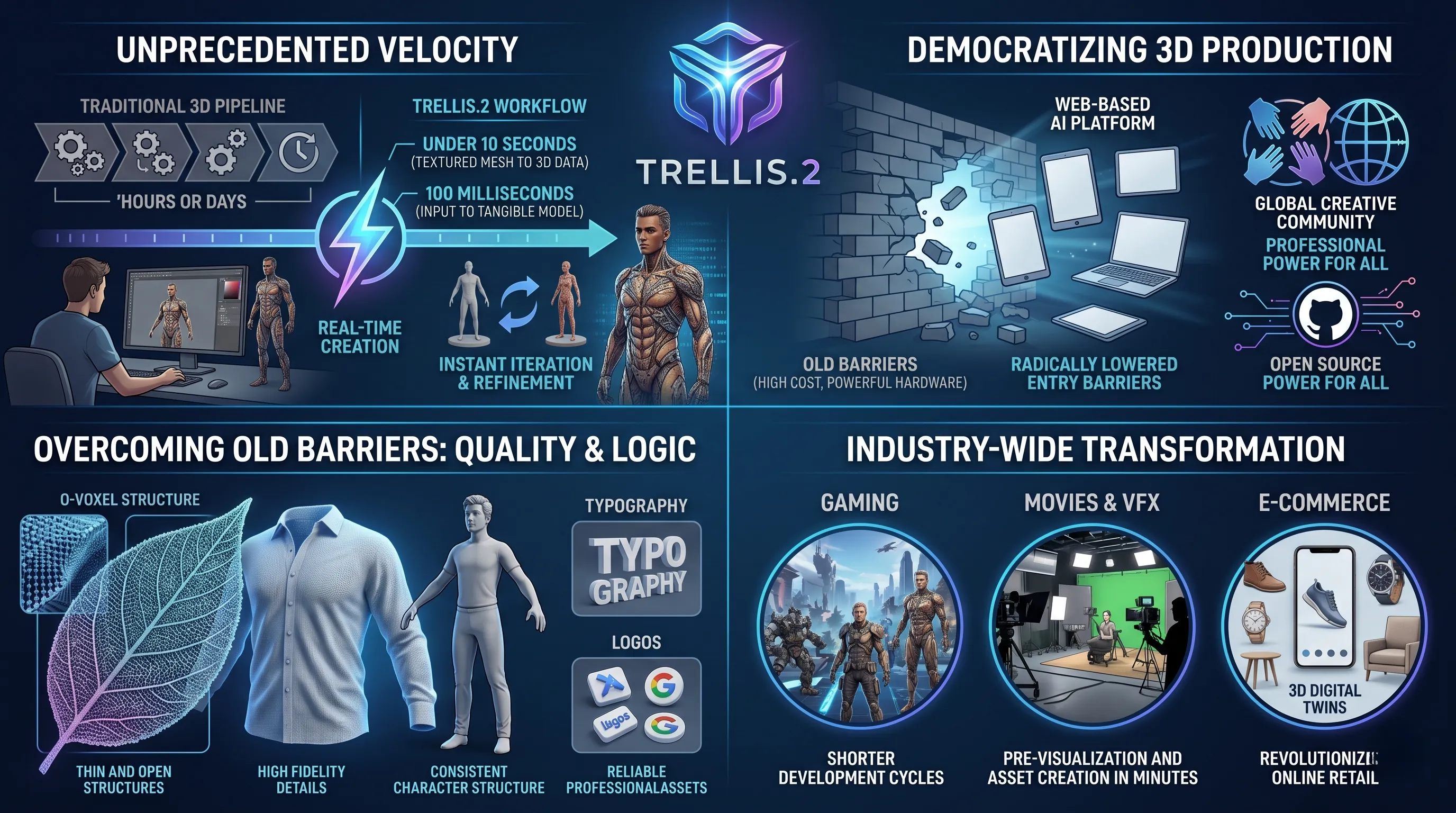
The system can convert a textured mesh into usable 3D data in under 10 seconds.
Even more astonishingly, the core reconstruction from input to a tangible 3D model is completed in just 100 milliseconds.
This is not merely an incremental improvement; it is a temporal leap that redefines the very nature of creative work.
A 100-millisecond feedback loop means that creation is no longer a stop-and-wait process but a fluid, real-time conversation between the artist and the AI.
This capability is the engine that accelerates the era of real-time content creation, allowing for instant iteration, experimentation, and refinement that was previously the stuff of science fiction.
Complex post-processing, once a mandatory and time-consuming bottleneck, is virtually eliminated, allowing creators to move from concept to usable asset at the speed of thought.
Democratizing 3D: Professional Power for Everyone
For decades, high-end 3D production has been a gated community, protected by walls of expensive software licenses and the need for powerful, dedicated hardware.
TRELLIS.2 tears down these walls.
Its deployment as a professional-grade, web-based AI means that the only hardware required is a device with a web browser.
This radically lowers the entry barriers for 3D production, shifting the focus from financial investment to creative talent.
Furthermore, its status as an open-source project is a powerful catalyst for innovation.
Developers, studios, and individual creators can freely integrate, modify, and build upon TRELLIS.2's core technology, fostering a collaborative ecosystem that will undoubtedly push its capabilities even further.
This combination of web-based access and an open-source philosophy effectively democratizes a once-exclusive field, putting tools of immense power into the hands of a global creative community.
Overcoming Old Barriers: A New Standard for Quality and Logic
TRELLIS.2 doesn't just make 3D creation faster and more accessible; it makes it better.
It directly addresses and overcomes the limitations of existing 3D generation methods, which often struggle with complex or delicate forms.
Powered by its 'O-Voxel' structure, the model can generate thin and open structures—like the intricate wrinkles on clothing or the delicate veins of a leaf—with a fidelity that other methods cannot match.
This extends to unique commercial needs, with dedicated support for generating clean and accurate typography and logos, a notoriously difficult task for generative models.
Crucially, TRELLIS.2 ensures logical continuity, meaning the models it produces are consistent and structurally sound, making them reliable for professional use rather than mere novelties.
A character generated will maintain its core structure and details across different poses, a critical requirement for animation and gaming.
The Ripple Effect: Industry-Wide Transformation
The cumulative impact of TRELLIS.2's speed, accessibility, and quality represents nothing less than a fundamental shift in professional 3D modeling.
The potential applications across major industries are vast and transformative.
- In Gaming: Development cycles will shorten dramatically. Artists can generate vast libraries of high-quality, game-ready assets in a fraction of the time, from environmental props to character variations, massively increasing the richness and scale of virtual worlds.
- In Movies & VFX: Pre-visualization and asset creation for visual effects can become an interactive, real-time process. Generating complex digital sets, vehicles, or props can be done in minutes, freeing up artists to focus on the final creative polish.
- In E-commerce: The high cost and effort of creating 3D models for every product has been a major barrier to widespread adoption of AR and virtual try-on experiences. TRELLIS.2 makes it economically viable to create a photorealistic 3D digital twin for any product, revolutionizing online retail.
By solving the core challenges of speed, cost, and complexity, TRELLIS.2 is not just another tool; it is a foundational technology poised to enhance content quality and competitiveness across the board, truly changing the game for how we create and interact with the three-dimensional world.
3. TRELLIS.2's Path to Impact: Research Status and Release Roadmap
A revolutionary technology's potential to "change the game," as the overarching topic "Next-gen Generative AI ‘TRELLIS.2’ is a Game Changer" suggests, is ultimately measured by its journey from a concept to a tangible tool in the hands of creators. This section maps out that critical journey for TRELLIS.2, providing the concrete timeline that transforms its groundbreaking capabilities from a theoretical promise into an inevitable market disruption. The roadmap detailed here is not merely a list of dates; it is the strategic plan for how and when TRELLIS.2 will begin to fundamentally redefine the 3D content landscape.
From Laboratory to Reality: Anchored in Pure Research
Before a single polygon is rendered by the public, it is crucial to understand TRELLIS.2's current state of being. The technology is officially classified as a 'Purely a research project.'
This status is not a limitation but a testament to its radical nature. It signifies that the core innovations, like the 'O-Voxel' sparse voxel structure, are so foundational that they are being perfected and validated within a controlled, academic environment before being unleashed. This phase ensures that when TRELLIS.2 does emerge, it does so with a level of stability, coherence, and power that surpasses incremental updates to existing tools. It is a ground-up reinvention, and this research phase is where the new foundation is being meticulously set. This period is dedicated to hardening the algorithms and ensuring the logical continuity that allows for the creation of consistently coherent models, moving it beyond the realm of unpredictable generative curiosities and into the domain of a reliable professional-grade tool.
The Strategic Rollout: A Three-Phase Path to Industry Integration
The transition from research to industry-wide adoption is not a single event but a deliberately staged process designed to build momentum, gather feedback, and systematically onboard different user segments. TRELLIS.2 will follow a clear, three-phase release schedule, targeting the open-source community, high-end professionals, and enterprise ecosystems in succession.
Phase 1: The Community Proving Ground on Huggingface (December 2, 2024)
The first public appearance of TRELLIS.2 is slated for December 2, 2024, with its release on Huggingface. This choice is deeply strategic. Huggingface is the global hub for the machine learning community, a place where developers, researchers, and AI enthusiasts converge. By launching here first, the creators are making a powerful statement: TRELLIS.2 is built on a foundation of open access and community collaboration, as confirmed by its 'Open_Source_Availability.' This initial release will put the 4B-parameter image-to-3D model into the hands of the most innovative and experimental users on the planet. They will test its limits, discover novel applications, and begin building the ecosystem of tools and workflows around it, effectively stress-testing the technology at a massive scale long before its official commercial debut.
Phase 2: The Professional Litmus Test at Build_Nvidia.com (September 2, 2025)
Nearly nine months later, the next major milestone occurs on September 2, 2025, with availability on Build_Nvidia.com. This marks a critical pivot from the broader ML community to the core demographic of professional 3D artists, game developers, and VFX studios. NVIDIA is the undisputed leader in the hardware that powers professional graphics. A release on its platform is a direct appeal to the creators who will integrate TRELLIS.2 into demanding, real-world production pipelines. This is where its claims of generating complex, thin structures and production-quality PBR textures will be put to the ultimate test in professional environments, setting the stage for its commercial viability.
Phase 3: The Official Enterprise Launch and Academic Validation (December 16, 2025)
The culmination of this strategic rollout is the Microsoft_Official_Release on December 16, 2025. This represents the final evolution of TRELLIS.2 from an open-source model and professional tool into a fully integrated, enterprise-ready solution. Microsoft's involvement signals deep integration with cloud platforms like Azure and professional software suites, making the technology accessible and scalable for the largest corporations and creative studios.
Crucially, this final release will be accompanied by the publication of its foundational research paper, 'Native and Compact Structured Latents for 3D...' This act anchors all of TRELLIS.2's commercial power in verifiable, peer-reviewed science. It provides the academic blueprint for the 'O-Voxel' technology, giving the industry not just a powerful new tool, but a new, documented methodology for 3D generation. This roadmap, from open-source experimentation to professional deployment and finally to enterprise-scale integration, provides a clear and inevitable timeline for when the 3D industry will be irrevocably changed.

📚 Related Posts
Microsoft Copilot: The Agentic AI Colleague Revolutionizing Productivity & Delivering 353% ROI Across Microsoft 365
🚀 Key TakeawaysMicrosoft Copilot is fundamentally ushering in the 'AI Colleague' era, transforming how work is done across productivity tools like Word, Excel, and PowerPoint by enabling agent-type AI functionality that performs complex multi-step tasks
tech.dragon-story.com
Claude AI's 'Connector' Transforms Daily Life: 200+ App Integrations Redefine Productivity & Trust
🚀 Key TakeawaysClaude's latest evolution, driven by the innovative 'Connector' function, profoundly integrates advanced AI into daily life by seamlessly linking with over 200 everyday applications, enabling users to manage complex, multi-step tasks with
tech.dragon-story.com
OpenAI's Free 'ChatGPT for Clinicians' (GPT-5.4): 99.6% Accurate AI Outperforms Doctors, Redefining US Healthcare
🚀 Key TakeawaysOpenAI's "ChatGPT for Clinicians" is a free, advanced AI tool leveraging the latest GPT-5.4 model, specifically designed for US medical professionals to enhance efficiency and patient focus.It has demonstrated exceptional performance, wit
tech.dragon-story.com


