🚀 Key Takeaways
- Microsoft Copilot is fundamentally ushering in the 'AI Colleague' era, transforming how work is done across productivity tools like Word, Excel, and PowerPoint by enabling agent-type AI functionality that performs complex multi-step tasks, ultimately delivering significant measurable benefits and high ROI for businesses.
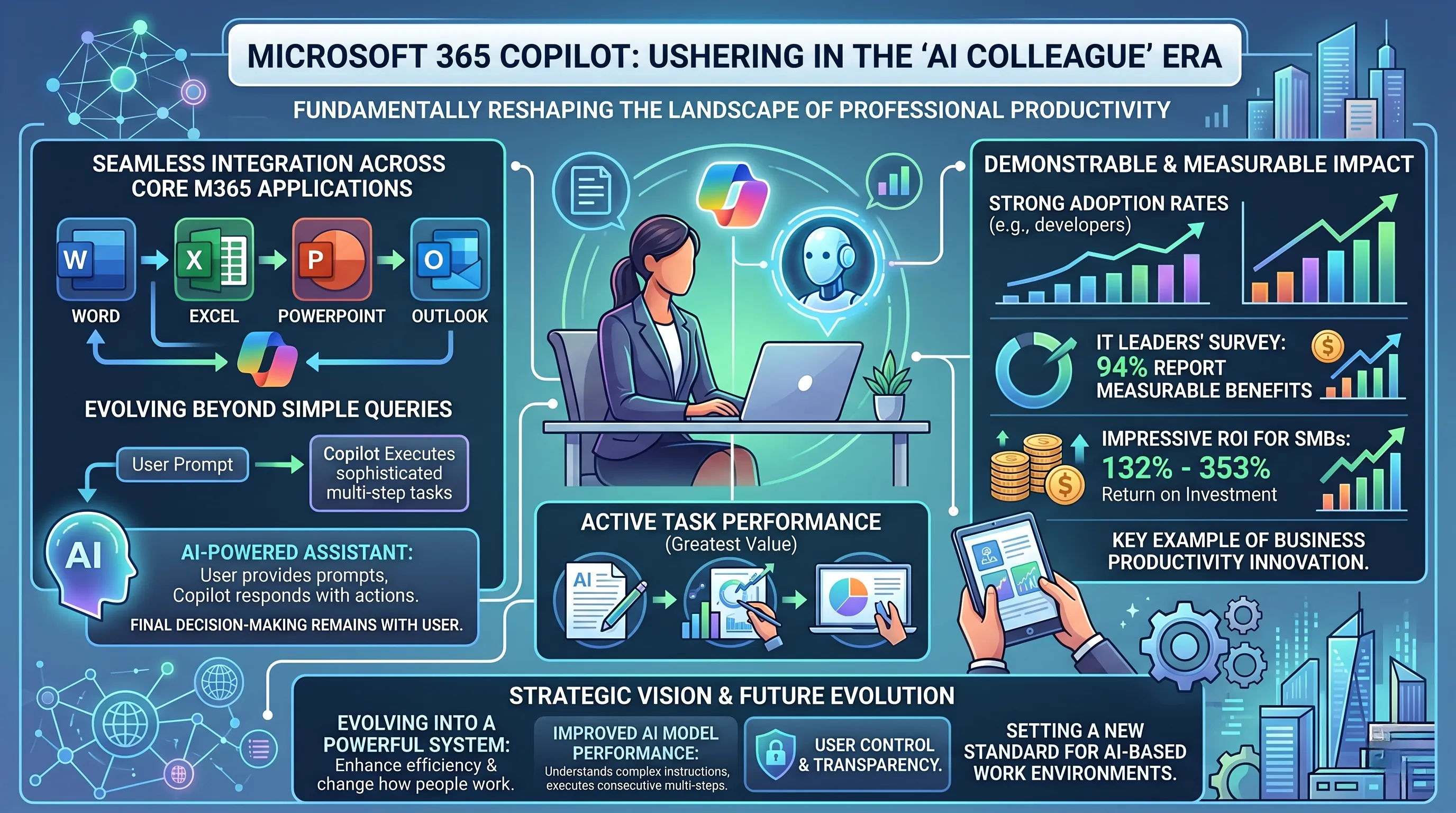
Microsoft 365 Copilot is rapidly ushering in the 'AI Colleague' era, fundamentally reshaping the landscape of professional productivity.
This advanced AI tool is seamlessly integrated across core Microsoft applications, including Word, Excel, and PowerPoint, evolving beyond simple query responses to performing sophisticated, multi-step tasks.
It functions as an AI-powered assistant for work, where users provide prompts and Copilot responds by executing program-specific actions, always ensuring that the final decision-making power remains with the user.
The impact of Copilot is already demonstrably significant, with strong adoption rates among developers and a high success rate in getting users productive from day one.
It is not merely a conversational AI; experts highlight its greatest value when it actively performs actual tasks such as generating document summaries, analyzing data, or creating presentation materials.
Surveys indicate that 94% of IT leaders report measurable benefits, and it has driven impressive ROIs ranging from 132% to 353% for small and medium businesses, making it a key example of business productivity innovation.
Microsoft's strategic vision for Copilot is clear: to evolve into a powerful system that not only enhances individual efficiency but also fundamentally changes the way people work, setting a new standard for AI-based work environments.
With significant improvements in AI model performance, Copilot now understands complex instructions and executes multiple steps consecutively, ready to tackle even more challenging tasks while providing users with greater control and transparency.
1. Microsoft Copilot: Redefining Productivity with Agentic AI
Microsoft Copilot's integration into the Microsoft 365 ecosystem marks a pivotal moment, directly fulfilling the promise of the overarching theme: "Microsoft Copilot, The Era of the 'AI Colleague' Begins".
This section delves into how Copilot transcends the role of a simple chatbot to become a true agentic partner—an AI colleague that understands complex objectives and executes multi-step tasks across the applications that define modern knowledge work.
Its evolution from providing simple answers to performing sophisticated actions is what truly ushers in a new standard for AI-based work environments.
From Digital Assistant to Autonomous Agent
The fundamental shift introduced by Microsoft 365 Copilot is its transition to an agent-type AI functionality.
Historically, AI assistants responded to single, discrete commands.
Copilot, however, has evolved to understand complex instructions that require it to perform multiple steps consecutively, fundamentally changing the human-computer interaction model.
It no longer just finds information; it actively works with it.
This leap is powered by significantly improved AI models that enhance its ability to understand and execute program-specific tasks, turning abstract user intent into concrete results within familiar applications.
This agentic capability is the very mechanism that transforms a tool into a colleague, one that can be delegated complex projects rather than simple chores.
The Agent at Work: Transforming Microsoft 365 Applications
Copilot’s true power is demonstrated by its deep integration into core productivity tools, where it acts as a specialist for each application.
Word: The AI Writing and Research Partner
Within Word, Copilot becomes a drafting partner.
A user can issue a complex prompt like, "Create a two-page case study based on our last quarter's sales data and recent client testimonials," and Copilot can access the relevant data, synthesize it, and generate a structured document.
For example, it can assist marketing teams by automatically generating client background summaries for case studies, performing a task that would normally take hours of research and writing.
This has a tangible impact, with data showing that Word usage increased by 52% among Copilot users, a clear indicator that the AI is removing friction from the document creation process and encouraging more sophisticated use of the application.
Excel: The On-Demand Data Scientist
Excel is where Copilot’s agentic nature shines brightest, democratizing data analysis.
Instead of a user needing to know complex syntax, they can simply ask, "Analyze the sales trend for Product X in the last six months and create a chart showing the correlation with marketing spend."
Copilot simplifies these complex tasks by not only generating the correct Excel formulas but also creating data visualizations automatically.
This direct, task-oriented capability is profoundly impactful, evidenced by the fact that Excel usage saw the highest increase at 67%.
This figure doesn't just represent more usage; it represents a workforce newly empowered to extract insights from data without needing specialized training, with Copilot acting as their personal analyst.
PowerPoint: The Presentation Strategist
In PowerPoint, Copilot can perform one of the most classic multi-step office tasks: transforming a document into a presentation.
A user can point Copilot to a detailed Word document or a set of notes and instruct it to generate a complete presentation, complete with slide structures, speaker notes, and even suggested imagery.
This demonstrates its ability to not only process information but also to understand context, structure, and visual storytelling—the core skills of a communications colleague.
A Partnership Built on Control and Trust
While Copilot’s autonomy is its strength, Microsoft has ensured that the human remains the strategist and final arbiter.
A core design principle is that the final decision-making power remains with the user.
Copilot suggests, creates, and analyzes, but it never executes without oversight.
This "human in the loop" approach is critical for adoption in high-stakes business environments.
This partnership is further fortified by a secure foundation.
Copilot works across all Microsoft apps with a secure AI chat powered by Work IQ, ensuring that corporate data and conversations remain within the organization's security perimeter.
This commitment to security and user control addresses key enterprise concerns, making the AI colleague a trusted partner rather than an unpredictable black box.
Setting the New Standard for Productivity
Microsoft’s goal is clear: to evolve Copilot into a system that fundamentally changes the way people work and sets a new standard for AI-based work environments.
The evidence suggests this is already happening.
Experts agree that the greatest value from AI arises when it performs actual tasks, not just recommendations, and Copilot is the prime example of this philosophy in action.
The business impact is staggering, with studies showing it can drive up to a 353% ROI for small and medium businesses.
For a composite organization, the benefits were measured at $36.8 million over three years, with a Net Present Value (NPV) of $955,000.
This isn't just about saving time; it's about enabling higher-value work, reflected in the belief of 83% of leaders that AI will allow employees to take on more strategic work earlier in their careers.
While a 2025 Gartner survey highlights a paradox—94% of IT leaders report measurable benefits, yet only 6% report widespread adoption—this doesn't signal failure.
Instead, it indicates that the revolution is just beginning.
The value of having an AI colleague is proven; now, organizations are navigating the cultural and procedural shift to fully integrate this powerful new way of working.

2. The Measurable Impact: Driving Adoption and Unlocking Strategic Value
This section directly connects to the overarching theme of "Microsoft Copilot, The Era of the 'AI Colleague' Begins" by moving beyond theoretical potential to present concrete, quantifiable evidence of its success. For Copilot to be considered a true "colleague," its impact must be felt in daily workflows, productivity metrics, and the company's bottom line. The data on adoption, engagement, and ROI demonstrates that Copilot is not merely a tool but a value-generating partner that is already reshaping how businesses operate and justifying its place as an indispensable member of the team.
A Groundswell of Adoption: From C-Suites to Developer Desks
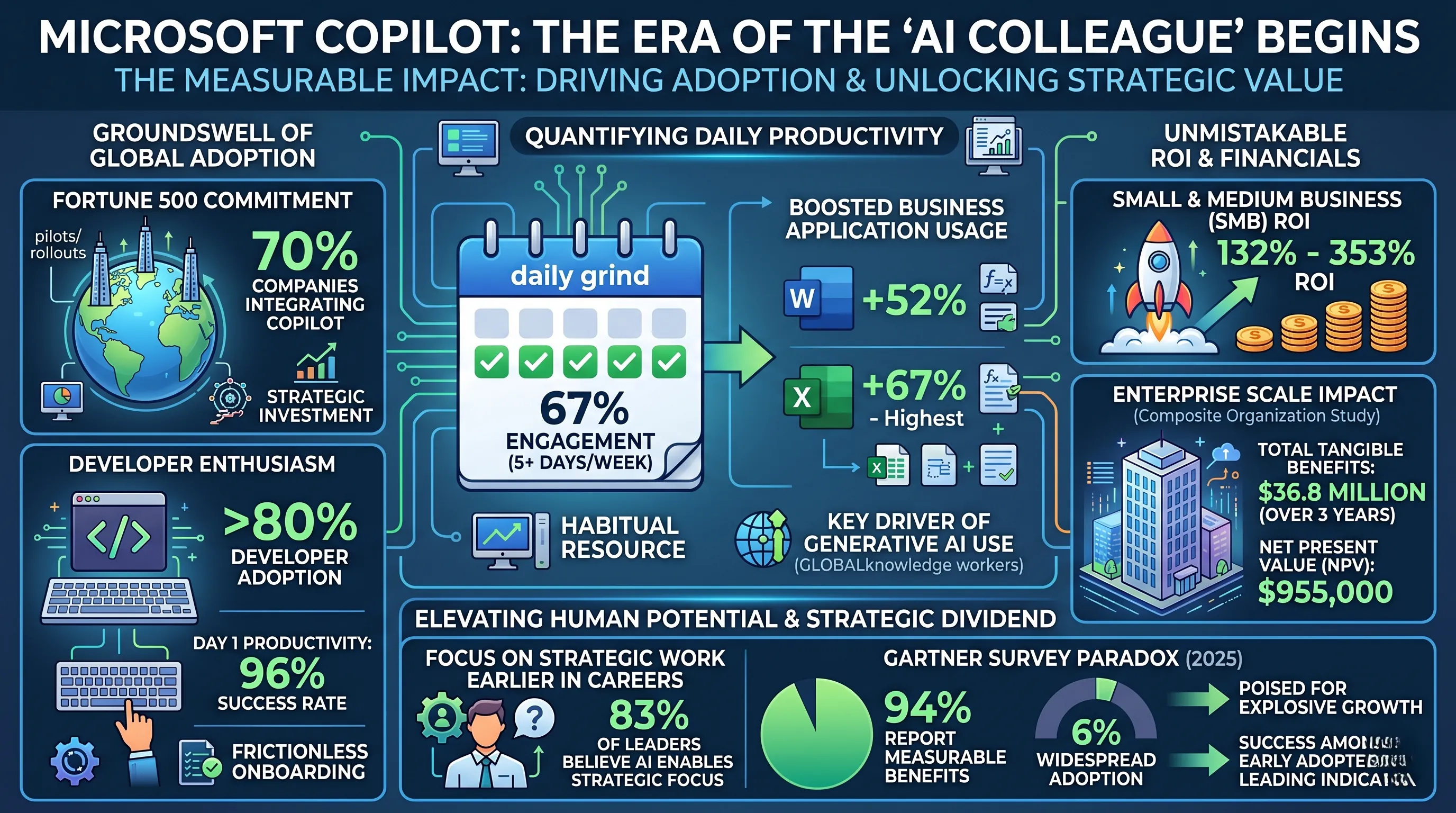
The transition of Copilot from a promising concept to an essential business asset is most clearly seen in its rapid and significant adoption rates across the world's most demanding environments. A staggering 70% of Fortune 500 companies are already integrating Copilot through pilot programs and phased rollouts. This is not a casual experiment; it represents a strategic commitment by industry leaders who have vetted the technology and recognized its potential to create a competitive advantage. This level of buy-in from the corporate elite serves as a powerful testament to Copilot's perceived value and its alignment with enterprise-level goals.
This enthusiasm is mirrored, and perhaps even surpassed, in the developer community—a demographic known for its high standards and skepticism towards productivity fads. An overwhelming majority, with over 80% of developers successfully adopting it, have integrated Copilot into their workflows. More impressively, the tool demonstrates immediate, tangible value with a 96% success rate for developers in getting productive on day one. This near-frictionless onboarding experience is critical; it proves that Copilot is not a complex system requiring extensive training but an intuitive partner that accelerates productivity from the very first interaction, solidifying its role as a capable AI colleague in highly technical fields.
Quantifying the Productivity Surge: More Than Just a Helper
The true measure of an AI colleague lies in its ability to become an integral part of the daily grind. The data shows Copilot achieving exactly that, with 67% of users engaging with it at least five days a week. This frequency indicates that Copilot has transcended the status of a niche gadget and has become a habitual, go-to resource, much like email or a team messaging app. This consistent interaction is occurring within a broader trend where generative AI use has nearly doubled in the last six months, with 75% of global knowledge workers now using it. Copilot is not just riding this wave; it is a key driver of it, turning general interest in AI into specific, daily productivity gains.
The impact on core business applications is profound and undeniable. Copilot has triggered a renaissance in the use of established productivity software, with Word usage increasing by 52% and, most remarkably, Excel usage increasing by 67%. This surge, the highest recorded, suggests that Copilot is unlocking the latent power of these tools. It acts as an expert guide, simplifying complex tasks like generating sophisticated formulas or creating compelling data visualizations in Excel, thus lowering the barrier to entry for advanced functionality. Users are not just using their tools more; they are using them better, extracting more value and achieving more sophisticated outcomes with their AI colleague's assistance.
The Unmistakable ROI: Translating Productivity into Profit
For business leaders, productivity gains must ultimately translate into financial value. Here, Copilot delivers an exceptionally strong business case. For small and medium businesses (SMBs), the platform has driven a return on investment (ROI) ranging from an impressive 132% to a phenomenal 353%. An ROI of this magnitude transforms the purchasing decision from a cost consideration into a strategic imperative for growth and efficiency.
At the enterprise scale, the financial impact is just as compelling. A study of a composite organization revealed tangible benefits totaling $36.8 million over three years, culminating in a Net Present Value (NPV) of $955,000. This positive NPV confirms that the investment is financially sound even after accounting for all costs and the time value of money. These figures prove that Copilot's ability to streamline workflows, such as assisting marketing teams by automatically generating client background summaries for case studies, directly contributes to significant financial returns.
The Strategic Dividend: Elevating Human Potential
Beyond immediate productivity and financial returns lies Copilot's most transformative impact: its ability to elevate the nature of human work. A commanding 83% of leaders believe AI will allow employees to take on more strategic work earlier in their careers. Copilot acts as a force multiplier, automating the repetitive, time-consuming tasks that often bog down junior employees and freeing them to focus on critical thinking, problem-solving, and creative strategy. This aligns with the expert consensus that the greatest value of AI arises when it performs actual tasks, not just provides recommendations. By evolving from a simple answer engine to an agent capable of executing multi-step instructions, Copilot is closing the gap between idea and execution, thereby unlocking higher-level strategic contributions from across the organization.
This shift addresses a critical paradox highlighted in a 2025 Gartner survey. The survey found that while 94% of IT leaders report measurable benefits from generative AI, only 6% report widespread adoption. This disparity does not indicate a failure of the technology but rather the nascent stage of its deployment. The 94% figure is a powerful confirmation from early adopters that the value is real and quantifiable. The low widespread adoption rate reflects the careful, phased rollouts common with transformative technologies. The overwhelming success and high engagement rates among early adopters are the leading indicators that this 6% figure is poised for explosive growth as organizations move from successful pilots to full-scale implementation, truly ushering in the era of the universal AI colleague.
3. Shaping the Future: Copilot's Evolution into a More Advanced AI Partner
This section directly addresses the core theme of "Microsoft Copilot, The Era of the 'AI Colleague' Begins" by examining the strategic roadmap that will transform Copilot from a capable assistant into a truly indispensable AI colleague.
The evolution discussed here—towards handling greater complexity, ensuring reliability in critical tasks, and empowering users with more control—is the very process by which Copilot cements its role as an integrated partner, fundamentally changing the nature of professional work and ushering in the era of the AI colleague.
From Assistant to Agent: The Leap Towards Complexity
Microsoft's vision for Copilot extends far beyond a simple question-and-answer tool.
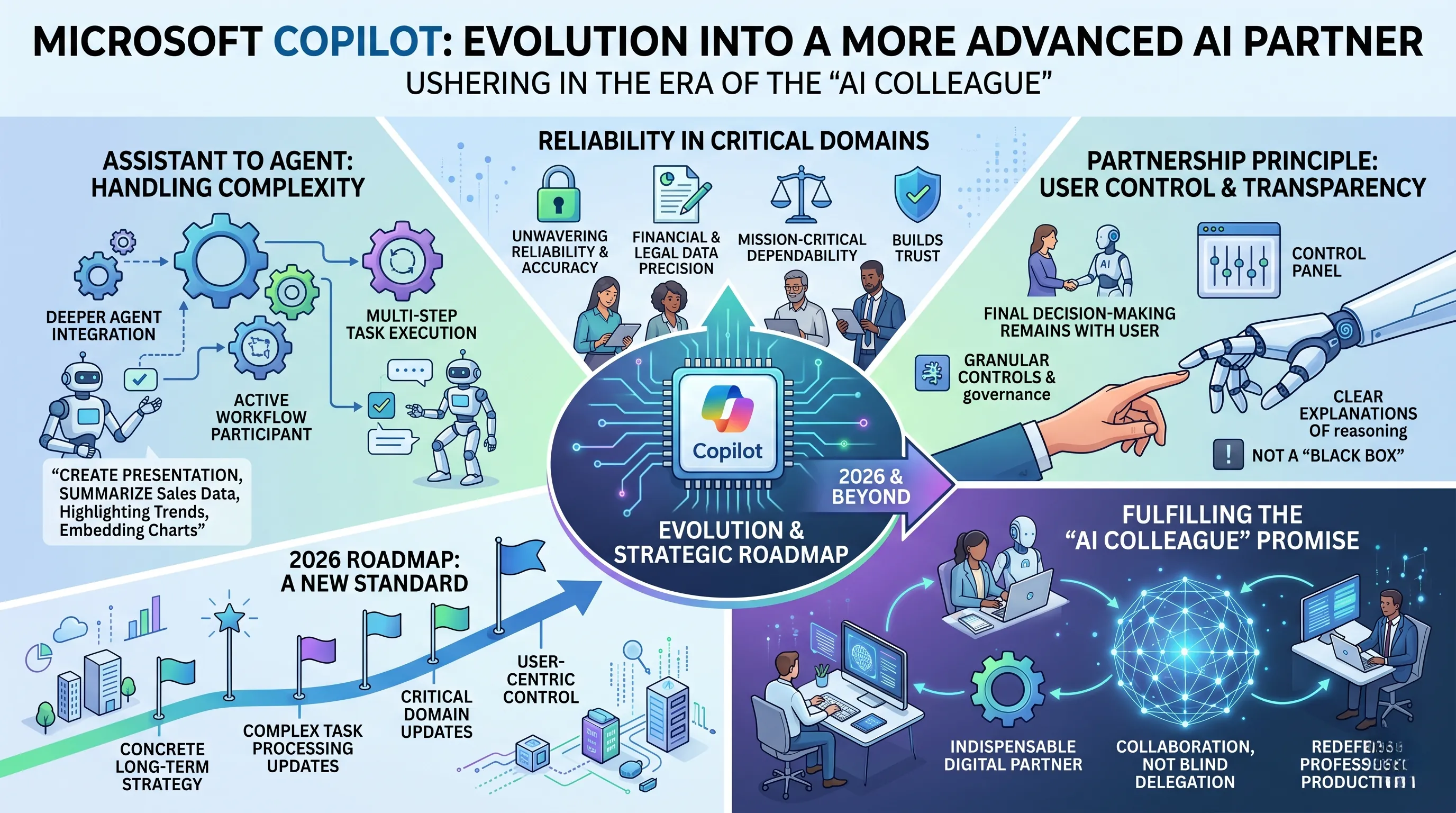
The journey has already seen its role evolve from providing simple answers to performing multi-step tasks, and the future promises an even deeper integration of agent-type AI functionality across all productivity tools.
This strategic shift is a direct response to the understanding, shared by experts, that the greatest value from AI arises when it performs actual tasks, not just recommendations.
The roadmap focuses on significantly improving the AI model's performance to understand complex instructions and execute multiple steps consecutively.
This isn't just about writing a better email; it's about Copilot being able to take a high-level command like "Create a presentation summarizing last quarter's sales data, highlighting key trends, and embedding relevant charts from the Excel report," and then executing each of those steps autonomously.
This evolution is central to Microsoft's goal: to create a system that fundamentally changes how people work, making the AI an active participant in complex workflows rather than a passive source of information.
Forging Reliability in Critical Domains
For Copilot to become a trusted "AI colleague," its capabilities must be matched by unwavering reliability, especially where the stakes are highest.
A core tenet of Microsoft's future focus is strengthening Copilot's reliability and accuracy in high-difficulty tasks involving sensitive information like financial data or legal documents.
An error in a casual email is a minor inconvenience; a miscalculated figure in a quarterly financial report or a misinterpreted clause in a legal contract can lead to disastrous consequences.
Recognizing this, the development path is heavily concentrated on building a robust system that professionals can depend on for mission-critical work.
This commitment to precision is what will ultimately build the trust required for deep adoption, transforming Copilot from a helpful productivity booster into a non-negotiable tool for professionals in finance, law, and other exacting fields.
The Partnership Principle: Enhancing User Control and Transparency
A successful partnership is built on collaboration and trust, not blind delegation.
Microsoft is reinforcing this principle by committing to provide users with more control and transparency over Copilot's operations.
While the AI's ability to handle complex tasks will grow, the foundational rule that the final decision-making power remains with the user will be strengthened, not diminished.
This means future iterations will likely include more granular controls, clearer explanations of how the AI arrived at a conclusion, and more robust governance features.
This focus on transparency is crucial for the "AI colleague" concept to succeed.
A human professional would never blindly accept a report from a colleague without understanding the methodology; similarly, Copilot's evolution into a true partner requires that it operates not as an opaque "black box," but as a transparent collaborator whose work can be reviewed, guided, and ultimately approved by the user.
The 2026 Roadmap: A Glimpse into the New Standard
The "Microsoft 365 Roadmap 2026" officially signals that these advancements are not speculative but part of a concrete, long-term strategy.
The planned updates focusing on complex task processing, critical-domain reliability, and user-centric control are the building blocks for Microsoft's ultimate ambition: to evolve Copilot into a system that sets a new standard for AI-based work environments.
By 2026, the Copilot experience will be less about asking an assistant for help and more about collaborating with a sophisticated digital partner.
This partner will not only manage intricate, multi-step projects but will also be trusted with the most sensitive and critical aspects of business operations, truly fulfilling the promise of an "AI Colleague" and redefining professional productivity for the foreseeable future.
📚 Related Posts
OpenAI Codex Unleashed: Autonomous AI Agents Take Direct Computer Control & Reshape Software Development with LLMs, Copilot & AI
🚀 Key TakeawaysOpenAI Codex has undergone a major transformation, evolving into a sophisticated AI agent capable of direct computer control, autonomous task execution, and managing entire development lifecycles, thus becoming a true collaborator rather
tech.dragon-story.com
Google Deep Research Max: Gemini 3.1 Pro AI Agent Redefines Autonomous Enterprise Investigations & Report Generation for Regulat
🚀 Key TakeawaysGoogle's Deep Research Max is an autonomous AI agent, built on Gemini 3.1 Pro, designed to self-perform complex investigation and analysis tasks, effectively automating the entire research workflow from data exploration to report writing.
tech.dragon-story.com
OpenAI ChatGPT Images 2.0 Unveiled: First Inferential AI Model Transforms Visuals, Text & Multilingual Design for Production on
🚀 Key TakeawaysOpenAI's ChatGPT Images 2.0 (GPT-Image-2), officially released on April 21, 2026, represents a transformative leap as the first inferential image model.It excels in executing complex visual tasks, generating highly practical outputs such
tech.dragon-story.com


