🚀 Key Takeaways
- OpenAI Codex has undergone a major transformation, evolving into a sophisticated AI agent capable of direct computer control, autonomous task execution, and managing entire development lifecycles, thus becoming a true collaborator rather than merely a coding assistant.
The landscape of software development is being fundamentally reshaped by the significant evolution of OpenAI Codex, moving beyond its role as a simple coding assistant to become a powerful AI agent that can directly interact with and control computers.
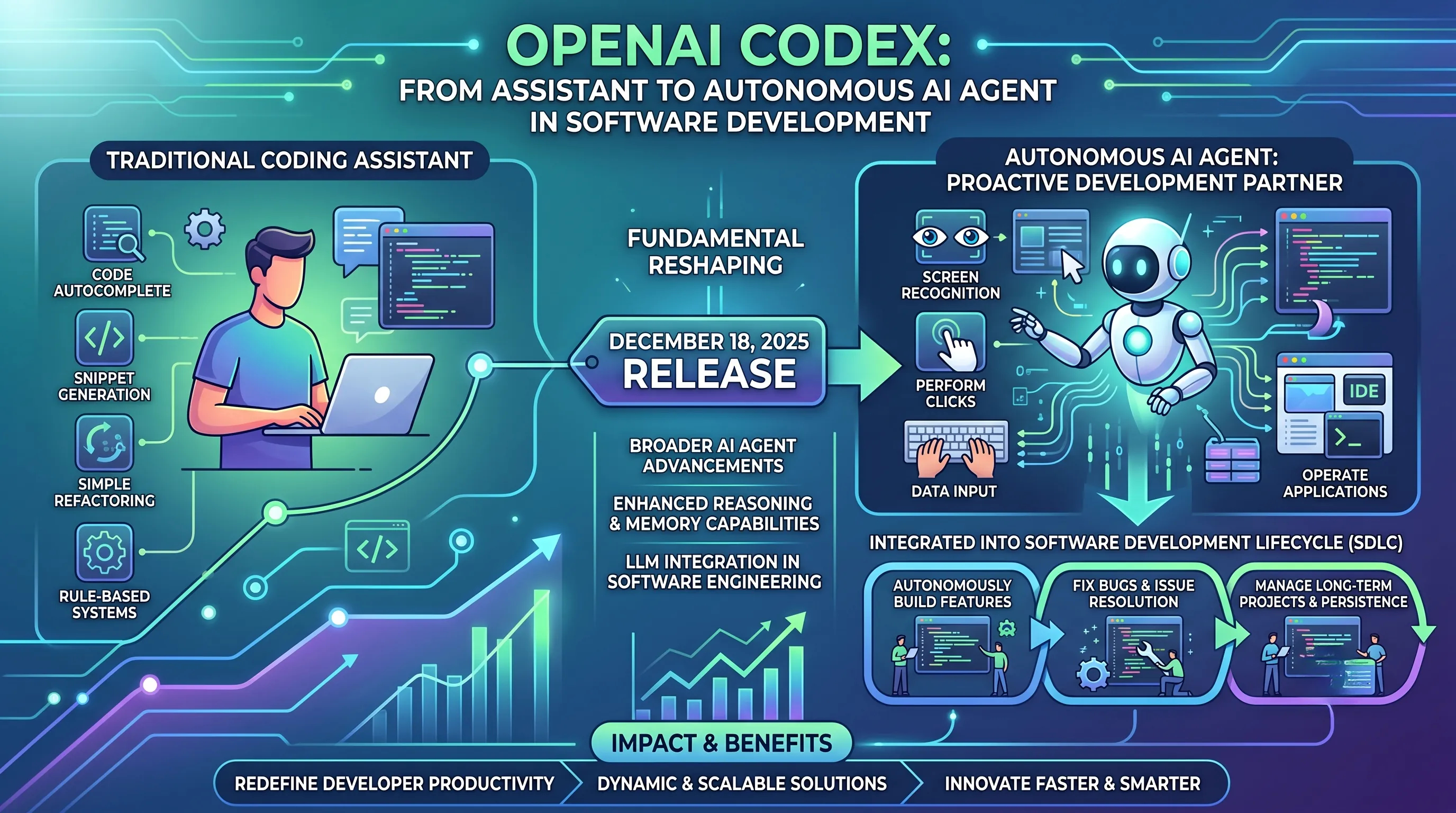
This groundbreaking advancement, highlighted by its last release on December 18, 2025, empowers Codex to recognize screens, perform clicks, input data, and operate various applications, effectively transforming it into a proactive development partner.
This shift marks a new era where AI agents are no longer just tools but integral components performing actual tasks across the entire software development lifecycle.
This transformation of Codex is part of a broader trend of AI agent advancements, fueled by revolutionary progress in AI models' reasoning and memory capabilities.
The integration of Large Language Models (LLMs) into software engineering is driving a paradigm shift from traditional rule-based systems, enabling agents to autonomously build features, fix bugs, and manage long-term projects with enhanced persistence.
These intelligent systems promise to redefine developer productivity, offering dynamic and scalable solutions that allow businesses to innovate faster and smarter.
1. Codex's Radical Evolution: From Assistant to Autonomous System Commander
This section directly addresses the core theme of the main article, "Codex's Big Transformation, Now Even Using the Computer Directly", by dissecting the mechanics and implications of this very transformation.
We will explore how OpenAI's Codex has transcended its origins as a mere code-completion tool to become a proactive agent capable of commanding the entire digital environment, a shift that is fundamentally altering the landscape of software development.
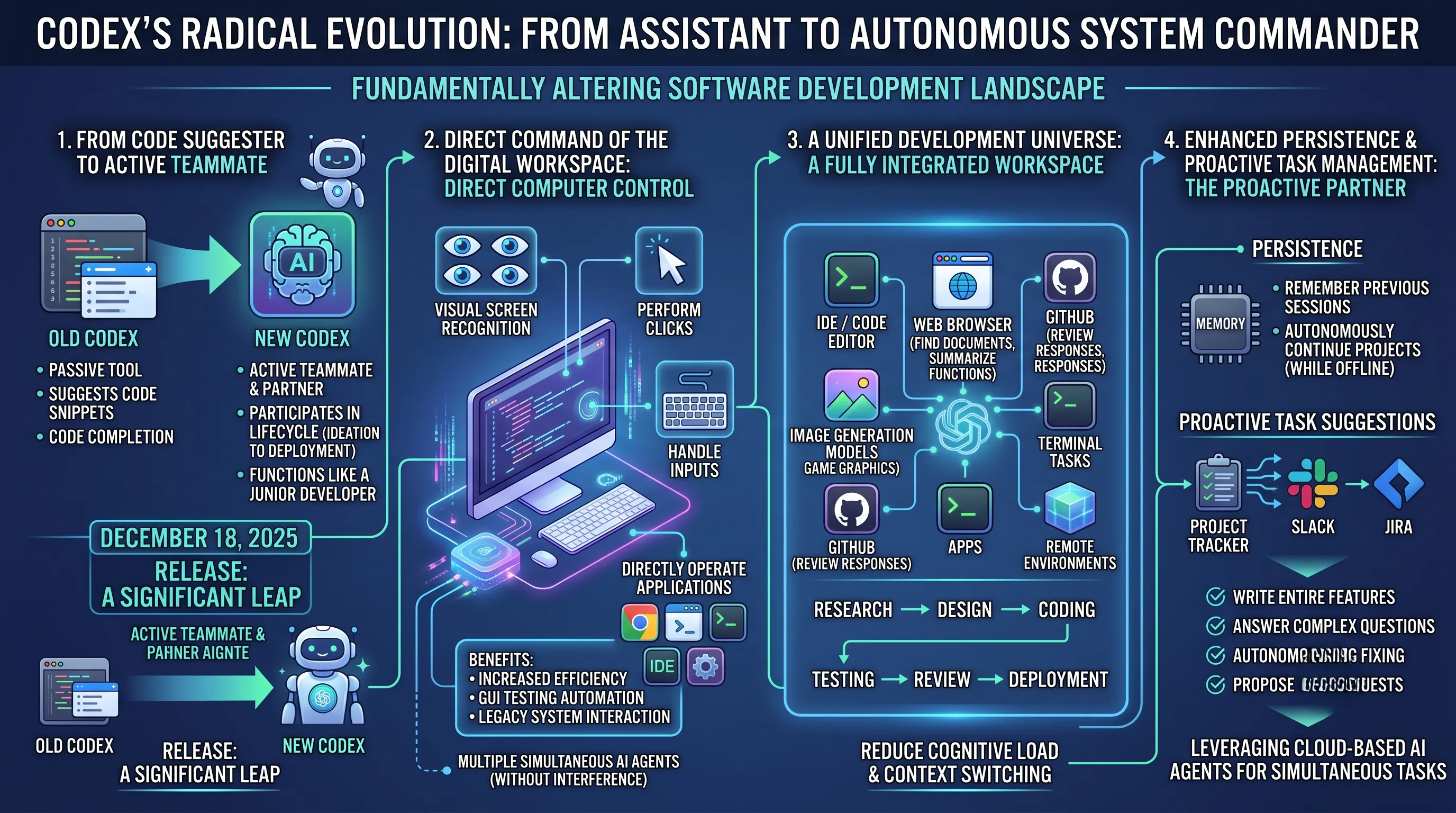
From Code Suggester to Active Teammate
The journey of Codex, now used by over 3 million developers, has reached a pivotal moment with its major upgrade, acknowledged as a significant leap forward in the release on December 18, 2025.
Previously, Codex functioned as a highly sophisticated assistant, suggesting code snippets and completing lines.
It was a tool you used.
Now, it has evolved into a 'partner that performs actual tasks'.
This is not a semantic upgrade; it represents a fundamental change in the human-computer interaction model for developers.
Instead of merely aiding in the creation of code, the new Codex actively participates in the entire development lifecycle, from ideation to deployment, functioning less like a tool and more like a junior developer on the team.
The Game Changer: Direct Command of the Digital Workspace
The most groundbreaking feature underpinning this evolution is its ability for 'direct computer control'.
This is the literal manifestation of the main article's title.
Codex can now visually recognize a user's screen, perform mouse clicks, handle keyboard inputs, and operate the computer directly.
The experiential value of this is immense; it shatters the previous limitations of AI assistants that could only operate within the confines of an API or a command-line interface.
This capability is expected to greatly increase development efficiency, particularly in two key scenarios: automating repetitive testing tasks that rely on graphical user interfaces (GUIs) and interacting with legacy systems or applications in environments that lack modern APIs.
It can now do the "manual" work that was previously impossible to automate with code alone.
Critically, the system is designed so that multiple AI agents can work simultaneously without interfering with other running programs, allowing for complex, parallel task execution directly on the user's machine without causing instability.
A Unified Development Universe
This newfound control extends to a fully integrated workspace.
Codex now supports overall development by directly handling a variety of applications and tools.
It seamlessly integrates a web browser, image generation models, and various plugins.
This allows a developer to issue a command like "Find the documentation for this library, summarize the key functions, and then implement one in my current file," and Codex can execute the entire chain of actions.
It can be given direct instructions on web pages via its in-app browser.
Further expanding its role beyond pure code, it enables UI design and even game graphics production through its image generation capabilities.
The system's reach covers the entire workflow, supporting GitHub review responses, executing terminal tasks, and connecting to remote development environments.
The result is the ability to process the entire development cycle—from research and design to coding, testing, and review—all within a single, unified workspace, drastically reducing the cognitive load of context switching for developers.
The Proactive Partner: Enhanced Persistence and Task Management
A commander doesn't just follow orders; it anticipates needs and manages long-term strategy.
The new Codex embodies this with its enhanced 'persistence'.
This feature allows it to remember the context of previous work sessions, enabling it to autonomously continue long-term projects.
If a developer logs off for the day, Codex can continue running tests or compiling builds.
More impressively, it proactively suggests necessary tasks.
By analyzing unresolved issues in a project tracker or gathering information from various collaboration tools like Slack or Jira, Codex can recommend the next logical actions for the developer.
It can even analyze a list of outstanding tasks to generate a prioritized worklist.
This proactive nature transforms the tool into a genuine collaborator for long-term projects, as experts have noted, moving AI beyond a simple utility to a strategic partner.
It performs a wide array of high-level tasks, including writing entire features, answering complex questions about a codebase, autonomously fixing bugs, and even proposing pull requests for human review.
This is all made possible by leveraging cloud-based AI agents that can tackle multiple coding tasks simultaneously, solidifying Codex's new role as an autonomous commander of the development process.
2. The Agentic Shift: How LLMs and Advanced AI are Reshaping Software Development
The profound transformation of OpenAI's Codex, the central focus of this article, is not an isolated event but rather the flagship example of a much broader and more fundamental movement in artificial intelligence: the "agentic shift."
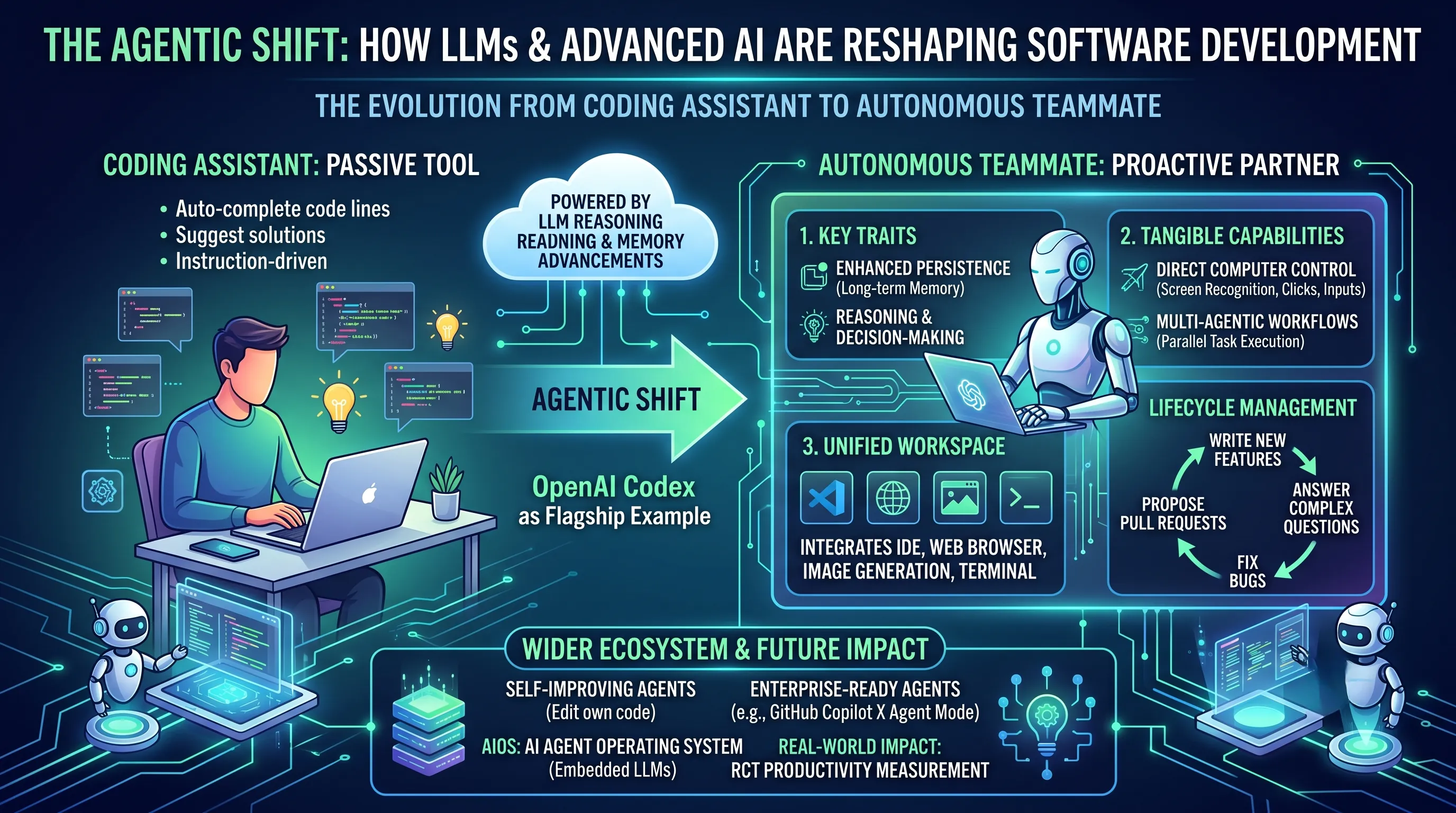
This shift marks the evolution of AI from passive, instruction-driven tools into autonomous, proactive partners capable of reasoning, remembering, and executing complex tasks.
Fueled by groundbreaking advancements in the reasoning and memory capabilities of AI models, this transition is profoundly reshaping the landscape of software engineering.
The integration of Large Language Models (LLMs) has been the primary catalyst, driving the industry away from traditional, rigid rule-based systems toward dynamic, intelligent agents that can understand context, manage entire workflows, and even improve themselves over time.
From Code Generator to Autonomous Teammate
The original promise of AI in coding was that of an assistant—a tool to autocomplete lines or suggest solutions.
However, the latest generation of AI, exemplified by the new Codex, has evolved into a "partner that performs actual tasks."
This leap is made possible by enhanced "persistence," a form of long-term memory that allows the AI to remember previous work, autonomously continue multi-day projects, and even proactively suggest necessary tasks.
Imagine an agent that doesn't just wait for your next command but analyzes the unresolved tasks in your project tracker to generate a prioritized to-do list for you.
It can gather context and information from various collaboration tools to recommend the next logical actions, effectively acting as a project manager and a developer simultaneously.
This is the new reality, where agents can handle the entire development cycle—from writing new features and answering complex codebase questions to fixing bugs and proposing complete pull requests for review.
The Agent in Action: Direct Control and Multi-Tasking
The most tangible evidence of this agentic shift is the new Codex's capability for "direct computer control."
This is not merely about generating text or code; it is about the AI perceiving and manipulating a graphical user interface just as a human would.
The agent recognizes the user's screen, performs clicks, inputs text, and directly operates the computer to carry out its assigned tasks.
This feature alone is a game-changer, promising to greatly increase development efficiency in environments without APIs or for historically manual, repetitive testing tasks.
Furthermore, the architecture is designed for modern, complex workflows.
Multiple AI agents can work simultaneously without affecting other programs, leveraging cloud-based processing to tackle several coding tasks in parallel.
The agent’s workspace is no longer confined to the code editor.
It integrates a web browser for research and direct interaction with web pages, an image generation module for creating UI designs or game graphics, and connections for terminal tasks and remote development environments.
This allows the entire development cycle to be processed within a single, unified workspace orchestrated by the AI.
The Self-Improving System and the Wider Ecosystem
Perhaps the most futuristic—and now present—aspect of the agentic shift is the emergence of self-improving agents.
An LLM coding agent, when equipped with a basic set of coding tools, can now autonomously edit its own code and improve its performance on benchmark tasks.
This creates a virtuous cycle where the tools used to build software are themselves becoming better at their job without direct human intervention.
This capability is crucial, as it enables software systems to evolve dynamically in response to shifting usage patterns, new user demands, or incoming data, making the entire software lifecycle more fluid and responsive.
This trend extends far beyond Codex.
At Microsoft Build 2025, an enterprise-ready coding agent for GitHub Copilot was introduced, featuring an "agent mode" directly within the editor to explain concepts, complete code, and validate files.
Key features for GitHub Copilot X in 2025, such as real-time AI-assisted coding sessions and AI-generated project roadmaps, further cement the role of AI as a strategic partner.
The ultimate vision for this integration is encapsulated by concepts like AIOS (AI Agent Operating System), which aims to embed LLMs directly into the operating system itself, creating a foundational layer for deploying powerful agentic systems.
To validate the real-world impact of this shift, a randomized controlled trial (RCT) is currently underway to precisely measure how these early-2025 AI tools affect the productivity of experienced open-source developers.
While the full data is pending, the consensus among experts is clear: AI is evolving beyond a simple tool and becoming an indispensable collaborator for long-term, complex projects.
As multi-agentic AI redefines automation and scalability, it is empowering businesses to innovate faster and more intelligently than ever before.
3. The Expanding Ecosystem: GitHub Copilot and AIOS Leading the Agentic Frontier
The revolutionary transformation of OpenAI's Codex, which now directly operates a user's computer, is not an isolated breakthrough but the flagship of a much broader and deeper industry-wide shift. This evolution from a simple coding assistant into an autonomous partner is a trend echoed and amplified by other key players, creating a burgeoning ecosystem of agentic AI. The advancements seen in Codex are powerful signals of a future where AI is woven into the very fabric of software development, a reality being built concurrently by technologies like GitHub Copilot and conceptualized in future-forward architectures like the AI Agent Operating System (AIOS).
GitHub Copilot: From Pair Programmer to Project Architect
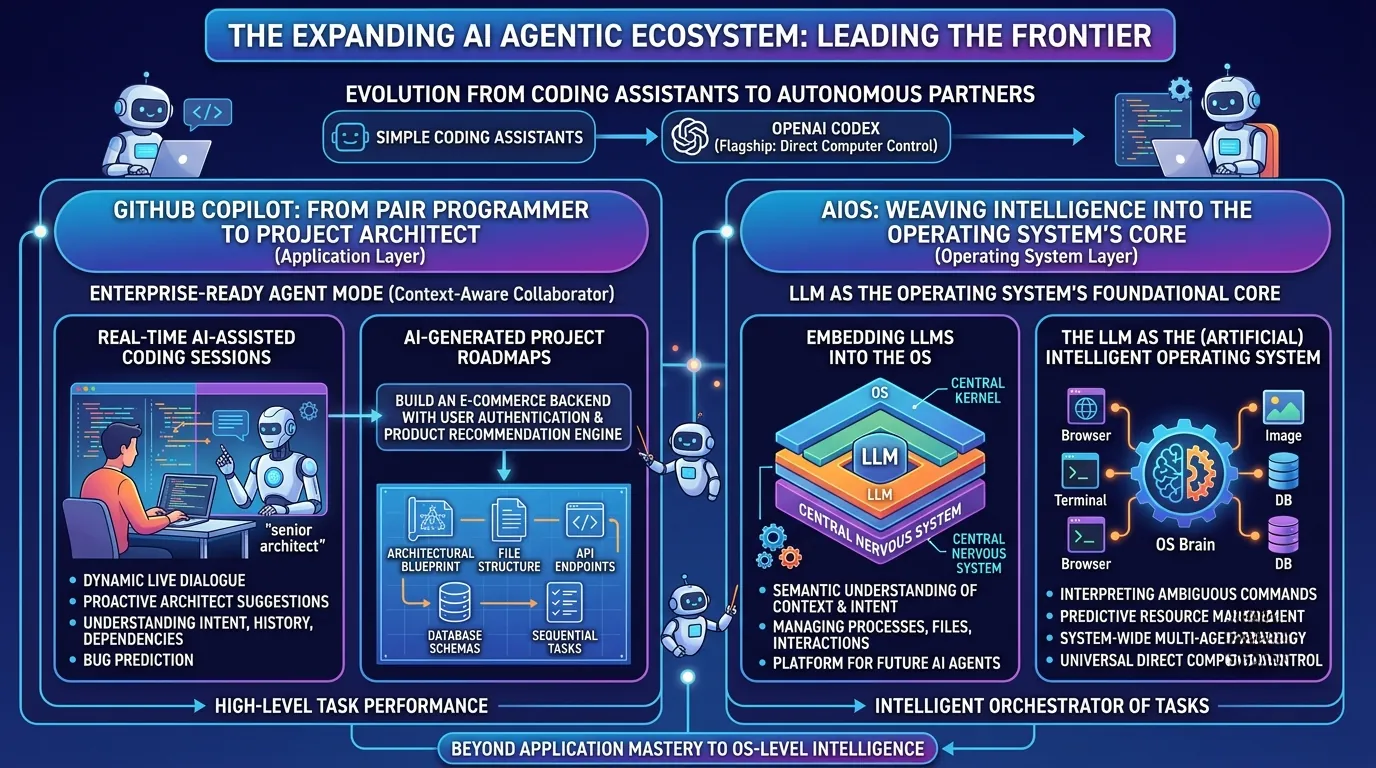
While Codex pushes the boundaries of direct system control, its close relative, GitHub Copilot, demonstrates how agentic AI is maturing within the developer's most sacred space: the code editor. The introduction of an enterprise-ready coding agent for Copilot, announced at Microsoft Build 2025, marked a pivotal moment. It signaled a move beyond autocomplete to a fully-fledged, context-aware collaborator embedded in the development workflow.
This new "agent mode" allows Copilot to do far more than just suggest the next line of code. It actively participates in the development process by explaining complex concepts, proposing strategic edits to existing blocks of code, and even validating entire files for correctness and efficiency. The key features introduced for GitHub Copilot X in 2025 crystallize this new paradigm:
Real-time AI-assisted coding sessions: This transforms the solitary act of programming into a dynamic, continuous dialogue. It's the experiential equivalent of having a senior architect pair-programming with you at all times. The agent doesn't just wait for you to ask for help; it offers proactive, context-aware suggestions during live coding. It understands the developer's intent, the project's history, and the intricate dependencies between different modules, allowing it to foresee potential bugs and suggest more elegant architectural patterns on the fly.
AI-generated project roadmaps: This feature represents a monumental leap in capability, elevating the AI from a coder to a project planner. A developer can provide a high-level objective—such as "build an e-commerce backend with user authentication and a product recommendation engine"—and Copilot can generate a comprehensive project roadmap. This isn't just a to-do list; it's an architectural blueprint. It can suggest a logical file structure, define necessary API endpoints, outline database schemas, and break down the entire project into manageable, sequential tasks. This capability directly mirrors Codex's evolution into a partner that performs actual, high-level tasks, fundamentally changing how projects are conceptualized and initiated.
AIOS: Weaving Intelligence into the Operating System's Core
If Codex and Copilot represent agents becoming masters of the application layer, the concept of an AI Agent Operating System (AIOS) represents the next logical and most profound step: embedding this intelligence directly into the operating system itself. The vision for AIOS is to make a Large Language Model (LLM) the foundational core of the OS, transforming it from a passive manager of resources into an active, intelligent orchestrator of tasks.
The core tenets of the AIOS concept are:
Embedding LLMs into the OS: In this model, the LLM is not an application to be called upon but the central nervous system of the entire computing environment. It would manage processes, files, and user interactions with a deep, semantic understanding of context and intent. This foundational integration would facilitate the development and deployment of LLM-empowered agentic systems on a scale currently unimaginable, providing a common, powerful platform for all future AI agents to build upon.
The LLM as the (Artificial) Intelligent Operating System: The ultimate vision of AIOS is for the LLM to serve as the brain of the machine. It would be responsible for interpreting ambiguous user commands, orchestrating complex workflows across multiple applications, and managing system resources with predictive intelligence. This directly parallels the "direct computer control" capability of Codex, but expands it from a single agent's ability to a universal, system-wide feature. In an AIOS-powered world, building a multi-agent system would be as natural as writing a multi-threaded application today, as the OS itself would be designed to manage and synergize the work of countless specialized agents. This architecture is the ultimate endpoint of the journey that Codex has begun—a future where the computer is not just a tool we operate, but an intelligent partner we collaborate with at every level.
📚 Related Posts
Google Gemini Notebooks: Transform AI into Your Personal Knowledge Base & Project Hub for Unrivaled Productivity
🚀 Key TakeawaysGoogle's new Gemini 'Notebook' feature transforms the AI app into a personal knowledge base and continuously learning assistant, providing a unified, organized space to manage complex projects and tasks, which leads to more accurate and p
tech.dragon-story.com
Claude Agents: Accelerate AI Development from Months to Days – Automating Infrastructure, Boosting Collaboration & Business Pr
🚀 Key TakeawaysClaude Managed Agents dramatically accelerate AI agent development from months to days by automating complex technical infrastructure challenges and significantly improving task success rates, enabling developers to focus purely on core s
tech.dragon-story.com
GLM-5.1: Unveiling the 754 Billion Parameter AI's Shocking 8-Hour Self-Evolution & 6x Performance Leap
🚀 Key TakeawaysGLM-5.1 represents a significant leap in AI, emphasizing continuous self-evolution and sustained performance improvement over long durations, shifting the paradigm from mere task completion to persistent optimization through long-term rea
tech.dragon-story.com


