🚀 Key Takeaways
- Claude Code revolutionizes the development workflow by enabling parallel AI tasks, fundamentally shifting the developer's role to an AI orchestrator.
- The platform offers an integrated and highly customizable development environment with features like a new sidebar, in-app terminal, and flexible workspace configuration.
- Powered by advanced models like Claude 3 Opus and Claude Opus 4.7, it delivers superior performance in complex coding, vision, and multi-step tasks, with significantly improved autonomy.
- Claude Code is becoming a go-to alternative for complex autonomous tasks and rapid prototyping, while still requiring developer discernment for basic coding challenges.
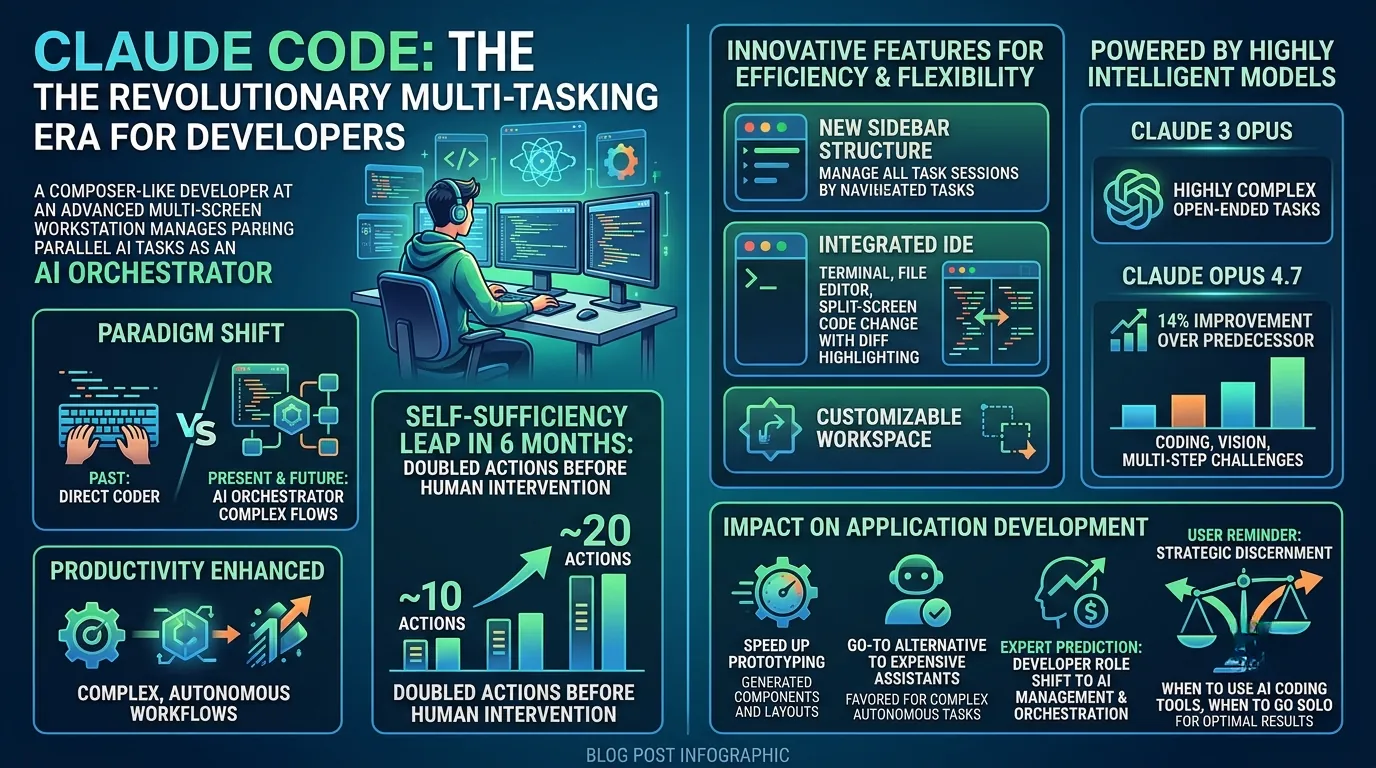
Claude Code is ushering in a revolutionary multi-tasking era for developers, fundamentally shifting the paradigm of application development. Its primary goal is to enable parallel AI tasks, thereby transforming the developer's role from direct coders into sophisticated AI orchestrators. This advanced platform significantly enhances productivity by allowing AI to handle more complex, autonomous workflows; just six months ago, Claude Code completed around 10 actions before human intervention, a figure that has now doubled to approximately 20 actions, marking a significant leap in its self-sufficiency.
Central to this transformation are Claude Code's innovative features, designed for maximum efficiency and flexibility. Developers now benefit from a new sidebar structure that adeptly manages all ongoing task sessions in one place, an integrated development environment complete with a terminal, file editor, and robust code change comparison features, and a customizable workspace enabled by intuitive drag-and-drop functionality. Powering these capabilities are highly intelligent models like Claude 3 Opus, renowned for its market-leading performance in highly complex and open-ended tasks, and the even more refined Claude Opus 4.7, which demonstrates a 14% improvement over its predecessor with stronger performance across coding, vision, and intricate multi-step challenges.
This comprehensive suite not only transforms the application development workflow but also speeds up prototyping by generating components and layouts with unprecedented ease. It has quickly become a 'go-to alternative to expensive coding assistants,' favored by many respected developers who leverage it for complex autonomous tasks while often using other tools for daily coding. While experts predict developer roles will increasingly shift from direct coding to AI management and orchestration, users are still reminded of the importance of discernment in knowing 'when to use AI coding tools, when to go solo' for optimal results.
1. Unleashing Parallel Power: Claude Code's Advanced AI & Autonomous Edge
The central promise of the main topic, "Claude Code, Ushering in the Era of Multi-Tasking," is realized not through simple interface tweaks, but through a profound enhancement of the underlying AI's cognitive and autonomous capabilities.
This section delves into the engine driving this new era: a combination of bleeding-edge AI models and a quantifiable leap in autonomous action, which together enable the parallel processing paradigm that redefines the developer's role.
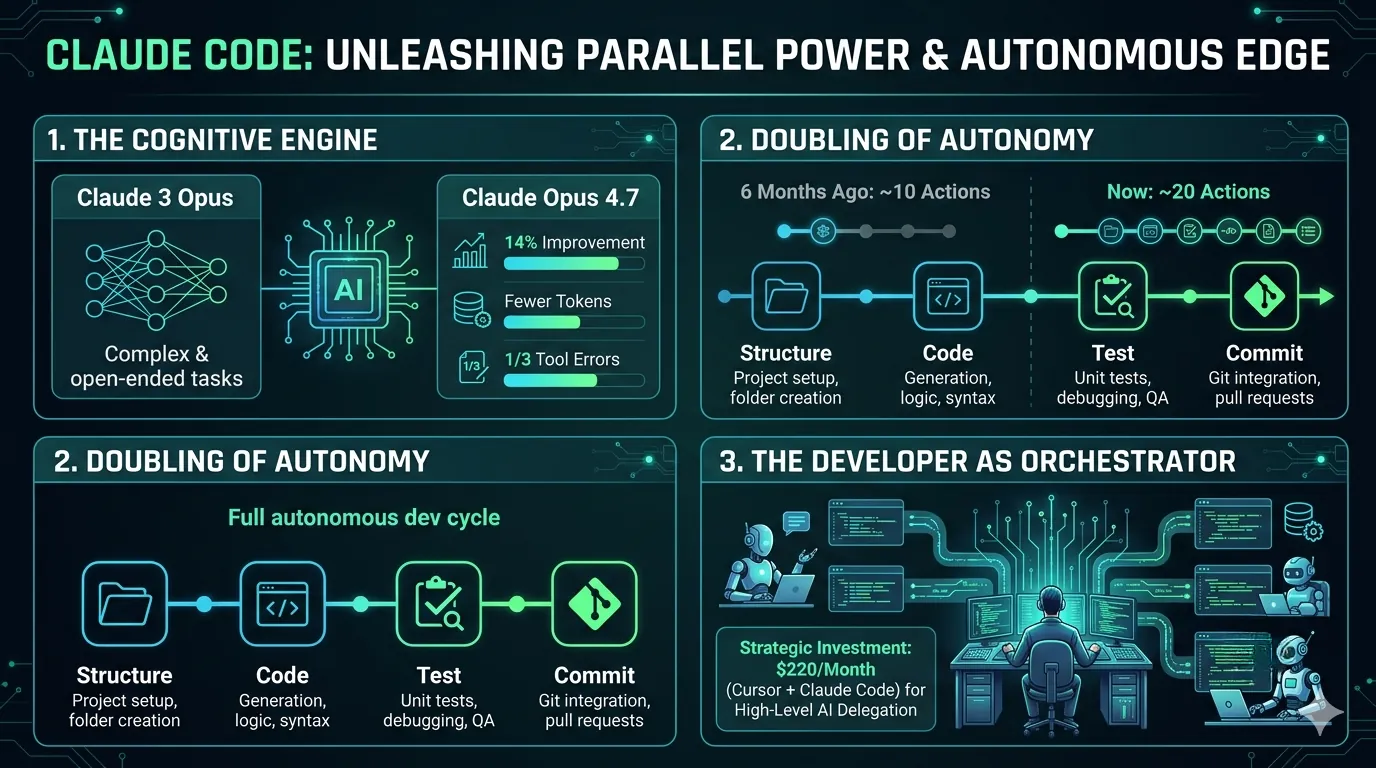
The Cognitive Engine: The Superiority of Claude 3 Opus and Opus 4.7
At its core, Claude Code's ability to manage parallel tasks stems directly from the raw intellectual horsepower of its foundation model, Claude 3 Opus.
Described as the "most intelligent model" with "best-in-market performance for highly complex tasks," Opus is the key that unlocks true parallel workflows.
It possesses the crucial ability to navigate "open-ended prompts," which is a world away from simple, single-command code completion.
For a developer, this means they can assign a vague, high-level objective like "Refactor the user authentication service for better scalability" to one AI agent, while another agent works on a concrete task like "Write unit tests for the new payment gateway." Opus provides the reasoning power to break down that ambiguous goal into a coherent series of steps, a prerequisite for any meaningful autonomous work.
This powerful foundation has been significantly refined with the introduction of Claude Opus 4.7.
This isn't a minor update; it's a targeted upgrade that directly enhances the reliability of parallel operations.
The model boasts a "14% improvement over Opus 4.6," a metric that translates into more efficient and dependable autonomous agents.
It achieves this with "fewer tokens," meaning faster processing and lower computational overhead—critical when running multiple tasks at once.
Even more importantly, it commits "one-third tool errors." Experientially, this is a massive leap for a developer acting as an orchestrator.
It means fewer stalled tasks, less time spent debugging the AI's process, and a higher degree of trust that a complex, multi-step job will run to completion without constant human intervention.
Its "stronger performance across coding, vision, and complex multi-step tasks" confirms its specialization in the exact kind of diverse, sophisticated work that defines the new multi-tasking development environment.
A Doubling of Autonomy: From Assistant to Agent
The theoretical power of these models is made practical through a tangible increase in operational endurance.
The data shows a clear evolution: "Six months ago, Claude Code completed ~10 actions before human input; now, generally handles ~20 actions."
This doubling is not merely an incremental improvement; it represents a phase shift in capability.
Ten actions might be enough to scaffold a file or complete a single function.
However, a sequence of ~20 actions is substantial enough to represent an entire development cycle for a small feature: creating the file structure, writing the boilerplate code, implementing the core logic, generating corresponding tests, and even committing the changes.
This extended autonomy is the mechanism that makes parallel work feasible.
A developer can now confidently delegate a 20-step task, knowing it has a high probability of success, freeing their cognitive load to define and launch the next parallel task.
This transforms the AI from a simple coding assistant you consult into a genuine software agent you delegate to.
The Orchestrator's Investment: Redefining Value
This shift from hands-on coding to high-level orchestration is the ultimate fulfillment of Claude Code's primary goal: to "Enable parallel AI tasks, shifting developers to an 'orchestrator' role."
This new paradigm, however, comes with a professional-grade price tag that reflects its power.
For many serious developers, the effective workflow involves using both Cursor for moment-to-moment coding and Claude Code for these larger autonomous jobs, bringing the combined cost to $220/month.
This price point positions the toolset not as a casual utility but as a strategic investment in productivity.
When a single developer's time is valued in the hundreds of dollars per hour, a $220 monthly fee that enables them to supervise multiple complex development threads simultaneously offers an undeniable return on investment, cementing Claude Code's place as a tool for the new era of AI-driven, parallel software development.
2. Redefining Development: Integrated Features for Seamless Multi-Tasking
The promise of an AI-driven, multi-tasking development era, as heralded by our main topic "Claude Code, Opening the Era of Multi-Tasking", is not merely an abstract concept; it is a tangible reality forged through a completely overhauled user interface and feature set. Claude Code's latest iteration moves beyond being a simple chat-based assistant and becomes a comprehensive command center. Its primary goal is to enable parallel AI tasks, fundamentally shifting the developer's role from a hands-on coder to a high-level 'orchestrator' who directs multiple AI agents simultaneously. This section delves into the specific architectural choices and features that make this new paradigm possible.
The Command Center: A Revolutionary Sidebar Structure
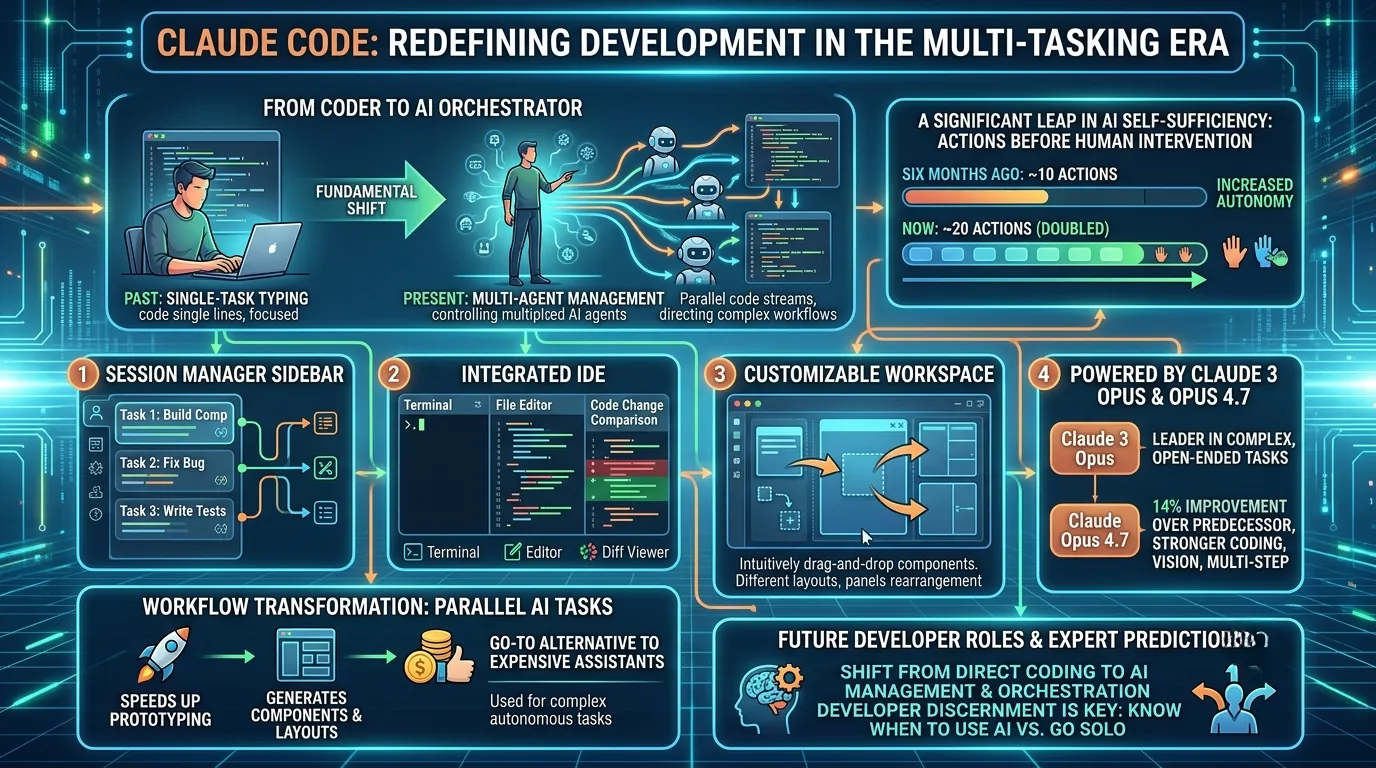
At the heart of Claude Code's multi-tasking prowess is its new sidebar structure. This is not just a cosmetic update; it is the central nervous system for managing concurrent development workflows.
In previous development models, a programmer might work on a bug fix, then context-switch to write a new feature, and then switch again to draft unit tests. Each task required a significant mental reset. The new sidebar obliterates this fragmented process. It allows a developer to manage all ongoing task sessions in a single, persistent view.
The experiential value is profound. A developer can now initiate a complex code modification in one repository, kick off a bug-fixing process in a second, and simultaneously have Claude Code write a full suite of tests for a third project. Each of these "sessions" exists as a distinct, manageable item in the sidebar. There is no need to juggle different windows, terminals, or mental states. The developer, acting as an orchestrator, can monitor progress, provide input, and direct each task from this unified dashboard. Furthermore, the system intelligently cleans up completed tasks, reducing clutter and allowing the developer to maintain focus on active work streams. This is the literal interface for the multi-tasking era.
A Self-Contained Universe: The Integrated Development Environment
Effective multi-tasking is impossible amidst constant disruption. A key barrier to seamless workflow has always been the dependency on external tools. To address this, Claude Code now incorporates an integrated development environment (IDE) directly within the application.
This built-in suite includes a terminal, a file editor, and robust code change comparison features (diff views). The impact on productivity cannot be overstated. Instead of writing a prompt in Claude Code, then tabbing to an external terminal to run a command, then switching to a separate VS Code window to view the file change, and finally using another tool to see the diff—all these actions now happen within the same pane of glass.
This integration drastically reduces the cognitive load associated with context switching, keeping the developer in a state of flow. When you are orchestrating multiple complex AI tasks, this saved mental energy is critical. It allows the developer to dedicate their full attention to the high-level strategy of the tasks at hand, rather than the low-level mechanics of tool-juggling. It transforms the application from a "coding assistant" you consult into a "workbench" where you operate.
Personalized Orchestration: The Customizable Workspace
Claude Code recognizes that every developer and every multi-tasking scenario is unique. A rigid interface would hinder, not help, the complex orchestration it aims to facilitate. To solve this, the platform introduces a fully customizable workspace with drag-and-drop functionality.
This allows developers to freely configure their work screen to match their specific needs. For instance, a developer might be debugging a frontend issue that requires them to see the terminal output, the affected React component file, and the AI chat session all at once. They can now simply drag and arrange these elements into a layout that provides maximum clarity for that specific task. For another parallel task involving backend API development, they might prioritize a different layout. This level of personalization is a force multiplier for efficiency, empowering developers to build their own perfect cockpit for orchestrating complex, parallel operations.
The Engine and Its Extended Reach: Evolved Platform and AI Core
The sophisticated interface is powered by an increasingly autonomous AI core. A mere six months ago, Claude Code could complete approximately 10 actions before requiring human input. Now, it generally handles around 20 actions, effectively doubling its operational stamina for any given task. This is the power that allows a developer to confidently delegate a complex sequence of operations and turn their attention to another parallel task. This autonomy is fueled by models like Claude 3 Opus, which excels at highly complex tasks, and the newer Claude Opus 4.7, which demonstrates a 14% improvement over its predecessor with stronger performance in coding and complex multi-step tasks, all while making one-third fewer tool errors.
The platform's capabilities are also extended through what can be called an evolved AI collaboration platform. With full SSH support, a developer can seamlessly manage and orchestrate tasks on a remote server directly from the Claude Code interface, placing remote and local workflows on equal footing. Compatibility with plugins and various view modes further enhances this flexibility, ensuring the tool can adapt to a developer's established work style rather than forcing them into a new one. This combination of a more powerful AI engine and a more flexible, connected platform solidifies Claude Code's position not just as a tool, but as a comprehensive environment for orchestrating the future of software development.
3. Orchestrating the Future: Impact, Adoption, and the Evolving Developer Workflow
The emergence of Claude Code directly serves the overarching theme of a new multi-tasking era by fundamentally restructuring the developer's role from a hands-on coder to a high-level AI orchestrator.
This section analyzes how its architecture facilitates this shift, examines the real-world adoption patterns, and addresses the critical challenges that define the modern developer's evolving workflow.
From Coder to Conductor: A New Development Paradigm
The primary goal of the Claude Code desktop experience is to enable the execution of parallel AI tasks, a design choice that explicitly redefines the developer's function.
This isn't merely about speeding up a single coding task; it's about managing a fleet of AI agents simultaneously.
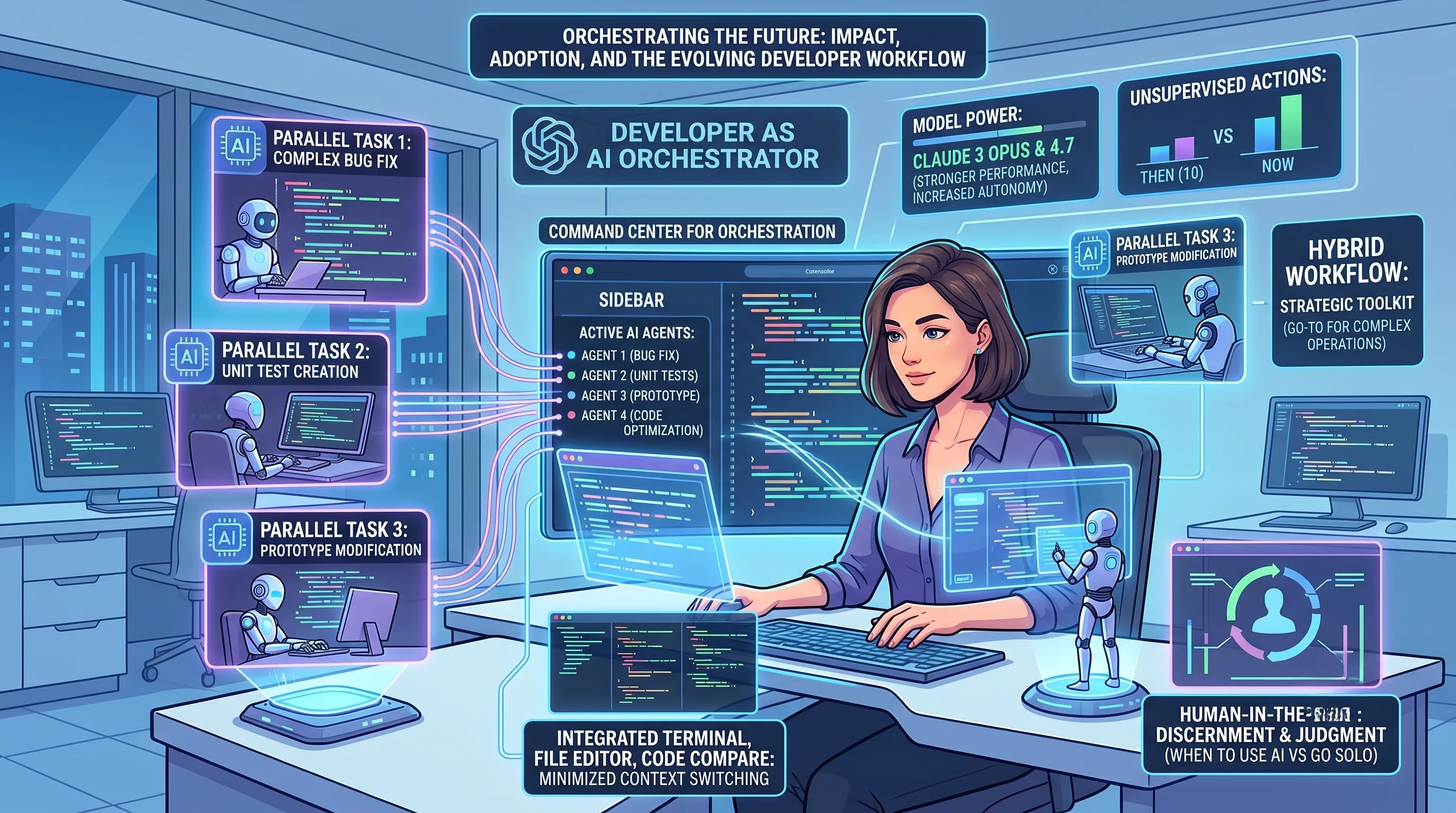
The new sidebar structure is the command center for this operation, allowing a developer to view and manage all ongoing task sessions in one unified interface.
Experientially, this means a developer can initiate a complex bug fix in one repository, delegate the creation of unit tests for a new feature in another, and have a third AI agent modify code for a prototype, all at the same time.
Completed tasks are automatically cleaned up, reducing cognitive clutter and allowing the developer to focus on strategic direction rather than micromanagement.
This workflow is further solidified by the integrated development environment.
By bringing the terminal, file editor, and code change comparison features directly into the application, Claude Code minimizes the context-switching that plagues traditional development.
The developer no longer needs to juggle multiple external tools, keeping their attention focused on orchestrating the AI's output, thus embodying the shift experts predict: a move from direct coding to AI management and orchestration.
The platform’s flexibility, including SSH support for remote work and plugin compatibility, acknowledges that this orchestration must fit into diverse and established developer habits, not force a rigid new one.
Powering the Autonomous Workforce
This new era of multi-tasking is only possible due to the sheer power and increasing autonomy of the underlying models.
The system leverages models like Claude 3 Opus, which is positioned as the most intelligent in the market, capable of navigating the open-ended prompts required for highly complex, multi-step objectives.
The newer Claude Opus 4.7 demonstrates tangible progress, showing a 14% improvement over its predecessor with stronger performance in coding, vision, and complex tasks, all while using fewer tokens and committing one-third fewer tool errors.
This isn't just an incremental update; it translates to more reliable and thorough work on difficult problems, building the trust necessary for a developer to delegate significant tasks.
The evolution of autonomy is a key metric: six months ago, Claude Code could complete roughly 10 actions before needing human intervention.
Now, it generally handles around 20 actions, effectively doubling its unsupervised operational capacity.
This leap makes it a viable tool for ambitious, complex autonomous tasks, such as building entire AI operating systems or conducting in-depth competitive landscape analysis, which were previously impractical to automate.
Adoption Strategy and the Reality of a Hybrid Workflow
The market's reaction reveals a sophisticated adoption pattern.
Many respected developers are not replacing their daily coding assistants but are instead creating a hybrid toolkit.
They continue to use tools like Cursor for routine, daily coding tasks while strategically deploying Claude Code for complex, autonomous operations.
This bifurcated approach highlights a mature understanding of the current AI landscape, where different tools are suited for different jobs.
The financial commitment underscores this strategic choice; a combined cost of $220 per month for both Cursor and Claude Code signifies a deliberate investment in a specialized, high-performance workflow.
This suggests Claude Code is successfully carving out its niche not as a universal replacement, but as a "go-to alternative to expensive coding assistants" for a specific and highly valuable class of problems.
The Human in the Loop: Discernment and Lingering Challenges
Despite these significant advancements, the transition to a fully autonomous development future is not yet complete.
The platform’s own performance on benchmarks like ProgramBench indicates that even with cutting-edge AI, basic coding and the execution of truly complex tasks remain challenging.
This reality check is crucial: the AI is a powerful force multiplier, not a silver bullet.
Consequently, the most critical skill for the modern developer is becoming discernment—the ability to recognize "when to use AI coding tools, and when to go solo."
The role of the orchestrator is not passive; it requires deep technical expertise to set up problems correctly, evaluate the AI's output critically, and intervene when the AI reaches its limitations.
The developer's value is shifting from writing every line of code to architecting the solution and making the high-stakes judgment calls that AI, for all its power, cannot yet make on its own.
📚 Related Posts
Google Gemini Notebooks: Transform AI into Your Personal Knowledge Base & Project Hub for Unrivaled Productivity
🚀 Key TakeawaysGoogle's new Gemini 'Notebook' feature transforms the AI app into a personal knowledge base and continuously learning assistant, providing a unified, organized space to manage complex projects and tasks, which leads to more accurate and p
tech.dragon-story.com
Claude Agents: Accelerate AI Development from Months to Days – Automating Infrastructure, Boosting Collaboration & Business Pr
🚀 Key TakeawaysClaude Managed Agents dramatically accelerate AI agent development from months to days by automating complex technical infrastructure challenges and significantly improving task success rates, enabling developers to focus purely on core s
tech.dragon-story.com
GLM-5.1: Unveiling the 754 Billion Parameter AI's Shocking 8-Hour Self-Evolution & 6x Performance Leap
🚀 Key TakeawaysGLM-5.1 represents a significant leap in AI, emphasizing continuous self-evolution and sustained performance improvement over long durations, shifting the paradigm from mere task completion to persistent optimization through long-term rea
tech.dragon-story.com


