🚀 Key Takeaways
- NVIDIA's Nemotron 3 Nano Omni is a groundbreaking open multimodal AI model designed to eliminate bottlenecks for AI agents by simultaneously understanding video, audio, and text, achieving up to 9 times higher throughput and significantly reducing processing costs and complexity.
- This innovative model, based on a 30B-A3B hybrid Mixture-of-Experts (MoE) structure, offers unparalleled efficiency and accuracy, enabling the development of advanced AI agents capable of real-time analysis for diverse applications like customer support, financial analysis, and sophisticated computer-using agents.
- Released with open weights, datasets, and training methods, Nemotron 3 Nano Omni empowers developers and companies with full customization capabilities, promising to revolutionize the next-generation agent market and expand the entire AI agent ecosystem.
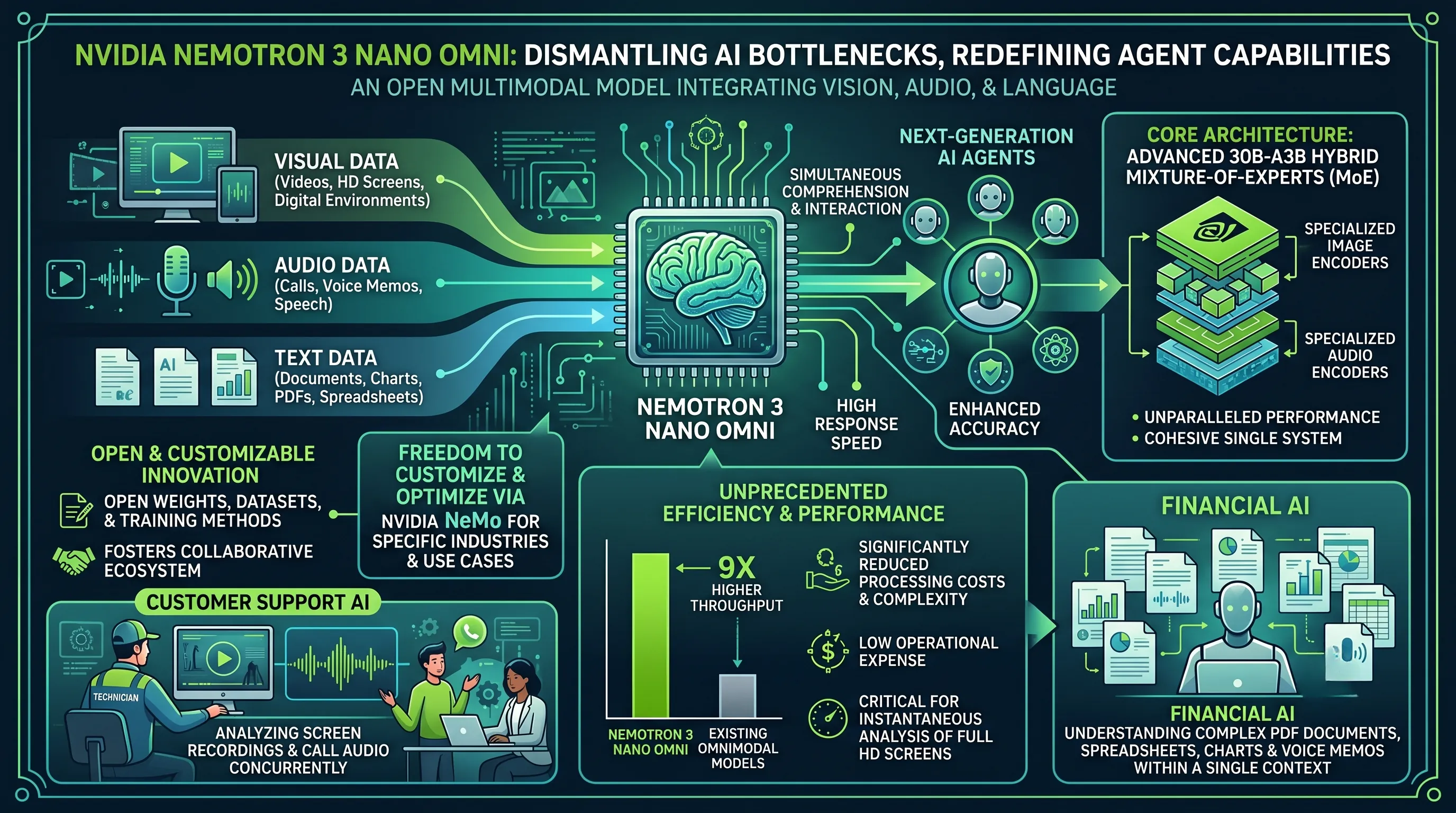
NVIDIA introduces Nemotron 3 Nano Omni, a revolutionary new open multimodal model set to redefine the capabilities of AI agents by dismantling previous bottlenecks in data processing.
This cutting-edge model integrates vision, audio, and language models into a single, cohesive system, allowing AI agents to simultaneously comprehend and interact with video, audio, and text data in real-time.
Such comprehensive understanding significantly enhances the accuracy and response speed of AI agents, making them more versatile and powerful across a multitude of applications.
At its core, Nemotron 3 Nano Omni boasts an advanced 30B-A3B hybrid Mixture-of-Experts (MoE) architecture, integrating specialized image and audio encoders to deliver unparalleled performance.
This innovative design translates into remarkable efficiency, achieving up to 9 times higher throughput compared to existing open omnimodal models, as assessed by NVIDIA.
The result is a substantial reduction in multimodal processing costs and complexity, thereby securing high response speed and accuracy at a much lower operational expense.
This efficiency is critical for developing next-generation computer-using agents that require instantaneous analysis of full HD screens and complex digital environments.
Furthermore, Nemotron 3 Nano Omni is released with open weights, datasets, and training methods, fostering a collaborative environment for innovation.
This open-source approach empowers companies and developers with the freedom to customize and optimize the model via NVIDIA NeMo for specific industries and unique use cases.
From customer support AI analyzing screen recordings and call audio concurrently, to financial AI understanding complex PDF documents, spreadsheets, charts, and voice memos within a single context, Nemotron 3 Nano Omni is poised to expand the AI agent ecosystem and fundamentally change the landscape of the next-generation agent market.
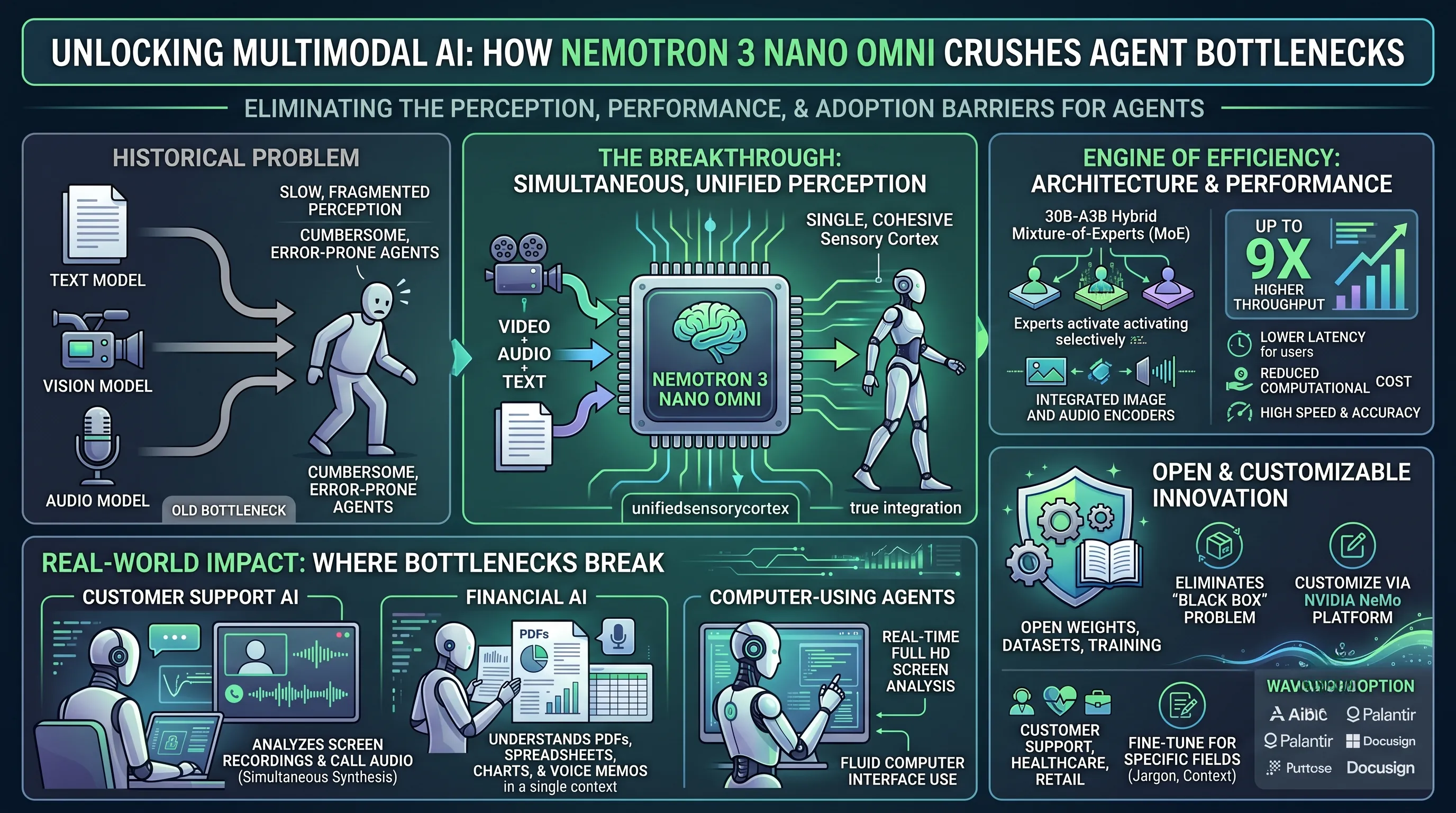
1. Unlocking Multimodal AI: How Nemotron 3 Nano Omni Crushes Agent Bottlenecks
The primary reason AI agents have struggled to feel truly intelligent and responsive is a fundamental processing bottleneck: their inability to perceive and understand the world as humans do, through multiple senses at once.
Historically, an agent would need to use separate, cumbersome models for text, vision, and audio, creating a slow, inefficient, and error-prone chain of command.
This is the precise bottleneck NVIDIA's Nemotron 3 Nano Omni is engineered to shatter, directly contributing to our main topic, "The Bottlenecks of AI Agents are Disappearing," by creating a single, hyper-efficient brain for multimodal understanding.
The Core Breakthrough: Simultaneous, Unified Perception
At its heart, Nemotron 3 Nano Omni is a new open multimodal model designed with a singular, revolutionary purpose: to understand video, audio, and text simultaneously.
This isn't about processing one data type after another in quick succession; it's about true integration.
The model integrates vision, audio, and language models into a single, cohesive system.
For an AI agent, this is the difference between clumsily juggling three separate tools and having a unified sensory cortex.
This architectural choice directly attacks the latency bottleneck, as the time wasted passing data between different specialized models is completely eliminated, enabling faster and more accurate inference from the start.
Architecture and Performance: The Engine of Efficiency
The power behind this unified perception lies in Nemotron 3 Nano Omni's sophisticated architecture.
It is built upon a 30B-A3B hybrid Mixture-of-Experts (MoE) structure.
Think of MoE as an incredibly efficient management system; instead of activating the entire massive model for every single task, it intelligently routes the query to only the most relevant "experts" or parts of the network.
This targeted activation, combined with integrated image and audio encoders, is the key to its stunning performance gains.
According to NVIDIA's own assessments, this design achieves up to 9 times higher throughput compared to existing open omnimodal models.
This isn't just an incremental improvement; it's a paradigm shift.
This massive leap in throughput directly demolishes the cost and speed bottlenecks that have plagued agent development.
Higher throughput means lower latency for the end-user and significantly lower computational cost for the company deploying the agent, securing high response speed and accuracy at a fraction of the previous expense.
Open and Customizable: Eliminating the Adoption Bottleneck
NVIDIA is further accelerating the removal of agent bottlenecks by making Nemotron 3 Nano Omni remarkably accessible.
The model has been released with open weights, datasets, and training methods.
This open-source philosophy empowers companies and developers to freely customize the model for their specific needs, removing the "black box" problem and dependency on a single provider.
Furthermore, it can be optimized for specific industries using the NVIDIA NeMo platform, allowing a business to fine-tune an agent that understands the unique jargon, data formats, and context of its field.
This democratization is already creating a wave of adoption, with companies like Aible, ASI, Eka Care, Foxconn, and Palantir already implementing the technology, while industry giants such as Dell Technologies, Oracle, and Docusign are actively evaluating it.
Real-World Impact: Where the Bottlenecks Break
The practical applications demonstrate how Nemotron 3 Nano Omni obliterates specific, long-standing agent bottlenecks:
- Customer Support AI:
The agent can now analyze a user's screen recording to see a bug while simultaneously listening to the frustration and specific keywords in their call audio. The bottleneck of needing a human to synthesize these two data streams after the fact is gone, leading to instant, context-aware problem-solving. - Financial AI:
An agent can ingest a complex PDF document, cross-reference figures in an attached spreadsheet, interpret a visual chart, and understand a partner's voice memo about market sentiment, all within a single, unified context. This crushes the workflow bottleneck that forced sequential, isolated analysis. - Computer-Using Agents:
This is arguably the most profound impact. The model's efficiency makes real-time, Full HD screen analysis a practical reality. For next-generation agents tasked with using computer interfaces, the bottleneck has always been the immense challenge of understanding a complex, dynamic screen and reacting instantly. Nemotron 3 Nano Omni's ability to process this visual and potential audio data feed in real-time grants agents unprecedented fluidity and responsiveness, as seen in its application by pioneering companies like H Company.
By combining a unified architecture, hyper-efficient MoE design, and an open-source approach, Nemotron 3 Nano Omni doesn't just chip away at the edges of AI agent limitations; it dynamites the very foundation of the multimodal processing bottleneck.
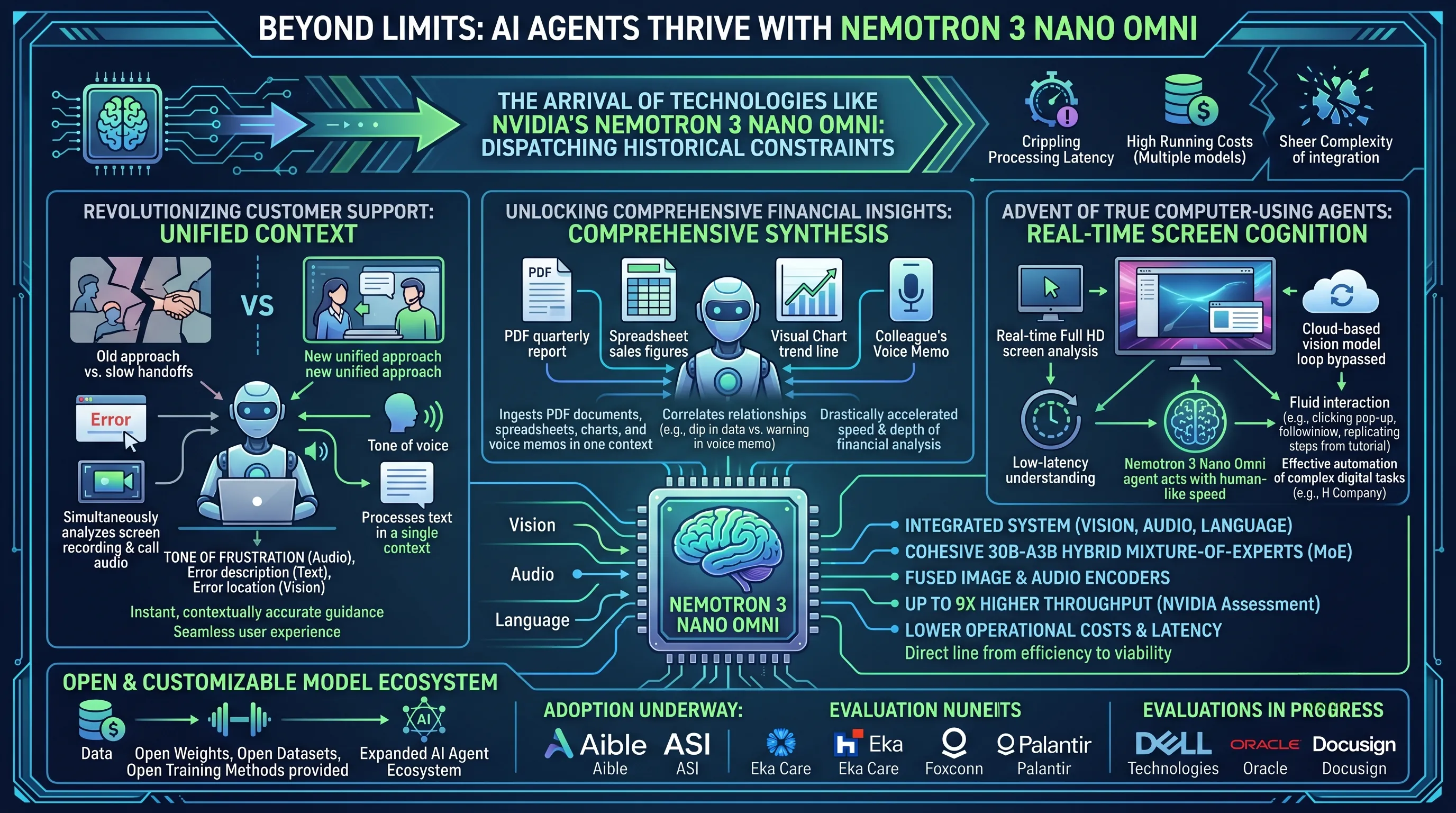
2. Beyond Limits: Real-World AI Agents Thrive with Nemotron 3 Nano Omni
The central theme of "The Bottlenecks of AI Agents are Disappearing" is perfectly encapsulated by the arrival of technologies like NVIDIA's Nemotron 3 Nano Omni.
This new open multimodal model directly attacks the foundational constraints that have historically throttled AI agent development: crippling processing latency, the high cost of running multiple specialized models, and the sheer complexity of making them work together.
Nemotron 3 Nano Omni is not merely an incremental improvement; it represents a paradigm shift by integrating vision, audio, and language understanding into a single, highly efficient system, thereby dissolving the very bottlenecks that made real-time, context-aware agents a distant dream.
The core of this breakthrough lies in its architecture and performance.
By fusing image and audio encoders into a cohesive 30B-A3B hybrid Mixture-of-Experts (MoE) structure, Nemotron 3 Nano Omni avoids the slow and error-prone process of "chaining" separate AIs—one for vision, one for audio, one for text.
This integrated design is the engine behind its remarkable efficiency, achieving what NVIDIA's internal assessments claim is up to 9 times higher throughput compared to existing open omnimodal models.
This isn't just a number; it is the critical difference between an agent that can react to a user's world in real-time and one that is perpetually a step behind, rendering it useless for dynamic tasks.
The result is not only faster and more accurate inference but a direct reduction in operational costs and latency, making sophisticated AI agents economically viable for a wide range of applications.
Revolutionizing Customer Support: The End of Siloed Analysis
Nowhere is the elimination of bottlenecks more apparent than in customer support.
Previously, an AI agent assisting a user with a software problem faced a fragmented reality.
It would need one model to transcribe the user's spoken words, a second to analyze the text for sentiment and intent, and a third, entirely separate vision model to interpret a screen recording of the issue.
This process was slow, computationally expensive, and the constant data handoffs between models created numerous points of failure and misunderstanding.
Nemotron 3 Nano Omni demolishes this siloed approach.
An agent built on this model can perceive the user's experience holistically, simultaneously analyzing the screen recording and the call audio in a single, unified context.
It can understand the user's frustrated tone of voice (audio), read the error message they are pointing to on the screen (vision), and process their verbal description of the problem (text) all at once.
This immediately removes the latency bottleneck, allowing the agent to provide instant, contextually accurate guidance, transforming the user experience from frustrating to seamless.
Unlocking Comprehensive Financial Insights: From Documents to Voice Memos
The financial sector has long been burdened by the bottleneck of disparate data formats.
An analyst might have a quarterly report in a PDF, raw sales figures in a spreadsheet, market trend projections in a chart, and a crucial voice memo from a colleague discussing market sentiment.
Synthesizing these required multiple tools and significant manual effort.
An AI agent powered by Nemotron 3 Nano Omni can ingest all of these formats—PDF documents, spreadsheets, charts, and voice memos—within a single context.
The model doesn't just process each item individually; it understands the relationships between them.
It can correlate a dip in the spreadsheet data with a warning mentioned in the voice memo and a corresponding trend line on the chart, delivering a level of comprehensive analysis that was previously impossible without intensive human intervention.
This capability removes the information-synthesis bottleneck, drastically accelerating the speed and depth of financial analysis.
The Advent of True Computer-Using Agents: Real-Time Screen Cognition
Perhaps the most forward-looking application is the development of next-generation computer-using agents.
Early iterations of these agents were hampered by a debilitating see-think-act loop.
They would capture a screenshot, send it to a cloud-based vision model for analysis, wait for a response, and only then decide on a mouse click or keyboard input.
This latency made them clumsy and unusable for any task requiring fluid interaction.
Nemotron 3 Nano Omni's ability to perform real-time Full HD screen analysis changes the entire landscape.
As demonstrated by its application in companies like 'H Company', agents can now perceive and understand on-screen interfaces with human-like speed.
This low-latency understanding allows an agent to instantly react to a new pop-up window, follow a complex workflow in a custom application, or even watch a video tutorial while simultaneously replicating the steps on the screen.
This real-time cognition is the final piece of the puzzle, removing the performance bottleneck and enabling agents that can truly and effectively automate complex digital tasks.
The industry's rapid response, with adoption by firms like Aible, ASI, Eka Care, Foxconn, and Palantir, and evaluations underway by giants such as Dell Technologies, Oracle, and Docusign, confirms the transformative potential.
By providing its weights, datasets, and training methods as an open model that is freely customizable, NVIDIA is not just releasing a product; it is dismantling the final barriers of cost and accessibility, poised to expand the entire AI agent ecosystem and fulfill the promise of a world where computational bottlenecks no longer constrain intelligent automation.
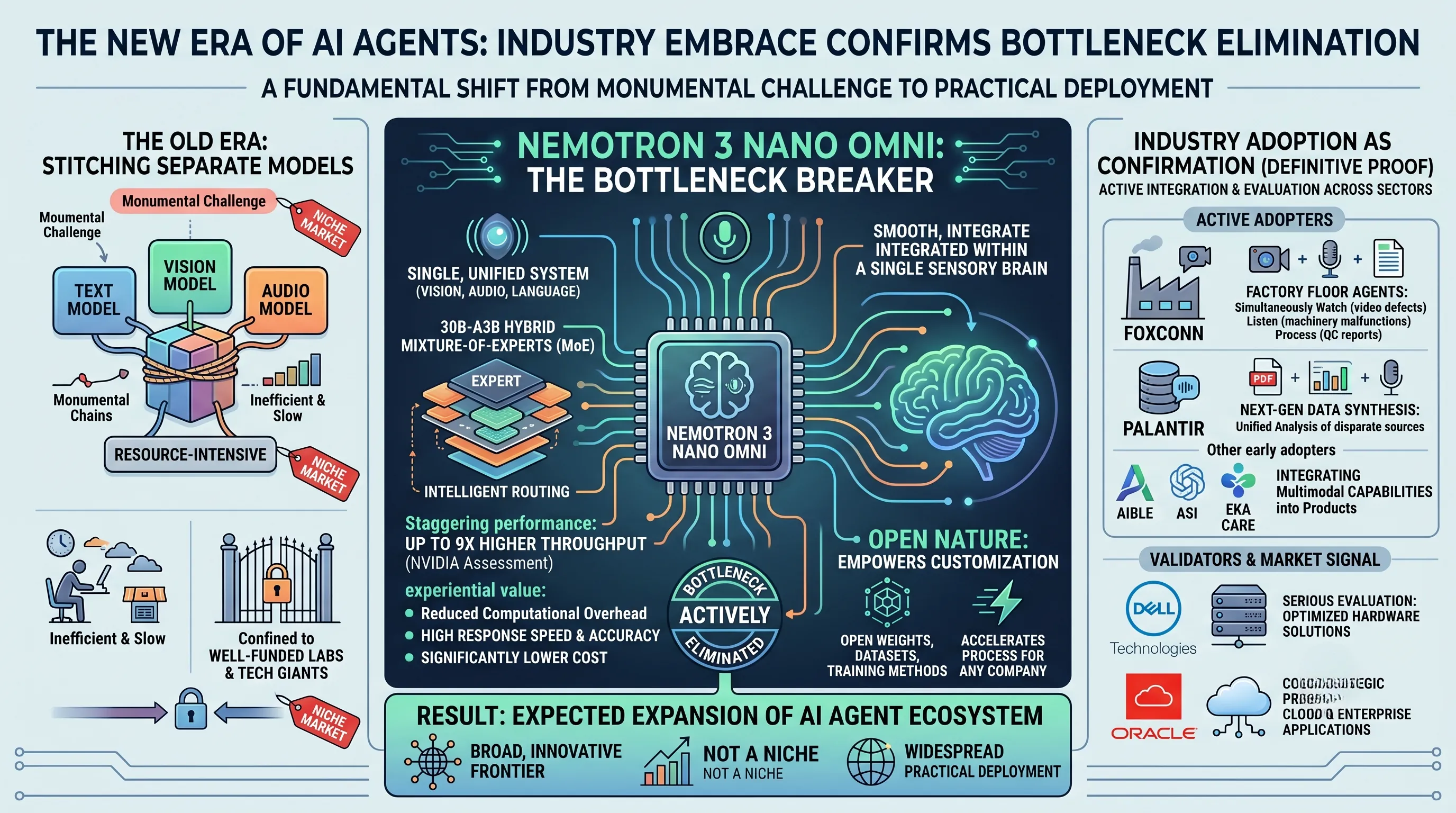
3. The New Era of AI Agents: Industry Embrace Confirms Bottleneck Elimination
The central theme of this article, "The Bottlenecks of AI Agents are Disappearing," finds its most concrete evidence in the industry's rapid embrace of technologies that directly dismantle the biggest barrier to progress: the prohibitive cost and complexity of multimodal processing.
For years, creating AI agents that could simultaneously see, hear, and read—much like a human—was a monumental challenge, requiring the inefficient and slow stitching together of separate, resource-intensive models.
This integration difficulty was the primary bottleneck, confining advanced agent capabilities to well-funded research labs and a handful of tech giants.
Now, the arrival and industry adoption of models like NVIDIA’s Nemotron 3 Nano Omni signal a fundamental shift, confirming that this bottleneck is not just being eased, but actively eliminated.
Nemotron 3 Nano Omni: The Bottleneck Breaker
NVIDIA's Nemotron 3 Nano Omni isn't merely another model; it's an architectural solution to the multimodal problem.
By integrating vision, audio, and language models into a single, unified system, it eradicates the complexity and latency that plagued previous multi-model approaches.
This is not an incremental improvement; it is a complete rethinking of how an agent perceives the world.
The model’s design, based on a 30B-A3B hybrid Mixture-of-Experts (MoE) structure, is key to its efficiency.
Instead of activating a monolithic model for every query, the MoE architecture intelligently engages only the necessary "experts" for a given task, dramatically reducing computational overhead.
The result, according to NVIDIA's own assessments, is a staggering performance increase, achieving up to 9 times higher throughput compared to existing open omnimodal models.
This leap in efficiency directly translates into the two things that have held the agent market back: cost and speed.
For businesses, "9 times higher throughput" is not just a technical specification; it is the experiential value of securing high response speed and accuracy at a significantly lower cost.
This is the mechanism by which the bottleneck is broken, opening the door for widespread, practical deployment of truly intelligent agents.
The decision by NVIDIA to release the model with open weights, datasets, and training methods further accelerates this process, empowering any company or developer to freely customize and build upon this powerful foundation.
Industry Adoption as Confirmation
The theoretical promise of a technology means little until the market validates it.
The industry outlook for Nemotron 3 Nano Omni is not just optimistic; it's one of active adoption, providing definitive proof that the agent market is changing in response to this new, cost-effective power.
Companies are not just experimenting; they are integrating.
- Foxconn, a leader in global manufacturing, can now deploy agents on the factory floor that simultaneously watch for assembly line defects (video), listen for machinery malfunctions (audio), and process quality control reports (text).
This level of real-time, multi-sensory analysis was previously economically unfeasible. - Palantir, a specialist in complex data analysis, can build next-generation agents capable of synthesizing intelligence from disparate sources—like understanding a PDF report, its embedded charts, and an accompanying voice memo—all within a single, coherent context.
- Enterprise AI platforms like Aible and companies like ASI and Eka Care are also listed as early adopters, signaling their intent to bake these advanced, yet affordable, multimodal capabilities directly into the products they offer their own customers.
Beyond direct adoption, the serious evaluation of Nemotron by industry titans like Dell Technologies and Oracle is a powerful indicator of a market-wide shift.
Dell could integrate this technology to create optimized hardware solutions for running next-gen agents, while Oracle could embed it within its vast suite of cloud and enterprise applications.
Their interest confirms that the elimination of the cost bottleneck has made multimodal AI a core strategic priority for the entire tech ecosystem.
The expected expansion of the AI agent ecosystem is a direct consequence of this newfound accessibility, changing the landscape from a niche market to a broad, innovative frontier.
📚 Related Posts
TRELLIS.2: O-Voxel AI Revolutionizes 3D Generation with Unprecedented Speed, Hyper-Realism & Democratized Access – Full Releas
🚀 Key TakeawaysTRELLIS.2 revolutionizes 3D generation with its innovative O-Voxel technology, enabling the creation of highly complex, thin, and hollow structures with exceptional detail and realism.This 4B-parameter image-to-3D model offers unprecedent
tech.dragon-story.com
Microsoft Copilot: The Agentic AI Colleague Revolutionizing Productivity & Delivering 353% ROI Across Microsoft 365
🚀 Key TakeawaysMicrosoft Copilot is fundamentally ushering in the 'AI Colleague' era, transforming how work is done across productivity tools like Word, Excel, and PowerPoint by enabling agent-type AI functionality that performs complex multi-step tasks
tech.dragon-story.com
Claude AI's 'Connector' Transforms Daily Life: 200+ App Integrations Redefine Productivity & Trust
🚀 Key TakeawaysClaude's latest evolution, driven by the innovative 'Connector' function, profoundly integrates advanced AI into daily life by seamlessly linking with over 200 everyday applications, enabling users to manage complex, multi-step tasks with
tech.dragon-story.com


