🚀 Key Takeaways
- Poolside AI's Laguna XS.2, a 33-billion-parameter model, is poised to challenge larger AI systems in agentic coding by offering comparable performance while being open-weight (Apache 2.0 license) and capable of running on a single GPU, dramatically enhancing accessibility and lowering development costs for a broader range of developers.
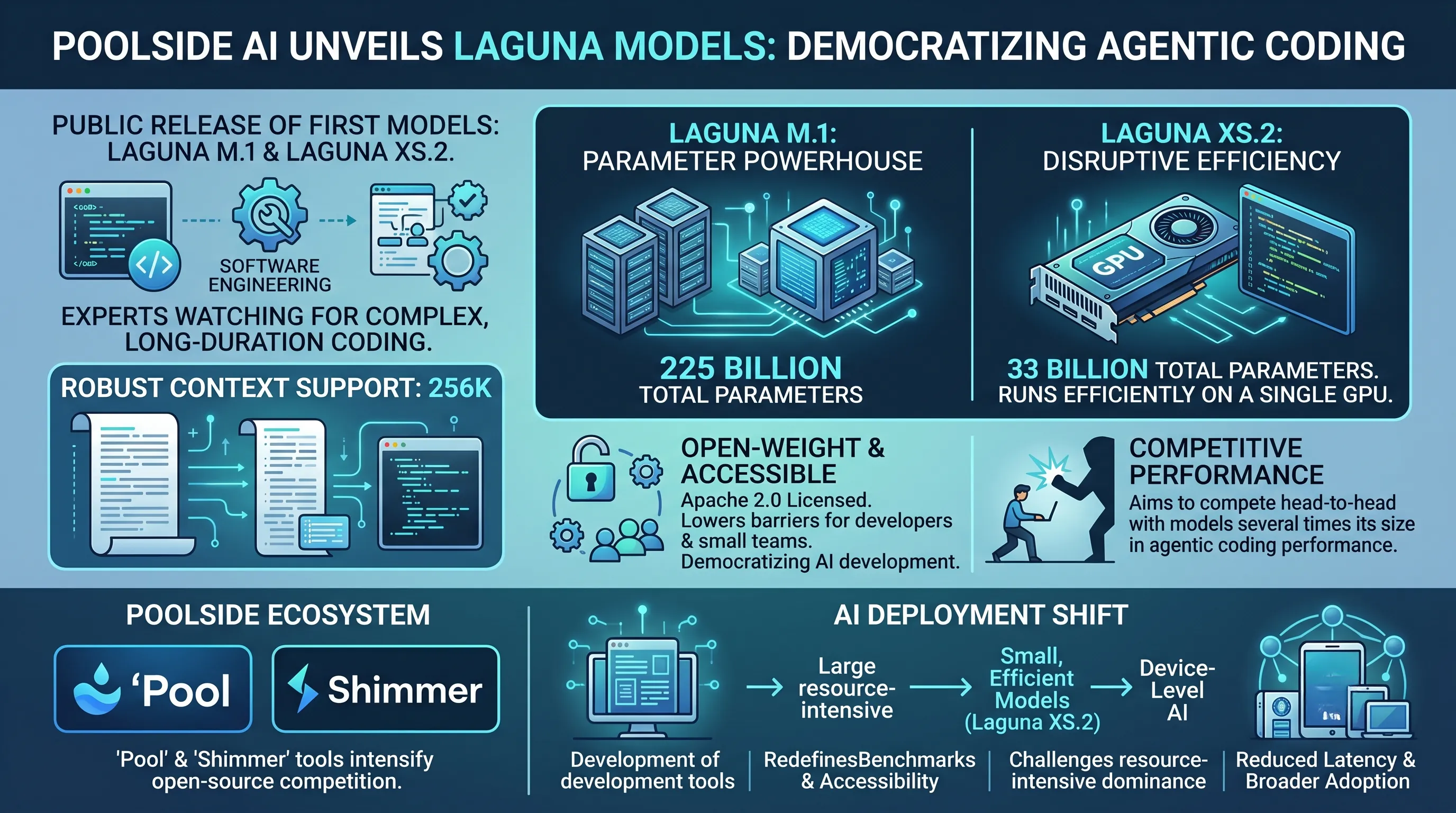
Poolside AI has made a significant entrance into the artificial intelligence arena with the public release of its first models, Laguna M.1 and Laguna XS.2.
Both models are expertly designed for complex, long-duration agentic coding and demanding software engineering tasks, offering robust context support of up to 256K.
Laguna M.1 features 225 billion total parameters, while its lightweight counterpart, Laguna XS.2, operates with 33 billion total parameters.
The true disruptor, however, is the Laguna XS.2 model, which has quickly become a focal point of industry attention.
This 33-billion-parameter model is not only open-weight and distributed under the Apache 2.0 license, but it also boasts the remarkable capability of running efficiently on a single GPU.
This accessibility feature dramatically lowers the barrier to entry for individual developers and smaller teams, potentially democratizing advanced AI development.
Poolside AI's ambition is for Laguna XS.2 to compete head-to-head with models several times its size in critical agentic coding performance.
This strategic release, alongside new development tools like 'Pool' and 'Shimmer,' is intensifying the competition within the open-source coding AI ecosystem.
Industry experts are keenly observing how this powerful, yet lightweight model will redefine performance benchmarks and accessibility standards, potentially enabling real-time AI at the device level and fundamentally challenging the dominance of larger, more resource-intensive AI systems.
The implications for reduced latency and broader AI adoption are substantial, signaling a potential shift in the landscape of AI deployment and innovation.
1. Poolside AI Unveils Laguna Series: Agentic Coding Powerhouses
Poolside AI's entrance into the public developer space with its Laguna series directly supports the overarching theme that 33B models are threatening large AI.
Specifically, the Laguna XS.2 model, with its 33 billion total parameters, is engineered as a lightweight, open-weight powerhouse designed to challenge models several times its size in the highly specialized and valuable domain of agentic coding.
This release exemplifies the trend of smaller, more efficient models democratizing access to advanced AI capabilities and creating intense competition for established, larger-scale systems.
The Laguna Models: A Tale of Two Scales
Poolside AI has introduced a duo of models, each tailored for different segments of the development landscape but sharing a common DNA focused on software engineering.
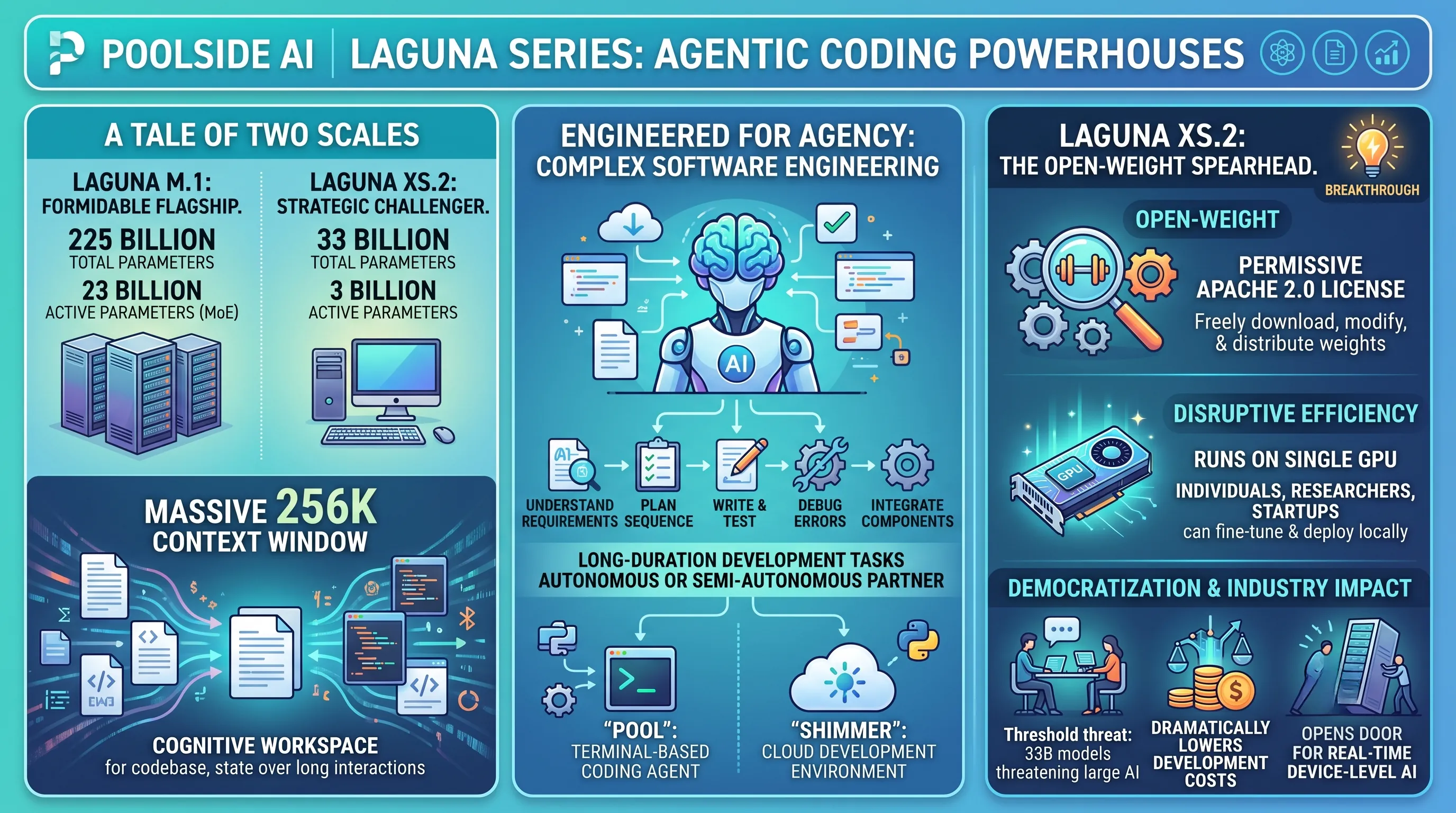
The flagship is the Laguna M.1, a formidable model with a total of 225 billion parameters, of which 23 billion are active at any given time.
This Mixture-of-Experts (MoE) architecture suggests a focus on efficiency at a massive scale.
However, the model that truly electrifies the current market conversation is the Laguna XS.2.
It features a total parameter count of 33 billion, with only 3 billion active parameters.
This smaller model is positioned not as a lesser version, but as a strategic challenger.
Both models share a critical feature: a massive context window supporting up to 256K tokens.
This isn't just for reading long documents; it's the essential cognitive workspace for an AI agent to grasp the full scope of a complex codebase, maintain state over long interactions, and execute multi-step development plans without losing track of the initial goal.
Engineered for Agency: The Goal of Complex Software Engineering
The explicit design goal for both Laguna models is to perform complex, long-duration development tasks and software engineering.
This marks a significant departure from models primarily focused on code completion or simple function generation.
Poolside AI is targeting the holy grail of coding AI: creating an agent that can understand high-level requirements, plan a sequence of actions, write and test code, debug errors, and integrate components over an extended period.
This "agentic coding" specialization is what separates the Laguna series from the pack.
The models are not just tools for a human developer; they are positioned as autonomous or semi-autonomous partners in the development process.
This ambition is further underscored by the introduction of preview tools like 'Pool', a terminal-based coding agent, and 'Shimmer', a cloud development environment, which are designed to harness the agentic capabilities of the Laguna models for building web applications, APIs, and CLIs.
Laguna XS.2: The Open-Weight Spearhead
The strategic brilliance of Poolside's release lies in the handling of the Laguna XS.2.
This 33B model is open-weight, distributed under the permissive Apache 2.0 license.
This means developers can freely download, modify, and even distribute the model weights for their own projects.
This move is a direct injection of power into the Western open AI ecosystem, intended to accelerate technological advancement by encouraging hands-on use and improvement on real-world projects.
The most disruptive feature, however, is its accessibility.
The Laguna XS.2 can run on a single GPU.
This fact cannot be overstated.
It demolishes the barrier to entry that has kept agentic AI capabilities in the exclusive domain of corporations with massive cloud computing budgets.
It means individual developers, researchers, and startups can now experiment with, fine-tune, and deploy a sophisticated coding agent locally.
This dramatically lowers development costs and opens the door for applications that require low latency, such as real-time AI at the device level, fundamentally threatening the business models of closed, API-only large AI providers.
The industry is now keenly watching for performance verification results, eager to see how this lightweight champion performs against its heavyweight competitors in real-world agentic coding benchmarks.
2. Laguna XS.2: Open-Weight Accessibility Driving Development Evolution
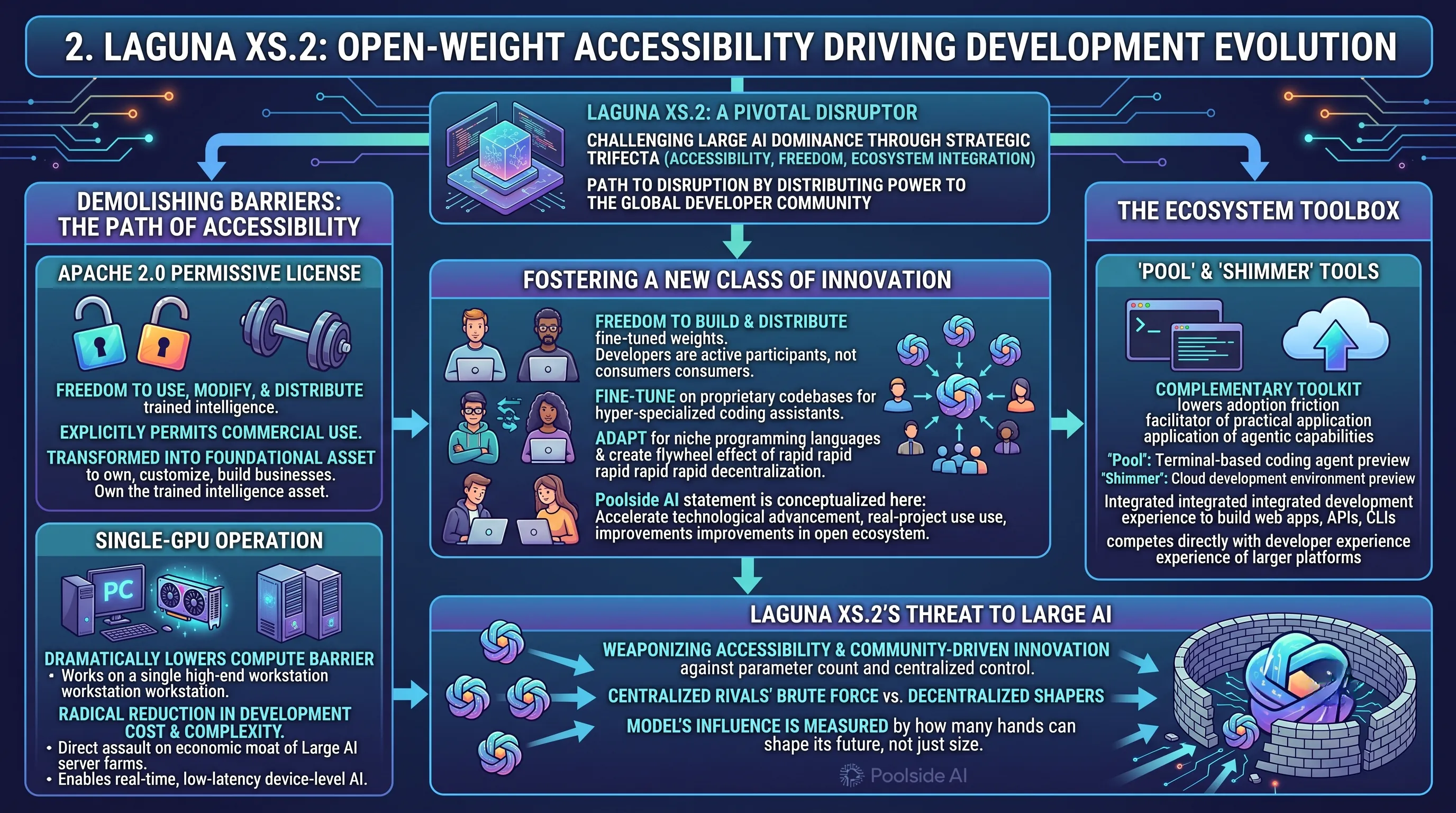
The emergence of Poolside AI's Laguna XS.2 model is a pivotal chapter in the narrative of how 33B models are challenging the dominance of large AI systems. Its threat is not merely a function of its parameter count but is fundamentally rooted in a strategic trifecta of accessibility, freedom, and ecosystem integration. Laguna XS.2 demonstrates that the path to disrupting incumbent models is not by building a bigger digital brain, but by distributing a powerful, adaptable, and economically viable one to the global developer community. This section deconstructs how Laguna XS.2's open-weight nature and low hardware requirements are forging a new, decentralized frontline in the AI development war, directly undermining the walled-garden approach of massive, proprietary models.
Demolishing Barriers: The Power of Apache 2.0 and Single-GPU Operation
The most significant strategic decision made by Poolside AI is releasing Laguna XS.2 as an open-weight model under the Apache 2.0 license.
This is a critical distinction from simply being "open-source."
While open-source code is valuable, open weights provide developers with the trained intelligence of the model itself—the very asset that large AI companies typically guard with extreme prejudice.
The choice of the Apache 2.0 license is a deliberate masterstroke; it is a highly permissive license that explicitly grants users the freedom to use, modify, and distribute the model for commercial purposes.
This single decision transforms Laguna XS.2 from a product you rent via an API into a foundational asset you can own, customize, and build a business upon.
This freedom is amplified to an exponential degree by the model's technical design, specifically its ability to run on a single GPU.
This fact cannot be overstated.
It single-handedly dismantles the most formidable barrier in AI development: the prohibitive cost of compute infrastructure.
While mega-models require sprawling, multi-million-dollar server farms, Laguna XS.2 places sophisticated agentic coding capabilities within reach of individual developers, startups, and academic researchers with a single high-end workstation.
This dramatic reduction in development cost and complexity is a direct assault on the economic moat of large AI providers.
The experiential value is profound: it enables the possibility of real-time AI at the device level, slashing the latency inherent in cloud-based API calls and opening up new frontiers for applications that require instantaneous response, something that is often impractical for its larger, slower competitors.
Fostering a New Class of Innovation: The Freedom to Build and Distribute
The combination of an open-weight license and low hardware requirements cultivates an environment where developers are not merely consumers but active participants in the model's evolution.
The ability for developers to freely download, modify, and distribute the Laguna XS.2 model weights is the engine of this new paradigm.
A developer can now fine-tune the 33-billion-parameter model on a proprietary codebase to create a hyper-specialized internal coding assistant.
A startup can adapt it for a niche programming language and release a new, improved version to the community.
This creates a flywheel effect of decentralized, rapid, and hyper-specific innovation that monolithic, closed models cannot replicate.
Poolside AI explicitly stated its expectation that this open strategy will accelerate technological advancement by encouraging real-project use and improvement within the Western open AI ecosystem, a clear challenge to the centralized development model of its rivals.
The Ecosystem Toolbox: 'Pool' and 'Shimmer'
Understanding that releasing a model is not enough, Poolside AI has also introduced complementary tools that lower the friction of adoption.
The introduction of 'Pool,' a terminal-based coding agent preview, and 'Shimmer,' a cloud development environment preview, provides developers with a ready-made toolkit to immediately begin building.
These tools are designed to facilitate the practical application of the model's agentic capabilities for creating web applications, APIs, and command-line interfaces (CLIs).
By providing an an integrated development experience, Poolside AI ensures that Laguna XS.2 is not just a raw model but part of a productive ecosystem.
This strategy makes the 33B model a more compelling and complete package, directly competing with the developer experience offered by larger platforms and making it easier for developers to migrate their workflows.
Ultimately, Laguna XS.2's threat to large AI is a masterclass in asymmetric strategy: it weaponizes accessibility and community-driven innovation against the brute force of parameter count and centralized control, proving that a model's influence is measured not just by its size, but by how many hands can shape its future.
3. The 33B Threat: How Laguna XS.2 Reshapes Large AI Competition
The emergence of Poolside AI's Laguna XS.2 is a direct and potent manifestation of the core thesis that 33B models are threatening large AI.
This model is not merely an incremental improvement; it represents an asymmetric challenge, where a significantly smaller, more efficient model is engineered to compete in one of the most complex and valuable domains—agentic coding—directly undermining the "bigger is better" philosophy that has long justified the existence of colossal, resource-intensive models.
Laguna XS.2’s threat is multifaceted, attacking the incumbents not on raw parameter count but on efficiency, accessibility, and strategic openness, fundamentally reshaping the competitive landscape.
Democratizing Power: The Single-GPU Revolution
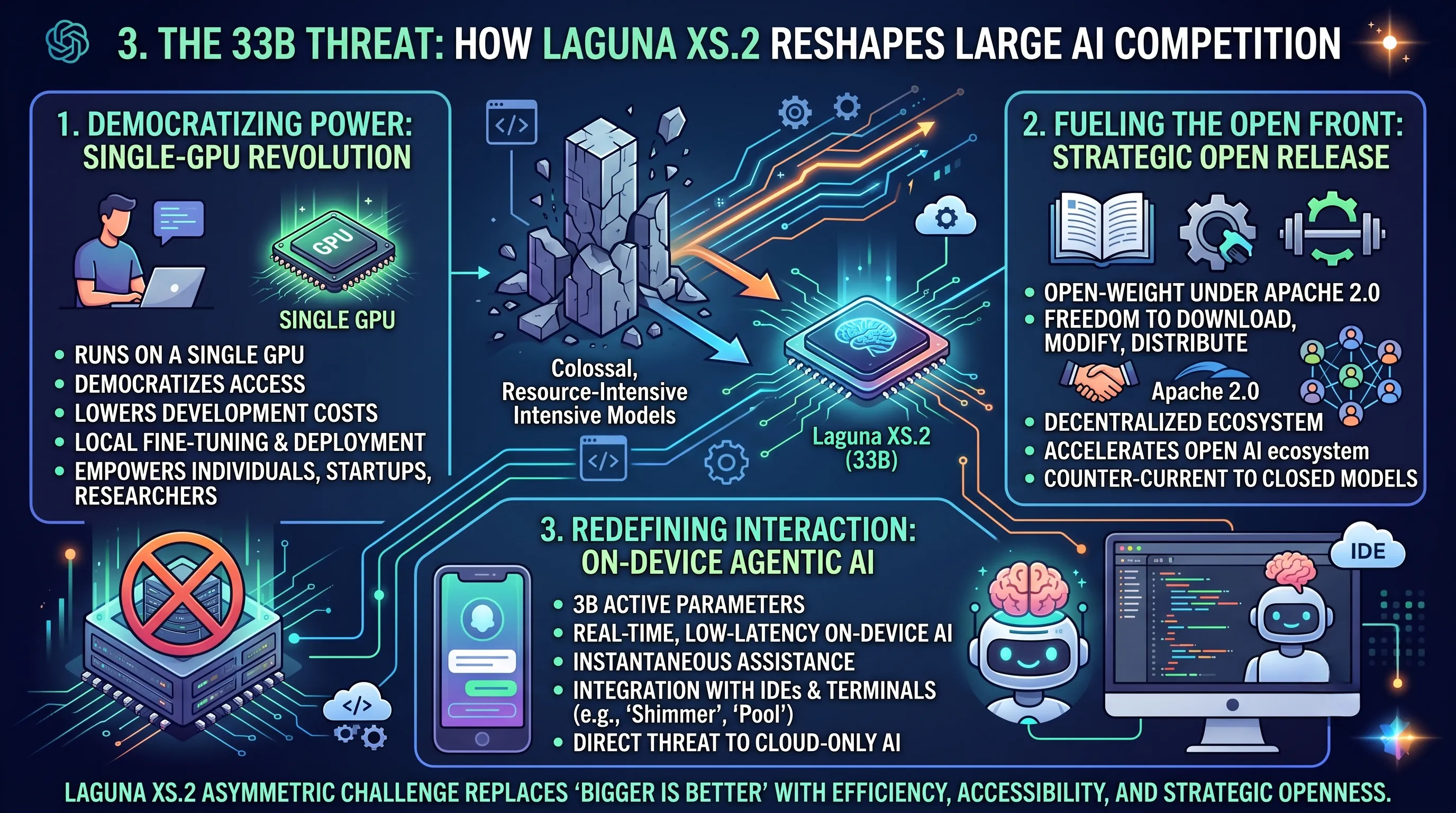
The most disruptive feature of Laguna XS.2 is its ability to run on a single GPU.
While larger models require vast, multi-million dollar server farms, this 33-billion-parameter model places state-of-the-art agentic coding capabilities within reach of a vastly wider audience.
This is not simply a convenience; it is an economic demolition of the high barrier to entry that has protected large AI labs.
The ability to deploy a powerful model without astronomical cloud computing bills or specialized hardware significantly lowers development costs and improves accessibility.
This directly empowers individual developers, small startups, and academic researchers, who can now download, fine-tune, and run a model designed for complex software engineering tasks on a local machine or a single affordable cloud instance.
The experiential value is transformative: what was once the exclusive domain of corporations with massive capital is now accessible to a lone developer in their home office, a change that promises to unleash a wave of innovation from the grassroots level.
Fueling the Open Front: A Strategic Release
Poolside AI's decision to release Laguna XS.2 as an open-weight model under the permissive Apache 2.0 license is a calculated strategic move.
By allowing anyone to download, modify, and distribute the model weights freely, the company is deliberately fostering a decentralized ecosystem.
This strategy is explicitly designed to accelerate technological advancement by encouraging real-project use and improvement in the Western open AI ecosystem.
Unlike closed, proprietary models that are controlled by a single entity, Laguna XS.2 becomes a foundational block for the entire community.
This inevitably intensifies open-source coding AI competition, creating a powerful counter-current to the closed models from major players.
Every developer who improves upon XS.2 or builds a new tool with it contributes to a collective force that the large, siloed AI companies cannot easily replicate.
The industry's intense focus on the future performance verification of this lightweight model challenging its larger counterparts underscores the credibility of this open-source threat.
Redefining Interaction: The Dawn of On-Device Agentic AI
The efficiency of Laguna XS.2, with only 3 billion active parameters out of 33 billion total, combined with its single-GPU compatibility, unlocks a new frontier for AI applications.
This design makes it possible to enable real-time AI at the device level, potentially reducing latency.
The implications for software development are profound.
Instead of a developer sending a query to a distant cloud server and waiting for a response, an AI agent powered by a model like Laguna XS.2 could run locally within an IDE like Poolside's own 'Shimmer' cloud environment or 'Pool' terminal agent.
This would provide instantaneous, context-aware assistance for complex, long-duration tasks—from building web applications to crafting APIs—without the lag inherent in network communication.
This shift from a slow, turn-based interaction to a fluid, real-time partnership fundamentally alters the user experience and poses a direct competitive threat to cloud-only AI services that cannot match this level of responsiveness and integration.
📚 Related Posts
NVIDIA Nemotron 3 Nano Omni: Open Multimodal AI Revolution Crushing Agent Bottlenecks for Real-Time Intelligence
🚀 Key TakeawaysNVIDIA's Nemotron 3 Nano Omni is a groundbreaking open multimodal AI model designed to eliminate bottlenecks for AI agents by simultaneously understanding video, audio, and text, achieving up to 9 times higher throughput and significantly
tech.dragon-story.com
DeepSeek V4 Pro & Flash: Unveiling the 1 Million Token Era – Architecture, Efficiency, and Real-World Performance Nuances
🚀 Key TakeawaysDeepSeek-V4 revolutionizes the AI landscape by officially launching its open-source V4-Pro and V4-Flash models, spearheading the "1 Million Token Era" with unprecedented context length capabilities, robust cost-efficiency, and cutting-edg
tech.dragon-story.com
TRELLIS.2: O-Voxel AI Revolutionizes 3D Generation with Unprecedented Speed, Hyper-Realism & Democratized Access – Full Releas
🚀 Key TakeawaysTRELLIS.2 revolutionizes 3D generation with its innovative O-Voxel technology, enabling the creation of highly complex, thin, and hollow structures with exceptional detail and realism.This 4B-parameter image-to-3D model offers unprecedent
tech.dragon-story.com


