🚀 Key Takeaways
- AWS customers can now directly access and deploy OpenAI's cutting-edge models, including the flagship GPT-5.5, GPT-5.4, and Codex, natively within their Amazon Web Services (AWS) environment.
- This strategic partnership enables enterprises to leverage OpenAI's advanced AI capabilities while maintaining their existing AWS infrastructure, security protocols, and compliance frameworks, simplifying AI integration and consolidating cloud spend.
- The integration extends to OpenAI Codex for advanced coding tasks and AWS-managed agents powered by OpenAI technology, allowing for the creation of complex, autonomous AI workflows seamlessly on Amazon Bedrock, with AWS handling complex infrastructure and governance.
A landmark strategic partnership between OpenAI and Amazon Web Services (AWS) is set to revolutionize how enterprises integrate advanced artificial intelligence into their operations.
This collaboration, announced in 2026, significantly expands their strategic cooperation in the enterprise AI market, making OpenAI's latest and most powerful models, including the highly anticipated GPT-5.5, directly accessible to AWS customers.
Enterprises can now tap into OpenAI's frontier models and AI agent technology seamlessly within their familiar AWS cloud environment.
This groundbreaking integration means that AWS customers can now leverage the full power of OpenAI's AI models without the need for complex migrations or new infrastructure setups.
Customers can continue to operate within their existing AWS infrastructure, security systems, and compliance environments, ensuring a smooth and secure transition to cutting-edge AI.
Furthermore, this partnership allows for the consolidation of AI spend alongside broader AWS cloud commitments, offering significant operational and financial efficiencies for businesses developing AI-powered applications.
Beyond GPT-5.5 and GPT-5.4, the partnership also brings OpenAI Codex, a leading coding agent platform, into AWS, available via Amazon Bedrock.
This enables advanced capabilities for code generation, testing, and system modernization directly on AWS.
Additionally, AWS Bedrock Managed Agents, powered by OpenAI technology, empower enterprises to build sophisticated AI agents capable of understanding complex workflows and performing multi-step autonomous actions, with AWS handling the underlying infrastructure, deployment, and security.
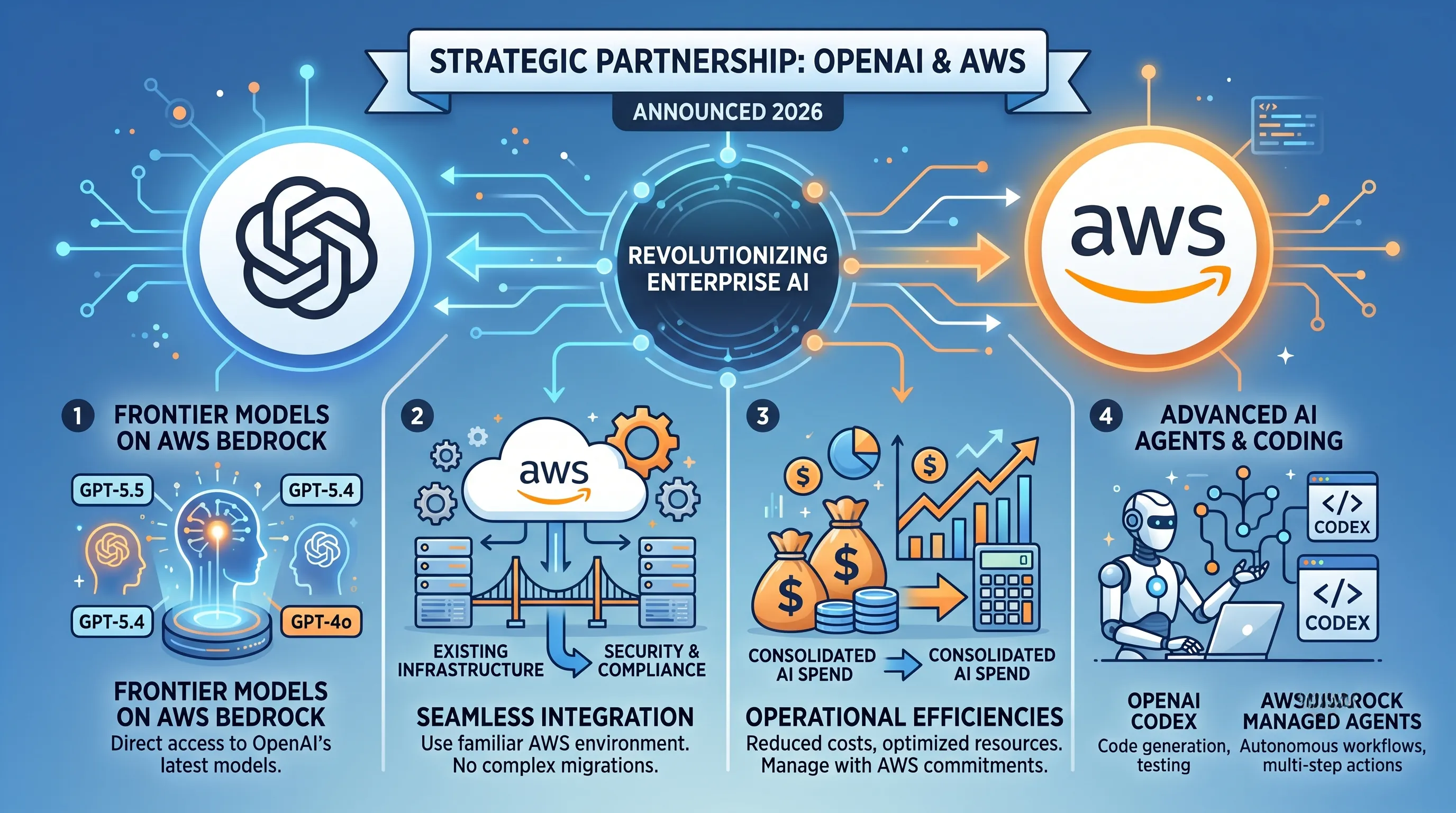
1. OpenAI's Strategic Leap: Bringing Advanced AI Directly to AWS Enterprises
The direct availability of OpenAI's flagship GPT-5.5 model on AWS is not an isolated event but the culmination of a deeply integrated, multiyear strategic partnership announced in 2026. This landmark cooperation was meticulously designed to achieve one primary goal: to allow the vast ecosystem of AWS customers to directly and seamlessly utilize OpenAI's latest models and AI agent technology within their existing cloud environments. This alliance fundamentally reshapes the enterprise AI landscape, moving beyond simple API access to a co-developed, native integration that prioritizes enterprise needs for security, stability, and financial efficiency. For companies heavily invested in AWS, this means the revolutionary power of models like GPT-5.5 is no longer a tool to be accessed externally but a native service to be leveraged internally, directly connecting the world's leading AI with the world's leading cloud platform.
A Symbiotic Alliance Built for the Enterprise
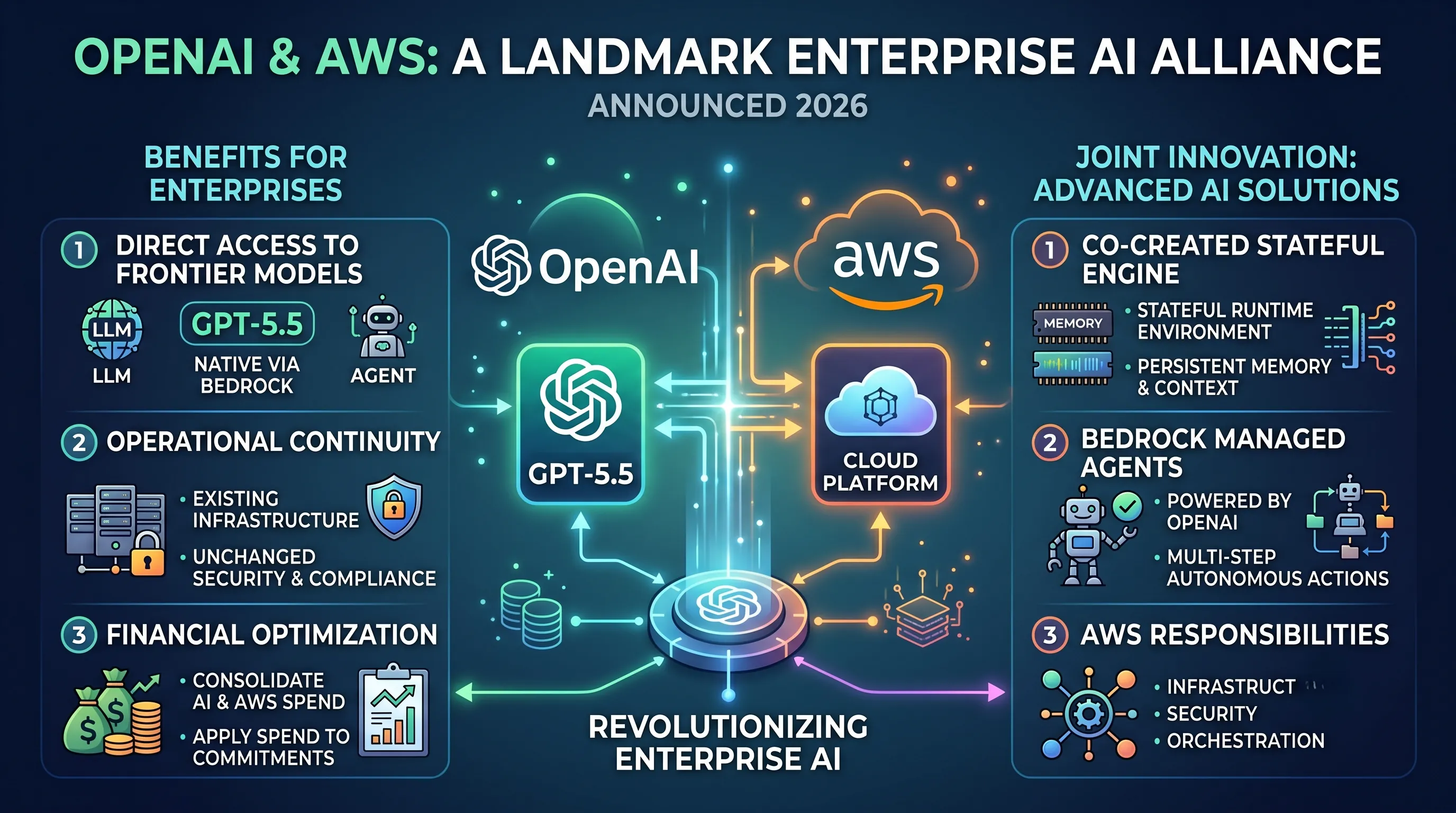
The partnership's structure is a masterclass in mutual benefit, squarely aimed at accelerating enterprise AI adoption by removing common friction points. For OpenAI, the alliance provides immediate access to run its advanced AI workloads on AWS's globally scaled, secure, and robust infrastructure, allowing it to focus on model innovation rather than infrastructure management.
For AWS customers, the advantages are far more direct and impactful. The core promise is the ability to maintain their entire existing operational posture. Enterprises can continue using their established AWS infrastructure, battle-tested security systems, and rigorous compliance environments without modification. This is a critical factor, as it eliminates the immense cost and risk associated with migrating data, re-architecting security protocols, or retraining teams on a new platform. Essentially, OpenAI's models, including GPT-5.5, become another service accessible through the familiar AWS Management Console and APIs, subject to the same IAM roles, VPC configurations, and security policies they already trust.
Furthermore, the financial integration is a game-changer for Chief Financial Officers and procurement teams. The agreement allows customers to apply their OpenAI model usage directly towards their existing AWS cloud commitments. This means that investments in cutting-edge AI are no longer a separate, off-platform expenditure. Instead, enterprises can consolidate their AI spend alongside their broader AWS spend, simplifying budgeting, streamlining vendor management, and potentially unlocking greater volume discounts through their Enterprise Discount Programs (EDPs). This strategic financial alignment significantly lowers the barrier to adoption, making it easier to justify and scale the use of powerful models across the organization.
The Co-Creation of a Stateful AI Engine
Perhaps the most forward-looking component of this strategic cooperation is the joint commitment to co-create a Stateful Runtime Environment. This new service, powered by OpenAI models and made available on Amazon Bedrock, is engineered to be the bedrock for a new generation of sophisticated AI agents.
Unlike stateless API calls that treat each request as an independent event, a "stateful" environment provides memory and context that persists across multiple interactions. This is the foundational requirement for building agents that can understand complex workflows and perform multiple steps autonomously. This jointly developed environment directly powers Amazon Bedrock Managed Agents, which leverage OpenAI's technology to execute multi-step tasks with a high degree of independence. AWS manages the incredibly complex underlying infrastructure—handling deployment, orchestration, security, and governance—while enterprises focus on defining the business logic for their agents. This collaboration effectively provides a turn-key solution for deploying autonomous agents capable of complex reasoning and decision-making, all within the secure and managed confines of the AWS ecosystem.
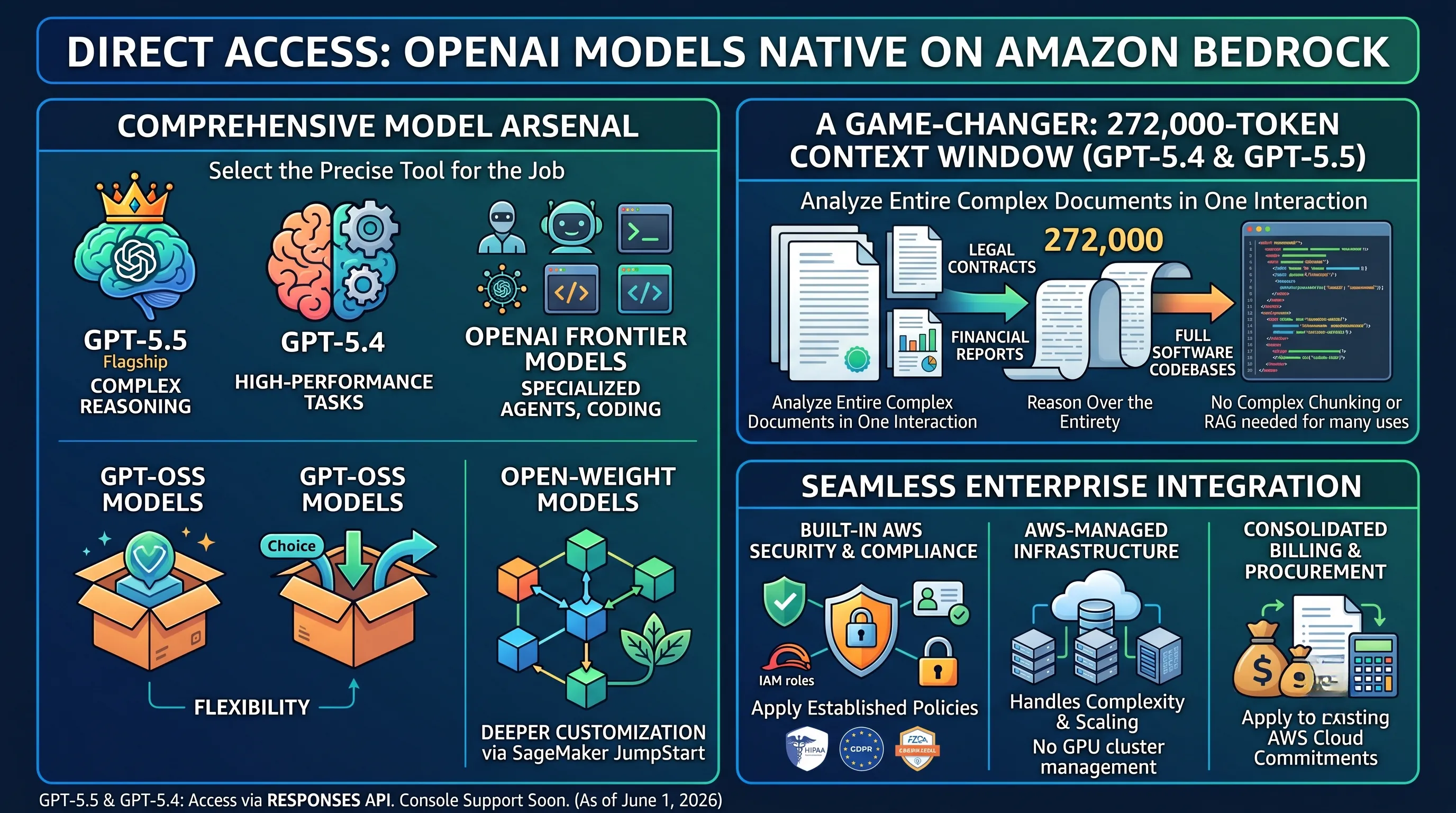
2. Direct Access: Flagship GPT-5.5 and More OpenAI Models Now Natively on Amazon Bedrock
The central theme of this article, "Use GPT-5.5 Directly on AWS," transitions from a strategic vision into a concrete, operational reality with the native integration of OpenAI's premier models into Amazon Bedrock.
This is not a mere API gateway or a marketplace listing; it is the deepest level of integration, allowing enterprises to access the raw power of OpenAI's latest innovations as if they were native AWS services.
This direct access fundamentally changes how businesses can build, secure, and deploy generative AI, anchoring it firmly within the familiar and trusted AWS ecosystem.
An Unprecedented Arsenal of AI Models
The announcement's headline feature is the immediate availability of OpenAI's flagship model, GPT-5.5, directly through the Amazon Bedrock service.
This grants AWS customers day-one access to the industry's leading-edge model for complex reasoning and generation.
However, the offering extends far beyond a single model, representing a comprehensive portfolio of OpenAI's capabilities:
- GPT-5.4: The powerful predecessor to the flagship model is also available, providing a high-performance option for a wide range of tasks.
- OpenAI Frontier Models: Specialized models designed for the most demanding enterprise challenges, including agentic coding, the creation of autonomous workflows, and intricate, multi-step reasoning, are now accessible.
- GPT-OSS Models: A selection of OpenAI's open-source models are integrated, providing flexibility and transparency for specific use cases.
- New Open-Weight Models: Furthering the commitment to choice, two new OpenAI models with open weights have been made available, which can be accessed not only through Bedrock APIs but also deployed directly via Amazon SageMaker JumpStart for deeper customization and control.
This diverse collection ensures that developers and data scientists can select the precise tool for the job, from general-purpose chatbots to highly specialized autonomous agents, all within a single, unified AWS environment.
The Game-Changer: A 272,000-Token Context Window
A standout technical specification for both GPT-5.4 and GPT-5.5 on Amazon Bedrock is the massive 272,000-token context window.
This is far more than an incremental improvement; it represents a paradigm shift in the scale of problems that can be addressed in a single interaction.
Experientially, this transforms the model from a brilliant conversationalist into a tireless, comprehensive analyst.
Enterprises can now feed entire complex documents—such as lengthy legal contracts, extensive financial reports, full software codebases, or detailed scientific research papers—directly into the model's context.
This eliminates the need for complex and sometimes brittle data chunking and retrieval-augmented generation (RAG) systems for many use cases.
The model can reason over the entirety of the provided information, identifying subtle connections, summarizing vast quantities of text, and answering specific questions with the full context intact, dramatically accelerating workflows that previously required significant human effort or complex data engineering.
Seamless and Secure Enterprise Integration
Perhaps the most critical advantage for enterprises is how these models are delivered.
Being natively available on Amazon Bedrock means that organizations can develop and deploy services using OpenAI's models without ever leaving their existing, hardened AWS security posture.
This integration allows businesses to:
- Leverage Existing Security & Compliance: Apply established AWS security policies, IAM roles, authentication systems, and compliance environments (like HIPAA, GDPR, etc.) directly to their AI workloads.
There is no need to vet a new vendor or create a separate, complex security architecture. - Utilize AWS-Managed Infrastructure: AWS handles the immense complexity of deploying, scaling, and managing the underlying infrastructure required to run these frontier models.
This removes the operational burden of GPU cluster management, orchestration, and security patching, allowing teams to focus on building value, not managing infrastructure. - Streamline Procurement and Billing: In a significant move that lowers adoption barriers, enterprises can apply their OpenAI model usage towards their existing AWS cloud commitments.
This allows companies to consolidate their AI spending alongside their broader AWS spend, simplifying budget management and maximizing the value of their AWS relationship.
As of June 1, 2026, access to the GPT-5.5 and GPT-5.4 models on Bedrock is available exclusively via the Responses API, with full console support slated to arrive soon.
This ensures that developers can immediately begin building programmatic solutions, while user-friendly console access for experimentation and management is on the near-term roadmap.
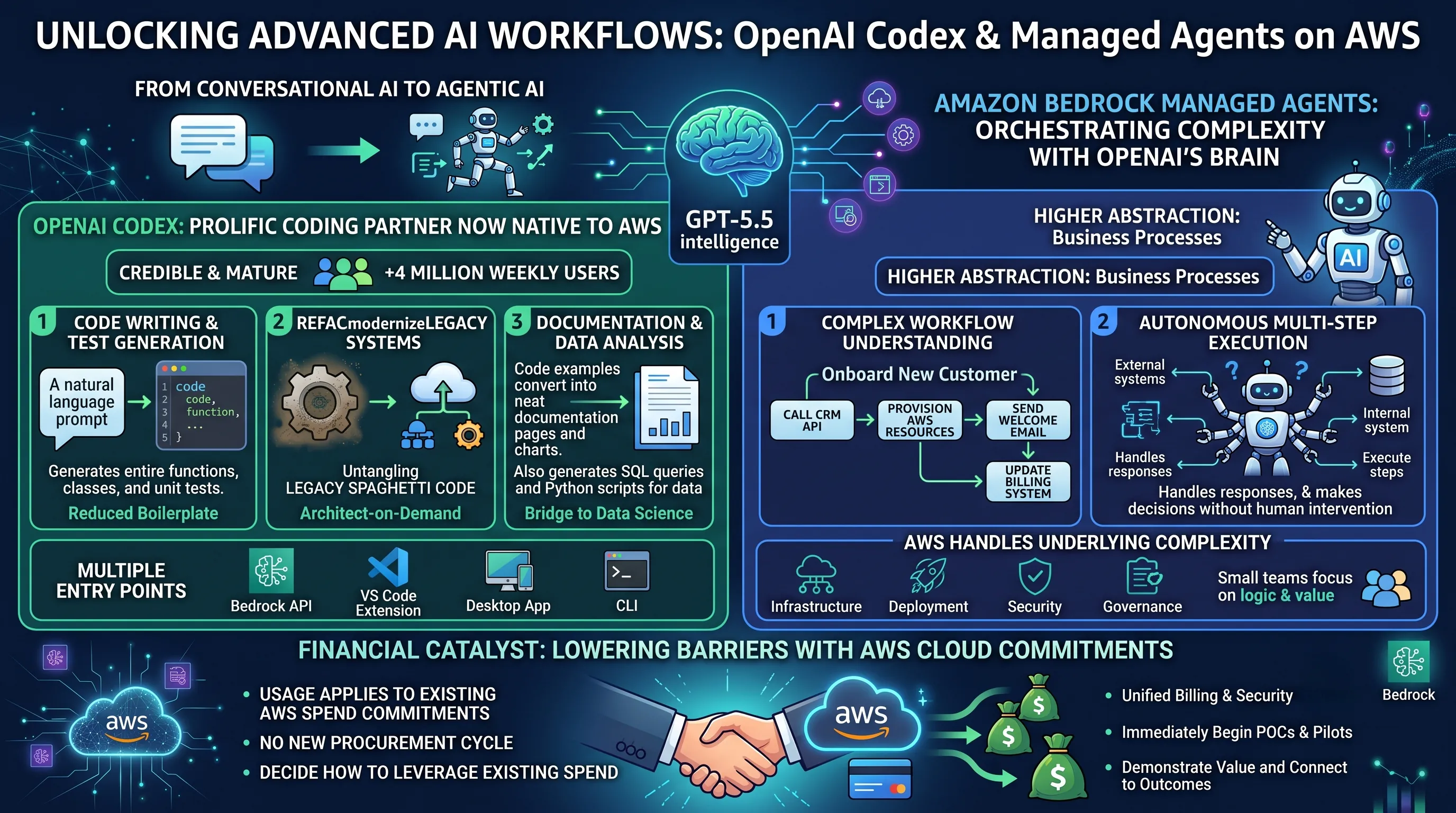
3. Unlocking Advanced AI Workflows: OpenAI Codex and Managed Agents on AWS
The arrival of GPT-5.5 on AWS is not merely about providing access to a more powerful language model for chat or text generation; it's about fundamentally transforming how complex digital work gets done. This section connects directly to the main topic, "Using GPT-5.5 Directly on AWS," by exploring the two primary platforms that harness this power for action and automation: OpenAI Codex and Amazon Bedrock Managed Agents.
These tools represent the evolution from conversational AI to agentic AI, turning the raw intelligence of models like GPT-5.5 into tangible, autonomous workflows that write code, orchestrate systems, and execute multi-step business processes, all within the secure and familiar AWS ecosystem.
OpenAI Codex: The Prolific Coding Partner Now Native to AWS
OpenAI Codex is far more than a simple code completion tool; it is OpenAI's representative coding agent platform, a mature and powerful assistant that now officially enters the AWS environment via Amazon Bedrock.
Its credibility is already well-established, with a massive existing user base exceeding 4 million weekly users who rely on it to accelerate development.
Now, AWS customers can seamlessly integrate this proven capability into their daily operations.
The features of Codex extend across the entire software development lifecycle:
- Code Writing and Test Generation: At its core, Codex excels at generating code from natural language prompts. But its true power lies in its contextual understanding, allowing it to write not just snippets, but entire functions, classes, and corresponding unit tests. This capability drastically reduces the time spent on boilerplate and repetitive coding, freeing developers to focus on high-level architecture and complex problem-solving.
- Refactoring and Modernizing Legacy Systems: For many large enterprises, technical debt is a multi-million dollar anchor. Codex provides a powerful lever to address this. It can analyze aging codebases—be it monolithic Java applications or arcane procedural scripts—and suggest or execute refactoring into modern, microservices-based architectures. This is the experiential equivalent of having a senior architect on-demand, dedicated to untangling legacy spaghetti code.
- Document Creation and Data Analysis: The integration doesn't stop at code. Codex can parse codebases to automatically generate accurate documentation, from function-level docstrings to comprehensive API guides. Furthermore, it can be prompted to write complex SQL queries or Python scripts for data analysis, effectively acting as a bridge between developers and data science teams.
Accessibility is a key design principle, with Codex available through multiple entry points to meet developers where they work: directly via the Bedrock API for custom integrations, a Visual Studio Code extension for in-editor assistance, a dedicated desktop app, and a command-line interface (CLI) for scripting and automation.
Amazon Bedrock Managed Agents: Orchestrating Complexity with OpenAI's Brain
While Codex focuses on the code-level tasks of a developer, Amazon Bedrock Managed Agents, powered by OpenAI technology, operates at a higher level of abstraction: the business process.
This service empowers enterprises to build sophisticated AI agents that understand and autonomously execute complex, multi-step workflows. If Codex is the specialist programmer, a Managed Agent is the AI project manager, capable of orchestrating various tools, APIs, and data sources to achieve a goal.
Key capabilities include:
- Complex Workflow Understanding: An agent can be tasked with a high-level goal like "Onboard a new enterprise customer." It will then intelligently break this down into a sequence of actions: calling a CRM API to create a record, provisioning resources via the AWS API, sending a welcome email through an email service, and updating a billing system.
- Autonomous Multi-Step Execution: The agent doesn't just plan the steps; it executes them. It can interact with internal and external systems, handle API responses, and even make decisions based on the outcome of a previous step, all without human intervention.
Crucially, AWS handles the immense underlying infrastructure complexity. The challenges of agent deployment, orchestration, security, and governance are managed by AWS. This means an enterprise's development team can focus entirely on defining the agent's logic and the business value it delivers, rather than building and maintaining the complex MLOps stack required to run such an agent reliably and securely.
The Financial Catalyst: Lowering Barriers with AWS Cloud Commitments
Perhaps the most significant aspect of this integration is the strategic removal of financial friction for enterprises. The usage of both OpenAI Codex and the OpenAI-powered Bedrock Managed Agents can be applied towards existing AWS cloud commitments.
This is a game-changer that dramatically lowers the barrier to adoption.
For a CIO or CTO with a pre-existing, multi-year spending commitment with AWS, this means the budget to experiment with and deploy these advanced agentic AI tools is already approved and allocated. There is no need for a new, arduous procurement cycle to get a separate contract with OpenAI. The decision shifts from "Can we afford this new AI tool?" to "How can we best leverage our existing AWS spend to innovate with this new AI tool?"
This ability to consolidate AI spend alongside broader AWS spend simplifies vendor management and provides a unified billing and security posture. It enables development teams to immediately begin building proof-of-concepts and pilot programs, demonstrating the value of autonomous workflows and advanced code generation without delay, directly connecting the power of OpenAI's models to tangible business outcomes on the AWS platform.
📚 Related Posts
OpenAI's Free 'ChatGPT for Clinicians' (GPT-5.4): 99.6% Accurate AI Outperforms Doctors, Redefining US Healthcare
🚀 Key TakeawaysOpenAI's "ChatGPT for Clinicians" is a free, advanced AI tool leveraging the latest GPT-5.4 model, specifically designed for US medical professionals to enhance efficiency and patient focus.It has demonstrated exceptional performance, wit
tech.dragon-story.com
OpenAI GPT-5.5 Unveiled: Autonomous AI Redefines Coding, Research & Enterprise Productivity with Advanced Security & New API Pri
🚀 Key TakeawaysOpenAI's GPT-5.5 redefines AI by autonomously planning and executing complex multi-step tasks across coding, office work, and scientific research, boasting unprecedented intelligence, intuition, and advanced security measures.OpenAI has o
tech.dragon-story.com
Mistral AI's Autonomous Agents: Code Continues While You Sleep, Reshaping Developer Roles & Productivity
🚀 Key TakeawaysThe advent of advanced AI agents, such as Mistral's Vibe Remote Agents and Le Chat Work Mode, is fundamentally transforming software development by enabling developers to delegate complex coding and business tasks. This allows work to con
tech.dragon-story.com


