🚀 Key Takeaways
- The advent of advanced AI agents, such as Mistral's Vibe Remote Agents and Le Chat Work Mode, is fundamentally transforming software development by enabling developers to delegate complex coding and business tasks. This allows work to continue autonomously, even after developers leave, thereby significantly boosting productivity and shifting the engineer's role towards managing and reviewing AI operations rather than direct coding.
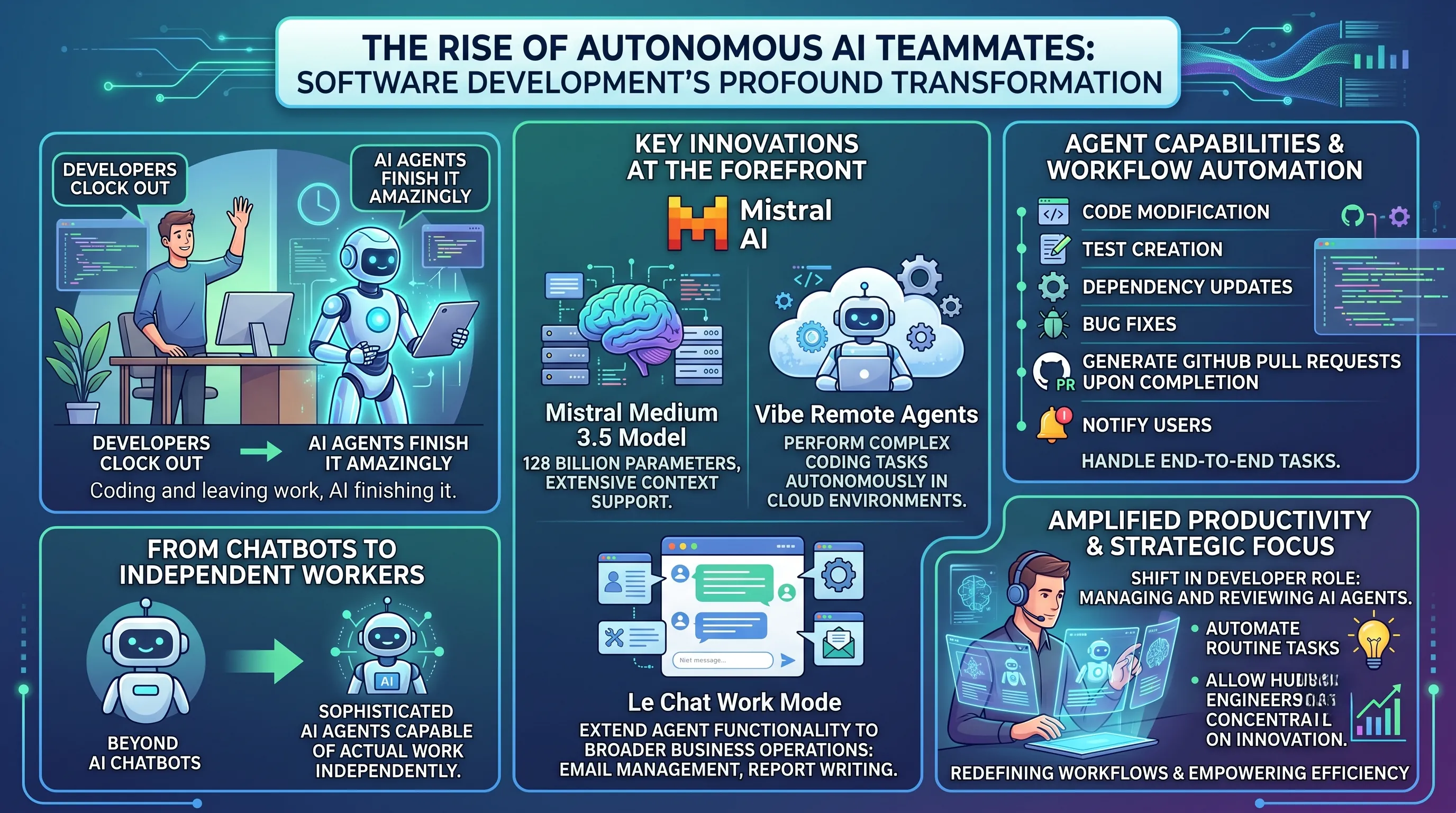
The landscape of software development is undergoing a profound transformation, ushering in an era where artificial intelligence agents are not merely assistants but autonomous teammates. The concept of "coding and then leaving work, with AI finishing it amazingly" is no longer a futuristic dream but a rapidly evolving reality. This paradigm shift signifies a move beyond traditional AI chatbots, focusing instead on sophisticated AI agents capable of performing actual work independently, even after developers have clocked out.
At the forefront of this revolution are innovations like Mistral AI's new offerings, including the powerful Mistral Medium 3.5 model, boasting 128 billion parameters and extensive context support. Integral to this vision are Vibe Remote Agents, designed to perform complex coding tasks autonomously in cloud environments, and Le Chat Work Mode, which extends AI agent functionality to broader business operations such as email management and report writing. These tools are meticulously engineered to handle everything from code modification and test creation to dependency updates and bug fixes, generating GitHub Pull Requests upon completion and notifying users.
This evolution promises a future where developer productivity is significantly amplified, with AI automating routine tasks and allowing human engineers to concentrate on innovation and strategic challenges. Industry experts project a fundamental shift in the developer's role, moving away from direct coding to one of managing and reviewing AI agents. While the impact on productivity is debated, with some studies showing remarkable speed-ups and others cautious reductions, the overarching trend is clear: software engineering is entering an age where AI Teammates redefine workflows and empower a new level of efficiency and strategic focus.
1. Beyond Your Desk: Mistral's AI Agents Finishing the Code
The central premise of this article—"When you go home after coding, AI finishes it for you"—is no longer a futuristic fantasy but an emerging reality, and Mistral AI's latest offerings are at the vanguard of this transformation.
Their ecosystem moves beyond simple code completion or conversational assistance, directly enabling a workflow where a developer can define a task, delegate it to an AI agent, and then physically step away, confident that the work will continue independently.
This is not about getting help with a line of code; it's about offloading entire development cycles to an autonomous system that operates in the cloud long after you've logged off.
Vibe Remote Agents: Your 24/7 Cloud-Based Coder
The most direct embodiment of this "instruct and leave" paradigm is Mistral's Vibe Remote Agents.
This service fundamentally changes the developer's relationship with AI by providing a system that performs coding tasks in an independent cloud environment.
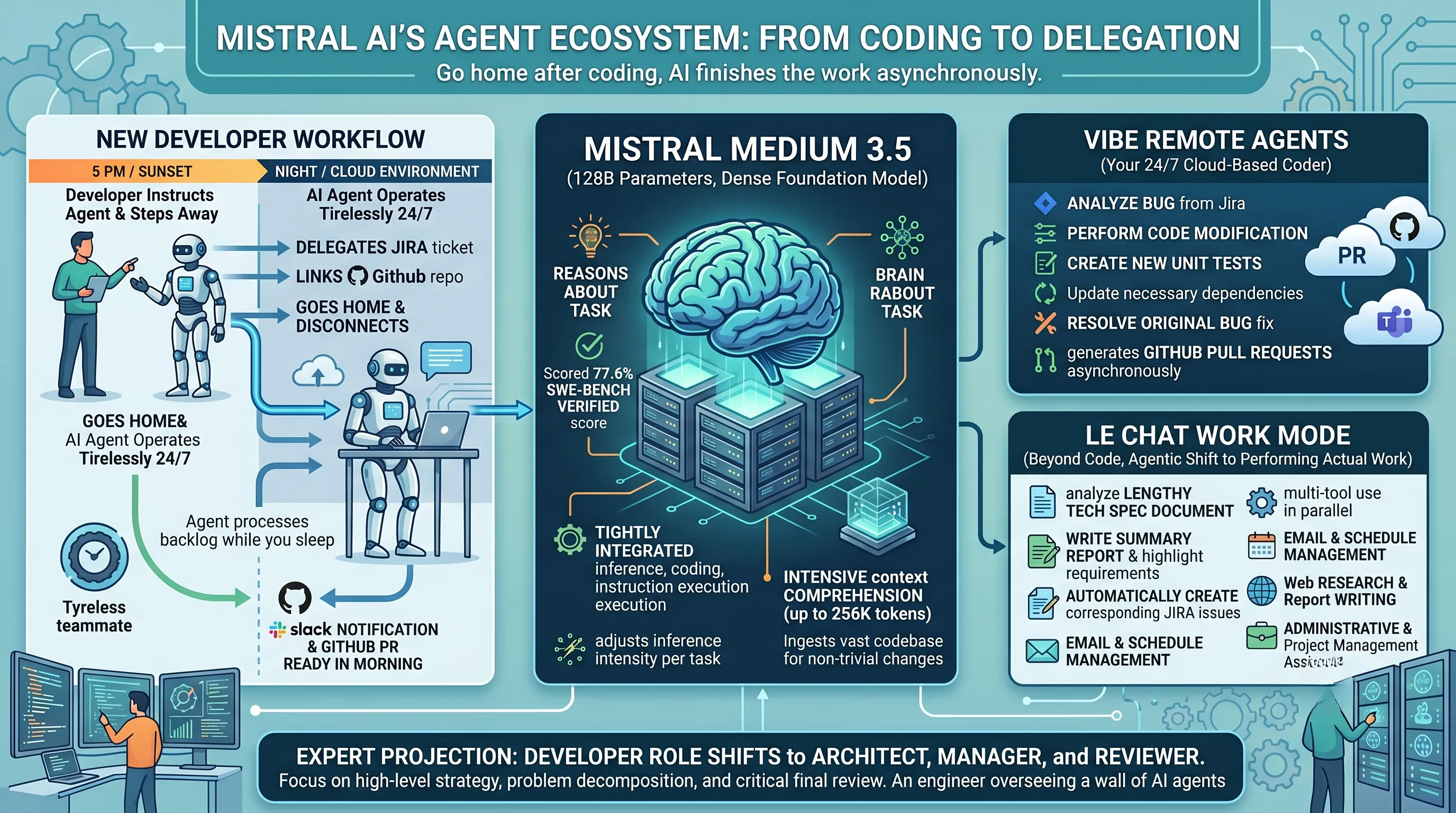
Imagine a scenario: at 5 PM, a developer is assigned a bug fix from a Jira ticket.
Instead of starting the work, they instruct a Vibe Remote Agent, linking it to the ticket and the relevant GitHub repository.
The developer can then commute home, have dinner, and disconnect for the evening.
While the developer is offline, the Vibe Agent gets to work.
It's not just generating snippets; it's performing a comprehensive set of automated tasks that mirror a human developer's process: analyzing the bug, performing the necessary code modification, creating new unit tests to ensure the fix is robust, handling any required dependency updates, and resolving the original bug fix.
This entire process happens asynchronously and autonomously.
The culmination of this work materializes as a notification on the developer's Slack or Teams the next morning, linked directly to a newly generated GitHub Pull Request, complete with the proposed changes, ready for human review.
The ability to run multiple agents simultaneously means an entire team's backlog of routine tasks could be processed overnight.
This is the tangible mechanism for how developer productivity is expected to significantly increase; the AI isn't just a tool, it's a tireless teammate clearing the path for the next day's high-level work.
The Engine: Mistral Medium 3.5
This level of autonomous capability is powered by an exceptionally potent model: Mistral Medium 3.5.
This is not a lightweight, specialized coding model but a massive, dense foundation model with 128 billion parameters.
Its raw power is demonstrated by its performance, scoring an impressive 77.6% on the SWE-Bench Verified benchmark, a rigorous test of real-world software engineering problem-solving.
What truly sets it apart for agentic work is its architecture, which tightly integrates inference, coding, and instruction execution into one model.
This means it can reason about a task, write the necessary code, and understand how to execute the steps required to complete it.
Furthermore, its massive context support of up to 256K tokens is a game-changer.
It can ingest and comprehend vast swathes of a project's codebase, giving it the necessary context to make intelligent, non-trivial changes rather than isolated, myopic edits.
The model also intelligently adjusts its inference intensity per task, ensuring that computational resources are used efficiently, a crucial feature for a cloud-based agent designed to run for extended periods.
Beyond Code: Le Chat Work Mode and the Agentic Shift
Mistral's vision extends beyond the IDE, reflecting a broader industry shift from AI chatbot competition to AI agents performing actual work.
Le Chat Work Mode exemplifies this by providing powerful agent functions for complex business tasks that surround the coding process.
This is a system designed to perform real work, not just chat about it.
For a developer, this means offloading adjacent responsibilities.
A developer could instruct Le Chat to analyze a lengthy technical specification document, write a summary report highlighting key requirements, and then automatically create corresponding Jira issues for the development team—all while utilizing multiple tools in parallel to achieve the goal.
Its capabilities span email and schedule management, document analysis, web research, and report writing, effectively acting as an administrative and project management assistant.
This trio of offerings—Vibe Remote Agents, Mistral Medium 3.5, and Le Chat Work Mode—creates a powerful ecosystem for delegation.
The expert projection is clear: the developer's role will inevitably shift from one of direct, line-by-line coding to that of an architect, manager, and reviewer of AI agents.
The core value a developer provides will be in high-level problem decomposition, strategic direction, and the critical final review of AI-generated work, freeing them from the granular implementation that can now be reliably completed after they've already gone home for the day.
2. The Shifting Sands of Software: AI's Impact on Developer Productivity and Roles
The central premise of our main topic, "Leave work while coding, and the AI will finish it," is no longer a futuristic fantasy but an emerging reality. This section delves into the very tools and paradigm shifts making this possible, examining the current landscape of AI's integration into software development, its paradoxical effects on productivity, and the profound evolution it is forcing upon the role of the engineer.
The current ecosystem of AI coding tools is vast and rapidly expanding beyond simple autocompletion. We can broadly categorize these tools to understand their different roles in the development lifecycle:
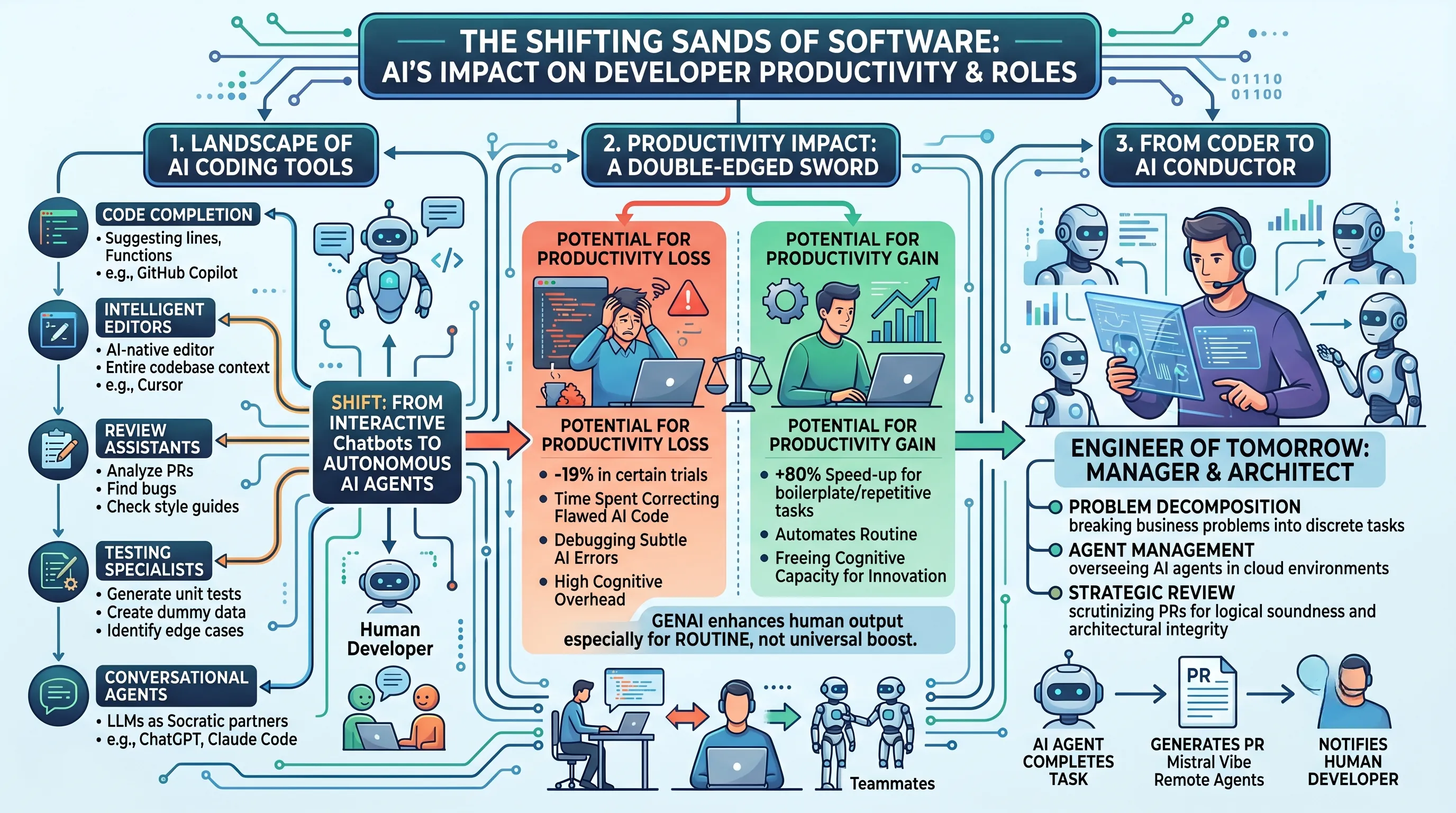
- Code Completion & Generation: This is the most familiar category, dominated by tools like GitHub Copilot. They act as sophisticated pair programmers, suggesting lines or entire functions as you type.
- Intelligent Editors: Platforms like Cursor are AI-native editors that integrate generation, editing, and debugging into a single, seamless environment, understanding the entire codebase for more context-aware assistance.
- Review Assistants: These tools analyze pull requests, spot potential bugs, suggest improvements to code quality, and even check for non-compliance with style guides, automating a significant part of the code review process.
- Testing Specialists: AI is now capable of generating unit tests, creating dummy data with specific requirements like hardcoded GUIDs, and identifying edge cases that human developers might overlook.
- Conversational Agents: Large language models like ChatGPT and Claude Code serve as powerful Socratic partners for developers, helping them brainstorm solutions, debug complex problems, and learn new technologies through dialogue.
These tools represent a spectrum of autonomy, but the most significant leap forward is the emergence of true AI agents that operate with minimal human supervision. The industry is witnessing a clear shift from AI chatbots to AI agents that perform actual work. Some of these autonomous agents are already capable of writing code for 20+ minutes without any human intervention, moving from suggesting a snippet to executing a multi-step plan. This is the technological foundation for a developer to genuinely delegate a task and disengage.
The Double-Edged Sword: Measuring AI's Productivity Impact
Despite the excitement, the real-world impact of these tools on developer productivity is a complex and contested issue. The data presents a fascinatingly mixed picture. For instance, a METR randomized controlled trial delivered a sobering result, finding that for some tasks, the use of AI tools actually reduced coding productivity by 19%. This might seem counterintuitive, but it speaks to the hidden costs of AI assistance: the time spent correcting flawed AI-generated code, debugging subtle errors introduced by the model, or the cognitive overhead of constantly verifying the AI's output can sometimes outweigh the benefits of speed.
On the other end of the spectrum, an observational study by Claude.ai reported that their AI could speed up certain tasks by an astonishing 80%. This highlights where AI currently excels: well-defined, repetitive, or boilerplate tasks where the solution path is clear. The overall promise of generative AI is not a simple, universal boost but a powerful tool to enhance human output, particularly by automating the routine and mundane. This frees up developers' cognitive capacity to focus on higher-order challenges like system architecture and genuine innovation. However, it's crucial to note a common misconception: AI tools do not automatically shorten the workday. In many cases, they may simply intensify the pressure to move faster and deliver more within the same timeframe.
From Code Snippets to Pull Requests: The Rise of the Autonomous Teammate
The true realization of the "leave work and let the AI finish" concept lies with the new generation of autonomous agents. Mistral AI's recent announcements provide a powerful case study for this industry-wide shift. Their Vibe Remote Agents are designed to function as independent members of a development team. A developer can assign a task through platforms like Jira or GitHub, and the agent gets to work in its own cloud environment. It can perform complex, multi-step operations such as code modification, creating new tests, updating dependencies, and fixing bugs—all without real-time supervision.
The workflow is transformative. Once the agent completes its assigned task, it generates a standard GitHub Pull Request and notifies the human developer via Slack or Teams. This is the critical handoff point. The developer’s role wasn’t to write the code but to define the task and then review the completed work. This is made possible by increasingly powerful models like Mistral Medium 3.5, a dense 128 billion parameter model that scores an impressive 77.6% on the SWE-Bench Verified benchmark, proving its robust coding capabilities. This move from interactive assistance to delegated execution defines the new era of software engineering, one shaped by what can only be described as AI Teammates.
The Engineer as Architect: Shifting from Coder to AI Conductor
This rise of the autonomous AI Teammate directly leads to an expert projection that is now widely accepted: the very role of a software engineer is evolving. The future of the profession is shifting away from the granular act of direct, line-by-line coding and toward a more strategic, managerial function. The engineer of tomorrow is less of a bricklayer and more of an architect and project manager.
In this new paradigm, the engineer's primary responsibilities will be:
- Problem Decomposition: Breaking down large, complex business problems into discrete, well-defined tasks that can be assigned to AI agents.
- Agent Management: Overseeing a team of AI agents, much like a tech lead manages a team of human developers. This includes assigning work, monitoring progress, and unblocking issues.
- Strategic Review: The most critical human-in-the-loop function will be reviewing the work submitted by AI agents—scrutinizing pull requests for logical soundness, architectural integrity, and alignment with business goals.
This is the ultimate fulfillment of the promise to automate routine tasks. By offloading the mechanical aspects of coding to AI, human engineers are liberated to focus on creativity, innovation, and strategic thinking—the very skills that deliver the most value and are hardest to automate. The era of the lone coder is waning, replaced by an era of human-AI collaboration where the engineer's primary job is to effectively manage and review their new, autonomous AI Teammates.
📚 Related Posts
NVIDIA Nemotron 3 Nano Omni: Open Multimodal AI Revolution Crushing Agent Bottlenecks for Real-Time Intelligence
🚀 Key TakeawaysNVIDIA's Nemotron 3 Nano Omni is a groundbreaking open multimodal AI model designed to eliminate bottlenecks for AI agents by simultaneously understanding video, audio, and text, achieving up to 9 times higher throughput and significantly
tech.dragon-story.com
DeepSeek V4 Pro & Flash: Unveiling the 1 Million Token Era – Architecture, Efficiency, and Real-World Performance Nuances
🚀 Key TakeawaysDeepSeek-V4 revolutionizes the AI landscape by officially launching its open-source V4-Pro and V4-Flash models, spearheading the "1 Million Token Era" with unprecedented context length capabilities, robust cost-efficiency, and cutting-edg
tech.dragon-story.com
TRELLIS.2: O-Voxel AI Revolutionizes 3D Generation with Unprecedented Speed, Hyper-Realism & Democratized Access – Full Releas
🚀 Key TakeawaysTRELLIS.2 revolutionizes 3D generation with its innovative O-Voxel technology, enabling the creation of highly complex, thin, and hollow structures with exceptional detail and realism.This 4B-parameter image-to-3D model offers unprecedent
tech.dragon-story.com


